
ORGANIZATIONALORGANIZATIONAL
STRUCTURESTRUCTURE
Prepared By :
Khushal Qaem :Roll No. 92
&
Khalid Shinwary :Roll No. 08
Contents
 Why have Structure?Why have Structure?
 Why is Structural Choice Important?Why is Structural Choice Important?
 Types of Organizational Structures.Types of Organizational Structures.
 ReferencesReferences
Why Have a Structure?
 All businesses have to organiseAll businesses have to organise
what they do.what they do.
 A clear structure makes it easier to seeA clear structure makes it easier to see
which part of the business does what.which part of the business does what.
Structural Choice is Important
Because
 it focuses attention on particular areas
 shapes how resources will be used
 directs communication flows
 defines control and other processes
 illustrates people’s roles relative to others’
roles
Types of Organizational
Structures
 Simple StructureSimple Structure
 Functional structureFunctional structure
 Divisional structure
 Matrix structure
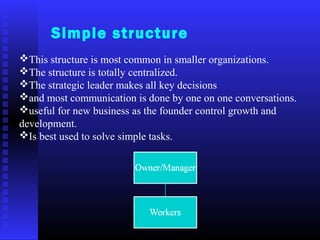
Simple structure
This structure is most common in smaller organizations.
The structure is totally centralized.
The strategic leader makes all key decisions
and most communication is done by one on one conversations.
useful for new business as the founder control growth and
development.
Is best used to solve simple tasks.
Functional structure:
 It is appropriate for medium sized firms,It is appropriate for medium sized firms,
with several related product lines.with several related product lines.
 Employees tend to be specialist in theEmployees tend to be specialist in the
business functions, such as marketing andbusiness functions, such as marketing and
finance etc.finance etc.
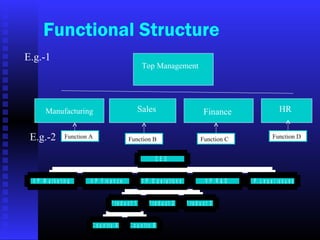
Functional Structure
V P M a r k e t in g V P F in a n c e
C o u n t r y A C o u n t r y B
P r o d u c t 1 P r o d u c t 2 P r o d u c t 3
V P O p e r a t io n s V P R & D V P L e g a l is s u e s
C E O
Top Management
Manufacturing FinanceSales HR
E.g.-1
E.g.-2 Function A Function B Function C Function D
Divisional Structure
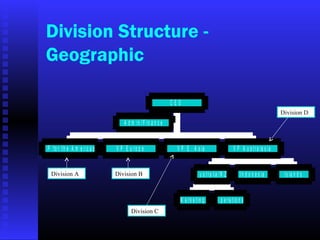
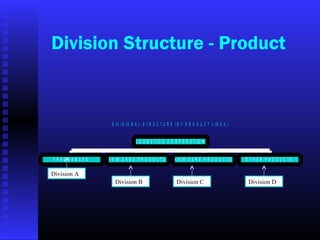
the divisional structure groups each organizational function
into a division
It is appropriate for a large corporation with many product
lines in several related industries.
Employees tend to be functional specialist organized
according to product market distinction.
 It has 2 Types : Geographic & Product Basis
Division Structure -
Geographic
A d m in /F in a n c e
V P fo r th e A m e ric a s V P E u ro p e V P E . A s ia
M a rk e tin g O p e ra tio n s
A u s tra lia /N Z In d o n e s ia Is la n d s
V P A u s tra la s ia
C E O
Division A Division B
Division C
Division D
Division Structure - Product
D I V I S I O N A L S T R U C T U R E ( B Y P R O D U C T L I N E S )
F R A G R A N C E S S K I N C A R E P R O D U C T S H A I R C A R E P R O D U C T S O T H E R P R O D U C T S
C O S M E T I C S C O R P O R A T I O N
Division A
Division B Division C Division D
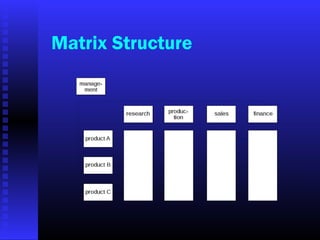
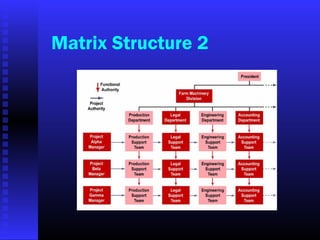
Matrix Structure
 It groups employees by both function andIt groups employees by both function and
product.product.
 This structure can combine the best of bothThis structure can combine the best of both
separate structures.separate structures.
 Employees from Different Depts. areEmployees from Different Depts. are
employed for the same assignment oremployed for the same assignment or
project.project.
Matrix Structure
Matrix Structure 2
References
 Jacobides., M. G. (2007). The inherent limits of organizational structure and the unfulfilled role of hierarchy: LessonsJacobides., M. G. (2007). The inherent limits of organizational structure and the unfulfilled role of hierarchy: Lessons
from a near-war. Organization Science, 18, 3, 455-477.from a near-war. Organization Science, 18, 3, 455-477.
 Lim, M., G. Griffiths, and S. Sambrook. (2010). Organizational structure for the twenty-first century. Presented at theLim, M., G. Griffiths, and S. Sambrook. (2010). Organizational structure for the twenty-first century. Presented at the
annual meeting ofannual meeting of
 Galbraith, J., (1973) Designing Complex Organizations, Reading, Massachusetts, Addison-Wesley. The Institute forGalbraith, J., (1973) Designing Complex Organizations, Reading, Massachusetts, Addison-Wesley. The Institute for
Operations Research and The Management Sciences, Austin.Operations Research and The Management Sciences, Austin.
 Based on Spector, B., (2007), Implementing Organization Change: Theory and Practice, 1st ed., pp. 141, PearsonBased on Spector, B., (2007), Implementing Organization Change: Theory and Practice, 1st ed., pp. 141, Pearson
Prentice Hall.Prentice Hall.
 Thompson, A. & Strickland, A., (2003), Strategic Management Concepts and Cases, 13th ed., pp. 129, McGraw-HillThompson, A. & Strickland, A., (2003), Strategic Management Concepts and Cases, 13th ed., pp. 129, McGraw-Hill
Irwin.Irwin.
 Source: Discussion of personality is loosely based on: McClelland, D. C. (1975),Source: Discussion of personality is loosely based on: McClelland, D. C. (1975), Power: the inner experience, NewPower: the inner experience, New
York: Halstead.York: Halstead.
 Mische, M.A., (2001), Strategic Renewal: Becoming a High-Performance Organization, Prentice Hall, p. 23.Mische, M.A., (2001), Strategic Renewal: Becoming a High-Performance Organization, Prentice Hall, p. 23.
 Robbins, S.F., Judge, T.A. (2007). Organizational Behaviour. 12th edition. Pearson Education Inc., p. 551-557.Robbins, S.F., Judge, T.A. (2007). Organizational Behaviour. 12th edition. Pearson Education Inc., p. 551-557.
 Grant, R.M. (2008). History of the Royal Dutch/Shell Group. AvailableGrant, R.M. (2008). History of the Royal Dutch/Shell Group. Available
at:http://www.blackwellpublishing.com/grant/docs/07Shell.pdf(accessed 20/10/08)at:http://www.blackwellpublishing.com/grant/docs/07Shell.pdf(accessed 20/10/08)
Thank You

Organizational structure

  • 1.
    ORGANIZATIONALORGANIZATIONAL STRUCTURESTRUCTURE Prepared By : KhushalQaem :Roll No. 92 & Khalid Shinwary :Roll No. 08
  • 2.
    Contents  Why haveStructure?Why have Structure?  Why is Structural Choice Important?Why is Structural Choice Important?  Types of Organizational Structures.Types of Organizational Structures.  ReferencesReferences
  • 3.
    Why Have aStructure?  All businesses have to organiseAll businesses have to organise what they do.what they do.  A clear structure makes it easier to seeA clear structure makes it easier to see which part of the business does what.which part of the business does what.
  • 4.
    Structural Choice isImportant Because  it focuses attention on particular areas  shapes how resources will be used  directs communication flows  defines control and other processes  illustrates people’s roles relative to others’ roles
  • 5.
    Types of Organizational Structures Simple StructureSimple Structure  Functional structureFunctional structure  Divisional structure  Matrix structure
  • 6.
    Simple structure This structureis most common in smaller organizations. The structure is totally centralized. The strategic leader makes all key decisions and most communication is done by one on one conversations. useful for new business as the founder control growth and development. Is best used to solve simple tasks.
  • 7.
    Functional structure:  Itis appropriate for medium sized firms,It is appropriate for medium sized firms, with several related product lines.with several related product lines.  Employees tend to be specialist in theEmployees tend to be specialist in the business functions, such as marketing andbusiness functions, such as marketing and finance etc.finance etc.
  • 8.
    Functional Structure V PM a r k e t in g V P F in a n c e C o u n t r y A C o u n t r y B P r o d u c t 1 P r o d u c t 2 P r o d u c t 3 V P O p e r a t io n s V P R & D V P L e g a l is s u e s C E O Top Management Manufacturing FinanceSales HR E.g.-1 E.g.-2 Function A Function B Function C Function D
  • 9.
    Divisional Structure the divisionalstructure groups each organizational function into a division It is appropriate for a large corporation with many product lines in several related industries. Employees tend to be functional specialist organized according to product market distinction.  It has 2 Types : Geographic & Product Basis
  • 10.
    Division Structure - Geographic Ad m in /F in a n c e V P fo r th e A m e ric a s V P E u ro p e V P E . A s ia M a rk e tin g O p e ra tio n s A u s tra lia /N Z In d o n e s ia Is la n d s V P A u s tra la s ia C E O Division A Division B Division C Division D
  • 11.
    Division Structure -Product D I V I S I O N A L S T R U C T U R E ( B Y P R O D U C T L I N E S ) F R A G R A N C E S S K I N C A R E P R O D U C T S H A I R C A R E P R O D U C T S O T H E R P R O D U C T S C O S M E T I C S C O R P O R A T I O N Division A Division B Division C Division D
  • 12.
    Matrix Structure  Itgroups employees by both function andIt groups employees by both function and product.product.  This structure can combine the best of bothThis structure can combine the best of both separate structures.separate structures.  Employees from Different Depts. areEmployees from Different Depts. are employed for the same assignment oremployed for the same assignment or project.project.
  • 13.
  • 14.
  • 15.
    References  Jacobides., M.G. (2007). The inherent limits of organizational structure and the unfulfilled role of hierarchy: LessonsJacobides., M. G. (2007). The inherent limits of organizational structure and the unfulfilled role of hierarchy: Lessons from a near-war. Organization Science, 18, 3, 455-477.from a near-war. Organization Science, 18, 3, 455-477.  Lim, M., G. Griffiths, and S. Sambrook. (2010). Organizational structure for the twenty-first century. Presented at theLim, M., G. Griffiths, and S. Sambrook. (2010). Organizational structure for the twenty-first century. Presented at the annual meeting ofannual meeting of  Galbraith, J., (1973) Designing Complex Organizations, Reading, Massachusetts, Addison-Wesley. The Institute forGalbraith, J., (1973) Designing Complex Organizations, Reading, Massachusetts, Addison-Wesley. The Institute for Operations Research and The Management Sciences, Austin.Operations Research and The Management Sciences, Austin.  Based on Spector, B., (2007), Implementing Organization Change: Theory and Practice, 1st ed., pp. 141, PearsonBased on Spector, B., (2007), Implementing Organization Change: Theory and Practice, 1st ed., pp. 141, Pearson Prentice Hall.Prentice Hall.  Thompson, A. & Strickland, A., (2003), Strategic Management Concepts and Cases, 13th ed., pp. 129, McGraw-HillThompson, A. & Strickland, A., (2003), Strategic Management Concepts and Cases, 13th ed., pp. 129, McGraw-Hill Irwin.Irwin.  Source: Discussion of personality is loosely based on: McClelland, D. C. (1975),Source: Discussion of personality is loosely based on: McClelland, D. C. (1975), Power: the inner experience, NewPower: the inner experience, New York: Halstead.York: Halstead.  Mische, M.A., (2001), Strategic Renewal: Becoming a High-Performance Organization, Prentice Hall, p. 23.Mische, M.A., (2001), Strategic Renewal: Becoming a High-Performance Organization, Prentice Hall, p. 23.  Robbins, S.F., Judge, T.A. (2007). Organizational Behaviour. 12th edition. Pearson Education Inc., p. 551-557.Robbins, S.F., Judge, T.A. (2007). Organizational Behaviour. 12th edition. Pearson Education Inc., p. 551-557.  Grant, R.M. (2008). History of the Royal Dutch/Shell Group. AvailableGrant, R.M. (2008). History of the Royal Dutch/Shell Group. Available at:http://www.blackwellpublishing.com/grant/docs/07Shell.pdf(accessed 20/10/08)at:http://www.blackwellpublishing.com/grant/docs/07Shell.pdf(accessed 20/10/08)
  • 16.

Editor's Notes

  • #4 structure is about who’s in charge, and who each is supposed to answer to . My point is that structure can be confusing and seem less than relevant to you and me — perhaps because we start our jobs at the very bottom where structure doesn’t mean that much to us or ou r future. But structure is important to you for several reasons: long-term: getting from the bottom to the top takes work and knowing how to navigate ; short-term: you have to describe structure in your paper which is due shortly .
  • #5 Ways to identify structure: s ometimes in an annual report on line or off ; l ook at who holds positions from Board through the business you are studying ; n ation of origin; if from Germany, you’ll have likely have a dual board. If from Italy, it is likely to be a private family owned firm.
  • #6 There is no perfect structural model; but the closest thing to perfect will be the structure that best facilitates organizational objectives . So, let’s look at pros and cons of each model; where it puts emphasis, etc .
  • #8 Functional structure Employees within the functional divisions of an organization tend to perform a specialized set of tasks, for instance the engineering department would be staffed only with software engineers. This leads to operational efficiencies within that group. However it could also lead to a lack of communication between the functional groups within an organization, making the organization slow and inflexible. As a whole, a functional organization is best suited as a producer of standardized goods and services at large volume and low cost. Coordination and specialization of tasks are centralized in a functional structure, which makes producing a limited amount of products or services efficient and predictable. Moreover, efficiencies can further be realized as functional organizations integrate their activities vertically so that products are sold and distributed quickly and at low cost. [11] For instance, a small business could start making the components it requires for production of its products instead of procuring it from an external organization.But not only beneficial for organization but also for employees faiths.
  • #9 Function first followed by product, then country attention usual for extractive industries (mining and oil) or where the firm is transporting products and raw materials from one geographic area to another . ADVANTAGES: High professional identity High external and internal specialization Ease of supervision and assessment; tight centralized control Limited duplication of resources; relatively lean managerial staff DISADVANTAGES: Encourages group differences and fiefdoms Putting products and marketing in different departments makes it difficult to manage multiple product lines Specialist skills may self-perpetuate and drive out new ideas or new ways Responsibility is sometimes elusive Limited training for developing senior exec utive s who need to be generalists
  • #10 Divisional structure Also called a "product structure", the divisional structure groups each organizational function into a division. Each division within a divisional structure contains all the necessary resources and functions within it. Divisions can be categorized from different points of view. One might make distinctions on a geographical basis (a US division and an EU division, for example) or on product/service basis (different products for different customers: households or companies). In another example, an automobile company with a divisional structure might have one division for SUVs, another division for subcompact cars, and another division for sedans. Each division may have its own sales, engineering and marketing departments.
  • #11 ADVANTAGES: Targets inherent differences Better accountability for performance Clarifies goals Moves decision making downward Simplifies intraunit coordination DISADVANTAGES: Duplicates and can be costly May lead to suboptimal decisions Clarifies opposition May induce reliance on bad decisions other s make Increase interunit competition
  • #13 Matrix structure The matrix structure groups employees by both function and product. This structure can combine the best of both separate structures. A matrix organization frequently uses teams of employees to accomplish work, in order to take advantage of the strengths, as well as make up for the weaknesses, of functional and decentralized forms. An example would be a company that produces two products, "product a" and "product b". Using the matrix structure, this company would organize functions within the company as follows: "product a" sales department, "product a" customer service department, "product a" accounting, "product b" sales department, "product b" customer service department, "product b" accounting department. Matrix structure is amongst the purest of organizational structures, a simple lattice emulating order and regularity demonstrated in nature. Weak/Functional Matrix: A project manager with only limited authority is assigned to oversee the cross- functional aspects of the project. The functional managers maintain control over their resources and project areas. Balanced/Functional Matrix: A project manager is assigned to oversee the project. Power is shared equally between the project manager and the functional managers. It brings the best aspects of functional and projectized organizations. However, this is the most difficult system to maintain as the sharing power is delicate proposition. Strong/Project Matrix: A project manager is primarily responsible for the project. Functional managers provide technical expertise and assign resources as needed. Among these matrixes, there is no best format; implementation success always depends on organization's purpose and function.
  • #14 Advantages useful when teams are needed to innovate ; when information sharing is important . Disadvantages people report to two or more bosses ; increases structural complexity ; can make it harder to work toward common goals .