Operation
Theatre

Prepared by:
Muhammad Affandi b Yusof
Supervisor:
En. Mohd Razali b Zulkiply
Introduction






Also known as an operating
theatre, operating room (OR) or operating
suite.
It is a facility within a hospital where surgical
operations are carried out in
a sterile environment.
Historically, the term "operating theatre"
referred to a non-sterile which students and
other spectators could watch surgeons
perform surgery.
General Requirement
Organization




Consulting surgeon
Consulting anesthetist
Supporting staff

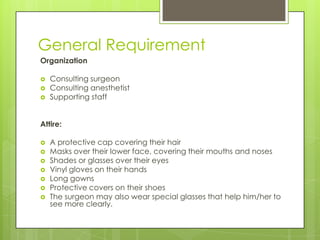
Attire:








A protective cap covering their hair
Masks over their lower face, covering their mouths and noses
Shades or glasses over their eyes
Vinyl gloves on their hands
Long gowns
Protective covers on their shoes
The surgeon may also wear special glasses that help him/her to
see more clearly.
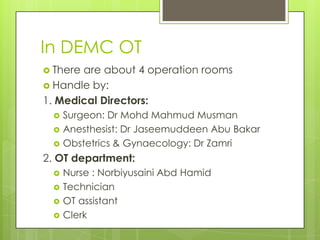
In DEMC OT
 There

are about 4 operation rooms
 Handle by:
1. Medical Directors:




Surgeon: Dr Mohd Mahmud Musman
Anesthesist: Dr Jaseemuddeen Abu Bakar
Obstetrics & Gynaecology: Dr Zamri

2. OT department:





Nurse : Norbiyusaini Abd Hamid
Technician
OT assistant
Clerk
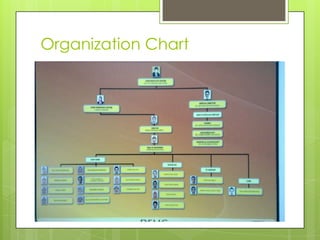
Organization Chart
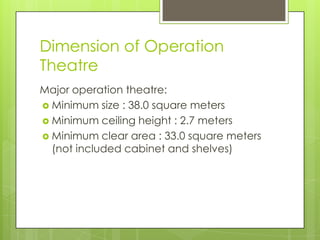
Dimension of Operation
Theatre
Major operation theatre:
 Minimum size : 38.0 square meters
 Minimum ceiling height : 2.7 meters
 Minimum clear area : 33.0 square meters
(not included cabinet and shelves)
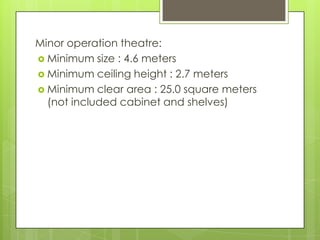
Minor operation theatre:
 Minimum size : 4.6 meters
 Minimum ceiling height : 2.7 meters
 Minimum clear area : 25.0 square meters
(not included cabinet and shelves)
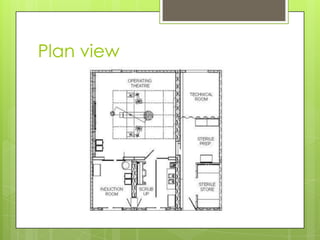
Plan view
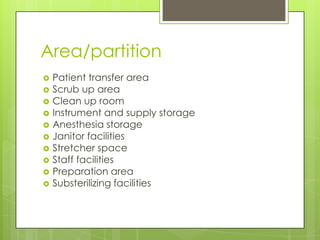
Area/partition












Patient transfer area
Scrub up area
Clean up room
Instrument and supply storage
Anesthesia storage
Janitor facilities
Stretcher space
Staff facilities
Preparation area
Substerilizing facilities
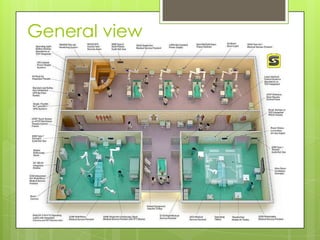
General view
Room Requirement
 Generally

windowless and feature controlled
temperature and humidity.
 Special air handlers filter the air and maintain a
slightly elevated pressure.
 Electricity support has backup systems in case of
a black-out.
 Rooms are supplied with wall suction, oxygen,
and possibly other, anesthetic gases.
 Easy

to clean.
 Any addition facilities should be place
outside the operation room.
 Operation suite must have own corridor to
avoid traffic when transfer the patient.
 The combined surgical suite or combined
surgical-obstetrical suite shall be arranged
and in one area to prevent traffic.
Ideal Room Condition
 Temperature

: 18-20 degree Celsius
 Humidity : 50% - 58%
 Pressure : 70 pascal
 Wind flow : more than 20 times
Why need to control the
temperature?








The humidity level will affect the growth of
bacteria and fungus
The humidity level will be control between 50%58%, if it higher or lower than the range the
bacteria and fungus will be able to growth rapidly.
The most important is to control the temperature
below 20 degree Celsius, and it is needed to be
checking at least 3 times per day.
The bacteria level should be maintain low than 35
CFU (colony forming unit).
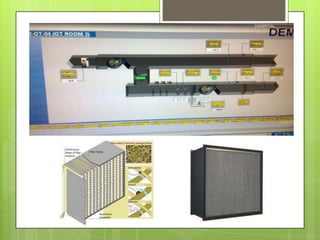
The High Efficiency Particulate
Air (HEPA) filter:







HEPA standards: an air filter must remove (from the
air that passes through) 99.97% of particles that
have a size of 0.3 micrometers.
Apply at operating theaters, outpatient surgery
suites, labor and delivery departments, isolation
rooms, critical care, intensive care, and several
other areas.
Put on the return air circulation system together or
near the air conditioner.
The air will be filtered by HEPA before it being
release through the air flow.
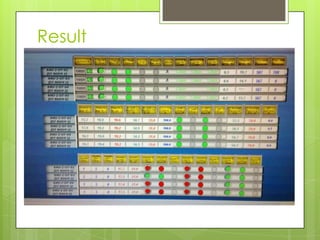
Result
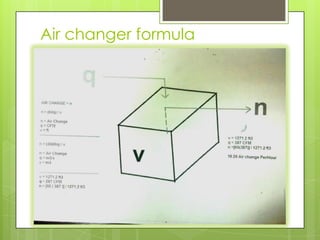
Air changer formula
Types of Power supply:
 Essential

power supply
 Uninterruptible power supply
 Normal power supply
Essential power supply
 Supply

power by generator.
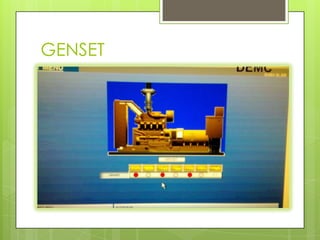
 Known as Genset
 Function when the power by TNB(normal
power) is stop functioning.
 It take 7 second on standby.
 Every plug in the building which
connected to Genset is label with red
color.
GENSET
Uninterruptible power supply
(UPS)
 This

kind of power supply is mainly known
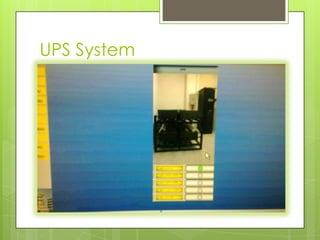
as backup power from the battery.
 The battery is use as power supply.
 UPS is critically use in the operation
theatre to avoid the power break down
during the case.
 It is label with the yellow plug.
 UPS will continue supply the power even
the power is off.
UPS System
Normal power supply
 This

kind of power supply is the normal
power supply from TNB to hospital.
 It used 3 phase.
 415/240v , normal commercial building.
 The power break down in the normal
power supply will be support by EPS and
UPS immediately.
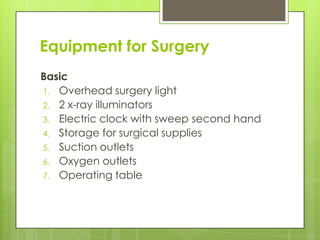
Equipment for Surgery
Basic
1. Overhead surgery light
2. 2 x-ray illuminators
3. Electric clock with sweep second hand
4. Storage for surgical supplies
5. Suction outlets
6. Oxygen outlets
7. Operating table
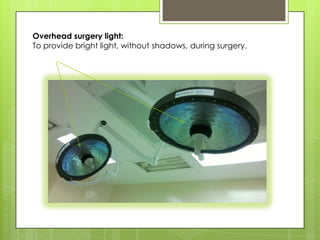
Overhead surgery light:
To provide bright light, without shadows, during surgery.
Specs of lighting


Homogenous light: The light should offer a good illumination on a
flat, narrow or deep surface in a cavity, despite obstacles such as
surgeons' heads or hands.



Lux: The central illuminance can not exceed 160 000 lux and should
not be lower than 40 000 lux



Light field diameter: The D50 should not exceed 50% of d10 diameter



Colour rendition: For the purpose of distinguishing true tissue colour in
a cavity, the colour rendering index (Ra) should be between 85 and
100.



Backup possibility: In case of interruption of the power supply, the
light should be restored within 5 seconds with at least 50% of the
previous lux intensity, but not less than 40 000 lux. Within 40 seconds
the light should be completely restored to the original amount of lux.
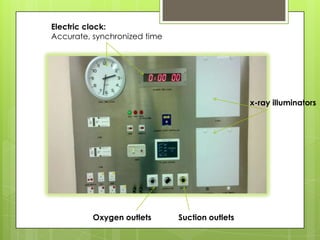
Electric clock:
Accurate, synchronized time

x-ray illuminators

Oxygen outlets

Suction outlets
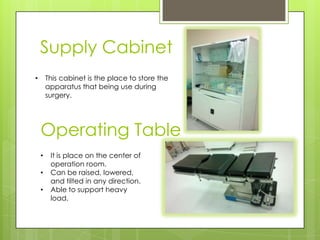
Supply Cabinet
This cabinet is the place to store the
apparatus that being use during
surgery.

•

Operating Table
•
•

•

It is place on the center of
operation room.
Can be raised, lowered,
and tilted in any direction.
Able to support heavy
load.
Addition
 A portable x-ray
 General Anesthetic Machine
 Anesthetic cart
 Surgeon Pendant
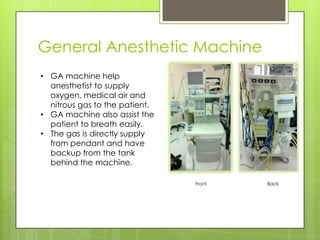
General Anesthetic Machine
• GA machine help
anesthetist to supply
oxygen, medical air and
nitrous gas to the patient.
• GA machine also assist the
patient to breath easily.
• The gas is directly supply
from pendant and have
backup from the tank
behind the machine.
Front

Back
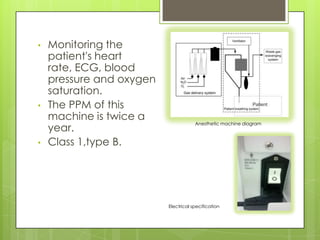
•

•

•

Monitoring the
patient's heart
rate, ECG, blood
pressure and oxygen
saturation.
The PPM of this
machine is twice a
year.
Class 1,type B.

Anesthetic machine diagram

Electrical specification
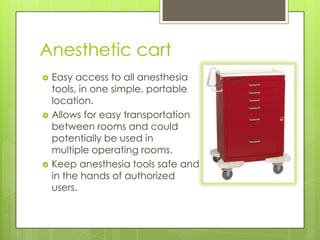
Anesthetic cart






Easy access to all anesthesia
tools, in one simple, portable
location.
Allows for easy transportation
between rooms and could
potentially be used in
multiple operating rooms.
Keep anesthesia tools safe and
in the hands of authorized
users.
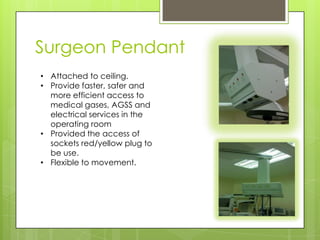
Surgeon Pendant
• Attached to ceiling.
• Provide faster, safer and
more efficient access to
medical gases, AGSS and
electrical services in the
operating room
• Provided the access of
sockets red/yellow plug to
be use.
• Flexible to movement.
Gas supply to OT
 Oxygen
 Nitrous

oxide
 Entonox
 Medical gas
Anesthetic Gas Scavenging
Systems (AGSS)
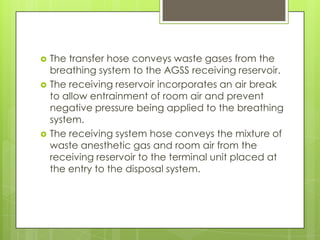
 Transport

exhaled and waste anesthetic
gases from the exhaust valve of an
anesthetic ventilator or anesthetic breathing
system into the atmosphere at a safe
location away from the operating theatre.
 ‘Active’ AGSS incorporate a mechanical
pump to assist with the disposal of the waste
gases.
 AGSS consist of transfer, receiving and
disposal components.






The transfer hose conveys waste gases from the
breathing system to the AGSS receiving reservoir.
The receiving reservoir incorporates an air break
to allow entrainment of room air and prevent
negative pressure being applied to the breathing
system.
The receiving system hose conveys the mixture of
waste anesthetic gas and room air from the
receiving reservoir to the terminal unit placed at
the entry to the disposal system.
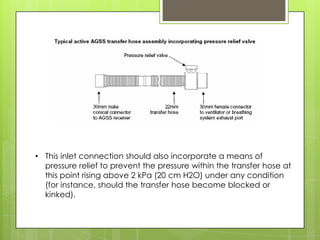
• This inlet connection should also incorporate a means of
pressure relief to prevent the pressure within the transfer hose at
this point rising above 2 kPa (20 cm H2O) under any condition
(for instance, should the transfer hose become blocked or
kinked).
The End
Thank You

Operation theater DEMC

  • 1.
    Operation Theatre Prepared by: Muhammad Affandib Yusof Supervisor: En. Mohd Razali b Zulkiply
  • 2.
    Introduction    Also known asan operating theatre, operating room (OR) or operating suite. It is a facility within a hospital where surgical operations are carried out in a sterile environment. Historically, the term "operating theatre" referred to a non-sterile which students and other spectators could watch surgeons perform surgery.
  • 3.
    General Requirement Organization    Consulting surgeon Consultinganesthetist Supporting staff Attire:        A protective cap covering their hair Masks over their lower face, covering their mouths and noses Shades or glasses over their eyes Vinyl gloves on their hands Long gowns Protective covers on their shoes The surgeon may also wear special glasses that help him/her to see more clearly.
  • 4.
    In DEMC OT There are about 4 operation rooms  Handle by: 1. Medical Directors:    Surgeon: Dr Mohd Mahmud Musman Anesthesist: Dr Jaseemuddeen Abu Bakar Obstetrics & Gynaecology: Dr Zamri 2. OT department:     Nurse : Norbiyusaini Abd Hamid Technician OT assistant Clerk
  • 5.
  • 6.
    Dimension of Operation Theatre Majoroperation theatre:  Minimum size : 38.0 square meters  Minimum ceiling height : 2.7 meters  Minimum clear area : 33.0 square meters (not included cabinet and shelves)
  • 7.
    Minor operation theatre: Minimum size : 4.6 meters  Minimum ceiling height : 2.7 meters  Minimum clear area : 25.0 square meters (not included cabinet and shelves)
  • 8.
  • 9.
    Area/partition           Patient transfer area Scrubup area Clean up room Instrument and supply storage Anesthesia storage Janitor facilities Stretcher space Staff facilities Preparation area Substerilizing facilities
  • 10.
  • 11.
    Room Requirement  Generally windowlessand feature controlled temperature and humidity.  Special air handlers filter the air and maintain a slightly elevated pressure.  Electricity support has backup systems in case of a black-out.  Rooms are supplied with wall suction, oxygen, and possibly other, anesthetic gases.
  • 12.
     Easy to clean. Any addition facilities should be place outside the operation room.  Operation suite must have own corridor to avoid traffic when transfer the patient.  The combined surgical suite or combined surgical-obstetrical suite shall be arranged and in one area to prevent traffic.
  • 13.
    Ideal Room Condition Temperature : 18-20 degree Celsius  Humidity : 50% - 58%  Pressure : 70 pascal  Wind flow : more than 20 times
  • 14.
    Why need tocontrol the temperature?     The humidity level will affect the growth of bacteria and fungus The humidity level will be control between 50%58%, if it higher or lower than the range the bacteria and fungus will be able to growth rapidly. The most important is to control the temperature below 20 degree Celsius, and it is needed to be checking at least 3 times per day. The bacteria level should be maintain low than 35 CFU (colony forming unit).
  • 15.
    The High EfficiencyParticulate Air (HEPA) filter:     HEPA standards: an air filter must remove (from the air that passes through) 99.97% of particles that have a size of 0.3 micrometers. Apply at operating theaters, outpatient surgery suites, labor and delivery departments, isolation rooms, critical care, intensive care, and several other areas. Put on the return air circulation system together or near the air conditioner. The air will be filtered by HEPA before it being release through the air flow.
  • 17.
  • 18.
  • 19.
    Types of Powersupply:  Essential power supply  Uninterruptible power supply  Normal power supply
  • 20.
    Essential power supply Supply power by generator.  Known as Genset  Function when the power by TNB(normal power) is stop functioning.  It take 7 second on standby.  Every plug in the building which connected to Genset is label with red color.
  • 21.
  • 22.
    Uninterruptible power supply (UPS) This kind of power supply is mainly known as backup power from the battery.  The battery is use as power supply.  UPS is critically use in the operation theatre to avoid the power break down during the case.  It is label with the yellow plug.  UPS will continue supply the power even the power is off.
  • 23.
  • 24.
    Normal power supply This kind of power supply is the normal power supply from TNB to hospital.  It used 3 phase.  415/240v , normal commercial building.  The power break down in the normal power supply will be support by EPS and UPS immediately.
  • 25.
    Equipment for Surgery Basic 1.Overhead surgery light 2. 2 x-ray illuminators 3. Electric clock with sweep second hand 4. Storage for surgical supplies 5. Suction outlets 6. Oxygen outlets 7. Operating table
  • 26.
    Overhead surgery light: Toprovide bright light, without shadows, during surgery.
  • 27.
    Specs of lighting  Homogenouslight: The light should offer a good illumination on a flat, narrow or deep surface in a cavity, despite obstacles such as surgeons' heads or hands.  Lux: The central illuminance can not exceed 160 000 lux and should not be lower than 40 000 lux  Light field diameter: The D50 should not exceed 50% of d10 diameter  Colour rendition: For the purpose of distinguishing true tissue colour in a cavity, the colour rendering index (Ra) should be between 85 and 100.  Backup possibility: In case of interruption of the power supply, the light should be restored within 5 seconds with at least 50% of the previous lux intensity, but not less than 40 000 lux. Within 40 seconds the light should be completely restored to the original amount of lux.
  • 28.
    Electric clock: Accurate, synchronizedtime x-ray illuminators Oxygen outlets Suction outlets
  • 29.
    Supply Cabinet This cabinetis the place to store the apparatus that being use during surgery. • Operating Table • • • It is place on the center of operation room. Can be raised, lowered, and tilted in any direction. Able to support heavy load.
  • 30.
    Addition  A portablex-ray  General Anesthetic Machine  Anesthetic cart  Surgeon Pendant
  • 31.
    General Anesthetic Machine •GA machine help anesthetist to supply oxygen, medical air and nitrous gas to the patient. • GA machine also assist the patient to breath easily. • The gas is directly supply from pendant and have backup from the tank behind the machine. Front Back
  • 32.
    • • • Monitoring the patient's heart rate,ECG, blood pressure and oxygen saturation. The PPM of this machine is twice a year. Class 1,type B. Anesthetic machine diagram Electrical specification
  • 33.
    Anesthetic cart    Easy accessto all anesthesia tools, in one simple, portable location. Allows for easy transportation between rooms and could potentially be used in multiple operating rooms. Keep anesthesia tools safe and in the hands of authorized users.
  • 34.
    Surgeon Pendant • Attachedto ceiling. • Provide faster, safer and more efficient access to medical gases, AGSS and electrical services in the operating room • Provided the access of sockets red/yellow plug to be use. • Flexible to movement.
  • 35.
    Gas supply toOT  Oxygen  Nitrous oxide  Entonox  Medical gas
  • 36.
    Anesthetic Gas Scavenging Systems(AGSS)  Transport exhaled and waste anesthetic gases from the exhaust valve of an anesthetic ventilator or anesthetic breathing system into the atmosphere at a safe location away from the operating theatre.  ‘Active’ AGSS incorporate a mechanical pump to assist with the disposal of the waste gases.  AGSS consist of transfer, receiving and disposal components.
  • 37.
       The transfer hoseconveys waste gases from the breathing system to the AGSS receiving reservoir. The receiving reservoir incorporates an air break to allow entrainment of room air and prevent negative pressure being applied to the breathing system. The receiving system hose conveys the mixture of waste anesthetic gas and room air from the receiving reservoir to the terminal unit placed at the entry to the disposal system.
  • 38.
    • This inletconnection should also incorporate a means of pressure relief to prevent the pressure within the transfer hose at this point rising above 2 kPa (20 cm H2O) under any condition (for instance, should the transfer hose become blocked or kinked).
  • 39.