Chapter Four: Foundations of
Organizational Design and
Structure
What Is Organizational Structure?
Key Elements:
• Work specialization
• Departmentalization
• Chain of command
• Span of control
• Centralization and
decentralization
• Formalization
Organizational Structure
- is a system used to define a
hierarchy within an organization.
- How jobs, tasks are formally
divided, grouped, and
coordinated.
- The structure is illustrated using
an organizational chart.
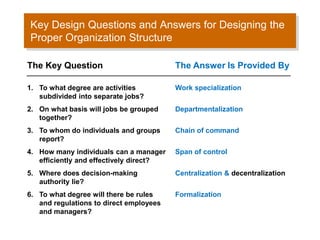
Key Design Questions and Answers for Designing the
Proper Organization Structure
The Key Question The Answer Is Provided By
1. To what degree are activities Work specialization
subdivided into separate jobs?
2. On what basis will jobs be grouped Departmentalization
together?
3. To whom do individuals and groups Chain of command
report?
4. How many individuals can a manager Span of control
efficiently and effectively direct?
5. Where does decision-making Centralization & decentralization
authority lie?
6. To what degree will there be rules Formalization
and regulations to direct employees
and managers?
Division of labor:
• Makes efficient use of employee skills
• Increases employee skills through repetition
• Increases productivity
• Specialized training is more efficient
• Allows use of specialized equipment
1. Work Specialization/division of labor
- The degree to which tasks in the organization are
subdivided into separate jobs.
- Allows managers to break down complex tasks into
smaller more specific tasks that the workers or
employees can complete. Thus, every worker in the
company becomes an expert to some extent.
- Job specialization refers to developing expertise in a
specific line of work, which is a smaller part of a bigger
job.
 What are the risks of specialization?
A. Monotony : can lead to boredom and reduced job
satisfaction.
B.Obsolete specialties: With the continuous improvement
in technologies, many specialized jobs risk getting
outdated.
C. Difficulty in transitioning: Becoming specialized in a
job area may require time. This requirement can make it
more difficult for you to change your career focus.
Grouping
Activities By:
• Function
• Product
• Geography
• Process
• Customer
2. Departmentalization
The basis by which jobs are grouped
together.
- The primary objectives of
businesses that choose to implement
departmentalization:
•Maintaining control
•Simplifying operational processes
•Grouping specialized activities
together
•Increasing overall efficiency
•Ensuring responsibility and
accountability
3. Chain of command
Is an organizational structure that documents how each
member of a company reports to one another.
Advantage
- Increased efficiency
- Clear direction
- Stability
- Structured responsibility
- Accountability
Disadvantage
- Less collaboration
- Slow communication
- Decreased employee empowerment
4. Span of control
Refers to how many direct reports or subordinates a
supervisor is responsible for managing.
o Factors That Influence Span of Control
- Size of Organization
- Nature of Organization
- Nature of Role
- Managerial Skills and Competencies
- Employee Skills and Abilities
5. Centralization and decentralization
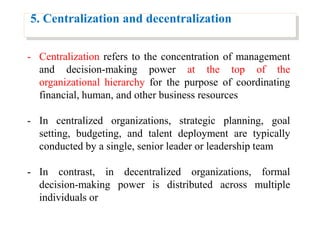
- Centralization refers to the concentration of management
and decision-making power at the top of the
organizational hierarchy for the purpose of coordinating
financial, human, and other business resources
- In centralized organizations, strategic planning, goal
setting, budgeting, and talent deployment are typically
conducted by a single, senior leader or leadership team
- In contrast, in decentralized organizations, formal
decision-making power is distributed across multiple
individuals or
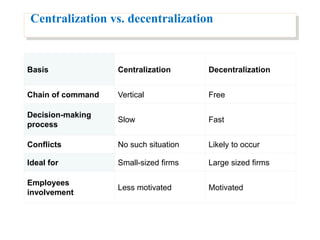
Centralization vs. decentralization
Basis Centralization Decentralization
Chain of command Vertical Free
Decision-making
process
Slow Fast
Conflicts No such situation Likely to occur
Ideal for Small-sized firms Large sized firms
Employees
involvement
Less motivated Motivated
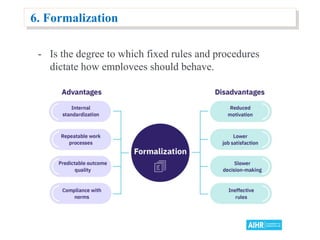
6. Formalization
- Is the degree to which fixed rules and procedures
dictate how employees should behave.
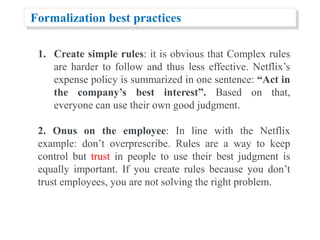
Formalization best practices
1. Create simple rules: it is obvious that Complex rules
are harder to follow and thus less effective. Netflix’s
expense policy is summarized in one sentence: “Act in
the company’s best interest”. Based on that,
everyone can use their own good judgment.
2. Onus on the employee: In line with the Netflix
example: don’t overprescribe. Rules are a way to keep
control but trust in people to use their best judgment is
equally important. If you create rules because you don’t
trust employees, you are not solving the right problem.
Formalization best practices
3. Formalization is a balancing act: Too little
formalization will bring chaos. Being too structured will
slow things down and ensure that nothing gets done.
Always aim for an optimum structure, between too many
and too few rules. In general we should determine what
level of formalization fits your environment
Structural Models
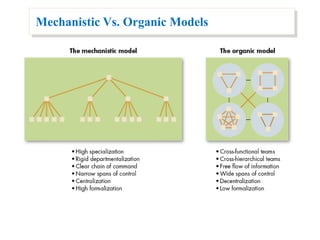
Mechanistic Model
- A structure characterized by extensive departmentalization,
high formalization, a limited information network, and
centralization.
- Are those that resemble a bureaucracy.
Organic Model
- A structure that is flat, uses cross-hierarchical and cross-
functional teams, has low formalization, possesses a
comprehensive information network, and relies on
participative decision making.
- Are those that resemble adhocracy.
Mechanistic Vs. Organic Models
Common Organization Designs
- Organizational design refers to how an organization is
structured to execute its strategic plan and achieve its
goals.
- There is no one best method, and there are no right or
wrong types of organizational design. Instead, each
organization must determine what works best for them.
- The 8 common types of organizational structures and
reasons why you might consider each of them.
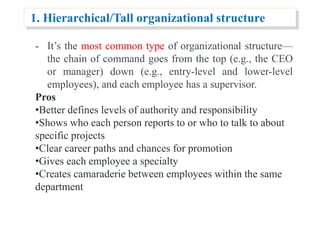
1. Hierarchical/Tall organizational structure
- It’s the most common type of organizational structure—
the chain of command goes from the top (e.g., the CEO
or manager) down (e.g., entry-level and lower-level
employees), and each employee has a supervisor.
Pros
•Better defines levels of authority and responsibility
•Shows who each person reports to or who to talk to about
specific projects
•Clear career paths and chances for promotion
•Gives each employee a specialty
•Creates camaraderie between employees within the same
department
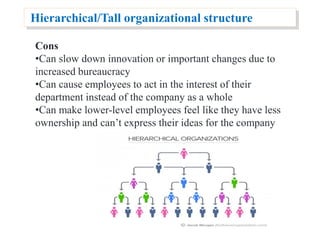
Hierarchical/Tall organizational structure
Cons
•Can slow down innovation or important changes due to
increased bureaucracy
•Can cause employees to act in the interest of their
department instead of the company as a whole
•Can make lower-level employees feel like they have less
ownership and can’t express their ideas for the company
2. Functional organizational structure
-Similar to a hierarchical organizational structure, a
functional organizational structure starts with positions with
the highest levels of responsibility at the top and goes down
from there. Primarily, though, employees are organized
according to their specific skills and their corresponding
function in the company. Each separate department is
managed independently.
Pros
•Allows employees to focus on their role
•Encourages specialization
•Help teams and departments feel self-determined
•Is easily scalable in any sized company
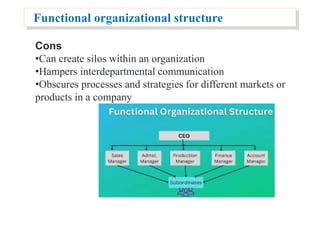
Functional organizational structure
Cons
•Can create silos within an organization
•Hampers interdepartmental communication
•Obscures processes and strategies for different markets or
products in a company
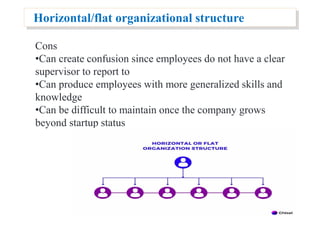
3. Horizontal/flat organizational structure
- Fits companies with few levels between upper
management and staff-level employees. Many startup
businesses use a horizontal organizational structure
before they grow large enough to build out different
departments, but some organizations maintain this
structure since it encourages less supervision and more
involvement from all employees.
Pros
•Gives employees more responsibility
•Fosters more open communication
•Improves coordination and speed of implementing new
ideas
Horizontal/flat organizational structure
Cons
•Can create confusion since employees do not have a clear
supervisor to report to
•Can produce employees with more generalized skills and
knowledge
•Can be difficult to maintain once the company grows
beyond startup status
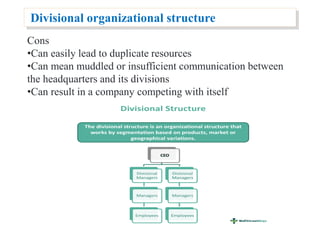
4. Divisional organizational structure
- In divisional organizational structures, a company’s
divisions have control over their own resources. This
structure works well for large companies as it empowers the
various divisions to make decisions without everyone having
to report to just a few executives.
Pros
•Helps large companies stay flexible
•Allows for a quicker response to industry changes or
customer needs
•Promotes independence, autonomy, and a customized
approach
Divisional organizational structure
Cons
•Can easily lead to duplicate resources
•Can mean muddled or insufficient communication between
the headquarters and its divisions
•Can result in a company competing with itself
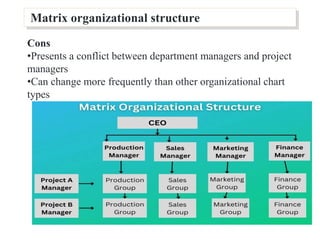
5. Matrix organizational structure
- Looks like a grid, and it shows cross-functional teams that
form for special projects. For example, an engineer may
regularly belong to the engineering department (led by an
engineering director) but work on a temporary project (led
by a project manager). The matrix org chart accounts for
both of these roles and reporting relationships.
Pros
•Allows supervisors to easily choose individuals by the needs
of a project
•Gives a more dynamic view of the organization
•Encourages employees to use their skills in various
capacities aside from their original roles
Matrix organizational structure
Cons
•Presents a conflict between department managers and project
managers
•Can change more frequently than other organizational chart
types
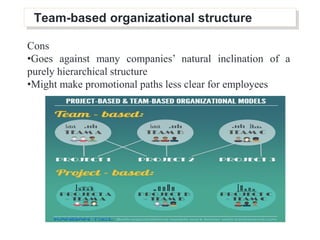
6. Team-based organizational structure
- Is meant to disrupt the traditional hierarchy, focusing more
on problem-solving, cooperation, and giving employees
more control.
Pros
•Increases productivity, performance, and transparency by
breaking down silo mentality.
•Promotes a growth mindset
•Changes the traditional career models by getting people to
move laterally
•Values experience rather than seniority
•Requires minimal management
•Fits well with agile companies with Scrum or tiger teams
Team-based organizational structure
Cons
•Goes against many companies’ natural inclination of a
purely hierarchical structure
•Might make promotional paths less clear for employees
7. Network organizational structure
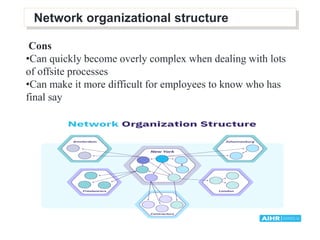
- Makes sense of the spread of resources. It can also
describe an internal structure that focuses more on open
communication and relationships rather than hierarchy.
- These days, few businesses have all their services under
one roof, and juggling the multitudes of vendors,
subcontractors, freelancers, offsite locations, and satellite
offices can get confusing.
Pros
•Visualizes the complex web of onsite and offsite
relationships in companies
•Allows companies to be more flexible and agile
•Give more power to all employees to collaborate, take
initiative, and make decisions
•Helps employees and stakeholders understand workflows
and processes
Network organizational structure
Cons
•Can quickly become overly complex when dealing with lots
of offsite processes
•Can make it more difficult for employees to know who has
final say
8. Circular structure
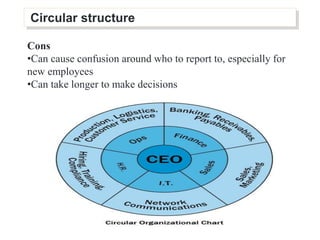
- Puts leaders of the organization at the center rather than the
top so they can share information outward rather than pass
it down a chain of command. Employees in different
departments are also seen as part of a larger whole rather
than isolated off by department.
Pros
•Promotes the flow of information across the organization
•Promotes communication and collaboration between
employees and departments
Circular structure
Cons
•Can cause confusion around who to report to, especially for
new employees
•Can take longer to make decisions

Chapter-4-Org-Design&Structure.pdf qefghfdhfhsdf

  • 1.
    Chapter Four: Foundationsof Organizational Design and Structure
  • 2.
    What Is OrganizationalStructure? Key Elements: • Work specialization • Departmentalization • Chain of command • Span of control • Centralization and decentralization • Formalization Organizational Structure - is a system used to define a hierarchy within an organization. - How jobs, tasks are formally divided, grouped, and coordinated. - The structure is illustrated using an organizational chart.
  • 3.
    Key Design Questionsand Answers for Designing the Proper Organization Structure The Key Question The Answer Is Provided By 1. To what degree are activities Work specialization subdivided into separate jobs? 2. On what basis will jobs be grouped Departmentalization together? 3. To whom do individuals and groups Chain of command report? 4. How many individuals can a manager Span of control efficiently and effectively direct? 5. Where does decision-making Centralization & decentralization authority lie? 6. To what degree will there be rules Formalization and regulations to direct employees and managers?
  • 4.
    Division of labor: •Makes efficient use of employee skills • Increases employee skills through repetition • Increases productivity • Specialized training is more efficient • Allows use of specialized equipment 1. Work Specialization/division of labor - The degree to which tasks in the organization are subdivided into separate jobs. - Allows managers to break down complex tasks into smaller more specific tasks that the workers or employees can complete. Thus, every worker in the company becomes an expert to some extent.
  • 5.
    - Job specializationrefers to developing expertise in a specific line of work, which is a smaller part of a bigger job.  What are the risks of specialization? A. Monotony : can lead to boredom and reduced job satisfaction. B.Obsolete specialties: With the continuous improvement in technologies, many specialized jobs risk getting outdated. C. Difficulty in transitioning: Becoming specialized in a job area may require time. This requirement can make it more difficult for you to change your career focus.
  • 6.
    Grouping Activities By: • Function •Product • Geography • Process • Customer 2. Departmentalization The basis by which jobs are grouped together. - The primary objectives of businesses that choose to implement departmentalization: •Maintaining control •Simplifying operational processes •Grouping specialized activities together •Increasing overall efficiency •Ensuring responsibility and accountability
  • 7.
    3. Chain ofcommand Is an organizational structure that documents how each member of a company reports to one another. Advantage - Increased efficiency - Clear direction - Stability - Structured responsibility - Accountability Disadvantage - Less collaboration - Slow communication - Decreased employee empowerment
  • 8.
    4. Span ofcontrol Refers to how many direct reports or subordinates a supervisor is responsible for managing. o Factors That Influence Span of Control - Size of Organization - Nature of Organization - Nature of Role - Managerial Skills and Competencies - Employee Skills and Abilities
  • 9.
    5. Centralization anddecentralization - Centralization refers to the concentration of management and decision-making power at the top of the organizational hierarchy for the purpose of coordinating financial, human, and other business resources - In centralized organizations, strategic planning, goal setting, budgeting, and talent deployment are typically conducted by a single, senior leader or leadership team - In contrast, in decentralized organizations, formal decision-making power is distributed across multiple individuals or
  • 10.
    Centralization vs. decentralization BasisCentralization Decentralization Chain of command Vertical Free Decision-making process Slow Fast Conflicts No such situation Likely to occur Ideal for Small-sized firms Large sized firms Employees involvement Less motivated Motivated
  • 11.
    6. Formalization - Isthe degree to which fixed rules and procedures dictate how employees should behave.
  • 12.
    Formalization best practices 1.Create simple rules: it is obvious that Complex rules are harder to follow and thus less effective. Netflix’s expense policy is summarized in one sentence: “Act in the company’s best interest”. Based on that, everyone can use their own good judgment. 2. Onus on the employee: In line with the Netflix example: don’t overprescribe. Rules are a way to keep control but trust in people to use their best judgment is equally important. If you create rules because you don’t trust employees, you are not solving the right problem.
  • 13.
    Formalization best practices 3.Formalization is a balancing act: Too little formalization will bring chaos. Being too structured will slow things down and ensure that nothing gets done. Always aim for an optimum structure, between too many and too few rules. In general we should determine what level of formalization fits your environment
  • 14.
    Structural Models Mechanistic Model -A structure characterized by extensive departmentalization, high formalization, a limited information network, and centralization. - Are those that resemble a bureaucracy. Organic Model - A structure that is flat, uses cross-hierarchical and cross- functional teams, has low formalization, possesses a comprehensive information network, and relies on participative decision making. - Are those that resemble adhocracy.
  • 15.
  • 16.
    Common Organization Designs -Organizational design refers to how an organization is structured to execute its strategic plan and achieve its goals. - There is no one best method, and there are no right or wrong types of organizational design. Instead, each organization must determine what works best for them. - The 8 common types of organizational structures and reasons why you might consider each of them.
  • 17.
    1. Hierarchical/Tall organizationalstructure - It’s the most common type of organizational structure— the chain of command goes from the top (e.g., the CEO or manager) down (e.g., entry-level and lower-level employees), and each employee has a supervisor. Pros •Better defines levels of authority and responsibility •Shows who each person reports to or who to talk to about specific projects •Clear career paths and chances for promotion •Gives each employee a specialty •Creates camaraderie between employees within the same department
  • 18.
    Hierarchical/Tall organizational structure Cons •Canslow down innovation or important changes due to increased bureaucracy •Can cause employees to act in the interest of their department instead of the company as a whole •Can make lower-level employees feel like they have less ownership and can’t express their ideas for the company
  • 19.
    2. Functional organizationalstructure -Similar to a hierarchical organizational structure, a functional organizational structure starts with positions with the highest levels of responsibility at the top and goes down from there. Primarily, though, employees are organized according to their specific skills and their corresponding function in the company. Each separate department is managed independently. Pros •Allows employees to focus on their role •Encourages specialization •Help teams and departments feel self-determined •Is easily scalable in any sized company
  • 20.
    Functional organizational structure Cons •Cancreate silos within an organization •Hampers interdepartmental communication •Obscures processes and strategies for different markets or products in a company
  • 21.
    3. Horizontal/flat organizationalstructure - Fits companies with few levels between upper management and staff-level employees. Many startup businesses use a horizontal organizational structure before they grow large enough to build out different departments, but some organizations maintain this structure since it encourages less supervision and more involvement from all employees. Pros •Gives employees more responsibility •Fosters more open communication •Improves coordination and speed of implementing new ideas
  • 22.
    Horizontal/flat organizational structure Cons •Cancreate confusion since employees do not have a clear supervisor to report to •Can produce employees with more generalized skills and knowledge •Can be difficult to maintain once the company grows beyond startup status
  • 23.
    4. Divisional organizationalstructure - In divisional organizational structures, a company’s divisions have control over their own resources. This structure works well for large companies as it empowers the various divisions to make decisions without everyone having to report to just a few executives. Pros •Helps large companies stay flexible •Allows for a quicker response to industry changes or customer needs •Promotes independence, autonomy, and a customized approach
  • 24.
    Divisional organizational structure Cons •Caneasily lead to duplicate resources •Can mean muddled or insufficient communication between the headquarters and its divisions •Can result in a company competing with itself
  • 25.
    5. Matrix organizationalstructure - Looks like a grid, and it shows cross-functional teams that form for special projects. For example, an engineer may regularly belong to the engineering department (led by an engineering director) but work on a temporary project (led by a project manager). The matrix org chart accounts for both of these roles and reporting relationships. Pros •Allows supervisors to easily choose individuals by the needs of a project •Gives a more dynamic view of the organization •Encourages employees to use their skills in various capacities aside from their original roles
  • 26.
    Matrix organizational structure Cons •Presentsa conflict between department managers and project managers •Can change more frequently than other organizational chart types
  • 27.
    6. Team-based organizationalstructure - Is meant to disrupt the traditional hierarchy, focusing more on problem-solving, cooperation, and giving employees more control. Pros •Increases productivity, performance, and transparency by breaking down silo mentality. •Promotes a growth mindset •Changes the traditional career models by getting people to move laterally •Values experience rather than seniority •Requires minimal management •Fits well with agile companies with Scrum or tiger teams
  • 28.
    Team-based organizational structure Cons •Goesagainst many companies’ natural inclination of a purely hierarchical structure •Might make promotional paths less clear for employees
  • 29.
    7. Network organizationalstructure - Makes sense of the spread of resources. It can also describe an internal structure that focuses more on open communication and relationships rather than hierarchy. - These days, few businesses have all their services under one roof, and juggling the multitudes of vendors, subcontractors, freelancers, offsite locations, and satellite offices can get confusing. Pros •Visualizes the complex web of onsite and offsite relationships in companies •Allows companies to be more flexible and agile •Give more power to all employees to collaborate, take initiative, and make decisions •Helps employees and stakeholders understand workflows and processes
  • 30.
    Network organizational structure Cons •Canquickly become overly complex when dealing with lots of offsite processes •Can make it more difficult for employees to know who has final say
  • 31.
    8. Circular structure -Puts leaders of the organization at the center rather than the top so they can share information outward rather than pass it down a chain of command. Employees in different departments are also seen as part of a larger whole rather than isolated off by department. Pros •Promotes the flow of information across the organization •Promotes communication and collaboration between employees and departments
  • 32.
    Circular structure Cons •Can causeconfusion around who to report to, especially for new employees •Can take longer to make decisions