ORGANIZATION STRUCTURE 
Rebecca@dysartjones.com 
“Damn org review…..”
ORGANIZATIONSTRUCTURES 
•Principles guiding design 
•Designing strategically & practically 
•Exercise to consider
ORGANIZATIONSTRUCTURES 
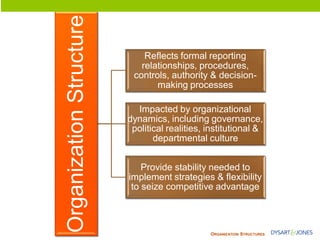
Organization Structure 
Reflects formal reporting relationships, procedures, controls, authority & decision- making processes 
Impacted by organizational dynamics, including governance, political realities, institutional & departmental culture 
Provide stability needed to implement strategies & flexibility to seize competitive advantage
ORGANIZATIONSTRUCTURES 
MIT: Best Practices for Organizational Excellence 
1.Simultaneous continuous improvement in cost, quality, service and product innovation 
2.Breaking down organizational barriers between departments 
3.Eliminating layers of management, creating flatter organizational hierarchies 
4.Closer relationships with customers and suppliers 
5.Intelligent use of new technology 
6.Global focus 
7.Improving human resource skills 
Hm…..telling that 3areas relate to Organizational Structure
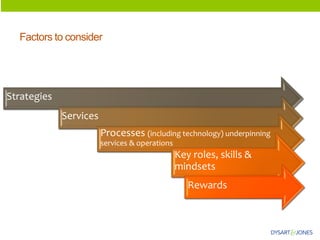
Factors to consider 
Strategies 
Services 
Processes (including technology) underpinning services & operations 
Key roles, skills & mindsets 
Rewards
ORGANIZATIONSTRUCTURES 
So why does it take such time & effort to change the org structure? 
“It takes a long time for change to happen quickly” 
Dr. Gerald Ross @ Faculty of Management, McGill University
ORGANIZATIONSTRUCTURES 
Questions organizations should be asking: 
•How should we be organized to best interact with & delight our clients or patrons? 
•How should we be organized to make the best decisions in the least amount of time? 
•How do we make it easy for people to work together, collaborate, discuss & make decisions?
ORGANIZATIONSTRUCTURES 
Organizational decisions 
Good people in a poorly designed organizational structure fail, while average people in a healthy organization succeed. 
The Science of Structure by Dean Meyer 
Arefundamentally 
about making 
choices & changes. 
Both are scary.
ORGANIZATIONSTRUCTURES 
Organization Design Principles 
•Strategy drives structure 
•Set them –clearly 
•Form follows function 
•Functions change quickly 
•Form drives behavior, shapes work processes & employee relationships to support your strategic priorities 
•Reporting relationships create “ties that bind” 
•Collaboration decreases as distance & priorities increase 
“First we shape our structures, then our structures shape us” 
Winston Churchill
ORGANIZATIONSTRUCTURES 
Organization Structure for Libraries 
•Libraries are typically highly bureaucratic, hierarchical and organized by function and / or physical setting 
•Teams result in greater engagement if handled well (i.e. clear roles, training, responsibility, accountability) 
“Innovation cannot occur without systematic abandonment” 
Peter Drucker
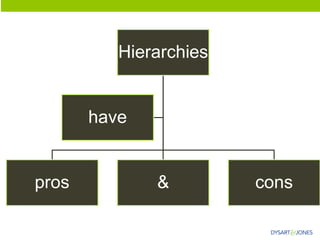
Hierarchies 
pros 
& 
cons 
have
ORGANIZATIONSTRUCTURES 
Structure should create an organizational focus on the right issues at the right time 
What IS the library’s main focus for the next few years??
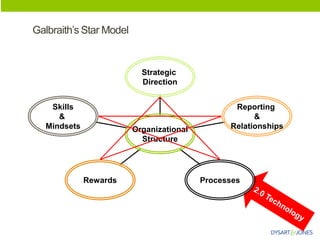
Galbraith’s Star Model 
Skills 
& 
Mindsets 
Rewards 
Processes 
Reporting 
& 
Relationships 
Strategic 
Direction 
Organizational 
Structure
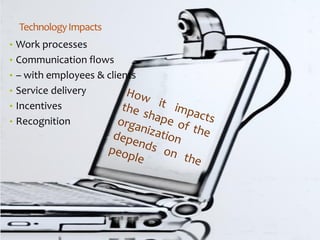
Technology Impacts 
•Work processes 
•Communication flows 
•–with employees & clients 
•Service delivery 
•Incentives 
•Recognition
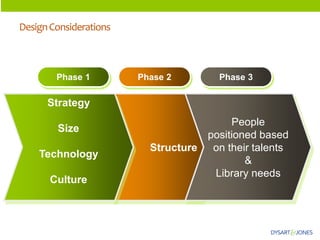
Structure 
Strategy 
Size 
Technology 
Culture 
Phase 1 
Phase 2 
Phase 3 
Design Considerations 
People positioned based on their talents 
& 
Library needs
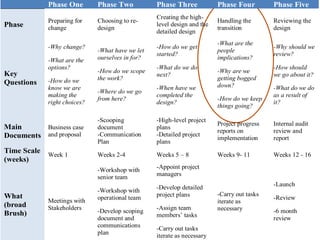
Phase One Phase Two Phase Three Phase Four Phase Five Phase Preparing for change Choosing to re- design Creating the high- level design and the detailed design Handling the transition Reviewing the design Key Questions -Why change? -What are the options? -How do we know we are making the right choices? -What have we let ourselves in for? -How do we scope the work? -Where do we go from here? -How do we get started? -What do we do next? -When have we completed the design? -What are the people implications? -Why are we getting bogged down? -How do we keep things going? -Why should we review? -How should we go about it? -What do we do as a result of it? Main Documents Business case and proposal -Scooping document -Communication Plan -High-level project plans -Detailed project plans Project progress reports on implementation Internal audit review and report Time Scale (weeks) Week 1 Weeks 2-4 Weeks 5 – 8 Weeks 9- 11 Weeks 12 - 16 What (broad Brush) Meetings with Stakeholders -Workshop with senior team -Workshop with operational team -Develop scoping document and communications plan -Appoint project managers -Develop detailed project plans -Assign team members’ tasks -Carry out tasks iterate as necessary -Carry out tasks iterate as necessary -Launch -Review -6 month review
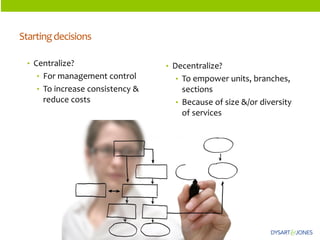
Starting decisions 
•Centralize? 
•For management control 
•To increase consistency & reduce costs 
•Decentralize? 
•To empower units, branches, sections 
•Because of size &/or diversity of services
ORGANIZATIONSTRUCTURES 
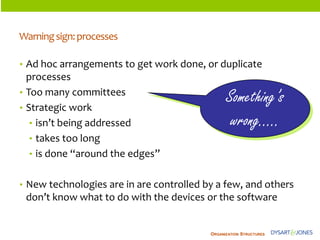
•Ad hoc arrangements to get work done, or duplicate processes 
•Too many committees 
•Strategic work 
•isn’t being addressed 
•takes too long 
•is done “around the edges” 
•New technologies are in are controlled by a few, and others don’t know what to do with the devices or the software 
Something’s wrong….. 
Warning sign: processes
ORGANIZATIONSTRUCTURES 
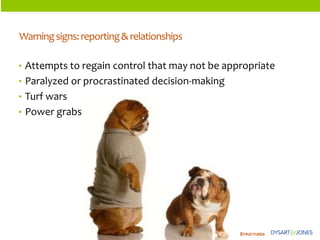
•Attempts to regain control that may not be appropriate 
•Paralyzed or procrastinated decision-making 
•Turf wars 
•Power grabs 
Warning signs: reporting & relationships
ORGANIZATIONSTRUCTURES 
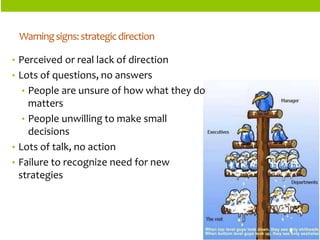
•Perceived or real lack of direction 
•Lots of questions, no answers 
•People are unsure of how what they do matters 
•People unwilling to make small decisions 
•Lots of talk, no action 
•Failure to recognize need for new strategies 
Warning signs: strategic direction
ORGANIZATIONSTRUCTURES 
•“Bad attitudes” & “personality conflicts” 
•Demonization & triangulation 
•“Too many meetings” 
•Confusion over priorities 
•Lots of overtime by a few people 
•Perceptions of an “in group” 
Warning sign: skills & mindsets
ORGANIZATIONSTRUCTURES 
•Techno pets & prima donnas 
•Faded stars 
•Technology becomes its own reward 
•New competencies not recognized by compensation system 
•The “right” behaviours aren’t being rewarded –or there’s no way to reward them 
Warning signs: rewards
•Every design is a trade-off among desirable choices. 
•A major redesign is a two-step process. 
#1. Choose a design approach (or approaches). 
#2: Mix and match the design elements. 
“The negatives are what the leader will have to manage.” Galbraith 
Realities of designing the organization
Ready yourselves with: 
•Strategic plan 
•Flip charts, post-its 
•Assumptions & principles 
•Humouror humor 
•The word “Draft” 
•Balance the practical 
with the potential
ORGANIZATIONSTRUCTURES 
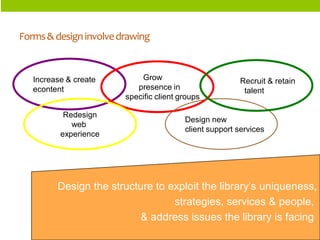
Forms & design involve drawing 
Increase & create 
econtent 
Grow 
presence in 
specific client groups 
Redesign 
web 
experience 
Design new 
client support services 
Recruit & retain 
talent 
Design the structure to exploit the library’s uniqueness, 
strategies, services & people, 
& address issues the library is facing
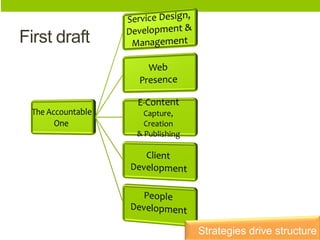
First draft 
Strategies drive structure
SKETCH OUT YOUR ORGANIZATION’S STRUCTURE (YES, THE CHART)
ORGANIZATIONSTRUCTURES 
Some basics 
•Develop a clear and consistent vision 
•Identify key success factors 
•Build in a way to assess 
•Train everyone, starting with those in people management positions 
•Develop system-wide knowledge and concern (Central vs. Branches)
ORGANIZATIONSTRUCTURES 
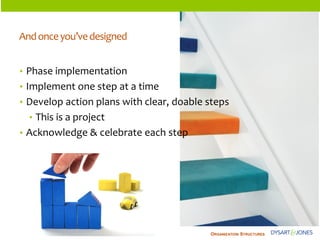
•Phase implementation 
•Implement one step at a time 
•Develop action plans with clear, doable steps 
•This is a project 
•Acknowledge & celebrate each step 
And once you’ve designed
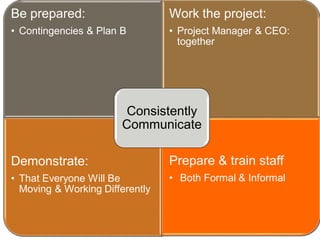
Be prepared: 
•Contingencies & Plan B 
Work the project: 
•Project Manager & CEO: together 
Demonstrate: 
•That Everyone Will Be Moving & Working Differently 
Prepare & train staff 
•Both Formal & Informal 
Consistently Communicate
ORGANIZATIONSTRUCTURES 
•Organizations are living systems. 
•New work arrangements take time. 
•Lack of clarity is the root of most evil. 
•85% of “people problems” aren’t caused by people but by process & organizational structure flaws 
To successfully implement, remember:
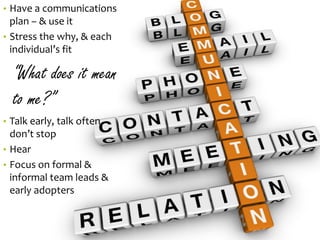
•Have a communications plan –& use it 
•Stress the why, & each individual’s fit 
“What does it mean to me?” 
•Talk early, talk often, don’t stop 
•Hear 
•Focus on formal & informal team leads & early adopters

Organization structure @ Building an Engaged Flat Army in the Library Symposium Nov 2014

  • 1.
  • 2.
    ORGANIZATIONSTRUCTURES •Principles guidingdesign •Designing strategically & practically •Exercise to consider
  • 3.
    ORGANIZATIONSTRUCTURES Organization Structure Reflects formal reporting relationships, procedures, controls, authority & decision- making processes Impacted by organizational dynamics, including governance, political realities, institutional & departmental culture Provide stability needed to implement strategies & flexibility to seize competitive advantage
  • 4.
    ORGANIZATIONSTRUCTURES MIT: BestPractices for Organizational Excellence 1.Simultaneous continuous improvement in cost, quality, service and product innovation 2.Breaking down organizational barriers between departments 3.Eliminating layers of management, creating flatter organizational hierarchies 4.Closer relationships with customers and suppliers 5.Intelligent use of new technology 6.Global focus 7.Improving human resource skills Hm…..telling that 3areas relate to Organizational Structure
  • 5.
    Factors to consider Strategies Services Processes (including technology) underpinning services & operations Key roles, skills & mindsets Rewards
  • 6.
    ORGANIZATIONSTRUCTURES So whydoes it take such time & effort to change the org structure? “It takes a long time for change to happen quickly” Dr. Gerald Ross @ Faculty of Management, McGill University
  • 7.
    ORGANIZATIONSTRUCTURES Questions organizationsshould be asking: •How should we be organized to best interact with & delight our clients or patrons? •How should we be organized to make the best decisions in the least amount of time? •How do we make it easy for people to work together, collaborate, discuss & make decisions?
  • 8.
    ORGANIZATIONSTRUCTURES Organizational decisions Good people in a poorly designed organizational structure fail, while average people in a healthy organization succeed. The Science of Structure by Dean Meyer Arefundamentally about making choices & changes. Both are scary.
  • 9.
    ORGANIZATIONSTRUCTURES Organization DesignPrinciples •Strategy drives structure •Set them –clearly •Form follows function •Functions change quickly •Form drives behavior, shapes work processes & employee relationships to support your strategic priorities •Reporting relationships create “ties that bind” •Collaboration decreases as distance & priorities increase “First we shape our structures, then our structures shape us” Winston Churchill
  • 10.
    ORGANIZATIONSTRUCTURES Organization Structurefor Libraries •Libraries are typically highly bureaucratic, hierarchical and organized by function and / or physical setting •Teams result in greater engagement if handled well (i.e. clear roles, training, responsibility, accountability) “Innovation cannot occur without systematic abandonment” Peter Drucker
  • 11.
  • 12.
    ORGANIZATIONSTRUCTURES Structure shouldcreate an organizational focus on the right issues at the right time What IS the library’s main focus for the next few years??
  • 13.
    Galbraith’s Star Model Skills & Mindsets Rewards Processes Reporting & Relationships Strategic Direction Organizational Structure
  • 14.
    Technology Impacts •Workprocesses •Communication flows •–with employees & clients •Service delivery •Incentives •Recognition
  • 15.
    Structure Strategy Size Technology Culture Phase 1 Phase 2 Phase 3 Design Considerations People positioned based on their talents & Library needs
  • 16.
    Phase One PhaseTwo Phase Three Phase Four Phase Five Phase Preparing for change Choosing to re- design Creating the high- level design and the detailed design Handling the transition Reviewing the design Key Questions -Why change? -What are the options? -How do we know we are making the right choices? -What have we let ourselves in for? -How do we scope the work? -Where do we go from here? -How do we get started? -What do we do next? -When have we completed the design? -What are the people implications? -Why are we getting bogged down? -How do we keep things going? -Why should we review? -How should we go about it? -What do we do as a result of it? Main Documents Business case and proposal -Scooping document -Communication Plan -High-level project plans -Detailed project plans Project progress reports on implementation Internal audit review and report Time Scale (weeks) Week 1 Weeks 2-4 Weeks 5 – 8 Weeks 9- 11 Weeks 12 - 16 What (broad Brush) Meetings with Stakeholders -Workshop with senior team -Workshop with operational team -Develop scoping document and communications plan -Appoint project managers -Develop detailed project plans -Assign team members’ tasks -Carry out tasks iterate as necessary -Carry out tasks iterate as necessary -Launch -Review -6 month review
  • 17.
    Starting decisions •Centralize? •For management control •To increase consistency & reduce costs •Decentralize? •To empower units, branches, sections •Because of size &/or diversity of services
  • 18.
    ORGANIZATIONSTRUCTURES •Ad hocarrangements to get work done, or duplicate processes •Too many committees •Strategic work •isn’t being addressed •takes too long •is done “around the edges” •New technologies are in are controlled by a few, and others don’t know what to do with the devices or the software Something’s wrong….. Warning sign: processes
  • 19.
    ORGANIZATIONSTRUCTURES •Attempts toregain control that may not be appropriate •Paralyzed or procrastinated decision-making •Turf wars •Power grabs Warning signs: reporting & relationships
  • 20.
    ORGANIZATIONSTRUCTURES •Perceived orreal lack of direction •Lots of questions, no answers •People are unsure of how what they do matters •People unwilling to make small decisions •Lots of talk, no action •Failure to recognize need for new strategies Warning signs: strategic direction
  • 21.
    ORGANIZATIONSTRUCTURES •“Bad attitudes”& “personality conflicts” •Demonization & triangulation •“Too many meetings” •Confusion over priorities •Lots of overtime by a few people •Perceptions of an “in group” Warning sign: skills & mindsets
  • 22.
    ORGANIZATIONSTRUCTURES •Techno pets& prima donnas •Faded stars •Technology becomes its own reward •New competencies not recognized by compensation system •The “right” behaviours aren’t being rewarded –or there’s no way to reward them Warning signs: rewards
  • 23.
    •Every design isa trade-off among desirable choices. •A major redesign is a two-step process. #1. Choose a design approach (or approaches). #2: Mix and match the design elements. “The negatives are what the leader will have to manage.” Galbraith Realities of designing the organization
  • 24.
    Ready yourselves with: •Strategic plan •Flip charts, post-its •Assumptions & principles •Humouror humor •The word “Draft” •Balance the practical with the potential
  • 25.
    ORGANIZATIONSTRUCTURES Forms &design involve drawing Increase & create econtent Grow presence in specific client groups Redesign web experience Design new client support services Recruit & retain talent Design the structure to exploit the library’s uniqueness, strategies, services & people, & address issues the library is facing
  • 26.
    First draft Strategiesdrive structure
  • 27.
    SKETCH OUT YOURORGANIZATION’S STRUCTURE (YES, THE CHART)
  • 28.
    ORGANIZATIONSTRUCTURES Some basics •Develop a clear and consistent vision •Identify key success factors •Build in a way to assess •Train everyone, starting with those in people management positions •Develop system-wide knowledge and concern (Central vs. Branches)
  • 29.
    ORGANIZATIONSTRUCTURES •Phase implementation •Implement one step at a time •Develop action plans with clear, doable steps •This is a project •Acknowledge & celebrate each step And once you’ve designed
  • 30.
    Be prepared: •Contingencies& Plan B Work the project: •Project Manager & CEO: together Demonstrate: •That Everyone Will Be Moving & Working Differently Prepare & train staff •Both Formal & Informal Consistently Communicate
  • 31.
    ORGANIZATIONSTRUCTURES •Organizations areliving systems. •New work arrangements take time. •Lack of clarity is the root of most evil. •85% of “people problems” aren’t caused by people but by process & organizational structure flaws To successfully implement, remember:
  • 32.
    •Have a communicationsplan –& use it •Stress the why, & each individual’s fit “What does it mean to me?” •Talk early, talk often, don’t stop •Hear •Focus on formal & informal team leads & early adopters