www.mathsbox.org.uk
CORE 1 Summary Notes
1 Linear Graphs and Equations
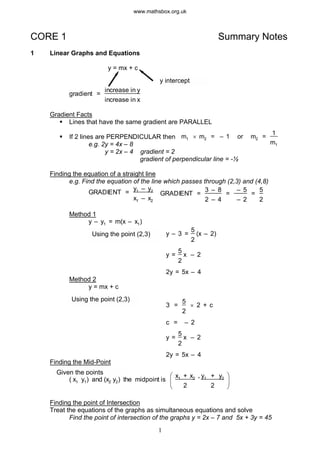
y = mx + c
gradient =
increase in y
increase in x
y intercept
Gradient Facts
§ Lines that have the same gradient are PARALLEL
§ If 2 lines are PERPENDICULAR then m1 ´ m2 = – 1 or m2 =
1
m1e.g. 2y = 4x – 8
y = 2x – 4 gradient = 2
gradient of perpendicular line = -½
Finding the equation of a straight line
e.g. Find the equation of the line which passes through (2,3) and (4,8)
GRADIENT =
y1 – y2
x1 – x2
GRADIENT =
3 – 8
=
– 5
=
5
2 – 4 – 2 2
Method 1
y – y1 = m(x – x1)
y – 3 =
5
(x – 2)
2
y =
5
x – 2
2
2y = 5x – 4
Using the point (2,3)
Method 2
y = mx + c
3 =
5
2
´ 2 + c
c = – 2
y =
5
x – 2
2
2y = 5x – 4
Using the point (2,3)
Finding the Mid-Point
( x1 y1) and (x2 y2) the midpoint is
æ
è
ç
x1 + x2
2
'
y1 + y2 ö
2 ø
÷
Given the points
Finding the point of Intersection
Treat the equations of the graphs as simultaneous equations and solve
Find the point of intersection of the graphs y = 2x – 7 and 5x + 3y = 45
1
Substituting y = 2x – 7 gives 5x + 3(2x –7) = 45
5x + 6x – 21 = 45
11x = 66
x = 6 y = 2 x 6 – 7
y = 5
Point of intersection = (6, 5)
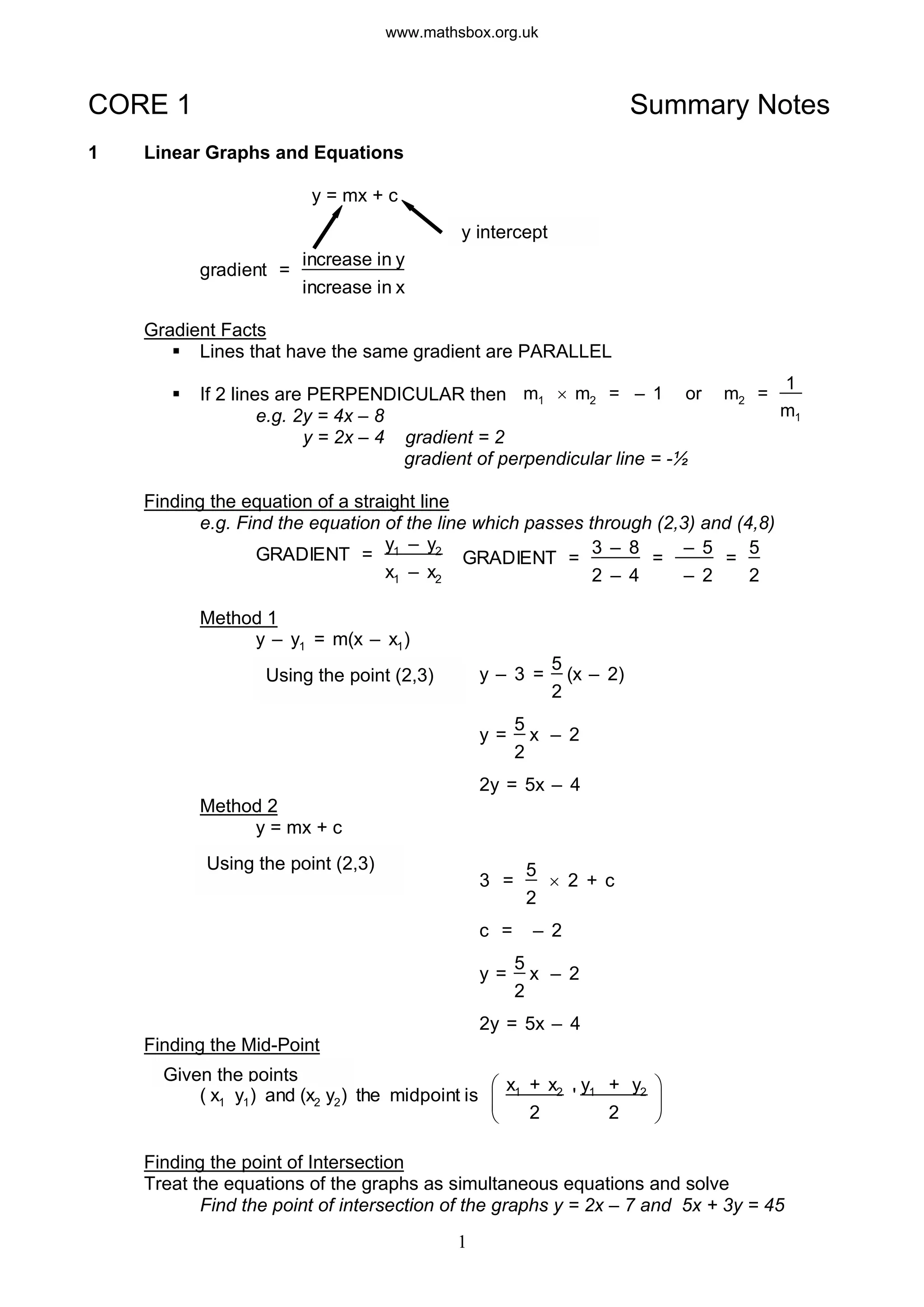
2 Surds
§ A root such as √5 that cannot be written exactly as a fraction is IRRATIONAL
§ An expression that involves irrational roots is in SURD FORM e.g. 3√5
§ ab = a ´ b
§
a
b
=
a
b
75 – 12
= 5 ´ 5 ´ 3 – 2 ´ 2 ´ 3
= 5 3 – 2 3
= 3 3
e.g
§ RATIONALISING THE DENOMINATOR
3 + √2  and  3  √2 is called a pair of CONJUGATES
The product of any pair of conjugates is always a rational number
e.g.  (3 + √2)(3  √2) = 9  3√2+3√22
= 7
2
1 – 5
Rationalise the denominator of
2
1 – 5
´
1 + 5
1 + 5
=
2 + 2 5
1 – 5
=
2 + 2 5
– 4
=
– 1 – 5
2
3. Quadratic Graphs and Equations
Solution of quadratic equations
§ Factorisation
x =
x
2
– 3x – 4 = 0
(x + 1)(x – 4) = 0
– 1 or x = 4
2
www.mathsbox.org.uk
§ Completing the square
x
2
– 4x – 3 = 0
(x – 2)
2
– (2)
2
– 3 = 0
(x – 2)
2
– 7 = 0
(x – 2)
2
= 7
x – 2 = ± 7
x = 2 + 7 or x = 2 – 7
§ Using the formula to solve ax2
+ bx + c = 0
x =
– b ± b
2
– 4ac
2a
E.g Solve x2
- 4x - 3 = 0
x =
– ( – 4) ± ( – 4)
2
– 4 ´ 1 ´ ( – 3)
2 ´ 1
=
4 ± 28
2
= 2 ± 7
§ The graph of y = ax2
+ bx + c crosses the y axis at y = c
It crosses or touches the x-axis if the equation has real solutions
The DISCRIMINANT of ax2
+ bx + c = 0 is the expression b2
– 4ac
If b2
– 4ac >0 there are 2 real distinct roots
If b2
– 4ac = 0 there is one repeated root
If b2
– 4ac < 0 there are no real roots
Graphs of Quadratic Functions
§ The graph of any quadratic expression in x is called a PARABOLA
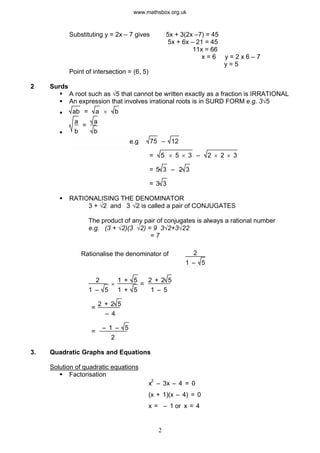
§ The graph of y – q = k(x - p)2
is a TRANSLATION of the graph y = kx2
In VECTOR notation this translation can be described as ú
û
ù
ê
ë
é p
q
The equation can also be written as y = k(x – p)2
+ q
The VERTEX of the graph is (p,q)
The LINE OF SYMMETRY is x = p
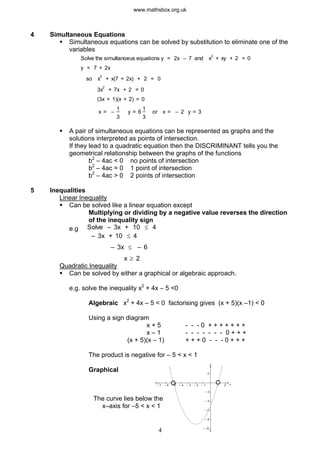
3
2x
2
+ 4x + 5 = 2(x + 1)
2
+ 3
Vertex (-1,3)
Line of symmetry x = -1
y
x1 2 3 4 5– 1– 2– 3– 4– 5
1
2
3
4
5
6
7
8
9
10
– 1
– 2
– 3
– 4
Translation of y=2x2
ú
û
ù
ê
ë
é-1
3
www.mathsbox.org.uk
4 Simultaneous Equations
§ Simultaneous equations can be solved by substitution to eliminate one of the
variables
Solve the simultanoeus equations y = 2x – 7 and x
2
+ xy + 2 = 0
y = 7 + 2x
so x
2
+ x(7 + 2x) + 2 = 0
3x
2
+ 7x + 2 = 0
(3x + 1)(x + 2) = 0
x = –
1
3
y = 6
1
3
or x = – 2 y = 3
§ A pair of simultaneous equations can be represented as graphs and the
solutions interpreted as points of intersection.
If they lead to a quadratic equation then the DISCRIMINANT tells you the
geometrical relationship between the graphs of the functions
b2
– 4ac < 0 no points of intersection
b2
– 4ac = 0 1 point of intersection
b2
– 4ac > 0 2 points of intersection
5 Inequalities
Linear Inequality
§ Can be solved like a linear equation except
Multiplying or dividing by a negative value reverses the direction
of the inequality sign
e.g Solve – 3x + 10 £ 4
x
– 3x + 10 £ 4
– 3x £ – 6
³ 2
Quadratic Inequality
§ Can be solved by either a graphical or algebraic approach.
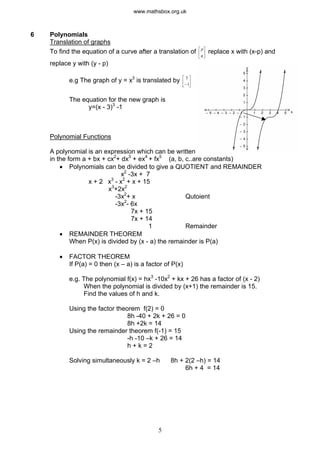
e.g. solve the inequality x2
+ 4x – 5 <0
Algebraic x2
+ 4x – 5 < 0 factorising gives (x + 5)(x –1) < 0
Using a sign diagram
x + 5 - - - 0 + + + + + + +
x – 1 - - - - - - - 0 + + +
(x + 5)(x – 1) + + + 0 - - - 0 + + +
The product is negative for – 5 < x < 1
4
y
x1 2– 1– 2– 3– 4– 5– 6– 7
2
– 2
– 4
– 6
– 8
– 10
Graphical
The curve lies below the
x–axis for –5 < x < 1
www.mathsbox.org.uk
6 Polynomials
Translation of graphs
To find the equation of a curve after a translation of ú replace x with (x-p) and
û
ù
ê
ë
é p
q
replace y with (y - p)
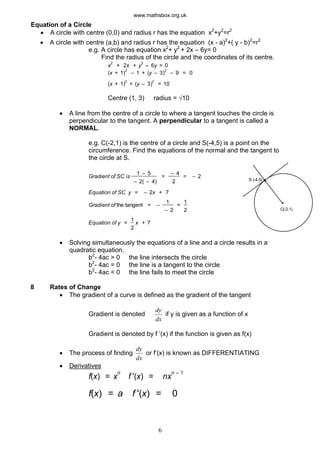
e.g The graph of y = x3
is translated by ú
û
ù
ê
ë
é 3
-1
The equation for the new graph is
y=(x - 3)3
-1
Polynomial Functions
A polynomial is an expression which can be written
in the form a + bx + cx2
+ dx3
+ ex4
+ fx5
(a, b, c..are constants)
y
x1 2
– 1
3 4 5– 1– 2– 3– 4– 5
1
2
3
4
5
– 2
– 3
– 4
– 5
· Polynomials can be divided to give a QUOTIENT and REMAINDER
x2
-3x + 7
x + 2 x3
- x2
+ x + 15
x3
+2x2
-3x2
+ x Qutoient
-3x2
- 6x
7x + 15
7x + 14
1 Remainder
· REMAINDER THEOREM
When P(x) is divided by (x - a) the remainder is P(a)
· FACTOR THEOREM
If P(a) = 0 then (x – a) is a factor of P(x)
e.g. The polynomial f(x) = hx3
-10x2
+ kx + 26 has a factor of (x - 2)
When the polynomial is divided by (x+1) the remainder is 15.
Find the values of h and k.
Using the factor theorem f(2) = 0
8h -40 + 2k + 26 = 0
8h +2k = 14
Using the remainder theorem f(-1) = 15
-h -10 –k + 26 = 14
h + k = 2
Solving simultaneously k = 2 –h 8h + 2(2 –h) = 14
6h + 4 = 14
5
www.mathsbox.org.uk
· A circle with centre (a,b) and radius r has the equation (x - a)2
+( y - b)2
=r2
e.g. A circle has equation x2
+ y2
+ 2x – 6y= 0
Find the radius of the circle and the coordinates of its centre.
x
2
+ 2x + y
2
– 6y = 0
(x + 1)
2
– 1 + (y – 3)
2
– 9 = 0
(x + 1)
2
+ (y – 3)
2
= 10
Centre (1, 3)  radius = √10
· A line from the centre of a circle to where a tangent touches the circle is
perpendicular to the tangent. A perpendicular to a tangent is called a
NORMAL.
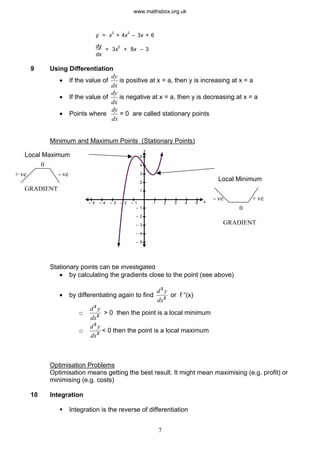
e.g. C(-2,1) is the centre of a circle and S(-4,5) is a point on the
circumference. Find the equations of the normal and the tangent to
the circle at S.
C(-2,1)
S (-4,5)
Gradient of SC is
1 – 5
– 2( – 4)
=
– 4
2
= – 2
Equation of SC y = – 2x + 7
Gradient of the tangent = –
1
– 2
=
1
2
Equation of y =
1
x + 7
2
· Solving simultaneously the equations of a line and a circle results in a
quadratic equation.
b2
- 4ac > 0 the line intersects the circle
b2
- 4ac = 0 the line is a tangent to the circle
b2
- 4ac < 0 the line fails to meet the circle
8 Rates of Change
· The gradient of a curve is defined as the gradient of the tangent
Gradient is denoted
dx
dy
if y is given as a function of x
Gradient is denoted by f ’(x) if the function is given as f(x)
· The process of finding
dy
dx
or f’(x) is known as DIFFERENTIATING
· Derivatives
f(x) = x
n
f '(x) = nx
n – 1
f(x) = a f '(x) = 0
6
www.mathsbox.org.uk
Equation of a Circle
· A circle with centre (0,0) and radius r has the equation x2
+y2
=r2
dx
y = x
3
+ 4x
2
– 3x + 6
dy
= 3x
2
+ 8x – 3
9 Using Differentiation
· If the value of
dy
dx
is positive at x = a, then y is increasing at x = a
· If the value of
dy
dx
is negative at x = a, then y is decreasing at x = a
· Points where
dy
dx
= 0 are called stationary points
Minimum and Maximum Points (Stationary Points)
Stationary points can be investigated
y
x1 2 3 4 5– 1– 2– 3– 4– 5
1
2
3
4
5
– 1
– 2
– 3
– 4
– 5
+ ve- ve
GRADIENT
GRADIENT
0
- ve+ ve
Local Minimum
Local Maximum
0
· by calculating the gradients close to the point (see above)
· by differentiating again to find
d
2
or f “(x)
2
y
dx
o
d
2
> 0 then the point is a local minimum
2
y
dx
o
d
2
2
y
dx
< 0 then the point is a local maximum
Optimisation Problems
Optimisation means getting the best result. It might mean maximising (e.g. profit) or
minimising (e.g. costs)
10 Integration
§ Integration is the reverse of differentiation
7
www.mathsbox.org.uk
ò x
n
dx =
x
n + 1
n + 1
+ c
Constant of integration
e.g. Given that
f '(x) = 8x
3
– 6x and that f(2) = 9 find f(x)
f(x) =
ò 8x
3
– 6x dx
=
8x
–
6x
+ c
4
4
2
2
= 2x
4
– 3x
2
+ c
To find c use f(2) = 9
So f(x) = 2x4
– 3x2
–11
32 – 12 + c = 9
c = – 11
11 Area Under a Graph
§ The are under the graph of y = f(x) between x= a and x = b is found by
evaluating the definite integral
ò
b
f(x) dx
a
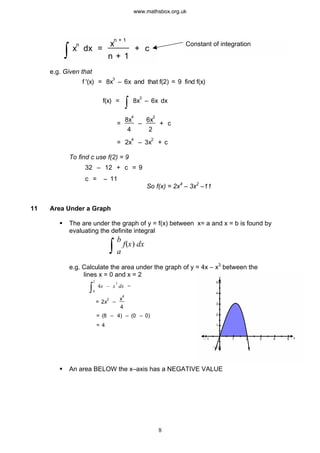
e.g. Calculate the area under the graph of y = 4x – x3
between the
lines x = 0 and x = 2 y
x1 2 3 4 5– 1
1
2
3
4
5
– 1
ò0
2
4x – x
3
dx =
= 2x
2
–
x
4
4
= (8 – 4) – (0 – 0)
= 4
§ An area BELOW the x–axis has a NEGATIVE VALUE
8
www.mathsbox.org.uk

Core 1 revision notes a

  • 1.
    www.mathsbox.org.uk CORE 1 SummaryNotes 1 Linear Graphs and Equations y = mx + c gradient = increase in y increase in x y intercept Gradient Facts § Lines that have the same gradient are PARALLEL § If 2 lines are PERPENDICULAR then m1 ´ m2 = – 1 or m2 = 1 m1e.g. 2y = 4x – 8 y = 2x – 4 gradient = 2 gradient of perpendicular line = -½ Finding the equation of a straight line e.g. Find the equation of the line which passes through (2,3) and (4,8) GRADIENT = y1 – y2 x1 – x2 GRADIENT = 3 – 8 = – 5 = 5 2 – 4 – 2 2 Method 1 y – y1 = m(x – x1) y – 3 = 5 (x – 2) 2 y = 5 x – 2 2 2y = 5x – 4 Using the point (2,3) Method 2 y = mx + c 3 = 5 2 ´ 2 + c c = – 2 y = 5 x – 2 2 2y = 5x – 4 Using the point (2,3) Finding the Mid-Point ( x1 y1) and (x2 y2) the midpoint is æ è ç x1 + x2 2 ' y1 + y2 ö 2 ø ÷ Given the points Finding the point of Intersection Treat the equations of the graphs as simultaneous equations and solve Find the point of intersection of the graphs y = 2x – 7 and 5x + 3y = 45 1
  • 2.
    Substituting y =2x – 7 gives 5x + 3(2x –7) = 45 5x + 6x – 21 = 45 11x = 66 x = 6 y = 2 x 6 – 7 y = 5 Point of intersection = (6, 5) 2 Surds § A root such as √5 that cannot be written exactly as a fraction is IRRATIONAL § An expression that involves irrational roots is in SURD FORM e.g. 3√5 § ab = a ´ b § a b = a b 75 – 12 = 5 ´ 5 ´ 3 – 2 ´ 2 ´ 3 = 5 3 – 2 3 = 3 3 e.g § RATIONALISING THE DENOMINATOR 3 + √2  and  3  √2 is called a pair of CONJUGATES The product of any pair of conjugates is always a rational number e.g.  (3 + √2)(3  √2) = 9  3√2+3√22 = 7 2 1 – 5 Rationalise the denominator of 2 1 – 5 ´ 1 + 5 1 + 5 = 2 + 2 5 1 – 5 = 2 + 2 5 – 4 = – 1 – 5 2 3. Quadratic Graphs and Equations Solution of quadratic equations § Factorisation x = x 2 – 3x – 4 = 0 (x + 1)(x – 4) = 0 – 1 or x = 4 2 www.mathsbox.org.uk
  • 3.
    § Completing thesquare x 2 – 4x – 3 = 0 (x – 2) 2 – (2) 2 – 3 = 0 (x – 2) 2 – 7 = 0 (x – 2) 2 = 7 x – 2 = ± 7 x = 2 + 7 or x = 2 – 7 § Using the formula to solve ax2 + bx + c = 0 x = – b ± b 2 – 4ac 2a E.g Solve x2 - 4x - 3 = 0 x = – ( – 4) ± ( – 4) 2 – 4 ´ 1 ´ ( – 3) 2 ´ 1 = 4 ± 28 2 = 2 ± 7 § The graph of y = ax2 + bx + c crosses the y axis at y = c It crosses or touches the x-axis if the equation has real solutions The DISCRIMINANT of ax2 + bx + c = 0 is the expression b2 – 4ac If b2 – 4ac >0 there are 2 real distinct roots If b2 – 4ac = 0 there is one repeated root If b2 – 4ac < 0 there are no real roots Graphs of Quadratic Functions § The graph of any quadratic expression in x is called a PARABOLA § The graph of y – q = k(x - p)2 is a TRANSLATION of the graph y = kx2 In VECTOR notation this translation can be described as ú û ù ê ë é p q The equation can also be written as y = k(x – p)2 + q The VERTEX of the graph is (p,q) The LINE OF SYMMETRY is x = p 3 2x 2 + 4x + 5 = 2(x + 1) 2 + 3 Vertex (-1,3) Line of symmetry x = -1 y x1 2 3 4 5– 1– 2– 3– 4– 5 1 2 3 4 5 6 7 8 9 10 – 1 – 2 – 3 – 4 Translation of y=2x2 ú û ù ê ë é-1 3 www.mathsbox.org.uk
  • 4.
    4 Simultaneous Equations §Simultaneous equations can be solved by substitution to eliminate one of the variables Solve the simultanoeus equations y = 2x – 7 and x 2 + xy + 2 = 0 y = 7 + 2x so x 2 + x(7 + 2x) + 2 = 0 3x 2 + 7x + 2 = 0 (3x + 1)(x + 2) = 0 x = – 1 3 y = 6 1 3 or x = – 2 y = 3 § A pair of simultaneous equations can be represented as graphs and the solutions interpreted as points of intersection. If they lead to a quadratic equation then the DISCRIMINANT tells you the geometrical relationship between the graphs of the functions b2 – 4ac < 0 no points of intersection b2 – 4ac = 0 1 point of intersection b2 – 4ac > 0 2 points of intersection 5 Inequalities Linear Inequality § Can be solved like a linear equation except Multiplying or dividing by a negative value reverses the direction of the inequality sign e.g Solve – 3x + 10 £ 4 x – 3x + 10 £ 4 – 3x £ – 6 ³ 2 Quadratic Inequality § Can be solved by either a graphical or algebraic approach. e.g. solve the inequality x2 + 4x – 5 <0 Algebraic x2 + 4x – 5 < 0 factorising gives (x + 5)(x –1) < 0 Using a sign diagram x + 5 - - - 0 + + + + + + + x – 1 - - - - - - - 0 + + + (x + 5)(x – 1) + + + 0 - - - 0 + + + The product is negative for – 5 < x < 1 4 y x1 2– 1– 2– 3– 4– 5– 6– 7 2 – 2 – 4 – 6 – 8 – 10 Graphical The curve lies below the x–axis for –5 < x < 1 www.mathsbox.org.uk
  • 5.
    6 Polynomials Translation ofgraphs To find the equation of a curve after a translation of ú replace x with (x-p) and û ù ê ë é p q replace y with (y - p) e.g The graph of y = x3 is translated by ú û ù ê ë é 3 -1 The equation for the new graph is y=(x - 3)3 -1 Polynomial Functions A polynomial is an expression which can be written in the form a + bx + cx2 + dx3 + ex4 + fx5 (a, b, c..are constants) y x1 2 – 1 3 4 5– 1– 2– 3– 4– 5 1 2 3 4 5 – 2 – 3 – 4 – 5 · Polynomials can be divided to give a QUOTIENT and REMAINDER x2 -3x + 7 x + 2 x3 - x2 + x + 15 x3 +2x2 -3x2 + x Qutoient -3x2 - 6x 7x + 15 7x + 14 1 Remainder · REMAINDER THEOREM When P(x) is divided by (x - a) the remainder is P(a) · FACTOR THEOREM If P(a) = 0 then (x – a) is a factor of P(x) e.g. The polynomial f(x) = hx3 -10x2 + kx + 26 has a factor of (x - 2) When the polynomial is divided by (x+1) the remainder is 15. Find the values of h and k. Using the factor theorem f(2) = 0 8h -40 + 2k + 26 = 0 8h +2k = 14 Using the remainder theorem f(-1) = 15 -h -10 –k + 26 = 14 h + k = 2 Solving simultaneously k = 2 –h 8h + 2(2 –h) = 14 6h + 4 = 14 5 www.mathsbox.org.uk
  • 6.
    · A circlewith centre (a,b) and radius r has the equation (x - a)2 +( y - b)2 =r2 e.g. A circle has equation x2 + y2 + 2x – 6y= 0 Find the radius of the circle and the coordinates of its centre. x 2 + 2x + y 2 – 6y = 0 (x + 1) 2 – 1 + (y – 3) 2 – 9 = 0 (x + 1) 2 + (y – 3) 2 = 10 Centre (1, 3)  radius = √10 · A line from the centre of a circle to where a tangent touches the circle is perpendicular to the tangent. A perpendicular to a tangent is called a NORMAL. e.g. C(-2,1) is the centre of a circle and S(-4,5) is a point on the circumference. Find the equations of the normal and the tangent to the circle at S. C(-2,1) S (-4,5) Gradient of SC is 1 – 5 – 2( – 4) = – 4 2 = – 2 Equation of SC y = – 2x + 7 Gradient of the tangent = – 1 – 2 = 1 2 Equation of y = 1 x + 7 2 · Solving simultaneously the equations of a line and a circle results in a quadratic equation. b2 - 4ac > 0 the line intersects the circle b2 - 4ac = 0 the line is a tangent to the circle b2 - 4ac < 0 the line fails to meet the circle 8 Rates of Change · The gradient of a curve is defined as the gradient of the tangent Gradient is denoted dx dy if y is given as a function of x Gradient is denoted by f ’(x) if the function is given as f(x) · The process of finding dy dx or f’(x) is known as DIFFERENTIATING · Derivatives f(x) = x n f '(x) = nx n – 1 f(x) = a f '(x) = 0 6 www.mathsbox.org.uk Equation of a Circle · A circle with centre (0,0) and radius r has the equation x2 +y2 =r2
  • 7.
    dx y = x 3 +4x 2 – 3x + 6 dy = 3x 2 + 8x – 3 9 Using Differentiation · If the value of dy dx is positive at x = a, then y is increasing at x = a · If the value of dy dx is negative at x = a, then y is decreasing at x = a · Points where dy dx = 0 are called stationary points Minimum and Maximum Points (Stationary Points) Stationary points can be investigated y x1 2 3 4 5– 1– 2– 3– 4– 5 1 2 3 4 5 – 1 – 2 – 3 – 4 – 5 + ve- ve GRADIENT GRADIENT 0 - ve+ ve Local Minimum Local Maximum 0 · by calculating the gradients close to the point (see above) · by differentiating again to find d 2 or f “(x) 2 y dx o d 2 > 0 then the point is a local minimum 2 y dx o d 2 2 y dx < 0 then the point is a local maximum Optimisation Problems Optimisation means getting the best result. It might mean maximising (e.g. profit) or minimising (e.g. costs) 10 Integration § Integration is the reverse of differentiation 7 www.mathsbox.org.uk
  • 8.
    ò x n dx = x n+ 1 n + 1 + c Constant of integration e.g. Given that f '(x) = 8x 3 – 6x and that f(2) = 9 find f(x) f(x) = ò 8x 3 – 6x dx = 8x – 6x + c 4 4 2 2 = 2x 4 – 3x 2 + c To find c use f(2) = 9 So f(x) = 2x4 – 3x2 –11 32 – 12 + c = 9 c = – 11 11 Area Under a Graph § The are under the graph of y = f(x) between x= a and x = b is found by evaluating the definite integral ò b f(x) dx a e.g. Calculate the area under the graph of y = 4x – x3 between the lines x = 0 and x = 2 y x1 2 3 4 5– 1 1 2 3 4 5 – 1 ò0 2 4x – x 3 dx = = 2x 2 – x 4 4 = (8 – 4) – (0 – 0) = 4 § An area BELOW the x–axis has a NEGATIVE VALUE 8 www.mathsbox.org.uk