Welcome to
Orientation Sessions
NOTES
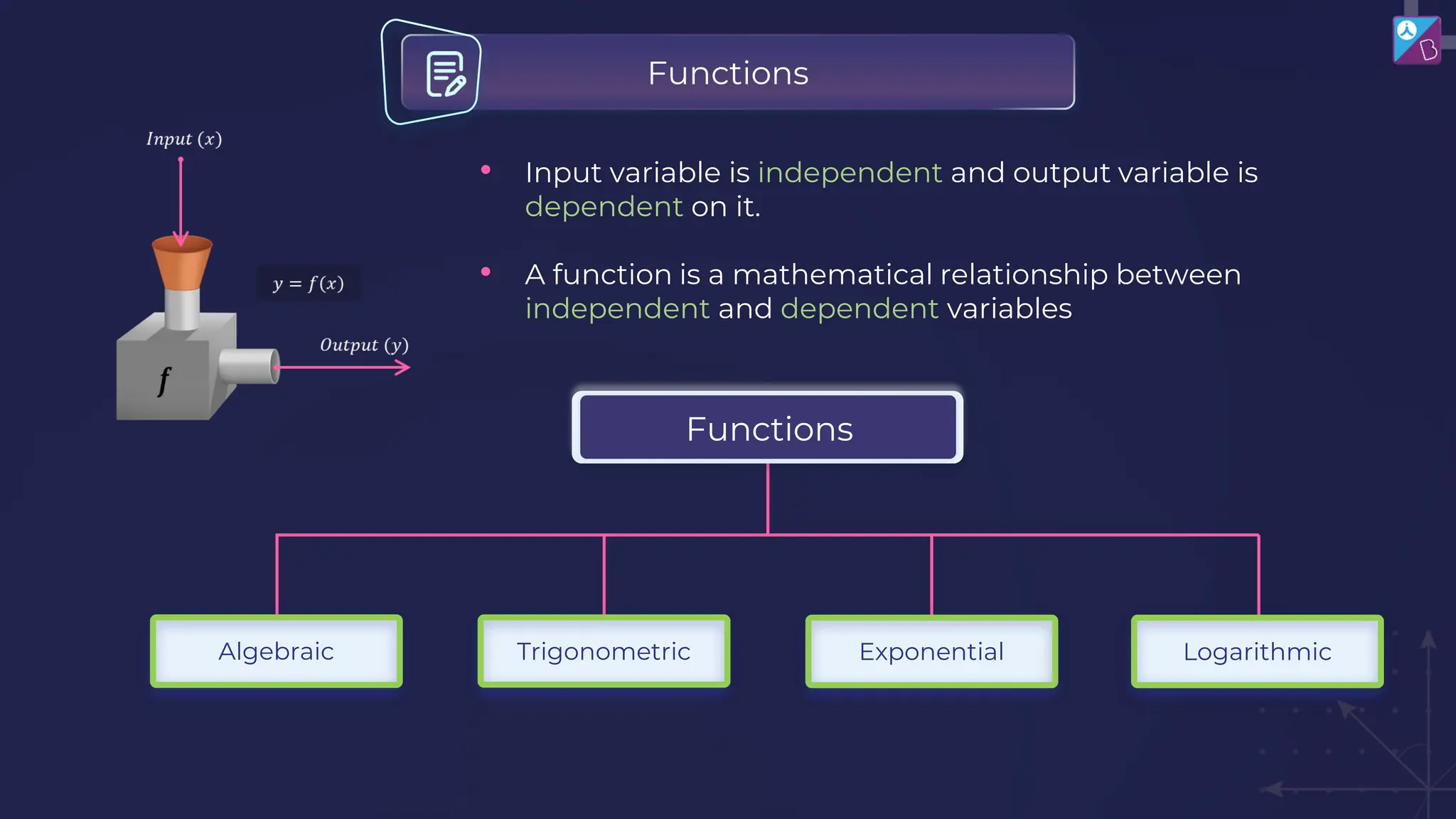
Functions
• Input variable is independent and output variable is
dependent on it.
• A function is a mathematical relationship between
independent and dependent variables
Algebraic Trigonometric Exponential Logarithmic
Functions
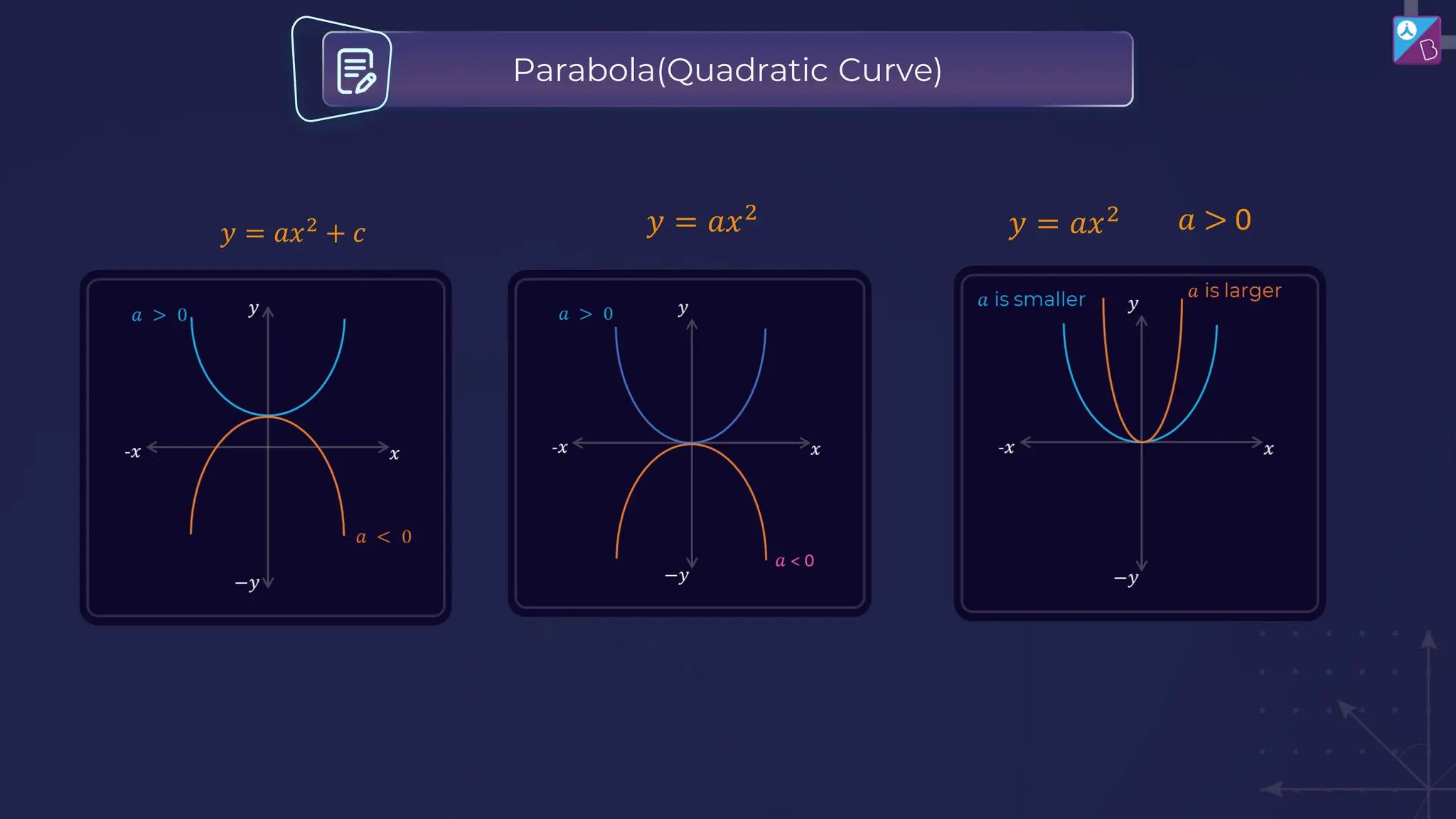
Polynomials
𝑦 = 𝑓 𝑥 = 𝑎0 + 𝑎1𝑥1
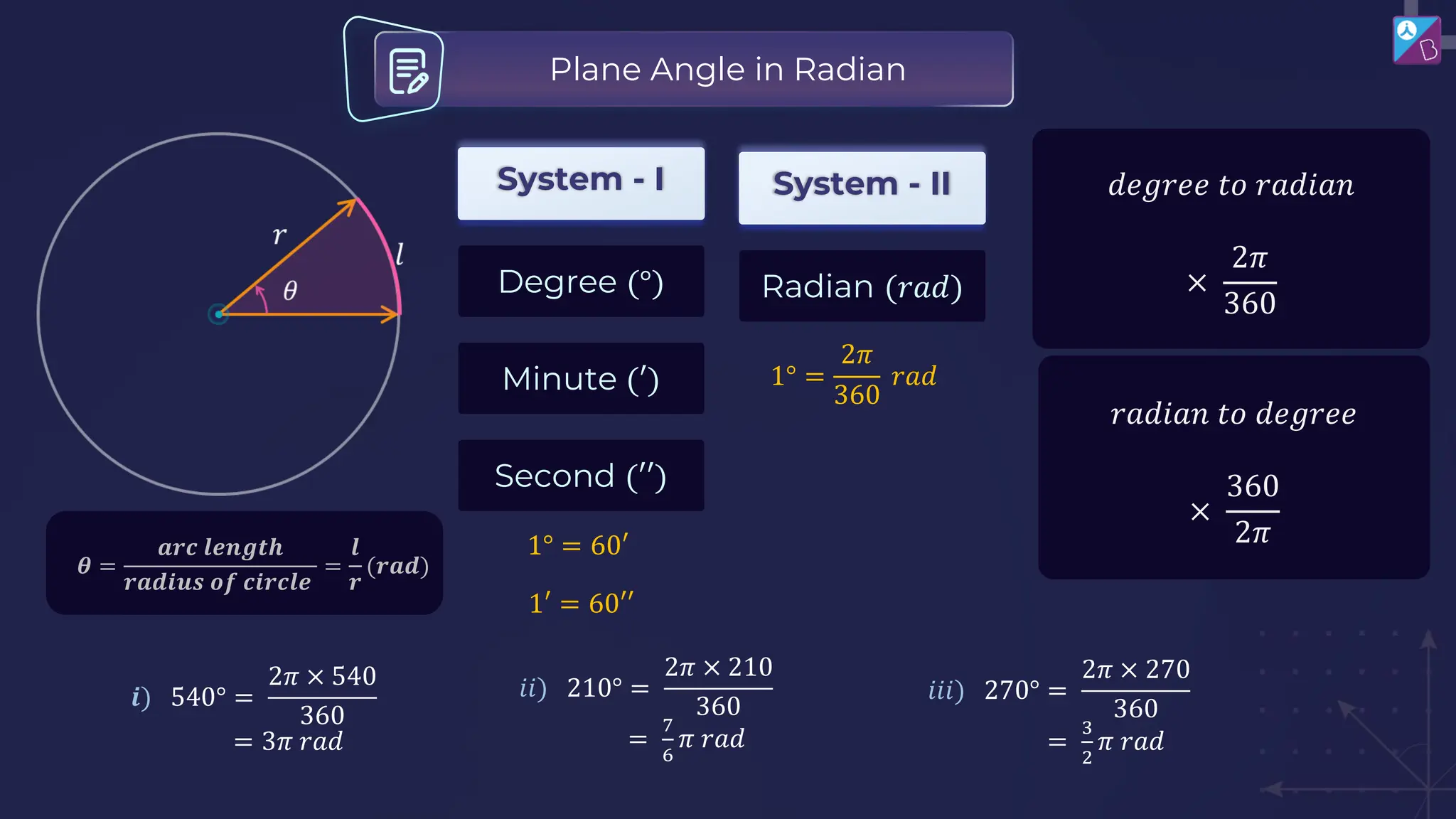
+ 𝑎2𝑥2
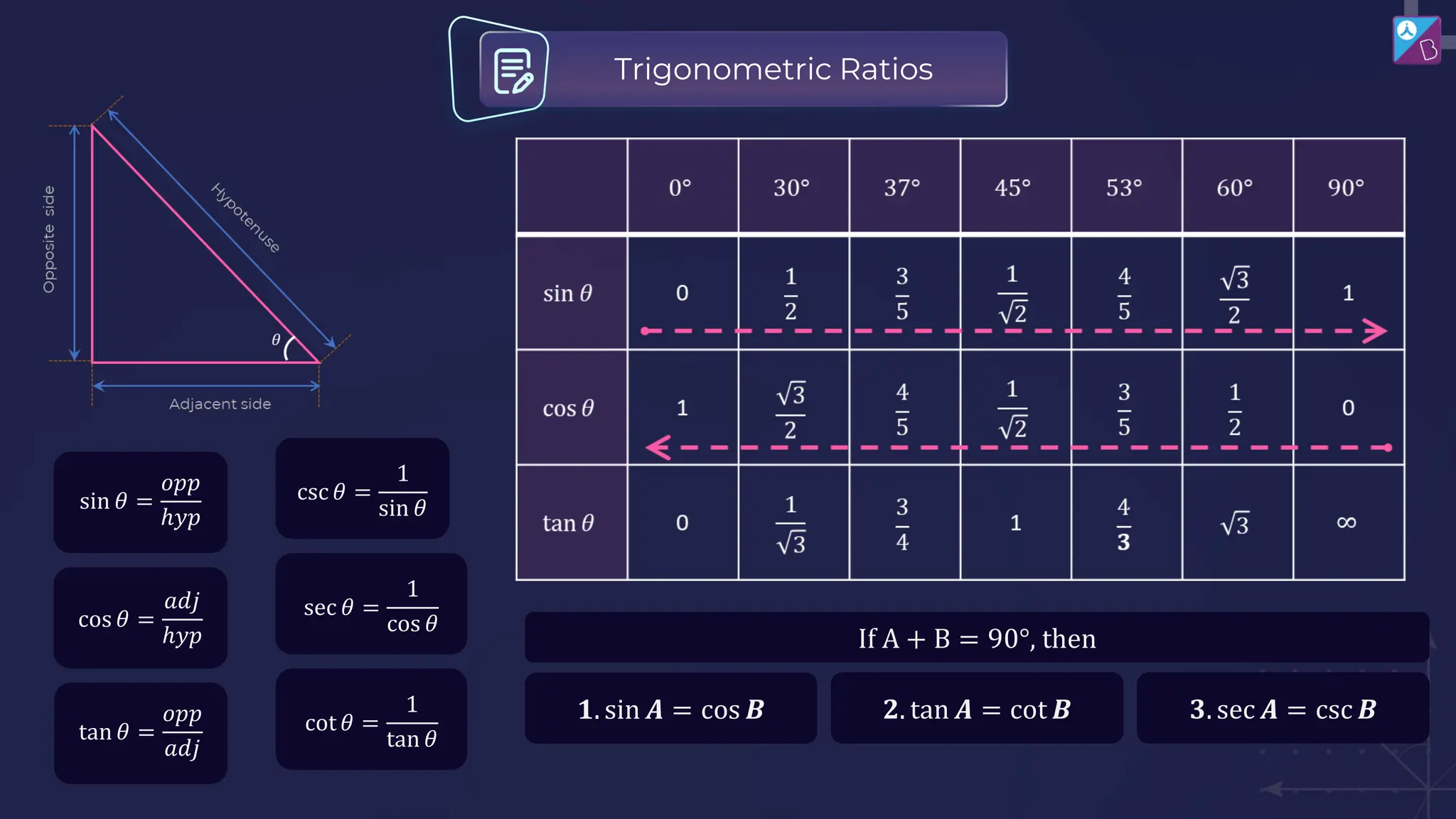
+ 𝑎3𝑥3
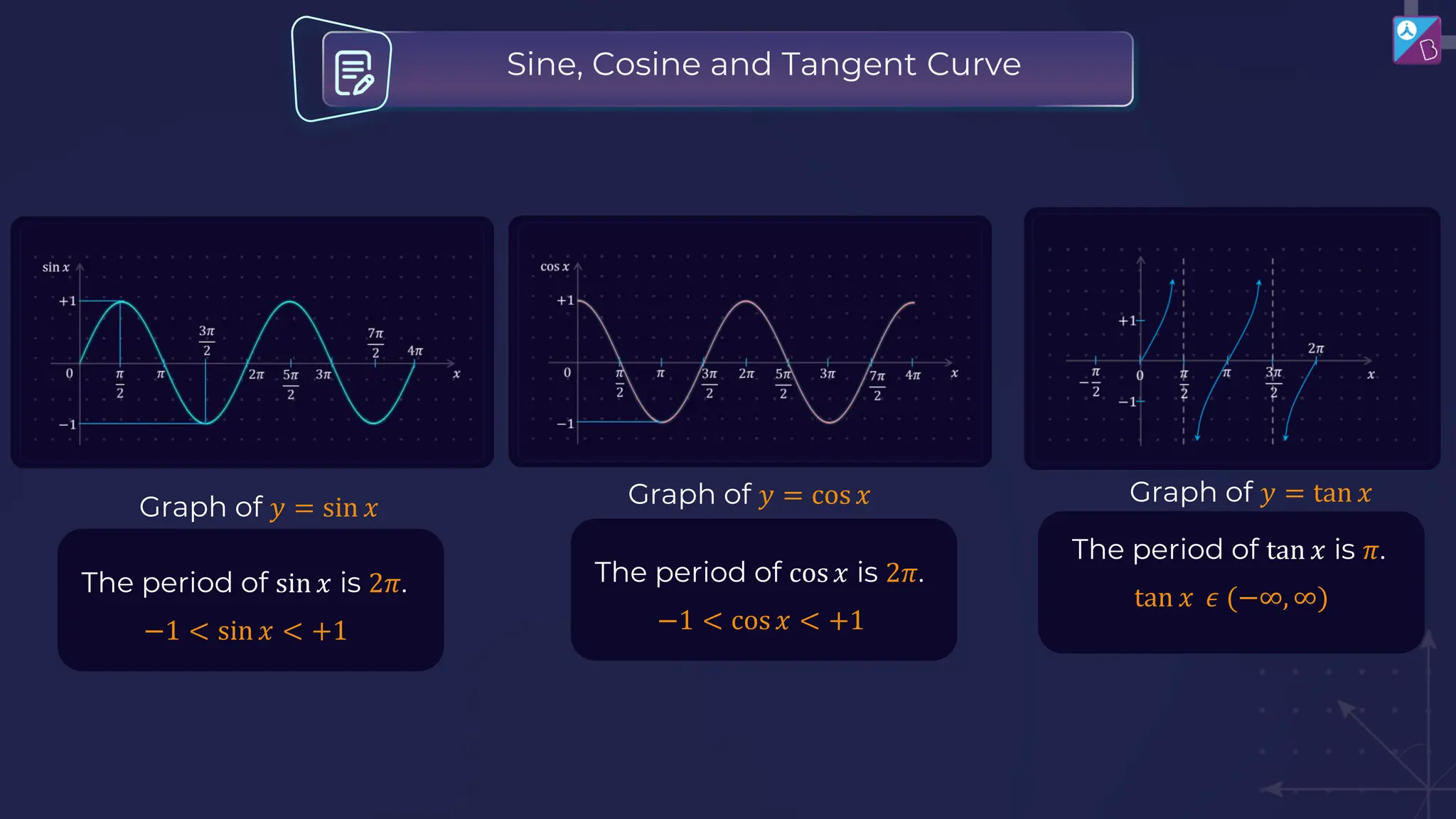
+ … … . 𝑎𝑛𝑥𝑛
Constants
Variables
= =
Degree of a
polynomial
Highest power
Maximum
number
of solutions
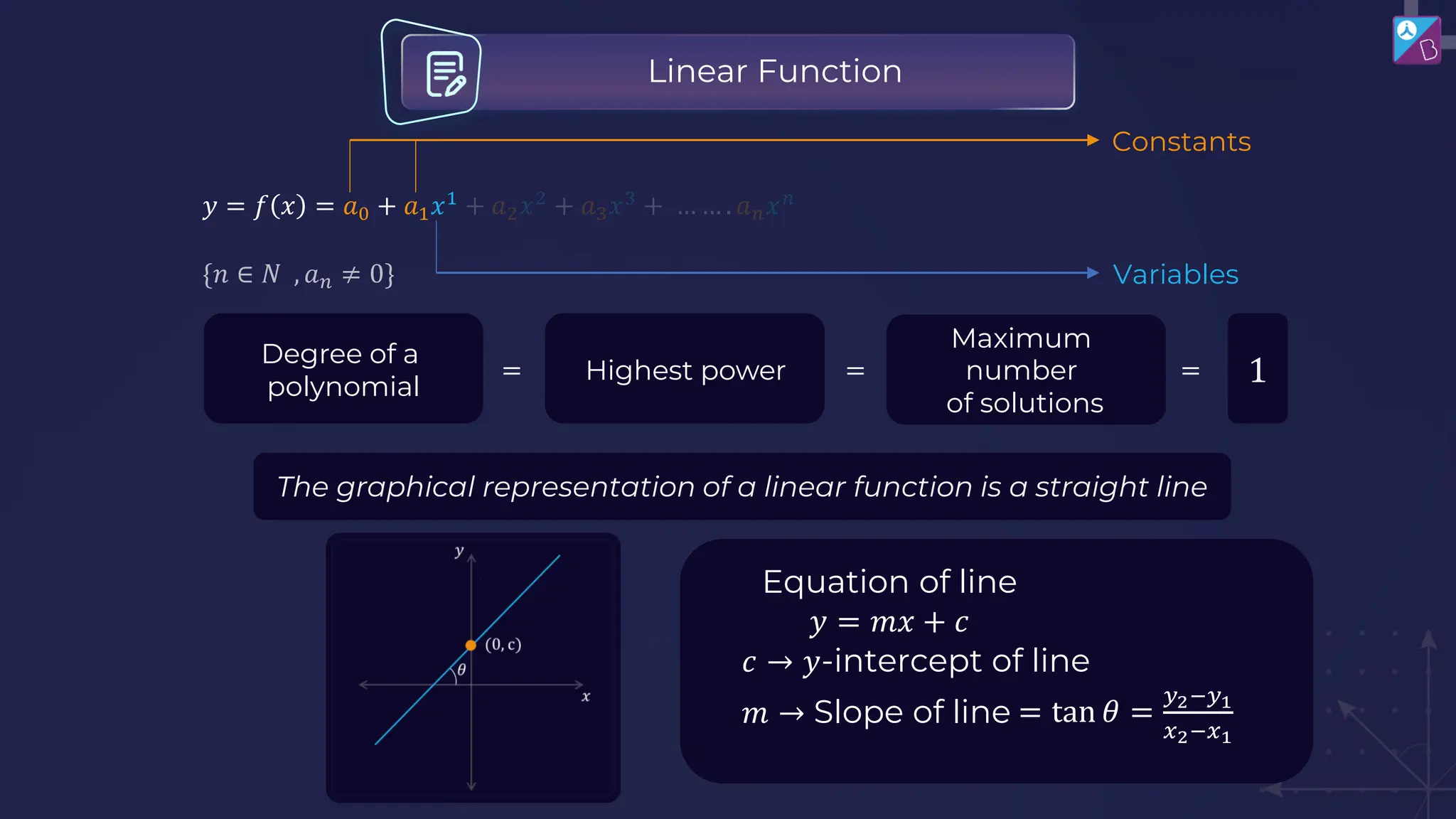
Algebraic Function
The graphical representation of a linear function is a straight line
1
Linear Function
𝑦 = 𝑓 𝑥 = 𝑎0 + 𝑎1𝑥1
Constants
Variables
= = =
Degree of a
polynomial
Highest power
Maximum
number
of solutions
Equation of line
𝑦 = 𝑚𝑥 + 𝑐
𝑐 → 𝑦-intercept of line
= tan 𝜃 =
𝑦2−𝑦1
𝑥2−𝑥1
𝑚 → Slope of line
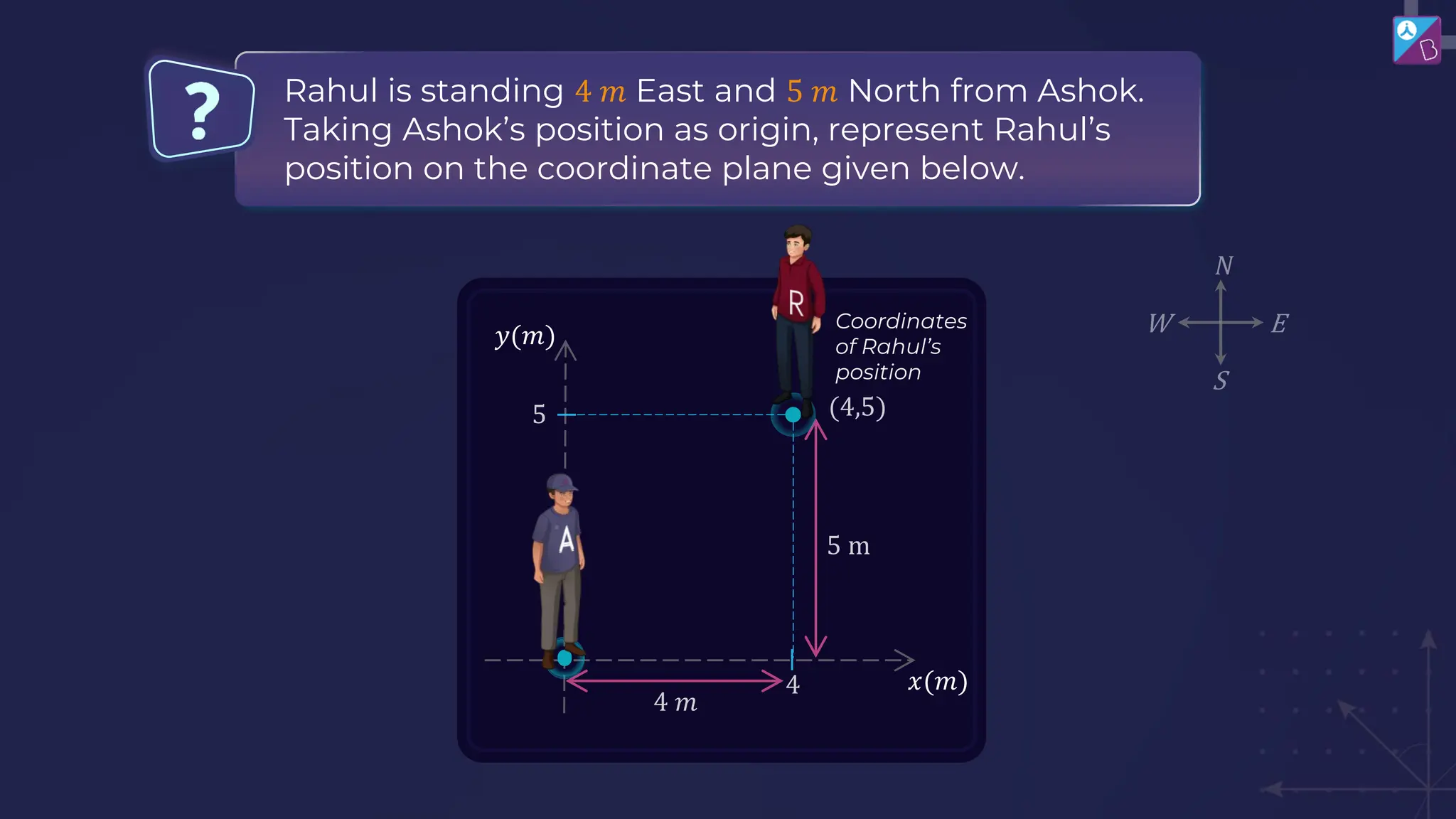
Rahul is standing 4 𝑚 East and 5 𝑚 North from Ashok.
Taking Ashok’s position as origin, represent Rahul’s
position on the coordinate plane given below.
𝑦(𝑚)
𝑥(𝑚)
Coordinates
of Rahul’s
position
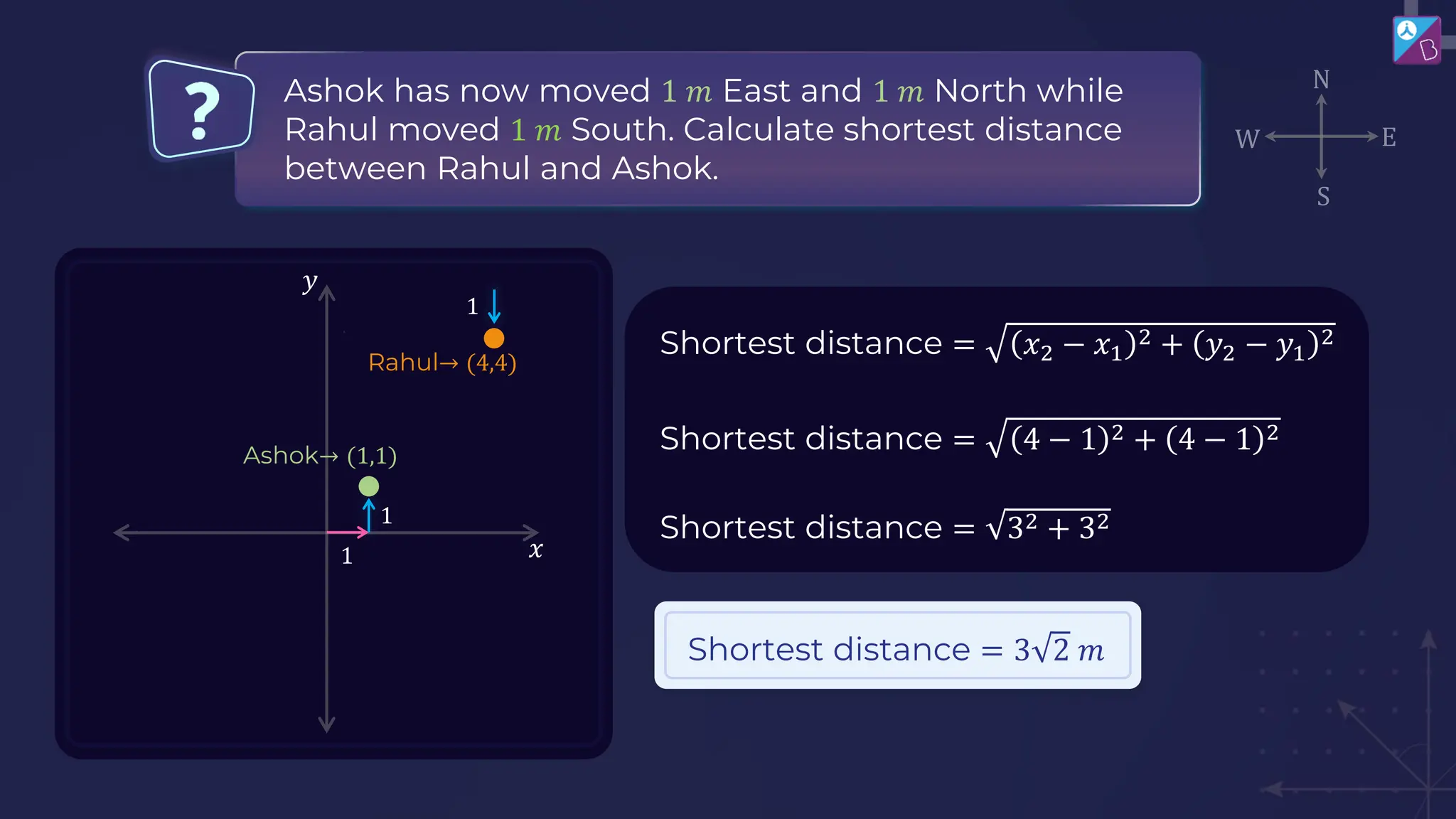
Ashok has now moved 1 𝑚 East and 1 𝑚 North while
Rahul moved 1 𝑚 South. Calculate shortest distance
between Rahul and Ashok.
Shortest distance = 𝑥2 − 𝑥1
2 + 𝑦2 − 𝑦1
2
Shortest distance = 4 − 1 2 + 4 − 1 2
Shortest distance = 32 + 32
Shortest distance = 3 2 𝑚
𝑥
𝑦
1
1
Rahul→ (4,4)
Ashok→ (1,1)
1
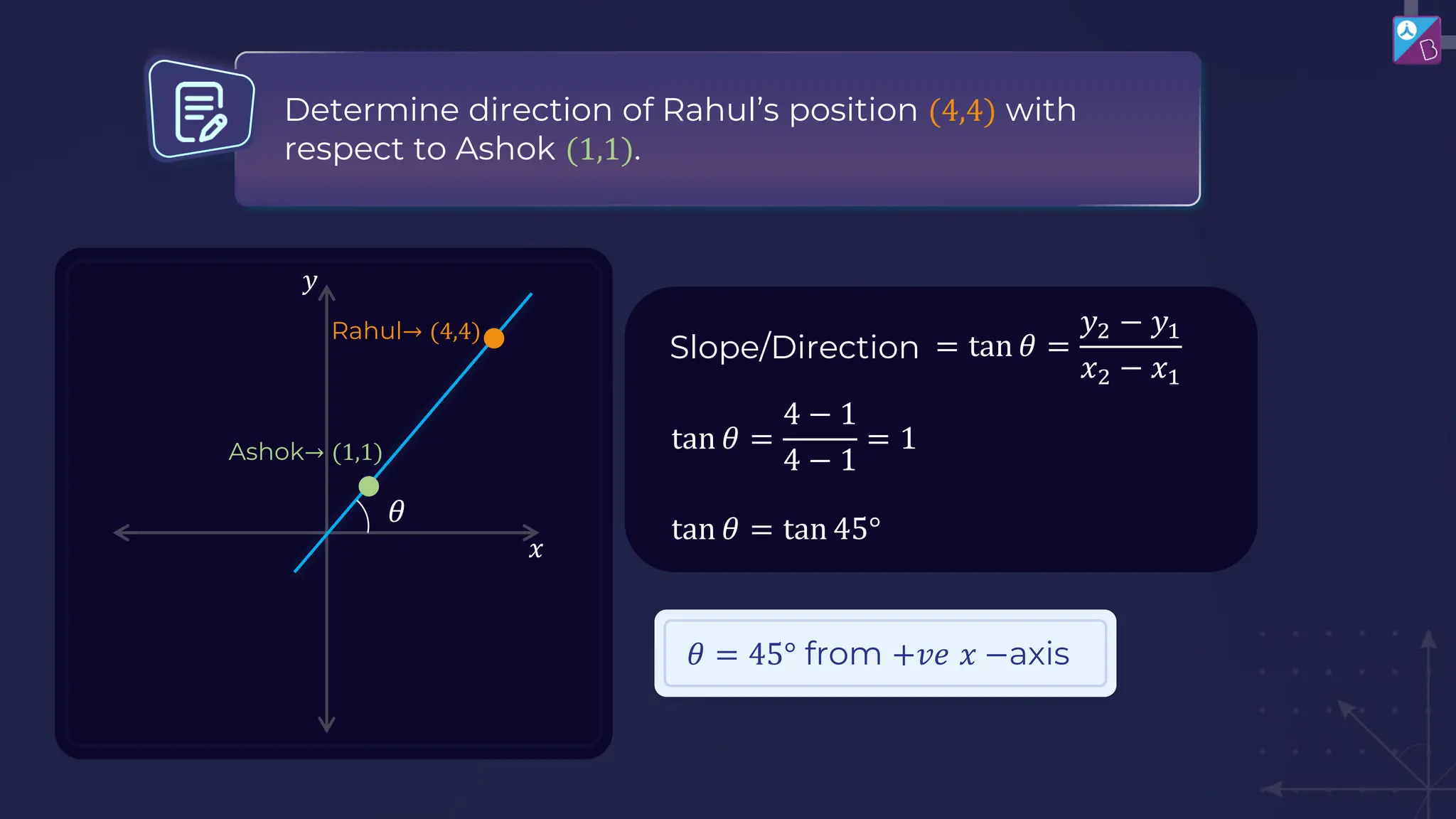
Determine direction of Rahul’s position (4,4) with
respect to Ashok (1,1).
Slope/Direction = tan 𝜃 =
𝑦2 − 𝑦1
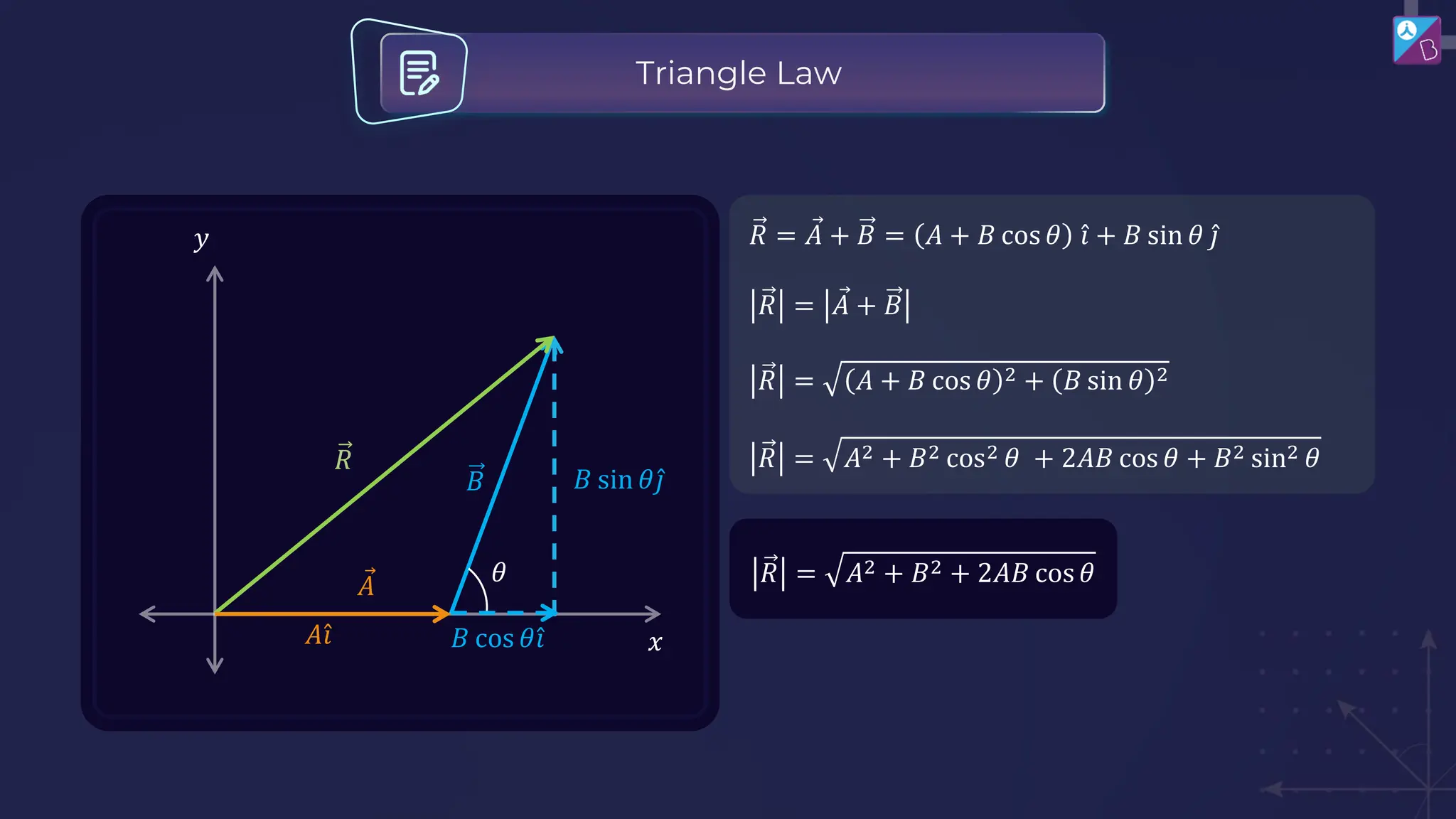
𝑥2 − 𝑥1
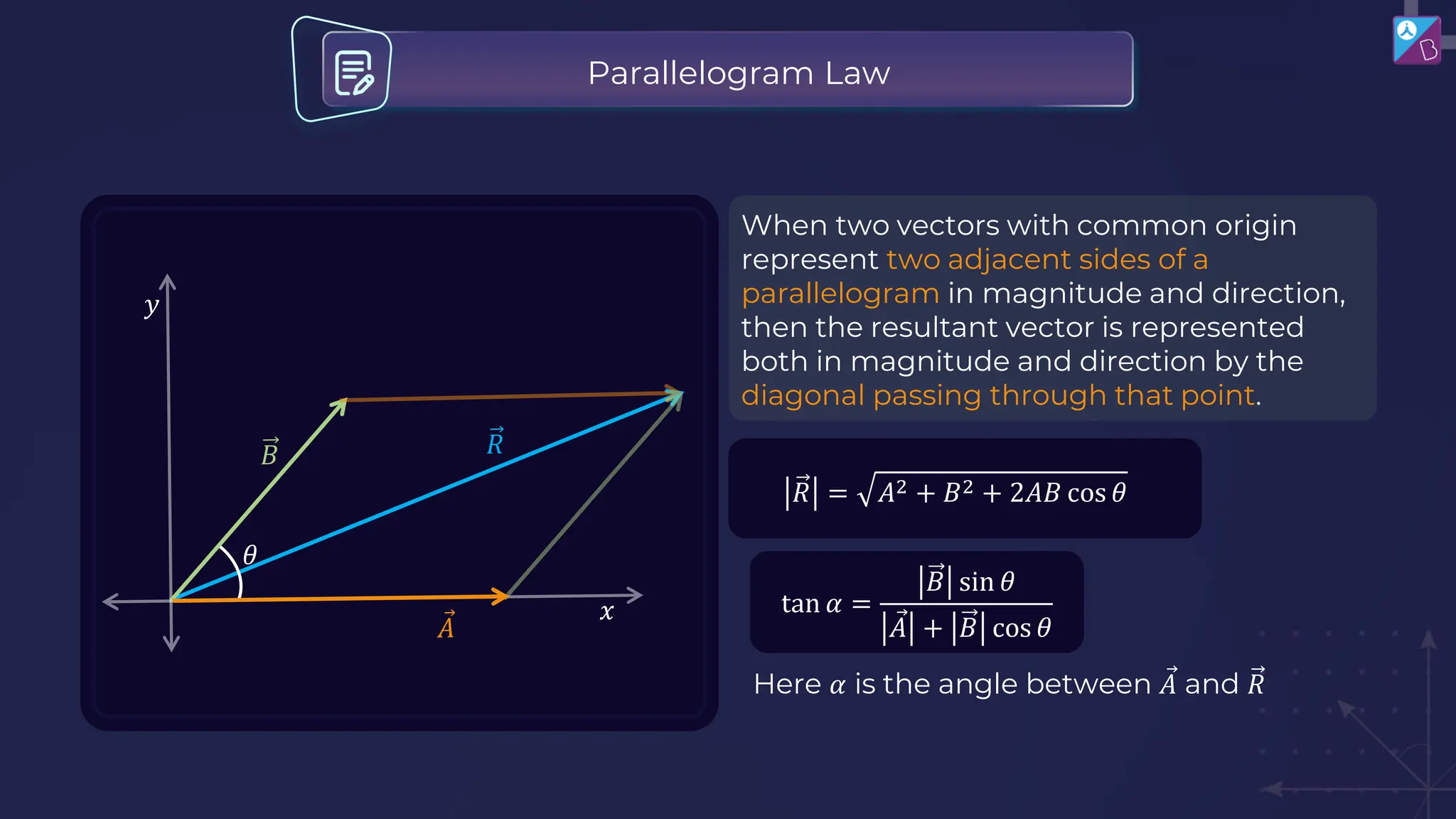
tan 𝜃 =
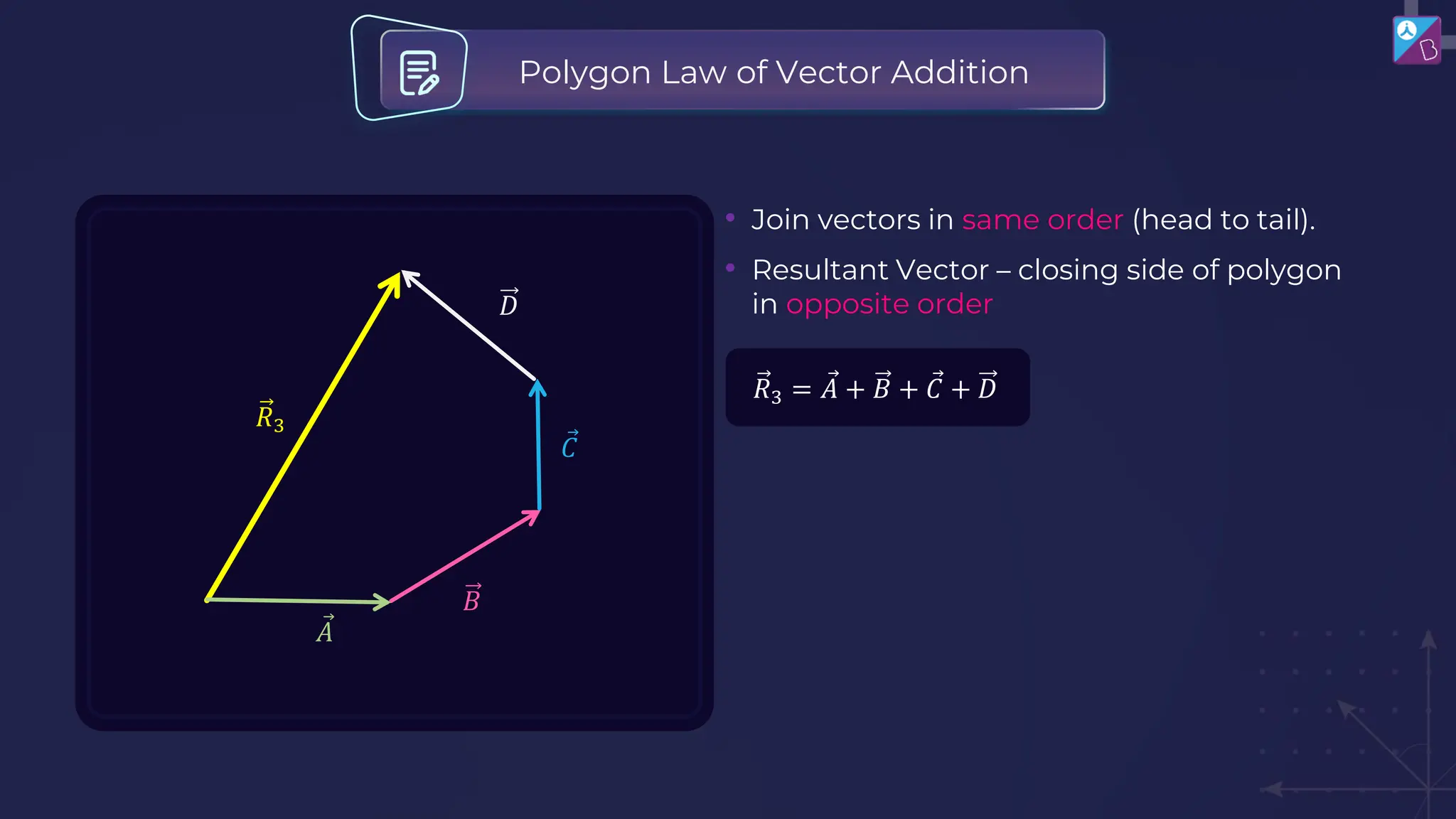
4 − 1
4 − 1
= 1
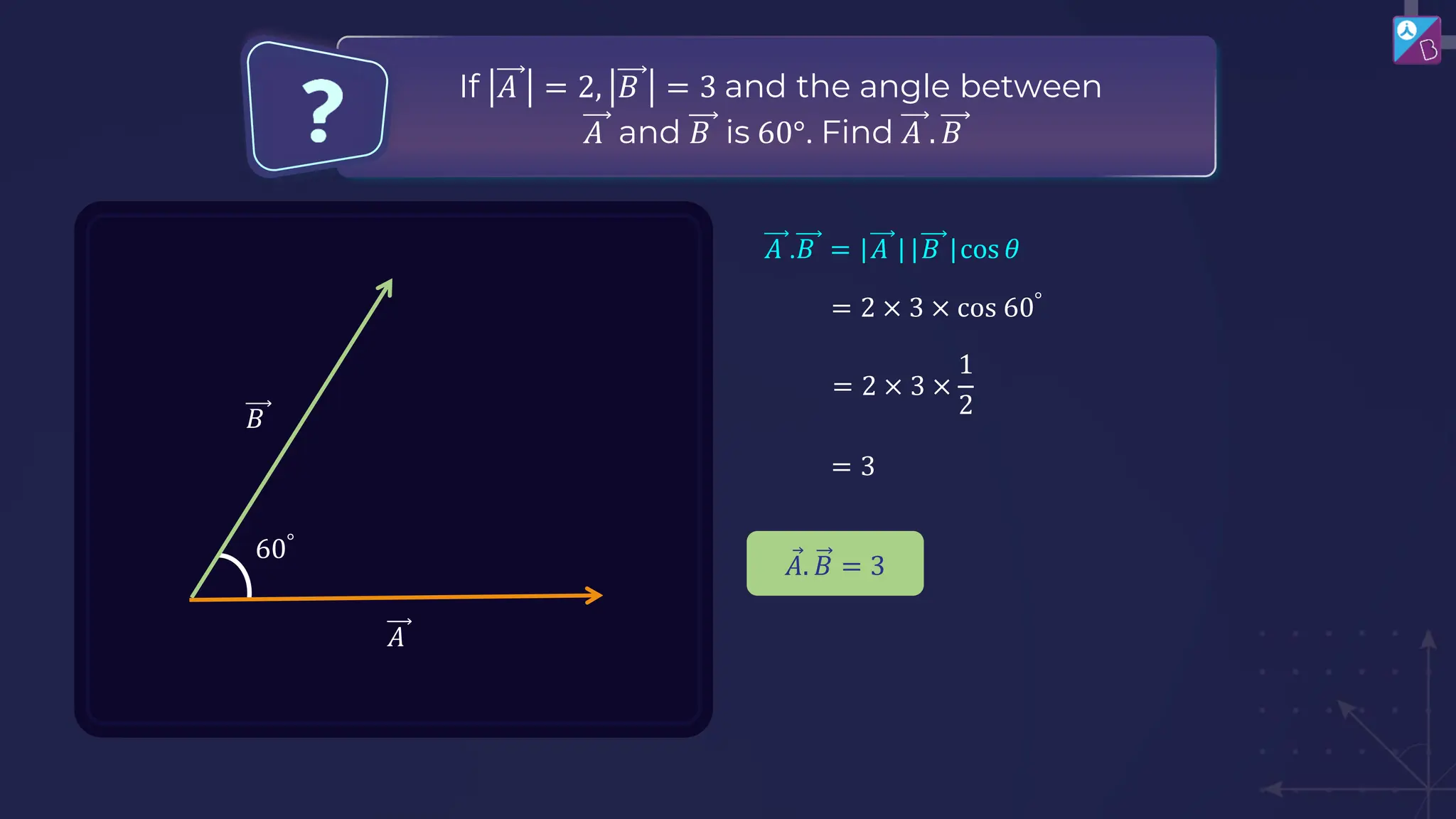
tan 𝜃 = tan 45°
𝜃 = 45° from +𝑣𝑒 𝑥 −axis
𝑥
𝑦
Rahul→ (4,4)
Ashok→ (1,1)
𝜃
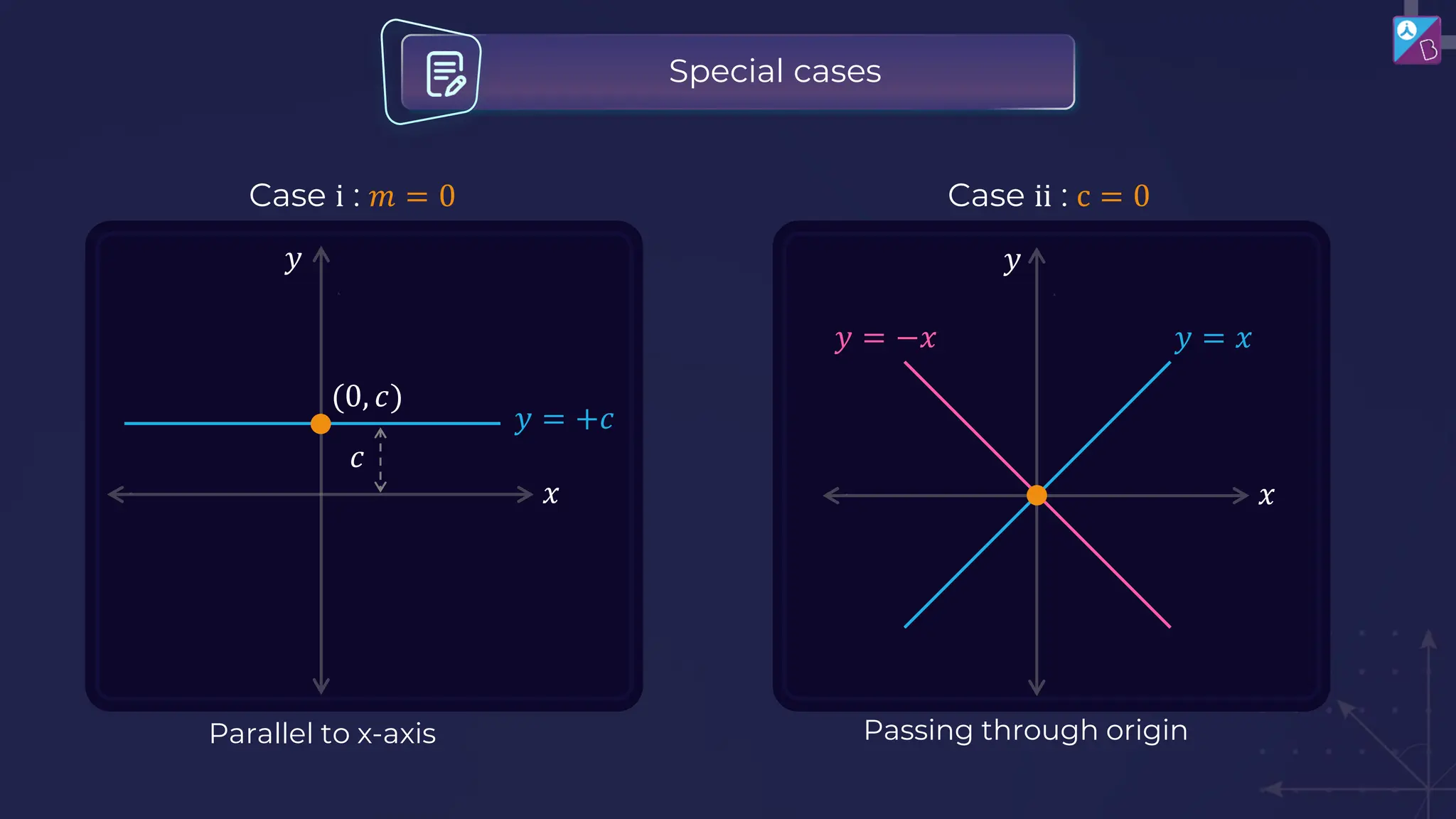
Case ii : c = 0
Passing through origin
𝑥
𝑦 = 𝑥
𝑦 = −𝑥
𝑦
Case i : 𝑚 = 0
Parallel to x-axis
𝑦 = +𝑐
(0, 𝑐)
𝑦
𝑥
𝑐
Special cases
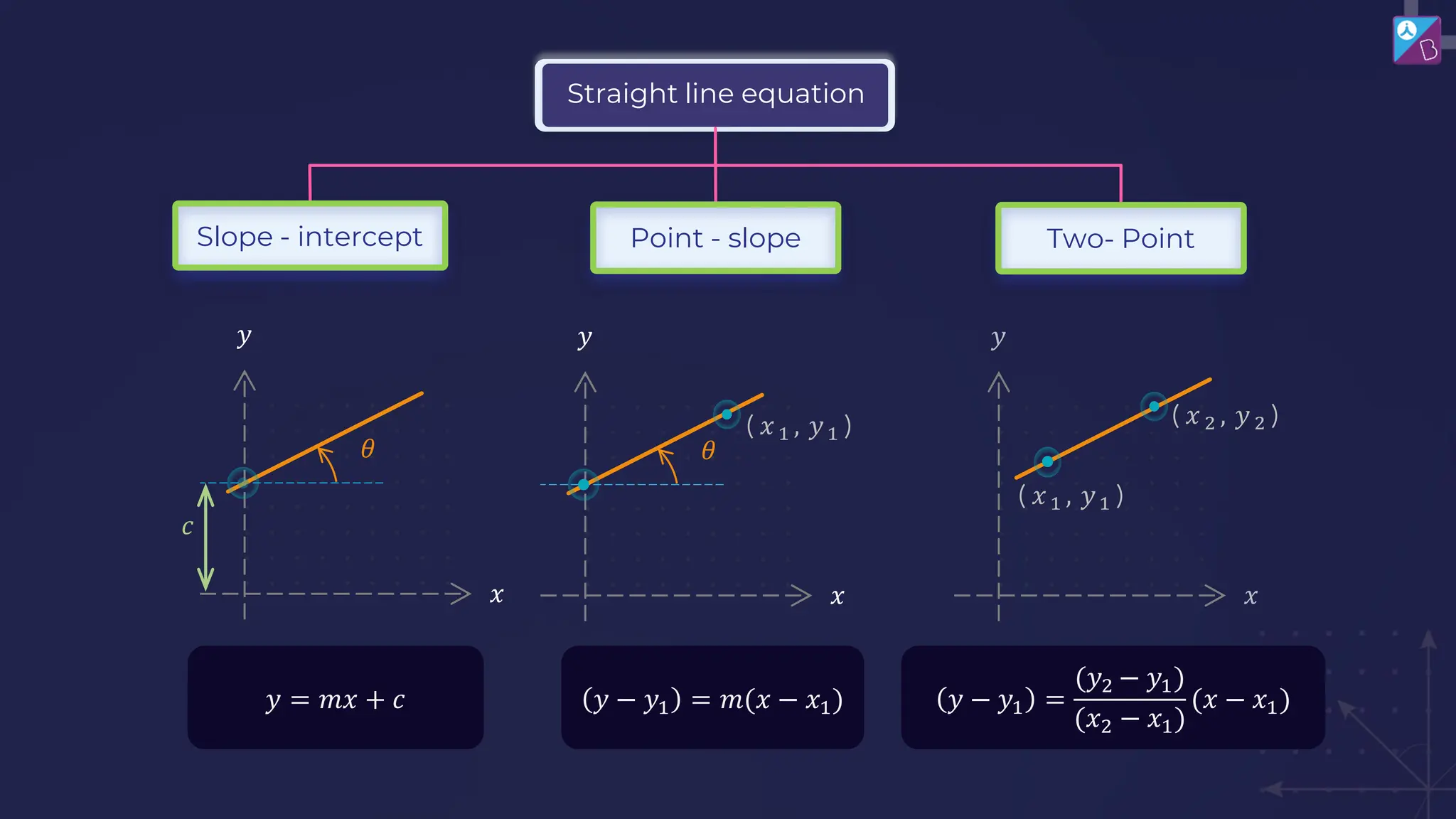
𝑦 = 𝑚𝑥 + 𝑐
Straight line equation
Slope - intercept
𝑥
𝑦
𝜃
𝑐
𝑦 − 𝑦1 = 𝑚(𝑥 − 𝑥1)
Point - slope
𝑥
𝑦
𝜃
( 𝑥1 , 𝑦1 )
𝑦 − 𝑦1 =
(𝑦2 − 𝑦1)
(𝑥2 − 𝑥1)
(𝑥 − 𝑥1)
( 𝑥 2 , 𝑦2 )
( 𝑥1 , 𝑦1 )
Two- Point
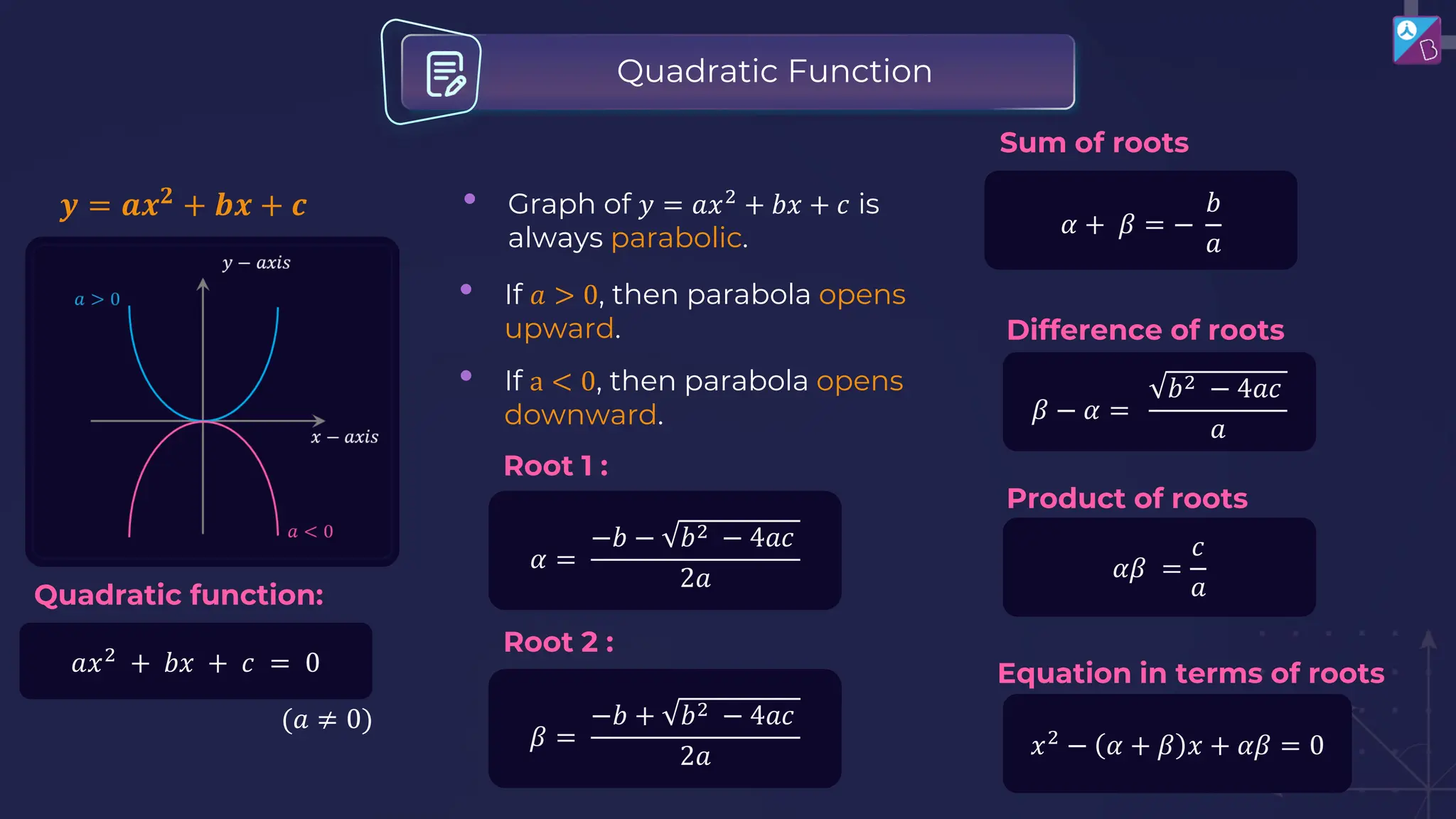
𝒚 = 𝒂𝒙𝟐
+ 𝒃𝒙 + 𝒄
(𝑎 ≠ 0)
• Graph of 𝑦 = 𝑎𝑥2
+ 𝑏𝑥 + 𝑐 is
always parabolic.
• If 𝑎 > 0, then parabola opens
upward.
• If a < 0, then parabola opens
downward.
Quadratic function:
Root 1 :
Root 2 :
𝛼 =
−𝑏 − 𝑏2 − 4𝑎𝑐
2𝑎
𝛽 =
−𝑏 + 𝑏2 − 4𝑎𝑐
2𝑎
𝑎𝑥2
+ 𝑏𝑥 + 𝑐 = 0
Sum of roots
Difference of roots
Product of roots
𝛼 + 𝛽 = −
𝑏
𝑎
𝛽 − 𝛼 =
𝑏2 − 4𝑎𝑐
𝑎
𝛼𝛽 =
𝑐
𝑎
Equation in terms of roots
𝑥2
− 𝛼 + 𝛽 𝑥 + 𝛼𝛽 = 0
Quadratic Function
𝑦 = 𝑎𝑥2
+ 𝑐
Parabola(Quadratic Curve)
𝑦 = 𝑎𝑥2
𝑦 = 𝑎𝑥2 𝑎 > 0
Plane Angle in Radian
𝜽 =
𝒂𝒓𝒄 𝒍𝒆𝒏𝒈𝒕𝒉
𝒓𝒂𝒅𝒊𝒖𝒔 𝒐𝒇 𝒄𝒊𝒓𝒄𝒍𝒆
=
𝒍
𝒓
(𝒓𝒂𝒅)
System - I
Degree (°)
Minute (′)
Second (′′)
System - II
Radian (𝑟𝑎𝑑)
1° = 60′
1′ = 60′′
1° =
2𝜋
360
𝑟𝑎𝑑
𝒊) 540° =
2𝜋 × 540
360
= 3𝜋 𝑟𝑎𝑑
𝑑𝑒𝑔𝑟𝑒𝑒 𝑡𝑜 𝑟𝑎𝑑𝑖𝑎𝑛
×
2𝜋
360
𝑟𝑎𝑑𝑖𝑎𝑛 𝑡𝑜 𝑑𝑒𝑔𝑟𝑒𝑒
×
360
2𝜋
𝑖𝑖) 210° =
2𝜋 × 210
360
=
7
6
𝜋 𝑟𝑎𝑑
𝑖𝑖𝑖) 270° =
2𝜋 × 270
360
=
3
2
𝜋 𝑟𝑎𝑑
Trigonometric Ratios
csc 𝜃 =
1
sin 𝜃
sec 𝜃 =
1
cos 𝜃
cot 𝜃 =
1
tan 𝜃
sin 𝜃 =
𝑜𝑝𝑝
ℎ𝑦𝑝
cos 𝜃 =
𝑎𝑑𝑗
ℎ𝑦𝑝
tan 𝜃 =
𝑜𝑝𝑝
𝑎𝑑𝑗
If A + B = 90°, then
𝟏. sin 𝑨 = cos 𝑩 𝟐. tan 𝑨 = cot 𝑩 𝟑. sec 𝑨 = csc 𝑩
Sine, Cosine and Tangent Curve
Graph of 𝑦 = sin 𝑥
The period of sin 𝑥 is 2𝜋.
−1 < sin 𝑥 < +1
Graph of 𝑦 = cos 𝑥
The period of cos 𝑥 is 2𝜋.
−1 < cos 𝑥 < +1
Graph of 𝑦 = tan 𝑥
The period of tan 𝑥 is 𝜋.
tan 𝑥 𝜖 (−∞, ∞)
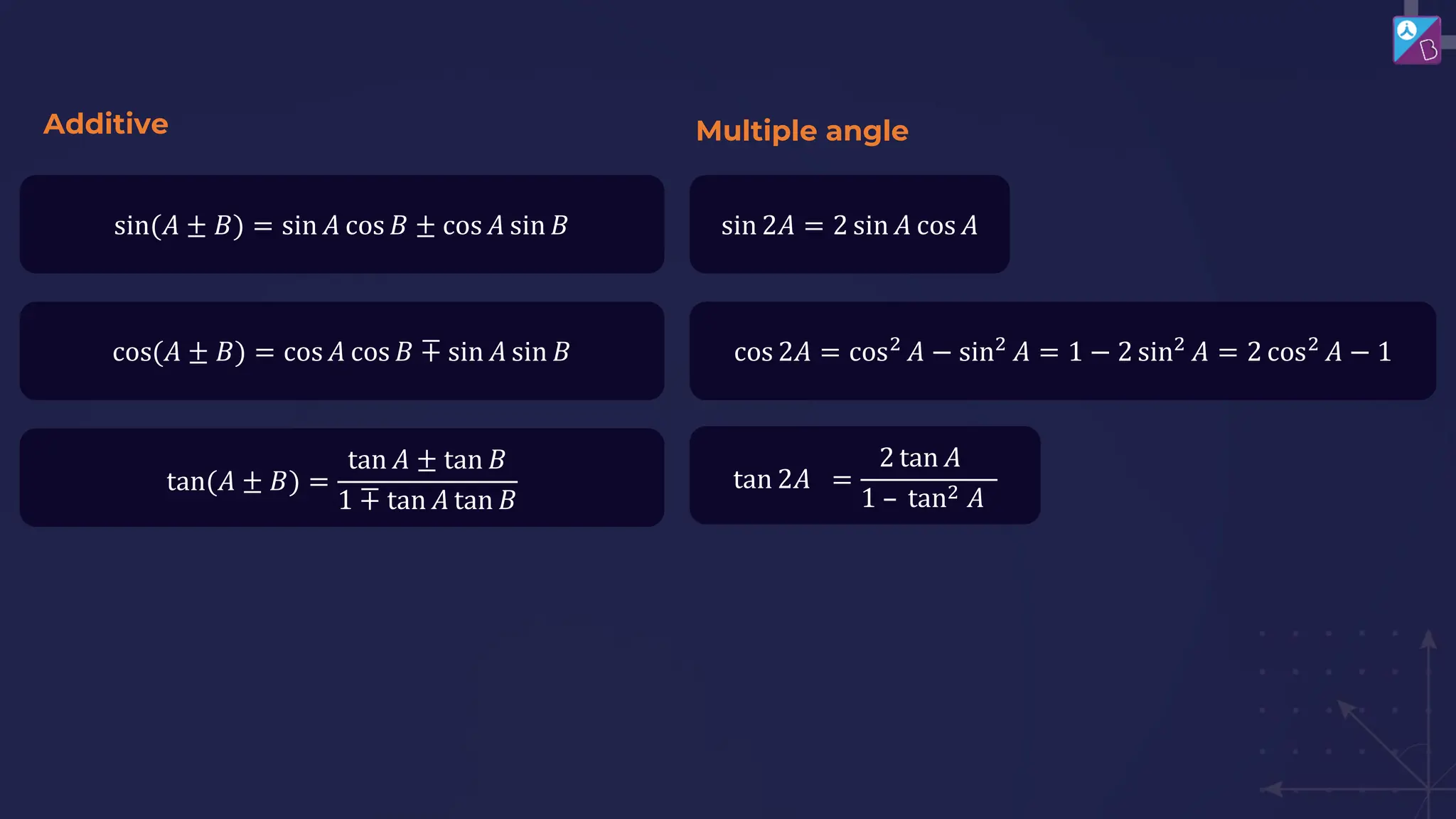
sin(𝐴 ± 𝐵) = sin 𝐴 cos 𝐵 ± cos 𝐴 sin 𝐵
cos(𝐴 ± 𝐵) = cos 𝐴 cos 𝐵 ∓ sin 𝐴 sin 𝐵
tan(𝐴 ± 𝐵) =
tan 𝐴 ± tan 𝐵
1 ∓ tan 𝐴 tan 𝐵
Additive Multiple angle
sin 2𝐴 = 2 sin 𝐴 cos 𝐴
cos 2𝐴 = cos2
𝐴 − sin2
𝐴 = 1 − 2 sin2
𝐴 = 2 cos2
𝐴 − 1
tan 2𝐴 =
2 tan 𝐴
1 – tan2 𝐴
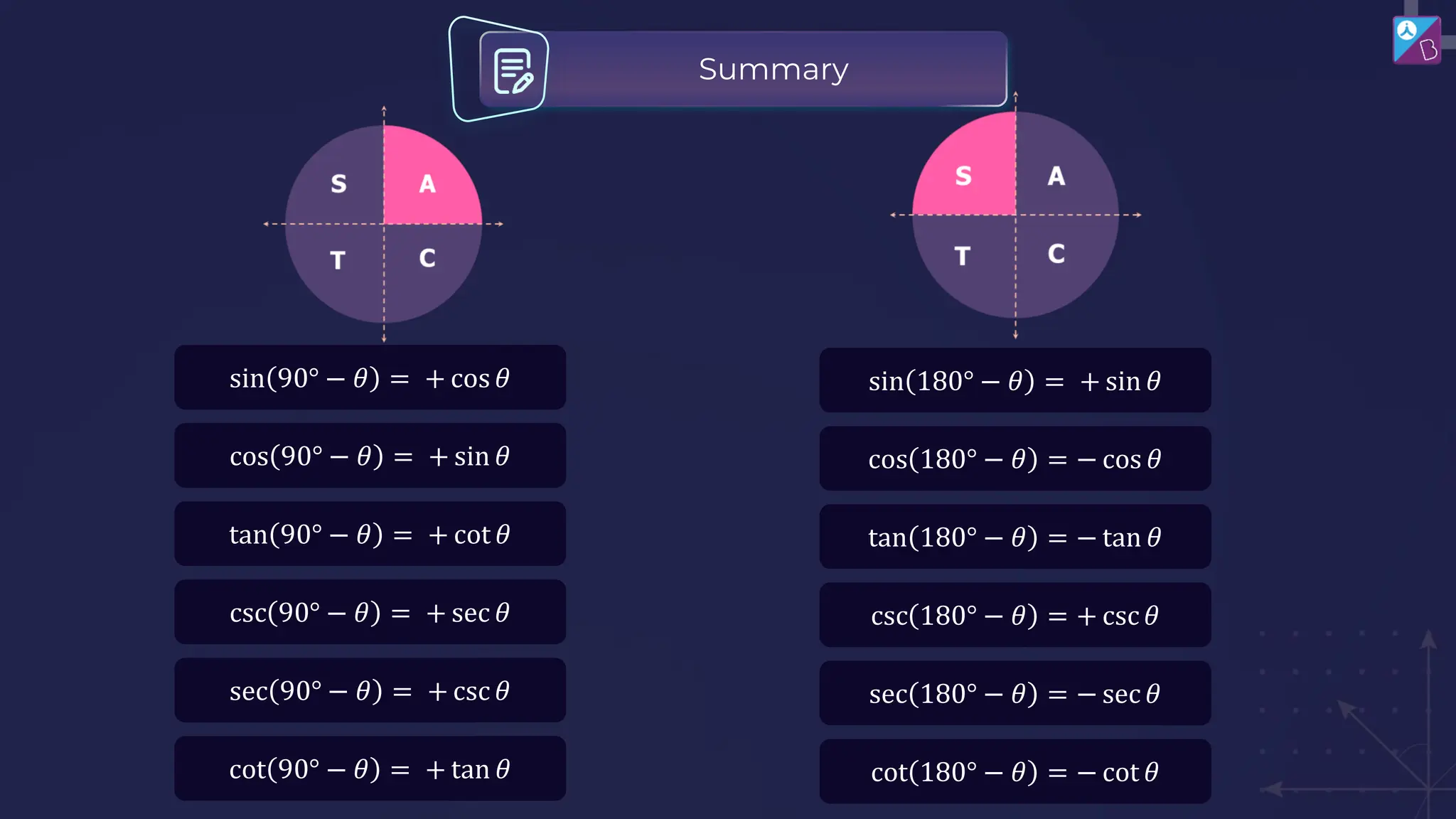
sin 90° − 𝜃 = + cos 𝜃
cos 90° − 𝜃 = + sin 𝜃
tan 90° − 𝜃 = + cot 𝜃
csc 90° − 𝜃 = + sec 𝜃
sec 90° − 𝜃 = + csc 𝜃
cot 90° − 𝜃 = + tan 𝜃
sin 180° − 𝜃 = + sin 𝜃
cos 180° − 𝜃 = − cos 𝜃
tan 180° − 𝜃 = − tan 𝜃
csc 180° − 𝜃 = + csc𝜃
sec 180° − 𝜃 = − sec 𝜃
cot 180° − 𝜃 = − cot 𝜃
Summary
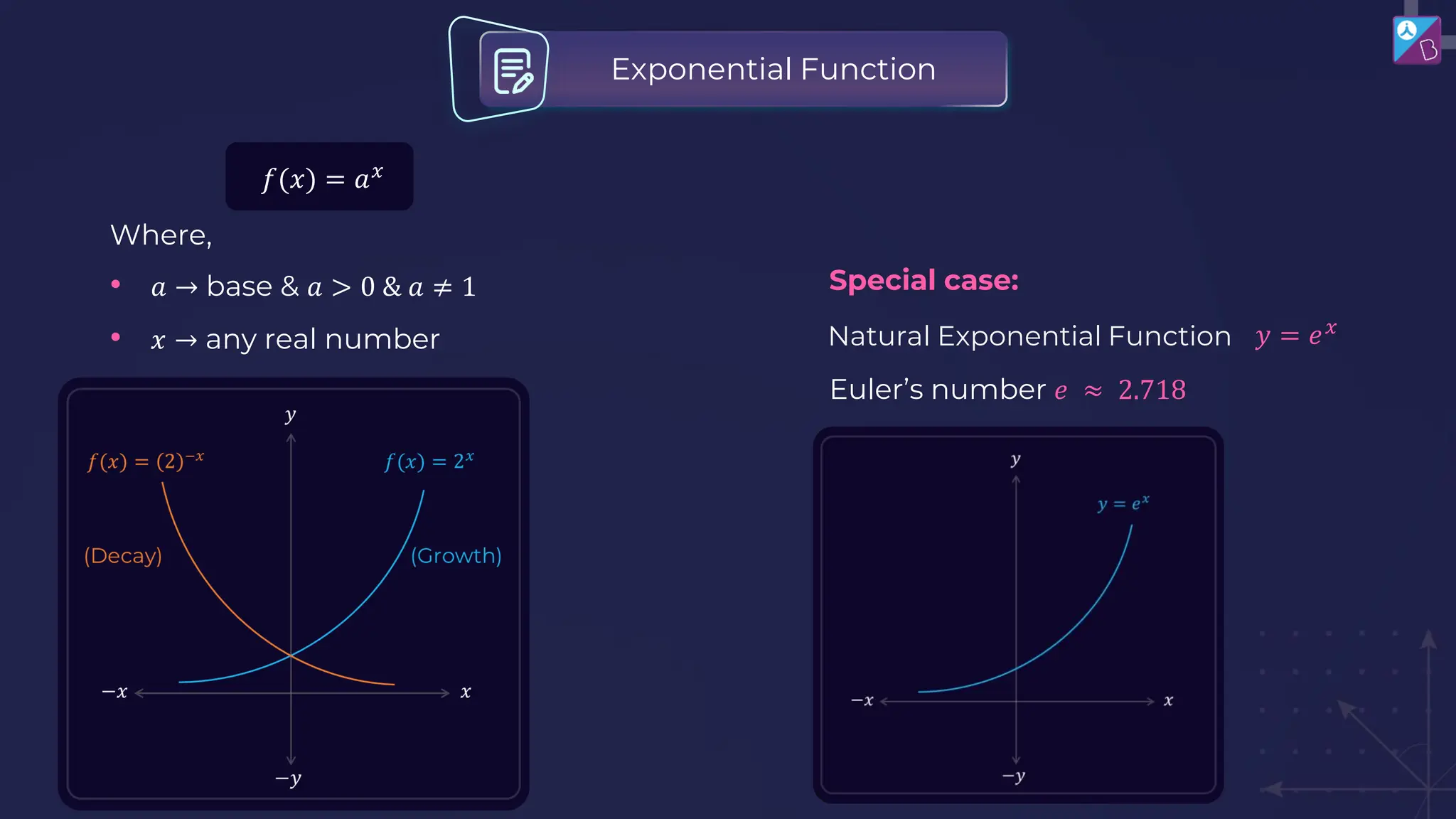
𝑓(𝑥) = 𝑎𝑥
Where,
• 𝑎 → base & 𝑎 > 0 & 𝑎 ≠ 1
• 𝑥 → any real number 𝑦 = 𝑒𝑥
Euler’s number 𝑒 ≈ 2.718
Special case:
Natural Exponential Function
Exponential Function
• y = log𝑎 𝑥 is logarithmic function where 𝑎 > 0 and 𝑎 ≠ 1
• Product Rule : log𝑎 𝑚𝑛 = log𝑎 𝑚 + log𝑎 𝑛
• Quotient Rule : log𝑎
𝑚
𝑛
= log𝑎 𝑚 − log𝑎 𝑛
• Power Rule : log𝑎 𝑚𝑛
= 𝑛 log𝑎 𝑚
• log𝑎 1 = 0
• log𝑎 0 = 𝑢𝑛𝑑𝑒𝑓𝑖𝑛𝑒𝑑
• log𝑎 𝑎 = 1
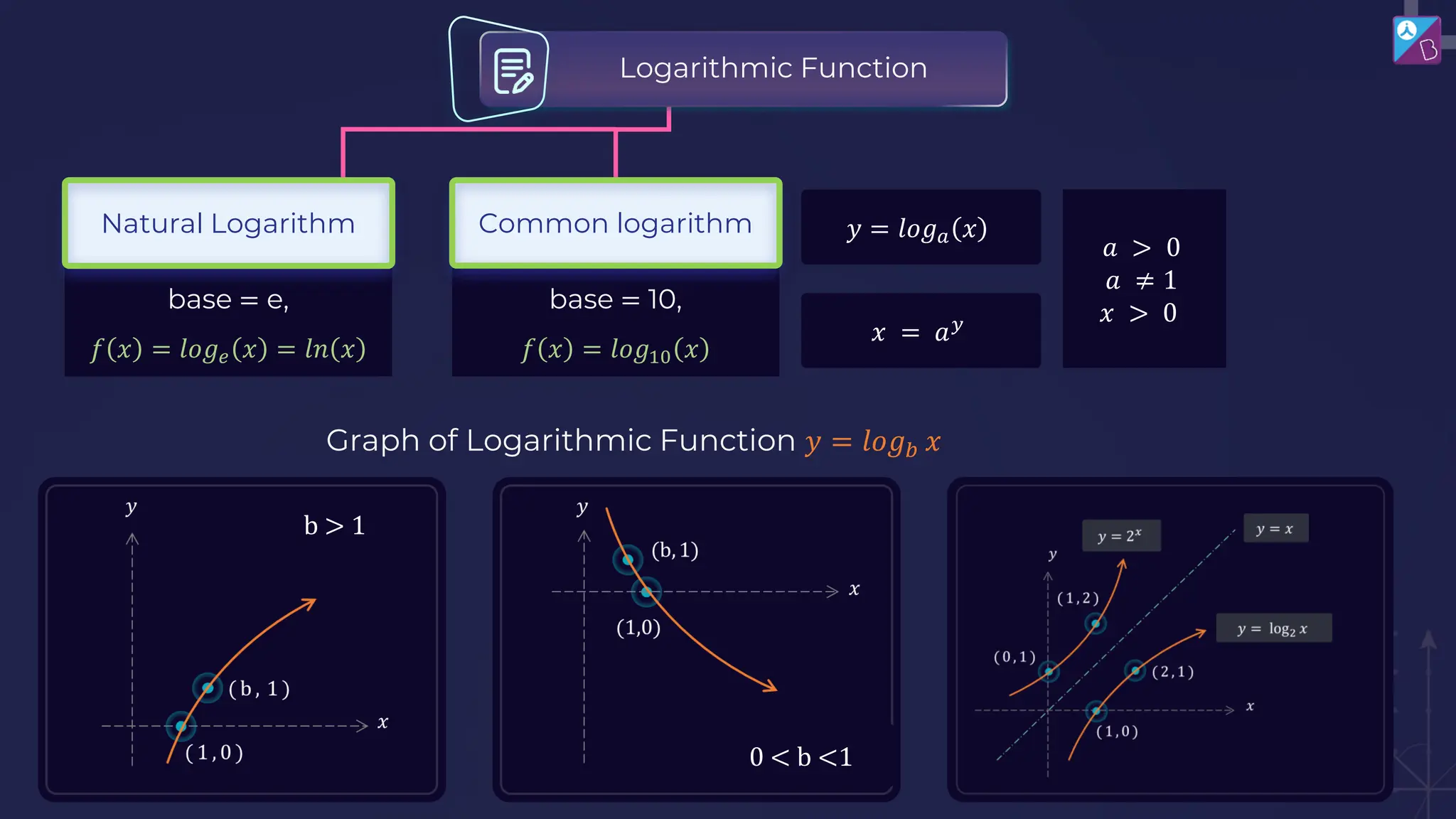
Logarithmic Function
base = e,
𝑓 𝑥 = 𝑙𝑜𝑔𝑒 𝑥 = 𝑙𝑛 𝑥
base = 10,
𝑓 𝑥 = 𝑙𝑜𝑔10 𝑥
𝑎 > 0
𝑎 ≠ 1
𝑥 > 0
𝑦 = 𝑙𝑜𝑔𝑎 𝑥
𝑥 = 𝑎𝑦
Common logarithm
Natural Logarithm
Graph of Logarithmic Function 𝑦 = 𝑙𝑜𝑔𝑏 𝑥
b > 1
0 < b <1
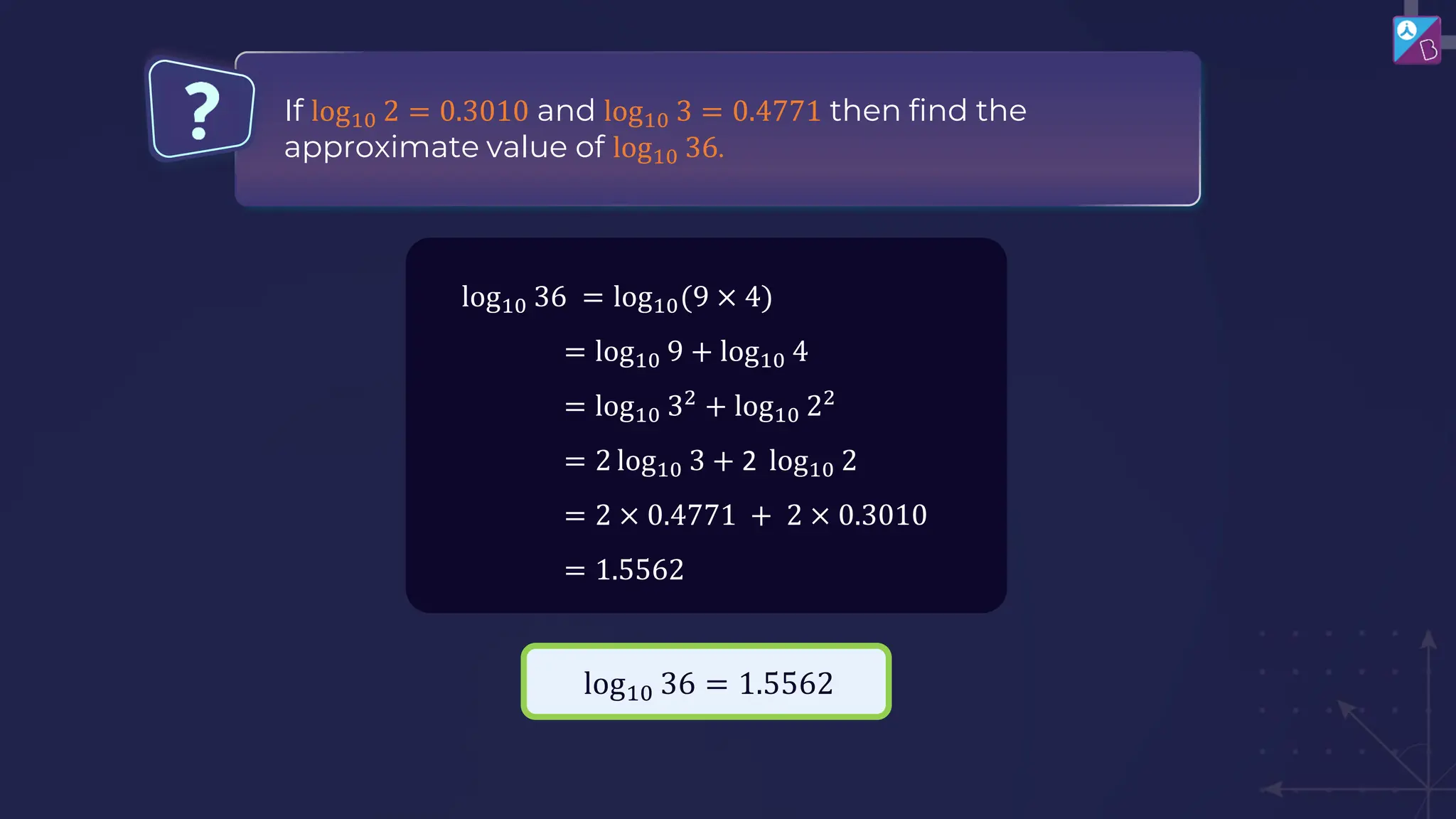
If log10 2 = 0.3010 and log10 3 = 0.4771 then find the
approximate value of log10 36.
log10 36 = log10(9 × 4)
= log10 9 + log10 4
= log10 32
+ log10 22
= 2 log10 3 + 2 log10 2
= 2 × 0.4771 + 2 × 0.3010
= 1.5562
log10 36 = 1.5562
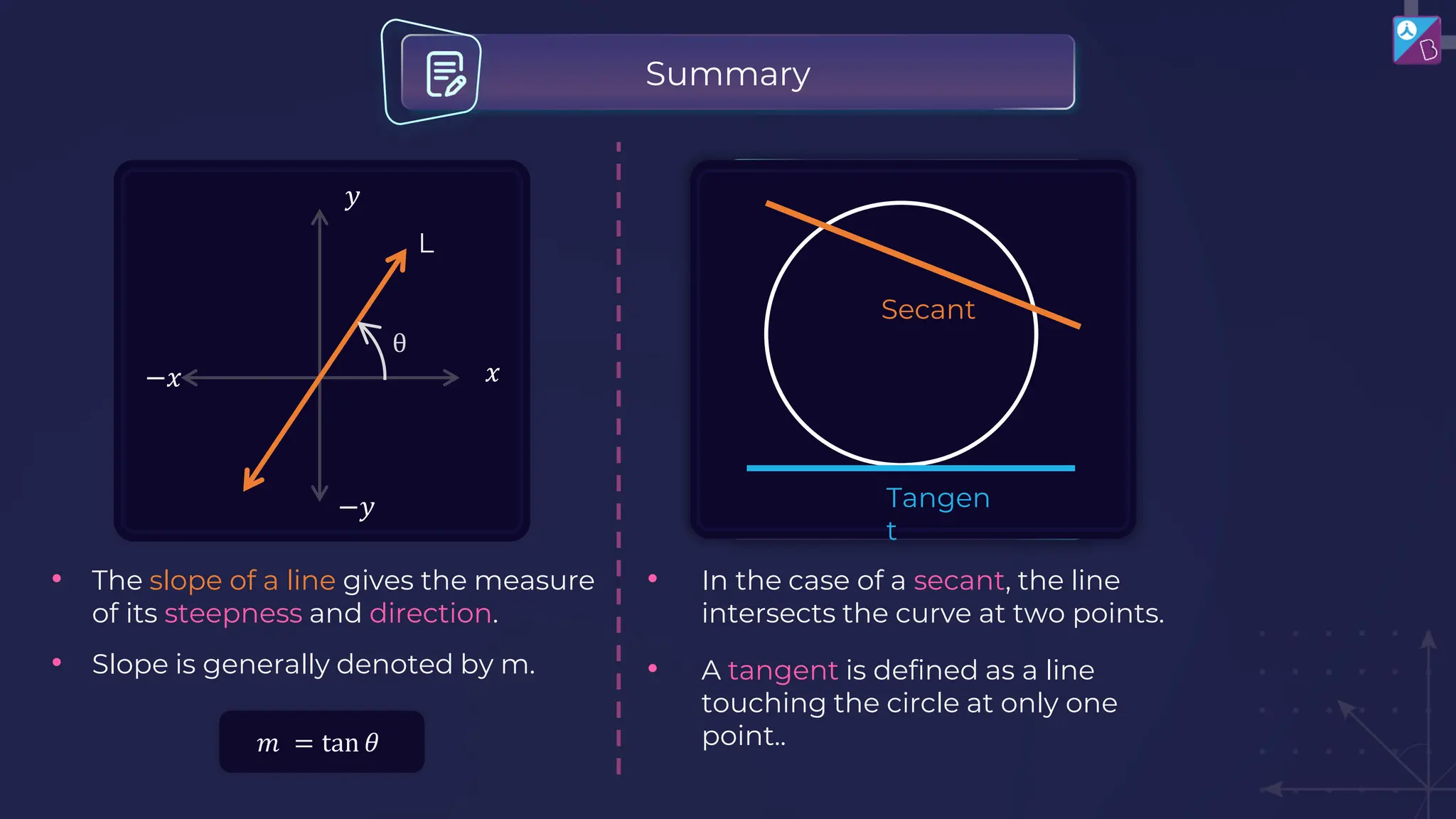
Summary
𝑚 = tan 𝜃
Tangen
t
Secant
• The slope of a line gives the measure
of its steepness and direction.
• Slope is generally denoted by m.
• In the case of a secant, the line
intersects the curve at two points.
• A tangent is defined as a line
touching the circle at only one
point..
𝑥
𝑦
−𝑥
−𝑦
θ
L
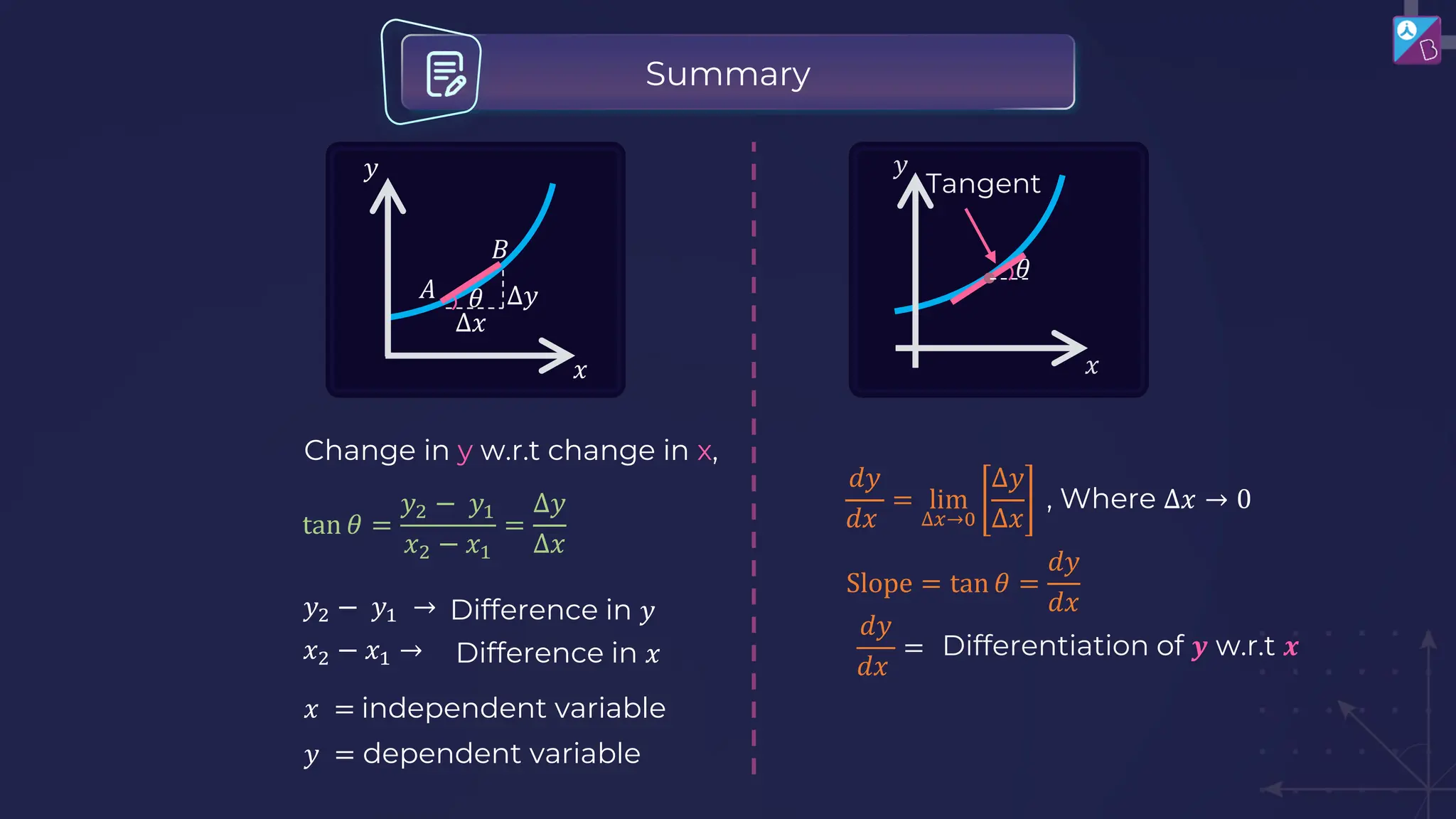
Summary
𝑦
𝑥
𝐴
Δ𝑥
Δ𝑦
𝐵
𝜃
𝑦
𝑥
Tangent
𝜃
tan 𝜃 =
𝑦2 − 𝑦1
𝑥2 − 𝑥1
=
Δ𝑦
Δ𝑥
Change in y w.r.t change in x,
𝑦2 − 𝑦1 → Difference in 𝑦
𝑥2 − 𝑥1 → Difference in 𝑥
𝑥 = independent variable
𝑦 = dependent variable
𝑑𝑦
𝑑𝑥
= lim
∆𝑥→0
Δ𝑦
Δ𝑥
, Where ∆𝑥 → 0
Slope = tan 𝜃 =
𝑑𝑦
𝑑𝑥
𝑑𝑦
𝑑𝑥
= Differentiation of 𝒚 w.r.t 𝒙
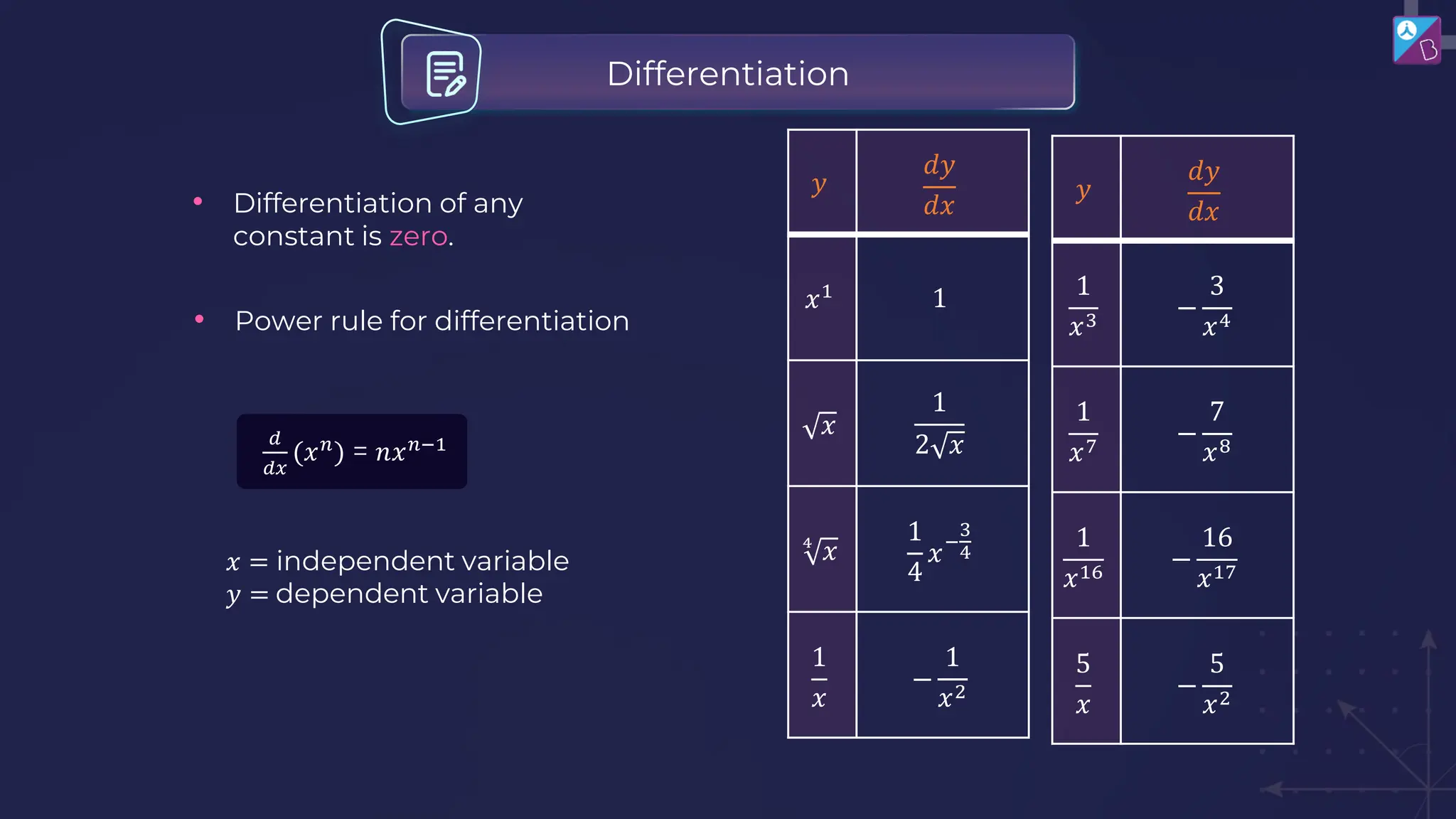
Differentiation
• Power rule for differentiation
𝑑
𝑑𝑥
(𝑥𝑛) = 𝑛𝑥𝑛−1
• Differentiation of any
constant is zero.
𝑥 = independent variable
𝑦 = dependent variable
𝑦
𝑑𝑦
𝑑𝑥
𝑥1 1
𝑥
1
2 𝑥
4
𝑥
1
4
𝑥−
3
4
1
𝑥
−
1
𝑥2
𝑦
𝑑𝑦
𝑑𝑥
1
𝑥3
−
3
𝑥4
1
𝑥7
−
7
𝑥8
1
𝑥16
−
16
𝑥17
5
𝑥
−
5
𝑥2
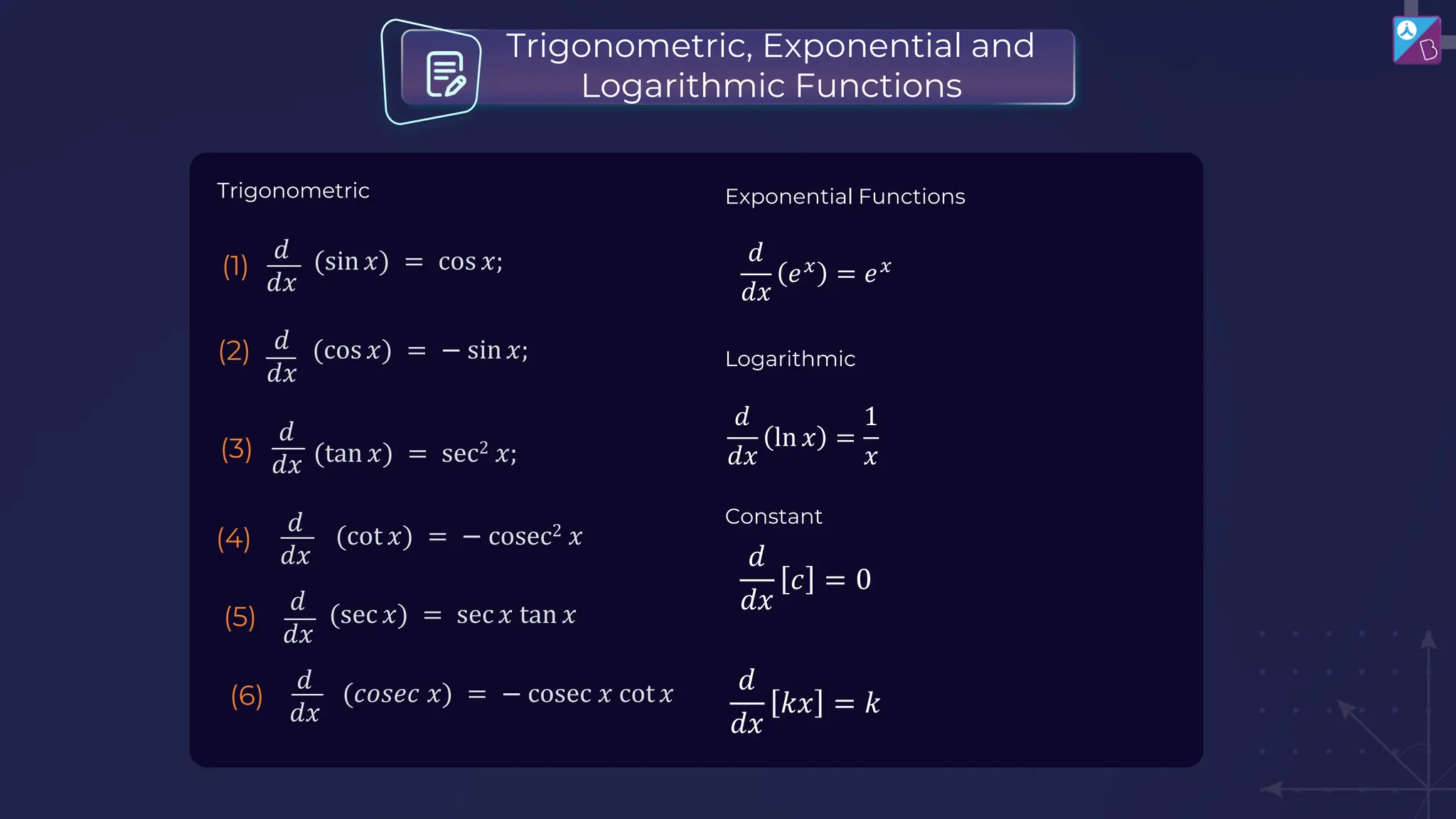
Trigonometric, Exponential and
Logarithmic Functions
(sin 𝑥) = cos 𝑥;
𝑑
𝑑𝑥
(1)
(tan 𝑥) = sec2 𝑥;
𝑑
𝑑𝑥
(3)
(sec 𝑥) = sec 𝑥 tan 𝑥
𝑑
𝑑𝑥
(5)
(𝑐𝑜𝑠𝑒𝑐 𝑥) = − cosec 𝑥 cot 𝑥
𝑑
𝑑𝑥
(6)
(cot 𝑥) = − cosec2 𝑥
𝑑
𝑑𝑥
(4)
(cos 𝑥) = − sin 𝑥;
𝑑
𝑑𝑥
(2)
Exponential Functions
Trigonometric
𝑑
𝑑𝑥
𝑒𝑥 = 𝑒𝑥
Logarithmic
𝑑
𝑑𝑥
ln 𝑥 =
1
𝑥
𝑑
𝑑𝑥
𝑐 = 0
𝑑
𝑑𝑥
𝑘𝑥 = 𝑘
Constant
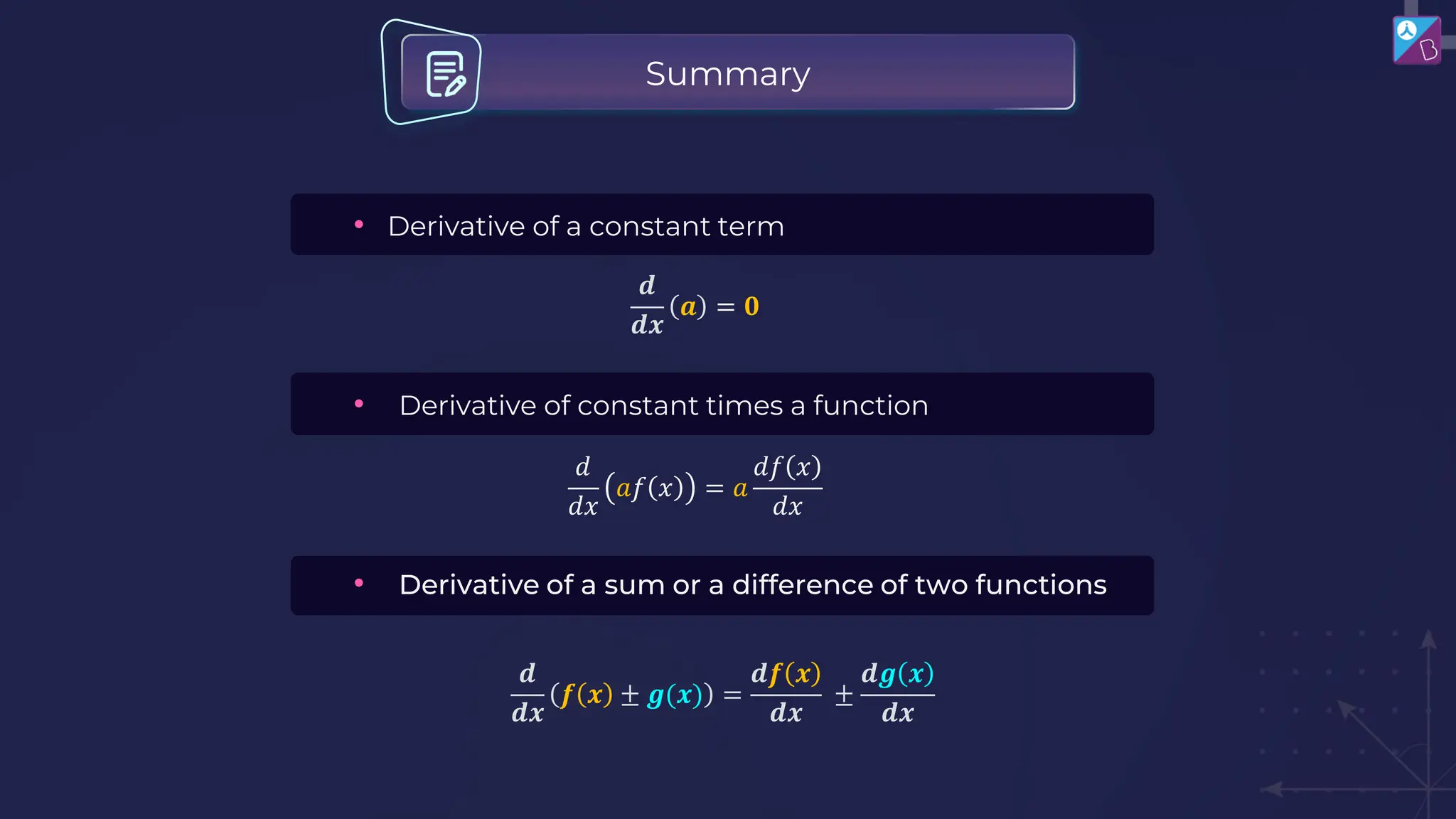
Summary
• Derivative of constant times a function
𝑑
𝑑𝑥
𝑎𝑓 𝑥 = 𝑎
𝑑𝑓 𝑥
𝑑𝑥
• Derivative of a sum or a difference of two functions
• Derivative of a constant term
𝒅
𝒅𝒙
𝒂 = 𝟎
𝒅
𝒅𝒙
𝒇 𝒙 ± 𝒈(𝒙) =
𝒅𝒇 𝒙
𝒅𝒙
Âą
𝒅𝒈 𝒙
𝒅𝒙
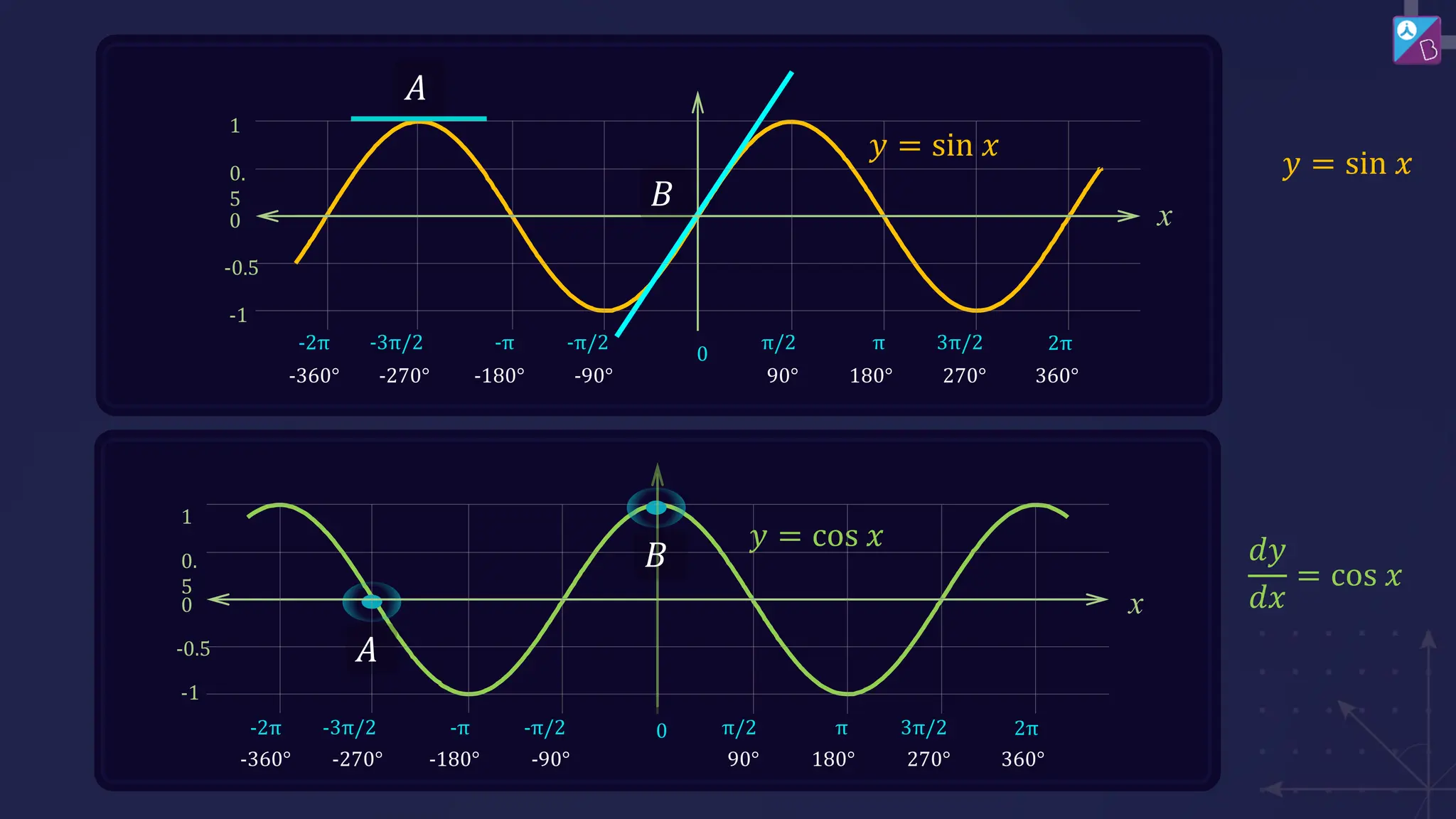
360°
270°
180°
90°
-90°
-180°
-270°
-360°
-2π 2π
3π/2
π
π/2
0
-π/2
-π
-3π/2
0
1
0.
5
-0.5
-1
𝑦 = sin 𝑥
x
𝐴
𝐵
360°
270°
180°
90°
-90°
-180°
-270°
-360°
𝑦 = cos 𝑥
x
-2π 2π
3π/2
π
π/2
0
-π/2
-π
-3π/2
1
0.
5
-0.5
-1
0
𝐴
𝐵
𝑦 = sin 𝑥
𝑑𝑦
𝑑𝑥
= cos 𝑥
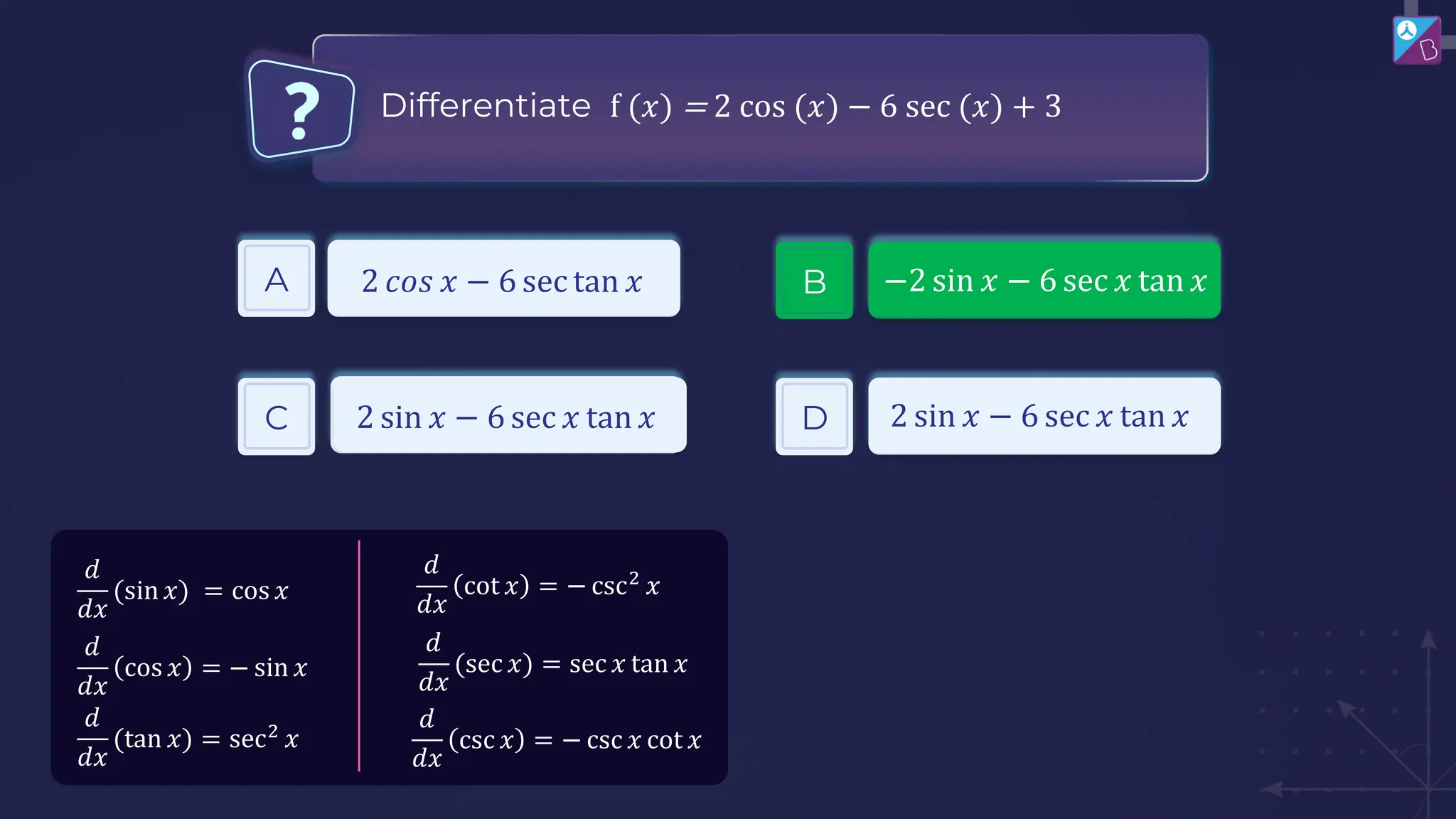
A
C D
2 𝑐𝑜𝑠 𝑥 − 6 sec tan 𝑥
2 sin 𝑥 − 6 sec 𝑥 tan 𝑥 2 sin 𝑥 − 6 sec 𝑥 tan 𝑥
Differentiate f (𝑥) = 2 cos (𝑥) − 6 sec (𝑥) + 3
𝑑
𝑑𝑥
cot 𝑥 = − csc2
𝑥
𝑑
𝑑𝑥
(sec 𝑥) = sec 𝑥 tan 𝑥
𝑑
𝑑𝑥
csc 𝑥 = − csc 𝑥 cot 𝑥
𝑑
𝑑𝑥
(sin 𝑥) = cos 𝑥
𝑑
𝑑𝑥
(tan 𝑥) = sec2
𝑥
𝑑
𝑑𝑥
cos 𝑥 = − sin 𝑥
B −2 sin 𝑥 − 6 sec 𝑥 tan 𝑥
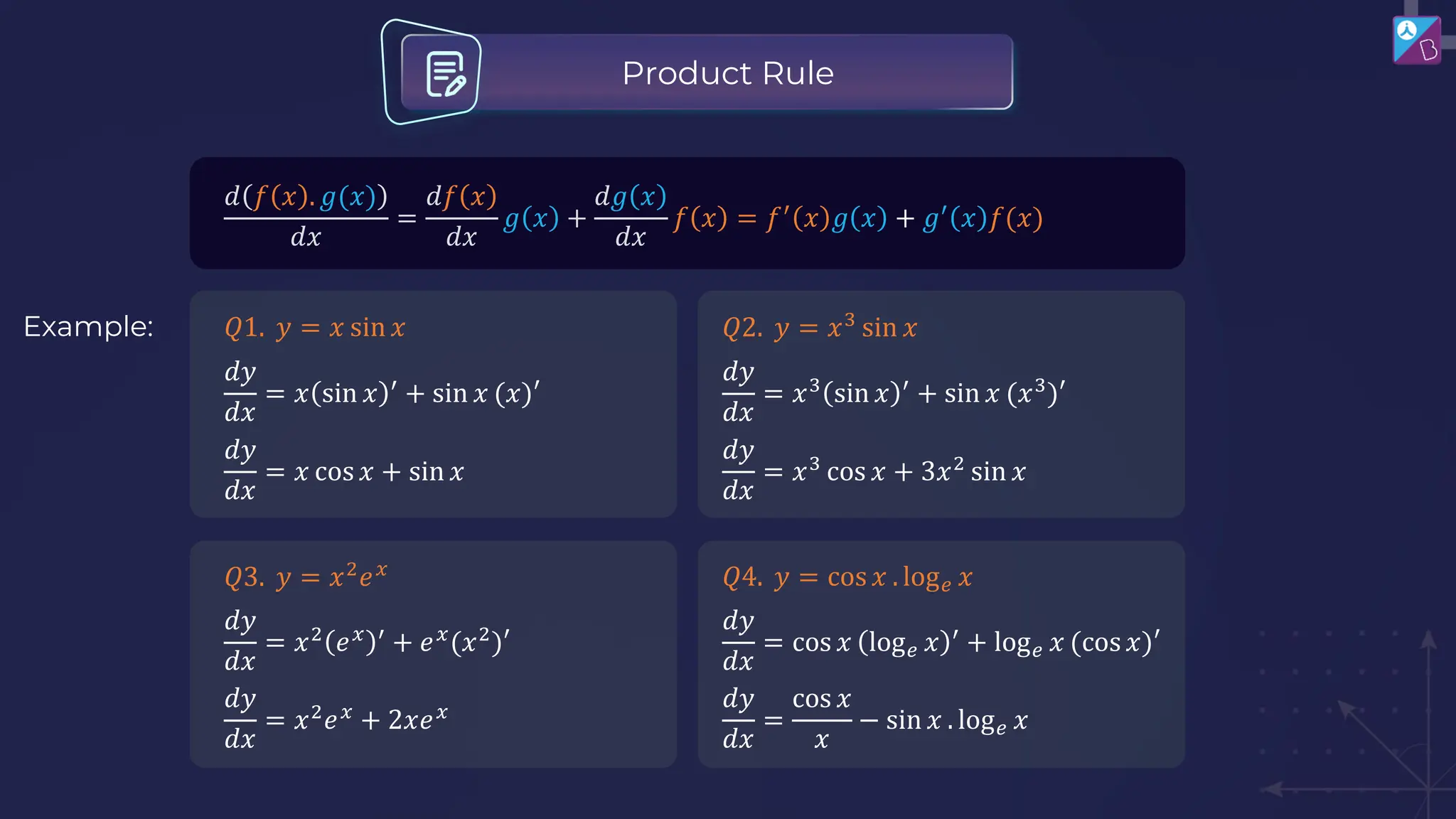
𝑑 𝑓 𝑥 . 𝑔(𝑥)
𝑑𝑥
=
𝑑𝑓 𝑥
𝑑𝑥
𝑔 𝑥 +
𝑑𝑔 𝑥
𝑑𝑥
𝑓 𝑥 = 𝑓′
𝑥 𝑔 𝑥 + 𝑔′
𝑥 𝑓(𝑥)
Product Rule
Example: 𝑄1. 𝑦 = 𝑥 sin 𝑥
𝑑𝑦
𝑑𝑥
= 𝑥 sin 𝑥 ′
+ sin 𝑥 (𝑥)′
𝑑𝑦
𝑑𝑥
= 𝑥 cos 𝑥 + sin 𝑥
𝑄2. 𝑦 = 𝑥3
sin 𝑥
𝑑𝑦
𝑑𝑥
= 𝑥3
sin 𝑥 ′
+ sin 𝑥 (𝑥3
)′
𝑑𝑦
𝑑𝑥
= 𝑥3
cos 𝑥 + 3𝑥2
sin 𝑥
𝑄3. 𝑦 = 𝑥2
𝑒𝑥
𝑑𝑦
𝑑𝑥
= 𝑥2
𝑒𝑥 ′
+ 𝑒𝑥
(𝑥2
)′
𝑑𝑦
𝑑𝑥
= 𝑥2
𝑒𝑥
+ 2𝑥𝑒𝑥
𝑄4. 𝑦 = cos 𝑥 . log𝑒 𝑥
𝑑𝑦
𝑑𝑥
= cos 𝑥 log𝑒 𝑥 ′
+ log𝑒 𝑥 (cos 𝑥)′
𝑑𝑦
𝑑𝑥
=
cos 𝑥
𝑥
− sin 𝑥 . log𝑒 𝑥
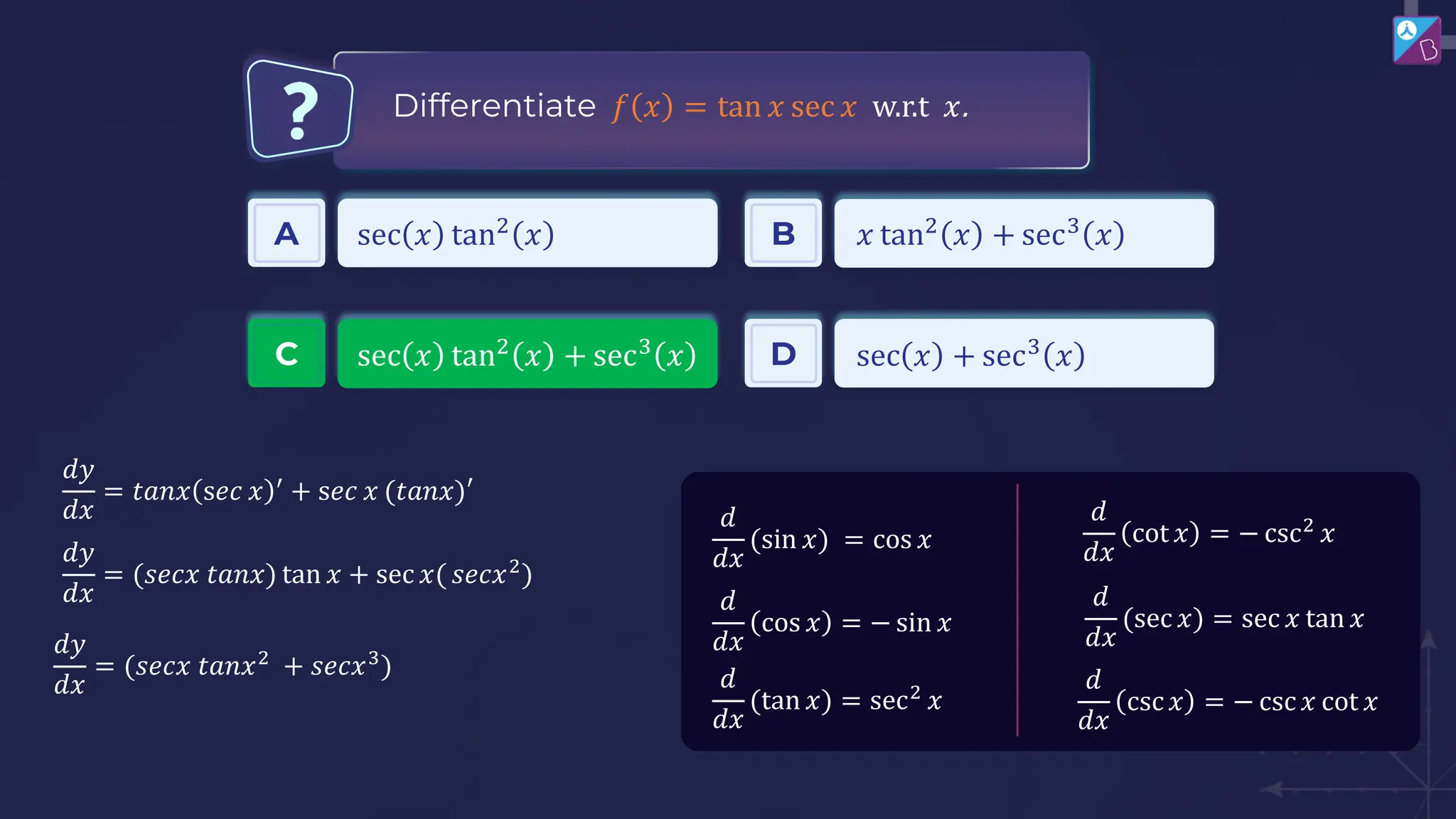
Differentiate 𝑓 𝑥 = tan 𝑥 sec 𝑥 w.r.t 𝑥.
𝑑
𝑑𝑥
cot 𝑥 = − csc2
𝑥
𝑑
𝑑𝑥
(sec 𝑥) = sec 𝑥 tan 𝑥
𝑑
𝑑𝑥
csc𝑥 = − csc𝑥 cot 𝑥
𝑑
𝑑𝑥
(sin 𝑥) = cos 𝑥
𝑑
𝑑𝑥
(tan 𝑥) = sec2
𝑥
𝑑
𝑑𝑥
cos 𝑥 = − sin 𝑥
𝑑𝑦
𝑑𝑥
= 𝑡𝑎𝑛𝑥 s𝑒𝑐 𝑥 ′
+ s𝑒𝑐 𝑥 (𝑡𝑎𝑛𝑥)′
𝑑𝑦
𝑑𝑥
= (𝑠𝑒𝑐𝑥 𝑡𝑎𝑛𝑥) tan 𝑥 + sec 𝑥( 𝑠𝑒𝑐𝑥2
)
𝑑𝑦
𝑑𝑥
= (𝑠𝑒𝑐𝑥 𝑡𝑎𝑛𝑥2
+ 𝑠𝑒𝑐𝑥3
)
A sec 𝑥 tan2
𝑥 B 𝑥 tan2
𝑥 + sec3
𝑥
C sec 𝑥 tan2
𝑥 + sec3
𝑥 D sec 𝑥 + sec3
𝑥
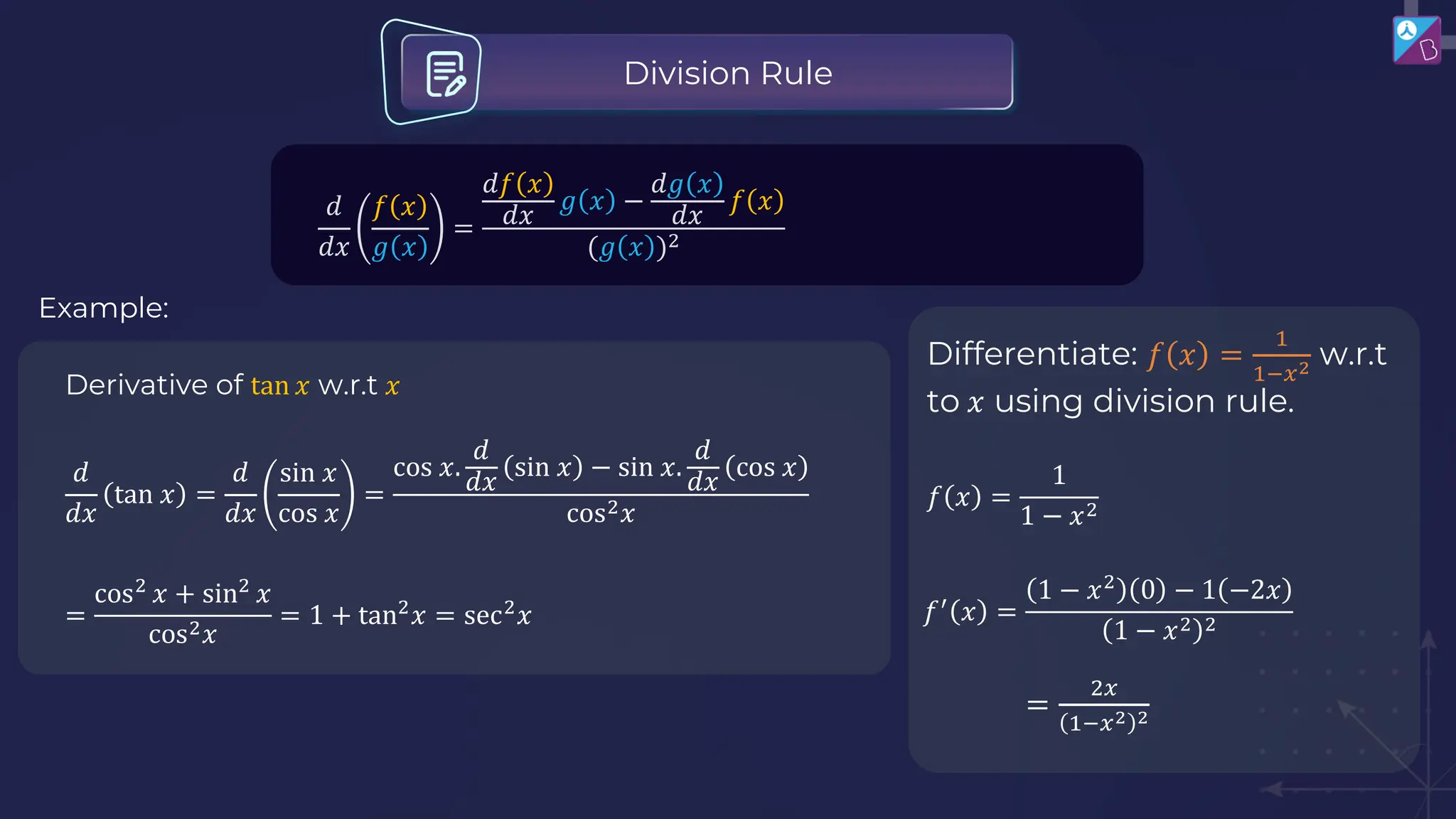
𝑑
𝑑𝑥
𝑓 𝑥
𝑔 𝑥
=
𝑑𝑓 𝑥
𝑑𝑥
𝑔 𝑥 −
𝑑𝑔 𝑥
𝑑𝑥
𝑓 𝑥
(𝑔 𝑥 )2
Division Rule
Derivative of tan 𝑥 w.r.t 𝑥
𝑑
𝑑𝑥
tan 𝑥 =
𝑑
𝑑𝑥
sin 𝑥
cos 𝑥
=
cos 𝑥.
𝑑
𝑑𝑥
sin 𝑥 − sin 𝑥.
𝑑
𝑑𝑥
cos 𝑥
cos2𝑥
=
cos2
𝑥 + sin2
𝑥
cos2𝑥
= 1 + tan2
𝑥 = sec2
𝑥
Example:
Differentiate: 𝑓 𝑥 =
1
1−𝑥2 w.r.t
to 𝑥 using division rule.
𝑓 𝑥 =
1
1 − 𝑥2
𝑓′
𝑥 =
1 − 𝑥2
0 − 1 −2𝑥
1 − 𝑥2 2
=
2𝑥
1−𝑥2 2
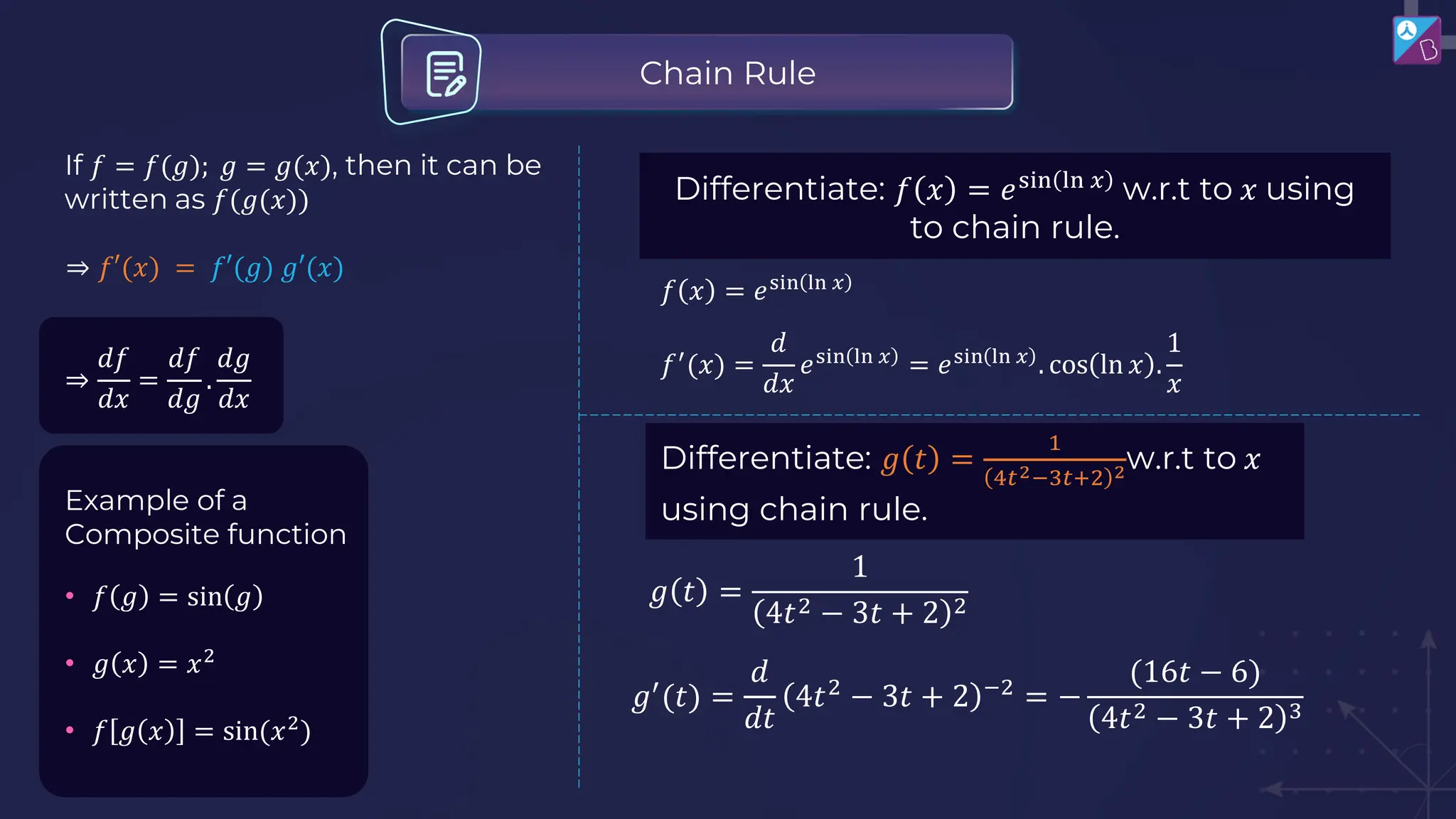
⇒
𝑑𝑓
𝑑𝑥
=
𝑑𝑓
𝑑𝑔
.
𝑑𝑔
𝑑𝑥
⇒ 𝑓′(𝑥) = 𝑓′(𝑔) 𝑔′(𝑥)
Example of a
Composite function
• 𝑓 𝑔 = sin 𝑔
• 𝑔 𝑥 = 𝑥2
• 𝑓 𝑔 𝑥 = sin(𝑥2
)
If 𝑓 = 𝑓(𝑔); 𝑔 = 𝑔(𝑥), then it can be
written as 𝑓(𝑔(𝑥))
Chain Rule
Differentiate: 𝑓 𝑥 = 𝑒sin ln 𝑥
w.r.t to 𝑥 using
to chain rule.
𝑓 𝑥 = 𝑒sin ln 𝑥
𝑓′
(𝑥) =
𝑑
𝑑𝑥
𝑒sin ln 𝑥
= 𝑒sin ln 𝑥
. cos ln 𝑥 .
1
𝑥
Differentiate: 𝑔 𝑡 =
1
4𝑡2−3𝑡+2 2w.r.t to 𝑥
using chain rule.
𝑔 𝑡 =
1
4𝑡2 − 3𝑡 + 2 2
𝑔′
(𝑡) =
𝑑
𝑑𝑡
4𝑡2
− 3𝑡 + 2 −2
= −
(16𝑡 − 6)
4𝑡2 − 3𝑡 + 2 3
𝑦 = cos 𝑥2
𝑑𝑦
𝑑𝑥
=
𝑑
𝑑𝑥
cos 𝑥2
= −sin 𝑥2
∙ 2𝑥
⇒
𝑑2
𝑦
𝑑𝑥2
= −2 sin 𝑥2
∙
𝑑
𝑑𝑥
𝑥 + 𝑥.
𝑑
𝑑𝑥
sin 𝑥2
⇒
𝑑2
𝑦
𝑑𝑥2
= −2 sin 𝑥2
∙ 1 + cos 𝑥2
∙ 2𝑥 ∙ 𝑥
⇒
𝑑𝑦
𝑑𝑥
= −2𝑥 sin 𝑥2
⇒
𝑑2
𝑦
𝑑𝑥2
= −4𝑥2
cos 𝑥2
− 2 sin 𝑥2
Successive or Double Differentiation
𝑦 = cos 𝑥2
𝑑𝑦
𝑑𝑥
=
𝑑
𝑑𝑥
cos 𝑥2
= −2𝑥 sin 𝑥2
𝑑2
𝑦
𝑑𝑥2
= −2
𝑑
𝑑𝑥
𝑥 sin 𝑥2
= −2[sin 𝑥2
+ 2𝑥2
cos 𝑥2
]
⇒
𝑑2
𝑦
𝑑𝑥2
= −2[sin 𝑥2
+ 2𝑥2
cos 𝑥2
]
Applications of Differentiation
Variation of one quantity
with respect to another
1
Slope of curve
2
Maxima and minima
of any function
3
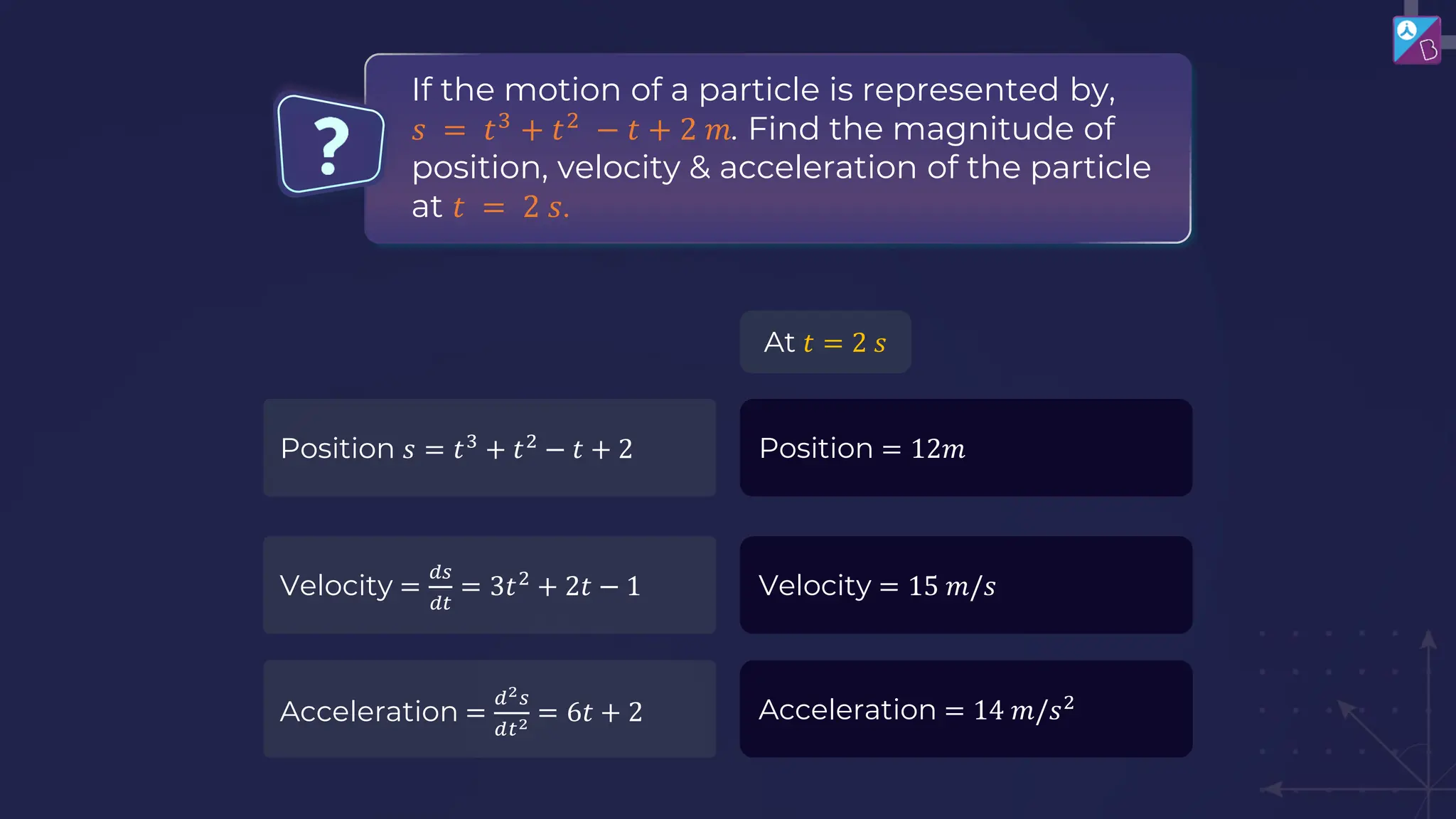
If the motion of a particle is represented by,
𝑠 = 𝑡3
+ 𝑡2
− 𝑡 + 2 𝑚. Find the magnitude of
position, velocity & acceleration of the particle
at 𝑡 = 2 𝑠.
At 𝑡 = 2 𝑠
Position = 12𝑚
Position 𝑠 = 𝑡3
+ 𝑡2
− 𝑡 + 2
Velocity =
𝑑𝑠
𝑑𝑡
= 3𝑡2
+ 2𝑡 − 1
Acceleration =
𝑑2𝑠
𝑑𝑡2 = 6𝑡 + 2
Velocity = 15 𝑚/𝑠
Acceleration = 14 𝑚/𝑠2
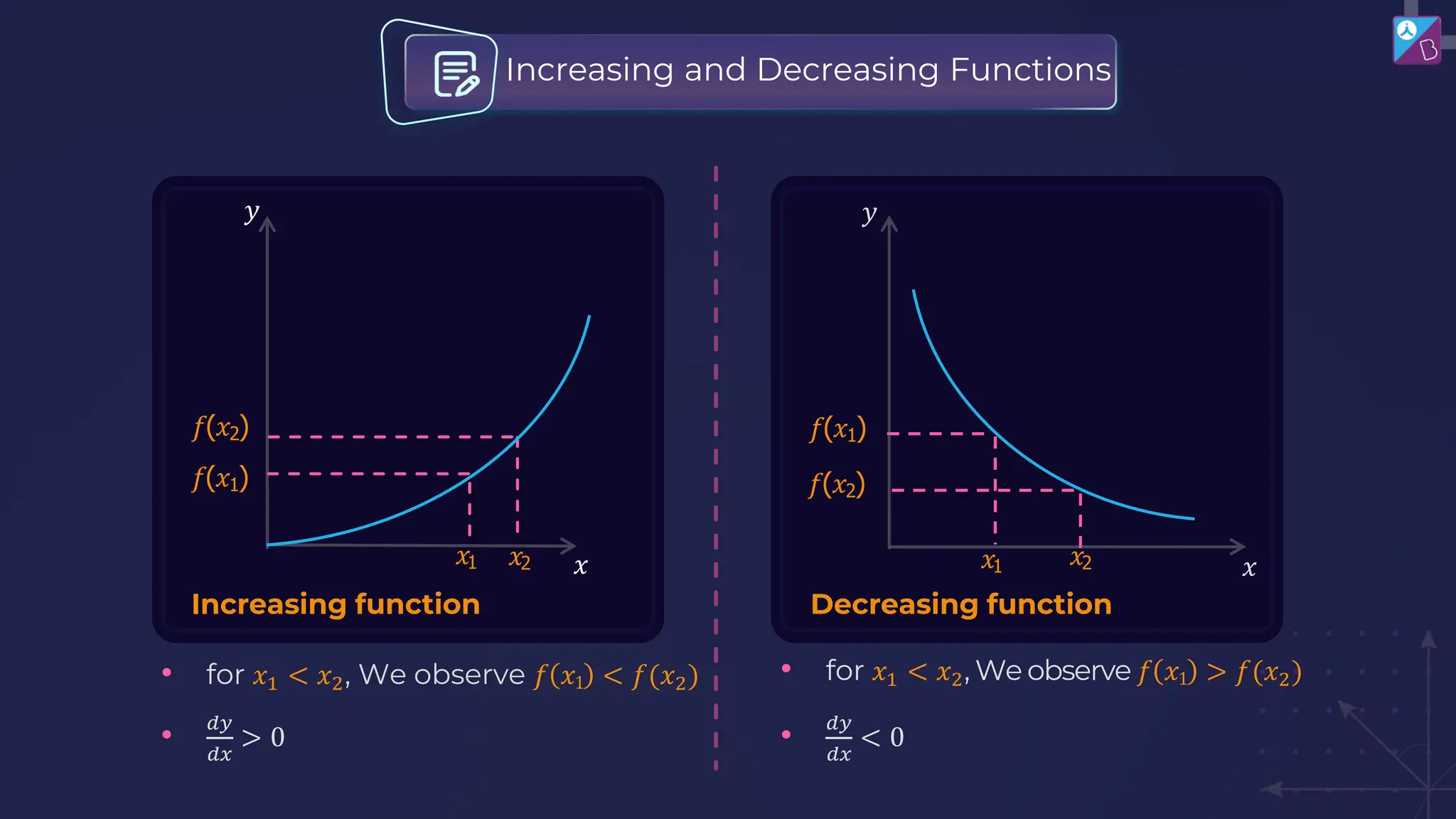
• for 𝑥1 < 𝑥2, We observe 𝑓 𝑥1 < 𝑓(𝑥2)
𝑓(𝑥1)
𝑓(𝑥2)
𝑥2
𝑥1 𝑥
𝑦
Increasing function
• 𝑑𝑦
𝑑𝑥
> 0
𝑓(𝑥2)
𝑓(𝑥1)
𝑥2
𝑥1 𝑥
𝑦
Decreasing function
• for 𝑥1 < 𝑥2, We observe 𝑓 𝑥1 > 𝑓(𝑥2)
• 𝑑𝑦
𝑑𝑥
< 0
Increasing and Decreasing Functions
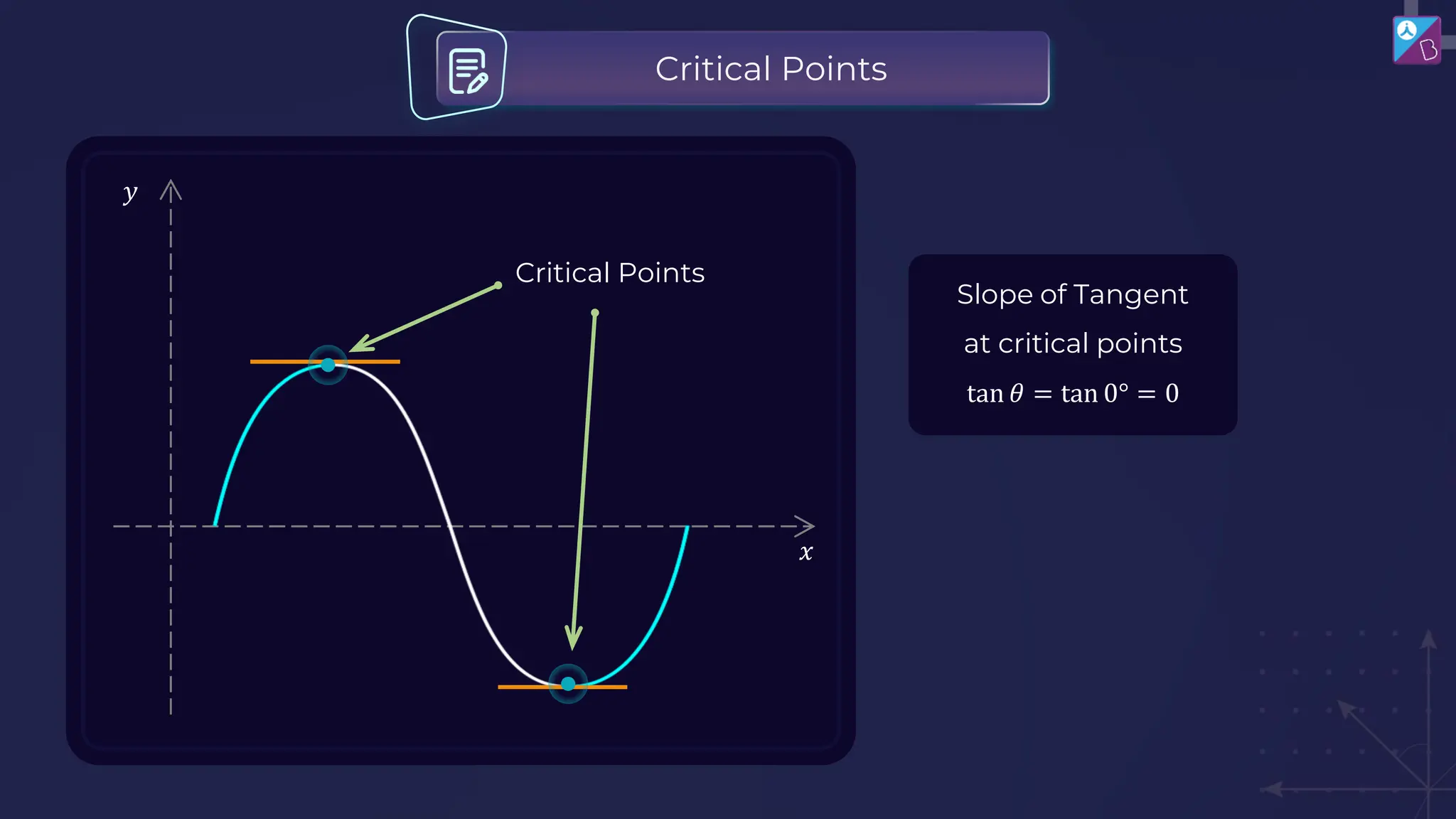
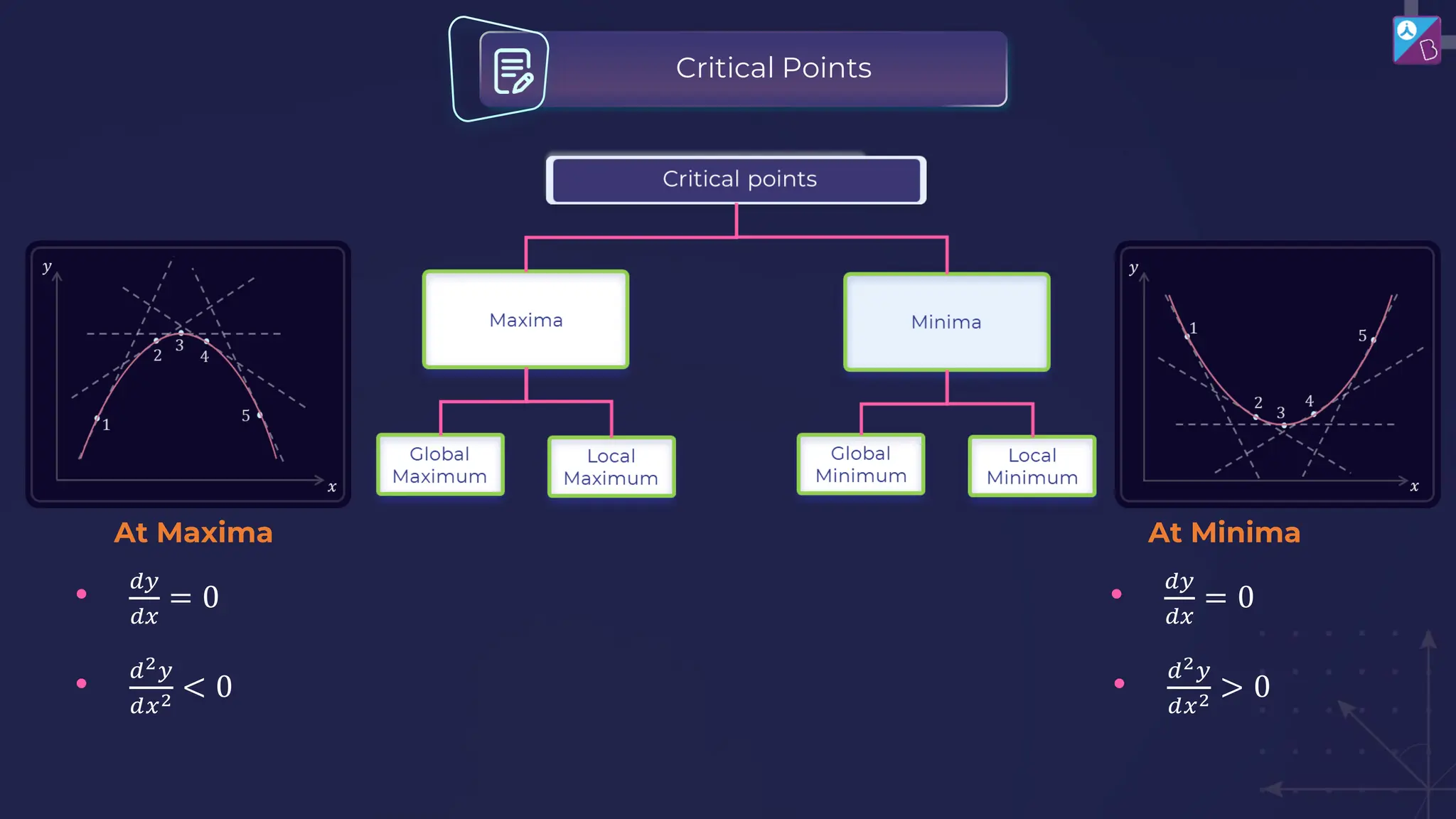
Critical Points
𝑦
𝑥
Critical Points
Slope of Tangent
at critical points
tan 𝜃 = tan 0° = 0
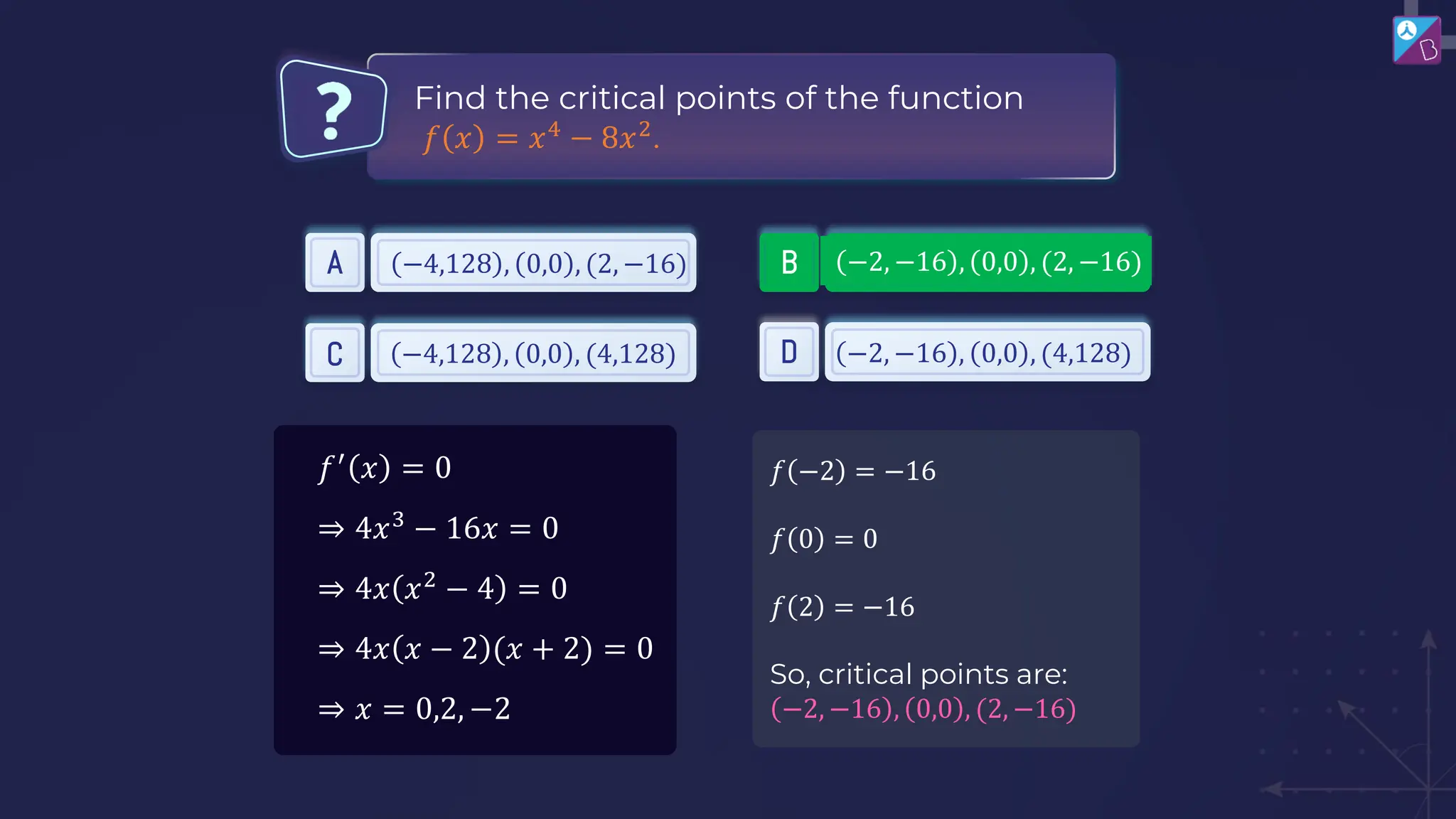
Find the critical points of the function
𝑓 𝑥 = 𝑥4
− 8𝑥2
.
A B
C D
−2, −16 , 0,0 , (2, −16)
−2, −16 , 0,0 , (4,128)
−4,128 , 0,0 , (2, −16)
−4,128 , 0,0 , (4,128)
𝑓′
𝑥 = 0
⇒ 4𝑥3
− 16𝑥 = 0
⇒ 4𝑥 𝑥2
− 4 = 0
⇒ 4𝑥 𝑥 − 2 (𝑥 + 2) = 0
⇒ 𝑥 = 0,2, −2
𝑓 −2 = −16
𝑓 0 = 0
𝑓 2 = −16
So, critical points are:
−2, −16 , 0,0 , (2, −16)
At Maxima
• 𝑑𝑦
𝑑𝑥
= 0
• 𝑑2𝑦
𝑑𝑥2 < 0
At Minima
• 𝑑𝑦
𝑑𝑥
= 0
• 𝑑2𝑦
𝑑𝑥2 > 0
Critical Points
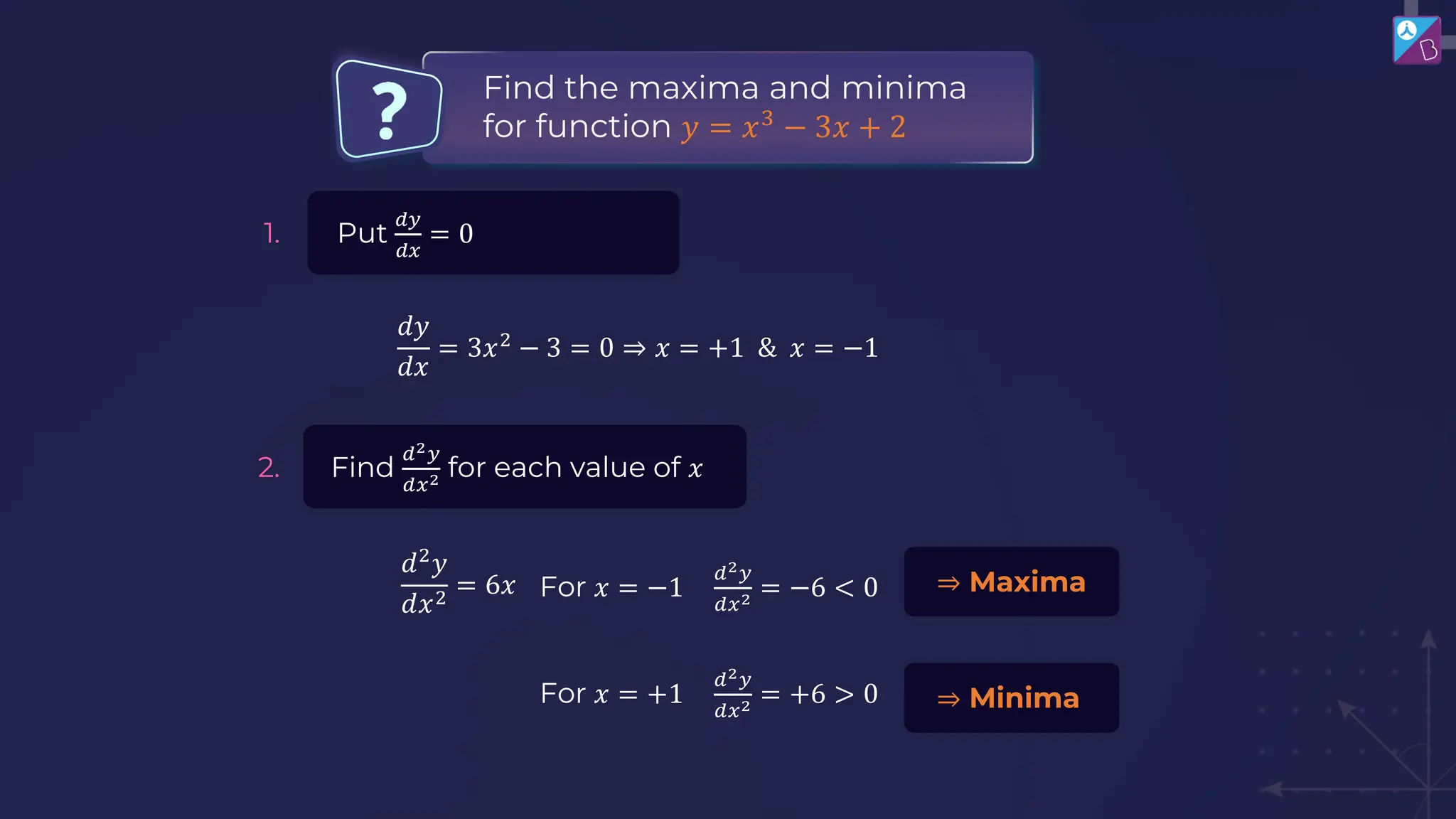
Find the maxima and minima
for function 𝑦 = 𝑥3
− 3𝑥 + 2
1. Put
𝑑𝑦
𝑑𝑥
= 0
𝑑𝑦
𝑑𝑥
= 3𝑥2
− 3 = 0 ⇒ 𝑥 = +1 & 𝑥 = −1
𝑑2
𝑦
𝑑𝑥2
= 6𝑥
For 𝑥 = +1
𝑑2𝑦
𝑑𝑥2 = +6 > 0
For 𝑥 = −1
𝑑2𝑦
𝑑𝑥2 = −6 < 0
⇒ Minima
⇒ Maxima
2. Find
𝑑2𝑦
𝑑𝑥2 for each value of 𝑥
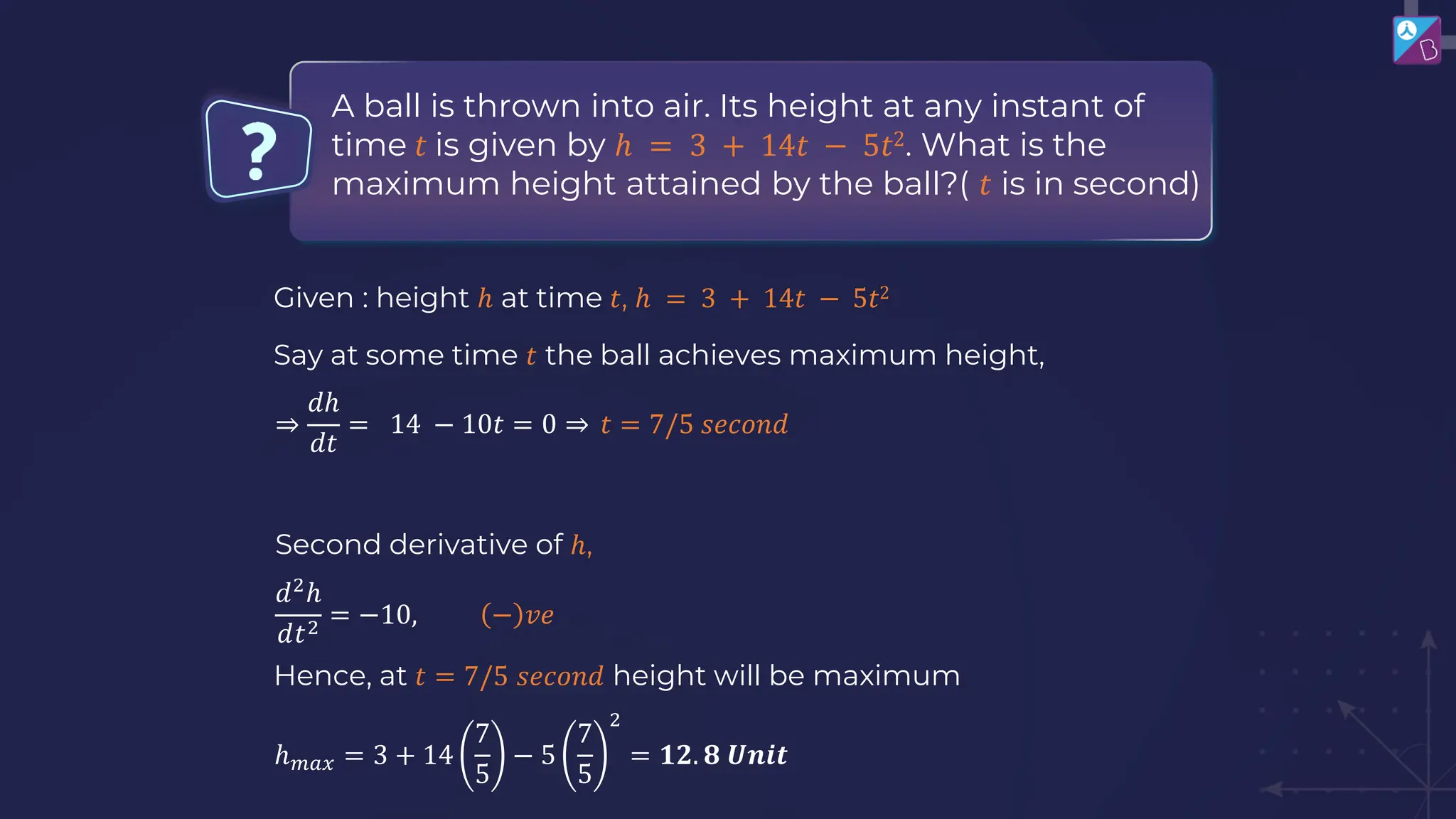
A ball is thrown into air. Its height at any instant of
time 𝑡 is given by ℎ = 3 + 14𝑡 − 5𝑡2. What is the
maximum height attained by the ball?( 𝑡 is in second)
Given : height ℎ at time 𝑡, ℎ = 3 + 14𝑡 − 5𝑡2
Say at some time 𝑡 the ball achieves maximum height,
⇒
𝑑ℎ
𝑑𝑡
= 14 − 10𝑡 = 0 ⇒ 𝑡 = 7/5 𝑠𝑒𝑐𝑜𝑛𝑑
Second derivative of ℎ,
𝑑2
ℎ
𝑑𝑡2
= −10, − 𝑣𝑒
Hence, at 𝑡 = 7/5 𝑠𝑒𝑐𝑜𝑛𝑑 height will be maximum
ℎ𝑚𝑎𝑥 = 3 + 14
7
5
− 5
7
5
2
= 𝟏𝟐. 𝟖 𝑼𝒏𝒊𝒕
Integration
Mathematically Integration and
differentiation are inverse of
each other.
• 𝑑
𝑑𝑥
𝑐 = 0
• 𝑑
𝑑𝑥
[𝑘𝑥] = 𝑘
• 𝑑
𝑑𝑥
sin 𝑥 = cos 𝑥
• 𝑑
𝑑𝑥
cos 𝑥 = − sin 𝑥
• 𝑑
𝑑𝑥
tan 𝑥 = sec2
𝑥
• ‫׬‬ 0 𝑑𝑥 = 𝑐
• ‫׬‬ 𝑘 𝑑𝑥 = 𝑘𝑥 + 𝑐
• ‫׬‬cos 𝑥 𝑑𝑥 = sin 𝑥 + 𝑐
• ‫׬‬ − sin 𝑥 𝑑𝑥 = cos 𝑥 + 𝑐
• ‫׬‬ sec2
𝑥 𝑑𝑥 = tan 𝑥 + 𝑐
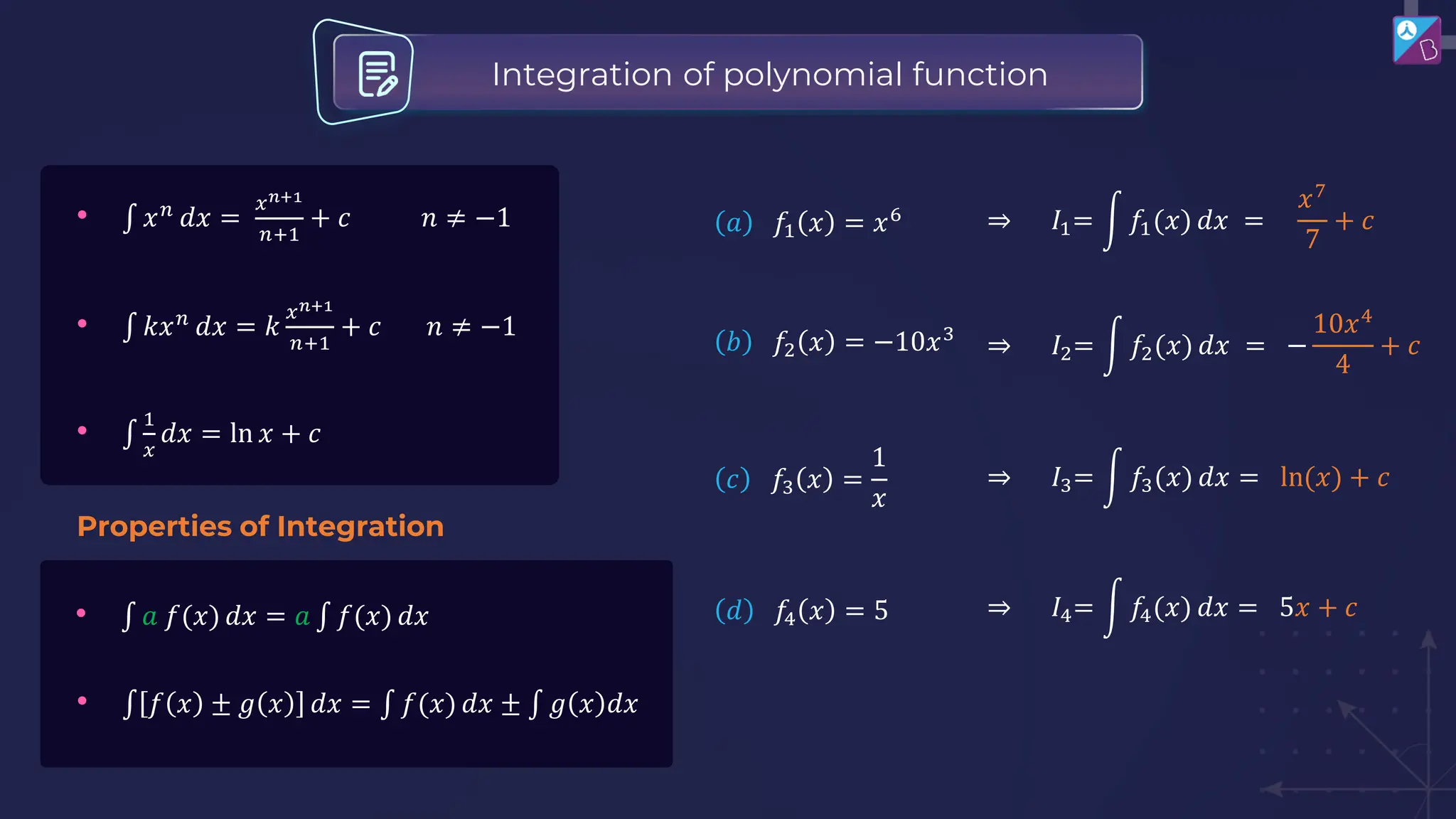
Integration of polynomial function
Properties of Integration
• ‫׬‬ 𝑥𝑛
𝑑𝑥 =
𝑥𝑛+1
𝑛+1
+ 𝑐 𝑛 ≠ −1
• ‫׬‬ 𝑘𝑥𝑛
𝑑𝑥 = 𝑘
𝑥𝑛+1
𝑛+1
+ 𝑐 𝑛 ≠ −1
• ‫׬‬
1
𝑥
𝑑𝑥 = ln 𝑥 + 𝑐
• ‫׬‬ 𝑎 𝑓(𝑥) 𝑑𝑥 = 𝑎 ‫׬‬ 𝑓(𝑥) 𝑑𝑥
• ‫׬‬ 𝑓 𝑥 ± 𝑔 𝑥 𝑑𝑥 = ‫׬‬ 𝑓(𝑥) 𝑑𝑥 ± ‫׬‬ 𝑔 𝑥 𝑑𝑥
𝑎 𝑓1 𝑥 = 𝑥6 ⇒ 𝐼1= න 𝑓1(𝑥) 𝑑𝑥 =
𝑥7
7
+ 𝑐
𝑏 𝑓2 𝑥 = −10𝑥3
⇒ 𝐼2= න 𝑓2(𝑥) 𝑑𝑥 = −
10𝑥4
4
+ 𝑐
𝑐 𝑓3 𝑥 =
1
𝑥
⇒ 𝐼3= න 𝑓3(𝑥) 𝑑𝑥 = ln(𝑥) + 𝑐
𝑑 𝑓4 𝑥 = 5 ⇒ 𝐼4= න 𝑓4(𝑥) 𝑑𝑥 = 5𝑥 + 𝑐
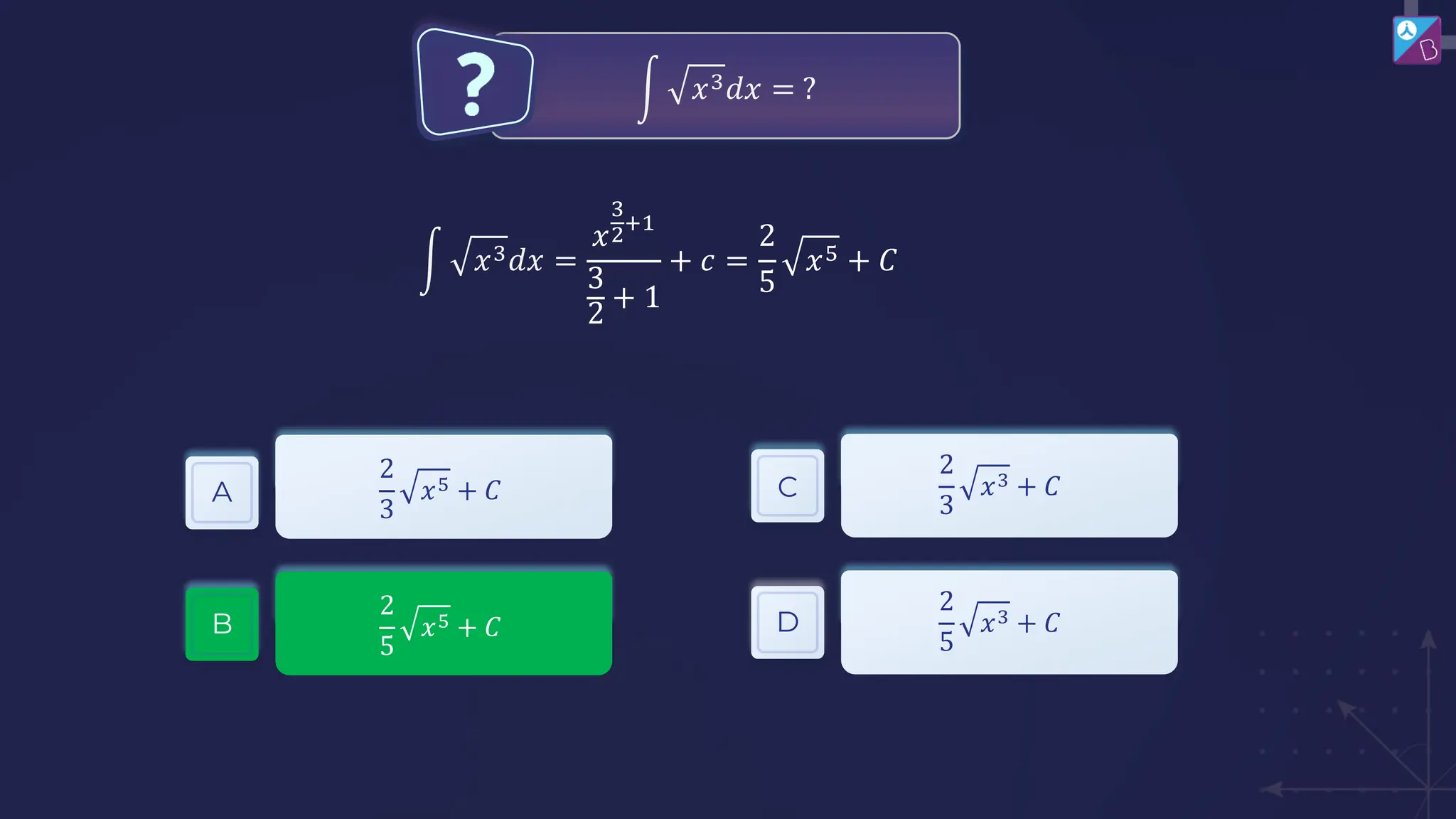
න 𝑥3𝑑𝑥 = ?
A
B
C
2
3
𝑥5 + 𝐶
2
5
𝑥5 + 𝐶 D
2
3
𝑥3 + 𝐶
2
5
𝑥3 + 𝐶
න 𝑥3𝑑𝑥 =
𝑥
3
2
+1
3
2
+ 1
+ 𝑐 =
2
5
𝑥5 + 𝐶
Summary
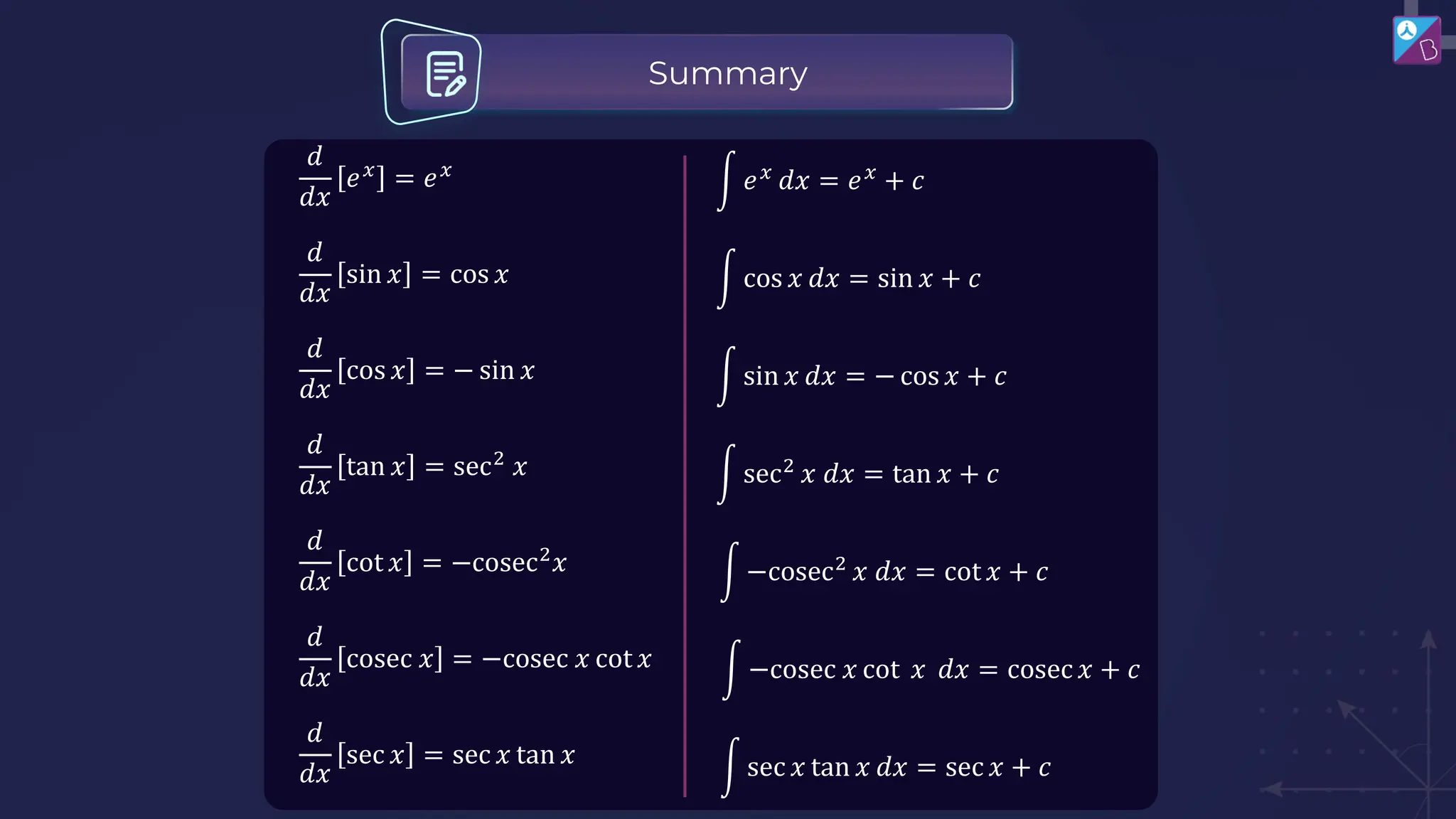
𝑑
𝑑𝑥
𝑒𝑥
= 𝑒𝑥
න 𝑒𝑥
𝑑𝑥 = 𝑒𝑥
+ 𝑐
𝑑
𝑑𝑥
sin 𝑥 = cos 𝑥 න cos 𝑥 𝑑𝑥 = sin 𝑥 + 𝑐
𝑑
𝑑𝑥
cos 𝑥 = − sin 𝑥 න sin 𝑥 𝑑𝑥 = − cos 𝑥 + 𝑐
𝑑
𝑑𝑥
tan 𝑥 = sec2
𝑥
𝑑
𝑑𝑥
cosec 𝑥 = −cosec 𝑥 cot 𝑥
𝑑
𝑑𝑥
sec 𝑥 = sec 𝑥 tan 𝑥
𝑑
𝑑𝑥
cot 𝑥 = −cosec2
𝑥
න −cosec 𝑥 cot 𝑥 𝑑𝑥 = cosec 𝑥 + 𝑐
න sec 𝑥 tan 𝑥 𝑑𝑥 = sec 𝑥 + 𝑐
න −cosec2
𝑥 𝑑𝑥 = cot 𝑥 + 𝑐
ŕśą sec2
𝑥 𝑑𝑥 = tan 𝑥 + 𝑐
Summary
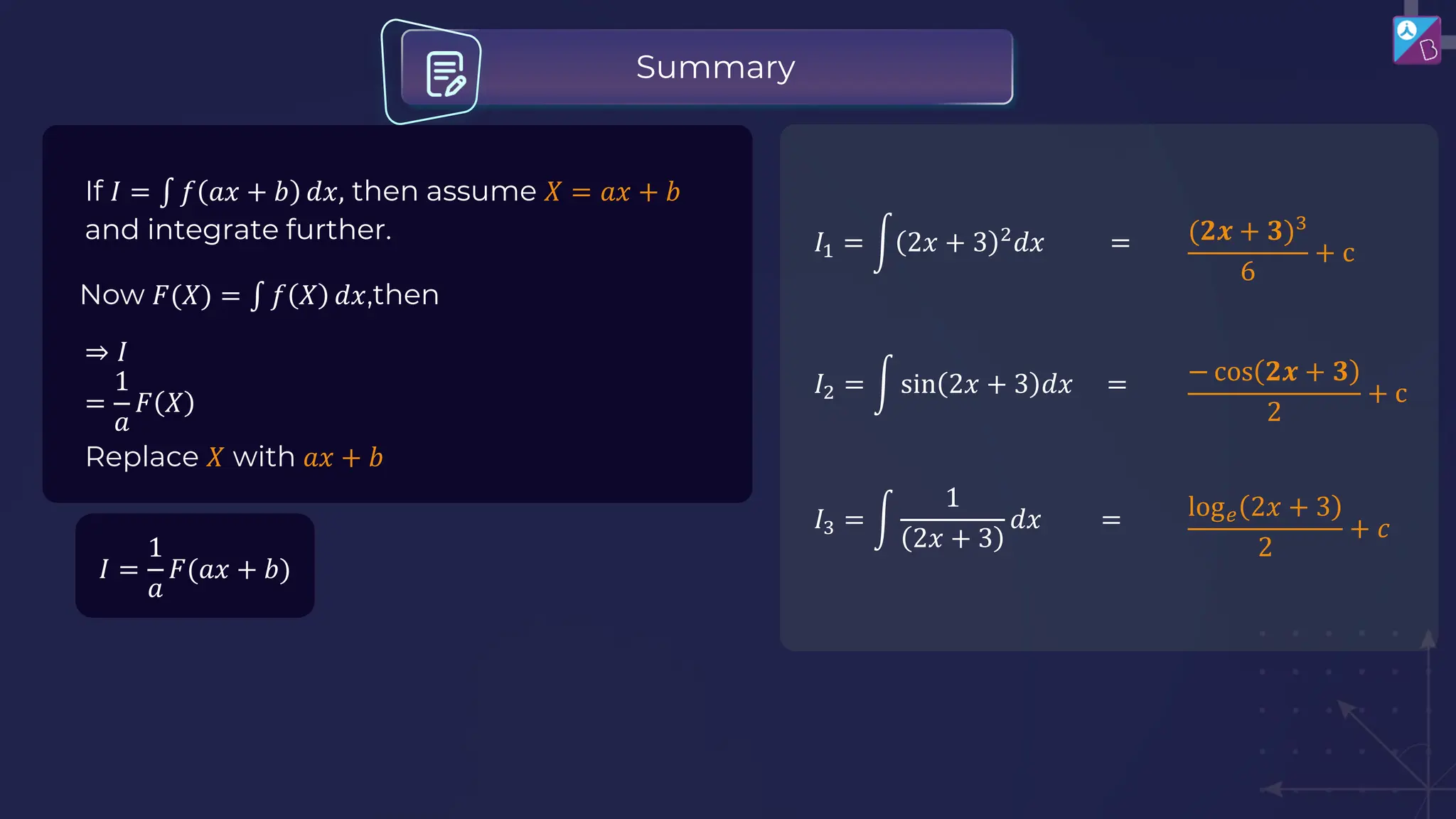
If 𝐼 = ‫׬‬ 𝑓 𝑎𝑥 + 𝑏 𝑑𝑥, then assume 𝑋 = 𝑎𝑥 + 𝑏
and integrate further.
⇒ 𝐼
=
1
𝑎
𝐹 𝑋
Now 𝐹(𝑋) = ‫׬‬ 𝑓 𝑋 𝑑𝑥,then
Replace 𝑋 with 𝑎𝑥 + 𝑏
𝐼 =
1
𝑎
𝐹(𝑎𝑥 + 𝑏)
𝐼1 = න 2𝑥 + 3 2
𝑑𝑥 = (𝟐𝒙 + 𝟑)3
6
+ c
𝐼2 = න sin 2𝑥 + 3 𝑑𝑥 = − cos 𝟐𝒙 + 𝟑
2
+ c
𝐼3 = න
1
2𝑥 + 3
𝑑𝑥 = log𝑒 2𝑥 + 3
2
+ 𝑐
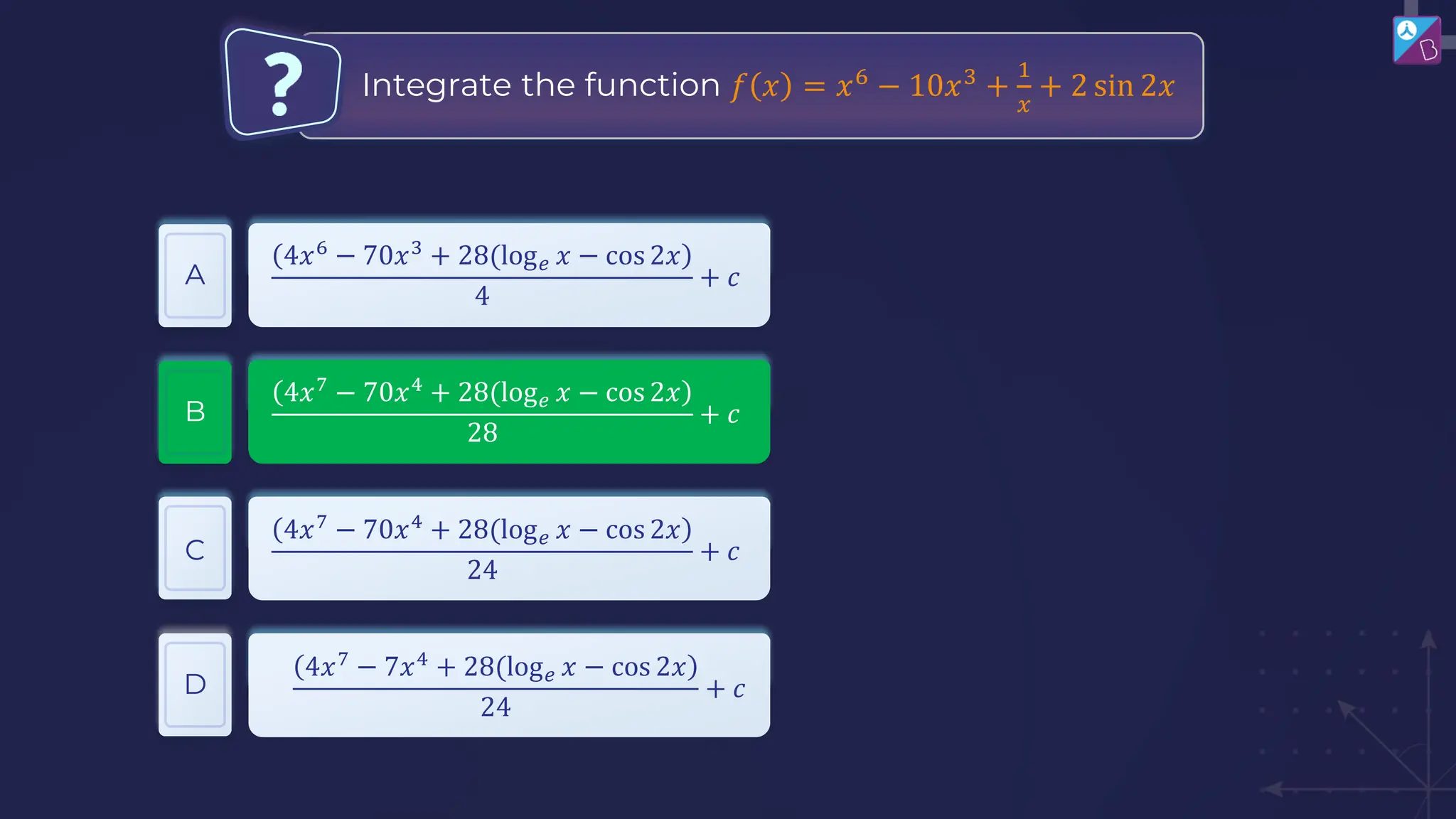
Integrate the function 𝑓 𝑥 = 𝑥6
− 10𝑥3
+
1
𝑥
+ 2 sin 2𝑥
A
B
C
4𝑥6
− 70𝑥3
+ 28(log𝑒 𝑥 − cos 2𝑥
4
+ 𝑐
4𝑥7
− 70𝑥4
+ 28(log𝑒 𝑥 − cos 2𝑥
28
+ 𝑐
D
4𝑥7
− 70𝑥4
+ 28(log𝑒 𝑥 − cos 2𝑥
24
+ 𝑐
4𝑥7
− 7𝑥4
+ 28(log𝑒 𝑥 − cos 2𝑥
24
+ 𝑐
Summary
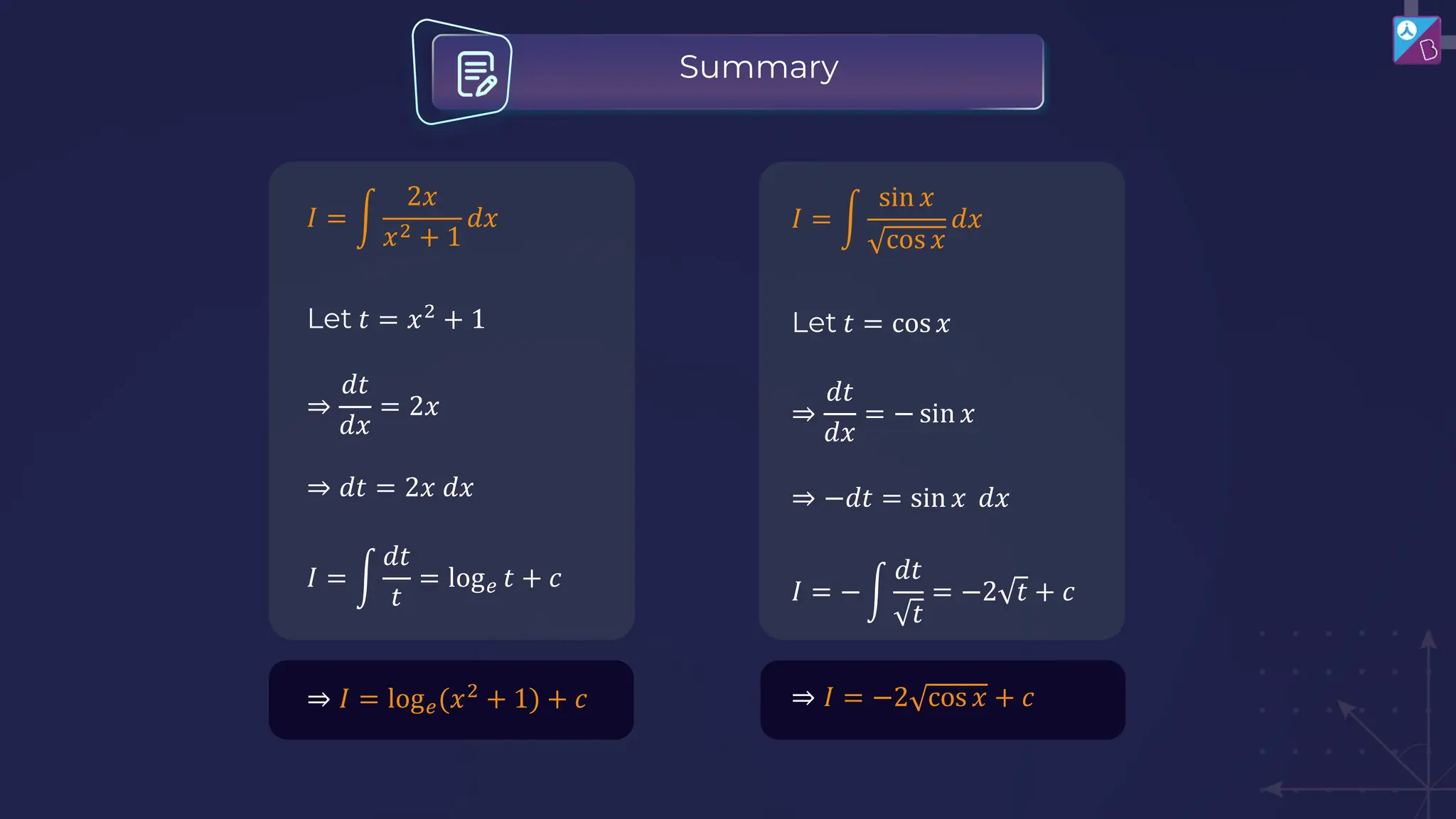
𝐼 = න
2𝑥
𝑥2 + 1
𝑑𝑥
Let 𝑡 = 𝑥2
+ 1
⇒
𝑑𝑡
𝑑𝑥
= 2𝑥
⇒ 𝑑𝑡 = 2𝑥 𝑑𝑥
𝐼 = න
𝑑𝑡
𝑡
= log𝑒 𝑡 + 𝑐
⇒ 𝐼 = log𝑒(𝑥2
+ 1) + 𝑐
𝐼 = න
sin 𝑥
cos 𝑥
𝑑𝑥
Let 𝑡 = cos 𝑥
⇒
𝑑𝑡
𝑑𝑥
= − sin 𝑥
⇒ −𝑑𝑡 = sin 𝑥 𝑑𝑥
𝐼 = − න
𝑑𝑡
𝑡
= −2 𝑡 + 𝑐
⇒ 𝐼 = −2 cos 𝑥 + 𝑐
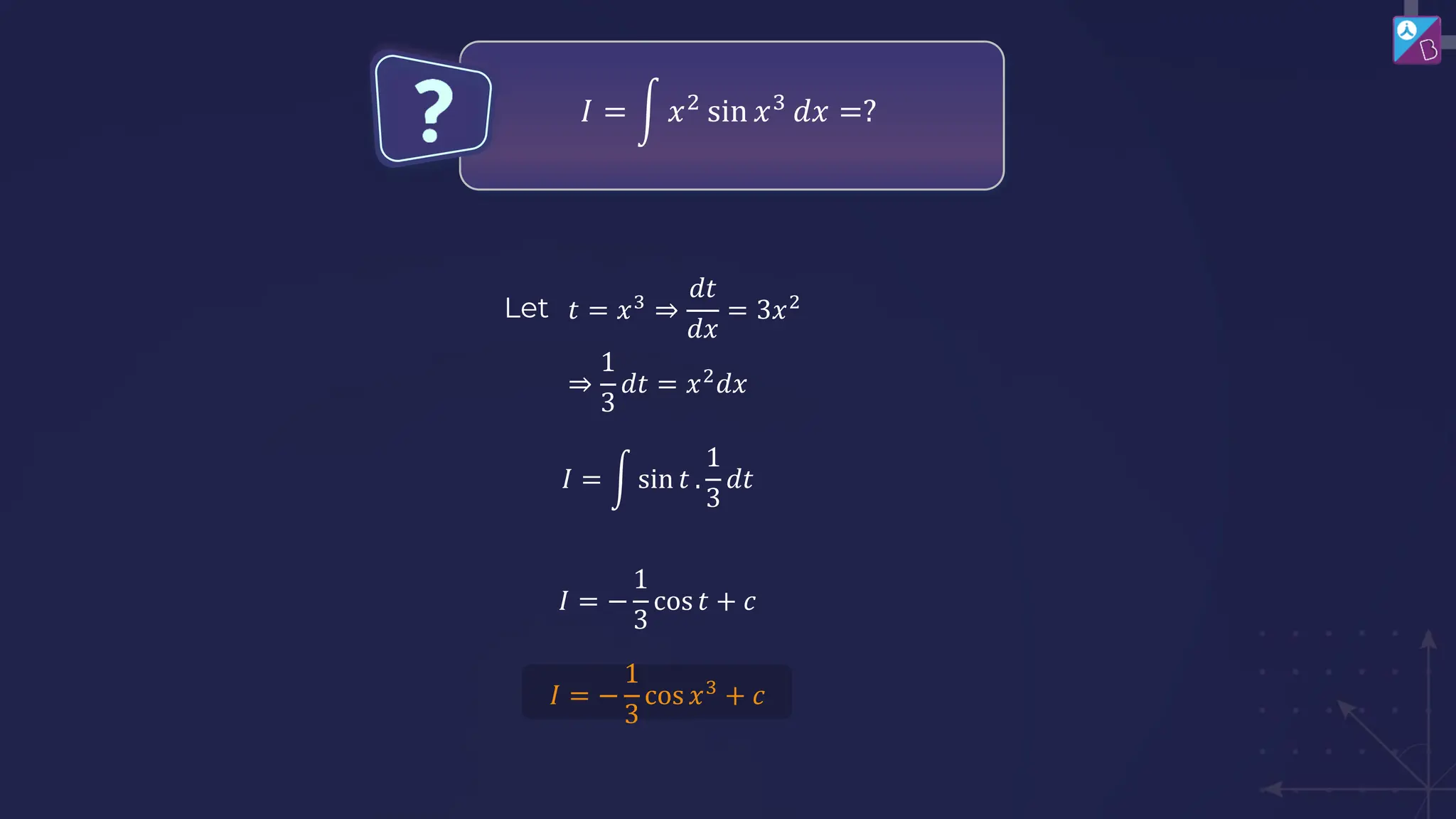
𝐼 = න 𝑥2
sin 𝑥3
𝑑𝑥 =?
𝑡 = 𝑥3
⇒
𝑑𝑡
𝑑𝑥
= 3𝑥2
Let
⇒
1
3
𝑑𝑡 = 𝑥2
𝑑𝑥
𝐼 = න sin 𝑡 .
1
3
𝑑𝑡
𝐼 = −
1
3
cos 𝑡 + 𝑐
𝐼 = −
1
3
cos 𝑥3
+ 𝑐
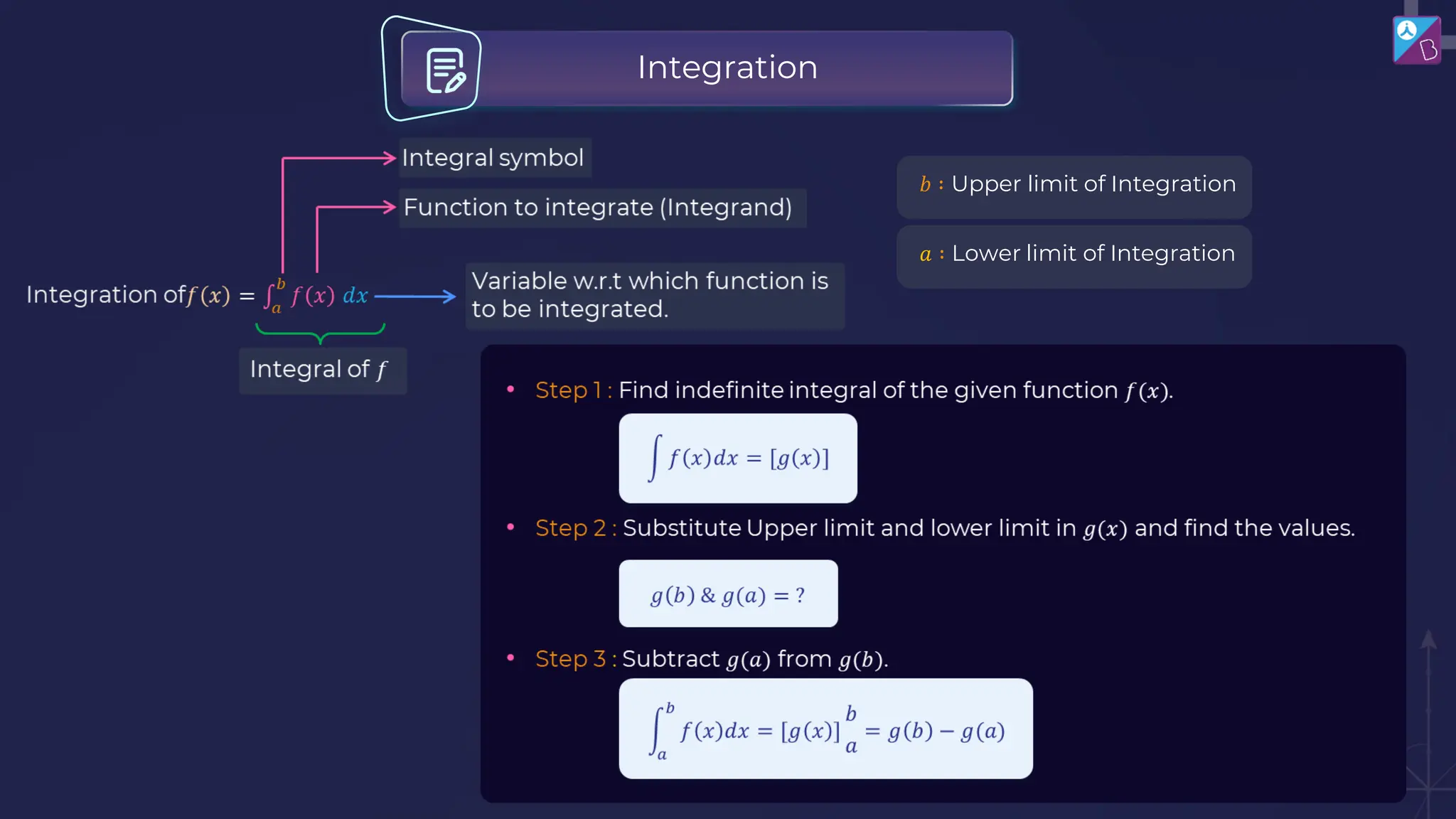
Integration
𝑏 ∶ Upper limit of Integration
𝑎 ∶ Lower limit of Integration
Find the value of
A
B
C
D
ln 2 + 𝐶
ln 2
ln 2 + 1 + 𝐶
ln 2 + 1
ŕśą
1
2
1
𝑥
𝑑𝑥
ŕśą
1
2
1
𝑥
𝑑𝑥 = [ln 𝑥 ]1
2
= ln(2)
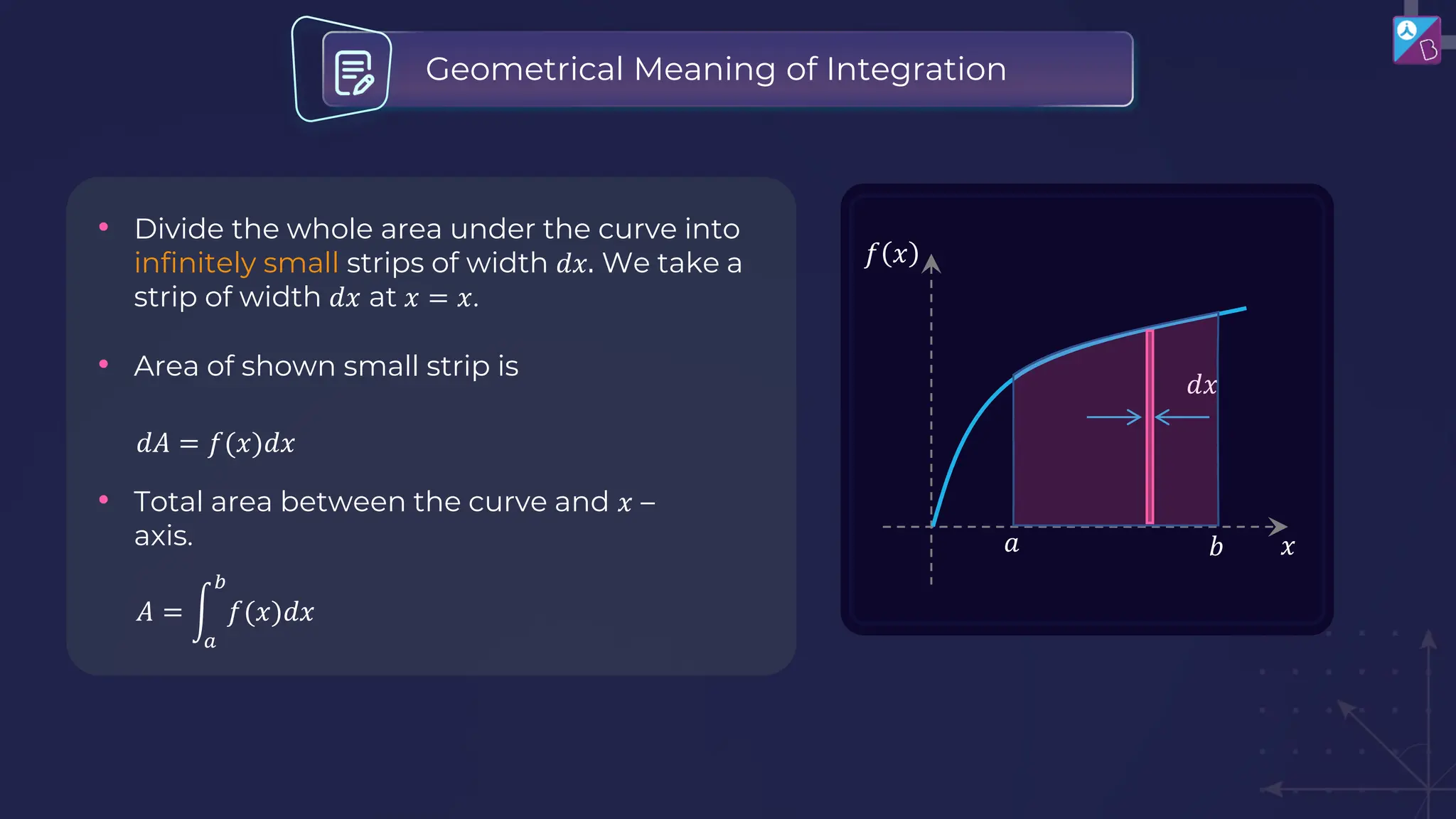
• Divide the whole area under the curve into
infinitely small strips of width 𝑑𝑥. We take a
strip of width 𝑑𝑥 at 𝑥 = 𝑥.
• Area of shown small strip is
𝑑𝐴 = 𝑓(𝑥)𝑑𝑥
• Total area between the curve and 𝑥 –
axis.
𝐴 = න
𝑎
𝑏
𝑓(𝑥)𝑑𝑥
Geometrical Meaning of Integration
𝑓 𝑥
𝑥
𝑑𝑥
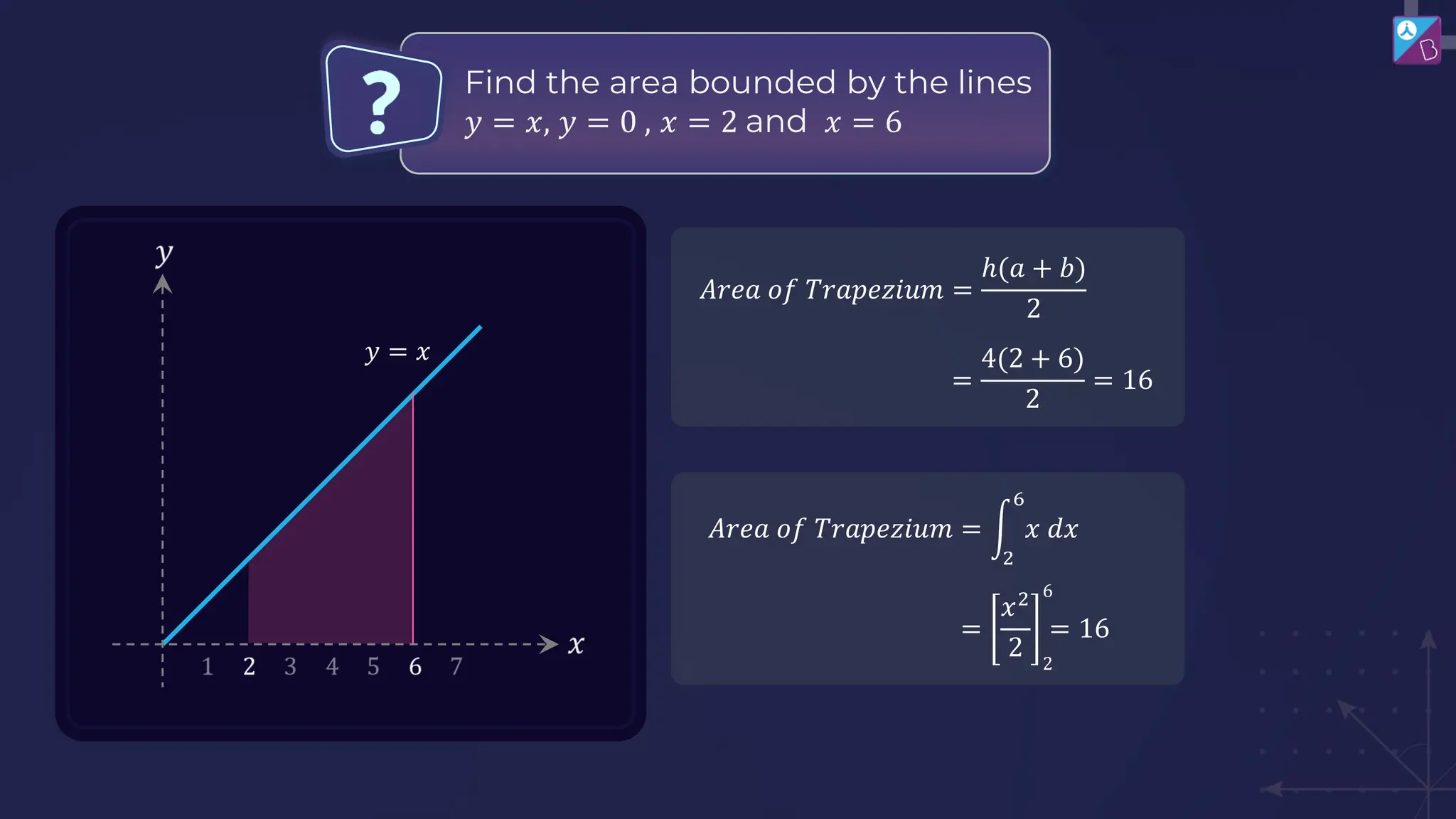
𝑎 𝑏
𝐴𝑟𝑒𝑎 𝑜𝑓 𝑇𝑟𝑎𝑝𝑒𝑧𝑖𝑢𝑚 =
ℎ(𝑎 + 𝑏)
2
=
4(2 + 6)
2
= 16
𝐴𝑟𝑒𝑎 𝑜𝑓 𝑇𝑟𝑎𝑝𝑒𝑧𝑖𝑢𝑚 = න
2
6
𝑥 𝑑𝑥
=
𝑥2
2
= 16
6
2
Find the area bounded by the lines
𝑦 = 𝑥, 𝑦 = 0 , 𝑥 = 2 and 𝑥 = 6
𝑦 = 𝑥
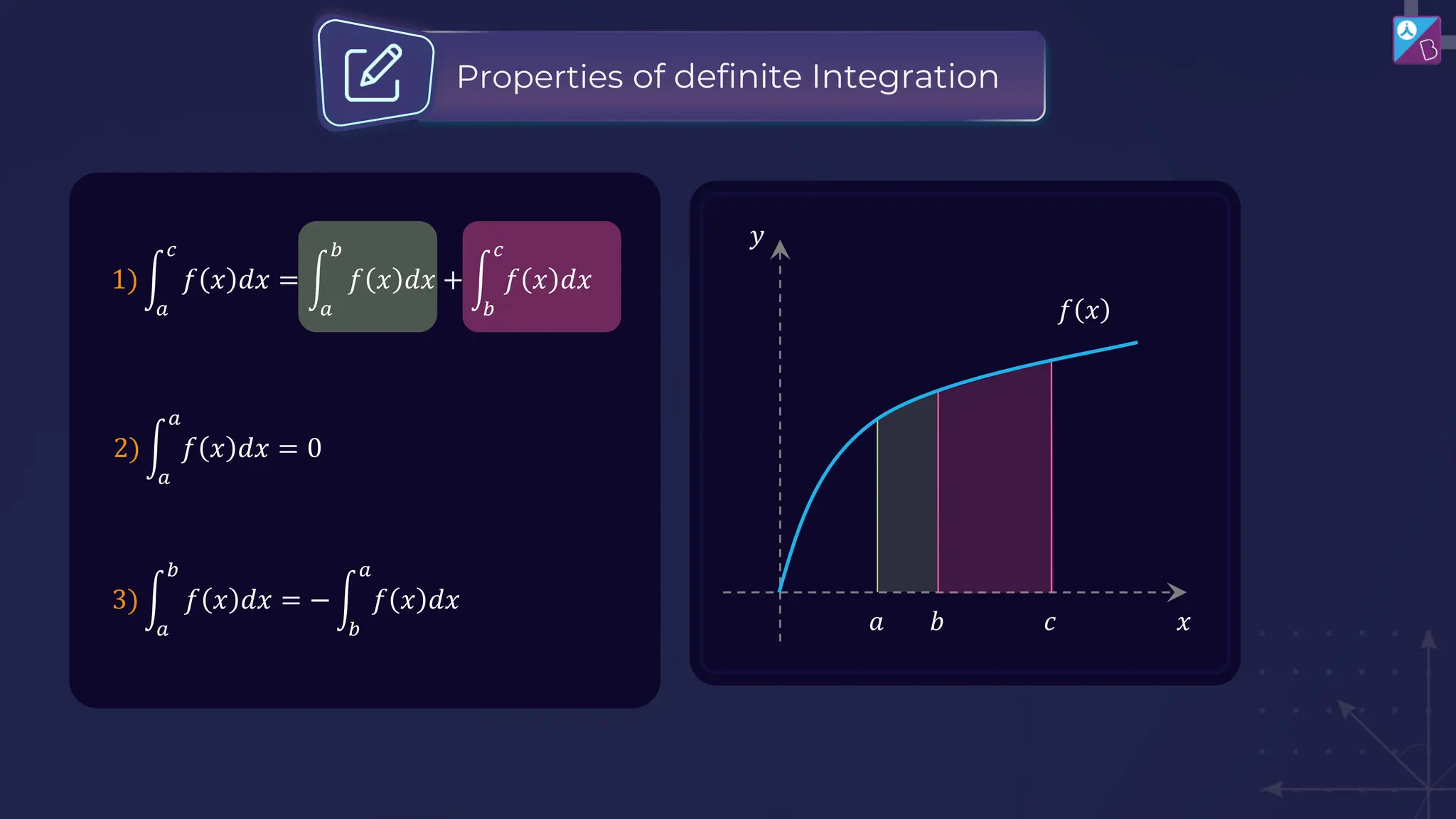
1) ŕśą
𝑎
𝑐
𝑓 𝑥 𝑑𝑥 = න
𝑎
𝑏
𝑓 𝑥 𝑑𝑥 + න
𝑏
𝑐
𝑓 𝑥 𝑑𝑥
Properties of definite Integration
2) ŕśą
𝑎
𝑎
𝑓 𝑥 𝑑𝑥 = 0
3) ŕśą
𝑎
𝑏
𝑓 𝑥 𝑑𝑥 = − න
𝑏
𝑎
𝑓 𝑥 𝑑𝑥
𝑓 𝑥
𝑥
𝑦
𝑎 𝑏 𝑐
Evaluate the integral: ŕśą
ൗ
−𝜋
2
ൗ
𝜋
2
cos 𝑥 𝑑𝑥
A 2 B 4
C 0 D 3
ŕśą
1
4
1
2 𝑥
2
𝑑𝑥 + න
4
1
1
2 𝑥
2
𝑑𝑥 =?
A 0 B 4
C 2 D 3
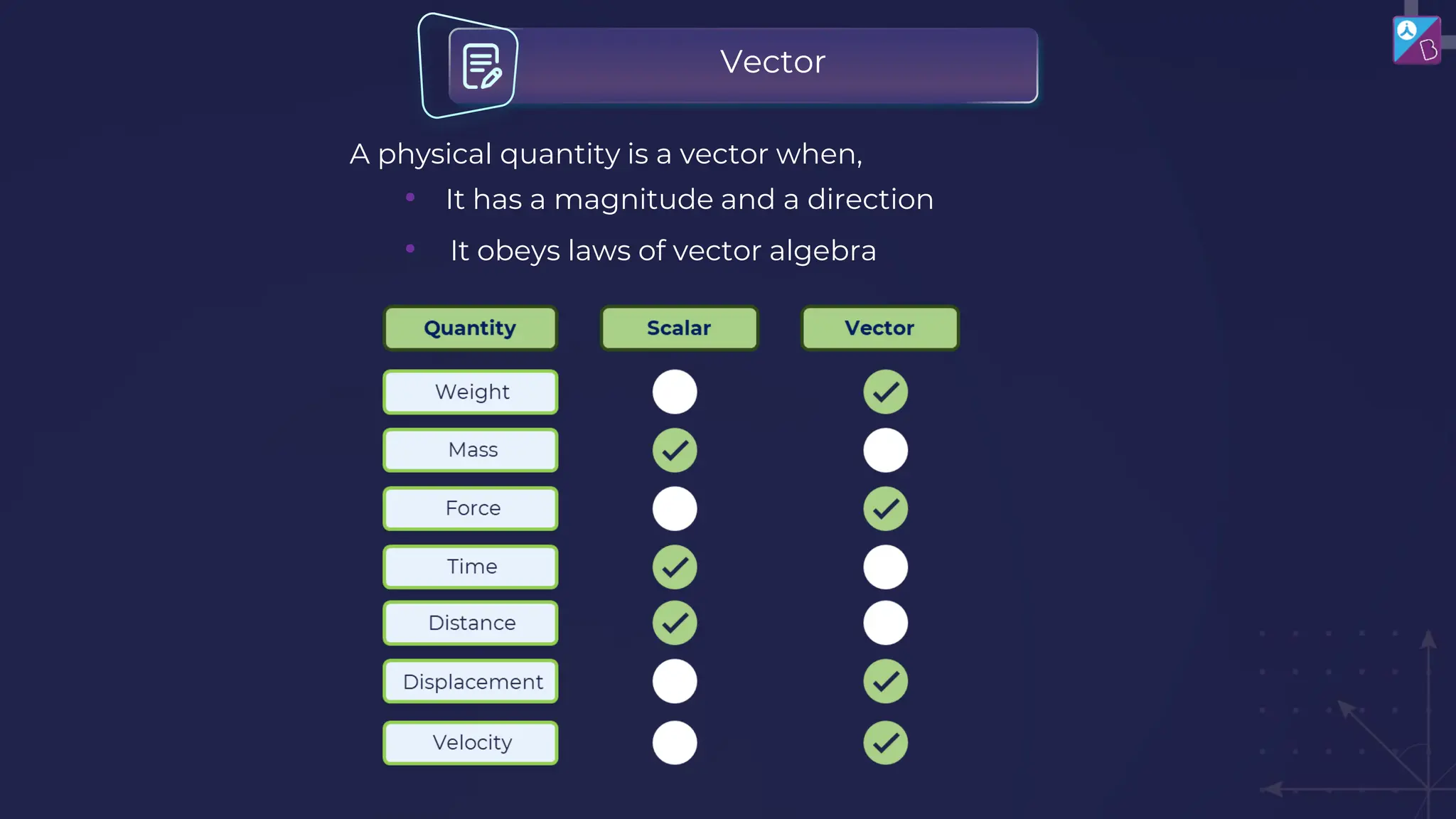
Vector
A physical quantity is a vector when,
• It has a magnitude and a direction
• It obeys laws of vector algebra
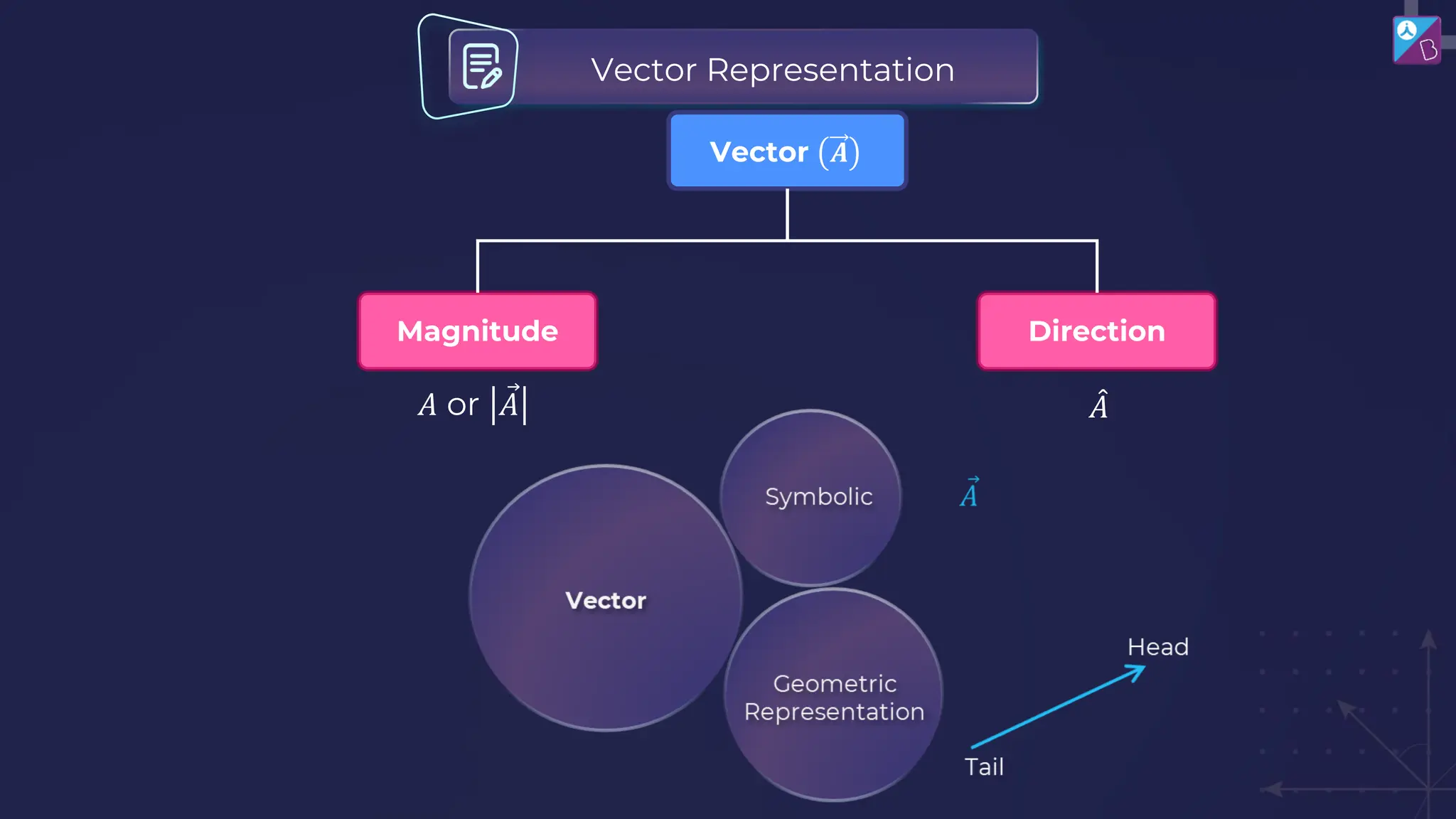
Vector Representation
Vector 𝑨
Magnitude Direction
𝐴 or Ԧ
𝐴 መ
𝐴
Vector divided by its own magnitude is a vector with unit magnitude
and in direction along the parent vector.
መ
𝐴
𝐴
Unit Vector
𝐴
|𝐴 |
= መ
𝐴
ÔŚ
𝐴 = |𝐴 | መ
𝐴
If a car has a velocity of 20 m/s in the east direction as shown in 𝐴 ?
(b) How to represent velocity vector of a girl running with 5 m/s in opposite
direction
𝐵 = − 05 መ
𝐴 𝑚/𝑠
𝐴 = 20 መ
𝐴 𝑚/𝑠
If the car’s velocity of 20 m/s along east is represented by Ԧ
𝐴, then how
can we represent velocity of a girl moving at 5 𝑚/𝑠 in the opposite
direction?
If the car’s velocity of 20 𝑚/𝑠 along east is represented by Ԧ
𝐴, then how can
we represent velocity of a girl moving at 5 𝑚/𝑠 in the opposite direction?
Cartesian Co-ordinate System
Representation of Unit Vector along Coordinate Axes
• A vector can be displaced parallel to itself as it
does not change its magnitude and direction.
• If a vector is rotated through an angle other
than multiple of 2𝜋 (or 360°) the vector
changes.
Properties of a Vector
Angle between Vectors
Step 1:
Place vectors tail to tail or head to head.
Step 2:
Measure the smaller angle i.e. angle
which is less than 180° between them.
(i) 𝐴 and 𝐵 is 60°
(ii) 𝐴 and 𝐶 is 45°
(iii) 𝐵 and 𝐶 is 105°
Three Vectors are arranged along sides of triangle as
shown. Find the angle between the vectors.
(i)
(ii)
(iii)
Multiplication of a Vector with a Scalar
Equal Vectors
• Ԧ
𝐴 = 𝐵 = Ԧ
𝐶 Equal magnitude
• መ
𝐴 = ෠
𝐵 = መ
𝐶 Same direction
Parallel vectors
Angle between any two
vectors is 0° or 180° then they
are along the same direction
or exactly opposite directions.
• 𝜃 = 0° or 180°
• Ԧ
𝐴 ≠ 𝐵
• Ԧ
𝐴 ∥ 𝐵 Null vector
• Ԧ
𝐴 = 0
If two vectors are co-linear or
parallel then one can be
expressed in the terms of
another as,
• Ԧ
𝑎 = 𝜆𝑏 (where 𝜆 is constant)
Collinear vectors
Types of Vectors
Three (or more) vectors are
called coplanar vectors if they
lie in the same plane. Two (free)
vectors can be made coplanar.
Coplanar vectors
Same in magnitude but opposite in
direction.
• መ
𝐶 = −෡
𝐷
• Ԧ
𝐶 = 𝐷
Negative of a vectors
Types of Vectors
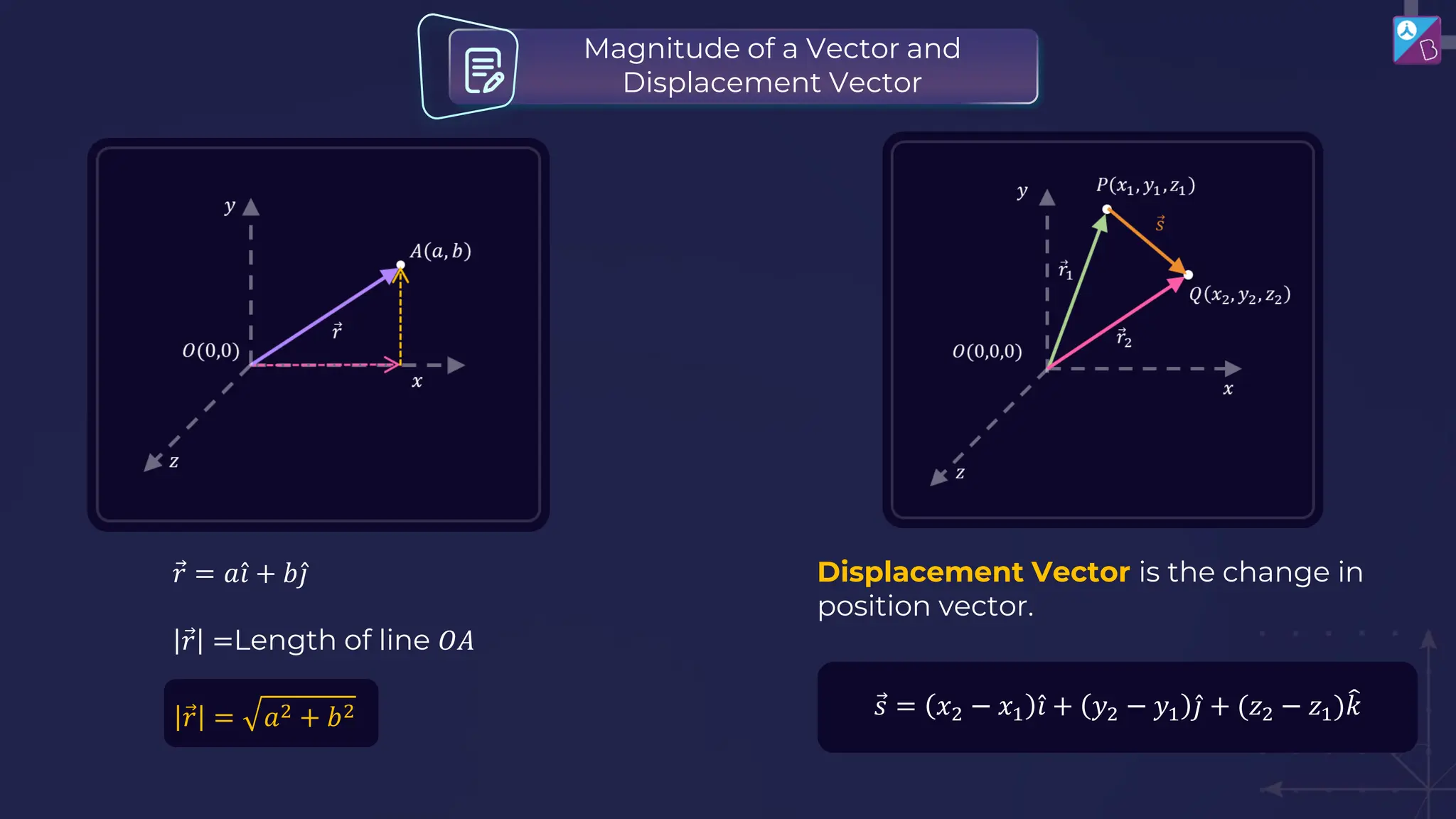
Magnitude of a Vector and
Displacement Vector
Displacement Vector is the change in
position vector.
ÔŚ
𝑠 = 𝑥2 − 𝑥1 Ƹ
𝑖 + 𝑦2 − 𝑦1 Ƹ
𝑗 + (𝑧2 − 𝑧1)෠
𝑘
ÔŚ
𝑟 = 𝑎 Ƹ
𝑖 + 𝑏 Ƹ
𝑗
ÔŚ
𝑟 =Length of line 𝑂𝐴
ÔŚ
𝑟 = 𝑎2 + 𝑏2
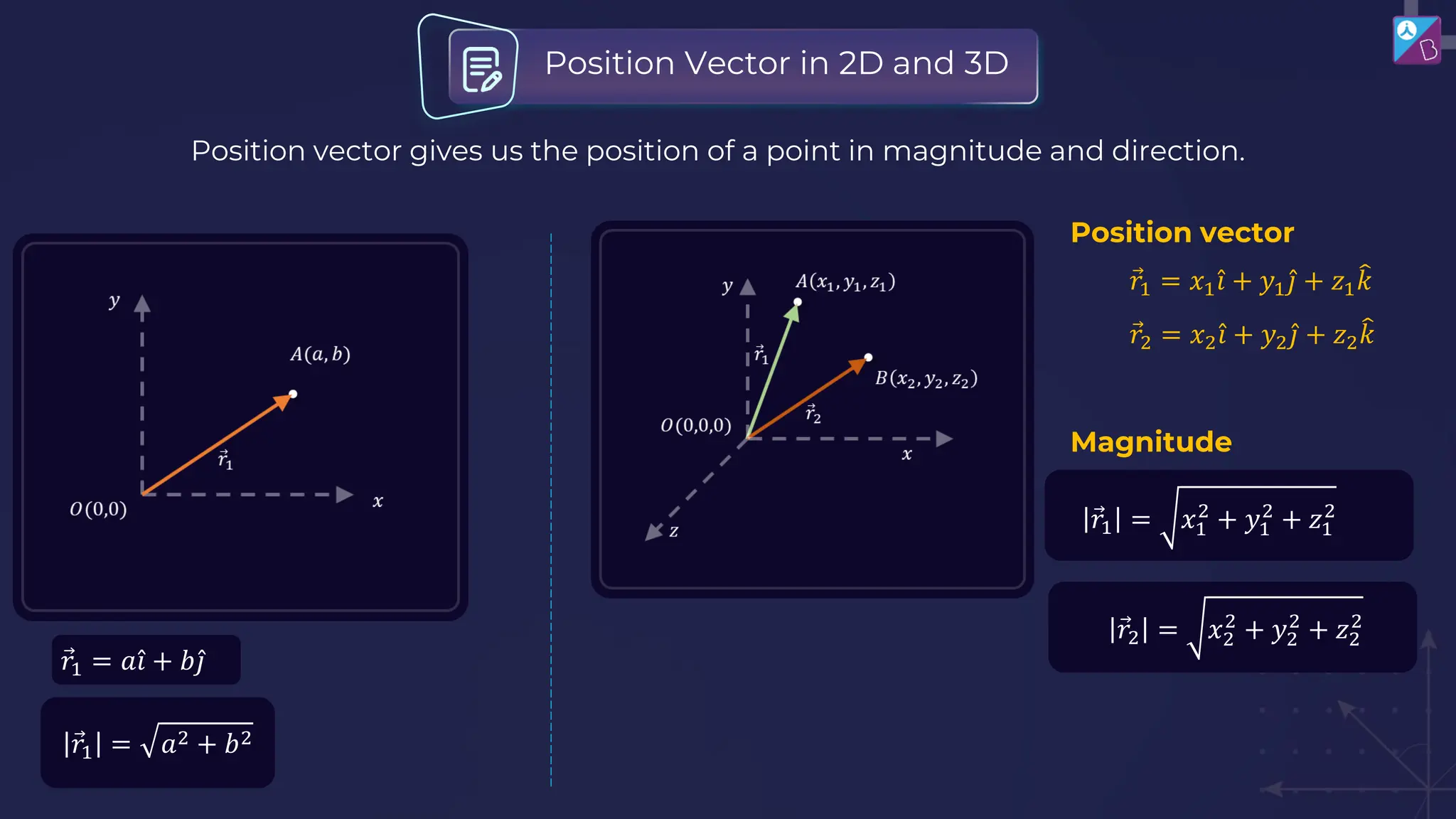
Position vector gives us the position of a point in magnitude and direction.
ÔŚ
𝑟1 = 𝑎 Ƹ
𝑖 + 𝑏 Ƹ
𝑗
Position Vector in 2D and 3D
Position vector
ÔŚ
𝑟1 = 𝑥1 Ƹ
𝑖 + 𝑦1 Ƹ
𝑗 + 𝑧1
ࡠ
𝑘
ÔŚ
𝑟2 = 𝑥2 Ƹ
𝑖 + 𝑦2 Ƹ
𝑗 + 𝑧2
ࡠ
𝑘
Magnitude
ÔŚ
𝑟1 = 𝑥1
2
+ 𝑦1
2
+ 𝑧1
2
ÔŚ
𝑟2 = 𝑥2
2
+ 𝑦2
2
+ 𝑧2
2
ÔŚ
𝑟1 = 𝑎2 + 𝑏2
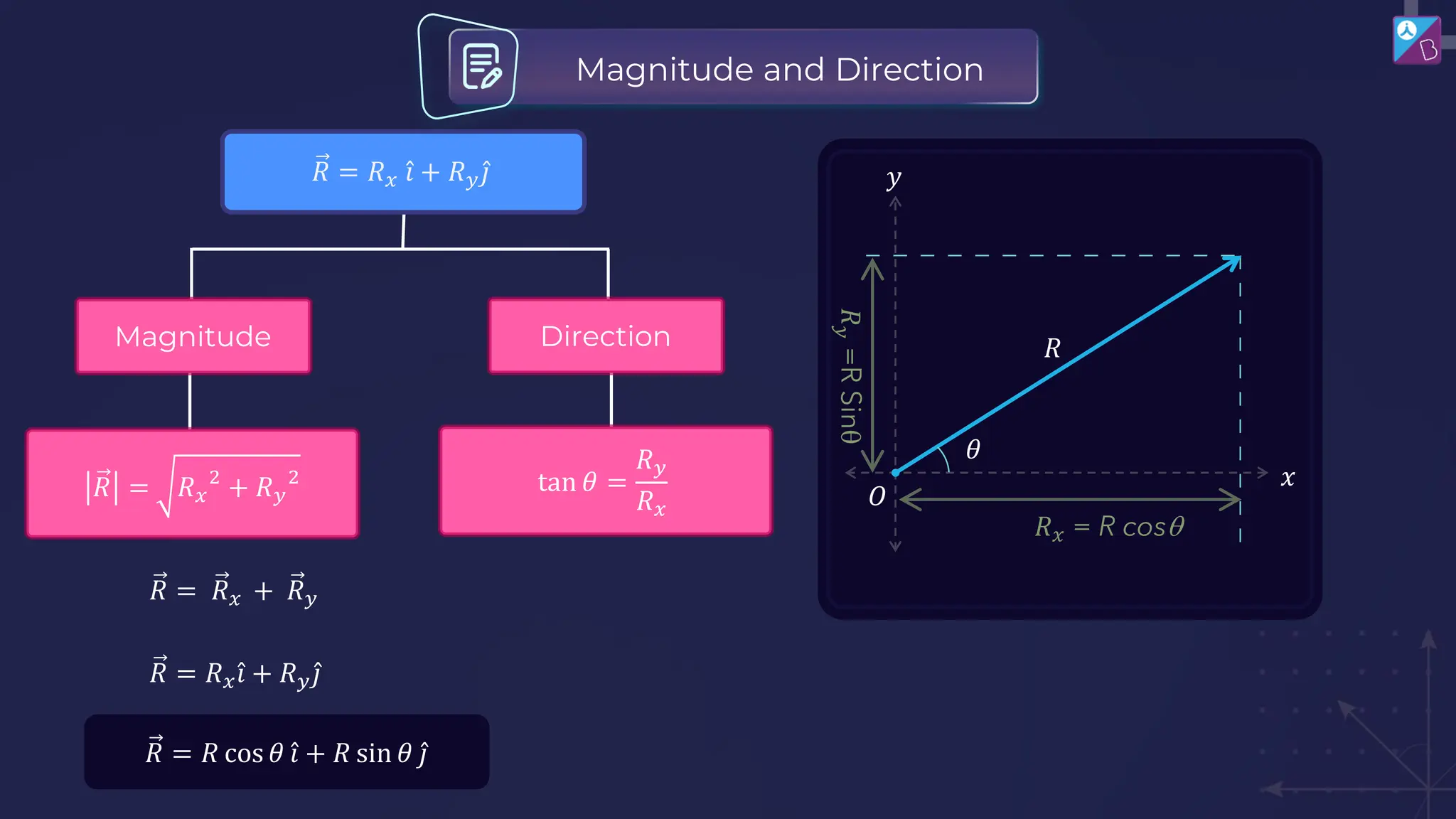
Magnitude
𝑅 = 𝑅𝑥 Ƹ
𝑖 + 𝑅𝑦 Ƹ
𝑗
Direction
𝑅 = 𝑅𝑥
2
+ 𝑅𝑦
2 tan 𝜃 =
𝑅𝑦
𝑅𝑥
𝑦
𝑥
𝑅
𝑂
𝜃
Magnitude and Direction
𝑅 = 𝑅𝑥 + 𝑅𝑦
𝑅 = 𝑅𝑥 Ƹ
𝑖 + 𝑅𝑦 Ƹ
𝑗
𝑅 = 𝑅 cos 𝜃 Ƹ
𝑖 + 𝑅 sin 𝜃 Ƹ
𝑗
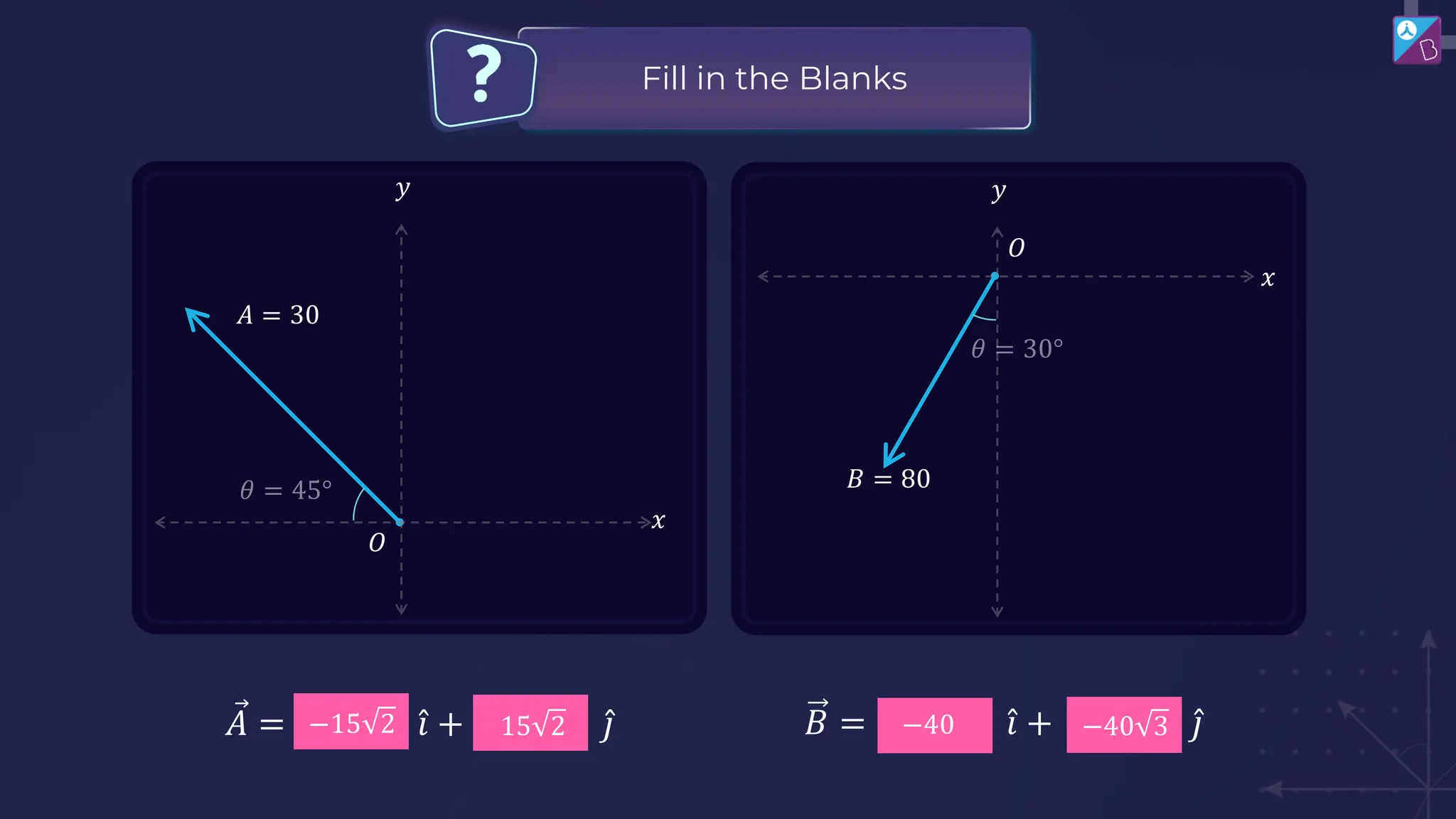
𝑦
𝑥
𝐴 = 30
𝑂
𝑦
𝐵 = 80
𝑂
Fill in the Blanks
ÔŚ
𝐴 = Ƹ
𝑖 + Ƹ
𝑗
−15 2 15 2 𝐵 = Ƹ
𝑖 + Ƹ
𝑗
−40 −40 3
𝑥
Two friends 𝐴 and 𝐵 are running parallel to each other.
Velocity of 𝐴 is 3 Ƹ
𝑖 + 4 Ƹ
𝑗 𝑚/𝑠 and speed of 𝐵 is 20 𝑚/𝑠. Find
the velocity of 𝐵?
𝐵 = 𝐵 ෠
𝐵
𝐵 = 20 ×
3 Ƹ
𝑖 + 4 Ƹ
𝑗
5
ÔŚ
𝐴 = 32 + 42 = 5
Unit vector along ÔŚ
𝐴,
መ
𝐴 =
3 Ƹ
𝑖 + 4 Ƹ
𝑗
5
𝐵 = 12 Ƹ
𝑖 + 16 Ƹ
𝑗
መ
𝐴 = ෠
𝐵
መ
𝐴 =
ÔŚ
𝐴
ÔŚ
𝐴
Steps for vector Addition
𝑦
𝑥
ÔŚ
𝑃
𝜃
∅
𝑃𝑥
𝑄𝑦
𝑄𝑥
𝑃𝑦
𝑄
ÔŚ
𝑃 = 𝑃𝑥 Ƹ
𝑖 + 𝑃𝑦 Ƹ
𝑗
𝑄 = 𝑄𝑥 Ƹ
𝑖 + 𝑄𝑦 Ƹ
𝑗
ÔŚ
𝑃 = 𝑃 cos 𝜃 Ƹ
𝑖 + 𝑃 sin 𝜃 Ƹ
𝑗
𝑄 = 𝑄 cos 𝜙 Ƹ
𝑖 + 𝑄 sin 𝜙 Ƹ
𝑗
ÔŚ
𝑃 + 𝑄 = 𝑃𝑥 + 𝑄𝑥 Ƹ
𝑖 + 𝑃𝑦 + 𝑄𝑦 Ƹ
𝑗
ÔŚ
𝑃 + 𝑄 = 𝑃 cos 𝜃 + 𝑄 cos 𝜙 Ƹ
𝑖 + 𝑃 sin 𝜃 + 𝑄 sin 𝜙 Ƹ
𝑗
ÔŚ
𝑃 + 𝑄 =
9
2
Ƹ
𝑗 +
9 3
2
Ƹ
𝑖 + 3 Ƹ
𝑗 − 3 3 Ƹ
𝑖
ÔŚ
𝑃 + 𝑄 =
9
2
Ƹ
𝑗 + 3 Ƹ
𝑗 +
9 3
2
Ƹ
𝑖 − 3 3 Ƹ
𝑖
ÔŚ
𝑃 + 𝑄 =
15
2
Ƹ
𝑗 +
3 3
2
Ƹ
𝑖
30°
𝑦
𝑥
6
30°
3
3 3
9
9 3
2
9
2
If ÔŚ
𝑃 = 9 units and 𝑄 = 6 units, then find Ԧ
𝑃 + 𝑄.
Laws of Vector
Addition/Subtraction
Laws of Vector Addition/Subtraction
Triangle Law
Parallelogram
Law
Polygon Law
𝑅 = 𝐴2 + 𝐵2 + 2𝐴𝐵 cos 𝜃
𝑦
𝜃
𝐵
𝑅
𝐴 Ƹ
𝑖 𝑥
ÔŚ
𝐴
𝐵 sin 𝜃 Ƹ
𝑗
𝑅
𝐵 cos 𝜃 Ƹ
𝑖
𝑅 = Ԧ
𝐴 + 𝐵 = 𝐴 + 𝐵 cos 𝜃 Ƹ
𝑖 + 𝐵 sin 𝜃 Ƹ
𝑗
𝑅 = Ԧ
𝐴 + 𝐵
𝑅 = 𝐴 + 𝐵 cos 𝜃 2 + 𝐵 sin 𝜃 2
𝑅 = 𝐴2 + 𝐵2 cos2 𝜃 + 2𝐴𝐵 cos 𝜃 + 𝐵2 sin2 𝜃
Triangle Law
When two vectors with common origin
represent two adjacent sides of a
parallelogram in magnitude and direction,
then the resultant vector is represented
both in magnitude and direction by the
diagonal passing through that point.
𝑦
𝑅 = 𝐴2 + 𝐵2 + 2𝐴𝐵 cos 𝜃
Here 𝛼 is the angle between Ԧ
𝐴 and 𝑅
tan 𝛼 =
𝐵 sin 𝜃
ÔŚ
𝐴 + 𝐵 cos 𝜃
Parallelogram Law
𝑅3
𝐷
ÔŚ
𝐴
𝐵
ÔŚ
𝐶
• Join vectors in same order (head to tail).
• Resultant Vector – closing side of polygon
in opposite order
𝑅3 = Ԧ
𝐴 + 𝐵 + Ԧ
𝐶 + 𝐷
Polygon Law of Vector Addition
• Ԧ
𝐴 + 𝐵 : Ԧ
𝐴 and 𝐵 must be same physical quantities.
• Commutative Property : Ԧ
𝐴 + 𝐵 = 𝐵 + Ԧ
𝐴
• Associative Property : ( Ԧ
𝐴 + 𝐵) + Ԧ
𝐶 = Ԧ
𝐴 + (𝐵 + Ԧ
𝐶)
Properties of Vector Addition
𝜃
𝐵
𝐴
ÔŚ
𝐴. 𝐵 = 𝐴𝐵 cos 𝜃
The dot product of two vectors 𝐴 and 𝐵 is
equal to the products of their magnitude
times the cosine of angle between them.
Scalar / Dot Product
ÔŚ
𝐴. 𝐵 = Ԧ
𝐴 𝐵 cos 𝜃
𝐴 = 𝐴𝑥 Ƹ
𝑖 + 𝐴𝑦 Ƹ
𝑗 + 𝐴𝑧
ࡠ
𝑘 ,
𝐵 = 𝐵𝑥 Ƹ
𝑖 + 𝐵𝑦 Ƹ
𝑗 + 𝐵𝑧
ࡠ
𝑘
𝐴 . 𝐵 = 𝐴𝑥𝐵𝑥 + 𝐴𝑦𝐵𝑦 + 𝐴𝑧𝐵𝑧
60°
𝐵
𝐴
If 𝐴 = 2, 𝐵 = 3 and the angle between
𝐴 and 𝐵 is 60°. Find 𝐴 . 𝐵
𝐴 .𝐵 = |𝐴 ||𝐵 |cos 𝜃
= 2 × 3 × cos 60°
= 2 × 3 ×
1
2
= 3
ÔŚ
𝐴. 𝐵 = 3
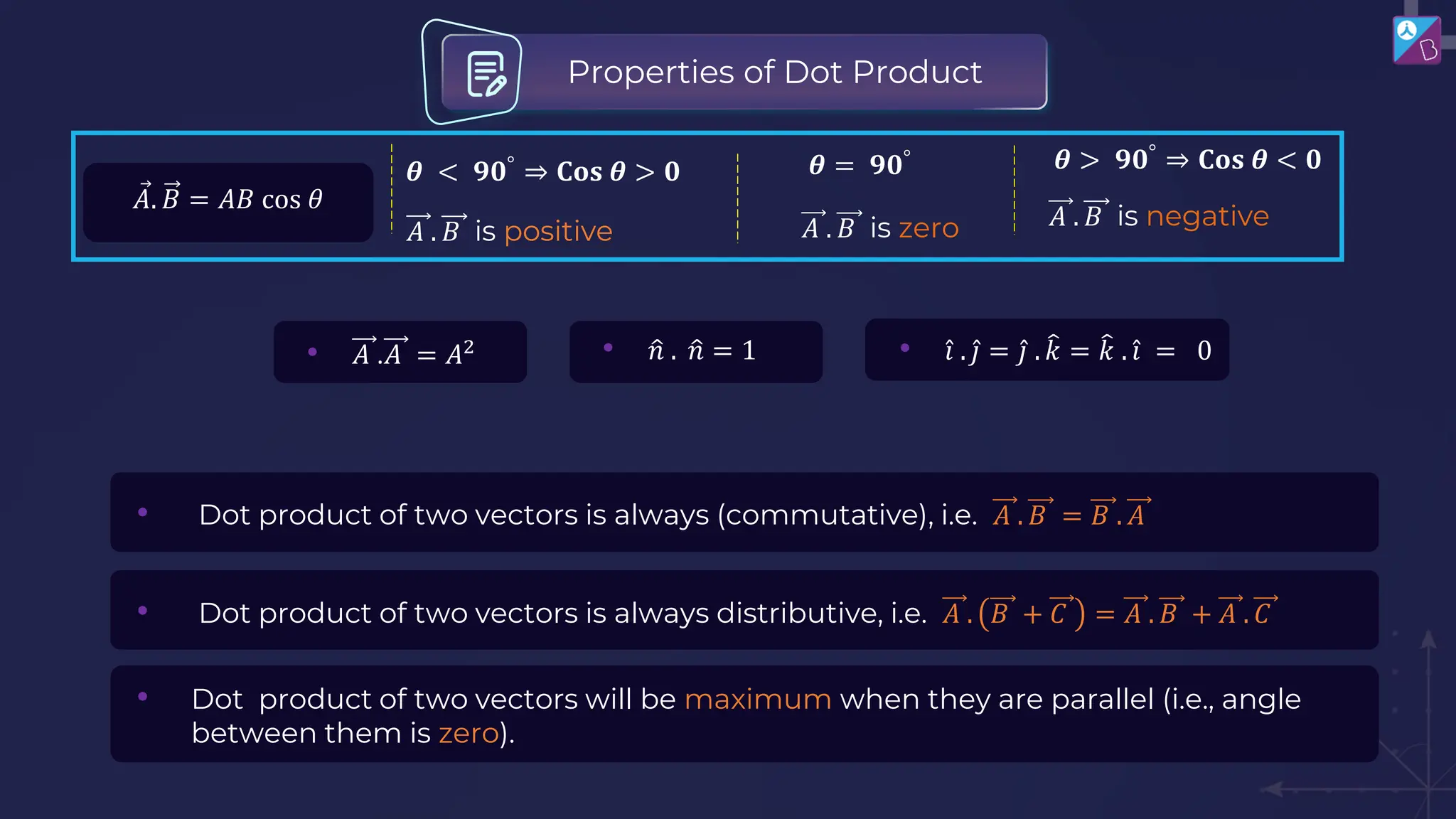
• Dot product of two vectors is always (commutative), i.e. 𝐴 . 𝐵 = 𝐵 . 𝐴
• Dot product of two vectors is always distributive, i.e. 𝐴 . 𝐵 + 𝐶 = 𝐴 . 𝐵 + 𝐴 . 𝐶
• Dot product of two vectors will be maximum when they are parallel (i.e., angle
between them is zero).
Properties of Dot Product
𝐴 . 𝐵 is positive
𝜽 < 𝟗𝟎°
⇒ 𝐂𝐨𝐬 𝜽 > 𝟎
ÔŚ
𝐴. 𝐵 = 𝐴𝐵 cos 𝜃
𝜽 = 𝟗𝟎°
𝐴 . 𝐵 is zero 𝐴 . 𝐵 is negative
𝜽 > 𝟗𝟎°
⇒ 𝐂𝐨𝐬 𝜽 < 𝟎
• 𝐴 .𝐴 = 𝐴2 • ො
𝑛 . ො
𝑛 = 1 • Ƹ
𝑖 . Ƹ
𝑗 = Ƹ
𝑗 . ෠
𝑘 = ෠
𝑘 . Ƹ
𝑖 = 0
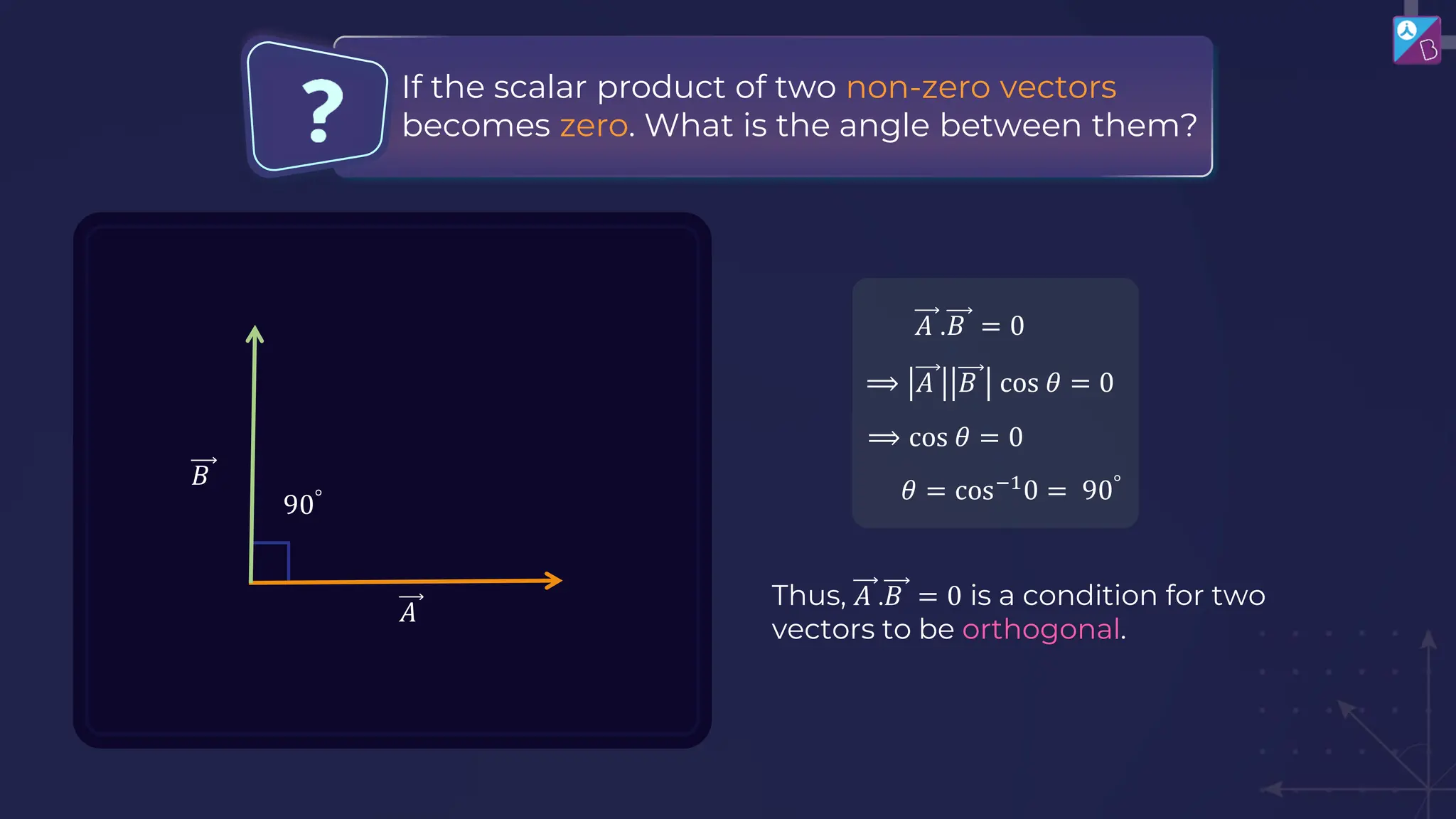
𝐴 .𝐵 = 0
⟹ 𝐴 𝐵 cos 𝜃 = 0
⟹ cos 𝜃 = 0
𝜃 = cos−1
0 = 90°
𝐴
𝐵
90°
Thus, 𝐴 .𝐵 = 0 is a condition for two
vectors to be orthogonal.
If the scalar product of two non-zero vectors
becomes zero. What is the angle between them?
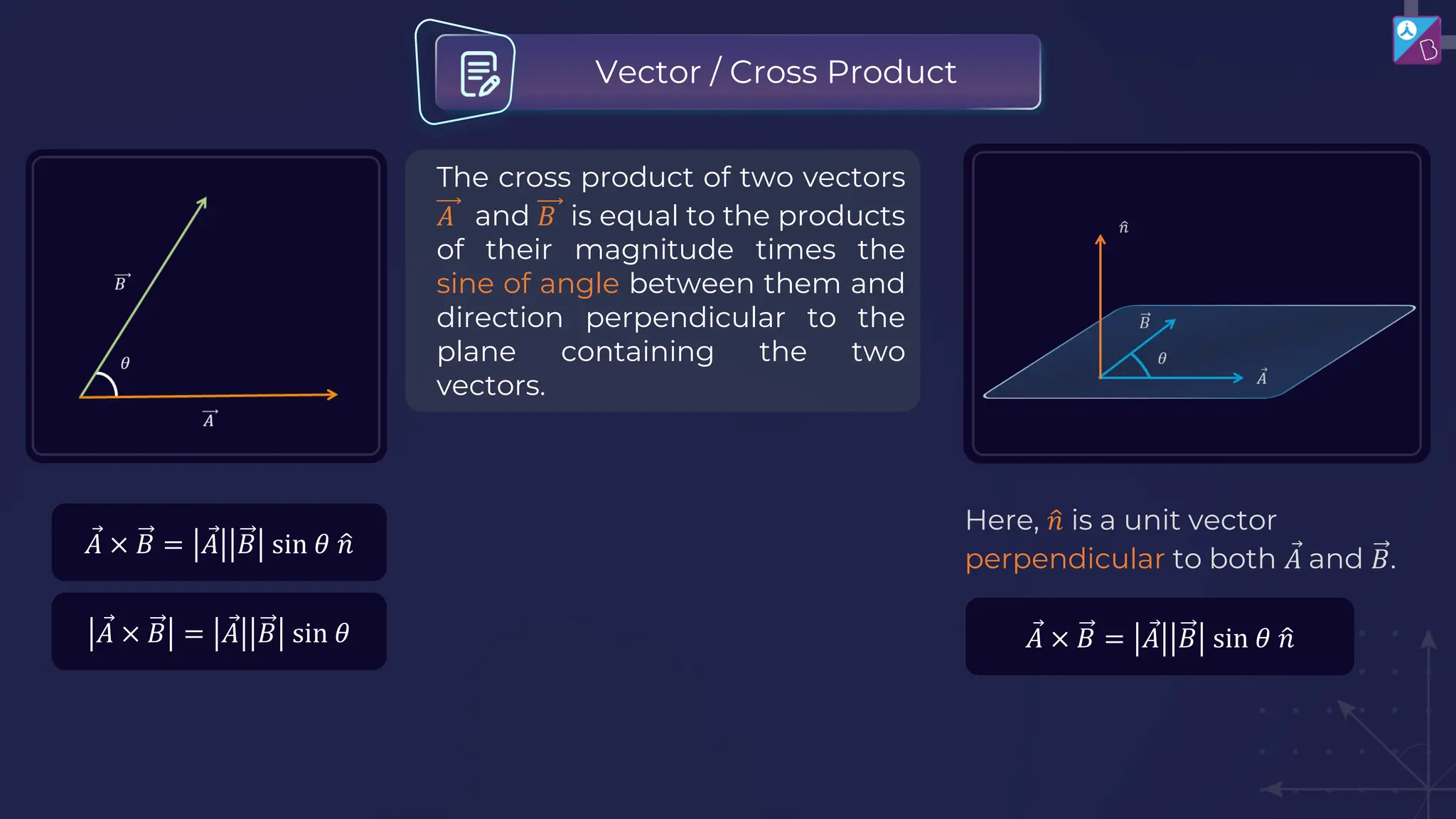
The cross product of two vectors
𝐴 and 𝐵 is equal to the products
of their magnitude times the
sine of angle between them and
direction perpendicular to the
plane containing the two
vectors.
ÔŚ
𝐴 × 𝐵 = Ԧ
𝐴 𝐵 sin 𝜃 ො
𝑛
ÔŚ
𝐴 × 𝐵 = Ԧ
𝐴 𝐵 sin 𝜃
Vector / Cross Product
Here, ො
𝑛 is a unit vector
perpendicular to both ÔŚ
𝐴 and 𝐵.
ÔŚ
𝐴 × 𝐵 = Ԧ
𝐴 𝐵 sin 𝜃 ො
𝑛
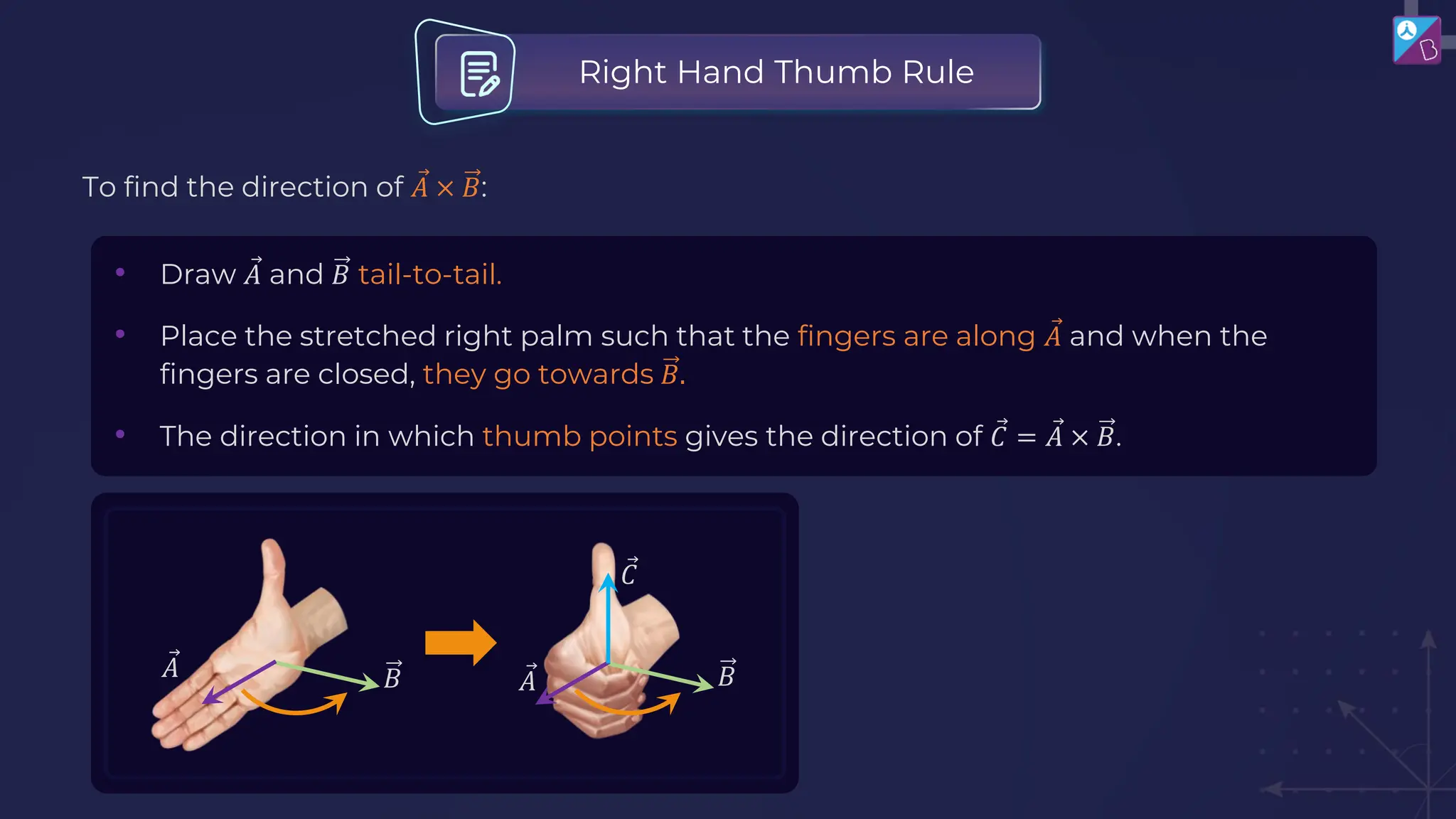
To find the direction of ÔŚ
𝐴 × 𝐵:
• Draw Ԧ
𝐴 and 𝐵 tail-to-tail.
• Place the stretched right palm such that the fingers are along Ԧ
𝐴 and when the
fingers are closed, they go towards 𝐵.
• The direction in which thumb points gives the direction of Ԧ
𝐶 = Ԧ
𝐴 × 𝐵.
Right Hand Thumb Rule
ÔŚ
𝐴 𝐵 Ԧ
𝐴 𝐵
ÔŚ
𝐶
ÔŚ
𝐴 × 𝐵 = Ԧ
𝐴 𝐵 sin 𝜃
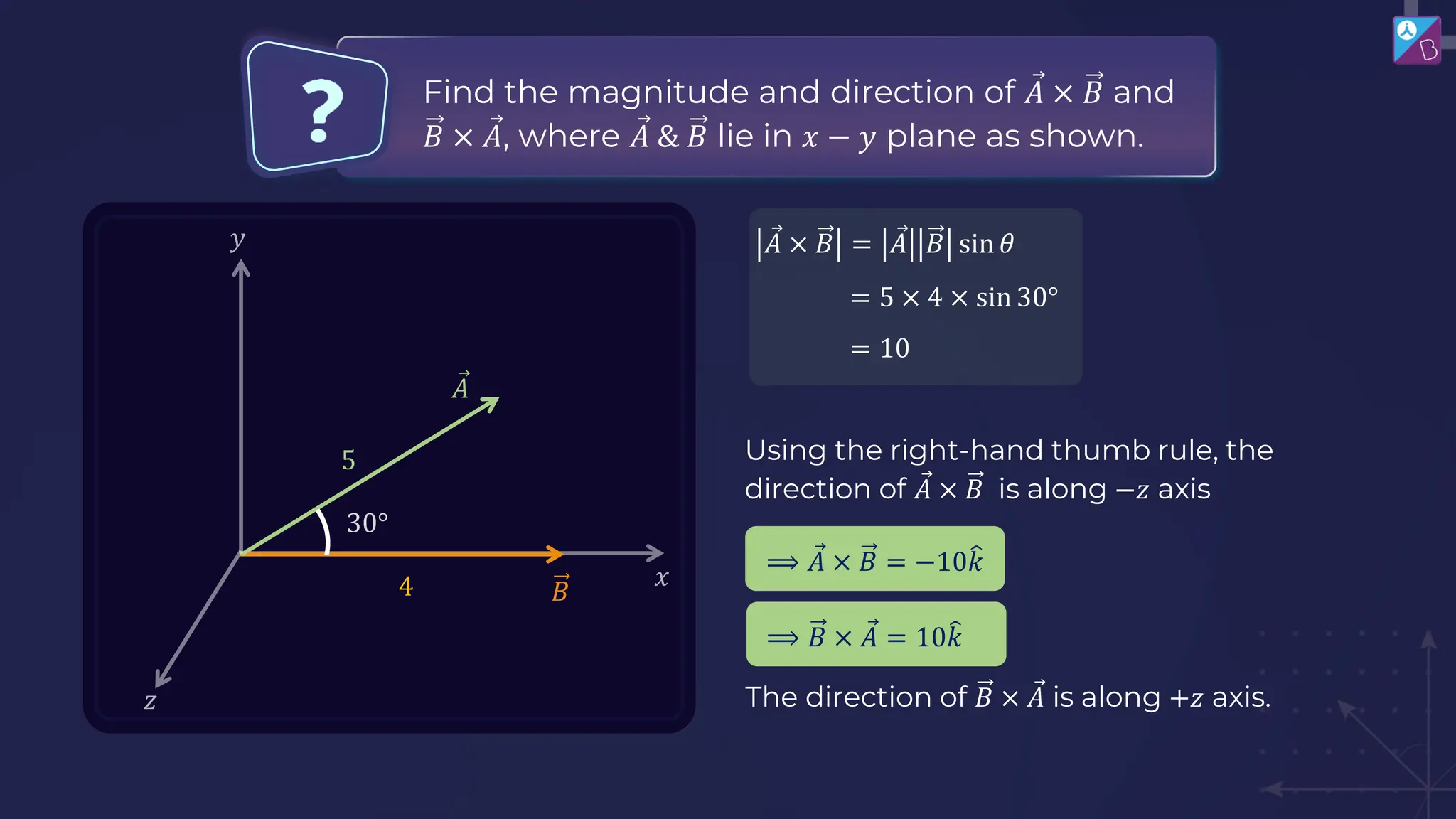
= 5 × 4 × sin 30°
= 10
Using the right-hand thumb rule, the
direction of ÔŚ
𝐴 × 𝐵 is along −𝑧 axis
Find the magnitude and direction of ÔŚ
𝐴 × 𝐵 and
𝐵 × Ԧ
𝐴, where Ԧ
𝐴 & 𝐵 lie in 𝑥 − 𝑦 plane as shown.
The direction of 𝐵 × Ԧ
𝐴 is along +𝑧 axis.
⟹ Ԧ
𝐴 × 𝐵 = −10෠
𝑘
⟹ 𝐵 × Ԧ
𝐴 = 10෠
𝑘
ÔŚ
𝐴
𝐵
30°
4
5
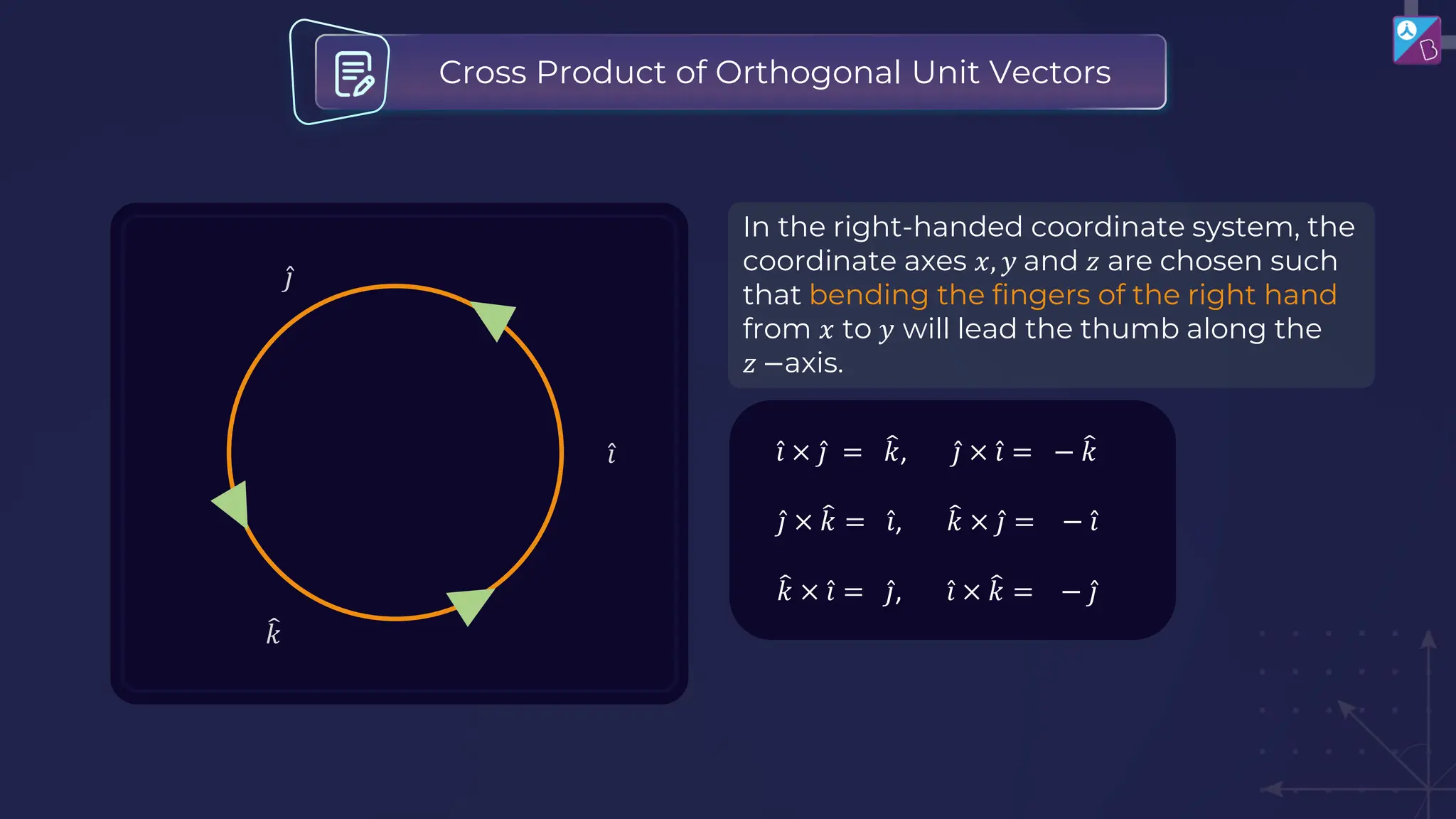
In the right-handed coordinate system, the
coordinate axes 𝑥, 𝑦 and 𝑧 are chosen such
that bending the fingers of the right hand
from 𝑥 to 𝑦 will lead the thumb along the
𝑧 −axis.
Ƹ
𝑖
Ƹ
𝑗
ࡠ
𝑘
Ƹ
𝑖 × Ƹ
𝑗 = ෠
𝑘, Ƹ
𝑗 × Ƹ
𝑖 = − ෠
𝑘
Ƹ
𝑗 × ෠
𝑘 = Ƹ
𝑖, ෠
𝑘 × Ƹ
𝑗 = − Ƹ
𝑖
ࡠ
𝑘 × Ƹ
𝑖 = Ƹ
𝑗, Ƹ
𝑖 × ෠
𝑘 = − Ƹ
𝑗
Cross Product of Orthogonal Unit Vectors
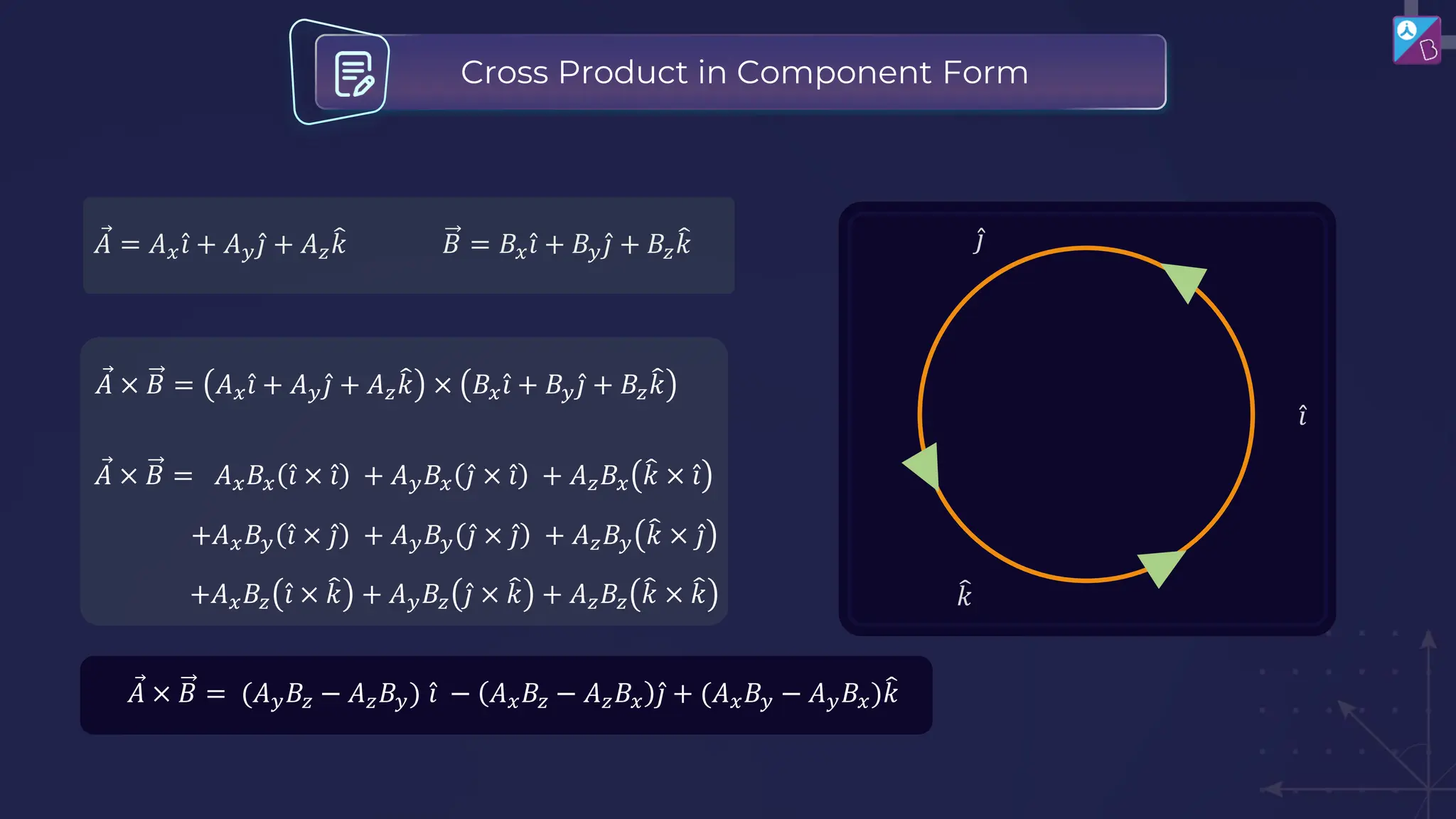
Cross Product in Component Form
ÔŚ
𝐴 × 𝐵 = 𝐴𝑥 Ƹ
𝑖 + 𝐴𝑦 Ƹ
𝑗 + 𝐴𝑧
ࡠ
𝑘 × 𝐵𝑥 Ƹ
𝑖 + 𝐵𝑦 Ƹ
𝑗 + 𝐵𝑧
ࡠ
𝑘
ÔŚ
𝐴 × 𝐵 = 𝐴𝑥𝐵𝑥 Ƹ
𝑖 × Ƹ
𝑖 + 𝐴𝑦𝐵𝑥 Ƹ
𝑗 × Ƹ
𝑖 + 𝐴𝑧𝐵𝑥
ࡠ
𝑘 × Ƹ
𝑖
+𝐴𝑥𝐵𝑦 Ƹ
𝑖 × Ƹ
𝑗 + 𝐴𝑦𝐵𝑦 Ƹ
𝑗 × Ƹ
𝑗 + 𝐴𝑧𝐵𝑦
ࡠ
𝑘 × Ƹ
𝑗
+𝐴𝑥𝐵𝑧 Ƹ
𝑖 × ෠
𝑘 + 𝐴𝑦𝐵𝑧 Ƹ
𝑗 × ෠
𝑘 + 𝐴𝑧𝐵𝑧
ࡠ
𝑘 × ෠
𝑘
ÔŚ
𝐴 × 𝐵 = (𝐴𝑦𝐵𝑧 − 𝐴𝑧𝐵𝑦) Ƹ
𝑖 − 𝐴𝑥𝐵𝑧 − 𝐴𝑧𝐵𝑥 Ƹ
𝑗 + (𝐴𝑥𝐵𝑦 − 𝐴𝑦𝐵𝑥)෠
𝑘
Ƹ
𝑖
Ƹ
𝑗
ࡠ
𝑘
ÔŚ
𝐴 = 𝐴𝑥 Ƹ
𝑖 + 𝐴𝑦 Ƹ
𝑗 + 𝐴𝑧
ࡠ
𝑘 𝐵 = 𝐵𝑥 Ƹ
𝑖 + 𝐵𝑦 Ƹ
𝑗 + 𝐵𝑧
ࡠ
𝑘
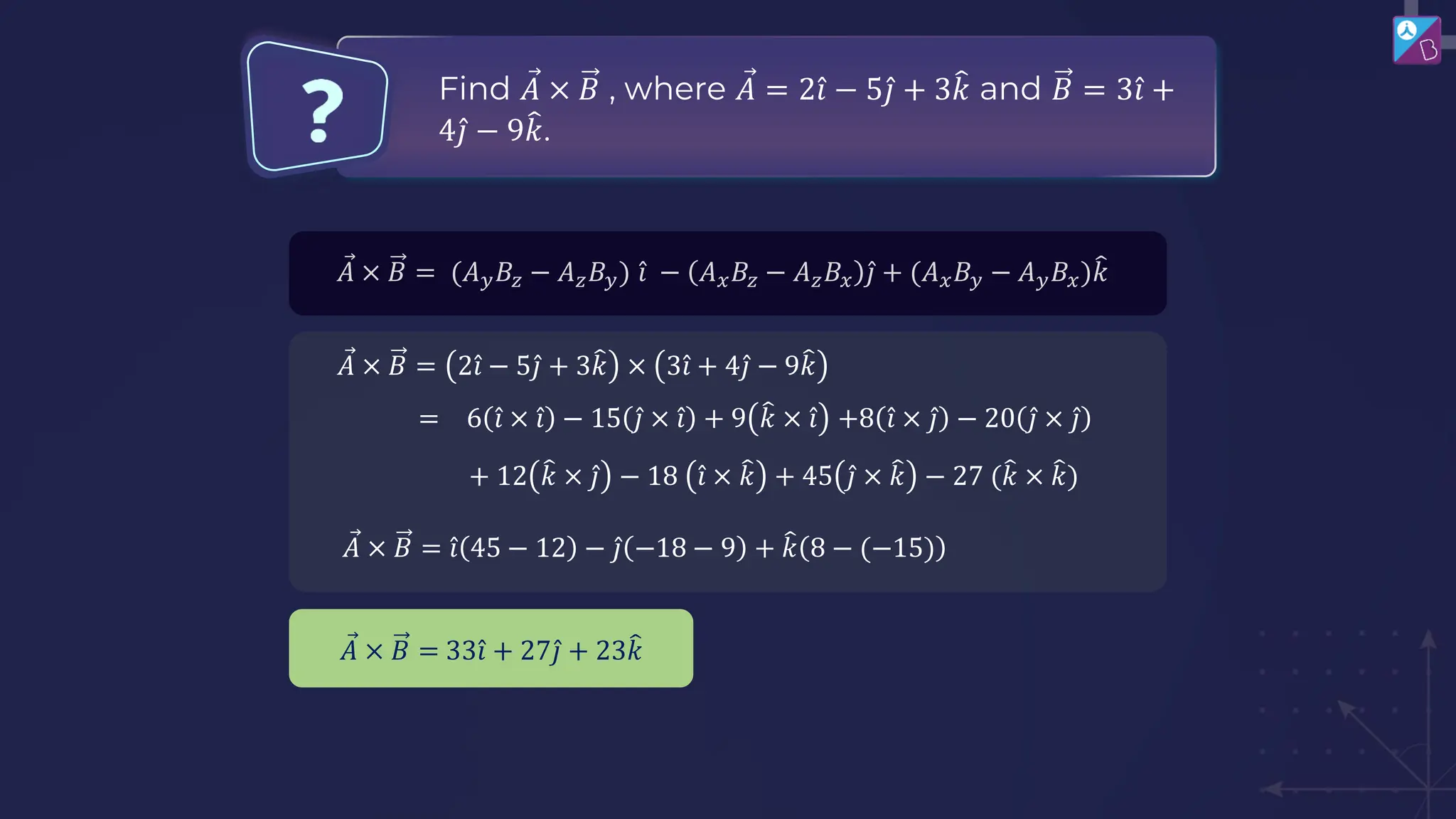
ÔŚ
𝐴 × 𝐵 = (𝐴𝑦𝐵𝑧 − 𝐴𝑧𝐵𝑦) Ƹ
𝑖 − 𝐴𝑥𝐵𝑧 − 𝐴𝑧𝐵𝑥 Ƹ
𝑗 + (𝐴𝑥𝐵𝑦 − 𝐴𝑦𝐵𝑥)෠
𝑘
ÔŚ
𝐴 × 𝐵 = 2 Ƹ
𝑖 − 5 Ƹ
𝑗 + 3෠
𝑘 × 3 Ƹ
𝑖 + 4 Ƹ
𝑗 − 9෠
𝑘
= 6 Ƹ
𝑖 × Ƹ
𝑖 − 15 Ƹ
𝑗 × Ƹ
𝑖 + 9 ෠
𝑘 × Ƹ
𝑖 +8 Ƹ
𝑖 × Ƹ
𝑗 − 20 Ƹ
𝑗 × Ƹ
𝑗
+ 12 ࡠ
𝑘 × Ƹ
𝑗 − 18 Ƹ
𝑖 × ෠
𝑘 + 45 Ƹ
𝑗 × ෠
𝑘 − 27 (෠
𝑘 × ෠
𝑘)
ÔŚ
𝐴 × 𝐵 = Ƹ
𝑖 45 − 12 − Ƹ
𝑗 −18 − 9 + ෠
𝑘 8 − (−15)
ÔŚ
𝐴 × 𝐵 = 33 Ƹ
𝑖 + 27 Ƹ
𝑗 + 23෠
𝑘
Find ÔŚ
𝐴 × 𝐵 , where Ԧ
𝐴 = 2 Ƹ
𝑖 − 5 Ƹ
𝑗 + 3෠
𝑘 and 𝐵 = 3 Ƹ
𝑖 +
4 Ƹ
𝑗 − 9෠
𝑘.

Neet class 11 12 basic mathematics notes

  • 1.
  • 2.
    Functions • Input variableis independent and output variable is dependent on it. • A function is a mathematical relationship between independent and dependent variables Algebraic Trigonometric Exponential Logarithmic Functions
  • 3.
    Polynomials 𝑦 = 𝑓𝑥 = 𝑎0 + 𝑎1𝑥1 + 𝑎2𝑥2 + 𝑎3𝑥3 + … … . 𝑎𝑛𝑥𝑛 Constants Variables = = Degree of a polynomial Highest power Maximum number of solutions Algebraic Function
  • 4.
    The graphical representationof a linear function is a straight line 1 Linear Function 𝑦 = 𝑓 𝑥 = 𝑎0 + 𝑎1𝑥1 Constants Variables = = = Degree of a polynomial Highest power Maximum number of solutions Equation of line 𝑦 = 𝑚𝑥 + 𝑐 𝑐 → 𝑦-intercept of line = tan 𝜃 = 𝑦2−𝑦1 𝑥2−𝑥1 𝑚 → Slope of line
  • 5.
    Rahul is standing4 𝑚 East and 5 𝑚 North from Ashok. Taking Ashok’s position as origin, represent Rahul’s position on the coordinate plane given below. 𝑦(𝑚) 𝑥(𝑚) Coordinates of Rahul’s position
  • 6.
    Ashok has nowmoved 1 𝑚 East and 1 𝑚 North while Rahul moved 1 𝑚 South. Calculate shortest distance between Rahul and Ashok. Shortest distance = 𝑥2 − 𝑥1 2 + 𝑦2 − 𝑦1 2 Shortest distance = 4 − 1 2 + 4 − 1 2 Shortest distance = 32 + 32 Shortest distance = 3 2 𝑚 𝑥 𝑦 1 1 Rahul→ (4,4) Ashok→ (1,1) 1
  • 7.
    Determine direction ofRahul’s position (4,4) with respect to Ashok (1,1). Slope/Direction = tan 𝜃 = 𝑦2 − 𝑦1 𝑥2 − 𝑥1 tan 𝜃 = 4 − 1 4 − 1 = 1 tan 𝜃 = tan 45° 𝜃 = 45° from +𝑣𝑒 𝑥 −axis 𝑥 𝑦 Rahul→ (4,4) Ashok→ (1,1) 𝜃
  • 8.
    Case ii :c = 0 Passing through origin 𝑥 𝑦 = 𝑥 𝑦 = −𝑥 𝑦 Case i : 𝑚 = 0 Parallel to x-axis 𝑦 = +𝑐 (0, 𝑐) 𝑦 𝑥 𝑐 Special cases
  • 9.
    𝑦 = 𝑚𝑥+ 𝑐 Straight line equation Slope - intercept 𝑥 𝑦 𝜃 𝑐 𝑦 − 𝑦1 = 𝑚(𝑥 − 𝑥1) Point - slope 𝑥 𝑦 𝜃 ( 𝑥1 , 𝑦1 ) 𝑦 − 𝑦1 = (𝑦2 − 𝑦1) (𝑥2 − 𝑥1) (𝑥 − 𝑥1) ( 𝑥 2 , 𝑦2 ) ( 𝑥1 , 𝑦1 ) Two- Point
  • 10.
    𝒚 = 𝒂𝒙𝟐 +𝒃𝒙 + 𝒄 (𝑎 ≠ 0) • Graph of 𝑦 = 𝑎𝑥2 + 𝑏𝑥 + 𝑐 is always parabolic. • If 𝑎 > 0, then parabola opens upward. • If a < 0, then parabola opens downward. Quadratic function: Root 1 : Root 2 : 𝛼 = −𝑏 − 𝑏2 − 4𝑎𝑐 2𝑎 𝛽 = −𝑏 + 𝑏2 − 4𝑎𝑐 2𝑎 𝑎𝑥2 + 𝑏𝑥 + 𝑐 = 0 Sum of roots Difference of roots Product of roots 𝛼 + 𝛽 = − 𝑏 𝑎 𝛽 − 𝛼 = 𝑏2 − 4𝑎𝑐 𝑎 𝛼𝛽 = 𝑐 𝑎 Equation in terms of roots 𝑥2 − 𝛼 + 𝛽 𝑥 + 𝛼𝛽 = 0 Quadratic Function
  • 11.
    𝑦 = 𝑎𝑥2 +𝑐 Parabola(Quadratic Curve) 𝑦 = 𝑎𝑥2 𝑦 = 𝑎𝑥2 𝑎 > 0
  • 12.
    Plane Angle inRadian 𝜽 = 𝒂𝒓𝒄 𝒍𝒆𝒏𝒈𝒕𝒉 𝒓𝒂𝒅𝒊𝒖𝒔 𝒐𝒇 𝒄𝒊𝒓𝒄𝒍𝒆 = 𝒍 𝒓 (𝒓𝒂𝒅) System - I Degree (°) Minute (′) Second (′′) System - II Radian (𝑟𝑎𝑑) 1° = 60′ 1′ = 60′′ 1° = 2𝜋 360 𝑟𝑎𝑑 𝒊) 540° = 2𝜋 × 540 360 = 3𝜋 𝑟𝑎𝑑 𝑑𝑒𝑔𝑟𝑒𝑒 𝑡𝑜 𝑟𝑎𝑑𝑖𝑎𝑛 × 2𝜋 360 𝑟𝑎𝑑𝑖𝑎𝑛 𝑡𝑜 𝑑𝑒𝑔𝑟𝑒𝑒 × 360 2𝜋 𝑖𝑖) 210° = 2𝜋 × 210 360 = 7 6 𝜋 𝑟𝑎𝑑 𝑖𝑖𝑖) 270° = 2𝜋 × 270 360 = 3 2 𝜋 𝑟𝑎𝑑
  • 13.
    Trigonometric Ratios csc 𝜃= 1 sin 𝜃 sec 𝜃 = 1 cos 𝜃 cot 𝜃 = 1 tan 𝜃 sin 𝜃 = 𝑜𝑝𝑝 ℎ𝑦𝑝 cos 𝜃 = 𝑎𝑑𝑗 ℎ𝑦𝑝 tan 𝜃 = 𝑜𝑝𝑝 𝑎𝑑𝑗 If A + B = 90°, then 𝟏. sin 𝑨 = cos 𝑩 𝟐. tan 𝑨 = cot 𝑩 𝟑. sec 𝑨 = csc 𝑩
  • 14.
    Sine, Cosine andTangent Curve Graph of 𝑦 = sin 𝑥 The period of sin 𝑥 is 2𝜋. −1 < sin 𝑥 < +1 Graph of 𝑦 = cos 𝑥 The period of cos 𝑥 is 2𝜋. −1 < cos 𝑥 < +1 Graph of 𝑦 = tan 𝑥 The period of tan 𝑥 is 𝜋. tan 𝑥 𝜖 (−∞, ∞)
  • 15.
    sin(𝐴 ± 𝐵)= sin 𝐴 cos 𝐵 ± cos 𝐴 sin 𝐵 cos(𝐴 ± 𝐵) = cos 𝐴 cos 𝐵 ∓ sin 𝐴 sin 𝐵 tan(𝐴 ± 𝐵) = tan 𝐴 ± tan 𝐵 1 ∓ tan 𝐴 tan 𝐵 Additive Multiple angle sin 2𝐴 = 2 sin 𝐴 cos 𝐴 cos 2𝐴 = cos2 𝐴 − sin2 𝐴 = 1 − 2 sin2 𝐴 = 2 cos2 𝐴 − 1 tan 2𝐴 = 2 tan 𝐴 1 – tan2 𝐴
  • 16.
    sin 90° −𝜃 = + cos 𝜃 cos 90° − 𝜃 = + sin 𝜃 tan 90° − 𝜃 = + cot 𝜃 csc 90° − 𝜃 = + sec 𝜃 sec 90° − 𝜃 = + csc 𝜃 cot 90° − 𝜃 = + tan 𝜃 sin 180° − 𝜃 = + sin 𝜃 cos 180° − 𝜃 = − cos 𝜃 tan 180° − 𝜃 = − tan 𝜃 csc 180° − 𝜃 = + csc𝜃 sec 180° − 𝜃 = − sec 𝜃 cot 180° − 𝜃 = − cot 𝜃 Summary
  • 17.
    𝑓(𝑥) = 𝑎𝑥 Where, •𝑎 → base & 𝑎 > 0 & 𝑎 ≠ 1 • 𝑥 → any real number 𝑦 = 𝑒𝑥 Euler’s number 𝑒 ≈ 2.718 Special case: Natural Exponential Function Exponential Function
  • 18.
    • y =log𝑎 𝑥 is logarithmic function where 𝑎 > 0 and 𝑎 ≠ 1 • Product Rule : log𝑎 𝑚𝑛 = log𝑎 𝑚 + log𝑎 𝑛 • Quotient Rule : log𝑎 𝑚 𝑛 = log𝑎 𝑚 − log𝑎 𝑛 • Power Rule : log𝑎 𝑚𝑛 = 𝑛 log𝑎 𝑚 • log𝑎 1 = 0 • log𝑎 0 = 𝑢𝑛𝑑𝑒𝑓𝑖𝑛𝑒𝑑 • log𝑎 𝑎 = 1 Logarithmic Function
  • 19.
    Logarithmic Function base =e, 𝑓 𝑥 = 𝑙𝑜𝑔𝑒 𝑥 = 𝑙𝑛 𝑥 base = 10, 𝑓 𝑥 = 𝑙𝑜𝑔10 𝑥 𝑎 > 0 𝑎 ≠ 1 𝑥 > 0 𝑦 = 𝑙𝑜𝑔𝑎 𝑥 𝑥 = 𝑎𝑦 Common logarithm Natural Logarithm Graph of Logarithmic Function 𝑦 = 𝑙𝑜𝑔𝑏 𝑥 b > 1 0 < b <1
  • 20.
    If log10 2= 0.3010 and log10 3 = 0.4771 then find the approximate value of log10 36. log10 36 = log10(9 × 4) = log10 9 + log10 4 = log10 32 + log10 22 = 2 log10 3 + 2 log10 2 = 2 × 0.4771 + 2 × 0.3010 = 1.5562 log10 36 = 1.5562
  • 21.
    Summary 𝑚 = tan𝜃 Tangen t Secant • The slope of a line gives the measure of its steepness and direction. • Slope is generally denoted by m. • In the case of a secant, the line intersects the curve at two points. • A tangent is defined as a line touching the circle at only one point.. 𝑥 𝑦 −𝑥 −𝑦 θ L
  • 22.
    Summary 𝑦 𝑥 𝐴 Δ𝑥 Δ𝑦 𝐵 𝜃 𝑦 𝑥 Tangent 𝜃 tan 𝜃 = 𝑦2− 𝑦1 𝑥2 − 𝑥1 = Δ𝑦 Δ𝑥 Change in y w.r.t change in x, 𝑦2 − 𝑦1 → Difference in 𝑦 𝑥2 − 𝑥1 → Difference in 𝑥 𝑥 = independent variable 𝑦 = dependent variable 𝑑𝑦 𝑑𝑥 = lim ∆𝑥→0 Δ𝑦 Δ𝑥 , Where ∆𝑥 → 0 Slope = tan 𝜃 = 𝑑𝑦 𝑑𝑥 𝑑𝑦 𝑑𝑥 = Differentiation of 𝒚 w.r.t 𝒙
  • 23.
    Differentiation • Power rulefor differentiation 𝑑 𝑑𝑥 (𝑥𝑛) = 𝑛𝑥𝑛−1 • Differentiation of any constant is zero. 𝑥 = independent variable 𝑦 = dependent variable 𝑦 𝑑𝑦 𝑑𝑥 𝑥1 1 𝑥 1 2 𝑥 4 𝑥 1 4 𝑥− 3 4 1 𝑥 − 1 𝑥2 𝑦 𝑑𝑦 𝑑𝑥 1 𝑥3 − 3 𝑥4 1 𝑥7 − 7 𝑥8 1 𝑥16 − 16 𝑥17 5 𝑥 − 5 𝑥2
  • 24.
    Trigonometric, Exponential and LogarithmicFunctions (sin 𝑥) = cos 𝑥; 𝑑 𝑑𝑥 (1) (tan 𝑥) = sec2 𝑥; 𝑑 𝑑𝑥 (3) (sec 𝑥) = sec 𝑥 tan 𝑥 𝑑 𝑑𝑥 (5) (𝑐𝑜𝑠𝑒𝑐 𝑥) = − cosec 𝑥 cot 𝑥 𝑑 𝑑𝑥 (6) (cot 𝑥) = − cosec2 𝑥 𝑑 𝑑𝑥 (4) (cos 𝑥) = − sin 𝑥; 𝑑 𝑑𝑥 (2) Exponential Functions Trigonometric 𝑑 𝑑𝑥 𝑒𝑥 = 𝑒𝑥 Logarithmic 𝑑 𝑑𝑥 ln 𝑥 = 1 𝑥 𝑑 𝑑𝑥 𝑐 = 0 𝑑 𝑑𝑥 𝑘𝑥 = 𝑘 Constant
  • 25.
    Summary • Derivative ofconstant times a function 𝑑 𝑑𝑥 𝑎𝑓 𝑥 = 𝑎 𝑑𝑓 𝑥 𝑑𝑥 • Derivative of a sum or a difference of two functions • Derivative of a constant term 𝒅 𝒅𝒙 𝒂 = 𝟎 𝒅 𝒅𝒙 𝒇 𝒙 ± 𝒈(𝒙) = 𝒅𝒇 𝒙 𝒅𝒙 ± 𝒅𝒈 𝒙 𝒅𝒙
  • 26.
    360° 270° 180° 90° -90° -180° -270° -360° -2π 2π 3π/2 π π/2 0 -π/2 -π -3π/2 0 1 0. 5 -0.5 -1 𝑦 =sin 𝑥 x 𝐴 𝐵 360° 270° 180° 90° -90° -180° -270° -360° 𝑦 = cos 𝑥 x -2π 2π 3π/2 π π/2 0 -π/2 -π -3π/2 1 0. 5 -0.5 -1 0 𝐴 𝐵 𝑦 = sin 𝑥 𝑑𝑦 𝑑𝑥 = cos 𝑥
  • 27.
    A C D 2 𝑐𝑜𝑠𝑥 − 6 sec tan 𝑥 2 sin 𝑥 − 6 sec 𝑥 tan 𝑥 2 sin 𝑥 − 6 sec 𝑥 tan 𝑥 Differentiate f (𝑥) = 2 cos (𝑥) − 6 sec (𝑥) + 3 𝑑 𝑑𝑥 cot 𝑥 = − csc2 𝑥 𝑑 𝑑𝑥 (sec 𝑥) = sec 𝑥 tan 𝑥 𝑑 𝑑𝑥 csc 𝑥 = − csc 𝑥 cot 𝑥 𝑑 𝑑𝑥 (sin 𝑥) = cos 𝑥 𝑑 𝑑𝑥 (tan 𝑥) = sec2 𝑥 𝑑 𝑑𝑥 cos 𝑥 = − sin 𝑥 B −2 sin 𝑥 − 6 sec 𝑥 tan 𝑥
  • 28.
    𝑑 𝑓 𝑥. 𝑔(𝑥) 𝑑𝑥 = 𝑑𝑓 𝑥 𝑑𝑥 𝑔 𝑥 + 𝑑𝑔 𝑥 𝑑𝑥 𝑓 𝑥 = 𝑓′ 𝑥 𝑔 𝑥 + 𝑔′ 𝑥 𝑓(𝑥) Product Rule Example: 𝑄1. 𝑦 = 𝑥 sin 𝑥 𝑑𝑦 𝑑𝑥 = 𝑥 sin 𝑥 ′ + sin 𝑥 (𝑥)′ 𝑑𝑦 𝑑𝑥 = 𝑥 cos 𝑥 + sin 𝑥 𝑄2. 𝑦 = 𝑥3 sin 𝑥 𝑑𝑦 𝑑𝑥 = 𝑥3 sin 𝑥 ′ + sin 𝑥 (𝑥3 )′ 𝑑𝑦 𝑑𝑥 = 𝑥3 cos 𝑥 + 3𝑥2 sin 𝑥 𝑄3. 𝑦 = 𝑥2 𝑒𝑥 𝑑𝑦 𝑑𝑥 = 𝑥2 𝑒𝑥 ′ + 𝑒𝑥 (𝑥2 )′ 𝑑𝑦 𝑑𝑥 = 𝑥2 𝑒𝑥 + 2𝑥𝑒𝑥 𝑄4. 𝑦 = cos 𝑥 . log𝑒 𝑥 𝑑𝑦 𝑑𝑥 = cos 𝑥 log𝑒 𝑥 ′ + log𝑒 𝑥 (cos 𝑥)′ 𝑑𝑦 𝑑𝑥 = cos 𝑥 𝑥 − sin 𝑥 . log𝑒 𝑥
  • 29.
    Differentiate 𝑓 𝑥= tan 𝑥 sec 𝑥 w.r.t 𝑥. 𝑑 𝑑𝑥 cot 𝑥 = − csc2 𝑥 𝑑 𝑑𝑥 (sec 𝑥) = sec 𝑥 tan 𝑥 𝑑 𝑑𝑥 csc𝑥 = − csc𝑥 cot 𝑥 𝑑 𝑑𝑥 (sin 𝑥) = cos 𝑥 𝑑 𝑑𝑥 (tan 𝑥) = sec2 𝑥 𝑑 𝑑𝑥 cos 𝑥 = − sin 𝑥 𝑑𝑦 𝑑𝑥 = 𝑡𝑎𝑛𝑥 s𝑒𝑐 𝑥 ′ + s𝑒𝑐 𝑥 (𝑡𝑎𝑛𝑥)′ 𝑑𝑦 𝑑𝑥 = (𝑠𝑒𝑐𝑥 𝑡𝑎𝑛𝑥) tan 𝑥 + sec 𝑥( 𝑠𝑒𝑐𝑥2 ) 𝑑𝑦 𝑑𝑥 = (𝑠𝑒𝑐𝑥 𝑡𝑎𝑛𝑥2 + 𝑠𝑒𝑐𝑥3 ) A sec 𝑥 tan2 𝑥 B 𝑥 tan2 𝑥 + sec3 𝑥 C sec 𝑥 tan2 𝑥 + sec3 𝑥 D sec 𝑥 + sec3 𝑥
  • 30.
    𝑑 𝑑𝑥 𝑓 𝑥 𝑔 𝑥 = 𝑑𝑓𝑥 𝑑𝑥 𝑔 𝑥 − 𝑑𝑔 𝑥 𝑑𝑥 𝑓 𝑥 (𝑔 𝑥 )2 Division Rule Derivative of tan 𝑥 w.r.t 𝑥 𝑑 𝑑𝑥 tan 𝑥 = 𝑑 𝑑𝑥 sin 𝑥 cos 𝑥 = cos 𝑥. 𝑑 𝑑𝑥 sin 𝑥 − sin 𝑥. 𝑑 𝑑𝑥 cos 𝑥 cos2𝑥 = cos2 𝑥 + sin2 𝑥 cos2𝑥 = 1 + tan2 𝑥 = sec2 𝑥 Example: Differentiate: 𝑓 𝑥 = 1 1−𝑥2 w.r.t to 𝑥 using division rule. 𝑓 𝑥 = 1 1 − 𝑥2 𝑓′ 𝑥 = 1 − 𝑥2 0 − 1 −2𝑥 1 − 𝑥2 2 = 2𝑥 1−𝑥2 2
  • 31.
    ⇒ 𝑑𝑓 𝑑𝑥 = 𝑑𝑓 𝑑𝑔 . 𝑑𝑔 𝑑𝑥 ⇒ 𝑓′(𝑥) =𝑓′(𝑔) 𝑔′(𝑥) Example of a Composite function • 𝑓 𝑔 = sin 𝑔 • 𝑔 𝑥 = 𝑥2 • 𝑓 𝑔 𝑥 = sin(𝑥2 ) If 𝑓 = 𝑓(𝑔); 𝑔 = 𝑔(𝑥), then it can be written as 𝑓(𝑔(𝑥)) Chain Rule Differentiate: 𝑓 𝑥 = 𝑒sin ln 𝑥 w.r.t to 𝑥 using to chain rule. 𝑓 𝑥 = 𝑒sin ln 𝑥 𝑓′ (𝑥) = 𝑑 𝑑𝑥 𝑒sin ln 𝑥 = 𝑒sin ln 𝑥 . cos ln 𝑥 . 1 𝑥 Differentiate: 𝑔 𝑡 = 1 4𝑡2−3𝑡+2 2w.r.t to 𝑥 using chain rule. 𝑔 𝑡 = 1 4𝑡2 − 3𝑡 + 2 2 𝑔′ (𝑡) = 𝑑 𝑑𝑡 4𝑡2 − 3𝑡 + 2 −2 = − (16𝑡 − 6) 4𝑡2 − 3𝑡 + 2 3
  • 32.
    𝑦 = cos𝑥2 𝑑𝑦 𝑑𝑥 = 𝑑 𝑑𝑥 cos 𝑥2 = −sin 𝑥2 ∙ 2𝑥 ⇒ 𝑑2 𝑦 𝑑𝑥2 = −2 sin 𝑥2 ∙ 𝑑 𝑑𝑥 𝑥 + 𝑥. 𝑑 𝑑𝑥 sin 𝑥2 ⇒ 𝑑2 𝑦 𝑑𝑥2 = −2 sin 𝑥2 ∙ 1 + cos 𝑥2 ∙ 2𝑥 ∙ 𝑥 ⇒ 𝑑𝑦 𝑑𝑥 = −2𝑥 sin 𝑥2 ⇒ 𝑑2 𝑦 𝑑𝑥2 = −4𝑥2 cos 𝑥2 − 2 sin 𝑥2 Successive or Double Differentiation 𝑦 = cos 𝑥2 𝑑𝑦 𝑑𝑥 = 𝑑 𝑑𝑥 cos 𝑥2 = −2𝑥 sin 𝑥2 𝑑2 𝑦 𝑑𝑥2 = −2 𝑑 𝑑𝑥 𝑥 sin 𝑥2 = −2[sin 𝑥2 + 2𝑥2 cos 𝑥2 ] ⇒ 𝑑2 𝑦 𝑑𝑥2 = −2[sin 𝑥2 + 2𝑥2 cos 𝑥2 ]
  • 33.
    Applications of Differentiation Variationof one quantity with respect to another 1 Slope of curve 2 Maxima and minima of any function 3
  • 34.
    If the motionof a particle is represented by, 𝑠 = 𝑡3 + 𝑡2 − 𝑡 + 2 𝑚. Find the magnitude of position, velocity & acceleration of the particle at 𝑡 = 2 𝑠. At 𝑡 = 2 𝑠 Position = 12𝑚 Position 𝑠 = 𝑡3 + 𝑡2 − 𝑡 + 2 Velocity = 𝑑𝑠 𝑑𝑡 = 3𝑡2 + 2𝑡 − 1 Acceleration = 𝑑2𝑠 𝑑𝑡2 = 6𝑡 + 2 Velocity = 15 𝑚/𝑠 Acceleration = 14 𝑚/𝑠2
  • 35.
    • for 𝑥1< 𝑥2, We observe 𝑓 𝑥1 < 𝑓(𝑥2) 𝑓(𝑥1) 𝑓(𝑥2) 𝑥2 𝑥1 𝑥 𝑦 Increasing function • 𝑑𝑦 𝑑𝑥 > 0 𝑓(𝑥2) 𝑓(𝑥1) 𝑥2 𝑥1 𝑥 𝑦 Decreasing function • for 𝑥1 < 𝑥2, We observe 𝑓 𝑥1 > 𝑓(𝑥2) • 𝑑𝑦 𝑑𝑥 < 0 Increasing and Decreasing Functions
  • 36.
    Critical Points 𝑦 𝑥 Critical Points Slopeof Tangent at critical points tan 𝜃 = tan 0° = 0
  • 37.
    Find the criticalpoints of the function 𝑓 𝑥 = 𝑥4 − 8𝑥2 . A B C D −2, −16 , 0,0 , (2, −16) −2, −16 , 0,0 , (4,128) −4,128 , 0,0 , (2, −16) −4,128 , 0,0 , (4,128) 𝑓′ 𝑥 = 0 ⇒ 4𝑥3 − 16𝑥 = 0 ⇒ 4𝑥 𝑥2 − 4 = 0 ⇒ 4𝑥 𝑥 − 2 (𝑥 + 2) = 0 ⇒ 𝑥 = 0,2, −2 𝑓 −2 = −16 𝑓 0 = 0 𝑓 2 = −16 So, critical points are: −2, −16 , 0,0 , (2, −16)
  • 38.
    At Maxima • 𝑑𝑦 𝑑𝑥 =0 • 𝑑2𝑦 𝑑𝑥2 < 0 At Minima • 𝑑𝑦 𝑑𝑥 = 0 • 𝑑2𝑦 𝑑𝑥2 > 0 Critical Points
  • 39.
    Find the maximaand minima for function 𝑦 = 𝑥3 − 3𝑥 + 2 1. Put 𝑑𝑦 𝑑𝑥 = 0 𝑑𝑦 𝑑𝑥 = 3𝑥2 − 3 = 0 ⇒ 𝑥 = +1 & 𝑥 = −1 𝑑2 𝑦 𝑑𝑥2 = 6𝑥 For 𝑥 = +1 𝑑2𝑦 𝑑𝑥2 = +6 > 0 For 𝑥 = −1 𝑑2𝑦 𝑑𝑥2 = −6 < 0 ⇒ Minima ⇒ Maxima 2. Find 𝑑2𝑦 𝑑𝑥2 for each value of 𝑥
  • 40.
    A ball isthrown into air. Its height at any instant of time 𝑡 is given by ℎ = 3 + 14𝑡 − 5𝑡2. What is the maximum height attained by the ball?( 𝑡 is in second) Given : height ℎ at time 𝑡, ℎ = 3 + 14𝑡 − 5𝑡2 Say at some time 𝑡 the ball achieves maximum height, ⇒ 𝑑ℎ 𝑑𝑡 = 14 − 10𝑡 = 0 ⇒ 𝑡 = 7/5 𝑠𝑒𝑐𝑜𝑛𝑑 Second derivative of ℎ, 𝑑2 ℎ 𝑑𝑡2 = −10, − 𝑣𝑒 Hence, at 𝑡 = 7/5 𝑠𝑒𝑐𝑜𝑛𝑑 height will be maximum ℎ𝑚𝑎𝑥 = 3 + 14 7 5 − 5 7 5 2 = 𝟏𝟐. 𝟖 𝑼𝒏𝒊𝒕
  • 41.
    Integration Mathematically Integration and differentiationare inverse of each other. • 𝑑 𝑑𝑥 𝑐 = 0 • 𝑑 𝑑𝑥 [𝑘𝑥] = 𝑘 • 𝑑 𝑑𝑥 sin 𝑥 = cos 𝑥 • 𝑑 𝑑𝑥 cos 𝑥 = − sin 𝑥 • 𝑑 𝑑𝑥 tan 𝑥 = sec2 𝑥 • ‫׬‬ 0 𝑑𝑥 = 𝑐 • ‫׬‬ 𝑘 𝑑𝑥 = 𝑘𝑥 + 𝑐 • ‫׬‬cos 𝑥 𝑑𝑥 = sin 𝑥 + 𝑐 • ‫׬‬ − sin 𝑥 𝑑𝑥 = cos 𝑥 + 𝑐 • ‫׬‬ sec2 𝑥 𝑑𝑥 = tan 𝑥 + 𝑐
  • 42.
    Integration of polynomialfunction Properties of Integration • ‫׬‬ 𝑥𝑛 𝑑𝑥 = 𝑥𝑛+1 𝑛+1 + 𝑐 𝑛 ≠ −1 • ‫׬‬ 𝑘𝑥𝑛 𝑑𝑥 = 𝑘 𝑥𝑛+1 𝑛+1 + 𝑐 𝑛 ≠ −1 • ‫׬‬ 1 𝑥 𝑑𝑥 = ln 𝑥 + 𝑐 • ‫׬‬ 𝑎 𝑓(𝑥) 𝑑𝑥 = 𝑎 ‫׬‬ 𝑓(𝑥) 𝑑𝑥 • ‫׬‬ 𝑓 𝑥 ± 𝑔 𝑥 𝑑𝑥 = ‫׬‬ 𝑓(𝑥) 𝑑𝑥 ± ‫׬‬ 𝑔 𝑥 𝑑𝑥 𝑎 𝑓1 𝑥 = 𝑥6 ⇒ 𝐼1= න 𝑓1(𝑥) 𝑑𝑥 = 𝑥7 7 + 𝑐 𝑏 𝑓2 𝑥 = −10𝑥3 ⇒ 𝐼2= න 𝑓2(𝑥) 𝑑𝑥 = − 10𝑥4 4 + 𝑐 𝑐 𝑓3 𝑥 = 1 𝑥 ⇒ 𝐼3= න 𝑓3(𝑥) 𝑑𝑥 = ln(𝑥) + 𝑐 𝑑 𝑓4 𝑥 = 5 ⇒ 𝐼4= න 𝑓4(𝑥) 𝑑𝑥 = 5𝑥 + 𝑐
  • 43.
    න 𝑥3𝑑𝑥 =? A B C 2 3 𝑥5 + 𝐶 2 5 𝑥5 + 𝐶 D 2 3 𝑥3 + 𝐶 2 5 𝑥3 + 𝐶 න 𝑥3𝑑𝑥 = 𝑥 3 2 +1 3 2 + 1 + 𝑐 = 2 5 𝑥5 + 𝐶
  • 44.
    Summary 𝑑 𝑑𝑥 𝑒𝑥 = 𝑒𝑥 න 𝑒𝑥 𝑑𝑥= 𝑒𝑥 + 𝑐 𝑑 𝑑𝑥 sin 𝑥 = cos 𝑥 න cos 𝑥 𝑑𝑥 = sin 𝑥 + 𝑐 𝑑 𝑑𝑥 cos 𝑥 = − sin 𝑥 න sin 𝑥 𝑑𝑥 = − cos 𝑥 + 𝑐 𝑑 𝑑𝑥 tan 𝑥 = sec2 𝑥 𝑑 𝑑𝑥 cosec 𝑥 = −cosec 𝑥 cot 𝑥 𝑑 𝑑𝑥 sec 𝑥 = sec 𝑥 tan 𝑥 𝑑 𝑑𝑥 cot 𝑥 = −cosec2 𝑥 න −cosec 𝑥 cot 𝑥 𝑑𝑥 = cosec 𝑥 + 𝑐 න sec 𝑥 tan 𝑥 𝑑𝑥 = sec 𝑥 + 𝑐 න −cosec2 𝑥 𝑑𝑥 = cot 𝑥 + 𝑐 න sec2 𝑥 𝑑𝑥 = tan 𝑥 + 𝑐
  • 45.
    Summary If 𝐼 =‫׬‬ 𝑓 𝑎𝑥 + 𝑏 𝑑𝑥, then assume 𝑋 = 𝑎𝑥 + 𝑏 and integrate further. ⇒ 𝐼 = 1 𝑎 𝐹 𝑋 Now 𝐹(𝑋) = ‫׬‬ 𝑓 𝑋 𝑑𝑥,then Replace 𝑋 with 𝑎𝑥 + 𝑏 𝐼 = 1 𝑎 𝐹(𝑎𝑥 + 𝑏) 𝐼1 = න 2𝑥 + 3 2 𝑑𝑥 = (𝟐𝒙 + 𝟑)3 6 + c 𝐼2 = න sin 2𝑥 + 3 𝑑𝑥 = − cos 𝟐𝒙 + 𝟑 2 + c 𝐼3 = න 1 2𝑥 + 3 𝑑𝑥 = log𝑒 2𝑥 + 3 2 + 𝑐
  • 46.
    Integrate the function𝑓 𝑥 = 𝑥6 − 10𝑥3 + 1 𝑥 + 2 sin 2𝑥 A B C 4𝑥6 − 70𝑥3 + 28(log𝑒 𝑥 − cos 2𝑥 4 + 𝑐 4𝑥7 − 70𝑥4 + 28(log𝑒 𝑥 − cos 2𝑥 28 + 𝑐 D 4𝑥7 − 70𝑥4 + 28(log𝑒 𝑥 − cos 2𝑥 24 + 𝑐 4𝑥7 − 7𝑥4 + 28(log𝑒 𝑥 − cos 2𝑥 24 + 𝑐
  • 47.
    Summary 𝐼 = න 2𝑥 𝑥2+ 1 𝑑𝑥 Let 𝑡 = 𝑥2 + 1 ⇒ 𝑑𝑡 𝑑𝑥 = 2𝑥 ⇒ 𝑑𝑡 = 2𝑥 𝑑𝑥 𝐼 = න 𝑑𝑡 𝑡 = log𝑒 𝑡 + 𝑐 ⇒ 𝐼 = log𝑒(𝑥2 + 1) + 𝑐 𝐼 = න sin 𝑥 cos 𝑥 𝑑𝑥 Let 𝑡 = cos 𝑥 ⇒ 𝑑𝑡 𝑑𝑥 = − sin 𝑥 ⇒ −𝑑𝑡 = sin 𝑥 𝑑𝑥 𝐼 = − න 𝑑𝑡 𝑡 = −2 𝑡 + 𝑐 ⇒ 𝐼 = −2 cos 𝑥 + 𝑐
  • 48.
    𝐼 = න𝑥2 sin 𝑥3 𝑑𝑥 =? 𝑡 = 𝑥3 ⇒ 𝑑𝑡 𝑑𝑥 = 3𝑥2 Let ⇒ 1 3 𝑑𝑡 = 𝑥2 𝑑𝑥 𝐼 = න sin 𝑡 . 1 3 𝑑𝑡 𝐼 = − 1 3 cos 𝑡 + 𝑐 𝐼 = − 1 3 cos 𝑥3 + 𝑐
  • 49.
    Integration 𝑏 ∶ Upperlimit of Integration 𝑎 ∶ Lower limit of Integration
  • 50.
    Find the valueof A B C D ln 2 + 𝐶 ln 2 ln 2 + 1 + 𝐶 ln 2 + 1 න 1 2 1 𝑥 𝑑𝑥 න 1 2 1 𝑥 𝑑𝑥 = [ln 𝑥 ]1 2 = ln(2)
  • 51.
    • Divide thewhole area under the curve into infinitely small strips of width 𝑑𝑥. We take a strip of width 𝑑𝑥 at 𝑥 = 𝑥. • Area of shown small strip is 𝑑𝐴 = 𝑓(𝑥)𝑑𝑥 • Total area between the curve and 𝑥 – axis. 𝐴 = න 𝑎 𝑏 𝑓(𝑥)𝑑𝑥 Geometrical Meaning of Integration 𝑓 𝑥 𝑥 𝑑𝑥 𝑎 𝑏
  • 52.
    𝐴𝑟𝑒𝑎 𝑜𝑓 𝑇𝑟𝑎𝑝𝑒𝑧𝑖𝑢𝑚= ℎ(𝑎 + 𝑏) 2 = 4(2 + 6) 2 = 16 𝐴𝑟𝑒𝑎 𝑜𝑓 𝑇𝑟𝑎𝑝𝑒𝑧𝑖𝑢𝑚 = න 2 6 𝑥 𝑑𝑥 = 𝑥2 2 = 16 6 2 Find the area bounded by the lines 𝑦 = 𝑥, 𝑦 = 0 , 𝑥 = 2 and 𝑥 = 6 𝑦 = 𝑥
  • 53.
    1) න 𝑎 𝑐 𝑓 𝑥𝑑𝑥 = න 𝑎 𝑏 𝑓 𝑥 𝑑𝑥 + න 𝑏 𝑐 𝑓 𝑥 𝑑𝑥 Properties of definite Integration 2) න 𝑎 𝑎 𝑓 𝑥 𝑑𝑥 = 0 3) න 𝑎 𝑏 𝑓 𝑥 𝑑𝑥 = − න 𝑏 𝑎 𝑓 𝑥 𝑑𝑥 𝑓 𝑥 𝑥 𝑦 𝑎 𝑏 𝑐
  • 54.
    Evaluate the integral:න ൗ −𝜋 2 ൗ 𝜋 2 cos 𝑥 𝑑𝑥 A 2 B 4 C 0 D 3 න 1 4 1 2 𝑥 2 𝑑𝑥 + න 4 1 1 2 𝑥 2 𝑑𝑥 =? A 0 B 4 C 2 D 3
  • 55.
    Vector A physical quantityis a vector when, • It has a magnitude and a direction • It obeys laws of vector algebra
  • 56.
    Vector Representation Vector 𝑨 MagnitudeDirection 𝐴 or Ԧ 𝐴 መ 𝐴
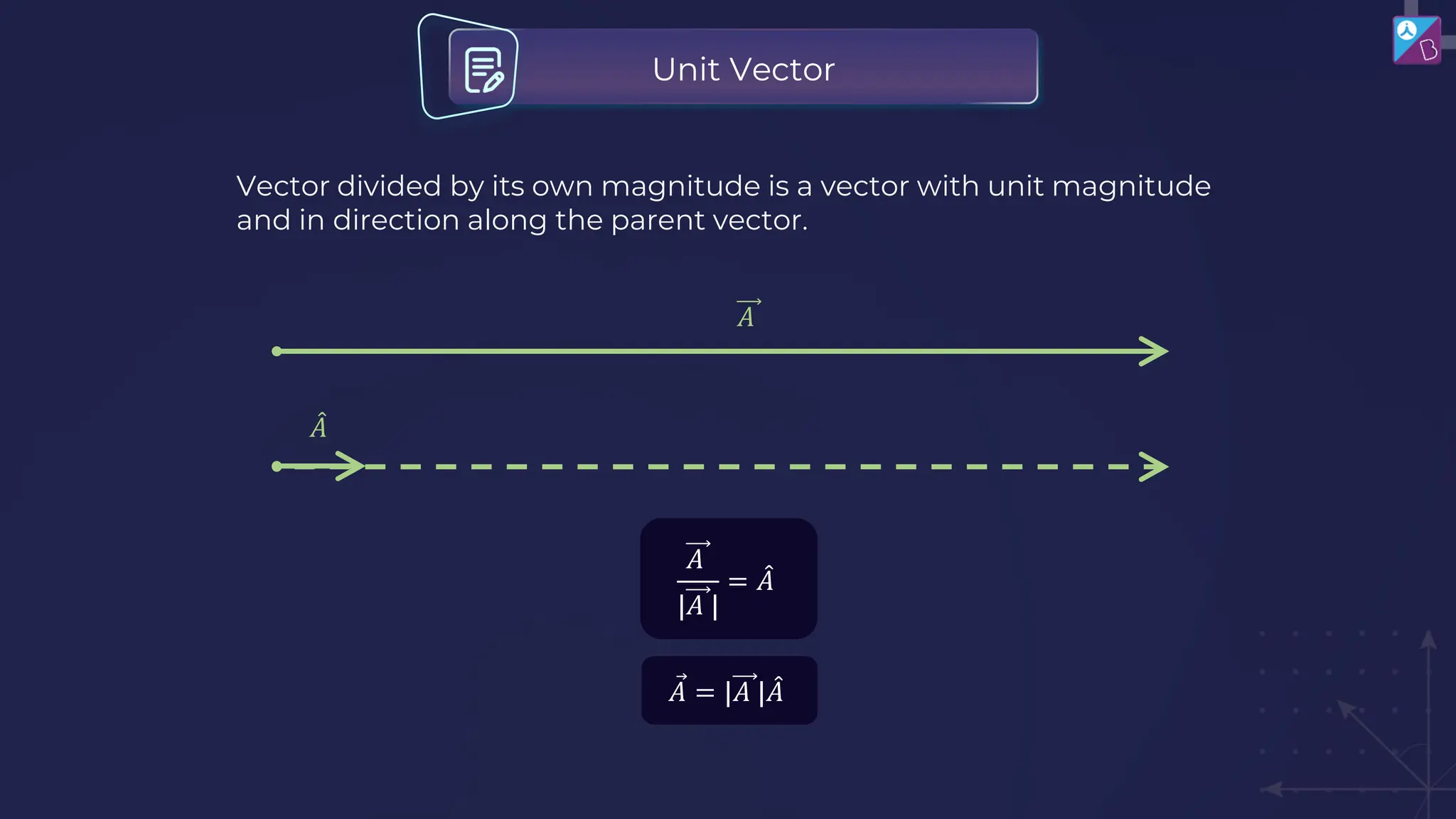
  • 57.
    Vector divided byits own magnitude is a vector with unit magnitude and in direction along the parent vector. መ 𝐴 𝐴 Unit Vector 𝐴 |𝐴 | = መ 𝐴 Ԧ 𝐴 = |𝐴 | መ 𝐴
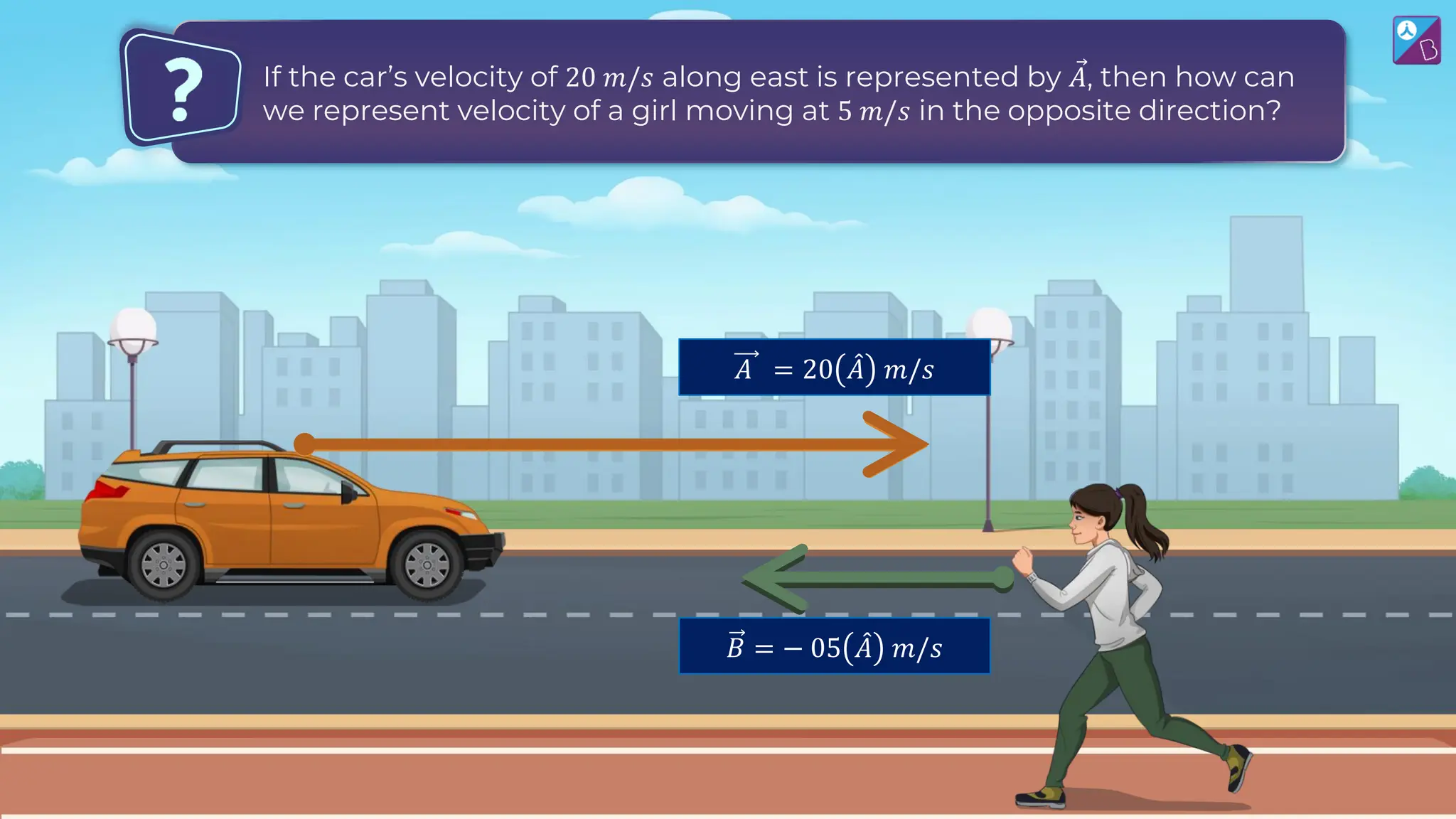
  • 58.
    If a carhas a velocity of 20 m/s in the east direction as shown in 𝐴 ? (b) How to represent velocity vector of a girl running with 5 m/s in opposite direction 𝐵 = − 05 መ 𝐴 𝑚/𝑠 𝐴 = 20 መ 𝐴 𝑚/𝑠 If the car’s velocity of 20 m/s along east is represented by Ԧ 𝐴, then how can we represent velocity of a girl moving at 5 𝑚/𝑠 in the opposite direction? If the car’s velocity of 20 𝑚/𝑠 along east is represented by Ԧ 𝐴, then how can we represent velocity of a girl moving at 5 𝑚/𝑠 in the opposite direction?
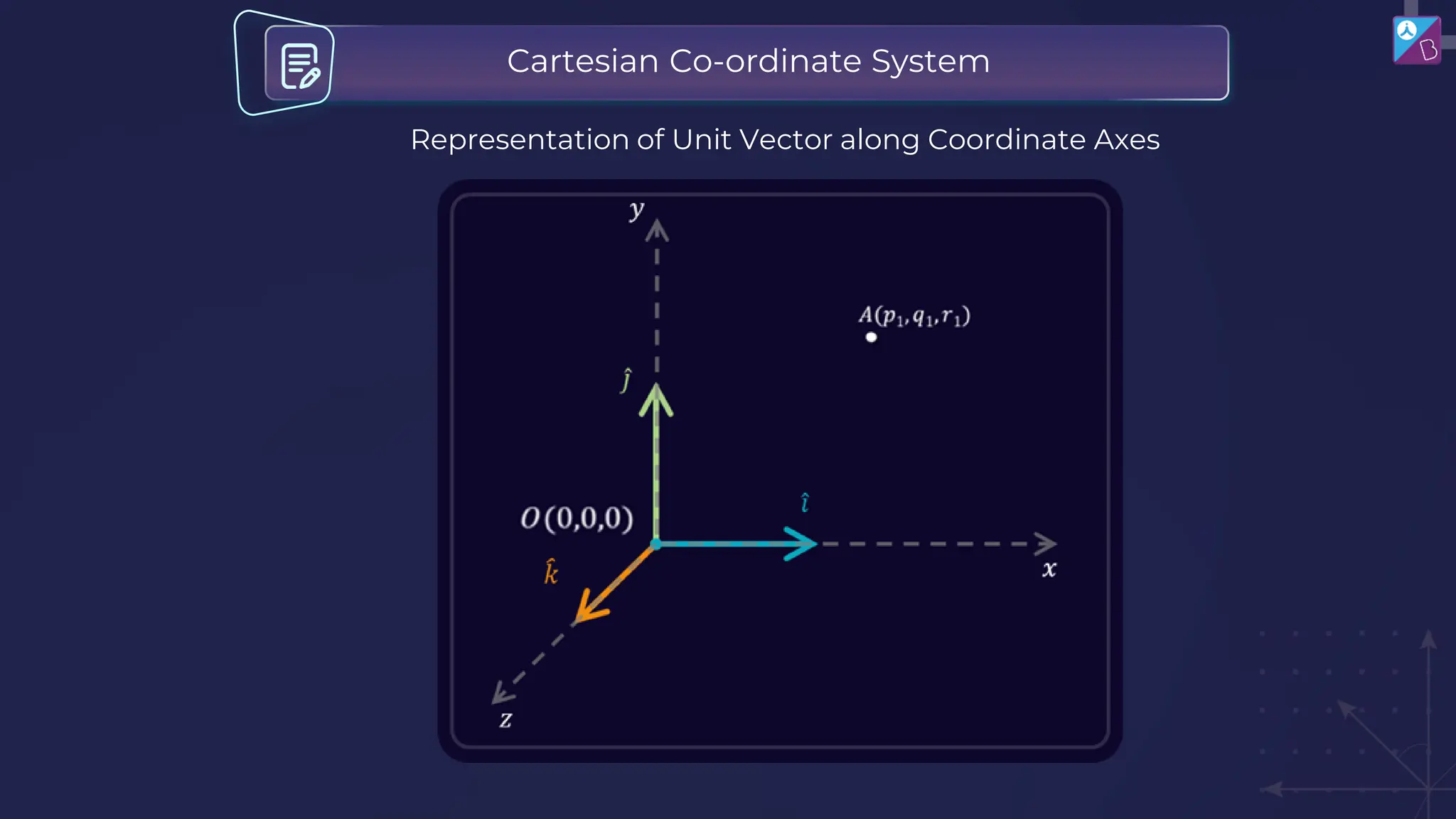
  • 59.
    Cartesian Co-ordinate System Representationof Unit Vector along Coordinate Axes
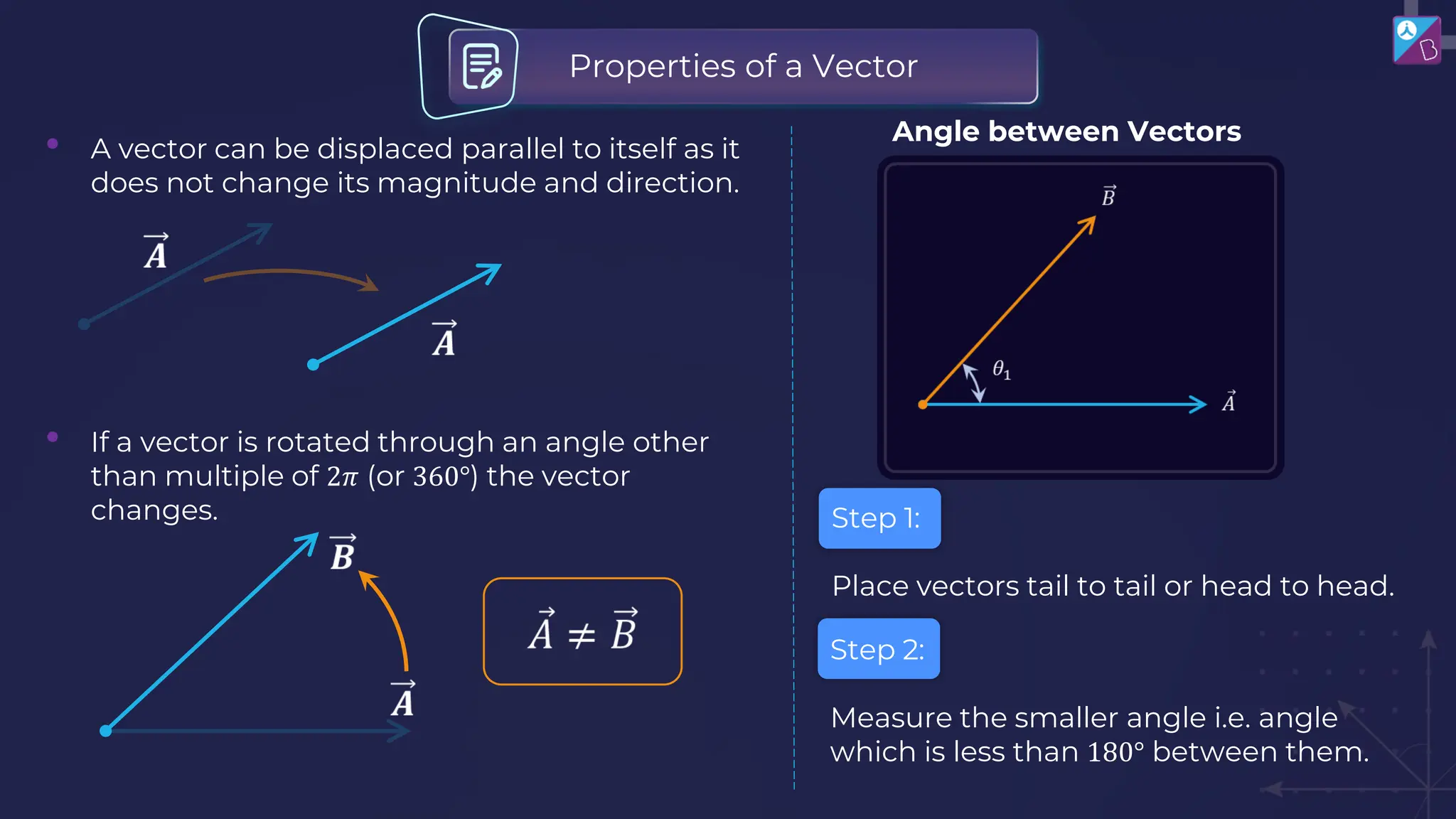
  • 60.
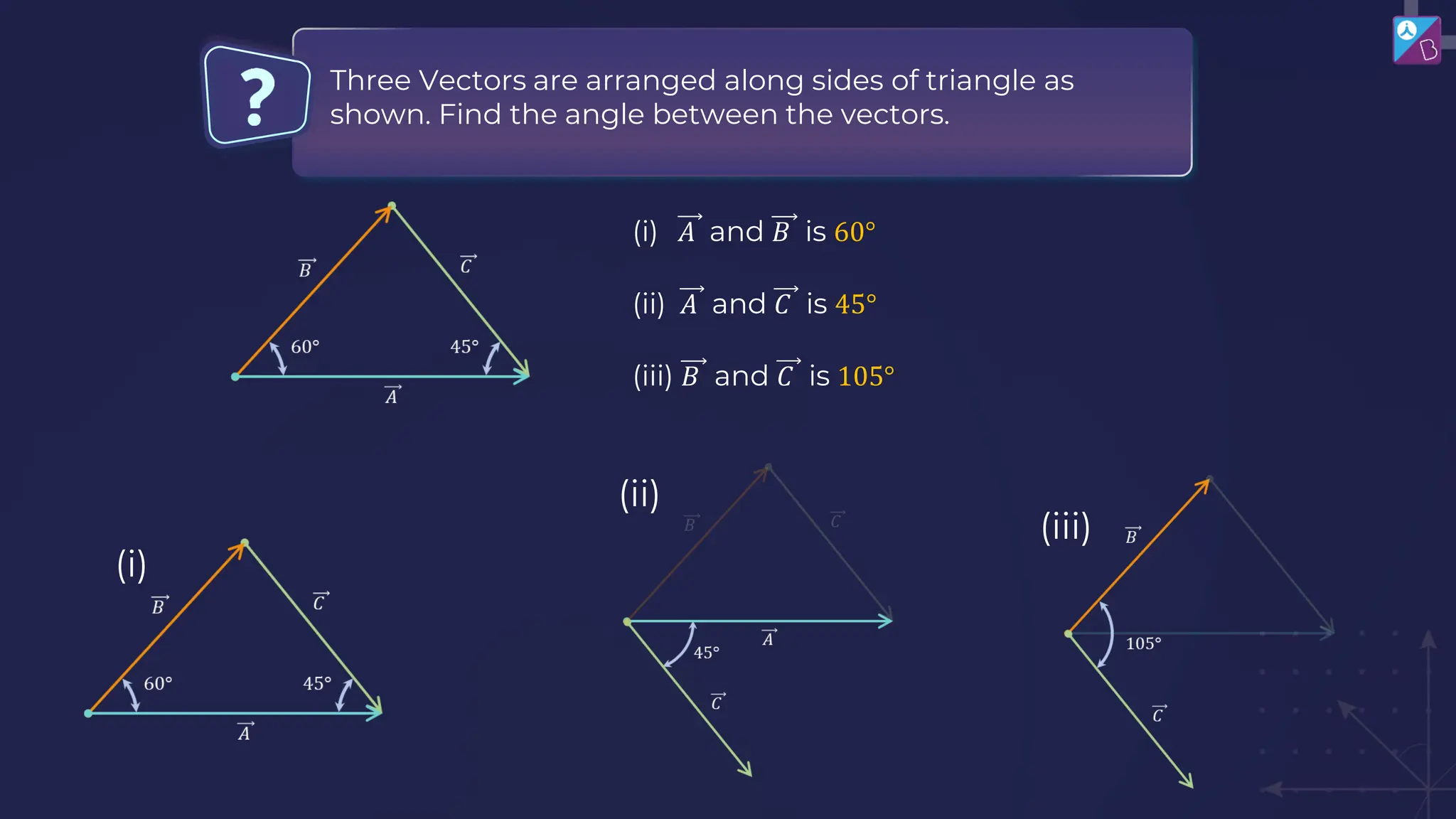
    • A vectorcan be displaced parallel to itself as it does not change its magnitude and direction. • If a vector is rotated through an angle other than multiple of 2𝜋 (or 360°) the vector changes. Properties of a Vector Angle between Vectors Step 1: Place vectors tail to tail or head to head. Step 2: Measure the smaller angle i.e. angle which is less than 180° between them.
  • 61.
    (i) 𝐴 and𝐵 is 60° (ii) 𝐴 and 𝐶 is 45° (iii) 𝐵 and 𝐶 is 105° Three Vectors are arranged along sides of triangle as shown. Find the angle between the vectors. (i) (ii) (iii)
  • 62.
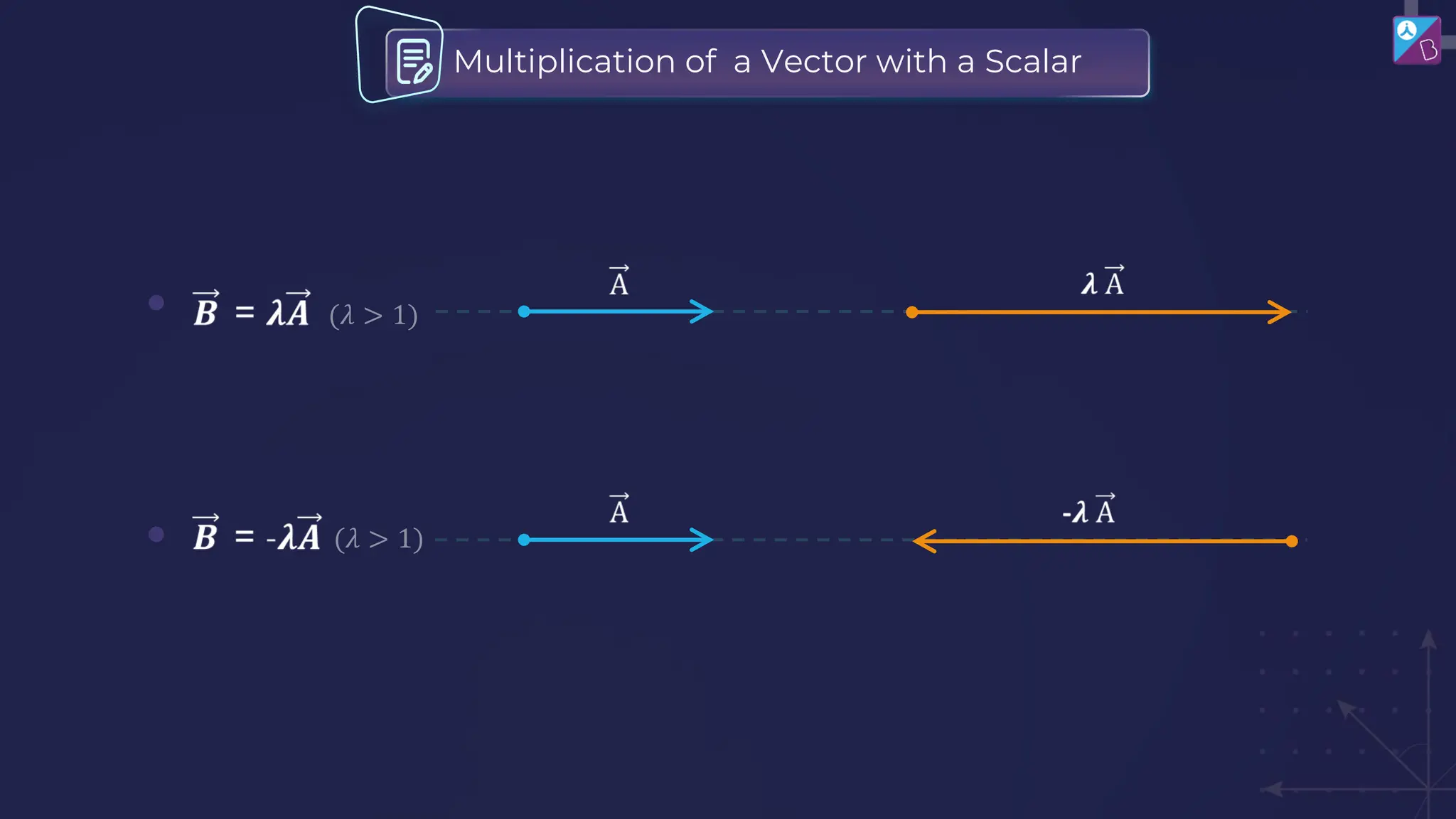
    Multiplication of aVector with a Scalar
  • 63.
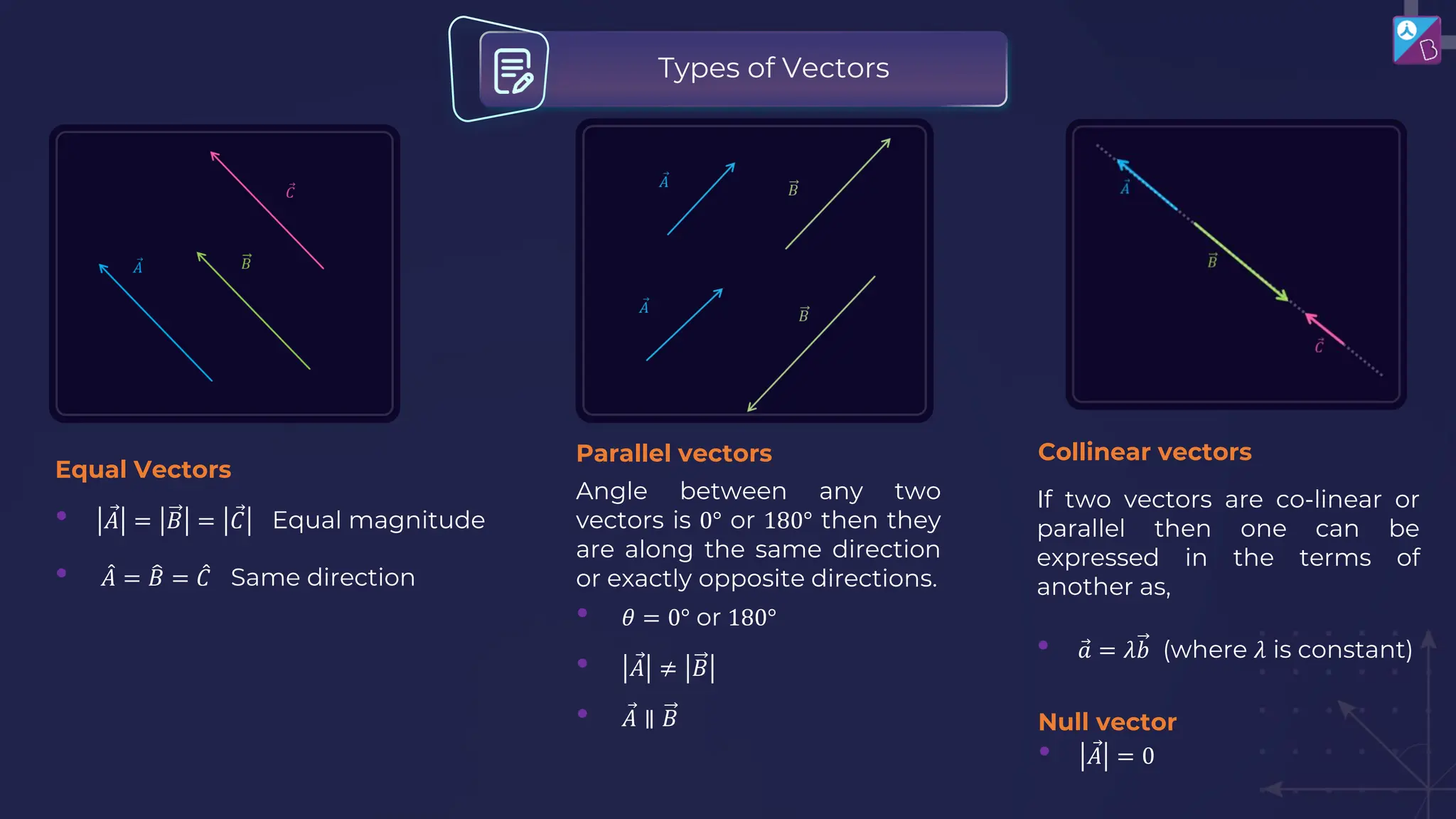
    Equal Vectors • Ԧ 𝐴= 𝐵 = Ԧ 𝐶 Equal magnitude • መ 𝐴 = ෠ 𝐵 = መ 𝐶 Same direction Parallel vectors Angle between any two vectors is 0° or 180° then they are along the same direction or exactly opposite directions. • 𝜃 = 0° or 180° • Ԧ 𝐴 ≠ 𝐵 • Ԧ 𝐴 ∥ 𝐵 Null vector • Ԧ 𝐴 = 0 If two vectors are co-linear or parallel then one can be expressed in the terms of another as, • Ԧ 𝑎 = 𝜆𝑏 (where 𝜆 is constant) Collinear vectors Types of Vectors
  • 64.
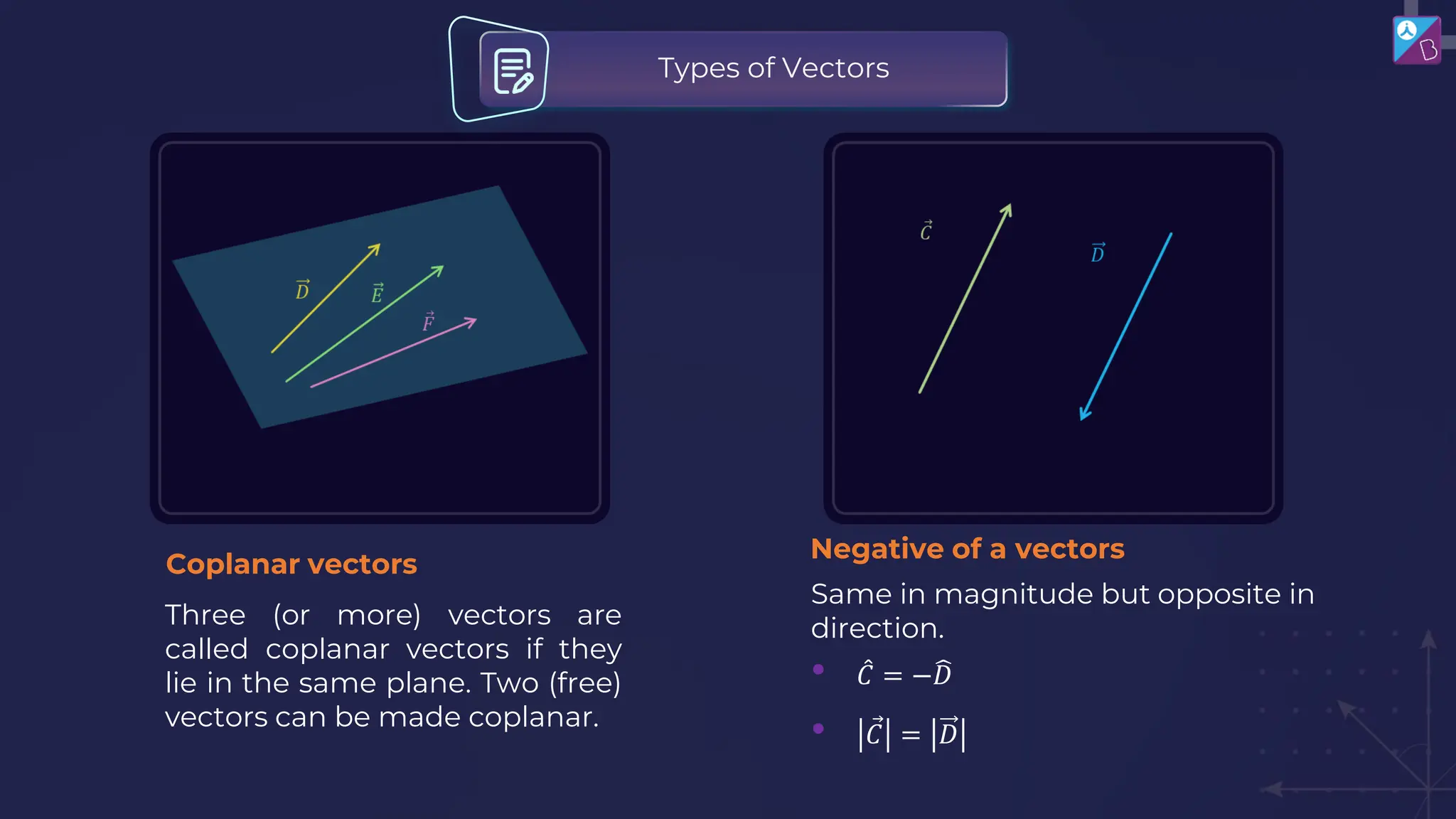
    Three (or more)vectors are called coplanar vectors if they lie in the same plane. Two (free) vectors can be made coplanar. Coplanar vectors Same in magnitude but opposite in direction. • መ 𝐶 = −෡ 𝐷 • Ԧ 𝐶 = 𝐷 Negative of a vectors Types of Vectors
  • 65.
    Magnitude of aVector and Displacement Vector Displacement Vector is the change in position vector. Ԧ 𝑠 = 𝑥2 − 𝑥1 Ƹ 𝑖 + 𝑦2 − 𝑦1 Ƹ 𝑗 + (𝑧2 − 𝑧1)෠ 𝑘 Ԧ 𝑟 = 𝑎 Ƹ 𝑖 + 𝑏 Ƹ 𝑗 Ԧ 𝑟 =Length of line 𝑂𝐴 Ԧ 𝑟 = 𝑎2 + 𝑏2
  • 66.
    Position vector givesus the position of a point in magnitude and direction. Ԧ 𝑟1 = 𝑎 Ƹ 𝑖 + 𝑏 Ƹ 𝑗 Position Vector in 2D and 3D Position vector Ԧ 𝑟1 = 𝑥1 Ƹ 𝑖 + 𝑦1 Ƹ 𝑗 + 𝑧1 ෠ 𝑘 Ԧ 𝑟2 = 𝑥2 Ƹ 𝑖 + 𝑦2 Ƹ 𝑗 + 𝑧2 ෠ 𝑘 Magnitude Ԧ 𝑟1 = 𝑥1 2 + 𝑦1 2 + 𝑧1 2 Ԧ 𝑟2 = 𝑥2 2 + 𝑦2 2 + 𝑧2 2 Ԧ 𝑟1 = 𝑎2 + 𝑏2
  • 67.
    Magnitude 𝑅 = 𝑅𝑥Ƹ 𝑖 + 𝑅𝑦 Ƹ 𝑗 Direction 𝑅 = 𝑅𝑥 2 + 𝑅𝑦 2 tan 𝜃 = 𝑅𝑦 𝑅𝑥 𝑦 𝑥 𝑅 𝑂 𝜃 Magnitude and Direction 𝑅 = 𝑅𝑥 + 𝑅𝑦 𝑅 = 𝑅𝑥 Ƹ 𝑖 + 𝑅𝑦 Ƹ 𝑗 𝑅 = 𝑅 cos 𝜃 Ƹ 𝑖 + 𝑅 sin 𝜃 Ƹ 𝑗
  • 68.
    𝑦 𝑥 𝐴 = 30 𝑂 𝑦 𝐵= 80 𝑂 Fill in the Blanks Ԧ 𝐴 = Ƹ 𝑖 + Ƹ 𝑗 −15 2 15 2 𝐵 = Ƹ 𝑖 + Ƹ 𝑗 −40 −40 3 𝑥
  • 69.
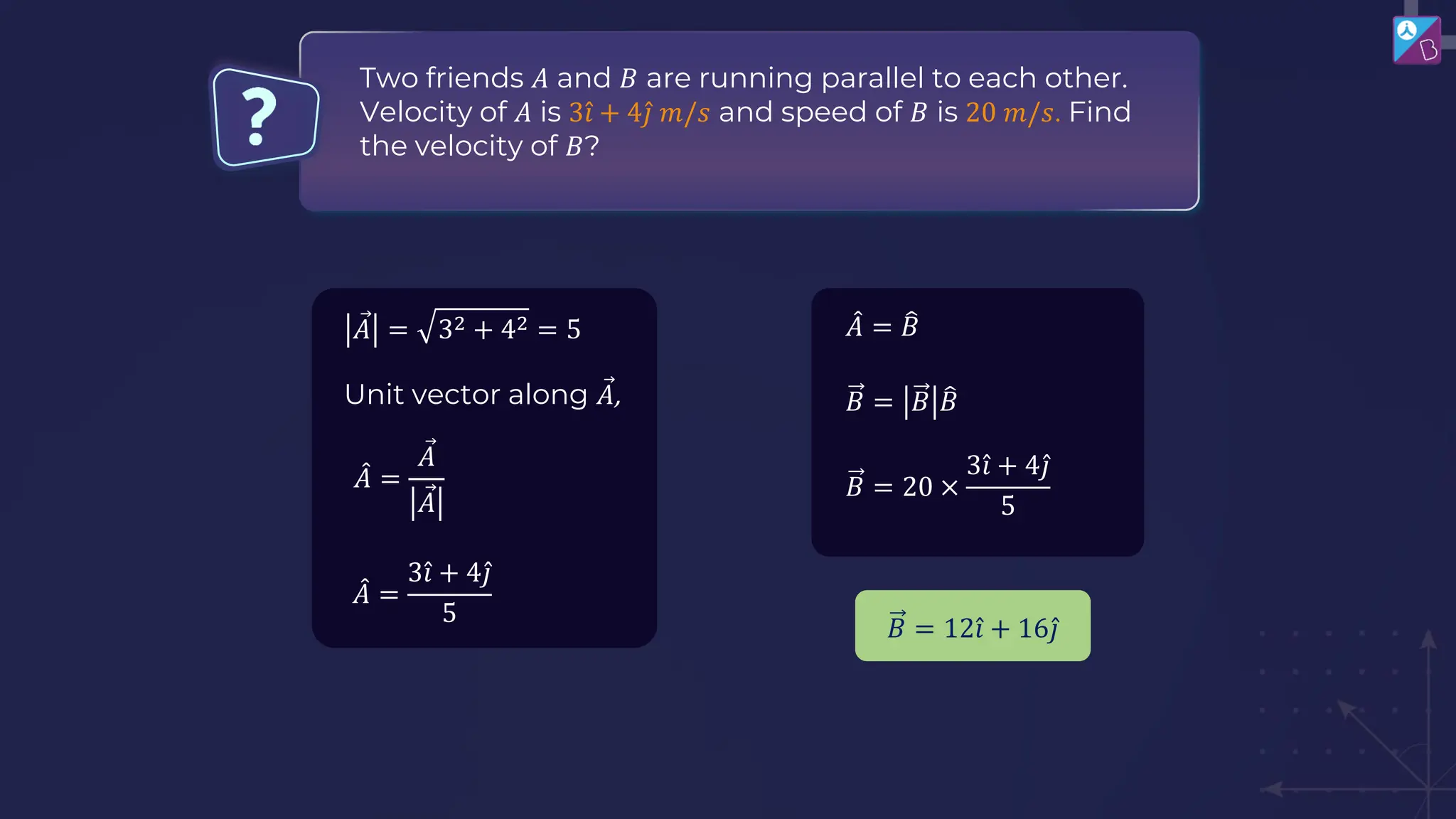
    Two friends 𝐴and 𝐵 are running parallel to each other. Velocity of 𝐴 is 3 Ƹ 𝑖 + 4 Ƹ 𝑗 𝑚/𝑠 and speed of 𝐵 is 20 𝑚/𝑠. Find the velocity of 𝐵? 𝐵 = 𝐵 ෠ 𝐵 𝐵 = 20 × 3 Ƹ 𝑖 + 4 Ƹ 𝑗 5 Ԧ 𝐴 = 32 + 42 = 5 Unit vector along Ԧ 𝐴, መ 𝐴 = 3 Ƹ 𝑖 + 4 Ƹ 𝑗 5 𝐵 = 12 Ƹ 𝑖 + 16 Ƹ 𝑗 መ 𝐴 = ෠ 𝐵 መ 𝐴 = Ԧ 𝐴 Ԧ 𝐴
  • 70.
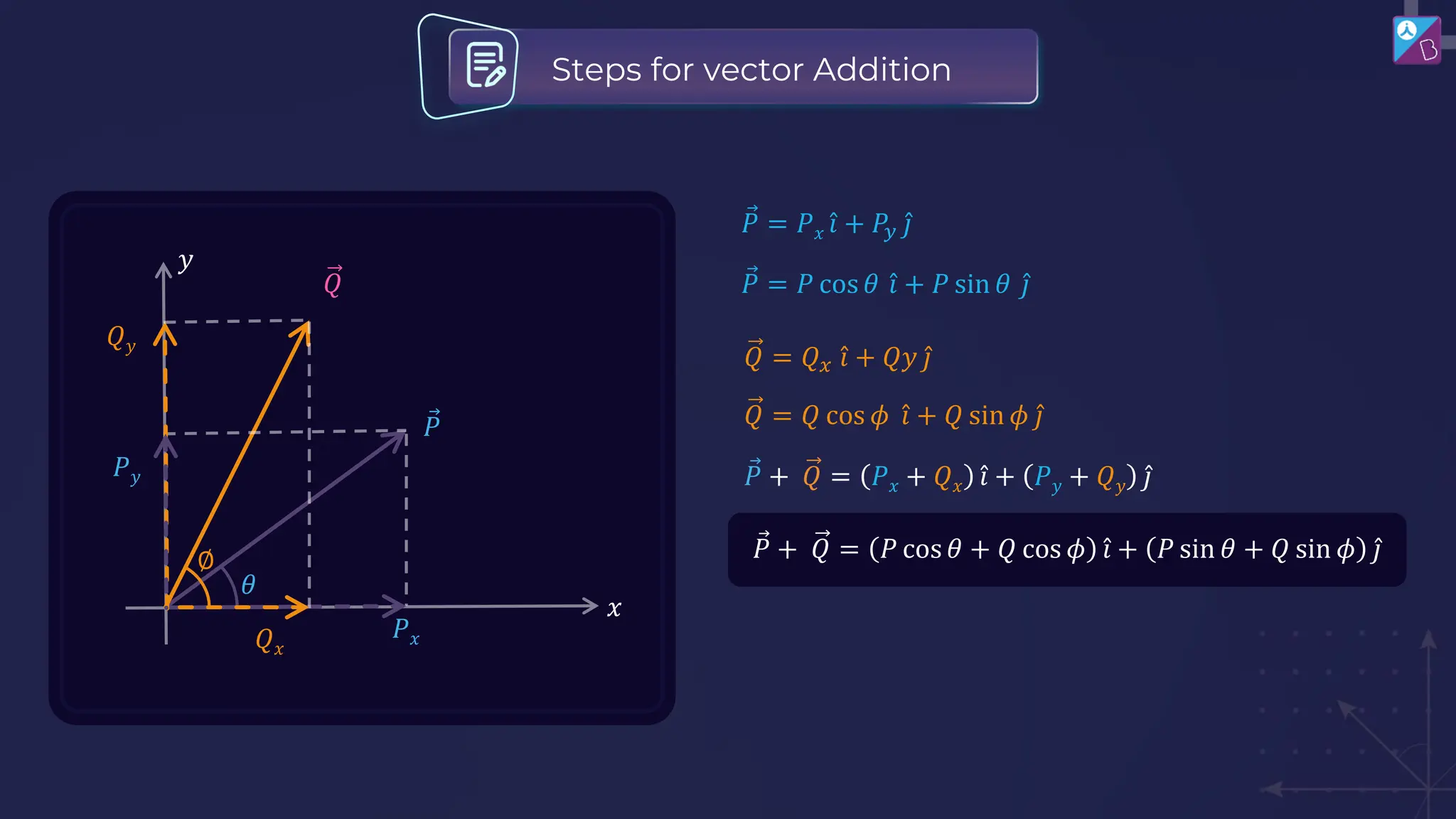
    Steps for vectorAddition 𝑦 𝑥 Ԧ 𝑃 𝜃 ∅ 𝑃𝑥 𝑄𝑦 𝑄𝑥 𝑃𝑦 𝑄 Ԧ 𝑃 = 𝑃𝑥 Ƹ 𝑖 + 𝑃𝑦 Ƹ 𝑗 𝑄 = 𝑄𝑥 Ƹ 𝑖 + 𝑄𝑦 Ƹ 𝑗 Ԧ 𝑃 = 𝑃 cos 𝜃 Ƹ 𝑖 + 𝑃 sin 𝜃 Ƹ 𝑗 𝑄 = 𝑄 cos 𝜙 Ƹ 𝑖 + 𝑄 sin 𝜙 Ƹ 𝑗 Ԧ 𝑃 + 𝑄 = 𝑃𝑥 + 𝑄𝑥 Ƹ 𝑖 + 𝑃𝑦 + 𝑄𝑦 Ƹ 𝑗 Ԧ 𝑃 + 𝑄 = 𝑃 cos 𝜃 + 𝑄 cos 𝜙 Ƹ 𝑖 + 𝑃 sin 𝜃 + 𝑄 sin 𝜙 Ƹ 𝑗
  • 71.
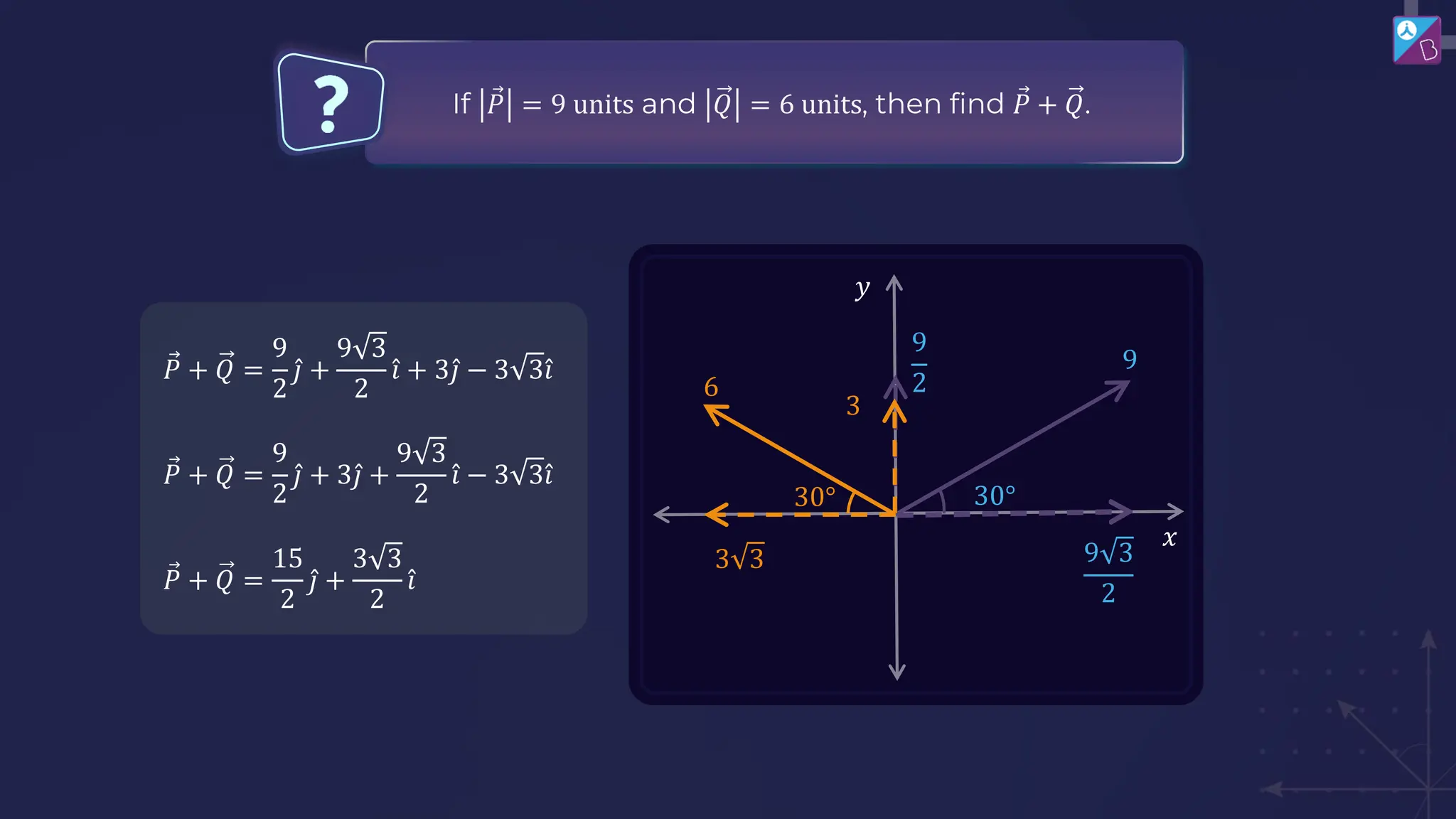
    Ԧ 𝑃 + 𝑄= 9 2 Ƹ 𝑗 + 9 3 2 Ƹ 𝑖 + 3 Ƹ 𝑗 − 3 3 Ƹ 𝑖 Ԧ 𝑃 + 𝑄 = 9 2 Ƹ 𝑗 + 3 Ƹ 𝑗 + 9 3 2 Ƹ 𝑖 − 3 3 Ƹ 𝑖 Ԧ 𝑃 + 𝑄 = 15 2 Ƹ 𝑗 + 3 3 2 Ƹ 𝑖 30° 𝑦 𝑥 6 30° 3 3 3 9 9 3 2 9 2 If Ԧ 𝑃 = 9 units and 𝑄 = 6 units, then find Ԧ 𝑃 + 𝑄.
  • 72.
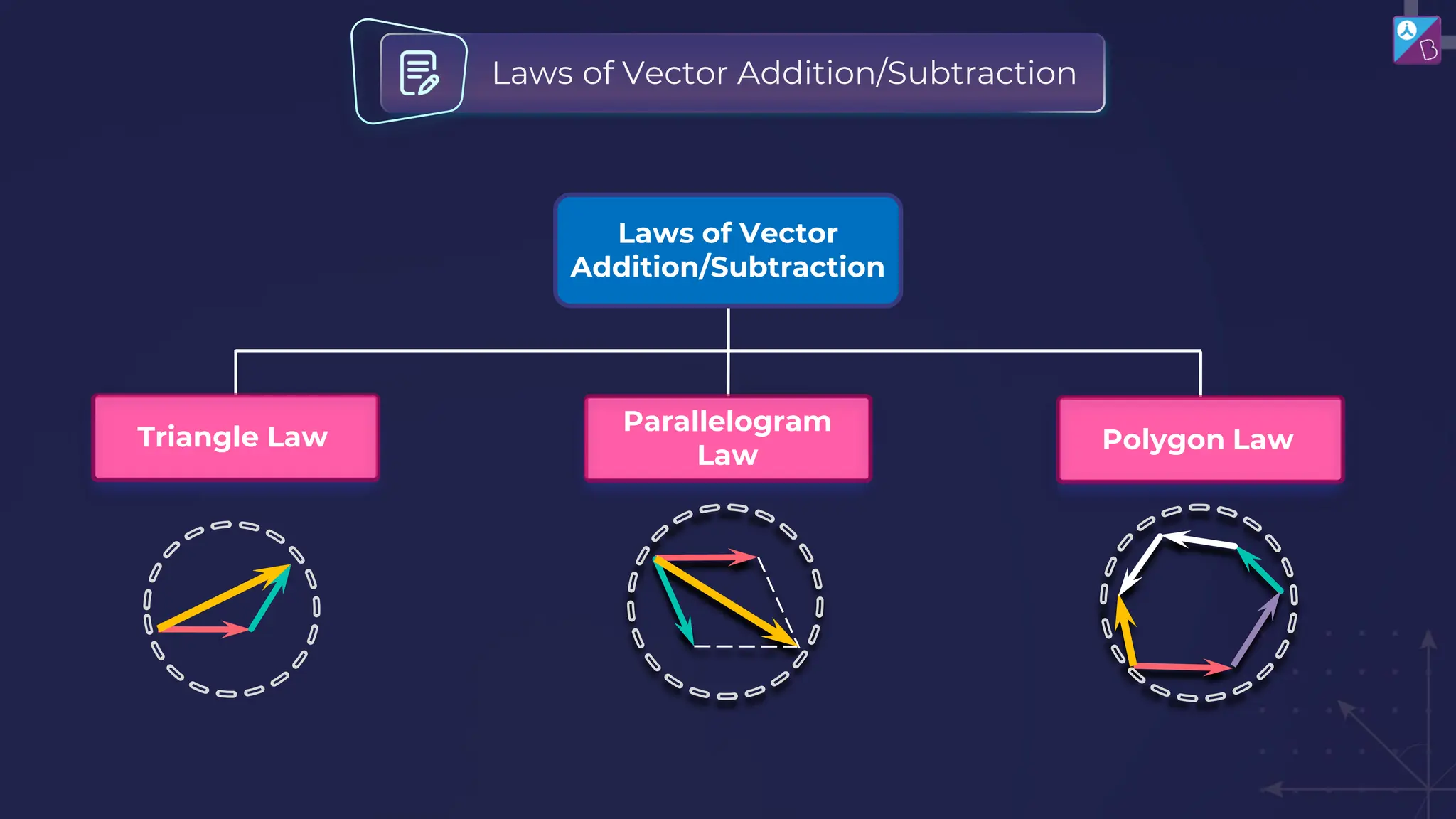
    Laws of Vector Addition/Subtraction Lawsof Vector Addition/Subtraction Triangle Law Parallelogram Law Polygon Law
  • 73.
    𝑅 = 𝐴2+ 𝐵2 + 2𝐴𝐵 cos 𝜃 𝑦 𝜃 𝐵 𝑅 𝐴 Ƹ 𝑖 𝑥 Ԧ 𝐴 𝐵 sin 𝜃 Ƹ 𝑗 𝑅 𝐵 cos 𝜃 Ƹ 𝑖 𝑅 = Ԧ 𝐴 + 𝐵 = 𝐴 + 𝐵 cos 𝜃 Ƹ 𝑖 + 𝐵 sin 𝜃 Ƹ 𝑗 𝑅 = Ԧ 𝐴 + 𝐵 𝑅 = 𝐴 + 𝐵 cos 𝜃 2 + 𝐵 sin 𝜃 2 𝑅 = 𝐴2 + 𝐵2 cos2 𝜃 + 2𝐴𝐵 cos 𝜃 + 𝐵2 sin2 𝜃 Triangle Law
  • 74.
    When two vectorswith common origin represent two adjacent sides of a parallelogram in magnitude and direction, then the resultant vector is represented both in magnitude and direction by the diagonal passing through that point. 𝑦 𝑅 = 𝐴2 + 𝐵2 + 2𝐴𝐵 cos 𝜃 Here 𝛼 is the angle between Ԧ 𝐴 and 𝑅 tan 𝛼 = 𝐵 sin 𝜃 Ԧ 𝐴 + 𝐵 cos 𝜃 Parallelogram Law
  • 75.
    𝑅3 𝐷 Ԧ 𝐴 𝐵 Ԧ 𝐶 • Join vectorsin same order (head to tail). • Resultant Vector – closing side of polygon in opposite order 𝑅3 = Ԧ 𝐴 + 𝐵 + Ԧ 𝐶 + 𝐷 Polygon Law of Vector Addition
  • 76.
    • Ԧ 𝐴 +𝐵 : Ԧ 𝐴 and 𝐵 must be same physical quantities. • Commutative Property : Ԧ 𝐴 + 𝐵 = 𝐵 + Ԧ 𝐴 • Associative Property : ( Ԧ 𝐴 + 𝐵) + Ԧ 𝐶 = Ԧ 𝐴 + (𝐵 + Ԧ 𝐶) Properties of Vector Addition
  • 77.
    𝜃 𝐵 𝐴 Ԧ 𝐴. 𝐵 =𝐴𝐵 cos 𝜃 The dot product of two vectors 𝐴 and 𝐵 is equal to the products of their magnitude times the cosine of angle between them. Scalar / Dot Product Ԧ 𝐴. 𝐵 = Ԧ 𝐴 𝐵 cos 𝜃 𝐴 = 𝐴𝑥 Ƹ 𝑖 + 𝐴𝑦 Ƹ 𝑗 + 𝐴𝑧 ෠ 𝑘 , 𝐵 = 𝐵𝑥 Ƹ 𝑖 + 𝐵𝑦 Ƹ 𝑗 + 𝐵𝑧 ෠ 𝑘 𝐴 . 𝐵 = 𝐴𝑥𝐵𝑥 + 𝐴𝑦𝐵𝑦 + 𝐴𝑧𝐵𝑧
  • 78.
    60° 𝐵 𝐴 If 𝐴 =2, 𝐵 = 3 and the angle between 𝐴 and 𝐵 is 60°. Find 𝐴 . 𝐵 𝐴 .𝐵 = |𝐴 ||𝐵 |cos 𝜃 = 2 × 3 × cos 60° = 2 × 3 × 1 2 = 3 Ԧ 𝐴. 𝐵 = 3
  • 79.
    • Dot productof two vectors is always (commutative), i.e. 𝐴 . 𝐵 = 𝐵 . 𝐴 • Dot product of two vectors is always distributive, i.e. 𝐴 . 𝐵 + 𝐶 = 𝐴 . 𝐵 + 𝐴 . 𝐶 • Dot product of two vectors will be maximum when they are parallel (i.e., angle between them is zero). Properties of Dot Product 𝐴 . 𝐵 is positive 𝜽 < 𝟗𝟎° ⇒ 𝐂𝐨𝐬 𝜽 > 𝟎 Ԧ 𝐴. 𝐵 = 𝐴𝐵 cos 𝜃 𝜽 = 𝟗𝟎° 𝐴 . 𝐵 is zero 𝐴 . 𝐵 is negative 𝜽 > 𝟗𝟎° ⇒ 𝐂𝐨𝐬 𝜽 < 𝟎 • 𝐴 .𝐴 = 𝐴2 • ො 𝑛 . ො 𝑛 = 1 • Ƹ 𝑖 . Ƹ 𝑗 = Ƹ 𝑗 . ෠ 𝑘 = ෠ 𝑘 . Ƹ 𝑖 = 0
  • 80.
    𝐴 .𝐵 =0 ⟹ 𝐴 𝐵 cos 𝜃 = 0 ⟹ cos 𝜃 = 0 𝜃 = cos−1 0 = 90° 𝐴 𝐵 90° Thus, 𝐴 .𝐵 = 0 is a condition for two vectors to be orthogonal. If the scalar product of two non-zero vectors becomes zero. What is the angle between them?
  • 81.
    The cross productof two vectors 𝐴 and 𝐵 is equal to the products of their magnitude times the sine of angle between them and direction perpendicular to the plane containing the two vectors. Ԧ 𝐴 × 𝐵 = Ԧ 𝐴 𝐵 sin 𝜃 ො 𝑛 Ԧ 𝐴 × 𝐵 = Ԧ 𝐴 𝐵 sin 𝜃 Vector / Cross Product Here, ො 𝑛 is a unit vector perpendicular to both Ԧ 𝐴 and 𝐵. Ԧ 𝐴 × 𝐵 = Ԧ 𝐴 𝐵 sin 𝜃 ො 𝑛
  • 82.
    To find thedirection of Ԧ 𝐴 × 𝐵: • Draw Ԧ 𝐴 and 𝐵 tail-to-tail. • Place the stretched right palm such that the fingers are along Ԧ 𝐴 and when the fingers are closed, they go towards 𝐵. • The direction in which thumb points gives the direction of Ԧ 𝐶 = Ԧ 𝐴 × 𝐵. Right Hand Thumb Rule Ԧ 𝐴 𝐵 Ԧ 𝐴 𝐵 Ԧ 𝐶
  • 83.
    Ԧ 𝐴 × 𝐵= Ԧ 𝐴 𝐵 sin 𝜃 = 5 × 4 × sin 30° = 10 Using the right-hand thumb rule, the direction of Ԧ 𝐴 × 𝐵 is along −𝑧 axis Find the magnitude and direction of Ԧ 𝐴 × 𝐵 and 𝐵 × Ԧ 𝐴, where Ԧ 𝐴 & 𝐵 lie in 𝑥 − 𝑦 plane as shown. The direction of 𝐵 × Ԧ 𝐴 is along +𝑧 axis. ⟹ Ԧ 𝐴 × 𝐵 = −10෠ 𝑘 ⟹ 𝐵 × Ԧ 𝐴 = 10෠ 𝑘 Ԧ 𝐴 𝐵 30° 4 5
  • 84.
    In the right-handedcoordinate system, the coordinate axes 𝑥, 𝑦 and 𝑧 are chosen such that bending the fingers of the right hand from 𝑥 to 𝑦 will lead the thumb along the 𝑧 −axis. Ƹ 𝑖 Ƹ 𝑗 ෠ 𝑘 Ƹ 𝑖 × Ƹ 𝑗 = ෠ 𝑘, Ƹ 𝑗 × Ƹ 𝑖 = − ෠ 𝑘 Ƹ 𝑗 × ෠ 𝑘 = Ƹ 𝑖, ෠ 𝑘 × Ƹ 𝑗 = − Ƹ 𝑖 ෠ 𝑘 × Ƹ 𝑖 = Ƹ 𝑗, Ƹ 𝑖 × ෠ 𝑘 = − Ƹ 𝑗 Cross Product of Orthogonal Unit Vectors
  • 85.
    Cross Product inComponent Form Ԧ 𝐴 × 𝐵 = 𝐴𝑥 Ƹ 𝑖 + 𝐴𝑦 Ƹ 𝑗 + 𝐴𝑧 ෠ 𝑘 × 𝐵𝑥 Ƹ 𝑖 + 𝐵𝑦 Ƹ 𝑗 + 𝐵𝑧 ෠ 𝑘 Ԧ 𝐴 × 𝐵 = 𝐴𝑥𝐵𝑥 Ƹ 𝑖 × Ƹ 𝑖 + 𝐴𝑦𝐵𝑥 Ƹ 𝑗 × Ƹ 𝑖 + 𝐴𝑧𝐵𝑥 ෠ 𝑘 × Ƹ 𝑖 +𝐴𝑥𝐵𝑦 Ƹ 𝑖 × Ƹ 𝑗 + 𝐴𝑦𝐵𝑦 Ƹ 𝑗 × Ƹ 𝑗 + 𝐴𝑧𝐵𝑦 ෠ 𝑘 × Ƹ 𝑗 +𝐴𝑥𝐵𝑧 Ƹ 𝑖 × ෠ 𝑘 + 𝐴𝑦𝐵𝑧 Ƹ 𝑗 × ෠ 𝑘 + 𝐴𝑧𝐵𝑧 ෠ 𝑘 × ෠ 𝑘 Ԧ 𝐴 × 𝐵 = (𝐴𝑦𝐵𝑧 − 𝐴𝑧𝐵𝑦) Ƹ 𝑖 − 𝐴𝑥𝐵𝑧 − 𝐴𝑧𝐵𝑥 Ƹ 𝑗 + (𝐴𝑥𝐵𝑦 − 𝐴𝑦𝐵𝑥)෠ 𝑘 Ƹ 𝑖 Ƹ 𝑗 ෠ 𝑘 Ԧ 𝐴 = 𝐴𝑥 Ƹ 𝑖 + 𝐴𝑦 Ƹ 𝑗 + 𝐴𝑧 ෠ 𝑘 𝐵 = 𝐵𝑥 Ƹ 𝑖 + 𝐵𝑦 Ƹ 𝑗 + 𝐵𝑧 ෠ 𝑘
  • 86.
    Ԧ 𝐴 × 𝐵= (𝐴𝑦𝐵𝑧 − 𝐴𝑧𝐵𝑦) Ƹ 𝑖 − 𝐴𝑥𝐵𝑧 − 𝐴𝑧𝐵𝑥 Ƹ 𝑗 + (𝐴𝑥𝐵𝑦 − 𝐴𝑦𝐵𝑥)෠ 𝑘 Ԧ 𝐴 × 𝐵 = 2 Ƹ 𝑖 − 5 Ƹ 𝑗 + 3෠ 𝑘 × 3 Ƹ 𝑖 + 4 Ƹ 𝑗 − 9෠ 𝑘 = 6 Ƹ 𝑖 × Ƹ 𝑖 − 15 Ƹ 𝑗 × Ƹ 𝑖 + 9 ෠ 𝑘 × Ƹ 𝑖 +8 Ƹ 𝑖 × Ƹ 𝑗 − 20 Ƹ 𝑗 × Ƹ 𝑗 + 12 ෠ 𝑘 × Ƹ 𝑗 − 18 Ƹ 𝑖 × ෠ 𝑘 + 45 Ƹ 𝑗 × ෠ 𝑘 − 27 (෠ 𝑘 × ෠ 𝑘) Ԧ 𝐴 × 𝐵 = Ƹ 𝑖 45 − 12 − Ƹ 𝑗 −18 − 9 + ෠ 𝑘 8 − (−15) Ԧ 𝐴 × 𝐵 = 33 Ƹ 𝑖 + 27 Ƹ 𝑗 + 23෠ 𝑘 Find Ԧ 𝐴 × 𝐵 , where Ԧ 𝐴 = 2 Ƹ 𝑖 − 5 Ƹ 𝑗 + 3෠ 𝑘 and 𝐵 = 3 Ƹ 𝑖 + 4 Ƹ 𝑗 − 9෠ 𝑘.