By Kaushal Patel
 The curve is symmetric about x-axis if the power of y
occurring in the equation are all even, i.e. f(x,-y)=f(x, y).
 The curve is symmetric about y-axis if the powers of x
occurring in equation are all even, i.e. f(-x, y)=f(x, y).
2
 The curve is symmetric about the line y= x, if on
interchanging x and y, the equation remains unchanged,
i.e. f(y, x)=f(x, y).
 The curve is symmetric in opposite quadrants or about
origin if on replacing x by –x by y by –y, the equation
remains unchanged, i.e. f(-x,-y)=f(x, y).
3
 The curve passes through the origin if there is no constant term
in the equation.
 If curve passes through the origin, the tangents at the origin are
obtained by equating the lowest degree term in x and y to zero.
 If there are two or more tangents at the origin, it is called a node,
a cusp or an isolated point if the tangents at this point are real
and distinct, real and coincident or imaginary respectively.
4
 The point of intersection of curve with x and y axis are
obtained by putting y=0 and x=0 respectively in the
equation of the curve.
 Tangent at the point of intersection is obtained by
shifting the origin to this point and then equating the
lowest degree term to zero.
5
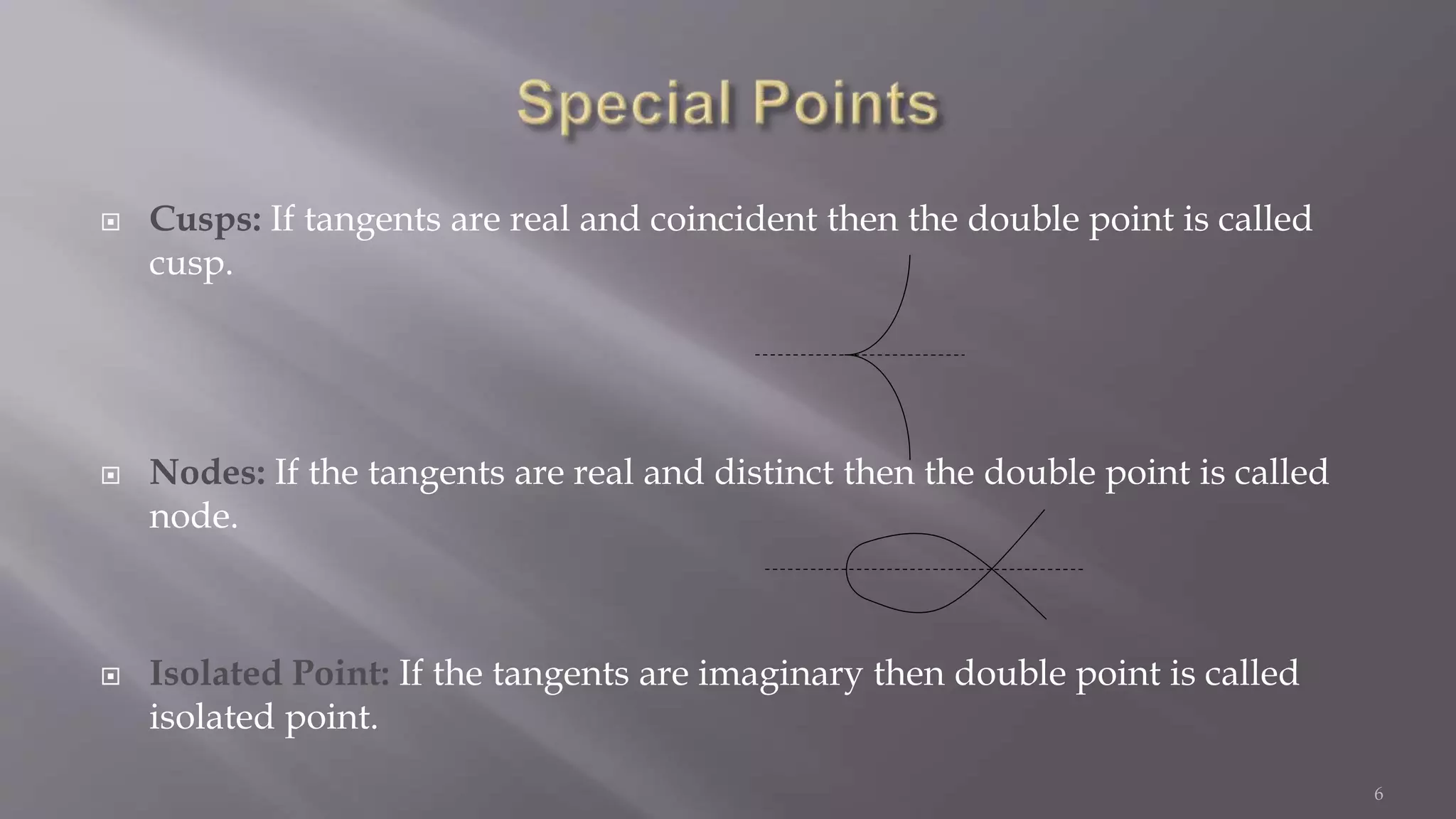
 Cusps: If tangents are real and coincident then the double point is called
cusp.
 Nodes: If the tangents are real and distinct then the double point is called
node.
 Isolated Point: If the tangents are imaginary then double point is called
isolated point.
6
 Asymptotes parallel to x-axis are obtain by equating the
coefficient of highest degree term of the equation to
zero.
 Asymptotes parallel to y-axis are obtained by equating
the coefficient of highest degree term of y in the
equation to zero.
7
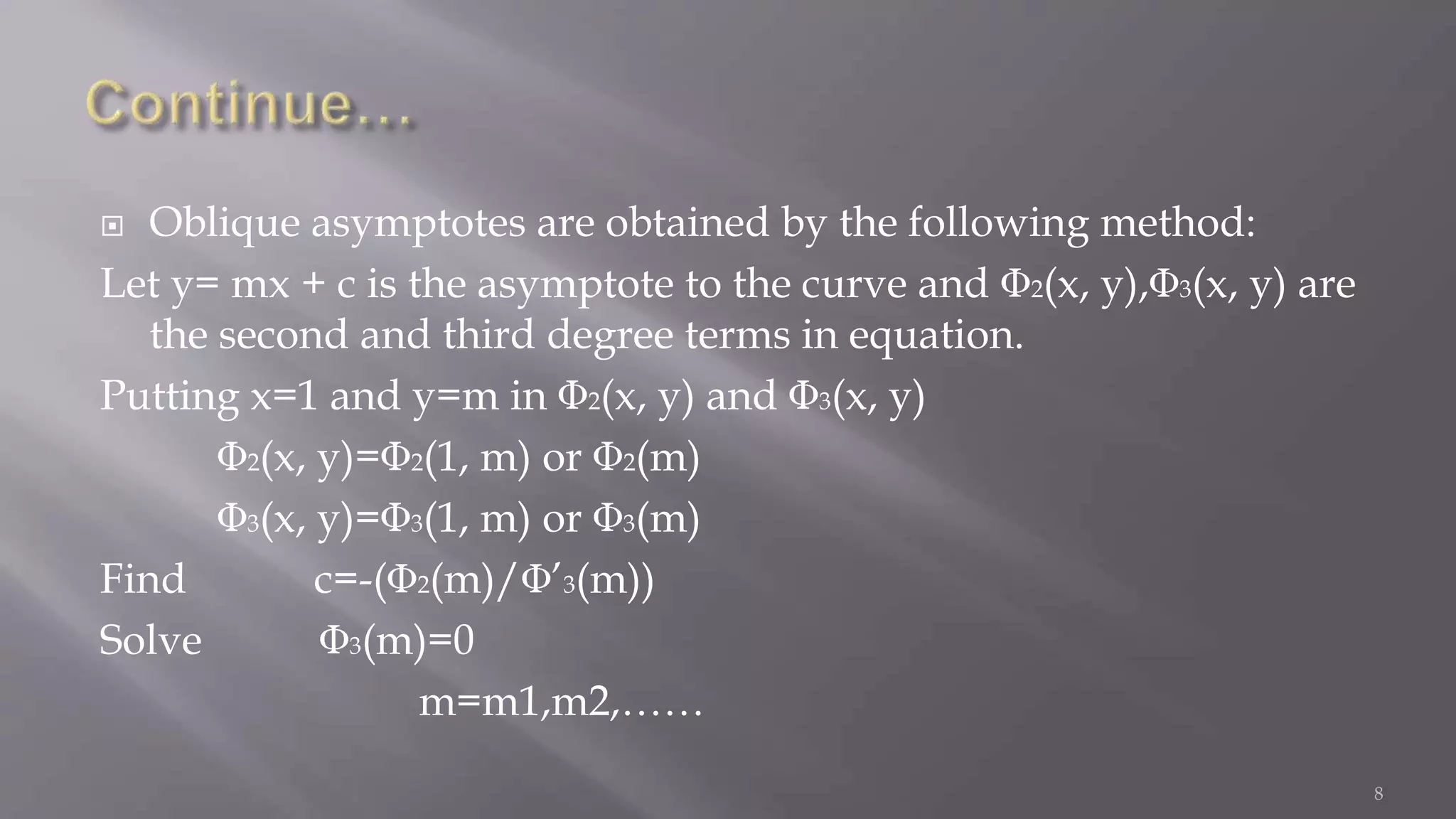
 Oblique asymptotes are obtained by the following method:
Let y= mx + c is the asymptote to the curve and 2(x, y), 3(x, y) are
the second and third degree terms in equation.
Putting x=1 and y=m in 2(x, y) and 3(x, y)
2(x, y)= 2(1, m) or 2(m)
3(x, y)= 3(1, m) or 3(m)
Find c=-( 2(m)/ ’3(m))
Solve 3(m)=0
m=m1,m2,……
8
 This region is obtained by expressing one variable in terms of
other, i.e., y=f(x)[or x=f(y)] and then finding the values of x (or y)
at which y(or x) becomes imaginary. The curve does not exist in
the region which lies between these values of x (or y).
9
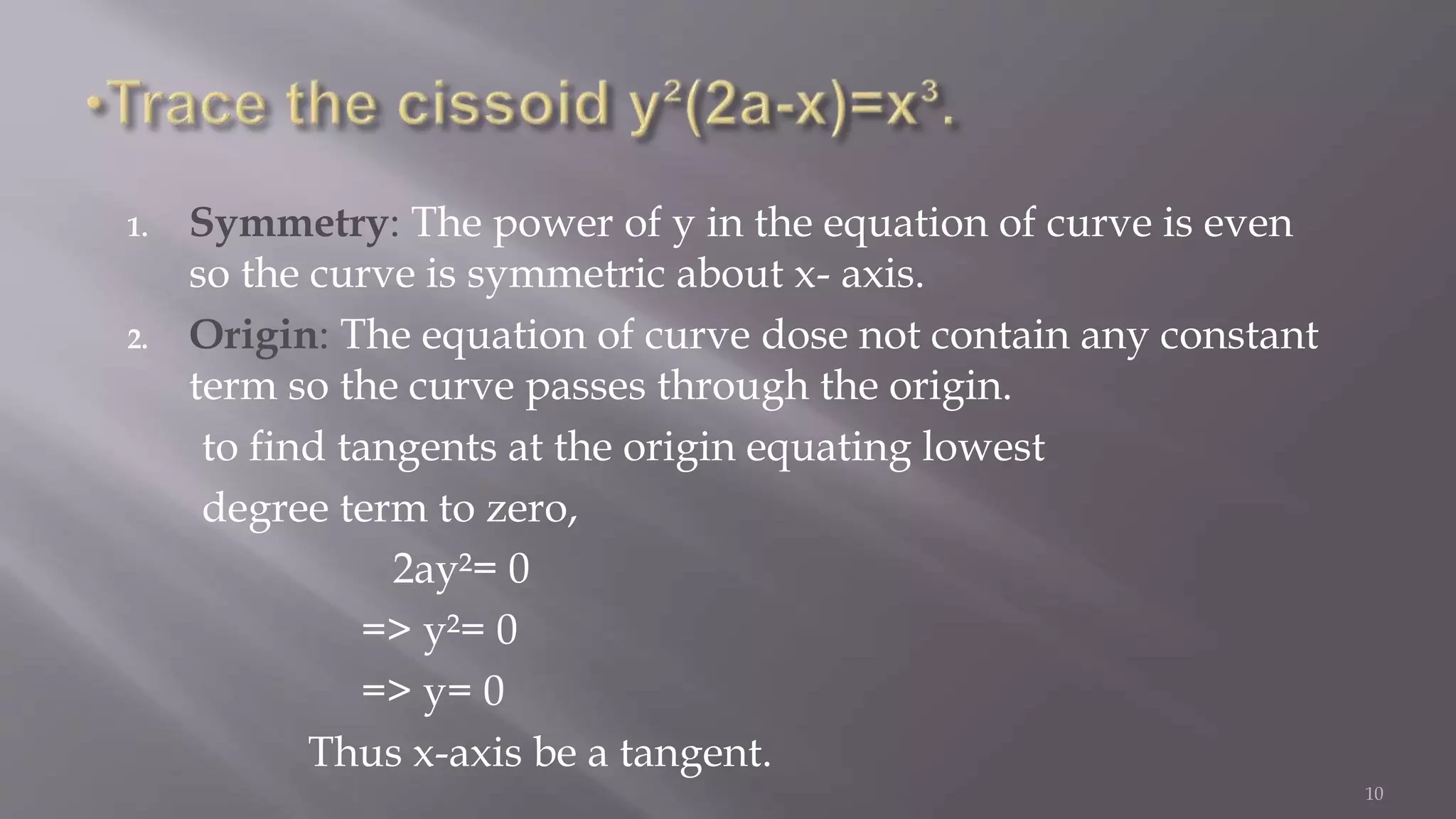
1. Symmetry: The power of y in the equation of curve is even
so the curve is symmetric about x- axis.
2. Origin: The equation of curve dose not contain any constant
term so the curve passes through the origin.
to find tangents at the origin equating lowest
degree term to zero,
2ay²= 0
=> y²= 0
=> y= 0
Thus x-axis be a tangent.
10
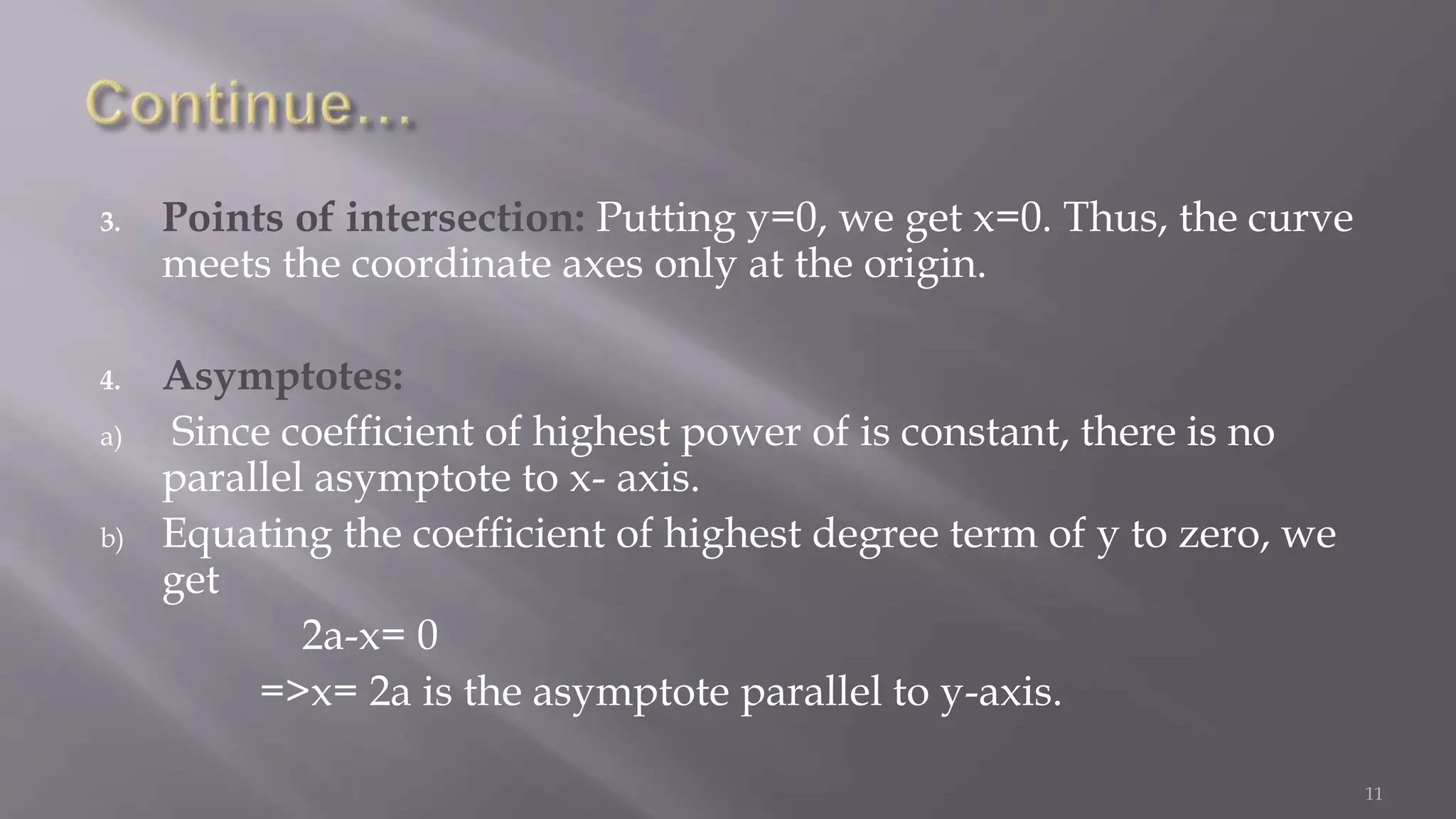
3. Points of intersection: Putting y=0, we get x=0. Thus, the curve
meets the coordinate axes only at the origin.
4. Asymptotes:
a) Since coefficient of highest power of is constant, there is no
parallel asymptote to x- axis.
b) Equating the coefficient of highest degree term of y to zero, we
get
2a-x= 0
=>x= 2a is the asymptote parallel to y-axis.
11
Continue…
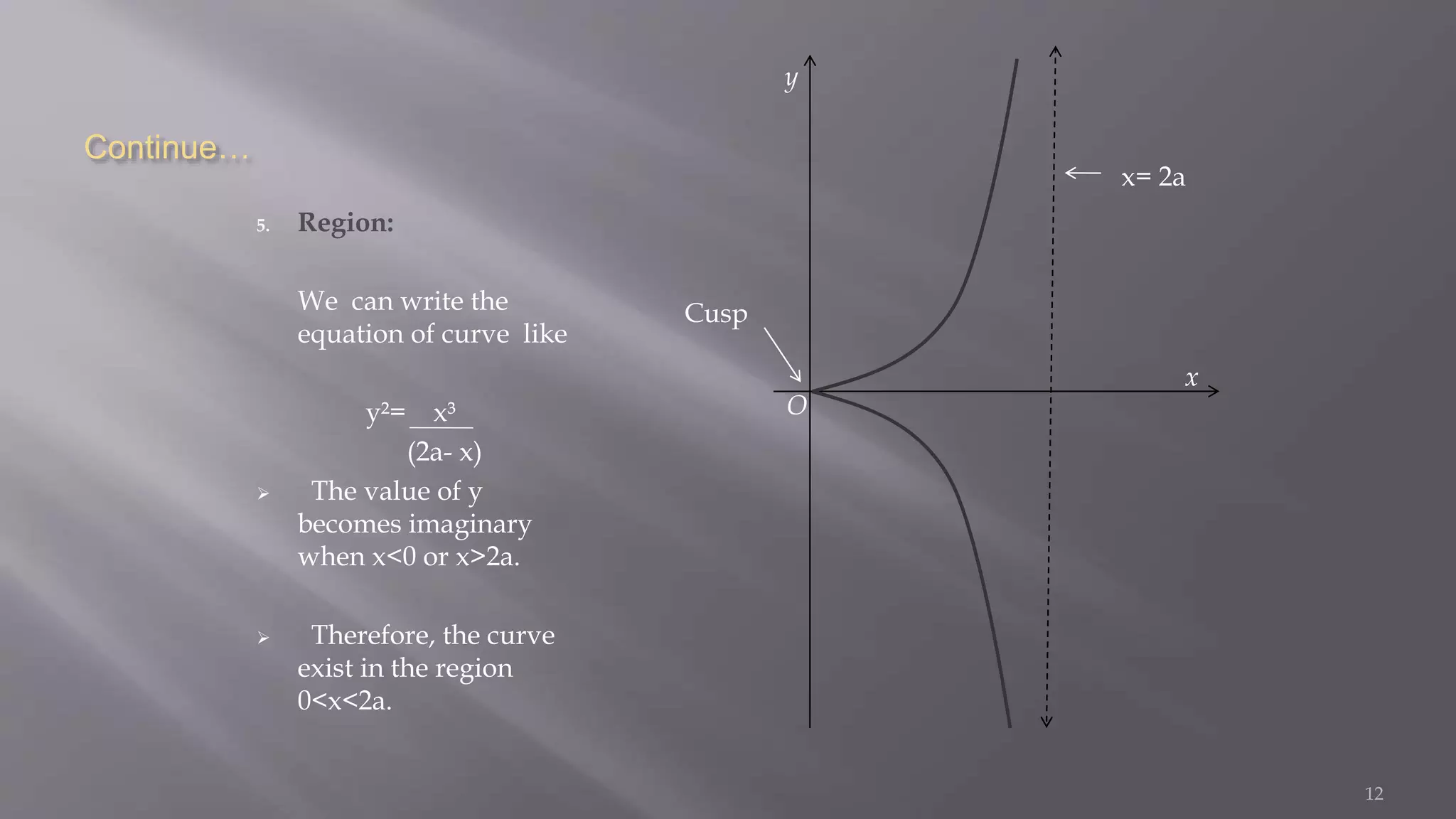
5. Region:
We can write the
equation of curve like
y²= x³
(2a- x)
 The value of y
becomes imaginary
when x<0 or x>2a.
 Therefore, the curve
exist in the region
0<x<2a.
12
y
O
x
x= 2a
Cusp
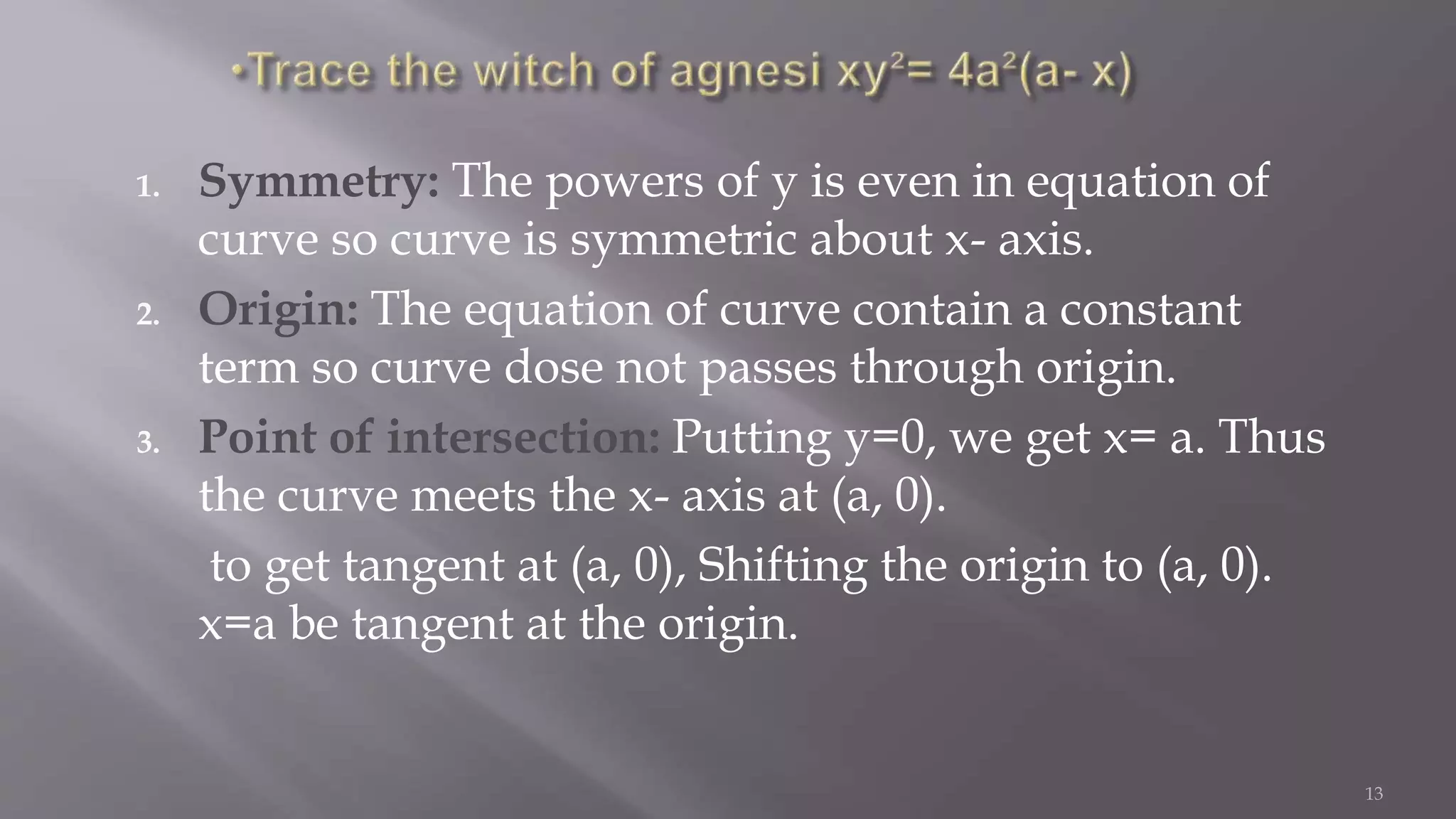
1. Symmetry: The powers of y is even in equation of
curve so curve is symmetric about x- axis.
2. Origin: The equation of curve contain a constant
term so curve dose not passes through origin.
3. Point of intersection: Putting y=0, we get x= a. Thus
the curve meets the x- axis at (a, 0).
to get tangent at (a, 0), Shifting the origin to (a, 0).
x=a be tangent at the origin.
13
4. Asymptotes:
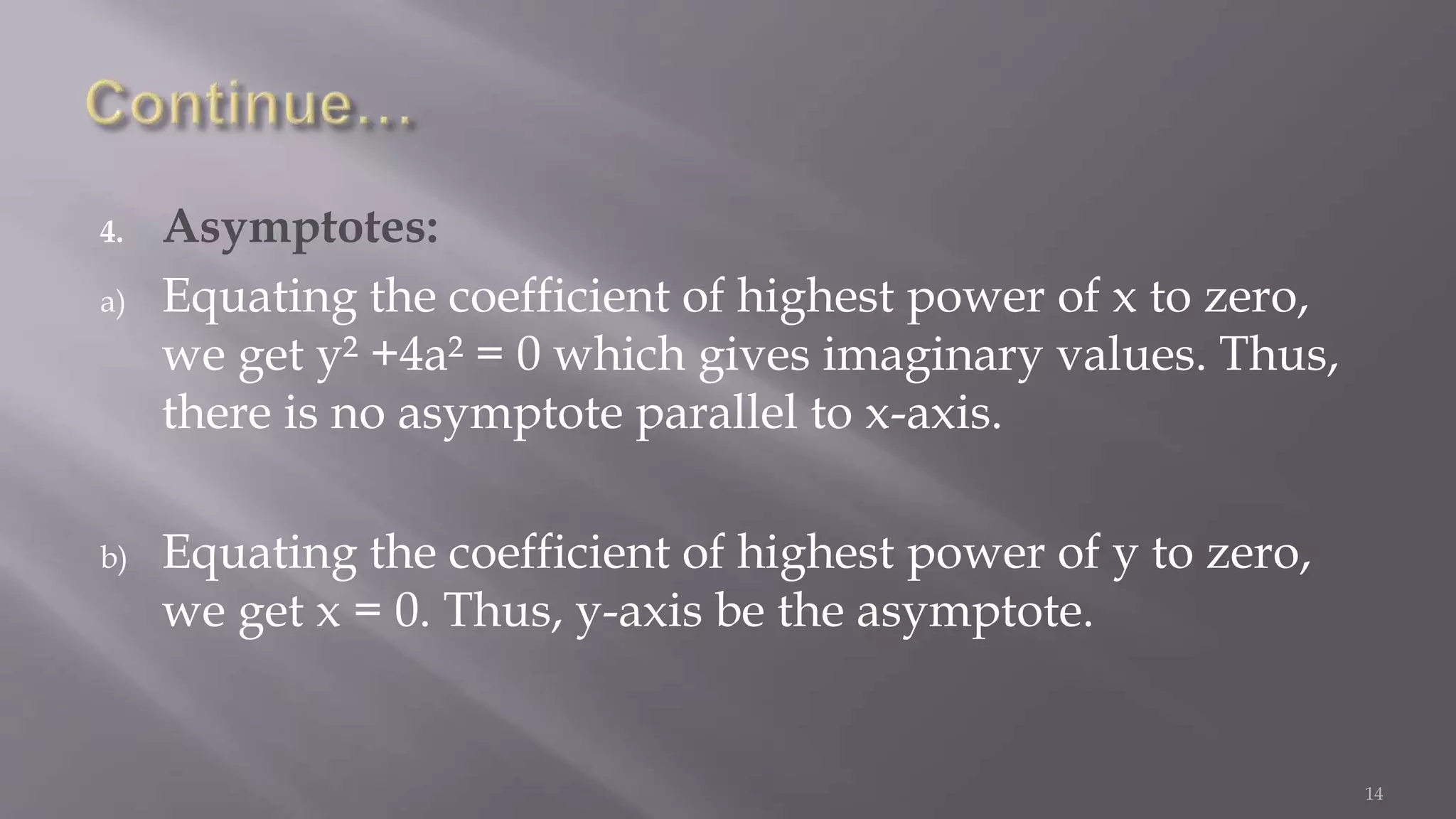
a) Equating the coefficient of highest power of x to zero,
we get y² +4a² = 0 which gives imaginary values. Thus,
there is no asymptote parallel to x-axis.
b) Equating the coefficient of highest power of y to zero,
we get x = 0. Thus, y-axis be the asymptote.
14
Continue…
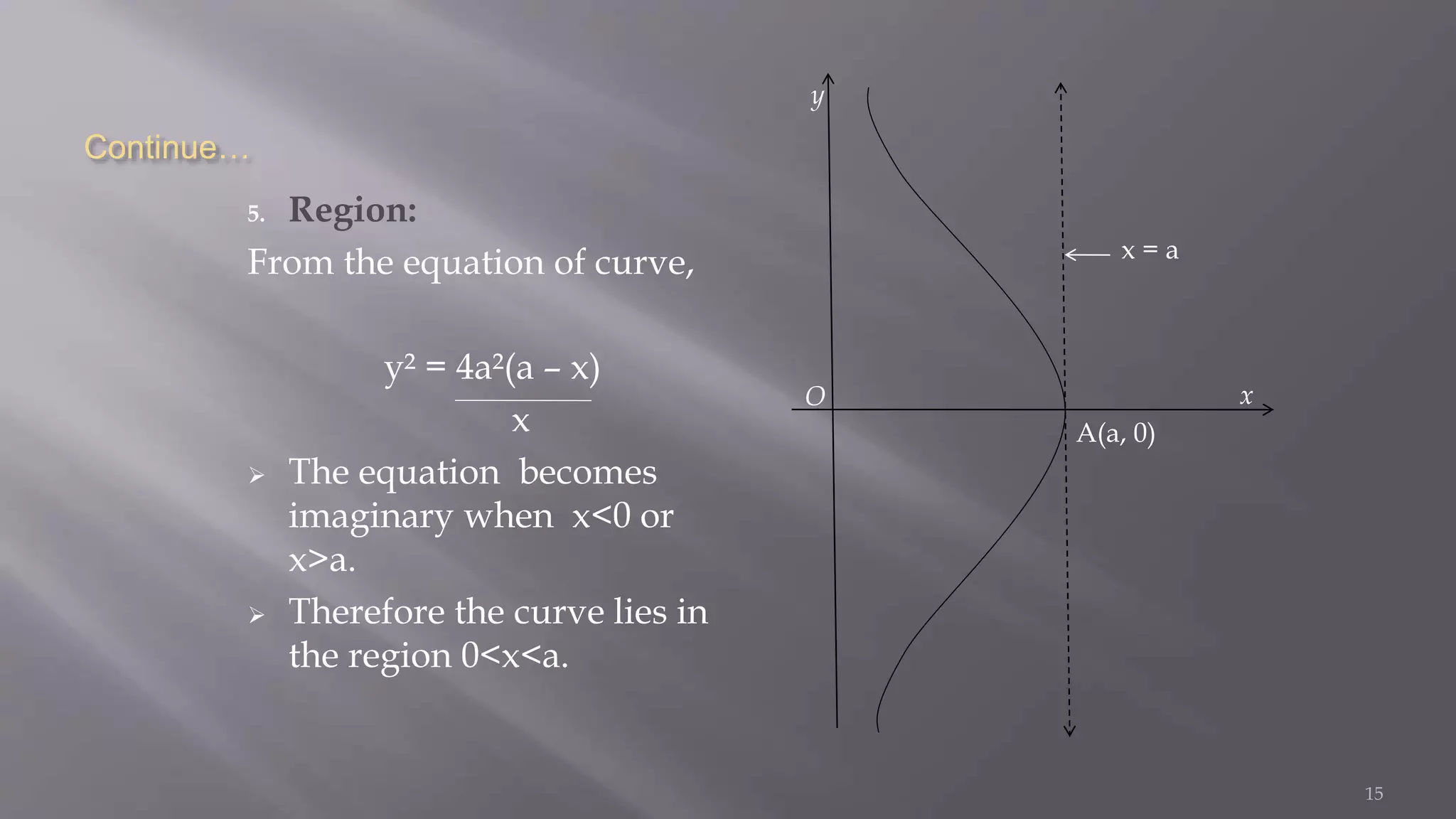
5. Region:
From the equation of curve,
y² = 4a²(a – x)
x
 The equation becomes
imaginary when x<0 or
x>a.
 Therefore the curve lies in
the region 0<x<a.
15
A(a, 0)
x = a
y
O x
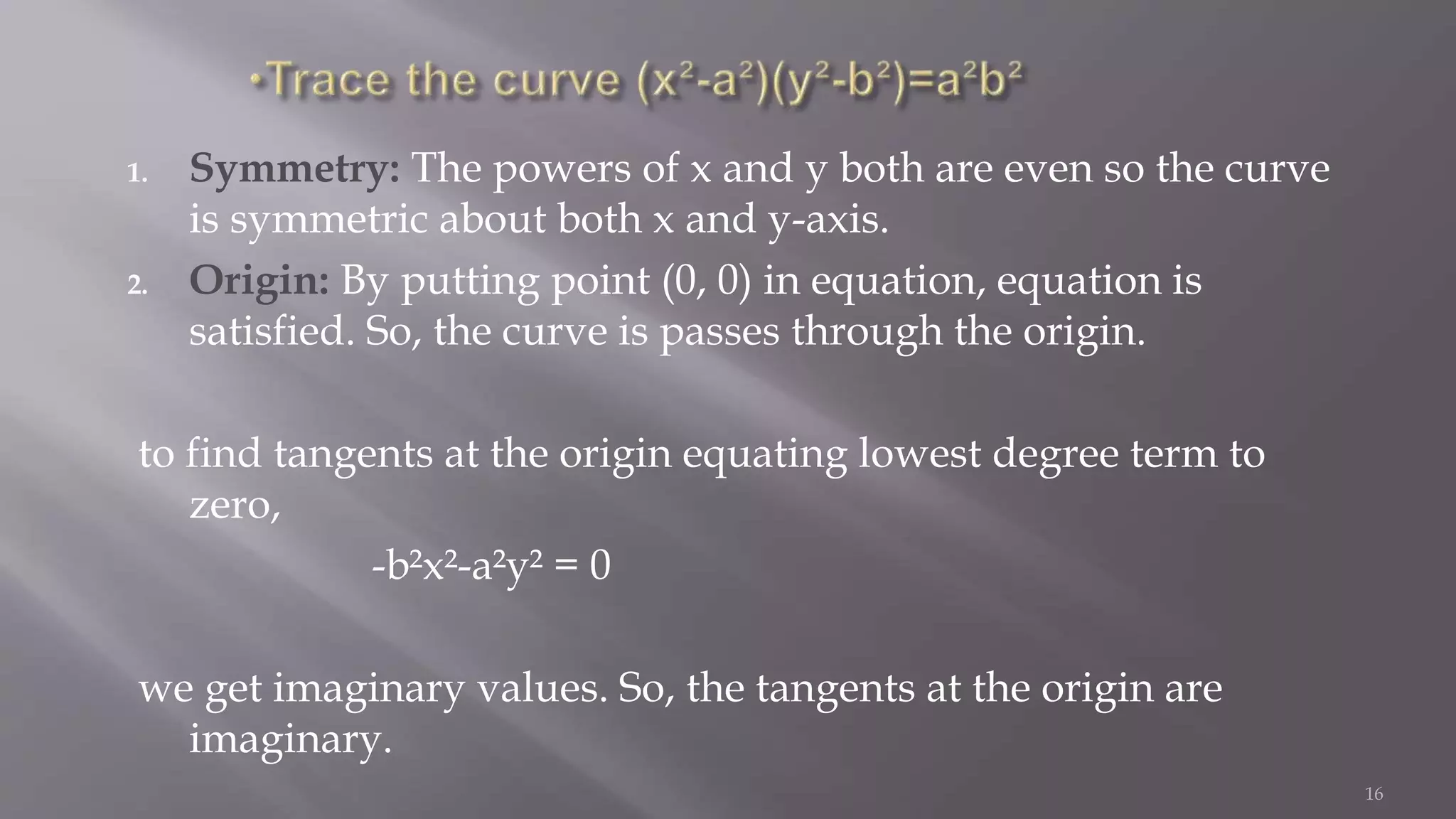
1. Symmetry: The powers of x and y both are even so the curve
is symmetric about both x and y-axis.
2. Origin: By putting point (0, 0) in equation, equation is
satisfied. So, the curve is passes through the origin.
to find tangents at the origin equating lowest degree term to
zero,
-b²x²-a²y² = 0
we get imaginary values. So, the tangents at the origin are
imaginary.
16
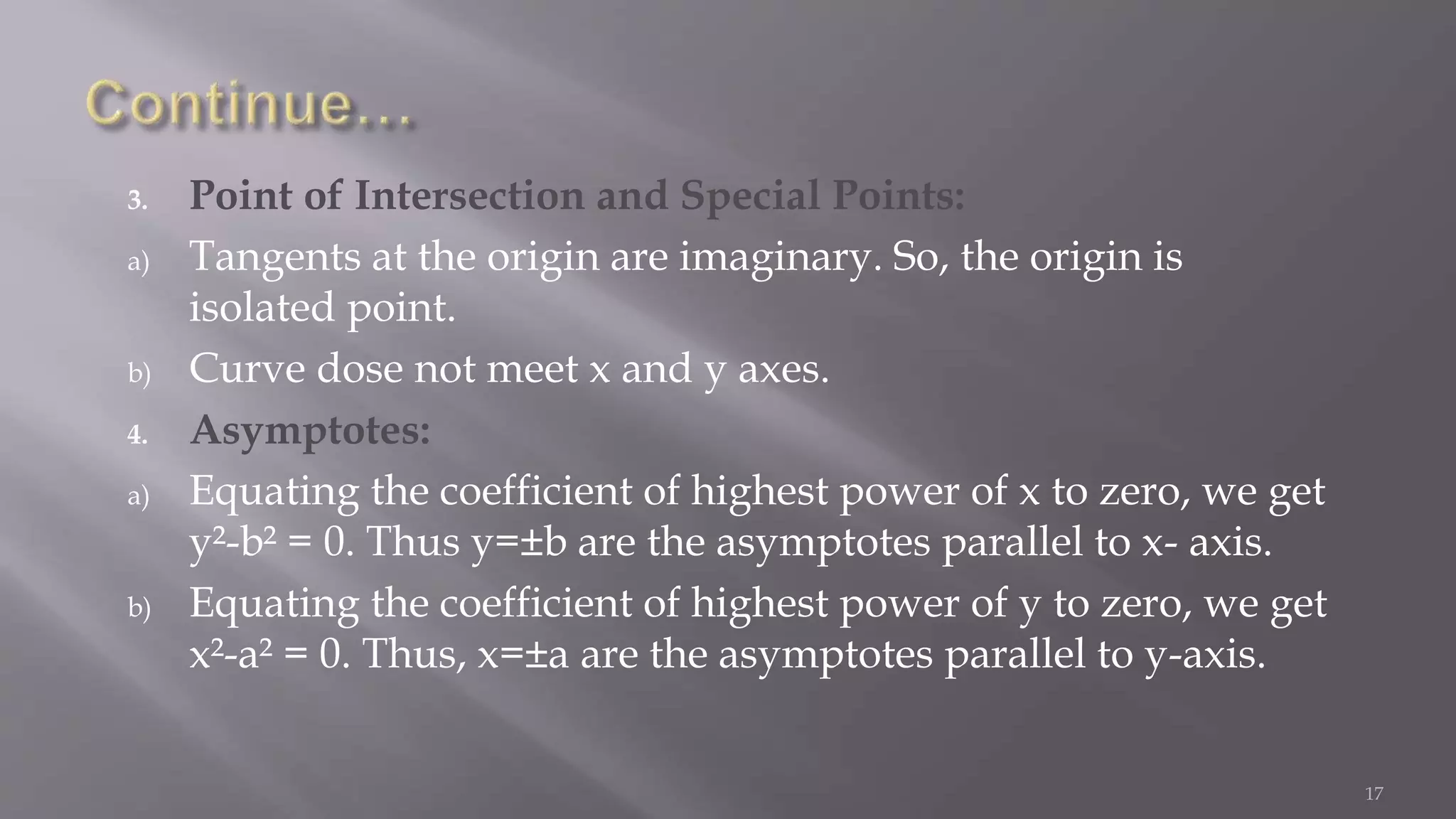
3. Point of Intersection and Special Points:
a) Tangents at the origin are imaginary. So, the origin is
isolated point.
b) Curve dose not meet x and y axes.
4. Asymptotes:
a) Equating the coefficient of highest power of x to zero, we get
y²-b² = 0. Thus y=±b are the asymptotes parallel to x- axis.
b) Equating the coefficient of highest power of y to zero, we get
x²-a² = 0. Thus, x=±a are the asymptotes parallel to y-axis.
17
Continue…
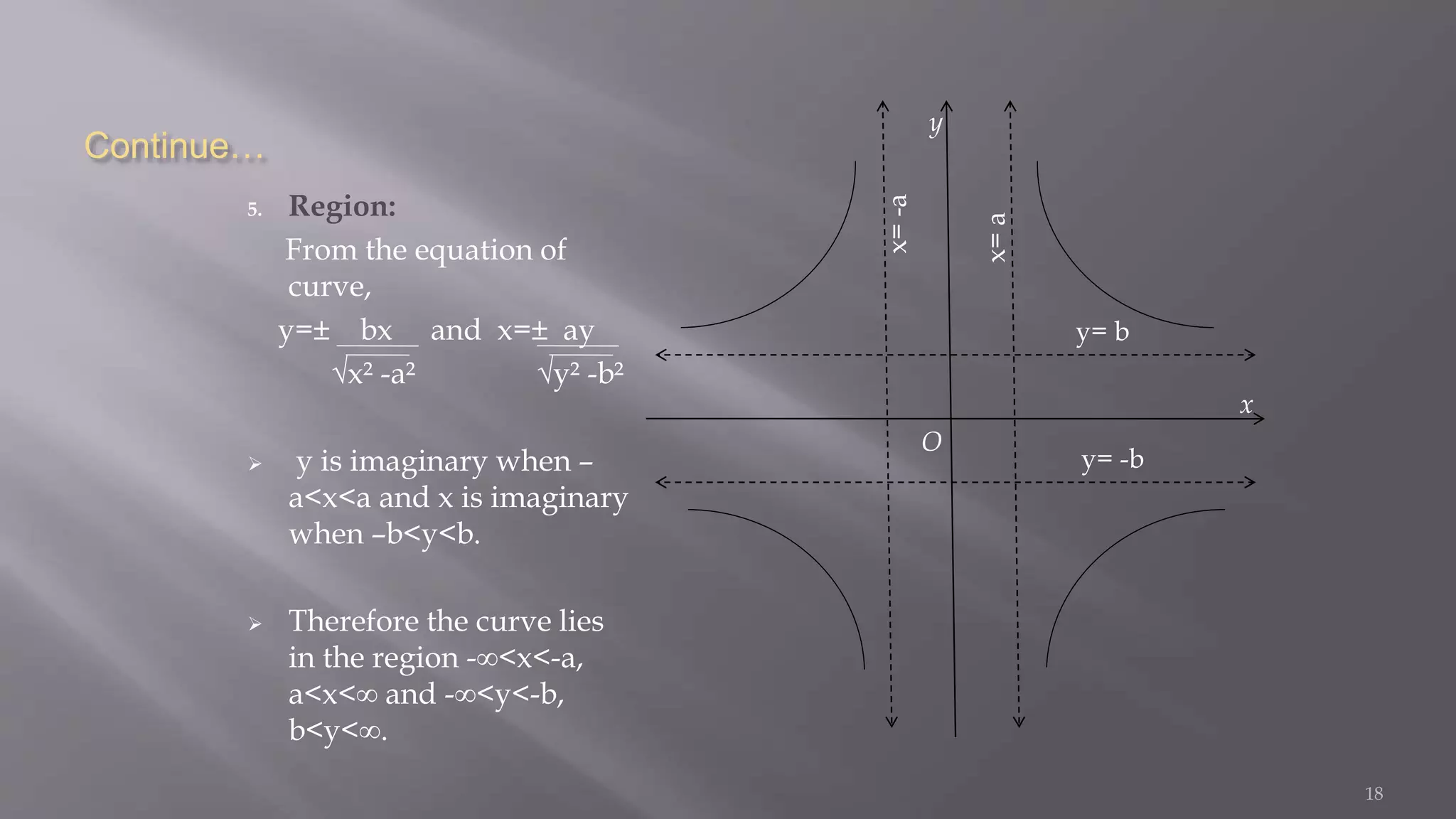
5. Region:
From the equation of
curve,
y=± bx and x=± ay
√x² -a² √y² -b²
 y is imaginary when –
a<x<a and x is imaginary
when –b<y<b.
 Therefore the curve lies
in the region -∞<x<-a,
a<x<∞ and -∞<y<-b,
b<y<∞.
18
y
x
O
x=-a
x=a
y= b
y= -b
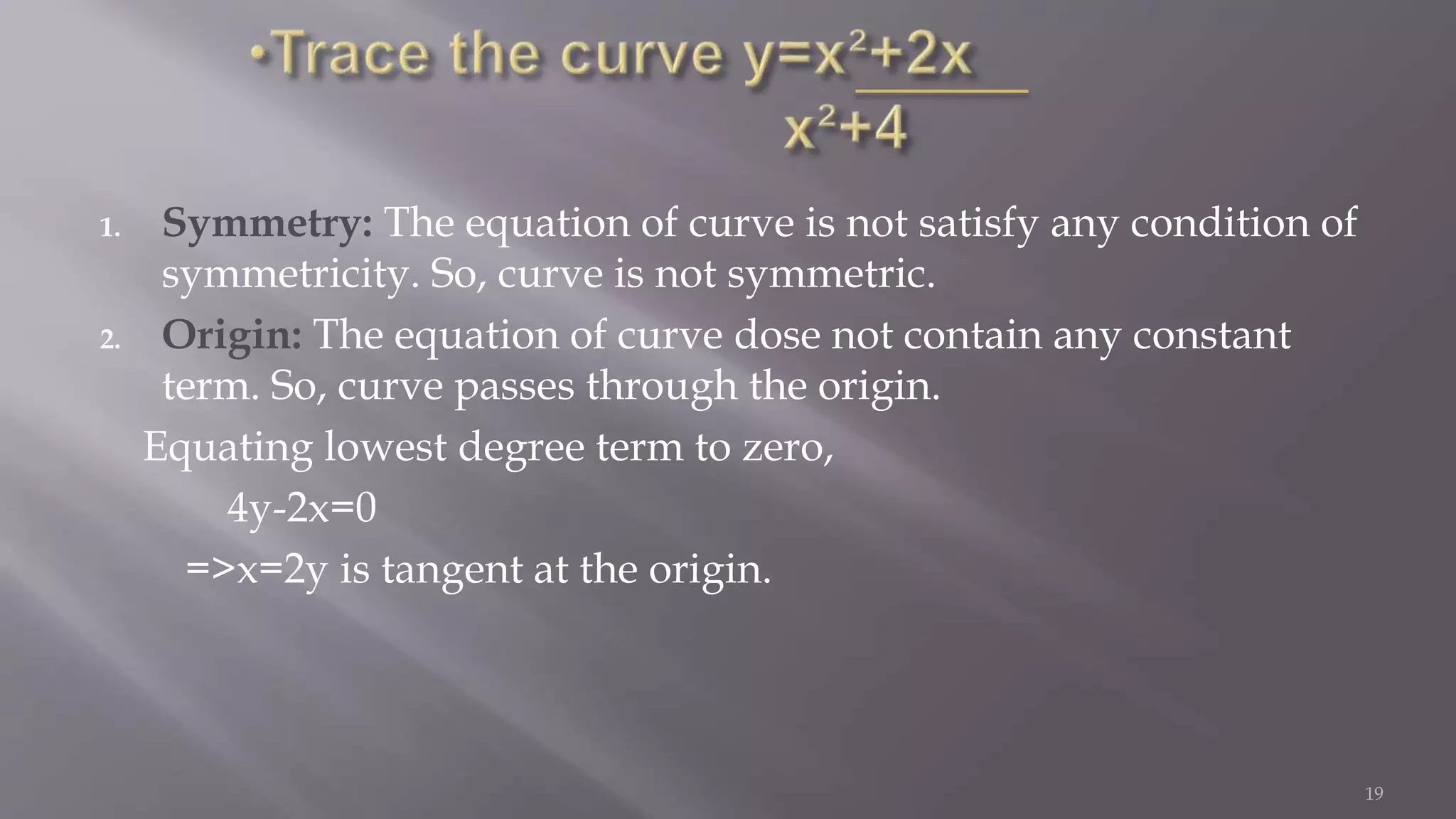
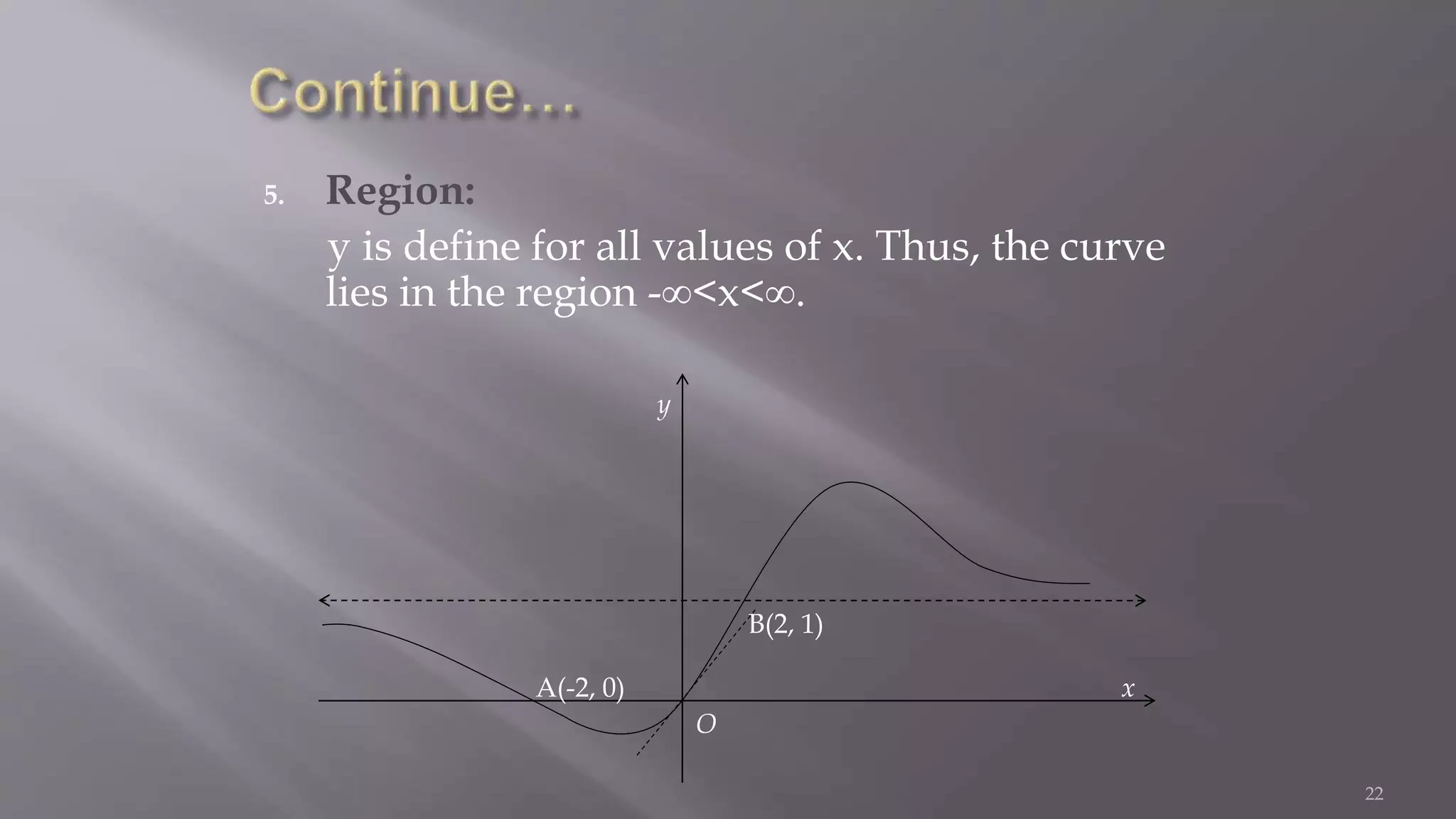
1. Symmetry: The equation of curve is not satisfy any condition of
symmetricity. So, curve is not symmetric.
2. Origin: The equation of curve dose not contain any constant
term. So, curve passes through the origin.
Equating lowest degree term to zero,
4y-2x=0
=>x=2y is tangent at the origin.
19
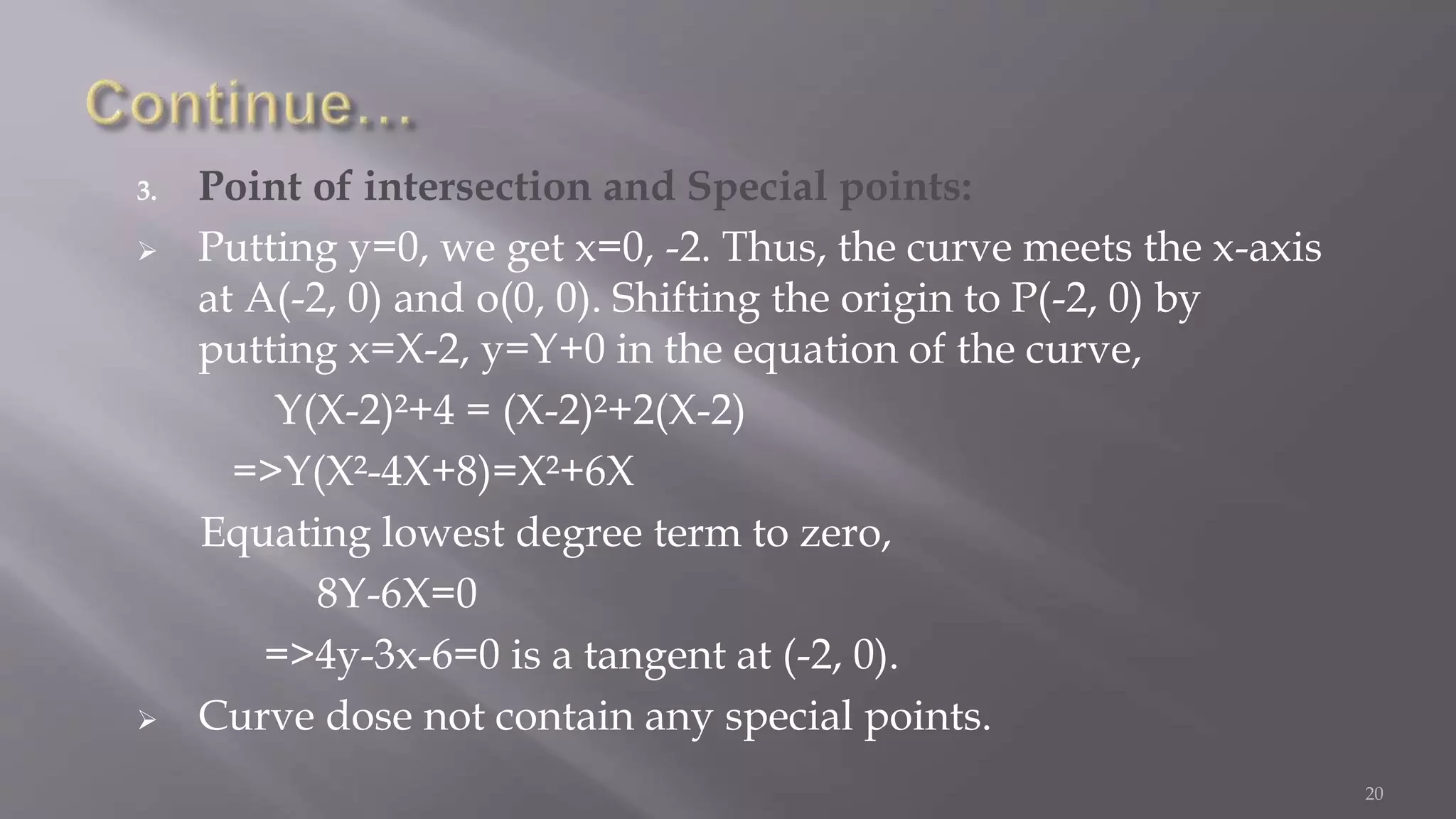
3. Point of intersection and Special points:
 Putting y=0, we get x=0, -2. Thus, the curve meets the x-axis
at A(-2, 0) and o(0, 0). Shifting the origin to P(-2, 0) by
putting x=X-2, y=Y+0 in the equation of the curve,
Y(X-2)²+4 = (X-2)²+2(X-2)
=>Y(X²-4X+8)=X²+6X
Equating lowest degree term to zero,
8Y-6X=0
=>4y-3x-6=0 is a tangent at (-2, 0).
 Curve dose not contain any special points.
20
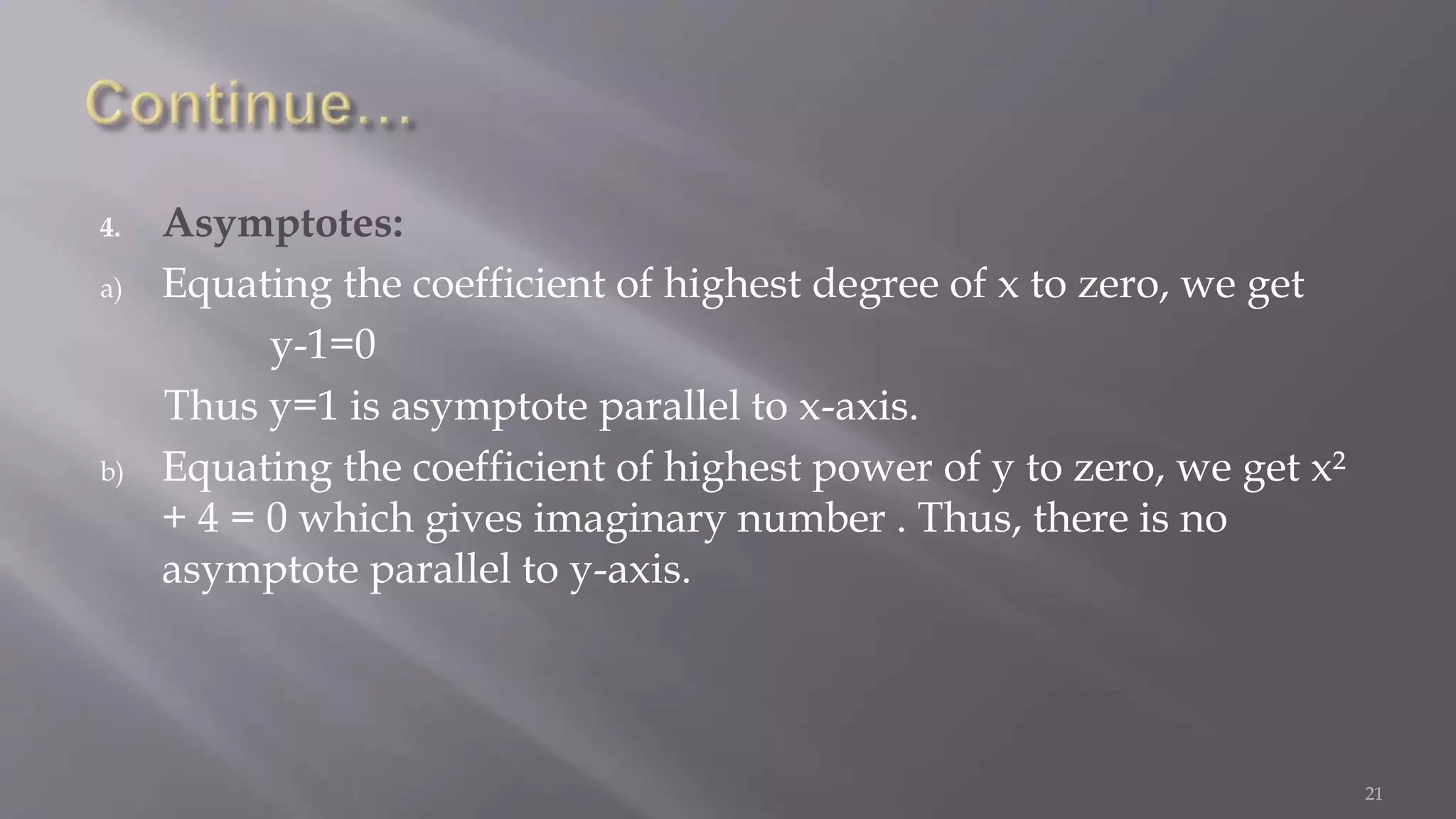
4. Asymptotes:
a) Equating the coefficient of highest degree of x to zero, we get
y-1=0
Thus y=1 is asymptote parallel to x-axis.
b) Equating the coefficient of highest power of y to zero, we get x²
+ 4 = 0 which gives imaginary number . Thus, there is no
asymptote parallel to y-axis.
21
5. Region:
y is define for all values of x. Thus, the curve
lies in the region -∞<x<∞.
22
B(2, 1)
O
A(-2, 0)
y
x
 www.tatamcgrawhill.com
23
24

Lecture 15

  • 1.
  • 2.
     The curveis symmetric about x-axis if the power of y occurring in the equation are all even, i.e. f(x,-y)=f(x, y).  The curve is symmetric about y-axis if the powers of x occurring in equation are all even, i.e. f(-x, y)=f(x, y). 2
  • 3.
     The curveis symmetric about the line y= x, if on interchanging x and y, the equation remains unchanged, i.e. f(y, x)=f(x, y).  The curve is symmetric in opposite quadrants or about origin if on replacing x by –x by y by –y, the equation remains unchanged, i.e. f(-x,-y)=f(x, y). 3
  • 4.
     The curvepasses through the origin if there is no constant term in the equation.  If curve passes through the origin, the tangents at the origin are obtained by equating the lowest degree term in x and y to zero.  If there are two or more tangents at the origin, it is called a node, a cusp or an isolated point if the tangents at this point are real and distinct, real and coincident or imaginary respectively. 4
  • 5.
     The pointof intersection of curve with x and y axis are obtained by putting y=0 and x=0 respectively in the equation of the curve.  Tangent at the point of intersection is obtained by shifting the origin to this point and then equating the lowest degree term to zero. 5
  • 6.
     Cusps: Iftangents are real and coincident then the double point is called cusp.  Nodes: If the tangents are real and distinct then the double point is called node.  Isolated Point: If the tangents are imaginary then double point is called isolated point. 6
  • 7.
     Asymptotes parallelto x-axis are obtain by equating the coefficient of highest degree term of the equation to zero.  Asymptotes parallel to y-axis are obtained by equating the coefficient of highest degree term of y in the equation to zero. 7
  • 8.
     Oblique asymptotesare obtained by the following method: Let y= mx + c is the asymptote to the curve and 2(x, y), 3(x, y) are the second and third degree terms in equation. Putting x=1 and y=m in 2(x, y) and 3(x, y) 2(x, y)= 2(1, m) or 2(m) 3(x, y)= 3(1, m) or 3(m) Find c=-( 2(m)/ ’3(m)) Solve 3(m)=0 m=m1,m2,…… 8
  • 9.
     This regionis obtained by expressing one variable in terms of other, i.e., y=f(x)[or x=f(y)] and then finding the values of x (or y) at which y(or x) becomes imaginary. The curve does not exist in the region which lies between these values of x (or y). 9
  • 10.
    1. Symmetry: Thepower of y in the equation of curve is even so the curve is symmetric about x- axis. 2. Origin: The equation of curve dose not contain any constant term so the curve passes through the origin. to find tangents at the origin equating lowest degree term to zero, 2ay²= 0 => y²= 0 => y= 0 Thus x-axis be a tangent. 10
  • 11.
    3. Points ofintersection: Putting y=0, we get x=0. Thus, the curve meets the coordinate axes only at the origin. 4. Asymptotes: a) Since coefficient of highest power of is constant, there is no parallel asymptote to x- axis. b) Equating the coefficient of highest degree term of y to zero, we get 2a-x= 0 =>x= 2a is the asymptote parallel to y-axis. 11
  • 12.
    Continue… 5. Region: We canwrite the equation of curve like y²= x³ (2a- x)  The value of y becomes imaginary when x<0 or x>2a.  Therefore, the curve exist in the region 0<x<2a. 12 y O x x= 2a Cusp
  • 13.
    1. Symmetry: Thepowers of y is even in equation of curve so curve is symmetric about x- axis. 2. Origin: The equation of curve contain a constant term so curve dose not passes through origin. 3. Point of intersection: Putting y=0, we get x= a. Thus the curve meets the x- axis at (a, 0). to get tangent at (a, 0), Shifting the origin to (a, 0). x=a be tangent at the origin. 13
  • 14.
    4. Asymptotes: a) Equatingthe coefficient of highest power of x to zero, we get y² +4a² = 0 which gives imaginary values. Thus, there is no asymptote parallel to x-axis. b) Equating the coefficient of highest power of y to zero, we get x = 0. Thus, y-axis be the asymptote. 14
  • 15.
    Continue… 5. Region: From theequation of curve, y² = 4a²(a – x) x  The equation becomes imaginary when x<0 or x>a.  Therefore the curve lies in the region 0<x<a. 15 A(a, 0) x = a y O x
  • 16.
    1. Symmetry: Thepowers of x and y both are even so the curve is symmetric about both x and y-axis. 2. Origin: By putting point (0, 0) in equation, equation is satisfied. So, the curve is passes through the origin. to find tangents at the origin equating lowest degree term to zero, -b²x²-a²y² = 0 we get imaginary values. So, the tangents at the origin are imaginary. 16
  • 17.
    3. Point ofIntersection and Special Points: a) Tangents at the origin are imaginary. So, the origin is isolated point. b) Curve dose not meet x and y axes. 4. Asymptotes: a) Equating the coefficient of highest power of x to zero, we get y²-b² = 0. Thus y=±b are the asymptotes parallel to x- axis. b) Equating the coefficient of highest power of y to zero, we get x²-a² = 0. Thus, x=±a are the asymptotes parallel to y-axis. 17
  • 18.
    Continue… 5. Region: From theequation of curve, y=± bx and x=± ay √x² -a² √y² -b²  y is imaginary when – a<x<a and x is imaginary when –b<y<b.  Therefore the curve lies in the region -∞<x<-a, a<x<∞ and -∞<y<-b, b<y<∞. 18 y x O x=-a x=a y= b y= -b
  • 19.
    1. Symmetry: Theequation of curve is not satisfy any condition of symmetricity. So, curve is not symmetric. 2. Origin: The equation of curve dose not contain any constant term. So, curve passes through the origin. Equating lowest degree term to zero, 4y-2x=0 =>x=2y is tangent at the origin. 19
  • 20.
    3. Point ofintersection and Special points:  Putting y=0, we get x=0, -2. Thus, the curve meets the x-axis at A(-2, 0) and o(0, 0). Shifting the origin to P(-2, 0) by putting x=X-2, y=Y+0 in the equation of the curve, Y(X-2)²+4 = (X-2)²+2(X-2) =>Y(X²-4X+8)=X²+6X Equating lowest degree term to zero, 8Y-6X=0 =>4y-3x-6=0 is a tangent at (-2, 0).  Curve dose not contain any special points. 20
  • 21.
    4. Asymptotes: a) Equatingthe coefficient of highest degree of x to zero, we get y-1=0 Thus y=1 is asymptote parallel to x-axis. b) Equating the coefficient of highest power of y to zero, we get x² + 4 = 0 which gives imaginary number . Thus, there is no asymptote parallel to y-axis. 21
  • 22.
    5. Region: y isdefine for all values of x. Thus, the curve lies in the region -∞<x<∞. 22 B(2, 1) O A(-2, 0) y x
  • 23.
  • 24.