
MATHEMATICS FUNDAE
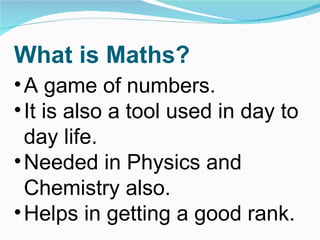
A game of numbers. It is also a tool used in day to day life. Needed in Physics and Chemistry also. Helps in getting a good rank. What is Maths?
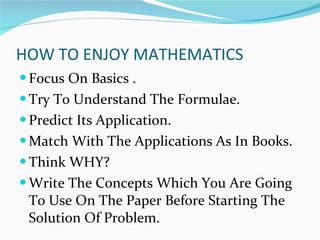
HOW TO ENJOY MATHEMATICS Focus On Basics . Try To Understand The Formulae. Predict Its Application. Match With The Applications As In Books. Think WHY?  Write The Concepts Which You Are Going To Use On The Paper Before Starting The Solution Of Problem.
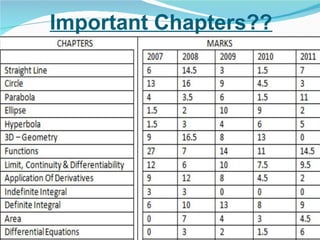
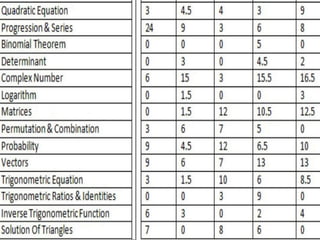
Important Chapters??
 
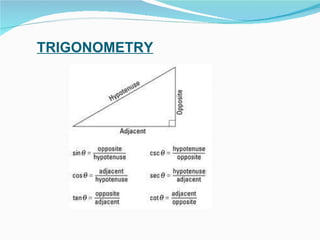
TRIGONOMETRY
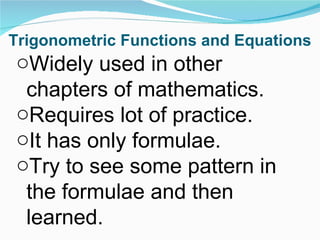
Trigonometric Functions and Equations Widely used in other chapters of mathematics. Requires lot of practice. It has only formulae. Try to see some pattern in the formulae and then learned.
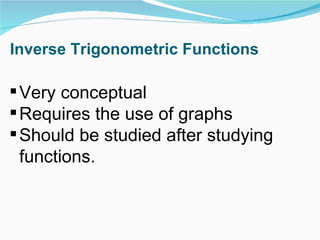
Inverse Trigonometric Functions Very conceptual Requires the use of graphs Should be studied after studying functions.
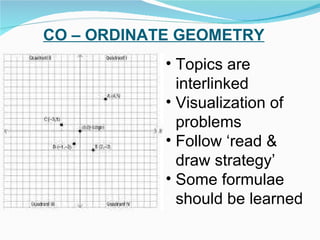
Topics are interlinked  Visualization of problems Follow ‘read & draw strategy’ Some formulae should be learned CO – ORDINATE GEOMETRY
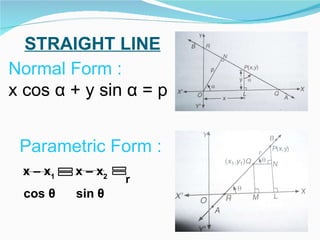
STRAIGHT LINE Normal Form : x cos  α   + y sin  α  = p Parametric Form :  x – x 1   x – x 2  r cos  θ   sin  θ
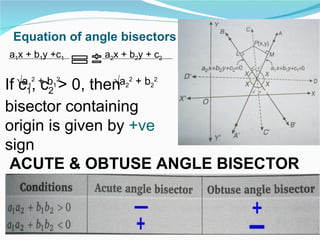
Equation of angle bisectors a 1 x + b 1 y +c 1   a 2 x + b 2 y + c 2   √ a 1 2  + b 1 2   √a 2 2  + b 2 2 If c 1 , c 2  > 0, then bisector containing origin is given by  +ve  sign ACUTE & OBTUSE ANGLE BISECTOR
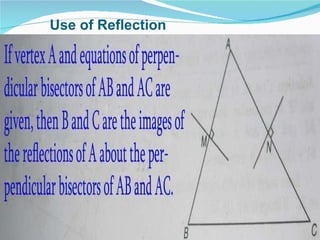
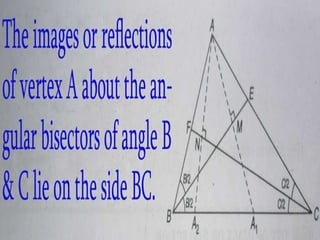
Use of Reflection
 
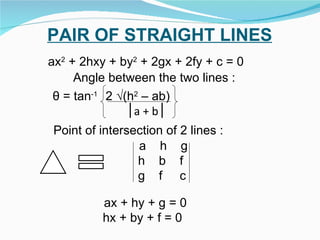
ax 2  + 2hxy + by 2  + 2gx + 2fy + c = 0 Angle between the two lines : θ  = tan -1  2 √(h 2  – ab)   │ a + b│ Point of intersection of 2 lines :   a  h  g h  b  f g  f  c ax + hy + g = 0 hx + by + f = 0 PAIR OF STRAIGHT LINES
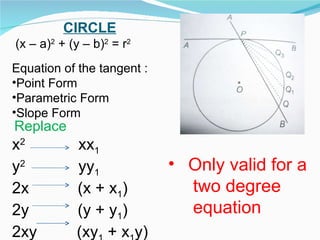
CIRCLE (x – a) 2  + (y – b) 2  = r 2 Equation of the tangent :  Point Form Parametric Form Slope Form Replace   x 2   xx 1   y 2   yy 1 2x  (x + x 1 )  2y  (y + y 1 )  2xy  (xy 1  + x 1 y) Only valid for a two degree equation
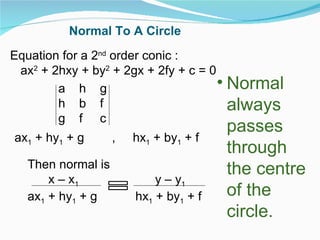
Normal To A Circle Equation for a 2 nd  order conic : ax 2  + 2hxy + by 2  + 2gx + 2fy + c = 0 Normal always passes through the centre of the circle. Then normal is x – x 1   y – y 1 ax 1  + hy 1  + g  hx 1  + by 1  + f  a  h  g h  b  f g  f  c   ax 1  + hy 1  + g  ,  hx 1  + by 1  + f
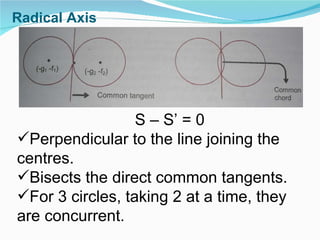
Radical Axis S – S’ = 0 Perpendicular to the line joining the centres. Bisects the direct common tangents. For 3 circles, taking 2 at a time, they are concurrent.
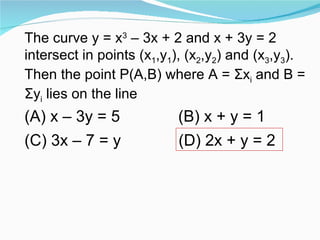
The curve y = x 3  – 3x + 2 and x + 3y = 2 intersect in points (x 1 ,y 1 ), (x 2 ,y 2 ) and (x 3 ,y 3 ). Then the point P(A,B) where A =  Σ x i  and B =  Σ y i  lies on the line  (A) x – 3y = 5 (B) x + y = 1 (C) 3x – 7 = y (D) 2x + y = 2
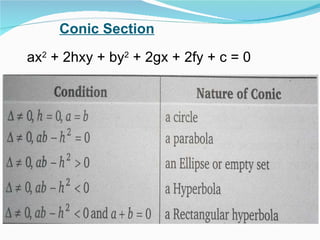
Conic Section ax 2  + 2hxy + by 2  + 2gx + 2fy + c = 0
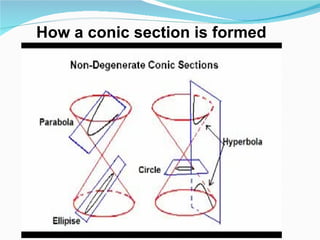
How a conic section is formed
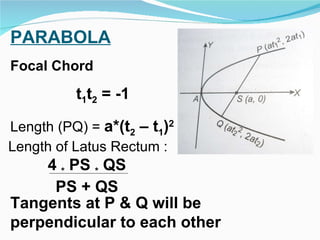
PARABOLA Focal Chord t 1 t 2  = -1 Length (PQ) =  a*(t 2  – t 1 ) 2 Tangents at P & Q will be perpendicular to each other Length of Latus Rectum : 4  *  PS  *  QS  PS + QS
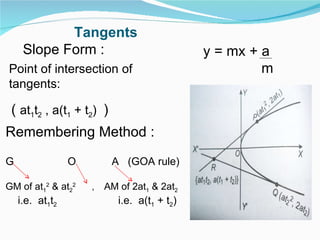
Tangents  Slope Form : Point of intersection of tangents: (  at 1 t 2  , a(t 1  + t 2 )  )  y = mx + a m Remembering Method : G  O  A  (GOA rule) GM of at 1 2  & at 2 2   ,  AM of 2at 1  & 2at 2 i.e.  at 1 t 2   i.e.  a(t 1  + t 2 )
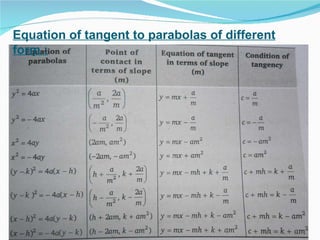
Equation of tangent to parabolas of different form :
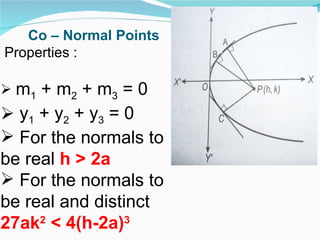
Co – Normal Points Properties : m 1  + m 2  + m 3  = 0 y 1  + y 2  + y 3  = 0 For the normals to be real  h > 2a For the normals to be real and distinct  27ak 2  < 4(h-2a) 3
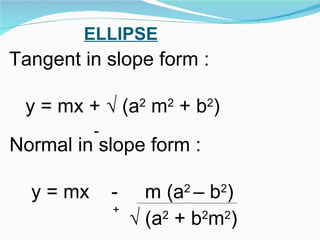
ELLIPSE Tangent in slope form :  y = mx + √ (a 2  m 2  + b 2 )  -   Normal in slope form : y = mx  -  m (a 2  – b 2 ) +  √ (a 2  + b 2 m 2 )
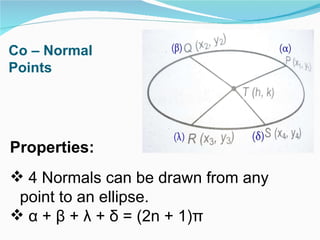
Co – Normal Points 4 Normals can be drawn from any point to an ellipse. α  +  β  +  λ  +  δ  = (2n + 1) π Properties:
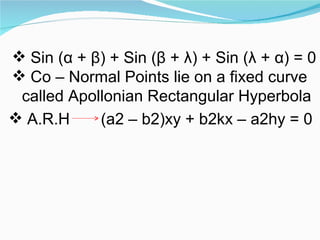
Sin ( α  +  β ) + Sin ( β  +  λ ) + Sin ( λ  +  α ) = 0 Co – Normal Points lie on a fixed curve called Apollonian Rectangular Hyperbola A.R.H  (a2 – b2)xy + b2kx – a2hy = 0
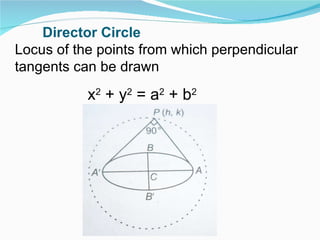
Director Circle  : Locus of the points from which perpendicular tangents can be drawn x 2  + y 2  = a 2  + b 2
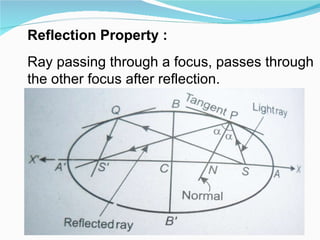
Reflection Property : Ray passing through a focus, passes through the other focus after reflection.
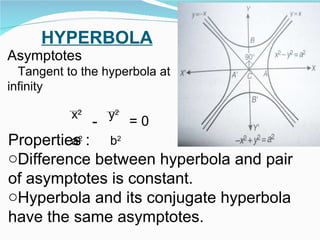
HYPERBOLA Asymptotes  Tangent to the hyperbola at infinity Properties : Difference between hyperbola and pair of asymptotes is constant. Hyperbola and its conjugate hyperbola have the same asymptotes. x 2   -   y 2   = 0   a 2   b 2
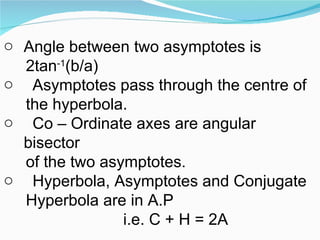
Angle between two asymptotes is  2tan -1 (b/a) Asymptotes pass through the centre of the hyperbola. Co – Ordinate axes are angular bisector of the two asymptotes. Hyperbola, Asymptotes and Conjugate Hyperbola are in A.P i.e. C + H = 2A
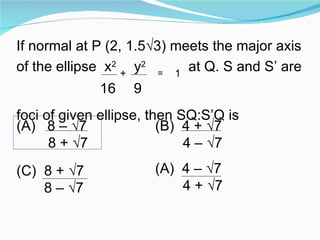
If normal at P (2, 1.5√3) meets the major axis of the ellipse  x 2   +   y 2   =   1  at Q. S and S’ are 16   9  foci of given ellipse, then SQ:S’Q is (A)  8 – √7  8 + √7 (B)  4 + √7 4 – √7  (C)  8 + √7 8 – √7  4 – √7 4 + √7
DIFFERENTIAL CALCULUS
FUNCTIONS Most Important Is Concept Of  DOMAIN  And  RANGE  . Knowledge About Some Important Functions Like  LOGARATHMIC, TRIGONOMETRIC, GREATEST INTEGER  etc. Focus On Domain And Range Of These Functions.
Give Attention To  COMPOSITE FUNCTIONS  . For Finding  PERIOD,  Be Careful About  CONSTANT FUNCTION.   HOW TO SOLVE PROBLEMS IN EXAMS  ?   Identify The Nature Of Function . Coordinate With Its Domain And Range.
Think Practically.  Go What The Question Says……. Get The Knowledge Of Symmetry About Any Point Or Line.
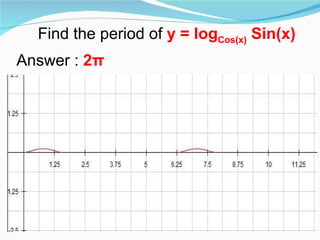
Find the period of  y = log Cos(x)  Sin(x) Answer :  2 π
LIMIT Condition For  EXISTANCE OF LIMIT Remember Some Important Expansions. L’HOSPITAL RULE  Try To Simplify The Question If You Get A Hard And Tough Looking Problem. 95% Of Such Problems Becomes Easy After Simplification
In Case When  x Tends To Infinity In Algebraic /Algebraic  Function Be Careful About Constants If  Given In Question.
CONTINUITY  AND DIFFERENTIABILITY Concept Of  LIMIT  Should Be Clear Before Attempting The Questions Of  Continuity. Remember The Approach Of  Continuity At End Points . For Differentiability Of Function, Careful Where To Use  Basic Funda  And Where  Direct Differntiation .
Differentiability At End Points In A Closed Or Open Interval. Differentiability  Implies  Contuinity .
APPLICATIONS OF dy/dx ROLLE’S THEOREM . LAGRANGE’S MEAN VALUE THEOREM. Use Of dy/dx In Deciding The Nature Of Curve. Try To Co-Relate Max. And Min. With The Help Of Graph.
Use nth Derivative Test. Concentrate On Maxima And Minima Of Discontinuous Function.
INTEGRAL CALULUS
INDEFINITE INTEGRAL Get Some Important Results. Use  By Parts  Method Whenever There Is Any Scope. Rearrangement  Is Your  Motto . Get The Approach Of Some Important Forms.
DEFINITE INTEGRALS An Easy Version Of Indefinite Integrals. Use Of Properties Are Very Useful. No Need Of Gamma Function , Walli’s Function etc. Maximum And Minimum Value of Integral Are Very Helpful During Exams.
Newton Method Of Differentiation Of Integrals. For Area , First Draw The Curve. Find Symmetrical Parts. Be Careful About Sign Of Integration.
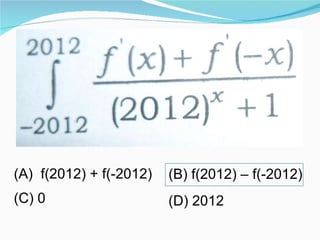
(A)  f(2012) + f(-2012) (B) f(2012) – f(-2012) (C) 0 (D) 2012
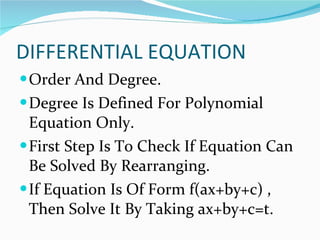
DIFFERENTIAL EQUATION Order And Degree. Degree Is Defined For Polynomial Equation Only. First Step Is To Check If Equation Can Be Solved By Rearranging. If Equation Is Of Form f(ax+by+c) , Then Solve It By Taking ax+by+c=t.
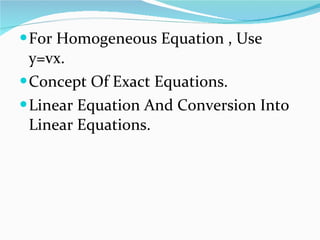
For Homogeneous Equation , Use y=vx. Concept Of Exact Equations. Linear Equation And Conversion Into Linear Equations.
ALGEBRA
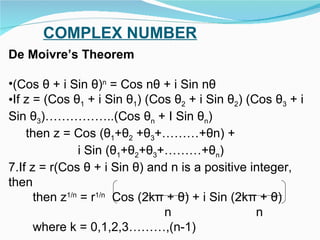
COMPLEX NUMBER De Moivre’s Theorem (Cos  θ  + i Sin  θ ) n  = Cos n θ  + i Sin n θ If z = (Cos  θ 1  + i Sin  θ 1 ) (Cos  θ 2  + i Sin  θ 2 ) (Cos  θ 3  + i Sin  θ 3 )……………..(Cos  θ n  + I Sin  θ n ) then z = Cos ( θ 1 + θ 2  + θ 3 +………+ θ n) +  i Sin ( θ 1 + θ 2 + θ 3 +………+ θ n ) If z = r(Cos  θ  + i Sin  θ ) and n is a positive integer, then  then z 1/n  = r 1/n   Cos (2k π  +  θ ) + i Sin (2k π  +  θ ) n    n where k = 0,1,2,3………,(n-1)
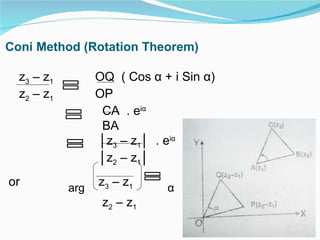
Coni Method (Rotation Theorem) z 3  – z 1   OQ  ( Cos  α  + i Sin  α ) z 2  – z 1   OP  CA  . e i α   BA │ z 3  – z 1 │  . e i α │ z 2  – z 1 │ or  arg   z 3  – z 1   α z 2  – z 1
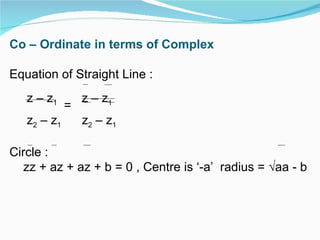
Co – Ordinate in terms of Complex Equation of Straight Line : z – z 1   =   z – z 1   z 2  – z 1   z 2  – z 1 Circle : zz + az + az + b = 0 , Centre is ‘-a’  radius = √aa - b
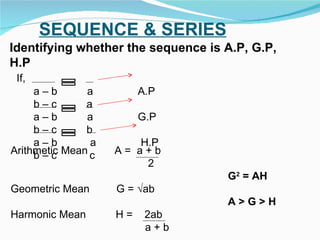
SEQUENCE & SERIES Identifying whether the sequence is A.P, G.P, H.P If,  a – b  a  A.P b – c  a a – b  a  G.P b – c  b a – b  a  H.P b – c  c  Arithmetic Mean  A =  a + b  2  G 2  = AH Geometric Mean  G = √ab A > G > H Harmonic Mean  H =  2ab a + b
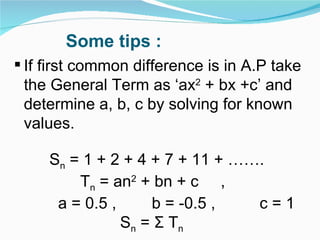
Some tips : If first common difference is in A.P take the General Term as ‘ax 2  + bx +c’ and determine a, b, c by solving for known values. S n  = 1 + 2 + 4 + 7 + 11 + …….  T n  = an 2  + bn + c  ,  a = 0.5 ,  b = -0.5 ,  c = 1 S n  =  Σ  T n
If second common difference is in A.P then take the cubic expression as the General Term and solve for constants.
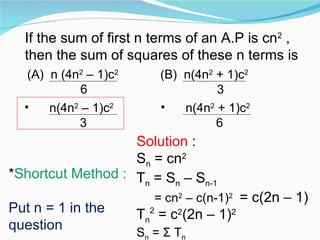
Solution  :  S n  = cn 2  T n  = S n  – S n-1 = cn 2  – c(n-1) 2   = c(2n – 1) T n 2  = c 2 (2n – 1) 2 S n  =  Σ  T n * Shortcut Method : Put n = 1 in the question If the sum of first n terms of an A.P is cn 2  , then the sum of squares of these n terms is  (A)  n (4n 2  – 1)c 2 6 (B)  n(4n 2  + 1)c 2 3 n(4n 2  – 1)c 2 3 n(4n 2  + 1)c 2 6
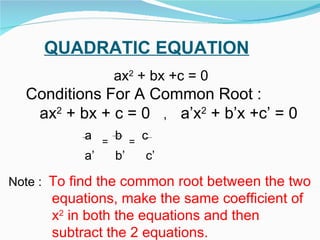
QUADRATIC EQUATION ax 2  + bx +c = 0 Conditions For A Common Root : ax 2  + bx + c = 0  ,  a’x 2  + b’x +c’ = 0  a  =   b  =   c a’  b’  c’ Note :  To find the common root between the two equations, make the same coefficient of  x 2  in both the equations and then  subtract the 2 equations.
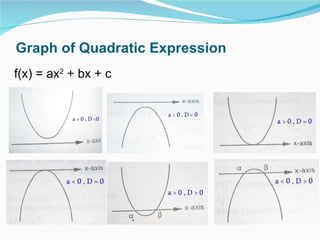
Graph of Quadratic Expression f(x) = ax 2  + bx + c
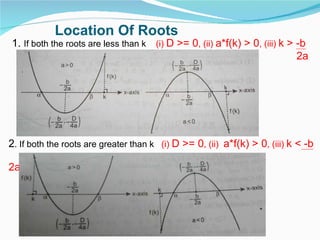
Location Of Roots 1.  If both the roots are less than k  (i)  D >= 0 , (ii)  a*f(k) > 0 , (iii)  k > -b 2a 2 . If both the roots are greater than k  (i)  D >= 0 , (ii)  a*f(k) > 0 , (iii)  k < -b 2a
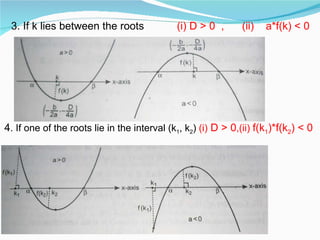
3. If k lies between the roots  (i) D > 0  ,  (ii)  a*f(k) < 0  4 . If one of the roots lie in the interval (k 1 , k 2 )  (i)  D > 0 ,(ii)  f(k 1 )*f(k 2 ) < 0
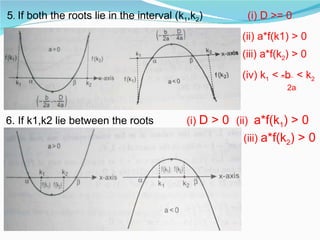
5 .  If both the roots lie in the interval (k 1 ,k 2 )  (i) D >= 0   6. If k1,k2 lie between the roots  (i)  D > 0  (ii)  a*f(k 1 ) > 0 (iii) a*f(k 2 ) > 0 (iv) k 1  < -b  < k 2 2a  (iii)  a*f(k 2 ) > 0 (ii) a*f(k1) > 0
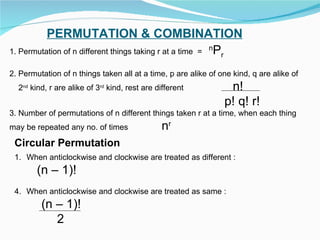
PERMUTATION & COMBINATION 1. Permutation of n different things taking r at a time  =  n P r 2. Permutation of n things taken all at a time, p are alike of one kind, q are alike of 2 nd  kind, r are alike of 3 rd  kind, rest are different  n! p! q! r! 3. Number of permutations of n different things taken r at a time, when each thing may be repeated any no. of times  n r Circular Permutation When anticlockwise and clockwise are treated as different : (n – 1)! When anticlockwise and clockwise are treated as same : (n – 1)! 2
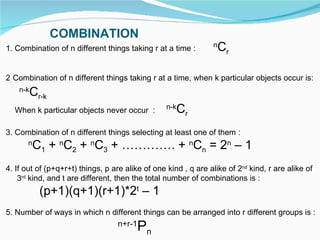
COMBINATION 1. Combination of n different things taking r at a time :  n C r 2 .  Combination of n different things taking r at a time, when k particular objects occur is: n-k C r-k   When k particular objects never occur  :  n-k C r 3. Combination of n different things selecting at least one of them : n C 1  +  n C 2  +  n C 3  + …………. +  n C n  = 2 n  – 1 4. If out of (p+q+r+t) things, p are alike of one kind , q are alike of 2 nd  kind, r are alike of 3 rd  kind, and t are different, then the total number of combinations is : (p+1)(q+1)(r+1)*2 t  – 1  5. Number of ways in which n different things can be arranged into r different groups is : n+r-1 P n
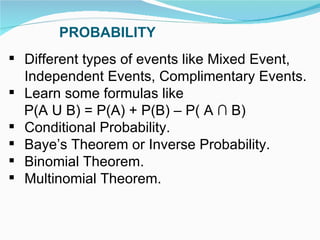
PROBABILITY Different types of events like Mixed Event, Independent Events, Complimentary Events. Learn some formulas like  P(A U B) = P(A) + P(B) – P( A ∩ B) Conditional Probability. Baye’s Theorem or Inverse Probability. Binomial Theorem. Multinomial Theorem.
VECTORS AND 3D GEOMETRY
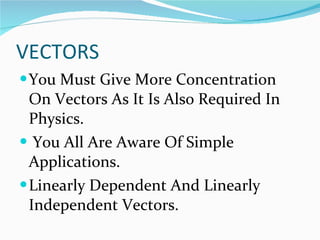
VECTORS You Must Give More Concentration On Vectors As It Is Also Required In Physics. You All Are Aware Of Simple Applications. Linearly Dependent And Linearly Independent Vectors.
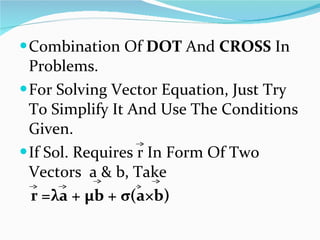
Combination Of  DOT  And  CROSS  In Problems. For Solving Vector Equation, Just Try To Simplify It And Use The Conditions Given.  If Sol. Requires r In Form Of Two Vectors  a & b, Take  r = λ a +  µ b +  σ (a×b)
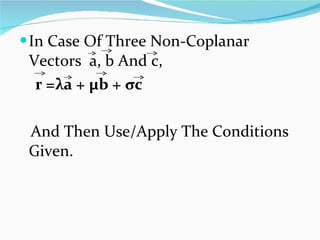
In Case Of Three Non-Coplanar Vectors  a, b And c, r = λ a + µb +  σ c And Then Use/Apply The Conditions  Given.
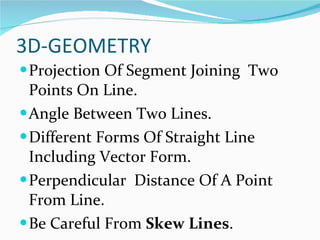
3D-GEOMETRY Projection Of Segment Joining  Two Points On Line. Angle Between Two Lines. Different Forms Of Straight Line Including Vector Form. Perpendicular  Distance Of A Point From Line. Be Careful From  Skew Lines .
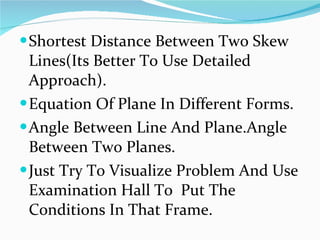
Shortest Distance Between Two Skew Lines(Its Better To Use Detailed Approach). Equation Of Plane In Different Forms. Angle Between Line And Plane.Angle  Between Two Planes. Just Try To Visualize Problem And Use Examination Hall To  Put The Conditions In That Frame.
Derive The Following Yourself: Equation Of Plane Containing The Given Lines. Shortest Distance Between Two Lines In All Three Forms. Condition For Lines To Intersect.
TIPS SECTION
TIPS FOR EXAMINATION First Of All , Keep Faith In Yourself. On Entering Examination Hall, Your Confidence Level Is Like That You Are JEE-2012 Topper But Don’t  Let This Confidence To Become Over-Confidence. During Examination, First Make A Quick View On Q. Paper.
Then Select The Question Which You Think ,You Will Solve Easily. Don’t Lose Your Confidence When You Are Not Able To Solve Any Problem. Keep In Mind, Some Questions Of  JEE  Are Not Given For Solving  But  Are Given To Leave . You Must Develop  A Sense About Selection  Of Question.
CONTACTS PHONE NO : 07501541135 EMAIL – ID :  [email_address]   Facebook.com/bilalshakir1 THANK YOU PHONE NO : 08927482599 EMAIL – ID :  [email_address] Facebook.com : Ashnil Kumar

Mathematics

  • 1.
  • 2.
    A game ofnumbers. It is also a tool used in day to day life. Needed in Physics and Chemistry also. Helps in getting a good rank. What is Maths?
  • 3.
    HOW TO ENJOYMATHEMATICS Focus On Basics . Try To Understand The Formulae. Predict Its Application. Match With The Applications As In Books. Think WHY? Write The Concepts Which You Are Going To Use On The Paper Before Starting The Solution Of Problem.
  • 4.
  • 5.
  • 6.
  • 7.
    Trigonometric Functions andEquations Widely used in other chapters of mathematics. Requires lot of practice. It has only formulae. Try to see some pattern in the formulae and then learned.
  • 8.
    Inverse Trigonometric FunctionsVery conceptual Requires the use of graphs Should be studied after studying functions.
  • 9.
    Topics are interlinked Visualization of problems Follow ‘read & draw strategy’ Some formulae should be learned CO – ORDINATE GEOMETRY
  • 10.
    STRAIGHT LINE NormalForm : x cos α + y sin α = p Parametric Form : x – x 1 x – x 2 r cos θ sin θ
  • 11.
    Equation of anglebisectors a 1 x + b 1 y +c 1 a 2 x + b 2 y + c 2 √ a 1 2 + b 1 2 √a 2 2 + b 2 2 If c 1 , c 2 > 0, then bisector containing origin is given by +ve sign ACUTE & OBTUSE ANGLE BISECTOR
  • 12.
  • 13.
  • 14.
    ax 2 + 2hxy + by 2 + 2gx + 2fy + c = 0 Angle between the two lines : θ = tan -1 2 √(h 2 – ab) │ a + b│ Point of intersection of 2 lines : a h g h b f g f c ax + hy + g = 0 hx + by + f = 0 PAIR OF STRAIGHT LINES
  • 15.
    CIRCLE (x –a) 2 + (y – b) 2 = r 2 Equation of the tangent : Point Form Parametric Form Slope Form Replace x 2 xx 1 y 2 yy 1 2x (x + x 1 ) 2y (y + y 1 ) 2xy (xy 1 + x 1 y) Only valid for a two degree equation
  • 16.
    Normal To ACircle Equation for a 2 nd order conic : ax 2 + 2hxy + by 2 + 2gx + 2fy + c = 0 Normal always passes through the centre of the circle. Then normal is x – x 1 y – y 1 ax 1 + hy 1 + g hx 1 + by 1 + f a h g h b f g f c ax 1 + hy 1 + g , hx 1 + by 1 + f
  • 17.
    Radical Axis S– S’ = 0 Perpendicular to the line joining the centres. Bisects the direct common tangents. For 3 circles, taking 2 at a time, they are concurrent.
  • 18.
    The curve y= x 3 – 3x + 2 and x + 3y = 2 intersect in points (x 1 ,y 1 ), (x 2 ,y 2 ) and (x 3 ,y 3 ). Then the point P(A,B) where A = Σ x i and B = Σ y i lies on the line (A) x – 3y = 5 (B) x + y = 1 (C) 3x – 7 = y (D) 2x + y = 2
  • 19.
    Conic Section ax2 + 2hxy + by 2 + 2gx + 2fy + c = 0
  • 20.
    How a conicsection is formed
  • 21.
    PARABOLA Focal Chordt 1 t 2 = -1 Length (PQ) = a*(t 2 – t 1 ) 2 Tangents at P & Q will be perpendicular to each other Length of Latus Rectum : 4 * PS * QS PS + QS
  • 22.
    Tangents SlopeForm : Point of intersection of tangents: ( at 1 t 2 , a(t 1 + t 2 ) ) y = mx + a m Remembering Method : G O A (GOA rule) GM of at 1 2 & at 2 2 , AM of 2at 1 & 2at 2 i.e. at 1 t 2 i.e. a(t 1 + t 2 )
  • 23.
    Equation of tangentto parabolas of different form :
  • 24.
    Co – NormalPoints Properties : m 1 + m 2 + m 3 = 0 y 1 + y 2 + y 3 = 0 For the normals to be real h > 2a For the normals to be real and distinct 27ak 2 < 4(h-2a) 3
  • 25.
    ELLIPSE Tangent inslope form : y = mx + √ (a 2 m 2 + b 2 ) - Normal in slope form : y = mx - m (a 2 – b 2 ) + √ (a 2 + b 2 m 2 )
  • 26.
    Co – NormalPoints 4 Normals can be drawn from any point to an ellipse. α + β + λ + δ = (2n + 1) π Properties:
  • 27.
    Sin ( α + β ) + Sin ( β + λ ) + Sin ( λ + α ) = 0 Co – Normal Points lie on a fixed curve called Apollonian Rectangular Hyperbola A.R.H (a2 – b2)xy + b2kx – a2hy = 0
  • 28.
    Director Circle : Locus of the points from which perpendicular tangents can be drawn x 2 + y 2 = a 2 + b 2
  • 29.
    Reflection Property :Ray passing through a focus, passes through the other focus after reflection.
  • 30.
    HYPERBOLA Asymptotes Tangent to the hyperbola at infinity Properties : Difference between hyperbola and pair of asymptotes is constant. Hyperbola and its conjugate hyperbola have the same asymptotes. x 2 - y 2 = 0 a 2 b 2
  • 31.
    Angle between twoasymptotes is 2tan -1 (b/a) Asymptotes pass through the centre of the hyperbola. Co – Ordinate axes are angular bisector of the two asymptotes. Hyperbola, Asymptotes and Conjugate Hyperbola are in A.P i.e. C + H = 2A
  • 32.
    If normal atP (2, 1.5√3) meets the major axis of the ellipse x 2 + y 2 = 1 at Q. S and S’ are 16 9 foci of given ellipse, then SQ:S’Q is (A) 8 – √7 8 + √7 (B) 4 + √7 4 – √7 (C) 8 + √7 8 – √7 4 – √7 4 + √7
  • 33.
  • 34.
    FUNCTIONS Most ImportantIs Concept Of DOMAIN And RANGE . Knowledge About Some Important Functions Like LOGARATHMIC, TRIGONOMETRIC, GREATEST INTEGER etc. Focus On Domain And Range Of These Functions.
  • 35.
    Give Attention To COMPOSITE FUNCTIONS . For Finding PERIOD, Be Careful About CONSTANT FUNCTION. HOW TO SOLVE PROBLEMS IN EXAMS ? Identify The Nature Of Function . Coordinate With Its Domain And Range.
  • 36.
    Think Practically. Go What The Question Says……. Get The Knowledge Of Symmetry About Any Point Or Line.
  • 37.
    Find the periodof y = log Cos(x) Sin(x) Answer : 2 π
  • 38.
    LIMIT Condition For EXISTANCE OF LIMIT Remember Some Important Expansions. L’HOSPITAL RULE Try To Simplify The Question If You Get A Hard And Tough Looking Problem. 95% Of Such Problems Becomes Easy After Simplification
  • 39.
    In Case When x Tends To Infinity In Algebraic /Algebraic Function Be Careful About Constants If Given In Question.
  • 40.
    CONTINUITY ANDDIFFERENTIABILITY Concept Of LIMIT Should Be Clear Before Attempting The Questions Of Continuity. Remember The Approach Of Continuity At End Points . For Differentiability Of Function, Careful Where To Use Basic Funda And Where Direct Differntiation .
  • 41.
    Differentiability At EndPoints In A Closed Or Open Interval. Differentiability Implies Contuinity .
  • 42.
    APPLICATIONS OF dy/dxROLLE’S THEOREM . LAGRANGE’S MEAN VALUE THEOREM. Use Of dy/dx In Deciding The Nature Of Curve. Try To Co-Relate Max. And Min. With The Help Of Graph.
  • 43.
    Use nth DerivativeTest. Concentrate On Maxima And Minima Of Discontinuous Function.
  • 44.
  • 45.
    INDEFINITE INTEGRAL GetSome Important Results. Use By Parts Method Whenever There Is Any Scope. Rearrangement Is Your Motto . Get The Approach Of Some Important Forms.
  • 46.
    DEFINITE INTEGRALS AnEasy Version Of Indefinite Integrals. Use Of Properties Are Very Useful. No Need Of Gamma Function , Walli’s Function etc. Maximum And Minimum Value of Integral Are Very Helpful During Exams.
  • 47.
    Newton Method OfDifferentiation Of Integrals. For Area , First Draw The Curve. Find Symmetrical Parts. Be Careful About Sign Of Integration.
  • 48.
    (A) f(2012)+ f(-2012) (B) f(2012) – f(-2012) (C) 0 (D) 2012
  • 49.
    DIFFERENTIAL EQUATION OrderAnd Degree. Degree Is Defined For Polynomial Equation Only. First Step Is To Check If Equation Can Be Solved By Rearranging. If Equation Is Of Form f(ax+by+c) , Then Solve It By Taking ax+by+c=t.
  • 50.
    For Homogeneous Equation, Use y=vx. Concept Of Exact Equations. Linear Equation And Conversion Into Linear Equations.
  • 51.
  • 52.
    COMPLEX NUMBER DeMoivre’s Theorem (Cos θ + i Sin θ ) n = Cos n θ + i Sin n θ If z = (Cos θ 1 + i Sin θ 1 ) (Cos θ 2 + i Sin θ 2 ) (Cos θ 3 + i Sin θ 3 )……………..(Cos θ n + I Sin θ n ) then z = Cos ( θ 1 + θ 2 + θ 3 +………+ θ n) + i Sin ( θ 1 + θ 2 + θ 3 +………+ θ n ) If z = r(Cos θ + i Sin θ ) and n is a positive integer, then then z 1/n = r 1/n Cos (2k π + θ ) + i Sin (2k π + θ ) n n where k = 0,1,2,3………,(n-1)
  • 53.
    Coni Method (RotationTheorem) z 3 – z 1 OQ ( Cos α + i Sin α ) z 2 – z 1 OP CA . e i α BA │ z 3 – z 1 │ . e i α │ z 2 – z 1 │ or arg z 3 – z 1 α z 2 – z 1
  • 54.
    Co – Ordinatein terms of Complex Equation of Straight Line : z – z 1 = z – z 1 z 2 – z 1 z 2 – z 1 Circle : zz + az + az + b = 0 , Centre is ‘-a’ radius = √aa - b
  • 55.
    SEQUENCE & SERIESIdentifying whether the sequence is A.P, G.P, H.P If, a – b a A.P b – c a a – b a G.P b – c b a – b a H.P b – c c Arithmetic Mean A = a + b 2 G 2 = AH Geometric Mean G = √ab A > G > H Harmonic Mean H = 2ab a + b
  • 56.
    Some tips :If first common difference is in A.P take the General Term as ‘ax 2 + bx +c’ and determine a, b, c by solving for known values. S n = 1 + 2 + 4 + 7 + 11 + ……. T n = an 2 + bn + c , a = 0.5 , b = -0.5 , c = 1 S n = Σ T n
  • 57.
    If second commondifference is in A.P then take the cubic expression as the General Term and solve for constants.
  • 58.
    Solution : S n = cn 2 T n = S n – S n-1 = cn 2 – c(n-1) 2 = c(2n – 1) T n 2 = c 2 (2n – 1) 2 S n = Σ T n * Shortcut Method : Put n = 1 in the question If the sum of first n terms of an A.P is cn 2 , then the sum of squares of these n terms is (A) n (4n 2 – 1)c 2 6 (B) n(4n 2 + 1)c 2 3 n(4n 2 – 1)c 2 3 n(4n 2 + 1)c 2 6
  • 59.
    QUADRATIC EQUATION ax2 + bx +c = 0 Conditions For A Common Root : ax 2 + bx + c = 0 , a’x 2 + b’x +c’ = 0 a = b = c a’ b’ c’ Note : To find the common root between the two equations, make the same coefficient of x 2 in both the equations and then subtract the 2 equations.
  • 60.
    Graph of QuadraticExpression f(x) = ax 2 + bx + c
  • 61.
    Location Of Roots1. If both the roots are less than k (i) D >= 0 , (ii) a*f(k) > 0 , (iii) k > -b 2a 2 . If both the roots are greater than k (i) D >= 0 , (ii) a*f(k) > 0 , (iii) k < -b 2a
  • 62.
    3. If klies between the roots (i) D > 0 , (ii) a*f(k) < 0 4 . If one of the roots lie in the interval (k 1 , k 2 ) (i) D > 0 ,(ii) f(k 1 )*f(k 2 ) < 0
  • 63.
    5 . If both the roots lie in the interval (k 1 ,k 2 ) (i) D >= 0 6. If k1,k2 lie between the roots (i) D > 0 (ii) a*f(k 1 ) > 0 (iii) a*f(k 2 ) > 0 (iv) k 1 < -b < k 2 2a (iii) a*f(k 2 ) > 0 (ii) a*f(k1) > 0
  • 64.
    PERMUTATION & COMBINATION1. Permutation of n different things taking r at a time = n P r 2. Permutation of n things taken all at a time, p are alike of one kind, q are alike of 2 nd kind, r are alike of 3 rd kind, rest are different n! p! q! r! 3. Number of permutations of n different things taken r at a time, when each thing may be repeated any no. of times n r Circular Permutation When anticlockwise and clockwise are treated as different : (n – 1)! When anticlockwise and clockwise are treated as same : (n – 1)! 2
  • 65.
    COMBINATION 1. Combinationof n different things taking r at a time : n C r 2 . Combination of n different things taking r at a time, when k particular objects occur is: n-k C r-k When k particular objects never occur : n-k C r 3. Combination of n different things selecting at least one of them : n C 1 + n C 2 + n C 3 + …………. + n C n = 2 n – 1 4. If out of (p+q+r+t) things, p are alike of one kind , q are alike of 2 nd kind, r are alike of 3 rd kind, and t are different, then the total number of combinations is : (p+1)(q+1)(r+1)*2 t – 1 5. Number of ways in which n different things can be arranged into r different groups is : n+r-1 P n
  • 66.
    PROBABILITY Different typesof events like Mixed Event, Independent Events, Complimentary Events. Learn some formulas like P(A U B) = P(A) + P(B) – P( A ∩ B) Conditional Probability. Baye’s Theorem or Inverse Probability. Binomial Theorem. Multinomial Theorem.
  • 67.
  • 68.
    VECTORS You MustGive More Concentration On Vectors As It Is Also Required In Physics. You All Are Aware Of Simple Applications. Linearly Dependent And Linearly Independent Vectors.
  • 69.
    Combination Of DOT And CROSS In Problems. For Solving Vector Equation, Just Try To Simplify It And Use The Conditions Given. If Sol. Requires r In Form Of Two Vectors a & b, Take r = λ a + µ b + σ (a×b)
  • 70.
    In Case OfThree Non-Coplanar Vectors a, b And c, r = λ a + µb + σ c And Then Use/Apply The Conditions Given.
  • 71.
    3D-GEOMETRY Projection OfSegment Joining Two Points On Line. Angle Between Two Lines. Different Forms Of Straight Line Including Vector Form. Perpendicular Distance Of A Point From Line. Be Careful From Skew Lines .
  • 72.
    Shortest Distance BetweenTwo Skew Lines(Its Better To Use Detailed Approach). Equation Of Plane In Different Forms. Angle Between Line And Plane.Angle Between Two Planes. Just Try To Visualize Problem And Use Examination Hall To Put The Conditions In That Frame.
  • 73.
    Derive The FollowingYourself: Equation Of Plane Containing The Given Lines. Shortest Distance Between Two Lines In All Three Forms. Condition For Lines To Intersect.
  • 74.
  • 75.
    TIPS FOR EXAMINATIONFirst Of All , Keep Faith In Yourself. On Entering Examination Hall, Your Confidence Level Is Like That You Are JEE-2012 Topper But Don’t Let This Confidence To Become Over-Confidence. During Examination, First Make A Quick View On Q. Paper.
  • 76.
    Then Select TheQuestion Which You Think ,You Will Solve Easily. Don’t Lose Your Confidence When You Are Not Able To Solve Any Problem. Keep In Mind, Some Questions Of JEE Are Not Given For Solving But Are Given To Leave . You Must Develop A Sense About Selection Of Question.
  • 77.
    CONTACTS PHONE NO: 07501541135 EMAIL – ID : [email_address] Facebook.com/bilalshakir1 THANK YOU PHONE NO : 08927482599 EMAIL – ID : [email_address] Facebook.com : Ashnil Kumar