DR NEEMU HAGE
 Tracheotomy
 Greek origin: ‘tom’- ‘to cut’ the trachea
 Surgical opening of the trachea
 Tracheostomy
 Greek origin: ‘stom’- ‘mouth’
 Creation of a stoma between trachea and
cervical skin
 1st known reference- rig veda dated 2000 BC.
 Ebers papyrus (dated 1550 BC)- Egyptian medical
papyrus mentions tracheotomy
 Alexander the Great
 Antyllus (2 AD), Greek surgeon-
performed tracheostomies in oral
surgeries
 Tracheotomy well documented in
Indian and Arabian literature in
middle ages.
 Tracheostomy gained popularity in 1800s
 Two methods:
 High- by dividing cricoid
 Low- trachea entered directly
 Significant problems associated with high
method
 Till the end of 19th century tracheostomy
considered hazardous
 Chevalier Jackson in 1923 established principles
of tracheostomy
Reduction in
respiratory
dead space
Laryngeal
bypass
Nasociliary
clearance and
humidification
lost Redundant
area between
stoma and
larynx
Disruption of
normal
swallowing
mechanism
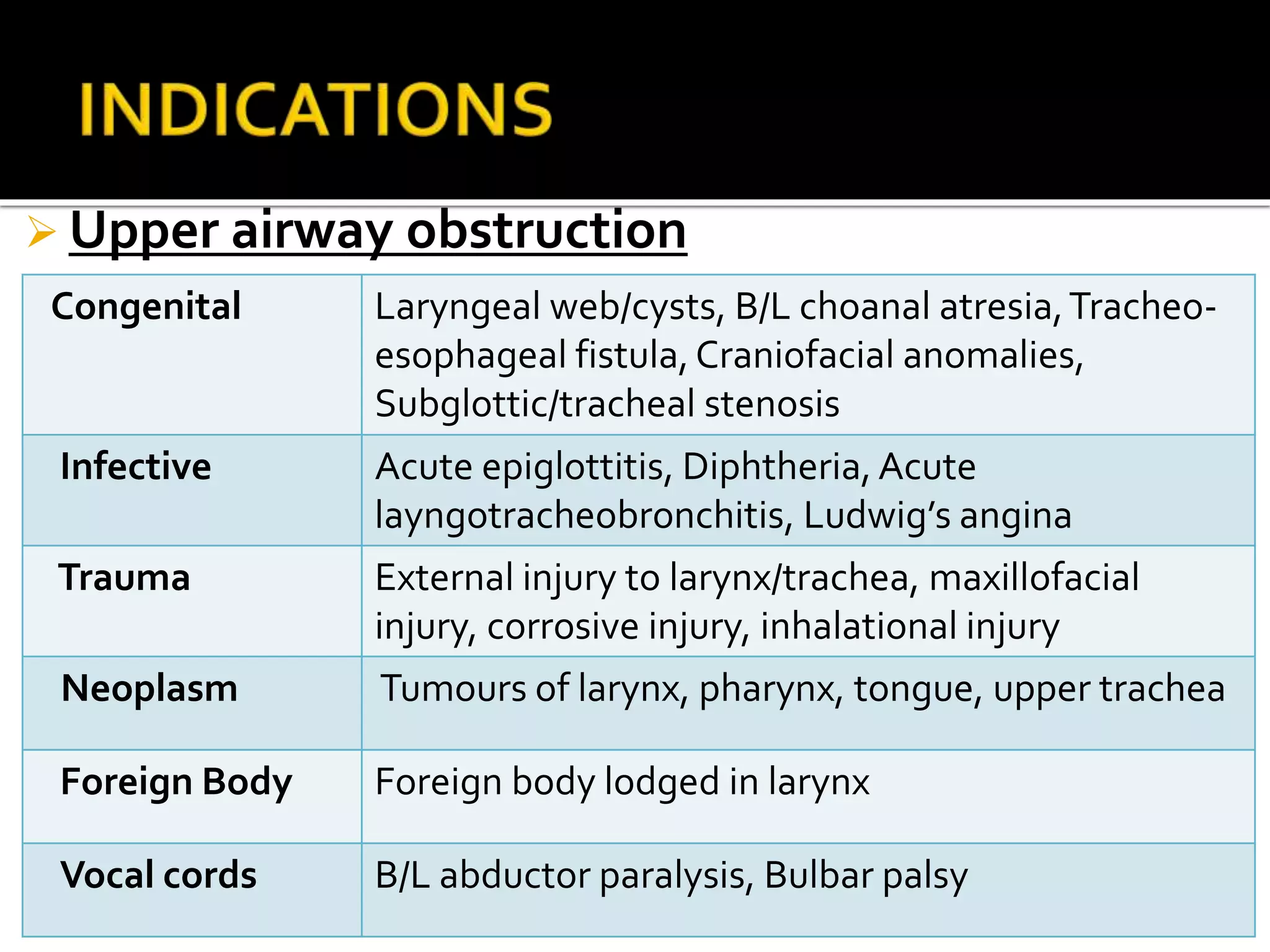
 Upper airway obstruction
Congenital Laryngeal web/cysts, B/L choanal atresia,Tracheo-
esophageal fistula,Craniofacial anomalies,
Subglottic/tracheal stenosis
Infective Acute epiglottitis, Diphtheria, Acute
layngotracheobronchitis, Ludwig’s angina
Trauma External injury to larynx/trachea, maxillofacial
injury, corrosive injury, inhalational injury
Neoplasm Tumours of larynx, pharynx, tongue, upper trachea
Foreign Body Foreign body lodged in larynx
Vocal cords B/L abductor paralysis, Bulbar palsy
 Removal of secretions and protection of
tracheobronchial tree from aspiration
 Neurological diseases- GBS, MS, Bulbar palsy
 Coma- head injury, poisoning, tumour
 In such situations- laryngeal/pharyngeal
incompetence
 Cuffed tube useful
 Respiratory failure
 Tracheostomy- dead space, effort of
breathing, alveolar ventilation
 Ease of removal of secretions
 Pulmonary diseases- exacerbation of chronic
bronchitis, emphysema, severe pneumonia
 Neurological diseases- MS, Motor neuron
disease
 Severe chest injury- flail chest
 Prolonged ventilation
 T-tube more secure than ET tube; easier to wean
off vent
 >3wks of intubation
 length of ventilation and hospital stay
 As a part of another procedure
 Temporary tracheostomy in head and neck
surgeries
 TEMPORARY/PERMANENT:
 Temporary tracheostomy- elective or emergency
 Permanent tracheostomy-as part of operation
involving removal of larynx
 HIGH/MID/LOW:
 High- above isthmus via 1st tracheal ring
 Mid- through 2nd-3rd tracheal ring, preferred
 Low- below level of isthmus
 Informed consent
 Coagulation profile adequate, platelet count
>50000/cumm
 Neck examination- to anticipate difficulties in
procedure as in enlarged thyroid, limited neck
extension.
 T-tube arranged, checked and prepared
 Surgical tracheostomy
 Minitracheostomy
 Paediatric tracheostomy
 Percutaneous dilatational tracheostomy
 Immediate
 Haemorrhage
 Local injury-cricoid cartilage,
1st tracheal ring, carotid artery
recurrent laryngeal nerve
 Air embolism
 Apnoea
 Cardiac arrest
 Intermediate (1st few hours or days)
 Secondary haemorrhage
 Tube displacement
 Tube blockage
 Subcutaneous emphysema
 Pneumothorax
 Infection
 Tracheal necrosis
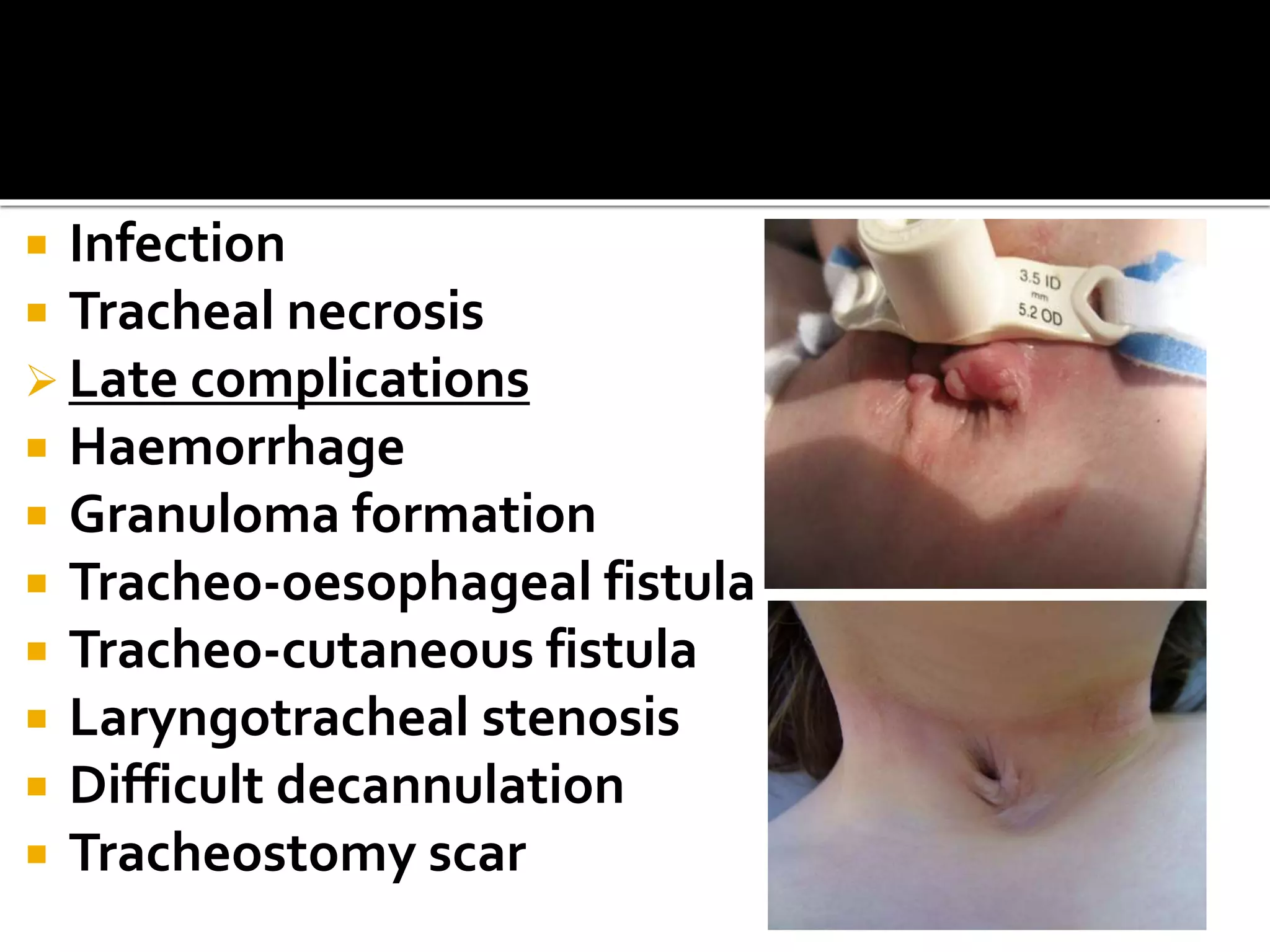
 Late complications
 Haemorrhage
 Granuloma formation
 Tracheo-oesophageal fistula
 Tracheo-cutaneous fistula
 Laryngotracheal stenosis
 Difficult decannulation
 Tracheostomy scar
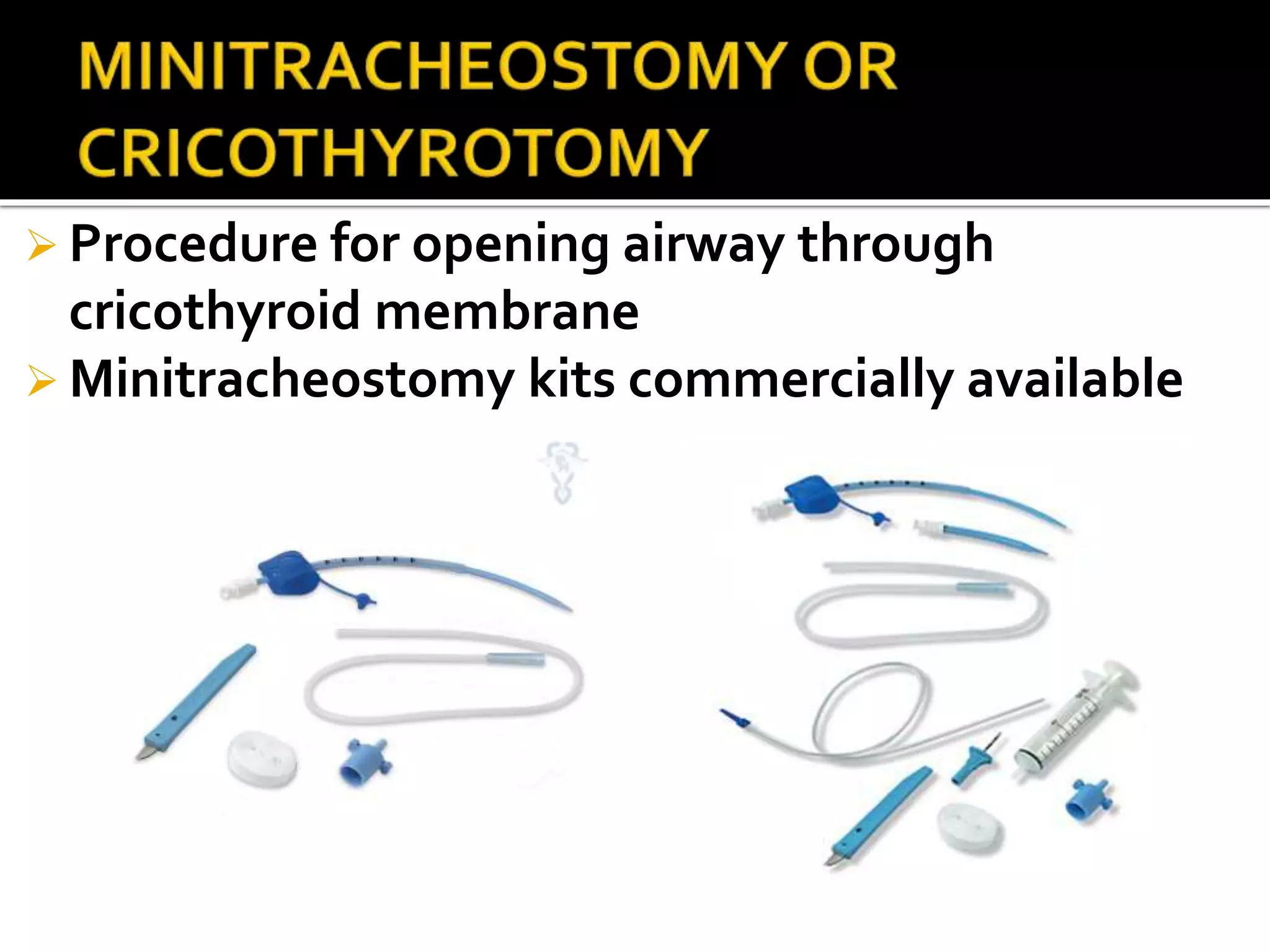
 Procedure for opening airway through
cricothyroid membrane
 Minitracheostomy kits commercially available
 Anatomy of paediatric upper airway different from
adults
 Age of child critical when deciding appropriate size
of tube
 Standard of paediatric intensive care facilities have
improved in last 2 decades
 Reduced rate of tracheostomy in paediatric
population
 Speech development may be impaired in long term
tracheostomies
 Upper airway obtruction
Oropharynx,
Tongue base
Macroglossia,Treacher Collins syndrome,
Goldenhar syndrome, Cystic hygroma,
Diphtheria
Nose, Nasopharynx B/L choanal atresia
Supraglottis Supraglottic cyst,Acute Epiglottitis
Glottis Vocal cord palsy, Laryngeal oedema,
Physical trauma, Juvenile respiratoty
papillomatosis
Subglottis Subglottic stenosis, Hemangioma
Trachea Acute laryngotracheobronchitis,
Tracheomalacia,Tracheal stenosis
 Prolonged intubation
 Indicated for patients requiring long term PPV
such as- PT neonate, CNS disease, severe burns
 Long term intubation leads to complications and
difficult decannulation
 >3 weeks of intubation
 Pulmonary toilet
 For intractable aspiration- decreases dead space
and eases work of pulmonary toilet
 Structures lie higher up
 Soft and compressible
airway
 Structures from superior
mediastinum pulled up
during extension of neck
 Small tracheal lumen
 Trachea, a developing
structure
 Funnel shaped larynx with
narrowest part being
subglottis
 Suction
 Regular suctioning
 Frequency depends on
individual basis
 Indications
 Appropriate size of
 Suction catheter
 Method
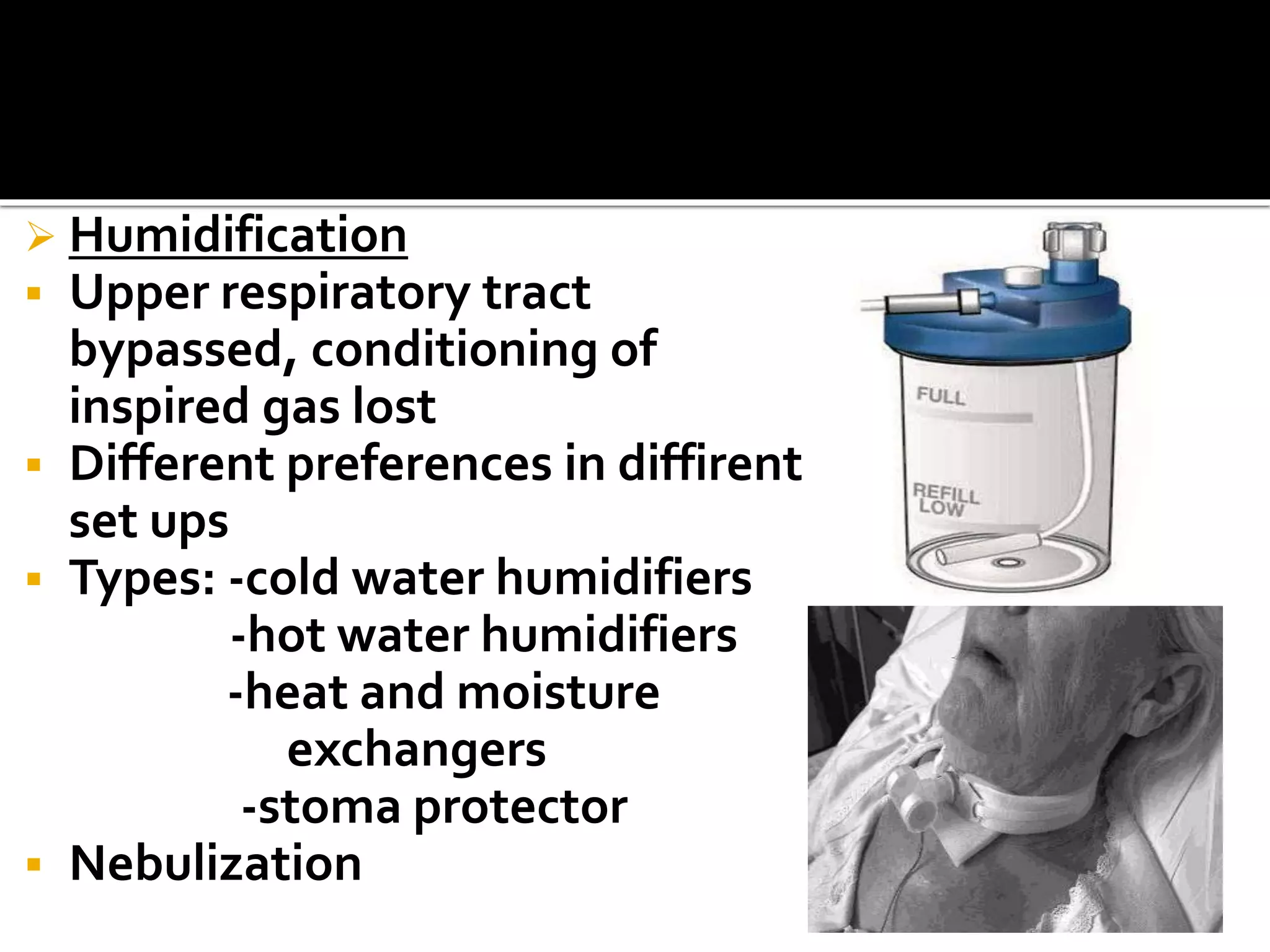
 Humidification
 Upper respiratory tract
bypassed, conditioning of
inspired gas lost
 Different preferences in diffirent
set ups
 Types: -cold water humidifiers
-hot water humidifiers
-heat and moisture
exchangers
-stoma protector
 Nebulization
 Tracheostomy tube change
 1st tube change- 5-7 days
 Frequency of tube change- no standard interval
 ‘if you can hear a tube, you should change it’
 Bougies or guidewires
 Wound care
 cuffed or uncuffed
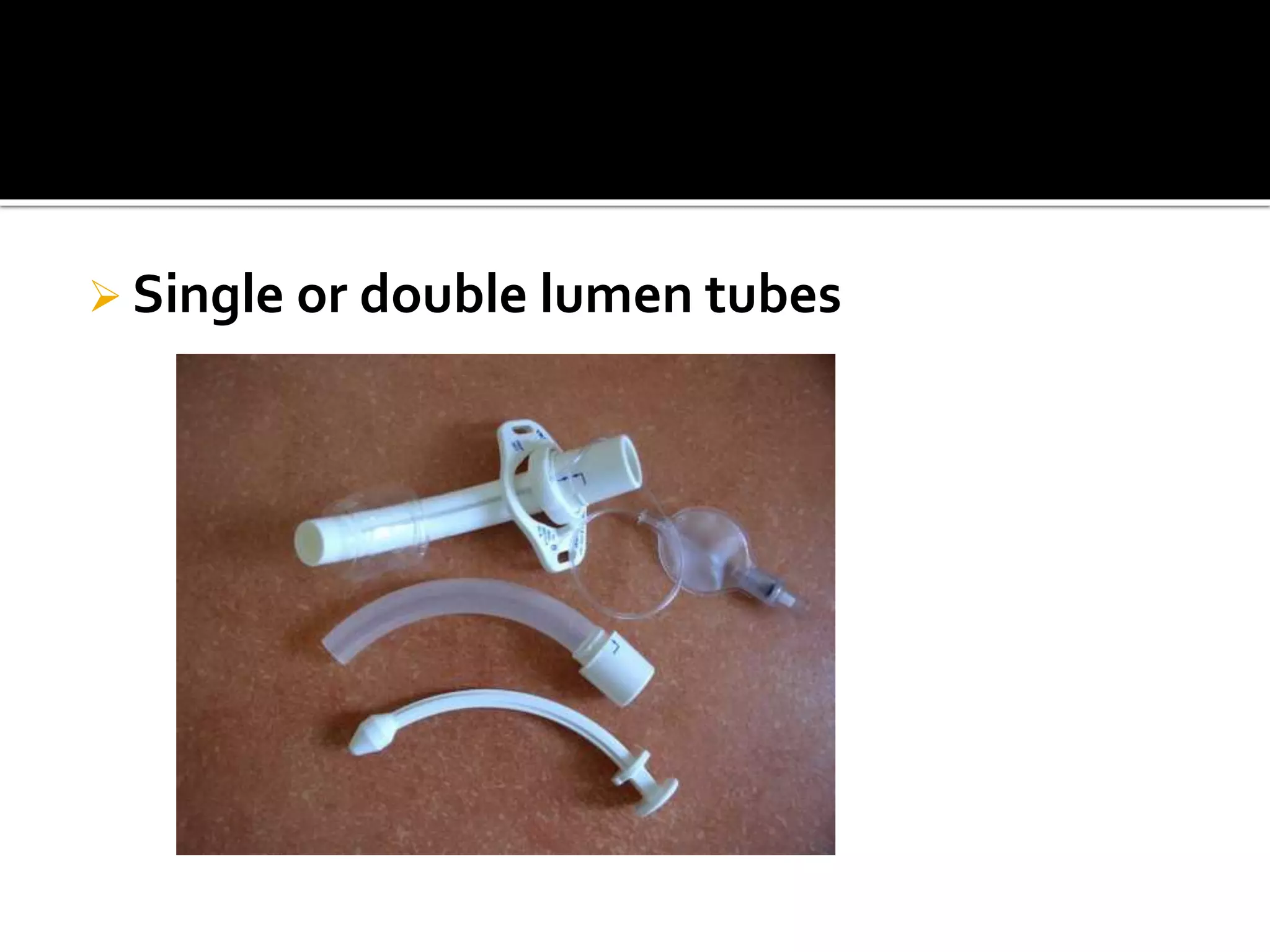
 Single or double lumen tubes
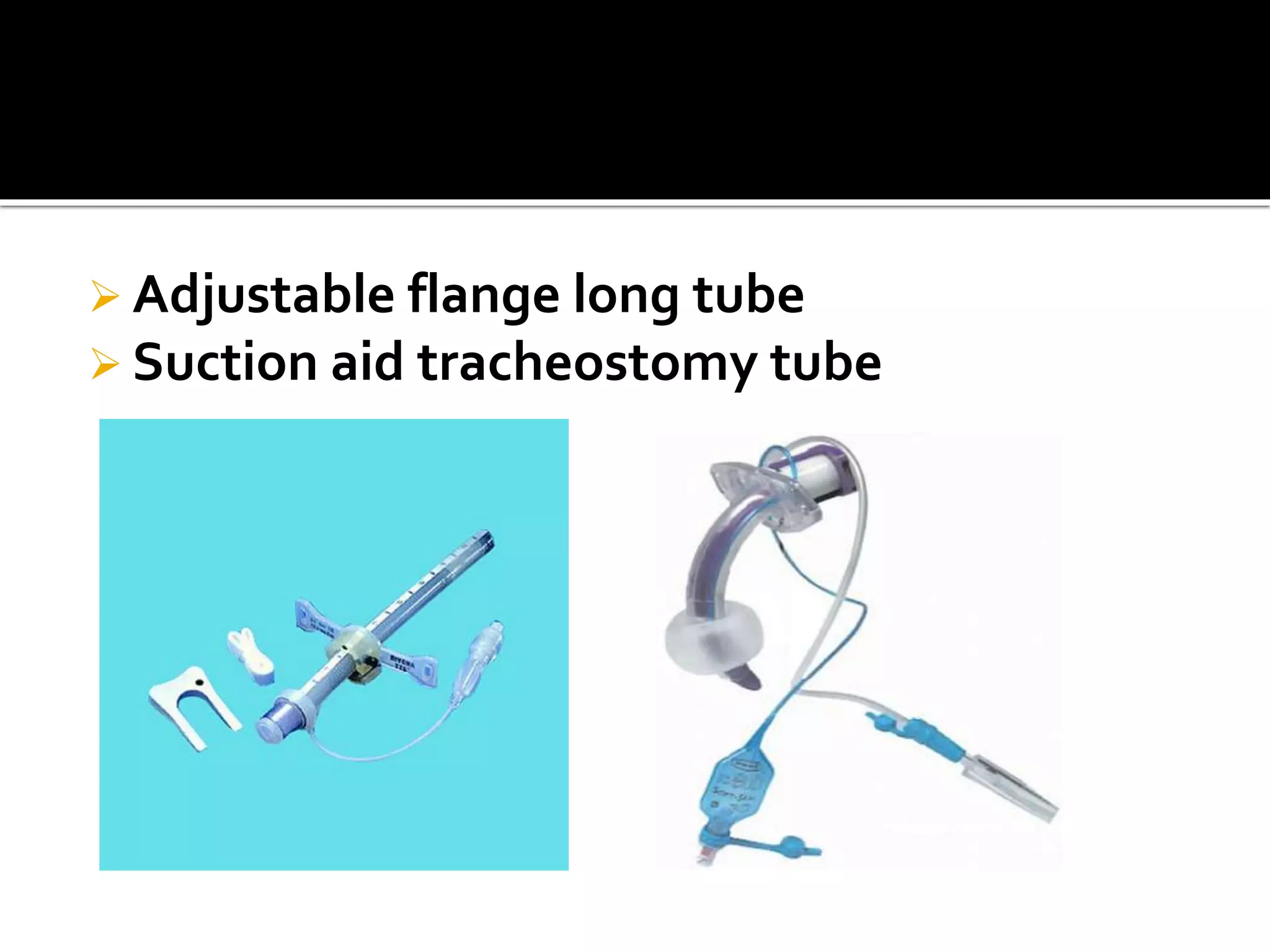
 Adjustable flange long tube
 Suction aid tracheostomy tube
 Tracheostomy with speaking valve
 Types of tubes based on material:
 PVC
 Silicone
 Siliconed PVC
 Silastic
 Silver
 Armoured
 Fullers tube
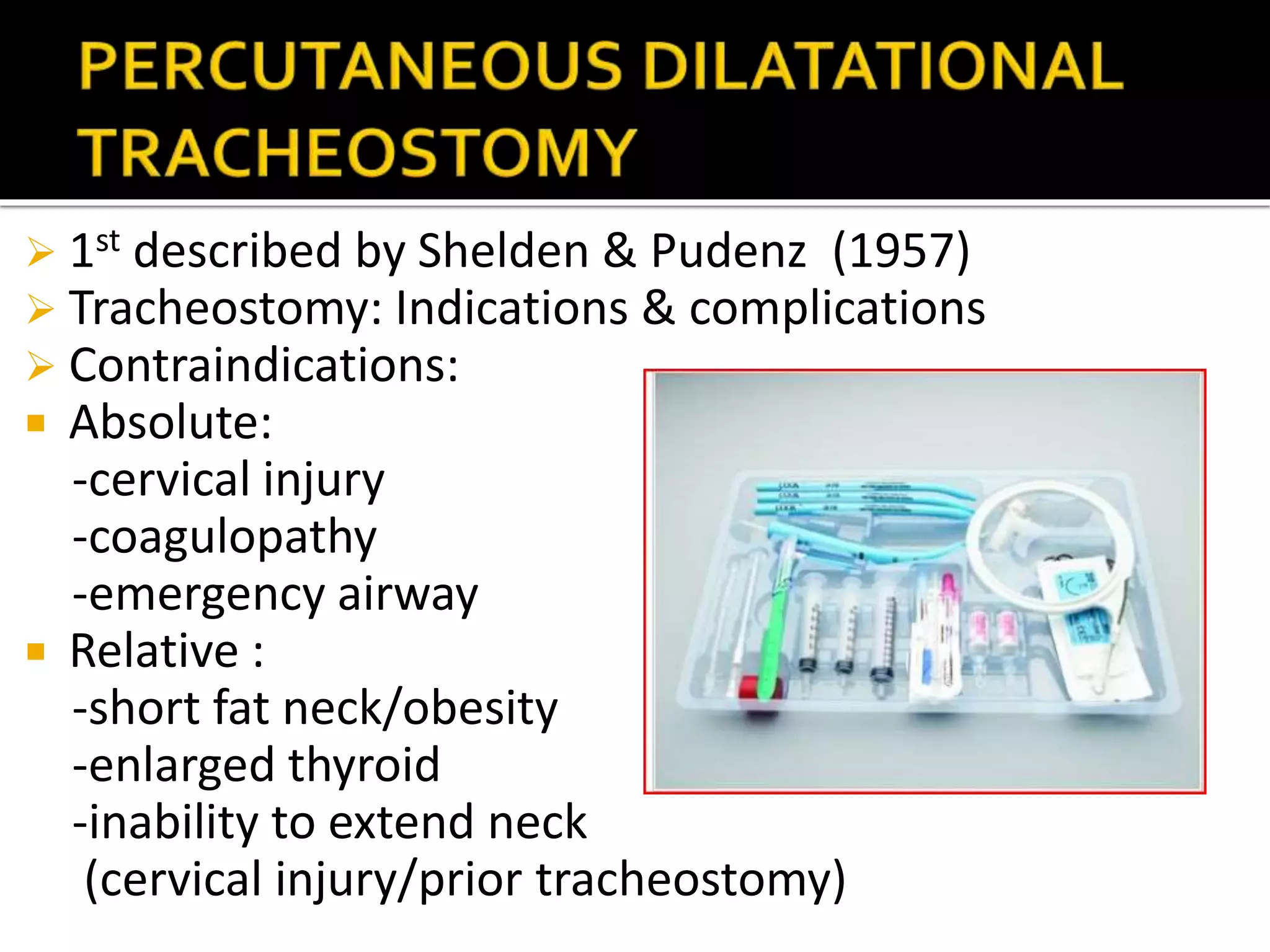
 1st described by Shelden & Pudenz (1957)
 Tracheostomy: Indications & complications
 Contraindications:
 Absolute:
-cervical injury
-coagulopathy
-emergency airway
 Relative :
-short fat neck/obesity
-enlarged thyroid
-inability to extend neck
(cervical injury/prior tracheostomy)
 Considered when original condition requiring
tracheostomy has improved
 Approached in a step-wise manner
 In paediatric group endoscopic assessment prior
to decannulation essential
 Fenestrated tube> occlusion cap> occlusion cap
for 12 hrs > 24 hrs>decannulation
THANKYOU

Tracheostomy ppt

  • 1.
  • 2.
     Tracheotomy  Greekorigin: ‘tom’- ‘to cut’ the trachea  Surgical opening of the trachea  Tracheostomy  Greek origin: ‘stom’- ‘mouth’  Creation of a stoma between trachea and cervical skin
  • 3.
     1st knownreference- rig veda dated 2000 BC.  Ebers papyrus (dated 1550 BC)- Egyptian medical papyrus mentions tracheotomy  Alexander the Great  Antyllus (2 AD), Greek surgeon- performed tracheostomies in oral surgeries  Tracheotomy well documented in Indian and Arabian literature in middle ages.
  • 4.
     Tracheostomy gainedpopularity in 1800s  Two methods:  High- by dividing cricoid  Low- trachea entered directly  Significant problems associated with high method  Till the end of 19th century tracheostomy considered hazardous  Chevalier Jackson in 1923 established principles of tracheostomy
  • 5.
    Reduction in respiratory dead space Laryngeal bypass Nasociliary clearanceand humidification lost Redundant area between stoma and larynx Disruption of normal swallowing mechanism
  • 6.
     Upper airwayobstruction Congenital Laryngeal web/cysts, B/L choanal atresia,Tracheo- esophageal fistula,Craniofacial anomalies, Subglottic/tracheal stenosis Infective Acute epiglottitis, Diphtheria, Acute layngotracheobronchitis, Ludwig’s angina Trauma External injury to larynx/trachea, maxillofacial injury, corrosive injury, inhalational injury Neoplasm Tumours of larynx, pharynx, tongue, upper trachea Foreign Body Foreign body lodged in larynx Vocal cords B/L abductor paralysis, Bulbar palsy
  • 7.
     Removal ofsecretions and protection of tracheobronchial tree from aspiration  Neurological diseases- GBS, MS, Bulbar palsy  Coma- head injury, poisoning, tumour  In such situations- laryngeal/pharyngeal incompetence  Cuffed tube useful
  • 8.
     Respiratory failure Tracheostomy- dead space, effort of breathing, alveolar ventilation  Ease of removal of secretions  Pulmonary diseases- exacerbation of chronic bronchitis, emphysema, severe pneumonia  Neurological diseases- MS, Motor neuron disease  Severe chest injury- flail chest
  • 9.
     Prolonged ventilation T-tube more secure than ET tube; easier to wean off vent  >3wks of intubation  length of ventilation and hospital stay  As a part of another procedure  Temporary tracheostomy in head and neck surgeries
  • 10.
     TEMPORARY/PERMANENT:  Temporarytracheostomy- elective or emergency  Permanent tracheostomy-as part of operation involving removal of larynx  HIGH/MID/LOW:  High- above isthmus via 1st tracheal ring  Mid- through 2nd-3rd tracheal ring, preferred  Low- below level of isthmus
  • 11.
     Informed consent Coagulation profile adequate, platelet count >50000/cumm  Neck examination- to anticipate difficulties in procedure as in enlarged thyroid, limited neck extension.  T-tube arranged, checked and prepared
  • 12.
     Surgical tracheostomy Minitracheostomy  Paediatric tracheostomy  Percutaneous dilatational tracheostomy
  • 22.
     Immediate  Haemorrhage Local injury-cricoid cartilage, 1st tracheal ring, carotid artery recurrent laryngeal nerve  Air embolism  Apnoea  Cardiac arrest
  • 23.
     Intermediate (1stfew hours or days)  Secondary haemorrhage
  • 24.
     Tube displacement Tube blockage  Subcutaneous emphysema  Pneumothorax
  • 25.
     Infection  Trachealnecrosis  Late complications  Haemorrhage  Granuloma formation  Tracheo-oesophageal fistula  Tracheo-cutaneous fistula  Laryngotracheal stenosis  Difficult decannulation  Tracheostomy scar
  • 26.
     Procedure foropening airway through cricothyroid membrane  Minitracheostomy kits commercially available
  • 27.
     Anatomy ofpaediatric upper airway different from adults  Age of child critical when deciding appropriate size of tube  Standard of paediatric intensive care facilities have improved in last 2 decades  Reduced rate of tracheostomy in paediatric population  Speech development may be impaired in long term tracheostomies
  • 28.
     Upper airwayobtruction Oropharynx, Tongue base Macroglossia,Treacher Collins syndrome, Goldenhar syndrome, Cystic hygroma, Diphtheria Nose, Nasopharynx B/L choanal atresia Supraglottis Supraglottic cyst,Acute Epiglottitis Glottis Vocal cord palsy, Laryngeal oedema, Physical trauma, Juvenile respiratoty papillomatosis Subglottis Subglottic stenosis, Hemangioma Trachea Acute laryngotracheobronchitis, Tracheomalacia,Tracheal stenosis
  • 29.
     Prolonged intubation Indicated for patients requiring long term PPV such as- PT neonate, CNS disease, severe burns  Long term intubation leads to complications and difficult decannulation  >3 weeks of intubation  Pulmonary toilet  For intractable aspiration- decreases dead space and eases work of pulmonary toilet
  • 30.
     Structures liehigher up  Soft and compressible airway  Structures from superior mediastinum pulled up during extension of neck  Small tracheal lumen  Trachea, a developing structure  Funnel shaped larynx with narrowest part being subglottis
  • 32.
     Suction  Regularsuctioning  Frequency depends on individual basis  Indications  Appropriate size of  Suction catheter  Method
  • 33.
     Humidification  Upperrespiratory tract bypassed, conditioning of inspired gas lost  Different preferences in diffirent set ups  Types: -cold water humidifiers -hot water humidifiers -heat and moisture exchangers -stoma protector  Nebulization
  • 34.
     Tracheostomy tubechange  1st tube change- 5-7 days  Frequency of tube change- no standard interval  ‘if you can hear a tube, you should change it’  Bougies or guidewires
  • 35.
  • 36.
     cuffed oruncuffed
  • 37.
     Single ordouble lumen tubes
  • 38.
     Adjustable flangelong tube  Suction aid tracheostomy tube
  • 39.
     Tracheostomy withspeaking valve
  • 40.
     Types oftubes based on material:  PVC  Silicone  Siliconed PVC  Silastic  Silver  Armoured  Fullers tube
  • 41.
     1st describedby Shelden & Pudenz (1957)  Tracheostomy: Indications & complications  Contraindications:  Absolute: -cervical injury -coagulopathy -emergency airway  Relative : -short fat neck/obesity -enlarged thyroid -inability to extend neck (cervical injury/prior tracheostomy)
  • 42.
     Considered whenoriginal condition requiring tracheostomy has improved  Approached in a step-wise manner  In paediatric group endoscopic assessment prior to decannulation essential  Fenestrated tube> occlusion cap> occlusion cap for 12 hrs > 24 hrs>decannulation
  • 43.