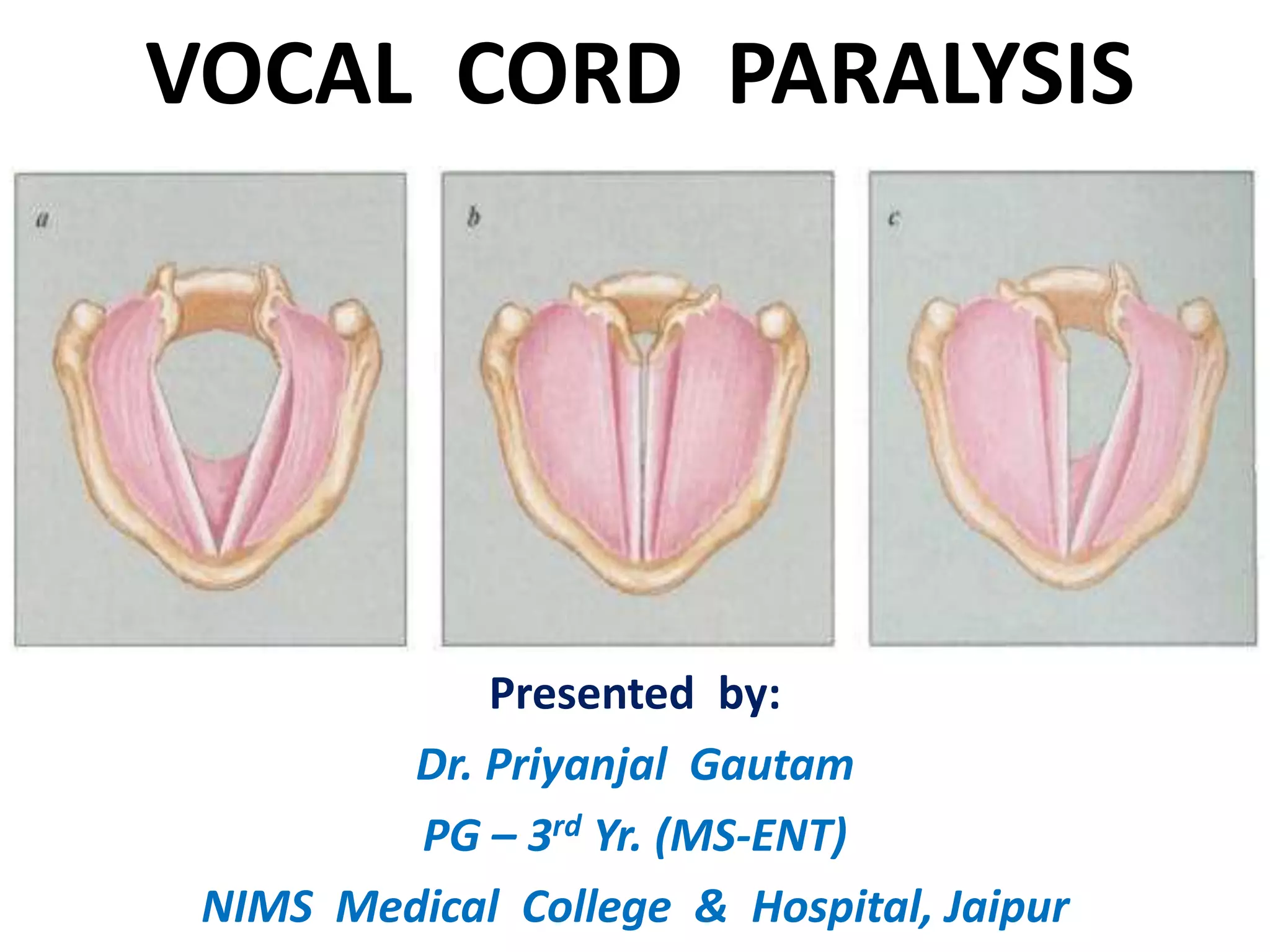
VOCAL CORD PARALYSIS
Presented by:
Dr. Priyanjal Gautam
PG – 3rd Yr. (MS-ENT)
NIMS Medical College & Hospital, Jaipur
INTRODUCTION
• Vocal cord Paralysis : defined as total
interruption of nerve impulse resulting in no
movement of laryngeal muscles.
• Vocal cord Paresis : defined as partial
interruption of nerve impulse resulting in weak or
abnormal movement of laryngeal muscles.
• Vocal cord paresis/paralysis can occur at any age
or sex.
• Effect of VC paralysis may vary & depends on the
patient’s use of his or her voice.
• A mild vocal cord paresis can be the end to a
singer's career but it have only marginal effect on
any other professional career life.
• Vocal cord Paralysis is a sign of a disease & not a
diagnosis by itself.
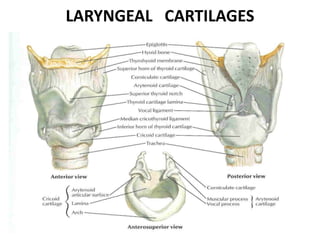
ANATOMY OF LARYNX
LARYNGEAL CARTILAGES
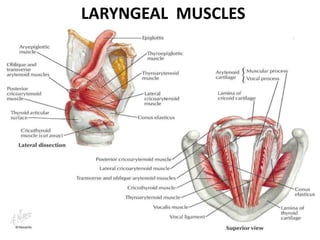
LARYNGEAL MUSCLES
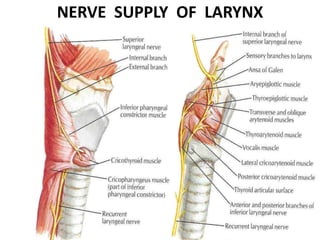
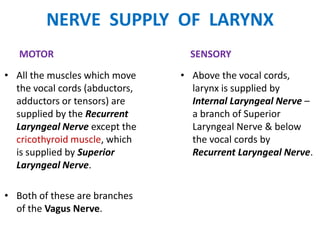
NERVE SUPPLY OF LARYNX
MOTOR
• All the muscles which move
the vocal cords (abductors,
adductors or tensors) are
supplied by the Recurrent
Laryngeal Nerve except the
cricothyroid muscle, which
is supplied by Superior
Laryngeal Nerve.
• Both of these are branches
of the Vagus Nerve.
SENSORY
• Above the vocal cords,
larynx is supplied by
Internal Laryngeal Nerve –
a branch of Superior
Laryngeal Nerve & below
the vocal cords by
Recurrent Laryngeal Nerve.
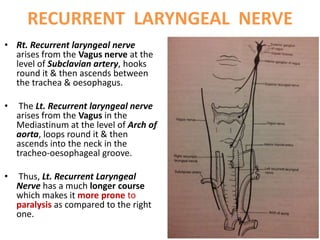
RECURRENT LARYNGEAL NERVE
• Rt. Recurrent laryngeal nerve
arises from the Vagus nerve at the
level of Subclavian artery, hooks
round it & then ascends between
the trachea & oesophagus.
• The Lt. Recurrent laryngeal nerve
arises from the Vagus in the
Mediastinum at the level of Arch of
aorta, loops round it & then
ascends into the neck in the
tracheo-oesophageal groove.
• Thus, Lt. Recurrent Laryngeal
Nerve has a much longer course
which makes it more prone to
paralysis as compared to the right
one.
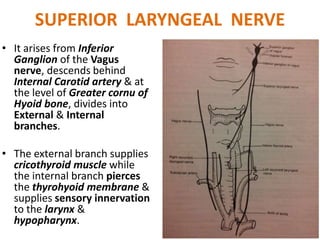
SUPERIOR LARYNGEAL NERVE
• It arises from Inferior
Ganglion of the Vagus
nerve, descends behind
Internal Carotid artery & at
the level of Greater cornu of
Hyoid bone, divides into
External & Internal
branches.
• The external branch supplies
cricothyroid muscle while
the internal branch pierces
the thyrohyoid membrane &
supplies sensory innervation
to the larynx &
hypopharynx.
FUNCTIONS OF VOCAL CORDS
Vocal cord mainly has the following movements :
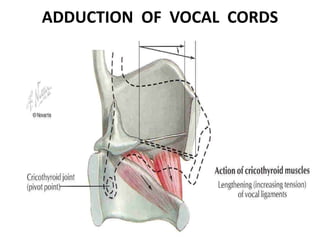
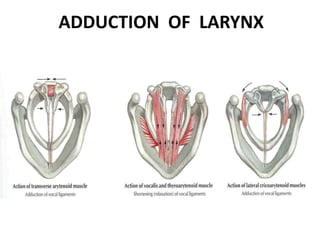
• Adduction : approximation of vocal cord with
each other.
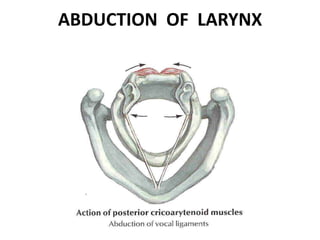
• Abduction : movement of vocal cord away from
each other.
ADDUCTION OF VOCAL CORDS
ADDUCTION OF LARYNX
ABDUCTION OF LARYNX
CLASSIFICATION OF LARYNGEAL PARALYSIS
• Laryngeal paralysis can be :
Unilateral or Bilateral & may involve –
1. Recurrent laryngeal nerve
2. Superior laryngeal nerve
3. Both (Combined / Complete)
CAUSES OF LARYNGEAL PARALYSIS
In topographical manner they are :
1. Supranuclear : Rare
2. Nuclear : Vascular disease, Neoplastic disease, Motor neuron disease,
Polio & Syringobulbia
3. High vagal lesions : Post. fossa tumors, Tubercular meningitis, Fracture of
skull base, Nasopharyngeal cancer, Glomus tumor, Penetrating injury of
neck, Parapharyngeal tumors, Metastatic neck nodes, Lymphoma
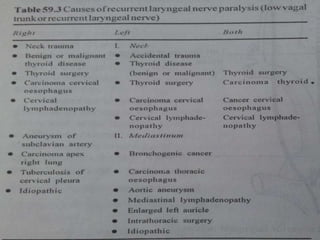
4. Low vagal or recurrent laryngeal nerve
5. Systemic causes : Diabetes, Syphilis, Diptheria, Typhoid, Viral infections,
Lead poisoning
6. Idiopathic
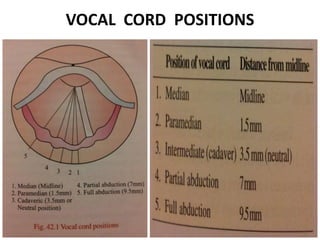
VOCAL CORD POSITIONS
THEORIES ON POSITION OF VOCAL
CORD IN VOCAL CORD PARALYSIS
• SEMON’S LAW : states that, in all progressive organic
lesions, abductor fibres of the nerve which are
phylogenitically newer are more susceptible & thus the
first to be paralysed as compared to adductor fibres
• WAGNER & GROSSMAN HYPOTHESIS : is the most
widely accepted theory. It states that complete
paralysis of the recurrent laryngeal nerve results in the
vocal cord being in paramedian because of an intact
cricothyroid muscle, which adducts the vocal cord.
When the Superior laryngeal nerve is also paralysed,
the vocal cord will be in intermediate or cadaveric
position because of loss of this adductive force.
RECURRENT LARYNGEAL NERVE PARALYSIS
(A) UNILATERAL
• Unilateral injury to recurrent
laryngeal nerve results in
ipsilateral paralysis of all the
intrinsic muscles of larynx
ecxept the cricothyroid.
• The vocal cords thus assumes a
median or paramedian
position & doesn’t move
laterally on deep inspiration.
• Clinical features :
- Asymptomatic
- Change in voice
 The voice in unilateral
paralysis gradually
improves due to
compensation by healthy
cord which crosses
midline to meet paralysed
one.
• Treatment : Generally no
treatment is required.
(B) BILATERAL (B/L Abductor paralysis) :
• Position of vocal cords : All the intrinsic muscles of
larynx are paralysed, vocal cords lie in median or
paramedian position due to unopposed action of
cricothyroid muscles.
• Clinical features :
- Dyspnoea
- Stridor
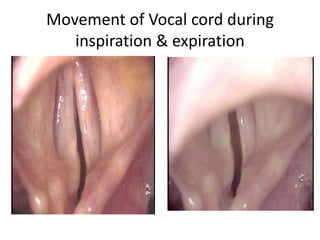
Movement of Vocal cord during
inspiration & expiration
• Treatment :
• Usually 6 months is an adequate time to wait for any spontaneous recovery.
• In acute stridor, Tracheostomy may be required.
- If patient doesn’t want tracheostomy following option can be considered :
• Lateralisation of the vocal cord: Aim is to move & fix the cord in a lateral
position to improve the airway. The various procedures are:
(a) Arytenoidectomy
(b) Vocal cord lateralisation through endoscope.
(c) Thyroplasty type II
(d) Cordectomy
(e) Nerve muscle implant
PARALYSIS OF SUPERIOR LARYNGEAL NERVE
(A) UNILATERAL
• Paralysis of cricothyroid muscle & ipsilateral
anaesthesia of the larynx above the vocal
cord.
• Causes :
- Thyroid surgery
- Thyroid Tumors
- Diptheria.
• Clinical features :
- Weak voice with decreased pitch
- Anaesthesia of the larynx on one side
- Occassional aspiration.
 Laryngeal findings include :
- Askew position of glottis - Ant. Comissure is
rotated to healthy side.
- Shortening of V.C. with loss of tension & V.C.
appears wavy
- Flapping of the paralysed vocal cord – V.C. sags
down during inspiration & bulges up during
expiration.
(B) BILATERAL
• An uncommon condition. Both the cricothyriod
muscles are paralysed along with anaesthesia
of upper larynx.
• Causes:
- Surgical or accidental trauma
- Diptheria
- Cervical lymphadenopathy
- Neoplastic disease
• Clinical features:
- Both V.C. paralysis
- Anaesthesia of larynx
- Cough
- Chocking fits
- Weak & husky voice
Treatment:
- Tracheostomy with a cuffed tube & an
oesophageal feeeding tube.
- Epiglottopexy is an operation to close the
laryngeal inlet to protect the lungs from
repeated aspiration. It is a reversible
precedure.
COMBINED/COMPLETE VOCAL CORD PARALYSIS
(Recurrent & Superior Laryngeal Nerve Paralysis)
(A) UNILATERAL :
• Paralysis of all the muscles of the larynx on one side except
interarytenoid which also receives innervation from opposite side.
Aetiology :
• Thyroid surgery
• Lesions of nucleus ambigus which may lie medulla, post. cranial fossa,
jugular foramen or parapharyngeal space.
Clinical features :
• All the muscles of larynx on one side are paralysed
• V.C. lie in cadeveric position ie. 3.5mm from the midline
• Glottic incompetence results in hoarseness of voice & aspiration of
liquids
• Treatment:
1. Speech therapy
2. Procedures to medialise the cord- Aim is to bring the
paralysed vocal cord towards the midline so that healthy cord
can meet it. This is achieved by :
(a) Injection of teflon paste
(b) Muscle or cartilage implant
(c) Arthrodesis of cricoarytenoid joint
(d) Thyroplasty type I
(B) Bilateral:
• Both recurrent & superior laryngeal nerves on both sides are
paralysed.
• Rare condition.
• Both cords lie in cadaveric position.
• Total anaesthesia of the larynx.
Clinical features :
-Aphonia: As V.C. cords doesn’t meet at all.
-Aspiration: due to incompetent glottis & laryngeal anaesthesia.
-Inability to cough: due to inability of V.C. to meet which results in retention of
secretions in the chest.
-Bronchopneumonia- due to repeated aspirations & retention of secretions.
Treatment:
1. Tracheostomy
2. Epiglottopexy
3. Vocal cord plication
4. Total laryngectomy
CONGENITAL VOCAL CORD PARALYSIS
UNILATERAL
• More common
• Causes :
- Birth trauma
- Congenital anomaly of great
vessels or heart
BILATERAL
• Causes :
- Hydrocephalus
- Arnold-Chiari malformation
- Intracerebral haemorrhage
- Meningocele
- Cerebral agenesis
• Clinical features :
- Dyspnoea
- Stridor
EVALUATION OF VOCAL CORD PARALYSIS PATIENT
• History
• Symptoms:
(a) Change in voice
(b) Hoarseness
(c) Aphonia
(d) Vocal fatigue
(e) Neck pain
(f) Aspiration
(g) Cough
• Past Medical & Surgical History :
• Social History :
• General Examination :
• Local Examination :
(a) Examination of larynx & laryngopharynx – IDL,
FOL
(b) Neck examination
(c) Cranial nerve examination
• Investigations :
- Nasopharyngolaryngoscopy
- Videostroboscopy
- Chest X-ray PA view
- C.T. with contrast- may evaluate the entire
course of recurrent laryngeal nerve
- MRI
DIFFERENTIAL DIAGNOSIS
1. Cricoarytenoid Fixation: caused by joint
subluxation or dislocation with ankylosis.
- Joint fixation by rheumatoid arthritris or gout.
2. Laryngeal malignancy:
Vocal  cord  paralysis

Vocal cord paralysis

  • 1.
    VOCAL CORD PARALYSIS Presentedby: Dr. Priyanjal Gautam PG – 3rd Yr. (MS-ENT) NIMS Medical College & Hospital, Jaipur
  • 2.
    INTRODUCTION • Vocal cordParalysis : defined as total interruption of nerve impulse resulting in no movement of laryngeal muscles. • Vocal cord Paresis : defined as partial interruption of nerve impulse resulting in weak or abnormal movement of laryngeal muscles.
  • 3.
    • Vocal cordparesis/paralysis can occur at any age or sex. • Effect of VC paralysis may vary & depends on the patient’s use of his or her voice. • A mild vocal cord paresis can be the end to a singer's career but it have only marginal effect on any other professional career life. • Vocal cord Paralysis is a sign of a disease & not a diagnosis by itself.
  • 4.
  • 5.
  • 6.
  • 7.
  • 8.
    NERVE SUPPLY OFLARYNX MOTOR • All the muscles which move the vocal cords (abductors, adductors or tensors) are supplied by the Recurrent Laryngeal Nerve except the cricothyroid muscle, which is supplied by Superior Laryngeal Nerve. • Both of these are branches of the Vagus Nerve. SENSORY • Above the vocal cords, larynx is supplied by Internal Laryngeal Nerve – a branch of Superior Laryngeal Nerve & below the vocal cords by Recurrent Laryngeal Nerve.
  • 9.
    RECURRENT LARYNGEAL NERVE •Rt. Recurrent laryngeal nerve arises from the Vagus nerve at the level of Subclavian artery, hooks round it & then ascends between the trachea & oesophagus. • The Lt. Recurrent laryngeal nerve arises from the Vagus in the Mediastinum at the level of Arch of aorta, loops round it & then ascends into the neck in the tracheo-oesophageal groove. • Thus, Lt. Recurrent Laryngeal Nerve has a much longer course which makes it more prone to paralysis as compared to the right one.
  • 10.
    SUPERIOR LARYNGEAL NERVE •It arises from Inferior Ganglion of the Vagus nerve, descends behind Internal Carotid artery & at the level of Greater cornu of Hyoid bone, divides into External & Internal branches. • The external branch supplies cricothyroid muscle while the internal branch pierces the thyrohyoid membrane & supplies sensory innervation to the larynx & hypopharynx.
  • 11.
    FUNCTIONS OF VOCALCORDS Vocal cord mainly has the following movements : • Adduction : approximation of vocal cord with each other. • Abduction : movement of vocal cord away from each other.
  • 12.
  • 13.
  • 14.
  • 15.
    CLASSIFICATION OF LARYNGEALPARALYSIS • Laryngeal paralysis can be : Unilateral or Bilateral & may involve – 1. Recurrent laryngeal nerve 2. Superior laryngeal nerve 3. Both (Combined / Complete)
  • 16.
    CAUSES OF LARYNGEALPARALYSIS In topographical manner they are : 1. Supranuclear : Rare 2. Nuclear : Vascular disease, Neoplastic disease, Motor neuron disease, Polio & Syringobulbia 3. High vagal lesions : Post. fossa tumors, Tubercular meningitis, Fracture of skull base, Nasopharyngeal cancer, Glomus tumor, Penetrating injury of neck, Parapharyngeal tumors, Metastatic neck nodes, Lymphoma 4. Low vagal or recurrent laryngeal nerve 5. Systemic causes : Diabetes, Syphilis, Diptheria, Typhoid, Viral infections, Lead poisoning 6. Idiopathic
  • 17.
  • 18.
    THEORIES ON POSITIONOF VOCAL CORD IN VOCAL CORD PARALYSIS • SEMON’S LAW : states that, in all progressive organic lesions, abductor fibres of the nerve which are phylogenitically newer are more susceptible & thus the first to be paralysed as compared to adductor fibres • WAGNER & GROSSMAN HYPOTHESIS : is the most widely accepted theory. It states that complete paralysis of the recurrent laryngeal nerve results in the vocal cord being in paramedian because of an intact cricothyroid muscle, which adducts the vocal cord. When the Superior laryngeal nerve is also paralysed, the vocal cord will be in intermediate or cadaveric position because of loss of this adductive force.
  • 19.
    RECURRENT LARYNGEAL NERVEPARALYSIS (A) UNILATERAL • Unilateral injury to recurrent laryngeal nerve results in ipsilateral paralysis of all the intrinsic muscles of larynx ecxept the cricothyroid. • The vocal cords thus assumes a median or paramedian position & doesn’t move laterally on deep inspiration. • Clinical features : - Asymptomatic - Change in voice  The voice in unilateral paralysis gradually improves due to compensation by healthy cord which crosses midline to meet paralysed one. • Treatment : Generally no treatment is required.
  • 21.
    (B) BILATERAL (B/LAbductor paralysis) : • Position of vocal cords : All the intrinsic muscles of larynx are paralysed, vocal cords lie in median or paramedian position due to unopposed action of cricothyroid muscles. • Clinical features : - Dyspnoea - Stridor
  • 22.
    Movement of Vocalcord during inspiration & expiration
  • 23.
    • Treatment : •Usually 6 months is an adequate time to wait for any spontaneous recovery. • In acute stridor, Tracheostomy may be required. - If patient doesn’t want tracheostomy following option can be considered : • Lateralisation of the vocal cord: Aim is to move & fix the cord in a lateral position to improve the airway. The various procedures are: (a) Arytenoidectomy (b) Vocal cord lateralisation through endoscope. (c) Thyroplasty type II (d) Cordectomy (e) Nerve muscle implant
  • 24.
    PARALYSIS OF SUPERIORLARYNGEAL NERVE (A) UNILATERAL • Paralysis of cricothyroid muscle & ipsilateral anaesthesia of the larynx above the vocal cord. • Causes : - Thyroid surgery - Thyroid Tumors - Diptheria. • Clinical features : - Weak voice with decreased pitch - Anaesthesia of the larynx on one side - Occassional aspiration.  Laryngeal findings include : - Askew position of glottis - Ant. Comissure is rotated to healthy side. - Shortening of V.C. with loss of tension & V.C. appears wavy - Flapping of the paralysed vocal cord – V.C. sags down during inspiration & bulges up during expiration. (B) BILATERAL • An uncommon condition. Both the cricothyriod muscles are paralysed along with anaesthesia of upper larynx. • Causes: - Surgical or accidental trauma - Diptheria - Cervical lymphadenopathy - Neoplastic disease • Clinical features: - Both V.C. paralysis - Anaesthesia of larynx - Cough - Chocking fits - Weak & husky voice Treatment: - Tracheostomy with a cuffed tube & an oesophageal feeeding tube. - Epiglottopexy is an operation to close the laryngeal inlet to protect the lungs from repeated aspiration. It is a reversible precedure.
  • 25.
    COMBINED/COMPLETE VOCAL CORDPARALYSIS (Recurrent & Superior Laryngeal Nerve Paralysis) (A) UNILATERAL : • Paralysis of all the muscles of the larynx on one side except interarytenoid which also receives innervation from opposite side. Aetiology : • Thyroid surgery • Lesions of nucleus ambigus which may lie medulla, post. cranial fossa, jugular foramen or parapharyngeal space. Clinical features : • All the muscles of larynx on one side are paralysed • V.C. lie in cadeveric position ie. 3.5mm from the midline • Glottic incompetence results in hoarseness of voice & aspiration of liquids
  • 26.
    • Treatment: 1. Speechtherapy 2. Procedures to medialise the cord- Aim is to bring the paralysed vocal cord towards the midline so that healthy cord can meet it. This is achieved by : (a) Injection of teflon paste (b) Muscle or cartilage implant (c) Arthrodesis of cricoarytenoid joint (d) Thyroplasty type I
  • 27.
    (B) Bilateral: • Bothrecurrent & superior laryngeal nerves on both sides are paralysed. • Rare condition. • Both cords lie in cadaveric position. • Total anaesthesia of the larynx. Clinical features : -Aphonia: As V.C. cords doesn’t meet at all. -Aspiration: due to incompetent glottis & laryngeal anaesthesia. -Inability to cough: due to inability of V.C. to meet which results in retention of secretions in the chest. -Bronchopneumonia- due to repeated aspirations & retention of secretions.
  • 28.
    Treatment: 1. Tracheostomy 2. Epiglottopexy 3.Vocal cord plication 4. Total laryngectomy
  • 29.
    CONGENITAL VOCAL CORDPARALYSIS UNILATERAL • More common • Causes : - Birth trauma - Congenital anomaly of great vessels or heart BILATERAL • Causes : - Hydrocephalus - Arnold-Chiari malformation - Intracerebral haemorrhage - Meningocele - Cerebral agenesis • Clinical features : - Dyspnoea - Stridor
  • 30.
    EVALUATION OF VOCALCORD PARALYSIS PATIENT • History • Symptoms: (a) Change in voice (b) Hoarseness (c) Aphonia (d) Vocal fatigue (e) Neck pain (f) Aspiration (g) Cough • Past Medical & Surgical History : • Social History : • General Examination : • Local Examination : (a) Examination of larynx & laryngopharynx – IDL, FOL (b) Neck examination (c) Cranial nerve examination • Investigations : - Nasopharyngolaryngoscopy - Videostroboscopy - Chest X-ray PA view - C.T. with contrast- may evaluate the entire course of recurrent laryngeal nerve - MRI
  • 31.
    DIFFERENTIAL DIAGNOSIS 1. CricoarytenoidFixation: caused by joint subluxation or dislocation with ankylosis. - Joint fixation by rheumatoid arthritris or gout. 2. Laryngeal malignancy: