By:
Mohamed Abuelnaga
50 years female patient admitted to ICU with DCL
due to spont. ICH
Tracheostomy was done after 7 days with MPDT
technique
After 4 days ,with patient care ,the outer part of the
traceostomy tube becomes longer with no
explanation
Then the patient shows surgical emphysema and
hypoxia. umbo ventilation was done with worsening
of the condition ,then patient arrested.
Icu resident tries to do oro-tracheal intubation ,he
found air way edema ,small sized ETT was inserted
,CPR started but the patient died
What is your explanation?
Definition.
Indications:
#facilitate weaning from prolonged ventilation
# bypass an obstruction of the URT
#prevent aspiration from the pharynx or GIT
#provide pulmonary toilet and facilitate removal
of secretions by aspiration
#as part of another procedure, as head and neck
surgery
Absolute contraindication for tracheotomy is
skin infection ,and prior major neck surgery
which completely obscures the anatomy
Technique:
Surgical tracheotomy
Percutaneous dilatational tracheotomy .
Effects of Tracheostomy:
-The larynx is bypassed and so the patient is
unable to phonate
-decreased anatomical and respiratory dead
space, decreasing the work of breathing
-There is loss of the humidification and
filtration function of the nasal mucosa
-There is an increased risk of respiratory
tract infection
-There is a redundant area above the tracheal
opening and below the larynx in which mucus
can accumulate and fall back into the lungs.
-A foreign body reaction can occur causing
local inflammation
1-Improvement of respiratory mechanics:
facilitate weaning due to reduced (WOB)
because of a decrease in flow resistance
2-Reduced laryngeal ulceration:
Endotracheal intubation can result in severe
injury of the upper airway which can be
largely prevented by early tracheotomy
3-Improved nutrition, enhanced mobility and
speech.
4-Improved patient comfort.
5-Patient can be nursed outside intensive
care unit (ICU).
6-Clearance of secretion
Tracheostomy tubes can be metal or plastic.
Metal tubes are constructed of silver or
stainless steel.
Plastic tubes are most commonly used and
can be made from polyvinylchloride or
silicone.
Polyvinyl chloride softens at body
temperature (thermolabile), conforming to
patient anatomy and centering the distal tip
in the trachea.
Silicone is naturally soft and unaffected by
temperature.
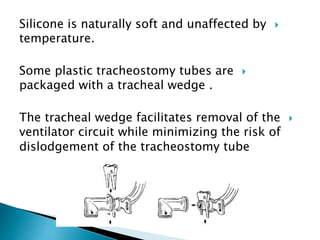
Some plastic tracheostomy tubes are
packaged with a tracheal wedge .
The tracheal wedge facilitates removal of the
ventilator circuit while minimizing the risk of
dislodgement of the tracheostomy tube
The dimensions of tracheostomy tubes are given
by their ID, OD, length, and curvature.
Single cannula tracheostomy tubes use the
International Standards Organization method of
sizing, determined by the ID of the outer cannula
at its smallest dimension.
Dual cannula tracheostomy tubes also use the
International Standards Organization method. If
an inner cannula is required for connection to the
ventilator, the published ID is the ID of the inner
cannula.
The OD is the largest diameter of the outer
cannula
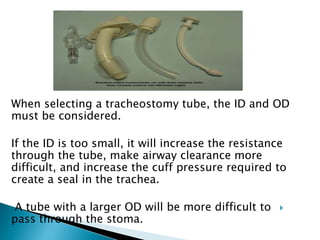
When selecting a tracheostomy tube, the ID and OD
must be considered.
If the ID is too small, it will increase the resistance
through the tube, make airway clearance more
difficult, and increase the cuff pressure required to
create a seal in the trachea.
A tube with a larger OD will be more difficult to
pass through the stoma.
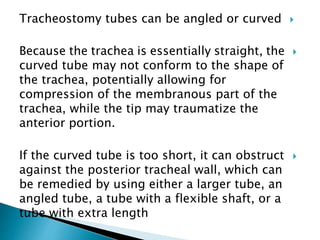
Tracheostomy tubes can be angled or curved
Because the trachea is essentially straight, the
curved tube may not conform to the shape of
the trachea, potentially allowing for
compression of the membranous part of the
trachea, while the tip may traumatize the
anterior portion.
If the curved tube is too short, it can obstruct
against the posterior tracheal wall, which can
be remedied by using either a larger tube, an
angled tube, a tube with a flexible shaft, or a
tube with extra length
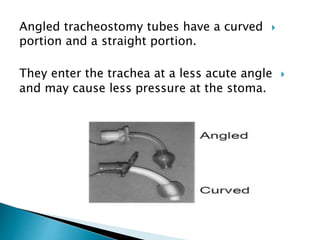
Angled tracheostomy tubes have a curved
portion and a straight portion.
They enter the trachea at a less acute angle
and may cause less pressure at the stoma.
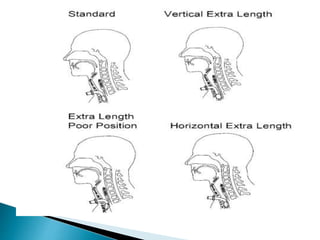
Tracheostomy tubes are available in standard
length or extra-length.
Extra-length tubes are constructed with extra-
proximal length (horizontal extra length) or with
extra-distal length (vertical extra length).
In the case of one manufacturer, extra-distal
length is achieved by a double cuff design.
This design also allows the cuffs to be
alternatively inflated and deflated, which may
reduce the risk of tracheal-wall injury, although
this has never been subjected to appropriate
clinical study
Differences in length exist between tubes of
the same ID.
Extra-proximal length facilitates tracheostomy
tube placement in patients with a large neck
(eg, obese patients).
Extra -distal length facilitates placement in
patients with trachealmalacia or tracheal
anomalies.
Care must be taken to avoid inappropriate use
of these tubes, which may induce distal
obstruction of the tube
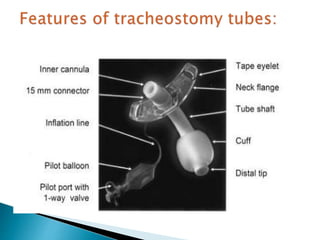
Cuff:
Tracheostomy tubes can be cuffed or uncuffed.
The cuff reduces aspiration and leakage of air
during anaesthesia and positive pressure
ventilation.
Specific types of cuffs used on tracheostomy
tubes include high-volume low-pressure
cuffs,tight-to-shaft cuffs (low-volume high-
pressure), and foam cuffs.
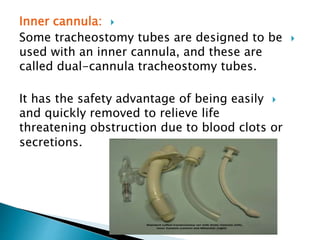
Inner cannula:
Some tracheostomy tubes are designed to be
used with an inner cannula, and these are
called dual-cannula tracheostomy tubes.
It has the safety advantage of being easily
and quickly removed to relieve life
threatening obstruction due to blood clots or
secretions.
Fenestration:
Fenestrations may be single or multiple and are
sited at the site of maximum curvature of the
tracheostomy tube. With the inner cannula
removed, the cuff deflated, and the normal air
passage occluded, the patient can inhale and
exhale through the fenestration and around the
tube .
This allows for assessment of the patient’s
ability to breathe through the normal oral/nasal
route (preparing the patient for decannulation)
and permits air to pass by the vocal cords
(allowing phonation)
Flexibility and adjustable flange:
Several tube designs have a spiral wire
reinforced flexible design.
These also have an adjustable flange design to
allow bedside adjustments to meet extra-
length tracheostomy tube needs.
This is useful in obese patients or those with
local tissue swelling, where the soft tissue
depth is increased.
Subglottic suction: Some newer tracheostomy
tubes include a subglottic suction port, the aim
of which is to try and reduce the incidence of
VAP.
Speaking valve: Speaking valves are one way
valves that are designed to be used with
fenestrated tracheostomy tubes or unfenestrated
tubes (with the cuff deflated).
They allow inspiration but not expiration. Hence
the expired air is forced through the larynx
allowing the patient to phonate
Mini-Tracheostomy Tubes:
The mini-tracheostomy tube is a small bore
cannula (4.0mm ID) inserted into the trachea
through the cricothyroid membrane or the
tracheal stoma after decannulation.
It can be used for oxygen administration.
However, it is used primarily for patients with
airway clearance issues because it allows
bronchial lavage and suctioning with a 10
French suction.
It is uncuffed and generally unsuitable for
provision of positive pressure ventilation
Nursing care:
the tracheotomy cannula is secured in place
and the tracheotomy is left to heal for 5-7
days, to allow for development of a stable
and patent cutaneo-endotracheal tract.
The tracheotomy wound has to be kept clean
and dry to prevent post-incisional wound
infection.
Changing tracheostomy tubes:
When a dual cannula is used, there is usually no
need to change the outer cannula. The inner
cannula is changed daily or more frequently if
necessary.
The first change should not occur within 72 hours
of the tracheostomy being sited and ideally not for
7 days after a percutaneous insertion.
This is to allow for the formation of a more reliable
‘track’ for the new tube to pass through.
The only indication to change the tube is when the
cuff has been damaged or when a tracheotomy
tube of different size or shape is found to be
necessary
Emergency airway equipment, including a
smaller tracheostomy tube, and emergency
drugs should be immediately available during
the change.
The tracheostomy tube may be changed over
a soft suction or airway exchange catheter or
soft tipped Ryle’s tube.
The use of a rigid gum-elastic bougie for this
purpose may increase the risk of creating a
false passage (i.e. the new tracheostomy
comes to lie next to rather than within the
trachea)..
If a soft tipped Ryle’s tube or similar is
used, it may be reassuring to see fogging
within that tube with respiration.
Alternatively, the track may be gently dilated
with a gloved little finger.
There should be a low threshold for suspicion of
erroneous placement if it is difficult to
ventilate the patient.
If difficulty is encountered in replacing the
tracheostomy tube, the clinical need for a tube
must be re-assessed. If in doubt, re-intubation
with an oral endotracheal tube may be required
Tube cuff pressure:
Tracheal capillary perfusion pressure is
normally 25–35 mm Hg so it is generally
agreed that 25 mm Hg (34 cm H2O) is the
maximum acceptable intra-cuff pressure.
If the cuff pressure is too low (below 18
mmHg) may cause the cuff to develop
longitudinal folds, promote microaspiration of
secretions collected above the cuff and increase
the risk for nosocomial pneumonia.
Tracheotomy tube cuffs require monitoring to
maintain pressures in a range of 20-25
mmHg.
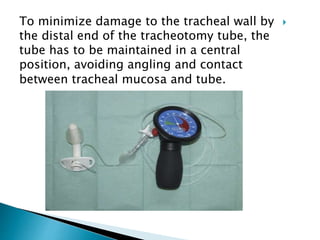
Cuff pressures should be monitored with
calibrated devices and recorded at least once
every nursing shift and after manipulation of
the tracheotomy tubes .
It has been suggested to deflate tracheotomy
cuffs on a regular schedule to allow mucosal
perfusion at the site of the cuff and to improve
clearance of secretions accumulated around the
cuff, but too little evidence is available to
advocate this practice.
To minimize damage to the tracheal wall by
the distal end of the tracheotomy tube, the
tube has to be maintained in a central
position, avoiding angling and contact
between tracheal mucosa and tube.
Humidification:
Cold and unfiltered air is an irritant when
inhaled and can lead to mucosal damage, loss
of mucociliary transport increased production
and viscosity of secretions.
This can be uncomfortable for the patient as
well as causing tracheal mucosal keratinisation.
The increasingly viscous secretions will be
difficult to clear, causing sputum retention,
increase the risk for lower respiratory tract
infection , atelectasis, impaired gas exchange
and even life threatening blockage of the
tracheostomy tube.
It is therefore essential that inhaled oxygen is
appropriately humidified and heated using
conventional techniques such as heat and
moisture exchange (HME) filters or heated water
baths.
Clearance of secretions:
Because suctioning is uncomfortable and is
associated with ventilatory complications such
as airway collapse and alveolar derecruitment, it
should be performed only when indicated and
not at a fixed frequency.
Frequency of airway suctioning should hence
be determined on a patient level, taking into
account factors such as viscosity and quantity
of mucus, neurological and muscular
performance and presence of active cough
reflexes and efforts.
The upper airway should also be suctioned
periodically to remove oral secretions and to
minimise stasis of pooled secretions above
the tracheotomy cuff with subsequent
potential aspiration into the lower airways.
Shallow suctioning, involving the insertion of
the aspiration catheter to a premeasured
depth not beyond the distal end of the
tracheotomy tube, is preferred to deep
suctioning, in which the aspiration tube is
inserted beyond the tracheotomy tube until
resistance is met.
Deep suctioning should be avoided since it is
associated with airway mucosal damage and
inflammation and may induce bronchial
bleeding with subsequent risk of airway
occlusion.
Speech:
Ventilator-dependent patients, who require low
minute ventilations may accomplish whispered
speech during periods of partial deflation of
the tracheotomy tube cuff, provided a good
swallowing function is present and stasis of
secretions above the cuff is limited.
After removal from mechanical ventilation, the
inner cannula is removed in awake and
adequate patients, allowing expiratory airflow
through the larynx when the external end of
the tracheotomy tube is occluded transiently.
Application of a one-way valve permits inspiratory
airflow through the tracheotomy tube during
inspiration but closes during expiration, promoting
airflow around a deflated cuff.
Some centres use a fenestrated tube promoting
airflow through the tube fenestrations during
expiration.
Nutrition
It is conventional to feed intubated, ventilated
patients enterally unless there is a good reason not
to. This is usually via a nasogastric or nasojejunal
tube but it may be possible for patients with
tracheostomies to be fed orally
However, swallowing is still adversely affected by
the presence of a tracheostomy tube, which has
a tendency to limit normal movement of the
larynx.
In addition, the inflated cuff causes a sense of
pressure in the upper oesophagus and the
difficulty that occurs with swallowing may result
in an increased risk of aspiration of food into
the lungs.
Between 20 and 70% of patients with a chronic
tracheotomy experience at least one episode of
aspiration every 48 h.
Patients may be fed orally, with the cuff inflated
or partially deflated, but staff must be alert to
signs of aspiration, such as coughing, increased
secretions and impaired gas exchange.
To decrease risks for nosocomial pneumonia
caused by aspiration, patients with tracheotomy
are kept with their heads elevated to 45o during
periods of tube feeding.
It is prudent to commence with sips of water
and some form of swallowing assessment by a
fiber optic.
There are many ways of assessing adequate
breathing around the tracheostomy tube.
Patients can be trialed with increasing periods
of cuff deflation. This allows patients to
become re-accustomed to swallowing more
normally and to having to clear their own
secretions.
Alternatively, an occlusion cap may be used
which completely blocks the tracheostomy
tube.
Of course this must be used with a
fenestrated tube or an unfenestrated tube
with the cuff deflated, and this greatly
increases the work of breathing due to
the increased airway resistance.
It will be harder for patients to breathe in this
situation than without the tracheostomy in
place and this must be taken into account
when interpreting the success or failure of
such a trial.
Decannulation can be carried out when:
• The patient is not dependent on ventilatory
support and has an adequate respiratory reserve
(dead space will be increased without the
tracheostomy tube)
• The patient is able to cough and swallow
effectively and manage their own secretions
whilst being able to protect their own airway
• The patient is able to cough and clear his
tracheal secretions
•Patient can tolerate cuff deflation or capping of
the tracheostomy tube.
Criteria for tracheotomy decannulation:
#Stable arterial blood gases.
#Absence of distress.
#Haemodynamic stability.
#Absence of fever or active infection.
#PaCO2 < 60 mmHg.
#Absence of delirium or psychiatric disorder.
#Normal endoscopic examination or revealing
stenotic lesion occupying <30% of the airway.
#Adequate swallowing.
#Able to expectorate.
Technique of decannulation:
Decannulation itself can be performed in the
morning, with a rested patient and daylight
hours in which to review their progress.
After deflation of the tracheotomy cuff, a
gloved finger occludes the opening of the tube
and one observes the patient for objective
signs of respiratory distress.
In case of problems, one promptly returns the
patient to breathing through the tracheotomy
tube and performs an endoscopic examination
to check for upper airway obstruction.
If no lesions are present, one should consider
whether the tube is not too large and try again
after changing the tube.
The tube can be removed and the stoma is
covered with a semi- permeable dressing. The
patient is encouraged to gently press over this
defect with whilst speaking or coughing.
They should be subsequently be monitored for
signs of respiratory distress.
Equipment and expertise to re-secure the
airway, either via the stoma or via oral
intubation, should be available.
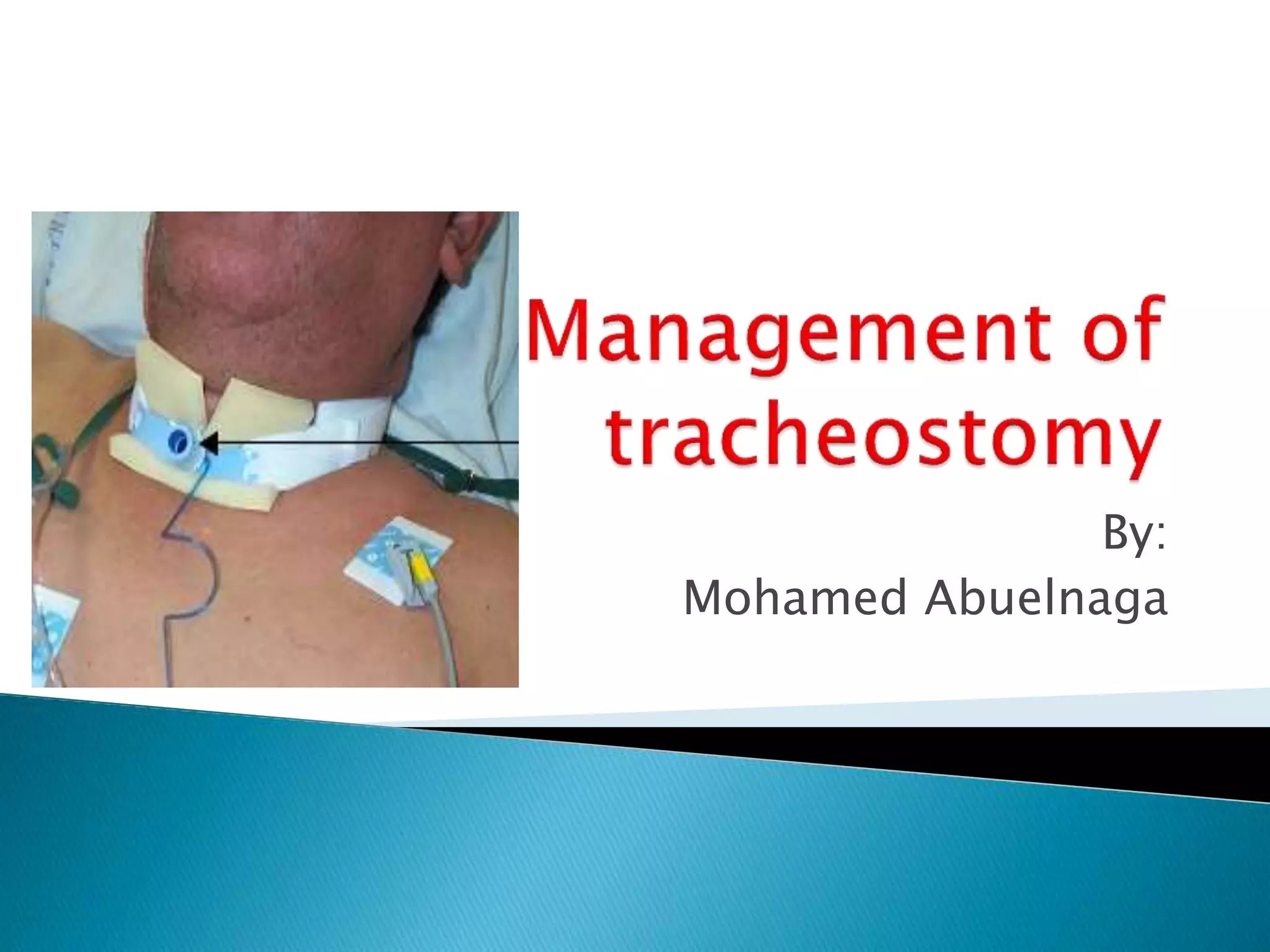
Management of tracheostomy

Management of tracheostomy

  • 1.
  • 2.
    50 years femalepatient admitted to ICU with DCL due to spont. ICH Tracheostomy was done after 7 days with MPDT technique After 4 days ,with patient care ,the outer part of the traceostomy tube becomes longer with no explanation Then the patient shows surgical emphysema and hypoxia. umbo ventilation was done with worsening of the condition ,then patient arrested. Icu resident tries to do oro-tracheal intubation ,he found air way edema ,small sized ETT was inserted ,CPR started but the patient died What is your explanation?
  • 3.
    Definition. Indications: #facilitate weaning fromprolonged ventilation # bypass an obstruction of the URT #prevent aspiration from the pharynx or GIT #provide pulmonary toilet and facilitate removal of secretions by aspiration #as part of another procedure, as head and neck surgery
  • 4.
    Absolute contraindication fortracheotomy is skin infection ,and prior major neck surgery which completely obscures the anatomy Technique: Surgical tracheotomy Percutaneous dilatational tracheotomy .
  • 5.
    Effects of Tracheostomy: -Thelarynx is bypassed and so the patient is unable to phonate -decreased anatomical and respiratory dead space, decreasing the work of breathing -There is loss of the humidification and filtration function of the nasal mucosa
  • 6.
    -There is anincreased risk of respiratory tract infection -There is a redundant area above the tracheal opening and below the larynx in which mucus can accumulate and fall back into the lungs. -A foreign body reaction can occur causing local inflammation
  • 7.
    1-Improvement of respiratorymechanics: facilitate weaning due to reduced (WOB) because of a decrease in flow resistance 2-Reduced laryngeal ulceration: Endotracheal intubation can result in severe injury of the upper airway which can be largely prevented by early tracheotomy
  • 8.
    3-Improved nutrition, enhancedmobility and speech. 4-Improved patient comfort. 5-Patient can be nursed outside intensive care unit (ICU). 6-Clearance of secretion
  • 10.
    Tracheostomy tubes canbe metal or plastic. Metal tubes are constructed of silver or stainless steel. Plastic tubes are most commonly used and can be made from polyvinylchloride or silicone. Polyvinyl chloride softens at body temperature (thermolabile), conforming to patient anatomy and centering the distal tip in the trachea.
  • 11.
    Silicone is naturallysoft and unaffected by temperature. Some plastic tracheostomy tubes are packaged with a tracheal wedge . The tracheal wedge facilitates removal of the ventilator circuit while minimizing the risk of dislodgement of the tracheostomy tube
  • 12.
    The dimensions oftracheostomy tubes are given by their ID, OD, length, and curvature. Single cannula tracheostomy tubes use the International Standards Organization method of sizing, determined by the ID of the outer cannula at its smallest dimension. Dual cannula tracheostomy tubes also use the International Standards Organization method. If an inner cannula is required for connection to the ventilator, the published ID is the ID of the inner cannula. The OD is the largest diameter of the outer cannula
  • 13.
    When selecting atracheostomy tube, the ID and OD must be considered. If the ID is too small, it will increase the resistance through the tube, make airway clearance more difficult, and increase the cuff pressure required to create a seal in the trachea. A tube with a larger OD will be more difficult to pass through the stoma.
  • 14.
    Tracheostomy tubes canbe angled or curved Because the trachea is essentially straight, the curved tube may not conform to the shape of the trachea, potentially allowing for compression of the membranous part of the trachea, while the tip may traumatize the anterior portion. If the curved tube is too short, it can obstruct against the posterior tracheal wall, which can be remedied by using either a larger tube, an angled tube, a tube with a flexible shaft, or a tube with extra length
  • 15.
    Angled tracheostomy tubeshave a curved portion and a straight portion. They enter the trachea at a less acute angle and may cause less pressure at the stoma.
  • 16.
    Tracheostomy tubes areavailable in standard length or extra-length. Extra-length tubes are constructed with extra- proximal length (horizontal extra length) or with extra-distal length (vertical extra length). In the case of one manufacturer, extra-distal length is achieved by a double cuff design. This design also allows the cuffs to be alternatively inflated and deflated, which may reduce the risk of tracheal-wall injury, although this has never been subjected to appropriate clinical study
  • 17.
    Differences in lengthexist between tubes of the same ID. Extra-proximal length facilitates tracheostomy tube placement in patients with a large neck (eg, obese patients). Extra -distal length facilitates placement in patients with trachealmalacia or tracheal anomalies. Care must be taken to avoid inappropriate use of these tubes, which may induce distal obstruction of the tube
  • 19.
    Cuff: Tracheostomy tubes canbe cuffed or uncuffed. The cuff reduces aspiration and leakage of air during anaesthesia and positive pressure ventilation. Specific types of cuffs used on tracheostomy tubes include high-volume low-pressure cuffs,tight-to-shaft cuffs (low-volume high- pressure), and foam cuffs.
  • 20.
    Inner cannula: Some tracheostomytubes are designed to be used with an inner cannula, and these are called dual-cannula tracheostomy tubes. It has the safety advantage of being easily and quickly removed to relieve life threatening obstruction due to blood clots or secretions.
  • 21.
    Fenestration: Fenestrations may besingle or multiple and are sited at the site of maximum curvature of the tracheostomy tube. With the inner cannula removed, the cuff deflated, and the normal air passage occluded, the patient can inhale and exhale through the fenestration and around the tube . This allows for assessment of the patient’s ability to breathe through the normal oral/nasal route (preparing the patient for decannulation) and permits air to pass by the vocal cords (allowing phonation)
  • 23.
    Flexibility and adjustableflange: Several tube designs have a spiral wire reinforced flexible design. These also have an adjustable flange design to allow bedside adjustments to meet extra- length tracheostomy tube needs. This is useful in obese patients or those with local tissue swelling, where the soft tissue depth is increased.
  • 25.
    Subglottic suction: Somenewer tracheostomy tubes include a subglottic suction port, the aim of which is to try and reduce the incidence of VAP. Speaking valve: Speaking valves are one way valves that are designed to be used with fenestrated tracheostomy tubes or unfenestrated tubes (with the cuff deflated). They allow inspiration but not expiration. Hence the expired air is forced through the larynx allowing the patient to phonate
  • 26.
    Mini-Tracheostomy Tubes: The mini-tracheostomytube is a small bore cannula (4.0mm ID) inserted into the trachea through the cricothyroid membrane or the tracheal stoma after decannulation. It can be used for oxygen administration. However, it is used primarily for patients with airway clearance issues because it allows bronchial lavage and suctioning with a 10 French suction. It is uncuffed and generally unsuitable for provision of positive pressure ventilation
  • 27.
    Nursing care: the tracheotomycannula is secured in place and the tracheotomy is left to heal for 5-7 days, to allow for development of a stable and patent cutaneo-endotracheal tract. The tracheotomy wound has to be kept clean and dry to prevent post-incisional wound infection.
  • 28.
    Changing tracheostomy tubes: Whena dual cannula is used, there is usually no need to change the outer cannula. The inner cannula is changed daily or more frequently if necessary. The first change should not occur within 72 hours of the tracheostomy being sited and ideally not for 7 days after a percutaneous insertion. This is to allow for the formation of a more reliable ‘track’ for the new tube to pass through. The only indication to change the tube is when the cuff has been damaged or when a tracheotomy tube of different size or shape is found to be necessary
  • 29.
    Emergency airway equipment,including a smaller tracheostomy tube, and emergency drugs should be immediately available during the change. The tracheostomy tube may be changed over a soft suction or airway exchange catheter or soft tipped Ryle’s tube. The use of a rigid gum-elastic bougie for this purpose may increase the risk of creating a false passage (i.e. the new tracheostomy comes to lie next to rather than within the trachea)..
  • 30.
    If a softtipped Ryle’s tube or similar is used, it may be reassuring to see fogging within that tube with respiration. Alternatively, the track may be gently dilated with a gloved little finger. There should be a low threshold for suspicion of erroneous placement if it is difficult to ventilate the patient. If difficulty is encountered in replacing the tracheostomy tube, the clinical need for a tube must be re-assessed. If in doubt, re-intubation with an oral endotracheal tube may be required
  • 31.
    Tube cuff pressure: Trachealcapillary perfusion pressure is normally 25–35 mm Hg so it is generally agreed that 25 mm Hg (34 cm H2O) is the maximum acceptable intra-cuff pressure. If the cuff pressure is too low (below 18 mmHg) may cause the cuff to develop longitudinal folds, promote microaspiration of secretions collected above the cuff and increase the risk for nosocomial pneumonia. Tracheotomy tube cuffs require monitoring to maintain pressures in a range of 20-25 mmHg.
  • 32.
    Cuff pressures shouldbe monitored with calibrated devices and recorded at least once every nursing shift and after manipulation of the tracheotomy tubes . It has been suggested to deflate tracheotomy cuffs on a regular schedule to allow mucosal perfusion at the site of the cuff and to improve clearance of secretions accumulated around the cuff, but too little evidence is available to advocate this practice.
  • 33.
    To minimize damageto the tracheal wall by the distal end of the tracheotomy tube, the tube has to be maintained in a central position, avoiding angling and contact between tracheal mucosa and tube.
  • 34.
    Humidification: Cold and unfilteredair is an irritant when inhaled and can lead to mucosal damage, loss of mucociliary transport increased production and viscosity of secretions. This can be uncomfortable for the patient as well as causing tracheal mucosal keratinisation. The increasingly viscous secretions will be difficult to clear, causing sputum retention, increase the risk for lower respiratory tract infection , atelectasis, impaired gas exchange and even life threatening blockage of the tracheostomy tube.
  • 35.
    It is thereforeessential that inhaled oxygen is appropriately humidified and heated using conventional techniques such as heat and moisture exchange (HME) filters or heated water baths. Clearance of secretions: Because suctioning is uncomfortable and is associated with ventilatory complications such as airway collapse and alveolar derecruitment, it should be performed only when indicated and not at a fixed frequency.
  • 36.
    Frequency of airwaysuctioning should hence be determined on a patient level, taking into account factors such as viscosity and quantity of mucus, neurological and muscular performance and presence of active cough reflexes and efforts. The upper airway should also be suctioned periodically to remove oral secretions and to minimise stasis of pooled secretions above the tracheotomy cuff with subsequent potential aspiration into the lower airways.
  • 37.
    Shallow suctioning, involvingthe insertion of the aspiration catheter to a premeasured depth not beyond the distal end of the tracheotomy tube, is preferred to deep suctioning, in which the aspiration tube is inserted beyond the tracheotomy tube until resistance is met. Deep suctioning should be avoided since it is associated with airway mucosal damage and inflammation and may induce bronchial bleeding with subsequent risk of airway occlusion.
  • 38.
    Speech: Ventilator-dependent patients, whorequire low minute ventilations may accomplish whispered speech during periods of partial deflation of the tracheotomy tube cuff, provided a good swallowing function is present and stasis of secretions above the cuff is limited. After removal from mechanical ventilation, the inner cannula is removed in awake and adequate patients, allowing expiratory airflow through the larynx when the external end of the tracheotomy tube is occluded transiently.
  • 39.
    Application of aone-way valve permits inspiratory airflow through the tracheotomy tube during inspiration but closes during expiration, promoting airflow around a deflated cuff. Some centres use a fenestrated tube promoting airflow through the tube fenestrations during expiration. Nutrition It is conventional to feed intubated, ventilated patients enterally unless there is a good reason not to. This is usually via a nasogastric or nasojejunal tube but it may be possible for patients with tracheostomies to be fed orally
  • 40.
    However, swallowing isstill adversely affected by the presence of a tracheostomy tube, which has a tendency to limit normal movement of the larynx. In addition, the inflated cuff causes a sense of pressure in the upper oesophagus and the difficulty that occurs with swallowing may result in an increased risk of aspiration of food into the lungs. Between 20 and 70% of patients with a chronic tracheotomy experience at least one episode of aspiration every 48 h.
  • 41.
    Patients may befed orally, with the cuff inflated or partially deflated, but staff must be alert to signs of aspiration, such as coughing, increased secretions and impaired gas exchange. To decrease risks for nosocomial pneumonia caused by aspiration, patients with tracheotomy are kept with their heads elevated to 45o during periods of tube feeding. It is prudent to commence with sips of water and some form of swallowing assessment by a fiber optic.
  • 42.
    There are manyways of assessing adequate breathing around the tracheostomy tube. Patients can be trialed with increasing periods of cuff deflation. This allows patients to become re-accustomed to swallowing more normally and to having to clear their own secretions. Alternatively, an occlusion cap may be used which completely blocks the tracheostomy tube.
  • 43.
    Of course thismust be used with a fenestrated tube or an unfenestrated tube with the cuff deflated, and this greatly increases the work of breathing due to the increased airway resistance. It will be harder for patients to breathe in this situation than without the tracheostomy in place and this must be taken into account when interpreting the success or failure of such a trial.
  • 44.
    Decannulation can becarried out when: • The patient is not dependent on ventilatory support and has an adequate respiratory reserve (dead space will be increased without the tracheostomy tube) • The patient is able to cough and swallow effectively and manage their own secretions whilst being able to protect their own airway • The patient is able to cough and clear his tracheal secretions •Patient can tolerate cuff deflation or capping of the tracheostomy tube.
  • 45.
    Criteria for tracheotomydecannulation: #Stable arterial blood gases. #Absence of distress. #Haemodynamic stability. #Absence of fever or active infection. #PaCO2 < 60 mmHg. #Absence of delirium or psychiatric disorder. #Normal endoscopic examination or revealing stenotic lesion occupying <30% of the airway. #Adequate swallowing. #Able to expectorate.
  • 46.
    Technique of decannulation: Decannulationitself can be performed in the morning, with a rested patient and daylight hours in which to review their progress. After deflation of the tracheotomy cuff, a gloved finger occludes the opening of the tube and one observes the patient for objective signs of respiratory distress. In case of problems, one promptly returns the patient to breathing through the tracheotomy tube and performs an endoscopic examination to check for upper airway obstruction.
  • 47.
    If no lesionsare present, one should consider whether the tube is not too large and try again after changing the tube. The tube can be removed and the stoma is covered with a semi- permeable dressing. The patient is encouraged to gently press over this defect with whilst speaking or coughing. They should be subsequently be monitored for signs of respiratory distress. Equipment and expertise to re-secure the airway, either via the stoma or via oral intubation, should be available.