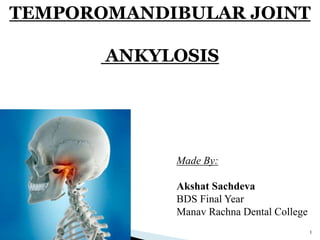
TEMPOROMANDIBULAR JOINT
ANKYLOSIS
Made By:
Akshat Sachdeva
BDS Final Year
Manav Rachna Dental College
1
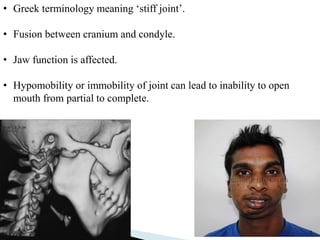
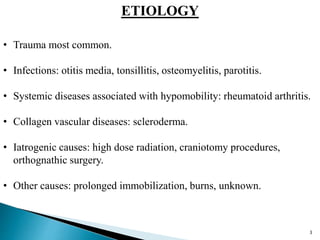
• Greek terminology meaning ‘stiff joint’.
• Fusion between cranium and condyle.
• Jaw function is affected.
• Hypomobility or immobility of joint can lead to inability to open
mouth from partial to complete.
2
ETIOLOGY
• Trauma most common.
• Infections: otitis media, tonsillitis, osteomyelitis, parotitis.
• Systemic diseases associated with hypomobility: rheumatoid arthritis.
• Collagen vascular diseases: scleroderma.
• Iatrogenic causes: high dose radiation, craniotomy procedures,
orthognathic surgery.
• Other causes: prolonged immobilization, burns, unknown.
3
PATHOPHYSIOLOGY
• Trauma brings about extravasation of blood into the joint space called
hemarthrosis.
• This predisposes to calcification and obliteration of a joint space,
where immobility of joint is maintained over a prolonged period.
• Many times initial fibrous bands lead towards bony consolidation to
ossification.
4
5
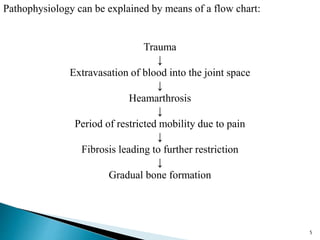
Pathophysiology can be explained by means of a flow chart:
Trauma
↓
Extravasation of blood into the joint space
↓
Heamarthrosis
↓
Period of restricted mobility due to pain
↓
Fibrosis leading to further restriction
↓
Gradual bone formation
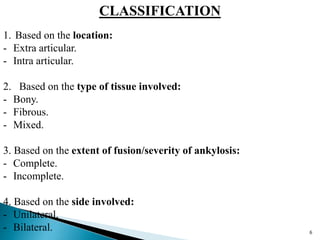
CLASSIFICATION
1. Based on the location:
- Extra articular.
- Intra articular.
2. Based on the type of tissue involved:
- Bony.
- Fibrous.
- Mixed.
3. Based on the extent of fusion/severity of ankylosis:
- Complete.
- Incomplete.
4. Based on the side involved:
- Unilateral.
- Bilateral. 6
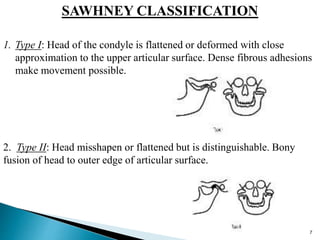
SAWHNEY CLASSIFICATION
1. Type I: Head of the condyle is flattened or deformed with close
approximation to the upper articular surface. Dense fibrous adhesions
make movement possible.
2. Type II: Head misshapen or flattened but is distinguishable. Bony
fusion of head to outer edge of articular surface.
7
8
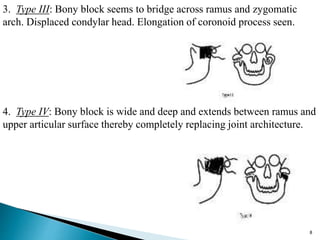
3. Type III: Bony block seems to bridge across ramus and zygomatic
arch. Displaced condylar head. Elongation of coronoid process seen.
4. Type IV: Bony block is wide and deep and extends between ramus and
upper articular surface thereby completely replacing joint architecture.
9
TOPAZIAN CLASSIFICATION
• Stage I: Ankylotic bone limited to the condylar process only.
• Stage II: Ankylotic bone extending to the sigmoid notch.
• Stage III: Amkylotic bone extending to the coronoid process.
• Disadvantage of classification: Does not include fibrous part.
CLINICAL MANIFESTATIONS
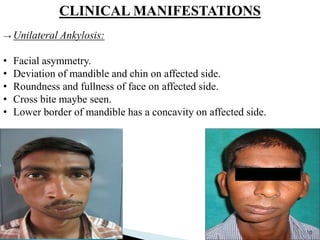
→ Unilateral Ankylosis:
• Facial asymmetry.
• Deviation of mandible and chin on affected side.
• Roundness and fullness of face on affected side.
• Cross bite maybe seen.
• Lower border of mandible has a concavity on affected side.
10
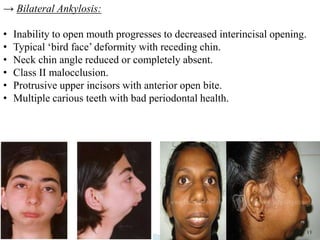
→ Bilateral Ankylosis:
• Inability to open mouth progresses to decreased interincisal opening.
• Typical ‘bird face’ deformity with receding chin.
• Neck chin angle reduced or completely absent.
• Class II malocclusion.
• Protrusive upper incisors with anterior open bite.
• Multiple carious teeth with bad periodontal health.
11
DIAGNOSIS
Diagnosis is based on the following:
1. History of trauma, infection etc.
2. Clinical findings.
3. Radiographic findings:
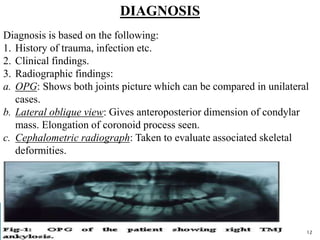
a. OPG: Shows both joints picture which can be compared in unilateral
cases.
b. Lateral oblique view: Gives anteroposterior dimension of condylar
mass. Elongation of coronoid process seen.
c. Cephalometric radiograph: Taken to evaluate associated skeletal
deformities.
12
13
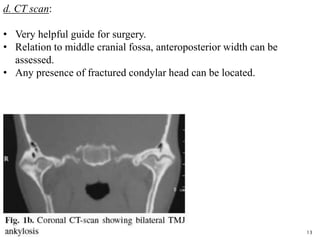
d. CT scan:
• Very helpful guide for surgery.
• Relation to middle cranial fossa, anteroposterior width can be
assessed.
• Any presence of fractured condylar head can be located.
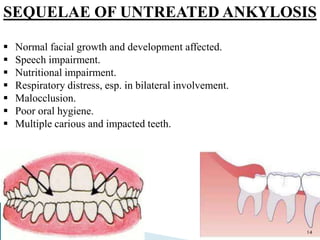
SEQUELAE OF UNTREATED ANKYLOSIS
 Normal facial growth and development affected.
 Speech impairment.
 Nutritional impairment.
 Respiratory distress, esp. in bilateral involvement.
 Malocclusion.
 Poor oral hygiene.
 Multiple carious and impacted teeth.
14
MANAGEMENT OF TMJ ANKYLOSIS
Aims and Objectives of Surgery:
1. Release the ankylosed mass and creation of a gap to mobilize the
joint.
2. Creation of a functional joint.
3. To reconstruct the joint and restore vertical height of ramus.
4. To prevent recurrence.
5. To restore normal facial growth pattern.
6. To improve esthetics and rehabilitate the patient.
Surgical Techniques:
I: Condylectomy.
II: Gap Arthroplasty.
III: Interpositional Arthroplasty. 15
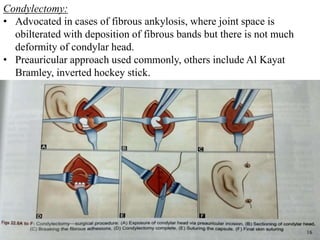
Condylectomy:
• Advocated in cases of fibrous ankylosis, where joint space is
obilterated with deposition of fibrous bands but there is not much
deformity of condylar head.
• Preauricular approach used commonly, others include Al Kayat
Bramley, inverted hockey stick.
16
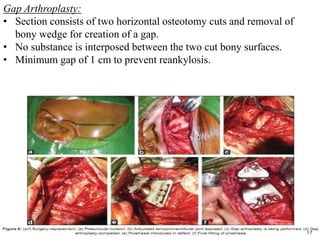
Gap Arthroplasty:
• Section consists of two horizontal osteotomy cuts and removal of
bony wedge for creation of a gap.
• No substance is interposed between the two cut bony surfaces.
• Minimum gap of 1 cm to prevent reankylosis.
17
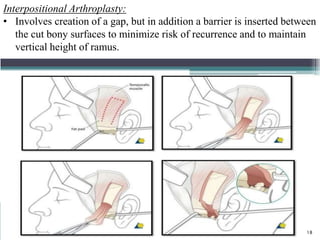
Interpositional Arthroplasty:
• Involves creation of a gap, but in addition a barrier is inserted between
the cut bony surfaces to minimize risk of recurrence and to maintain
vertical height of ramus.
18
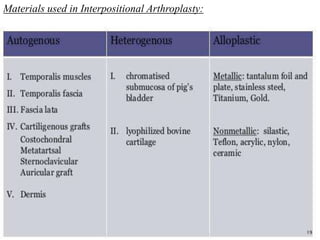
Materials used in Interpositional Arthroplasty:
19
INTERNATIONALLYACCEPTED PROTOCOL
FOR MANAGEMENT OF TMJ ANKYLOSIS
Put forward by Kaban, Perrot and Fischer in 1990:
1. Early surgical intervention.
2. Aggressive resection:
- Gap of at least 1 – 1.5 cm should be created.
3. Ipsilateral coronoidectomy and temporalis myotomy:
- After gap arthroplasty, coronoidectomy on the same side should be
carried out.
- Temporalis muscle attachments are severed by carrying out temporalis
myotomy.
4. Contralateral coronoidectomy and temporalis myotomy. 20
5. Lining of glenoid fossa region with temporalis fascia.
6. Reconstruction of ramus with costochondral graft.
7. Early mobilization and aggressive physiotherapy for at least six
months postoperatively.
8. Regular long term follow up.
9. To carry out cosmetic surgery at later date, when growth of patient is
completed.
21
COMPLICATIONS DURING SURGERY
During Anesthesia:
a. As the patient cannot open the mouth, awake blind intubation has to
be done where co – operation is required which is difficult to achieve
sometimes.
b. Because of small mandible and altered position of larynx, intubation
poses a problem.
c. Aspiration of blood clot, tooth or foreign body during extubation.
d. Danger of falling back of tongue and obstructing airway is always
there after extubation.
22
During Surgery:
a. Hemorrhage.
b. Damage to external auditory meatus.
c. Damage to zygomatic and temporal branch of facial nerve.
d. Damage to auriculotemporal nerve.
e. Damage to parotid gland.
f. Damage to glenoid fossa.
During Postoperative Follow – up:
a. Infection.
b. Open bite.
c. Recurrence of ankylosis.
23
RECURRENCE OF ANKYLOSIS
Several factors said to be responsible:
1. Inadequate gap created between fragments.
2. Fracture of costochondral graft.
3. Loosening of costochondral graft due to inadequate fixation to
ramus.
4. Inadequate postoperative physiotherapy.
5. Inadequate coverage of glenoid fossa surface.
6. Higher osteogenic potential and periosteal osteogenic power maybe
responsible for high rate of recurrence in children.
24
THANK YOU!
25

TMJ Ankylosis

  • 1.
    TEMPOROMANDIBULAR JOINT ANKYLOSIS Made By: AkshatSachdeva BDS Final Year Manav Rachna Dental College 1
  • 2.
    • Greek terminologymeaning ‘stiff joint’. • Fusion between cranium and condyle. • Jaw function is affected. • Hypomobility or immobility of joint can lead to inability to open mouth from partial to complete. 2
  • 3.
    ETIOLOGY • Trauma mostcommon. • Infections: otitis media, tonsillitis, osteomyelitis, parotitis. • Systemic diseases associated with hypomobility: rheumatoid arthritis. • Collagen vascular diseases: scleroderma. • Iatrogenic causes: high dose radiation, craniotomy procedures, orthognathic surgery. • Other causes: prolonged immobilization, burns, unknown. 3
  • 4.
    PATHOPHYSIOLOGY • Trauma bringsabout extravasation of blood into the joint space called hemarthrosis. • This predisposes to calcification and obliteration of a joint space, where immobility of joint is maintained over a prolonged period. • Many times initial fibrous bands lead towards bony consolidation to ossification. 4
  • 5.
    5 Pathophysiology can beexplained by means of a flow chart: Trauma ↓ Extravasation of blood into the joint space ↓ Heamarthrosis ↓ Period of restricted mobility due to pain ↓ Fibrosis leading to further restriction ↓ Gradual bone formation
  • 6.
    CLASSIFICATION 1. Based onthe location: - Extra articular. - Intra articular. 2. Based on the type of tissue involved: - Bony. - Fibrous. - Mixed. 3. Based on the extent of fusion/severity of ankylosis: - Complete. - Incomplete. 4. Based on the side involved: - Unilateral. - Bilateral. 6
  • 7.
    SAWHNEY CLASSIFICATION 1. TypeI: Head of the condyle is flattened or deformed with close approximation to the upper articular surface. Dense fibrous adhesions make movement possible. 2. Type II: Head misshapen or flattened but is distinguishable. Bony fusion of head to outer edge of articular surface. 7
  • 8.
    8 3. Type III:Bony block seems to bridge across ramus and zygomatic arch. Displaced condylar head. Elongation of coronoid process seen. 4. Type IV: Bony block is wide and deep and extends between ramus and upper articular surface thereby completely replacing joint architecture.
  • 9.
    9 TOPAZIAN CLASSIFICATION • StageI: Ankylotic bone limited to the condylar process only. • Stage II: Ankylotic bone extending to the sigmoid notch. • Stage III: Amkylotic bone extending to the coronoid process. • Disadvantage of classification: Does not include fibrous part.
  • 10.
    CLINICAL MANIFESTATIONS → UnilateralAnkylosis: • Facial asymmetry. • Deviation of mandible and chin on affected side. • Roundness and fullness of face on affected side. • Cross bite maybe seen. • Lower border of mandible has a concavity on affected side. 10
  • 11.
    → Bilateral Ankylosis: •Inability to open mouth progresses to decreased interincisal opening. • Typical ‘bird face’ deformity with receding chin. • Neck chin angle reduced or completely absent. • Class II malocclusion. • Protrusive upper incisors with anterior open bite. • Multiple carious teeth with bad periodontal health. 11
  • 12.
    DIAGNOSIS Diagnosis is basedon the following: 1. History of trauma, infection etc. 2. Clinical findings. 3. Radiographic findings: a. OPG: Shows both joints picture which can be compared in unilateral cases. b. Lateral oblique view: Gives anteroposterior dimension of condylar mass. Elongation of coronoid process seen. c. Cephalometric radiograph: Taken to evaluate associated skeletal deformities. 12
  • 13.
    13 d. CT scan: •Very helpful guide for surgery. • Relation to middle cranial fossa, anteroposterior width can be assessed. • Any presence of fractured condylar head can be located.
  • 14.
    SEQUELAE OF UNTREATEDANKYLOSIS  Normal facial growth and development affected.  Speech impairment.  Nutritional impairment.  Respiratory distress, esp. in bilateral involvement.  Malocclusion.  Poor oral hygiene.  Multiple carious and impacted teeth. 14
  • 15.
    MANAGEMENT OF TMJANKYLOSIS Aims and Objectives of Surgery: 1. Release the ankylosed mass and creation of a gap to mobilize the joint. 2. Creation of a functional joint. 3. To reconstruct the joint and restore vertical height of ramus. 4. To prevent recurrence. 5. To restore normal facial growth pattern. 6. To improve esthetics and rehabilitate the patient. Surgical Techniques: I: Condylectomy. II: Gap Arthroplasty. III: Interpositional Arthroplasty. 15
  • 16.
    Condylectomy: • Advocated incases of fibrous ankylosis, where joint space is obilterated with deposition of fibrous bands but there is not much deformity of condylar head. • Preauricular approach used commonly, others include Al Kayat Bramley, inverted hockey stick. 16
  • 17.
    Gap Arthroplasty: • Sectionconsists of two horizontal osteotomy cuts and removal of bony wedge for creation of a gap. • No substance is interposed between the two cut bony surfaces. • Minimum gap of 1 cm to prevent reankylosis. 17
  • 18.
    Interpositional Arthroplasty: • Involvescreation of a gap, but in addition a barrier is inserted between the cut bony surfaces to minimize risk of recurrence and to maintain vertical height of ramus. 18
  • 19.
    Materials used inInterpositional Arthroplasty: 19
  • 20.
    INTERNATIONALLYACCEPTED PROTOCOL FOR MANAGEMENTOF TMJ ANKYLOSIS Put forward by Kaban, Perrot and Fischer in 1990: 1. Early surgical intervention. 2. Aggressive resection: - Gap of at least 1 – 1.5 cm should be created. 3. Ipsilateral coronoidectomy and temporalis myotomy: - After gap arthroplasty, coronoidectomy on the same side should be carried out. - Temporalis muscle attachments are severed by carrying out temporalis myotomy. 4. Contralateral coronoidectomy and temporalis myotomy. 20
  • 21.
    5. Lining ofglenoid fossa region with temporalis fascia. 6. Reconstruction of ramus with costochondral graft. 7. Early mobilization and aggressive physiotherapy for at least six months postoperatively. 8. Regular long term follow up. 9. To carry out cosmetic surgery at later date, when growth of patient is completed. 21
  • 22.
    COMPLICATIONS DURING SURGERY DuringAnesthesia: a. As the patient cannot open the mouth, awake blind intubation has to be done where co – operation is required which is difficult to achieve sometimes. b. Because of small mandible and altered position of larynx, intubation poses a problem. c. Aspiration of blood clot, tooth or foreign body during extubation. d. Danger of falling back of tongue and obstructing airway is always there after extubation. 22
  • 23.
    During Surgery: a. Hemorrhage. b.Damage to external auditory meatus. c. Damage to zygomatic and temporal branch of facial nerve. d. Damage to auriculotemporal nerve. e. Damage to parotid gland. f. Damage to glenoid fossa. During Postoperative Follow – up: a. Infection. b. Open bite. c. Recurrence of ankylosis. 23
  • 24.
    RECURRENCE OF ANKYLOSIS Severalfactors said to be responsible: 1. Inadequate gap created between fragments. 2. Fracture of costochondral graft. 3. Loosening of costochondral graft due to inadequate fixation to ramus. 4. Inadequate postoperative physiotherapy. 5. Inadequate coverage of glenoid fossa surface. 6. Higher osteogenic potential and periosteal osteogenic power maybe responsible for high rate of recurrence in children. 24
  • 25.