
POSTERIOR
PALATAL SEAL
•   Definition
•   Function
•   Anatomic concideration
•   Physiologic concideration
•   Vibrating line
•   Classification of soft palate
•   Techniques
•   Errors in recording PPS
•   Summary
DEFINITION
   It is a soft tissue along the junction
of hard & soft palate on which pressure
with in the physiologic limit on the
tissue can be applied by denture to a in
the retention of the denture. (GPT)
• The peripheral seal of maxillary denture
  is a area of contact between the mucosa
  & peripheral polished surface of the
  denture base, the seal prevent passage
  of air between denture & tissue.
• Retention stability of a denture is
  achieved from adhesion, cohesion &
  interfacial surface tension that resist
  the dislodging forces that act
  perpendicular to the denture base.
• The adequate PPS resist the horizontal
   & lateral forces acting on maxillary
          denture base as the denture
  border terminate on soft resilient
  tissue &
 there by maintain a proper denture seal.
FUNCTION OF PPS
•   Stability
•   Prevention & retention
•   Compressibility
•   Comfort
• STABILITY:The main function of PPS
 is to maintain contact with the anterior
 portion of the soft palate ( the tissue
 under go shallow displacement ) during
 functional movement of the
 somatognathic system ( that is
 mastication, deglutination & phonation)
 therefore the main purpose of PPS is
 the retention of maxillary denture.
• PREVENTION : It also reduce gag
  reflex as there is no separation
  between denture base & soft palate
  during normal functional movement.
• COMPRESSIBILITY : It also reduce
  food accumulation beneath the
  posterior aspect of denture owing to
  proper utilization of tissue
  compressibility.
• COMFORT : reduce patient discomfort
  contact occur between dorsum of the
  tongue & posterior end of denture base.
  The correctly placed PPS creates a
  partial vaccum beneath the maxillarly
  denture , this partial vaccum is
  activated only one horizontal tipping
  forces act is very small & hence produce
  no irreversible alternation of the
  underlying mucosa.
ANATOMIC & PHYSIOLOGIC
      CONCIDERATION
• The PPS is divided in two anatomic separate
   boundaries-
1.Post palatal seal
2.Pteriomaxillary seal
    The post palatal seal is extend one
   tuberosity to other. Pterygomaxillary seal
   extend through pterygo maxillary notch
   continuing for 3-4 mm anterolaterally
   approximation the mucogingival junction. It
   also occupies the entire width of
   pterygomaxillary notch.
• This pterygomaxillary notch is covered
  by pterygomandibular fold which extend
  from the posterir aspect of the
  tuberocity posterio-inferiorly to insert
  into the retromolar pad.
• This fold of tissue influence the
  posterior border seal if the mouth is
  wide open position during the final
  impression process.
• Hamular notch should never be covered
  by denture as only covered by thin layer
  of mucous membrane.
• Fovea palatina are two glandular opening
  within the tissue posterior of hard
  palate lying on the either side of
  midline.
• Fovea palatina should be used only as a
  guideline for the placement of posterior
  palatal seal.
• Medial palatal raphe which overlies
  medial palatal suture contain little or
  submucosa & will tolerate little or no
  compression .
VIBRATING LINE
  The imaginary line across
the posterior part of the
palate marking the division
between the movable &
immovable tissue of the
soft palate which can be
identified when the movable
tissue are moving. (GPT)

• Anterior vibrating line
• Posterior vibrating line
ANTERIOR VIBRATING LINE
• It is an imaginary
  line lying at the
  junction between
  the immovable
  tissues over the
  hard palate & the
  slightly movable
  tissue of the
  soft palate-GPT.
METHOD OF LOCATING
          A.V.L.
• Instructing the patient to say “AH” with
  short vigorous bursts due to projection
  of the posterior nasal spine. The
  anterior vibrating line is not a straight
  line between both hamular process.
POSTERIOR VIBRATING LINE
• It is an imaginary line as junction of the
  aponeurosis of tensor vili palatini
  muscles in the muscular portion of the
  soft palate.-S. Winkler.
       It represent demarcation between
  the part of soft palate that has limited
  or shallow movement during function
  (quivers) & the remainder of the soft
  palate that is markedly displaced during
  functional movement.
• Thus the placement of PPS across mid-palatal
  suture demand careful attention.
• PPS should also extend into mid palatal
  fissure to ensure proper peripheral seal.
• Cord like band of tissue extending between
  the posterior nasal spine & aponeurosis of
  tensor vili palatini muscles should receive
  slight amount of relief.
• If the tours palatini extend to the bony limit
  of the palate leaving little or no room to place
  the PPS then its removable is indicated.
• The presence of thick ropy saliva may
  create a problem for maxillary complete
  denture retention as it create
  hydrostatic pressure in the area
  anterior to PPS resulting in a downward
  dislodging force everted major denture
  base.
METHOD OF LOCATING P.V.L.


• Instruct the patient to say “AH” in a
  short vigorous burst in a normal
  unexaggerated fashion. The posterior
  vibrating line marks the most distal
  extension of the denture base.
CLASSIFICATION OF SOFT
        PALATE
  It is classified in-

             class I
             class II
             class III
• CLASS I
     It indicate soft palate that is rather
 Horizontal as a extend posteriorly with
 minimum muscular activity.
     There is considerable separation
 between anterior & posterior vibrating
 line does having white PPS area yielding
 more retentive denture base.
• CLASS III
       it is seen in conjugation with high
 V shape palatal vault. There is few mm
 separation of anterior & posterior
 vibrating line thus there is small PPS
 area & less retention.
• CLASS II

      palatal contour lie between classI &
 classIII.
TECHNIQUES
•     There are several established
   techniques for the placement of PPS.
      The important once are:-
1. Conventional approach
2. Fluid wax technique
The rational for the placement of a
   seal in the impression tray as follows:-
1. To establish positive contact
   posteriorly to prevent the final
   impression material from sliding down
   the pharynx.
2. To serve as a guide for positioning the
   impression tray, especially if a shim
   has been used within the tray to
   establish the borders.
3. To create slight displacement of the
  soft palate.
4. To determine if adequate retention &
  seal of the potential denture border is
  present.
CONVENTIONAL APPROACH
After the special tray is fabricated there
   are certain instructions given to the
   patients:-
1. To rinse with an astringent mouth
   wash that is remove to stringy saliva
   that might prevent clear transfer
   marking.There are steps to be
   followed
2. Location of pterygo maxillary notch is
  done by moving the T burnisher posterior
  angle to the maxillary tuberosity until it
  drops into the pterygo maxillary notch.
  This is necessary as there are times when
  small depression in the residual ridge may
  resemble pterygo maxillary notch.
3. Identification of posterior vibrating line
  the patient asked to say “AH” in short
  burst in an exaggerated fashion.
4. Identification of the anterior vibration
  line. This is done by asking the patient
  to say “AH” with short vigorous bursts
  (Valsalva Maneuver can also be used)
PROCEDURE
• A line is placed with an indelible pencil
  (Thomson sanitary colour transfer
  applicators) through the pterygo
  maxillary notch & extended 3-4 mm
  antero-laterally the tuberosity
  approximating the mucogingival junction
  same is done on the opposite side. This
  complete the out lining of pterygo
  maxillary seal
• The posterior vibrating line is marked
  with an indelible pencil by connection
  the line through the pterygomaxillary
  seal with line just drown demarcation
  the post palatal seal
• The resin or shellac tray inserted into
  the mouth & seated firmly to place upon
  removal from the mouth. The indelible
  lines will be transferred to the tray.
• Sometimes it is necessary to redefine
  transfer marking. The tray in return to
  master cast to complete the transfer of
  the complete posterior border.
• The tray is trimmed until the posterior
  vibration line so that it decides the post
  extent denture border.
• Returning to the mouth the palatal fissure are
  palpated with the ‘T’ barnisher or mouth
  mirror to determine their compressibility in
  width & depth.
• The termination of glandular tissue usually
  coincides with the anterior vibrating line.
• The anterior vibrating line now marked
  stranseferred to master cast .this complete
  the transferring the outline of posterior
  palatal seal area.
(A) A T burnisher is
  used to palpate for
  the hamular process.


(B) Palpating for the
  pterygomaxillary
  notch
• The visual outline is in the shape of cupid bow
  the area between the anterior posterior
  vibrating line is usually narrowest in the mid
  palatal region because of the projection of
  the posterior nasal spine.
• Kingsley scraper used to score the cast the
  deepset area are located on either side of
  midline, one third the distance anteriorly
  from the posterior vibrating line. It is usually
  scraped to a depth of approximately 1-1.5
  mm . The tissue covering the medial palatal
  raffae as little sub mucosa & cannot
  withstand same compressive force as the
  tissue lateral to it
• This area is scraped to depth of
  approximately 0.5-1 mm within the
  outline of cupid bow & cast is scrapped
  to depth of half amoung to palatal
  tissue in that area can be compressed
  being tapered posteriorly.


• Failure to taper the seal posterior
  mainly to tissue irritation.
ADVANTAGE
1. The trail base will be more retentive.
   This can produce more accurate
   maxillo mandibular records.
2. Patient will be able to experience the
   retentive qualities of the trail base,
   giving them the psychologic security of
   knowings that retention will not be a
   problem in the completed prosthesis.
3. The practioner will be able to
  determine the retentive qualities of the
  finished denture, leaving nothing to
  chance at the insertion appointment.

4. The new denture wearer will be able to
  realize the posterior extent of the
  denture which may ease the adjustment
  periods.
DISADVANTAGES
1. It is not a physiologic technique &
   therefore depends upon accurate
   transfer of the vibrating lines &
   careful scraping of the cast.


2. The potential for over compression of
   the tissue is great.
FLUID WAX TECHNIQUE
     All of the procedure remain the same
  as conventional technique that is
  transfer location & transfer marking of
  the anterior & posterior vibrating line
     The marking are recorded in final
  impression one of the four type of wax
  can be used for their technique:-
1. Iowa wax white developed by Dr. Earl S.
  Smith.
2. Korecta wax no. 4, orange developed by
  Dr. O.C. Applegate.
3. H.L. physiologic paste, yellow-white
  developed by Dr. C.S. Harkins.
4. Adaptol green developed by Nathan G.
  these wax are designed to flow at
  mouth temperature. The melted wax is
  painted into the impression surface & in
  the outline at seal area , the wax applied
  in slightly & excess of the estimated
  depth & allowed to cool to blow mouth
  temperature to increase its consistency
  & make it more resistent of flow.
The impression is carried to mouth &
held under gentle pressure 4-6 minute
to allow the material flow position of
head & tongue during this is procedure.

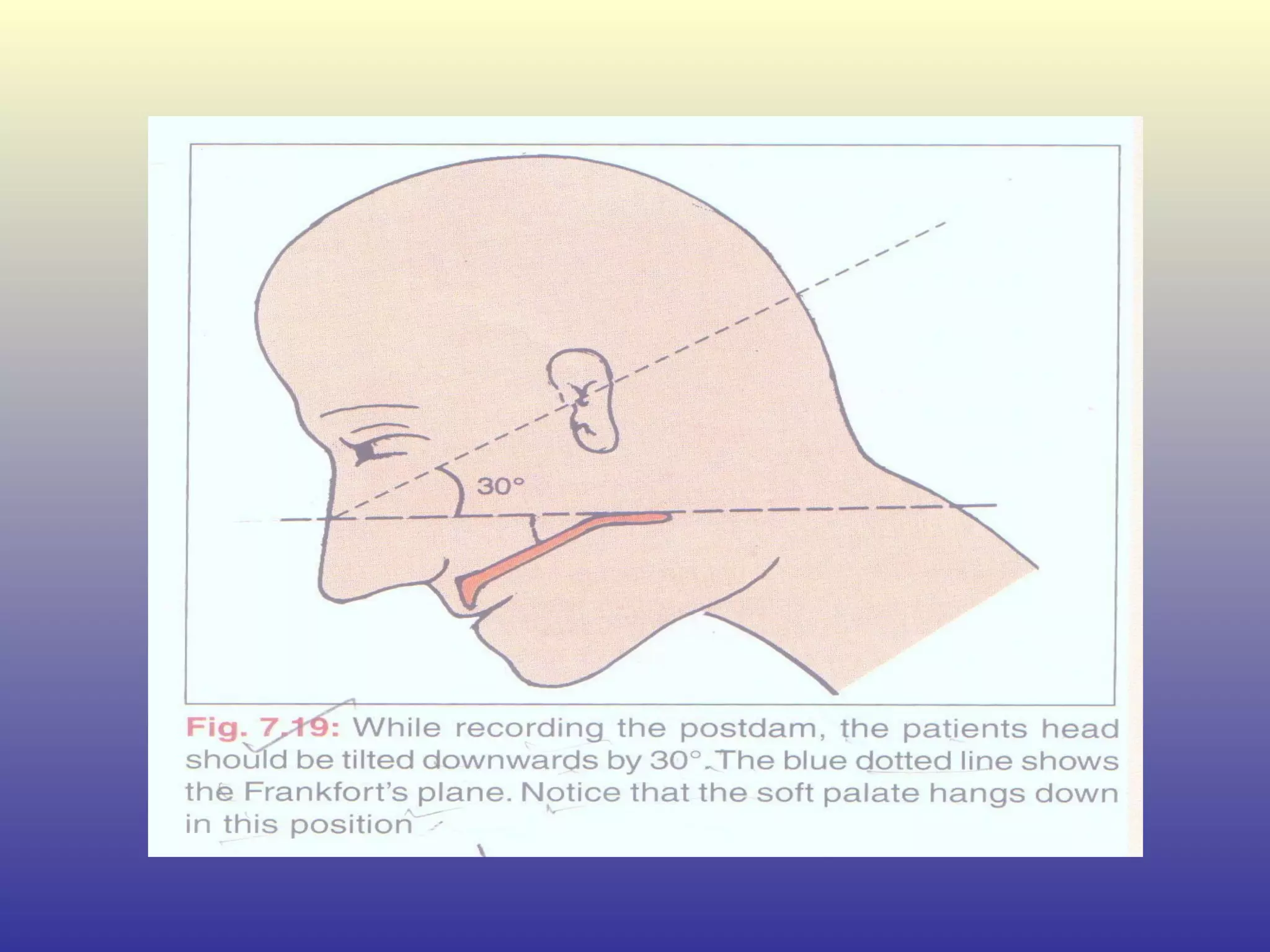
The soft palate should be impression in
it most functionally depressed positions
that is by keeping frankfort plane 30°
below the Hz & the tongue is firmly
positioned against mandibular anterior
teeth.
ADVANTAGE-THIS
         POSTION
1. Soft palate is impression in its most
   functionally depressed position.
2. The flow of saliva & impression
   material into the pharynx is prevented.
   After 4-6 minutes impression tray is
   removed from the mouth & examined
   for uniform contact.
    If the tissue contact has not
   established the wax will appear dull.
If the tissue contact has been established
it will appear glossy.
   If excess wax protruded out of the tray it
should be removed.
  A Secondary impression is reinserted & held
for 3-5 minutes under gentle pressure
followed by 2-3 minutes of firm pressure
applied to mid palatal area of the impression
tray, upon removal of tray from the mouth it
is careful examined to see wax terminate in
feathered edge near the anterior vibrating
line.
It a butt joint is present & proper
flow has not been taken place &
impression tray is reinserted.

  If the wax is over extended it should
be careful trimmed the scalpel.
ADVANTAGES
1. It is physiologic technique displacing
   tissues within their physiologically
   acceptable limits.
2. Over compression of tissue is avoided.
3. Posterior palatal seal is incorporated
   into the trail denture base for added
   retention.
4. Mechanical scrapping of the cast is
   avoided.
DISADVANTAGES
1. More time is necessary during the
   impression appointment.
2. Difficulty in handling the materials &
   added care during the boxing
   procedure.
ERROR IN RECORDING OF
              PPS
1.   Under extension
2.   Under post damming
3.   Over post damming
4.   Over extension
1. UNDER EXTENSION
       This is the most common cause for poor
    posterior palatal seal. It may be produced
    due to one of the following reason:-
1. The denture does not cover the fovea
    palatina, the tissue coverage is reduced &
    the posterior border of the denture is not
    in contact with the soft resilient tissue
    which will move alongwith the denture
    border during functional movements.
2. Reduce the patient anxiety to gagging.

3. Improper delineation of the anterior &
  posterior vibrating line.

4. Prevention: Excessive trimming of the
  posterior border of the cast.
2. OVER EXTENSION
1. The denture base can lead to ulceration of
   the soft palate & painful degulutition.
2. The most frequent complaint from the
   patient will be that swallowing is painful &
   difficult.
3. The hamuli are covered by the denture
   base , the patient will experience sharp pain,
   specially during function.
4. Prevention: These region are trimmed &
   poslished
4. The pterygoid hamuli must never be
  covered by the denture base.

5. The overextension can be removed with
  a bur & then carefully repolished.
3. UNDER POSTDAMMING
1. This can occur due to improper head
   positioning & mouth positioning. E.g.
   the mouth is wide open while recording
   the posterior palatal seal the mucosa
   over the hamular notch becomes
   stretched. This will produce a space
   between the denture base & tissue.
2. Inserting a wet denture into a patient’s
  mouth & inspecting the posterior border
  with the help of mouth mirror. If air
  bubble are seen to escape under the
  posterior border it indicates under
  damming.
3. Prevention: The master cast can
  scraped in the posterior palatal area or
  the fluid wax impression can be
  repeated with proper patient position.
4. OVER POSTDAMMING
1. This commonly occur due to excess
   scraping of the master cast. It occur
   more commonly in the hamular notch
   region.


2. Pterygo maxillary seal area, then upon
   insertion of the denture the posterior
   border will be displaced inferiorly.
3. Prevention: Reduction of the denture
  border with a carbide bur, followed by
  lightly pumishing the area while
  maintaining its convexity.
SUMMARY
    So, it is concluded that the
existence of posterior palatal seal plays
a major role in the development of
stability, retention & prevention,
compressibility & comfort of the
complete denture.
REFERENCES
• Sheldon Winkler, Essentials of complete
  denture prosthodontcs.second edition.
• Zarb Bolender,Prosthodontic Treatment for
  edentulous patients,twelfth edition.
• Boucher,s Prosthodontic treatment for
  edentulous patient,ninth edition.
• Deepak Nallaswamy,Text book of
  prosthodontics,first edition.
 posterior palatal seal

posterior palatal seal

  • 2.
  • 3.
    Definition • Function • Anatomic concideration • Physiologic concideration • Vibrating line • Classification of soft palate • Techniques • Errors in recording PPS • Summary
  • 4.
    DEFINITION It is a soft tissue along the junction of hard & soft palate on which pressure with in the physiologic limit on the tissue can be applied by denture to a in the retention of the denture. (GPT)
  • 5.
    • The peripheralseal of maxillary denture is a area of contact between the mucosa & peripheral polished surface of the denture base, the seal prevent passage of air between denture & tissue. • Retention stability of a denture is achieved from adhesion, cohesion & interfacial surface tension that resist the dislodging forces that act perpendicular to the denture base.
  • 6.
    • The adequatePPS resist the horizontal & lateral forces acting on maxillary denture base as the denture border terminate on soft resilient tissue & there by maintain a proper denture seal.
  • 7.
    FUNCTION OF PPS • Stability • Prevention & retention • Compressibility • Comfort
  • 8.
    • STABILITY:The mainfunction of PPS is to maintain contact with the anterior portion of the soft palate ( the tissue under go shallow displacement ) during functional movement of the somatognathic system ( that is mastication, deglutination & phonation) therefore the main purpose of PPS is the retention of maxillary denture.
  • 9.
    • PREVENTION :It also reduce gag reflex as there is no separation between denture base & soft palate during normal functional movement. • COMPRESSIBILITY : It also reduce food accumulation beneath the posterior aspect of denture owing to proper utilization of tissue compressibility.
  • 10.
    • COMFORT :reduce patient discomfort contact occur between dorsum of the tongue & posterior end of denture base. The correctly placed PPS creates a partial vaccum beneath the maxillarly denture , this partial vaccum is activated only one horizontal tipping forces act is very small & hence produce no irreversible alternation of the underlying mucosa.
  • 11.
    ANATOMIC & PHYSIOLOGIC CONCIDERATION • The PPS is divided in two anatomic separate boundaries- 1.Post palatal seal 2.Pteriomaxillary seal The post palatal seal is extend one tuberosity to other. Pterygomaxillary seal extend through pterygo maxillary notch continuing for 3-4 mm anterolaterally approximation the mucogingival junction. It also occupies the entire width of pterygomaxillary notch.
  • 13.
    • This pterygomaxillarynotch is covered by pterygomandibular fold which extend from the posterir aspect of the tuberocity posterio-inferiorly to insert into the retromolar pad. • This fold of tissue influence the posterior border seal if the mouth is wide open position during the final impression process. • Hamular notch should never be covered by denture as only covered by thin layer of mucous membrane.
  • 14.
    • Fovea palatinaare two glandular opening within the tissue posterior of hard palate lying on the either side of midline. • Fovea palatina should be used only as a guideline for the placement of posterior palatal seal. • Medial palatal raphe which overlies medial palatal suture contain little or submucosa & will tolerate little or no compression .
  • 15.
    VIBRATING LINE The imaginary line across the posterior part of the palate marking the division between the movable & immovable tissue of the soft palate which can be identified when the movable tissue are moving. (GPT) • Anterior vibrating line • Posterior vibrating line
  • 16.
    ANTERIOR VIBRATING LINE •It is an imaginary line lying at the junction between the immovable tissues over the hard palate & the slightly movable tissue of the soft palate-GPT.
  • 17.
    METHOD OF LOCATING A.V.L. • Instructing the patient to say “AH” with short vigorous bursts due to projection of the posterior nasal spine. The anterior vibrating line is not a straight line between both hamular process.
  • 18.
    POSTERIOR VIBRATING LINE •It is an imaginary line as junction of the aponeurosis of tensor vili palatini muscles in the muscular portion of the soft palate.-S. Winkler. It represent demarcation between the part of soft palate that has limited or shallow movement during function (quivers) & the remainder of the soft palate that is markedly displaced during functional movement.
  • 20.
    • Thus theplacement of PPS across mid-palatal suture demand careful attention. • PPS should also extend into mid palatal fissure to ensure proper peripheral seal. • Cord like band of tissue extending between the posterior nasal spine & aponeurosis of tensor vili palatini muscles should receive slight amount of relief. • If the tours palatini extend to the bony limit of the palate leaving little or no room to place the PPS then its removable is indicated.
  • 21.
    • The presenceof thick ropy saliva may create a problem for maxillary complete denture retention as it create hydrostatic pressure in the area anterior to PPS resulting in a downward dislodging force everted major denture base.
  • 22.
    METHOD OF LOCATINGP.V.L. • Instruct the patient to say “AH” in a short vigorous burst in a normal unexaggerated fashion. The posterior vibrating line marks the most distal extension of the denture base.
  • 23.
    CLASSIFICATION OF SOFT PALATE It is classified in- class I class II class III
  • 25.
    • CLASS I It indicate soft palate that is rather Horizontal as a extend posteriorly with minimum muscular activity. There is considerable separation between anterior & posterior vibrating line does having white PPS area yielding more retentive denture base.
  • 26.
    • CLASS III it is seen in conjugation with high V shape palatal vault. There is few mm separation of anterior & posterior vibrating line thus there is small PPS area & less retention.
  • 27.
    • CLASS II palatal contour lie between classI & classIII.
  • 28.
    TECHNIQUES • There are several established techniques for the placement of PPS. The important once are:- 1. Conventional approach 2. Fluid wax technique
  • 29.
    The rational forthe placement of a seal in the impression tray as follows:- 1. To establish positive contact posteriorly to prevent the final impression material from sliding down the pharynx. 2. To serve as a guide for positioning the impression tray, especially if a shim has been used within the tray to establish the borders.
  • 30.
    3. To createslight displacement of the soft palate. 4. To determine if adequate retention & seal of the potential denture border is present.
  • 31.
    CONVENTIONAL APPROACH After thespecial tray is fabricated there are certain instructions given to the patients:- 1. To rinse with an astringent mouth wash that is remove to stringy saliva that might prevent clear transfer marking.There are steps to be followed
  • 32.
    2. Location ofpterygo maxillary notch is done by moving the T burnisher posterior angle to the maxillary tuberosity until it drops into the pterygo maxillary notch. This is necessary as there are times when small depression in the residual ridge may resemble pterygo maxillary notch. 3. Identification of posterior vibrating line the patient asked to say “AH” in short burst in an exaggerated fashion.
  • 33.
    4. Identification ofthe anterior vibration line. This is done by asking the patient to say “AH” with short vigorous bursts (Valsalva Maneuver can also be used)
  • 34.
    PROCEDURE • A lineis placed with an indelible pencil (Thomson sanitary colour transfer applicators) through the pterygo maxillary notch & extended 3-4 mm antero-laterally the tuberosity approximating the mucogingival junction same is done on the opposite side. This complete the out lining of pterygo maxillary seal
  • 35.
    • The posteriorvibrating line is marked with an indelible pencil by connection the line through the pterygomaxillary seal with line just drown demarcation the post palatal seal • The resin or shellac tray inserted into the mouth & seated firmly to place upon removal from the mouth. The indelible lines will be transferred to the tray. • Sometimes it is necessary to redefine transfer marking. The tray in return to master cast to complete the transfer of the complete posterior border.
  • 36.
    • The trayis trimmed until the posterior vibration line so that it decides the post extent denture border. • Returning to the mouth the palatal fissure are palpated with the ‘T’ barnisher or mouth mirror to determine their compressibility in width & depth. • The termination of glandular tissue usually coincides with the anterior vibrating line. • The anterior vibrating line now marked stranseferred to master cast .this complete the transferring the outline of posterior palatal seal area.
  • 37.
    (A) A Tburnisher is used to palpate for the hamular process. (B) Palpating for the pterygomaxillary notch
  • 39.
    • The visualoutline is in the shape of cupid bow the area between the anterior posterior vibrating line is usually narrowest in the mid palatal region because of the projection of the posterior nasal spine. • Kingsley scraper used to score the cast the deepset area are located on either side of midline, one third the distance anteriorly from the posterior vibrating line. It is usually scraped to a depth of approximately 1-1.5 mm . The tissue covering the medial palatal raffae as little sub mucosa & cannot withstand same compressive force as the tissue lateral to it
  • 40.
    • This areais scraped to depth of approximately 0.5-1 mm within the outline of cupid bow & cast is scrapped to depth of half amoung to palatal tissue in that area can be compressed being tapered posteriorly. • Failure to taper the seal posterior mainly to tissue irritation.
  • 41.
    ADVANTAGE 1. The trailbase will be more retentive. This can produce more accurate maxillo mandibular records. 2. Patient will be able to experience the retentive qualities of the trail base, giving them the psychologic security of knowings that retention will not be a problem in the completed prosthesis.
  • 42.
    3. The practionerwill be able to determine the retentive qualities of the finished denture, leaving nothing to chance at the insertion appointment. 4. The new denture wearer will be able to realize the posterior extent of the denture which may ease the adjustment periods.
  • 43.
    DISADVANTAGES 1. It isnot a physiologic technique & therefore depends upon accurate transfer of the vibrating lines & careful scraping of the cast. 2. The potential for over compression of the tissue is great.
  • 44.
    FLUID WAX TECHNIQUE All of the procedure remain the same as conventional technique that is transfer location & transfer marking of the anterior & posterior vibrating line The marking are recorded in final impression one of the four type of wax can be used for their technique:- 1. Iowa wax white developed by Dr. Earl S. Smith.
  • 45.
    2. Korecta waxno. 4, orange developed by Dr. O.C. Applegate. 3. H.L. physiologic paste, yellow-white developed by Dr. C.S. Harkins. 4. Adaptol green developed by Nathan G. these wax are designed to flow at mouth temperature. The melted wax is painted into the impression surface & in the outline at seal area , the wax applied in slightly & excess of the estimated depth & allowed to cool to blow mouth temperature to increase its consistency & make it more resistent of flow.
  • 47.
    The impression iscarried to mouth & held under gentle pressure 4-6 minute to allow the material flow position of head & tongue during this is procedure. The soft palate should be impression in it most functionally depressed positions that is by keeping frankfort plane 30° below the Hz & the tongue is firmly positioned against mandibular anterior teeth.
  • 49.
    ADVANTAGE-THIS POSTION 1. Soft palate is impression in its most functionally depressed position. 2. The flow of saliva & impression material into the pharynx is prevented. After 4-6 minutes impression tray is removed from the mouth & examined for uniform contact. If the tissue contact has not established the wax will appear dull.
  • 50.
    If the tissuecontact has been established it will appear glossy. If excess wax protruded out of the tray it should be removed. A Secondary impression is reinserted & held for 3-5 minutes under gentle pressure followed by 2-3 minutes of firm pressure applied to mid palatal area of the impression tray, upon removal of tray from the mouth it is careful examined to see wax terminate in feathered edge near the anterior vibrating line.
  • 51.
    It a buttjoint is present & proper flow has not been taken place & impression tray is reinserted. If the wax is over extended it should be careful trimmed the scalpel.
  • 52.
    ADVANTAGES 1. It isphysiologic technique displacing tissues within their physiologically acceptable limits. 2. Over compression of tissue is avoided. 3. Posterior palatal seal is incorporated into the trail denture base for added retention. 4. Mechanical scrapping of the cast is avoided.
  • 53.
    DISADVANTAGES 1. More timeis necessary during the impression appointment. 2. Difficulty in handling the materials & added care during the boxing procedure.
  • 54.
    ERROR IN RECORDINGOF PPS 1. Under extension 2. Under post damming 3. Over post damming 4. Over extension
  • 55.
    1. UNDER EXTENSION This is the most common cause for poor posterior palatal seal. It may be produced due to one of the following reason:- 1. The denture does not cover the fovea palatina, the tissue coverage is reduced & the posterior border of the denture is not in contact with the soft resilient tissue which will move alongwith the denture border during functional movements.
  • 56.
    2. Reduce thepatient anxiety to gagging. 3. Improper delineation of the anterior & posterior vibrating line. 4. Prevention: Excessive trimming of the posterior border of the cast.
  • 57.
    2. OVER EXTENSION 1.The denture base can lead to ulceration of the soft palate & painful degulutition. 2. The most frequent complaint from the patient will be that swallowing is painful & difficult. 3. The hamuli are covered by the denture base , the patient will experience sharp pain, specially during function. 4. Prevention: These region are trimmed & poslished
  • 58.
    4. The pterygoidhamuli must never be covered by the denture base. 5. The overextension can be removed with a bur & then carefully repolished.
  • 59.
    3. UNDER POSTDAMMING 1.This can occur due to improper head positioning & mouth positioning. E.g. the mouth is wide open while recording the posterior palatal seal the mucosa over the hamular notch becomes stretched. This will produce a space between the denture base & tissue.
  • 60.
    2. Inserting awet denture into a patient’s mouth & inspecting the posterior border with the help of mouth mirror. If air bubble are seen to escape under the posterior border it indicates under damming. 3. Prevention: The master cast can scraped in the posterior palatal area or the fluid wax impression can be repeated with proper patient position.
  • 61.
    4. OVER POSTDAMMING 1.This commonly occur due to excess scraping of the master cast. It occur more commonly in the hamular notch region. 2. Pterygo maxillary seal area, then upon insertion of the denture the posterior border will be displaced inferiorly.
  • 62.
    3. Prevention: Reductionof the denture border with a carbide bur, followed by lightly pumishing the area while maintaining its convexity.
  • 63.
    SUMMARY So, it is concluded that the existence of posterior palatal seal plays a major role in the development of stability, retention & prevention, compressibility & comfort of the complete denture.
  • 64.
    REFERENCES • Sheldon Winkler,Essentials of complete denture prosthodontcs.second edition. • Zarb Bolender,Prosthodontic Treatment for edentulous patients,twelfth edition. • Boucher,s Prosthodontic treatment for edentulous patient,ninth edition. • Deepak Nallaswamy,Text book of prosthodontics,first edition.