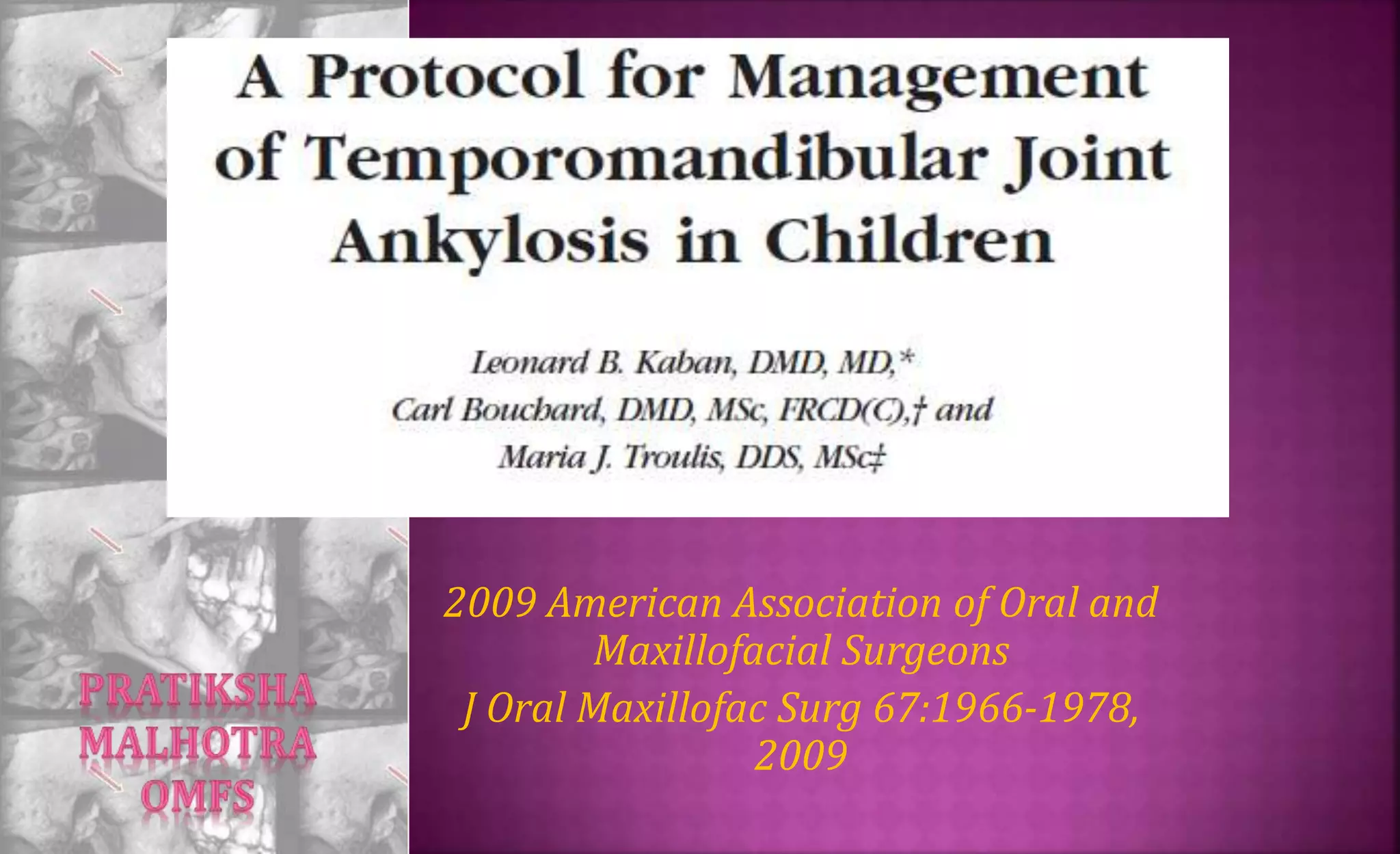
2009 American Association of Oral and
Maxillofacial Surgeons
J Oral Maxillofac Surg 67:1966-1978,
2009
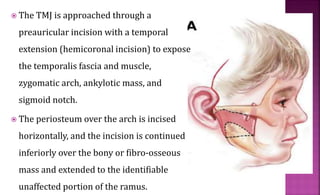
 The TMJ is approached through a
preauricular incision with a temporal
extension (hemicoronal incision) to expose
the temporalis fascia and muscle,
zygomatic arch, ankylotic mass, and
sigmoid notch.
 The periosteum over the arch is incised
horizontally, and the incision is continued
inferiorly over the bony or fibro-osseous
mass and extended to the identifiable
unaffected portion of the ramus.
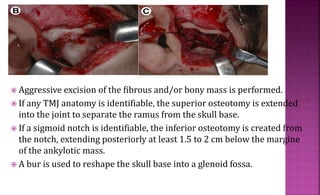
 Aggressive excision of the fibrous and/or bony mass is performed.
 If any TMJ anatomy is identifiable, the superior osteotomy is extended
into the joint to separate the ramus from the skull base.
 If a sigmoid notch is identifiable, the inferior osteotomy is created from
the notch, extending posteriorly at least 1.5 to 2 cm below the margine
of the ankylotic mass.
 A bur is used to reshape the skull base into a glenoid fossa.
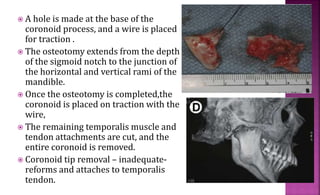
 A hole is made at the base of the
coronoid process, and a wire is placed
for traction .
 The osteotomy extends from the depth
of the sigmoid notch to the junction of
the horizontal and vertical rami of the
mandible.
 Once the osteotomy is completed,the
coronoid is placed on traction with the
wire,
 The remaining temporalis muscle and
tendon attachments are cut, and the
entire coronoid is removed.
 Coronoid tip removal – inadequate-
reforms and attaches to temporalis
tendon.
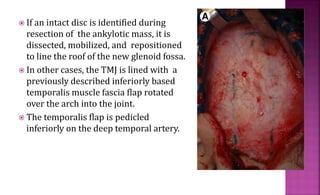
 If an intact disc is identified during
resection of the ankylotic mass, it is
dissected, mobilized, and repositioned
to line the roof of the new glenoid fossa.
 In other cases, the TMJ is lined with a
previously described inferiorly based
temporalis muscle fascia flap rotated
over the arch into the joint.
 The temporalis flap is pedicled
inferiorly on the deep temporal artery.
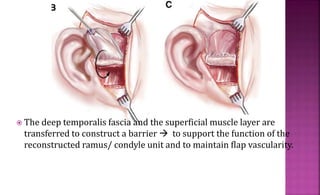
 The deep temporalis fascia and the superficial muscle layer are
transferred to construct a barrier  to support the function of the
reconstructed ramus/ condyle unit and to maintain flap vascularity.
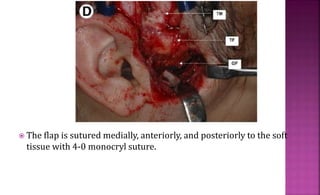
 The flap is sutured medially, anteriorly, and posteriorly to the soft
tissue with 4-0 monocryl suture.
1. Reconstruction with costochondral graft.
2. Reconstruction using distraction osteogenesis.
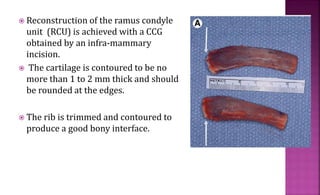
 Reconstruction of the ramus condyle
unit (RCU) is achieved with a CCG
obtained by an infra-mammary
incision.
 The cartilage is contoured to be no
more than 1 to 2 mm thick and should
be rounded at the edges.
 The rib is trimmed and contoured to
produce a good bony interface.
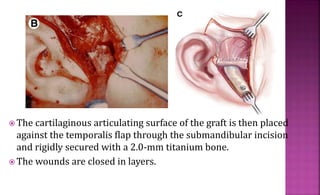
 The cartilaginous articulating surface of the graft is then placed
against the temporalis flap through the submandibular incision
and rigidly secured with a 2.0-mm titanium bone.
 The wounds are closed in layers.
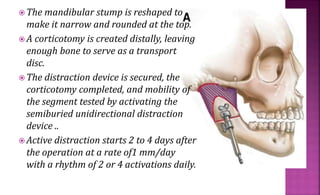
 The mandibular stump is reshaped to
make it narrow and rounded at the top.
 A corticotomy is created distally, leaving
enough bone to serve as a transport
disc.
 The distraction device is secured, the
corticotomy completed, and mobility of
the segment tested by activating the
semiburied unidirectional distraction
device ..
 Active distraction starts 2 to 4 days after
the operation at a rate of1 mm/day
with a rhythm of 2 or 4 activations daily.
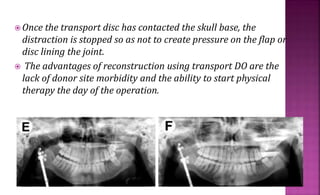
 Once the transport disc has contacted the skull base, the
distraction is stopped so as not to create pressure on the flap or
disc lining the joint.
 The advantages of reconstruction using transport DO are the
lack of donor site morbidity and the ability to start physical
therapy the day of the operation.
 It consists of active hinge opening
and lateral excursions combined
with manual finger stretching in
front of a mirror.
 The exercises are done 4 times
daily for 3 to 5 minutes by the
clock.
 At 6 weeks postoperatively, the
diet is advanced to solid foods, and
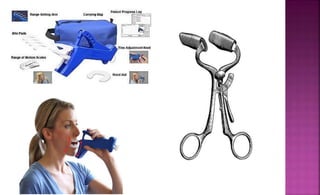
the “Thera- Bite Jaw Rehabilitation
System is used 4 to 5 times daily for
3 to 5 minutes .
 The physical therapy program also
includes heat, massage, and gum
chewing.
 If the patient is not able to
achieve the documented
intraoperative MIO, or if the
MIO shows no sign of
improvement at 6 to 8 weeks,
the jaw should be stretched
with the patient under general
anesthesia.
 The use of the TheraBite 3 to 4
times daily, gum chewing, and
finger stretching exercises
should be continued for 1 year,
and patients should be
followed closely for at least 1
year.
 In a more recent retrospective
analysis of 11 children younger
than 16 years of age treated by
this protocol
8 patients had ankylosis secondary
to trauma,
1 had hemifacial microsomia,
1 an infection,
and 1 congenital ankylosis.
 In 2 patients, both joints were
affected.
 The ramus condyle unit was
reconstructed with either a CCG
(n 6) or DO (n 5).
 The patients were followed for a
period of 4 to 74 months (mean
24.8).
 The mean preoperative MIO was
11.5 mm (range 1 to 23).
 Postoperatively, the mean MIO
was 38.2 mm (range 15 to 49).
 Ten of 11 patients had an MIO
greater than 30 mm after the
operation and 1 had to have
fibrous ankylosis release 6 years
after the first operation.
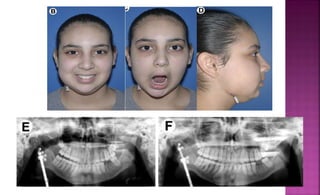
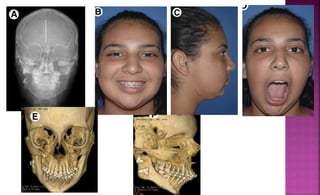
 Facial asymmetry progressively worsens because of the hypomobility
and abnormal muscle function.
 The short ramus condyle unit restricts mid-face growth.
 The longer the duration of hypomobility, the more severe will be the
muscle atrophy and facial asymmetry.
 If secondary elongation and hypertrophy of the coronoid process 
restricting jaw motion
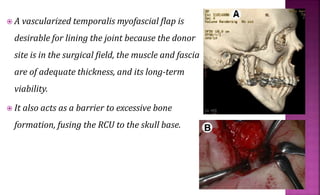
 A vascularized temporalis myofascial flap is
desirable for lining the joint because the donor
site is in the surgical field, the muscle and fascia
are of adequate thickness, and its long-term
viability.
 It also acts as a barrier to excessive bone
formation, fusing the RCU to the skull base.
 The benefits of a CCG its growth potential, its biologic
compatibility, and its capacity to remodel into a neocondyle with
time.
 Its major drawbacks donor site morbidity and reported
unpredictable growth.
Perrott and Kaban described 2types of overgrowth:
1) linear overgrowth resulting in asymmetric or bilateral prognathism;
2) Tumor like overgrowth and reankylosis.
Both types of overgrowth are caused by an excessive cartilaginous cap
on the graft.
The rib growth center is the costochondral junction. A
cartilaginous cap greater than 1 to 2 mm transfers an excessive
portion of the growth center, resulting in linear overgrowth.
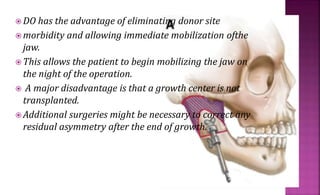
 DO has the advantage of eliminating donor site
 morbidity and allowing immediate mobilization ofthe
jaw.
 This allows the patient to begin mobilizing the jaw on
the night of the operation.
 A major disadvantage is that a growth center is not
transplanted.
 Additional surgeries might be necessary to correct any
residual asymmetry after the end of growth.
Kaban protocol tmj ankylosis treatment new 2009

Kaban protocol tmj ankylosis treatment new 2009

  • 1.
    2009 American Associationof Oral and Maxillofacial Surgeons J Oral Maxillofac Surg 67:1966-1978, 2009
  • 3.
     The TMJis approached through a preauricular incision with a temporal extension (hemicoronal incision) to expose the temporalis fascia and muscle, zygomatic arch, ankylotic mass, and sigmoid notch.  The periosteum over the arch is incised horizontally, and the incision is continued inferiorly over the bony or fibro-osseous mass and extended to the identifiable unaffected portion of the ramus.
  • 4.
     Aggressive excisionof the fibrous and/or bony mass is performed.  If any TMJ anatomy is identifiable, the superior osteotomy is extended into the joint to separate the ramus from the skull base.  If a sigmoid notch is identifiable, the inferior osteotomy is created from the notch, extending posteriorly at least 1.5 to 2 cm below the margine of the ankylotic mass.  A bur is used to reshape the skull base into a glenoid fossa.
  • 6.
     A holeis made at the base of the coronoid process, and a wire is placed for traction .  The osteotomy extends from the depth of the sigmoid notch to the junction of the horizontal and vertical rami of the mandible.  Once the osteotomy is completed,the coronoid is placed on traction with the wire,  The remaining temporalis muscle and tendon attachments are cut, and the entire coronoid is removed.  Coronoid tip removal – inadequate- reforms and attaches to temporalis tendon.
  • 8.
     If anintact disc is identified during resection of the ankylotic mass, it is dissected, mobilized, and repositioned to line the roof of the new glenoid fossa.  In other cases, the TMJ is lined with a previously described inferiorly based temporalis muscle fascia flap rotated over the arch into the joint.  The temporalis flap is pedicled inferiorly on the deep temporal artery.
  • 9.
     The deeptemporalis fascia and the superficial muscle layer are transferred to construct a barrier  to support the function of the reconstructed ramus/ condyle unit and to maintain flap vascularity.
  • 10.
     The flapis sutured medially, anteriorly, and posteriorly to the soft tissue with 4-0 monocryl suture.
  • 11.
    1. Reconstruction withcostochondral graft. 2. Reconstruction using distraction osteogenesis.
  • 12.
     Reconstruction ofthe ramus condyle unit (RCU) is achieved with a CCG obtained by an infra-mammary incision.  The cartilage is contoured to be no more than 1 to 2 mm thick and should be rounded at the edges.  The rib is trimmed and contoured to produce a good bony interface.
  • 13.
     The cartilaginousarticulating surface of the graft is then placed against the temporalis flap through the submandibular incision and rigidly secured with a 2.0-mm titanium bone.  The wounds are closed in layers.
  • 14.
     The mandibularstump is reshaped to make it narrow and rounded at the top.  A corticotomy is created distally, leaving enough bone to serve as a transport disc.  The distraction device is secured, the corticotomy completed, and mobility of the segment tested by activating the semiburied unidirectional distraction device ..  Active distraction starts 2 to 4 days after the operation at a rate of1 mm/day with a rhythm of 2 or 4 activations daily.
  • 15.
     Once thetransport disc has contacted the skull base, the distraction is stopped so as not to create pressure on the flap or disc lining the joint.  The advantages of reconstruction using transport DO are the lack of donor site morbidity and the ability to start physical therapy the day of the operation.
  • 19.
     It consistsof active hinge opening and lateral excursions combined with manual finger stretching in front of a mirror.  The exercises are done 4 times daily for 3 to 5 minutes by the clock.  At 6 weeks postoperatively, the diet is advanced to solid foods, and the “Thera- Bite Jaw Rehabilitation System is used 4 to 5 times daily for 3 to 5 minutes .  The physical therapy program also includes heat, massage, and gum chewing.  If the patient is not able to achieve the documented intraoperative MIO, or if the MIO shows no sign of improvement at 6 to 8 weeks, the jaw should be stretched with the patient under general anesthesia.  The use of the TheraBite 3 to 4 times daily, gum chewing, and finger stretching exercises should be continued for 1 year, and patients should be followed closely for at least 1 year.
  • 22.
     In amore recent retrospective analysis of 11 children younger than 16 years of age treated by this protocol 8 patients had ankylosis secondary to trauma, 1 had hemifacial microsomia, 1 an infection, and 1 congenital ankylosis.  In 2 patients, both joints were affected.  The ramus condyle unit was reconstructed with either a CCG (n 6) or DO (n 5).  The patients were followed for a period of 4 to 74 months (mean 24.8).  The mean preoperative MIO was 11.5 mm (range 1 to 23).  Postoperatively, the mean MIO was 38.2 mm (range 15 to 49).  Ten of 11 patients had an MIO greater than 30 mm after the operation and 1 had to have fibrous ankylosis release 6 years after the first operation.
  • 24.
     Facial asymmetryprogressively worsens because of the hypomobility and abnormal muscle function.  The short ramus condyle unit restricts mid-face growth.  The longer the duration of hypomobility, the more severe will be the muscle atrophy and facial asymmetry.  If secondary elongation and hypertrophy of the coronoid process  restricting jaw motion
  • 25.
     A vascularizedtemporalis myofascial flap is desirable for lining the joint because the donor site is in the surgical field, the muscle and fascia are of adequate thickness, and its long-term viability.  It also acts as a barrier to excessive bone formation, fusing the RCU to the skull base.
  • 26.
     The benefitsof a CCG its growth potential, its biologic compatibility, and its capacity to remodel into a neocondyle with time.  Its major drawbacks donor site morbidity and reported unpredictable growth. Perrott and Kaban described 2types of overgrowth: 1) linear overgrowth resulting in asymmetric or bilateral prognathism; 2) Tumor like overgrowth and reankylosis. Both types of overgrowth are caused by an excessive cartilaginous cap on the graft. The rib growth center is the costochondral junction. A cartilaginous cap greater than 1 to 2 mm transfers an excessive portion of the growth center, resulting in linear overgrowth.
  • 27.
     DO hasthe advantage of eliminating donor site  morbidity and allowing immediate mobilization ofthe jaw.  This allows the patient to begin mobilizing the jaw on the night of the operation.  A major disadvantage is that a growth center is not transplanted.  Additional surgeries might be necessary to correct any residual asymmetry after the end of growth.

Editor's Notes

  • #7 Removing only the tip of the coronoid or simply doing a coronoidotomy is inadequate, because the coronoid reforms and becomes attached and limited by the temporalis tendon and scar.
  • #15 The protocol is the same as described in the previous section, except for the reconstruction phase.
  • #25 Untreated TMJ ankylosis in children results in significant adverse consequences.