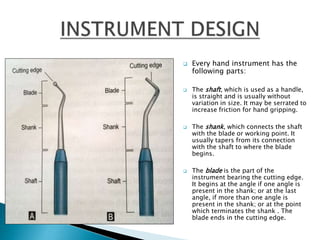

 Every hand instrument has the
following parts:
 The shaft, which is used as a handle,
is straight and is usually without
variation in size. It may be serrated to
increase friction for hand gripping.
 The shank, which connects the shaft
with the blade or working point. It
usually tapers from its connection
with the shaft to where the blade
begins.
 The blade is the part of the
instrument bearing the cutting edge.
It begins at the angle if one angle is
present in the shank; or at the last
angle, if more than one angle is
present in the shank; or at the point
which terminates the shank . The
blade ends in the cutting edge.
The blade angle is defined
as the angle between the
long axis of the blade and
the long axis of the shaft.
The cutting edge is the
working part of the
instrument. It is usually in
the form of a bevel with
different shapes.
The cutting edge angle is
defined as an angle between
the margin of the cutting
edge and the long axis of
the shaft.
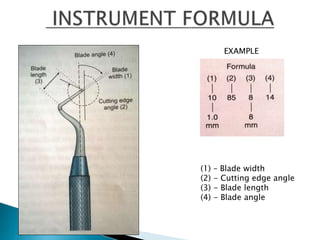
(1) – Blade width
(2) - Cutting edge angle
(3) - Blade length
(4) - Blade angle
EXAMPLE
 Cutting instruments have formula describing the dimensions and angles
of the working end. These are placed on the handle using a code of
three or four numbers separated by dashes or spaces (e.g. 10-85-8-
14).
 The first no. indicates the width of blade or primary cutting edge in
tenths of a millimeter(0.1mm) (e.g.10=1mm).
 The second number of a four number code indicates the primary cutting
edge angle measured from a line parallel to the long axis of the
instrument handle in clockwise centigrade. The angle is expressed as a
percent of 360 degrees (e.g. 85= 85% x 360 degrees= 306 degrees).If
the edge is locally perpendicular to the blade, this number is normally
omitted, resulting in a three-number code.
 The third number (second number of a three-number code) indicates
the blade length in millimeter (e.g. 8=8mm).
 The fourth number (third number of a three number code) indicates the
blade angle relative to the long axis of the handle in clockwise
centigrade (14=50 degrees ).
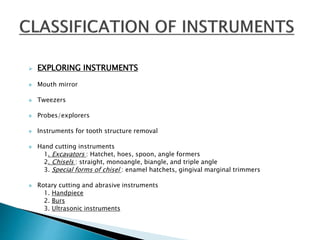
 EXPLORING INSTRUMENTS
 Mouth mirror
 Tweezers
 Probes/explorers
 Instruments for tooth structure removal
 Hand cutting instruments
1. Excavators : Hatchet, hoes, spoon, angle formers
2. Chisels : straight, monoangle, biangle, and triple angle
3. Special forms of chisel : enamel hatchets, gingival marginal trimmers
 Rotary cutting and abrasive instruments
1. Handpiece
2. Burs
3. Ultrasonic instruments
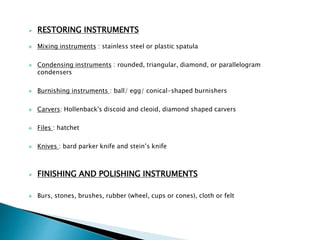
 RESTORING INSTRUMENTS
 Mixing instruments : stainless steel or plastic spatula
 Condensing instruments : rounded, triangular, diamond, or parallelogram
condensers
 Burnishing instruments : ball/ egg/ conical-shaped burnishers
 Carvers: Hollenback's discoid and cleoid, diamond shaped carvers
 Files : hatchet
 Knives : bard parker knife and stein’s knife
 FINISHING AND POLISHING INSTRUMENTS
 Burs, stones, brushes, rubber (wheel, cups or cones), cloth or felt
• Mouth mirrors are used as
supplement to improve
access to instrumentation.
• Used to reflect dental light
on to a specific area of oral
cavity.
• It is used for retraction of
soft tissues such as the
cheeks and the tongue to
aid in better visualization of
the operating field.
• Mirror is placed in oral
cavity that cannot be seen
directly without
compromising dentist’s
position.
MOUTH MIRROR
•These have angled tip
and are available in
different sizes.
• They are used to
place and remove
cotton rolls and other
small materials.
• It comes in different
sizes to fit various
needs.
TWEEZERS
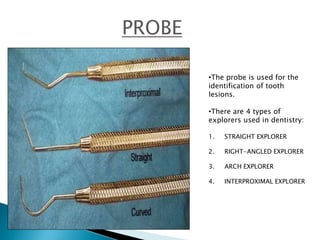
•The probe is used for the
identification of tooth
lesions.
•There are 4 types of
explorers used in dentistry:
1. STRAIGHT EXPLORER
2. RIGHT-ANGLED EXPLORER
3. ARCH EXPLORER
4. INTERPROXIMAL EXPLORER
PROBE
• Any instrument where the cutting
edge is parallel or close to parallel to
the plane of the instrument is called
hatchet.
• Hatchet is a paired instrument in
which blade makes 45 or 90 degree
angle to the shank.
• In paired right and left hatchets,
blades are beveled on opposite sides
to form their cutting edges.
• Hatchets are used for cleaving
enamel and walls so as to have sharp
outline of the preparation.
HATCHET
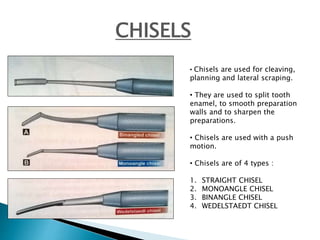
• Chisels are used for cleaving,
planning and lateral scraping.
• They are used to split tooth
enamel, to smooth preparation
walls and to sharpen the
preparations.
• Chisels are used with a push
motion.
• Chisels are of 4 types :
1. STRAIGHT CHISEL
2. MONOANGLE CHISEL
3. BINANGLE CHISEL
4. WEDELSTAEDT CHISEL
CHISELS
•The gingival margin trimmer
(GMT) is a modified hatchet
which has working ends with
opposite curvatures and
bevels.
• The GMT is available in a set
of two double ended styles
and is used in pairs. The
distal GMT is used for the
mesial surface.
• GMT is used for planning
gingival cavosurface margin
that is removal of
unsupported enamel and to
bevel axiopulpal line angle in
classII tooth preparation
GINGIVAL MARGINAL TRIMMER
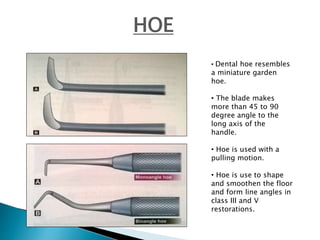
• Dental hoe resembles
a miniature garden
hoe.
• The blade makes
more than 45 to 90
degree angle to the
long axis of the
handle.
• Hoe is used with a
pulling motion.
• Hoe is use to shape
and smoothen the floor
and form line angles in
class III and V
restorations.
HOE
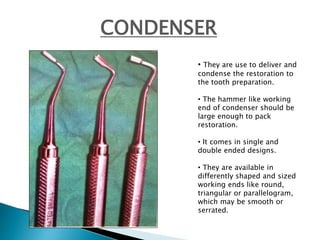
• They are use to deliver and
condense the restoration to
the tooth preparation.
• The hammer like working
end of condenser should be
large enough to pack
restoration.
• It comes in single and
double ended designs.
• They are available in
differently shaped and sized
working ends like round,
triangular or parallelogram,
which may be smooth or
serrated.
CONDENSER
• Amalgam carriers carry
the freshly prepared
amalgam restorative
material to the prepared
tooth.
• It have hollow working
ends called barrels into
which the amalgam is
packed for
transportation.
• It can be single and
double ended.
AMALGAM CARRIERS
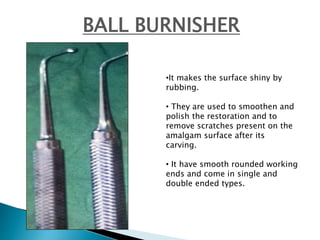
•It makes the surface shiny by
rubbing.
• They are used to smoothen and
polish the restoration and to
remove scratches present on the
amalgam surface after its
carving.
• It have smooth rounded working
ends and come in single and
double ended types.
BALL BURNISHER
 Rotary cutting instruments are
those instruments which rotate
on an axis to do the work of
abrading and cutting on tooth
structure.
 Types of rotary cutting
instruments:
 Handpiece : It is a power device
- Straight hand piece
- Contra-angle handpiece
 Bur : It is a cutting tool.
 According to their mode of attachment to hand piece:
 Latch type
 Friction type
 According to their composition:
 Stainless steel burs
 Tungsten carbide bur
 Combination of both
 According to their motion:
 Right bur
 Left bur
TUNGSTEN CARBIDE BURS
 According to the length of their
head:
 Long
 Short
 Regular
 According to their use:
 Cutting burs
 Finishing burs
 Polishing burs
 According to their shapes:
 Round bur
 Inverted cone
 Pear-shaped
 Wheel shaped
 Tapering fissure
THANK YOU

Instrumentation

  • 2.
     Every handinstrument has the following parts:  The shaft, which is used as a handle, is straight and is usually without variation in size. It may be serrated to increase friction for hand gripping.  The shank, which connects the shaft with the blade or working point. It usually tapers from its connection with the shaft to where the blade begins.  The blade is the part of the instrument bearing the cutting edge. It begins at the angle if one angle is present in the shank; or at the last angle, if more than one angle is present in the shank; or at the point which terminates the shank . The blade ends in the cutting edge.
  • 3.
    The blade angleis defined as the angle between the long axis of the blade and the long axis of the shaft. The cutting edge is the working part of the instrument. It is usually in the form of a bevel with different shapes. The cutting edge angle is defined as an angle between the margin of the cutting edge and the long axis of the shaft.
  • 4.
    (1) – Bladewidth (2) - Cutting edge angle (3) - Blade length (4) - Blade angle EXAMPLE
  • 5.
     Cutting instrumentshave formula describing the dimensions and angles of the working end. These are placed on the handle using a code of three or four numbers separated by dashes or spaces (e.g. 10-85-8- 14).  The first no. indicates the width of blade or primary cutting edge in tenths of a millimeter(0.1mm) (e.g.10=1mm).  The second number of a four number code indicates the primary cutting edge angle measured from a line parallel to the long axis of the instrument handle in clockwise centigrade. The angle is expressed as a percent of 360 degrees (e.g. 85= 85% x 360 degrees= 306 degrees).If the edge is locally perpendicular to the blade, this number is normally omitted, resulting in a three-number code.  The third number (second number of a three-number code) indicates the blade length in millimeter (e.g. 8=8mm).  The fourth number (third number of a three number code) indicates the blade angle relative to the long axis of the handle in clockwise centigrade (14=50 degrees ).
  • 6.
     EXPLORING INSTRUMENTS Mouth mirror  Tweezers  Probes/explorers  Instruments for tooth structure removal  Hand cutting instruments 1. Excavators : Hatchet, hoes, spoon, angle formers 2. Chisels : straight, monoangle, biangle, and triple angle 3. Special forms of chisel : enamel hatchets, gingival marginal trimmers  Rotary cutting and abrasive instruments 1. Handpiece 2. Burs 3. Ultrasonic instruments
  • 7.
     RESTORING INSTRUMENTS Mixing instruments : stainless steel or plastic spatula  Condensing instruments : rounded, triangular, diamond, or parallelogram condensers  Burnishing instruments : ball/ egg/ conical-shaped burnishers  Carvers: Hollenback's discoid and cleoid, diamond shaped carvers  Files : hatchet  Knives : bard parker knife and stein’s knife  FINISHING AND POLISHING INSTRUMENTS  Burs, stones, brushes, rubber (wheel, cups or cones), cloth or felt
  • 8.
    • Mouth mirrorsare used as supplement to improve access to instrumentation. • Used to reflect dental light on to a specific area of oral cavity. • It is used for retraction of soft tissues such as the cheeks and the tongue to aid in better visualization of the operating field. • Mirror is placed in oral cavity that cannot be seen directly without compromising dentist’s position. MOUTH MIRROR
  • 9.
    •These have angledtip and are available in different sizes. • They are used to place and remove cotton rolls and other small materials. • It comes in different sizes to fit various needs. TWEEZERS
  • 10.
    •The probe isused for the identification of tooth lesions. •There are 4 types of explorers used in dentistry: 1. STRAIGHT EXPLORER 2. RIGHT-ANGLED EXPLORER 3. ARCH EXPLORER 4. INTERPROXIMAL EXPLORER PROBE
  • 11.
    • Any instrumentwhere the cutting edge is parallel or close to parallel to the plane of the instrument is called hatchet. • Hatchet is a paired instrument in which blade makes 45 or 90 degree angle to the shank. • In paired right and left hatchets, blades are beveled on opposite sides to form their cutting edges. • Hatchets are used for cleaving enamel and walls so as to have sharp outline of the preparation. HATCHET
  • 12.
    • Chisels areused for cleaving, planning and lateral scraping. • They are used to split tooth enamel, to smooth preparation walls and to sharpen the preparations. • Chisels are used with a push motion. • Chisels are of 4 types : 1. STRAIGHT CHISEL 2. MONOANGLE CHISEL 3. BINANGLE CHISEL 4. WEDELSTAEDT CHISEL CHISELS
  • 13.
    •The gingival margintrimmer (GMT) is a modified hatchet which has working ends with opposite curvatures and bevels. • The GMT is available in a set of two double ended styles and is used in pairs. The distal GMT is used for the mesial surface. • GMT is used for planning gingival cavosurface margin that is removal of unsupported enamel and to bevel axiopulpal line angle in classII tooth preparation GINGIVAL MARGINAL TRIMMER
  • 14.
    • Dental hoeresembles a miniature garden hoe. • The blade makes more than 45 to 90 degree angle to the long axis of the handle. • Hoe is used with a pulling motion. • Hoe is use to shape and smoothen the floor and form line angles in class III and V restorations. HOE
  • 15.
    • They areuse to deliver and condense the restoration to the tooth preparation. • The hammer like working end of condenser should be large enough to pack restoration. • It comes in single and double ended designs. • They are available in differently shaped and sized working ends like round, triangular or parallelogram, which may be smooth or serrated. CONDENSER
  • 16.
    • Amalgam carrierscarry the freshly prepared amalgam restorative material to the prepared tooth. • It have hollow working ends called barrels into which the amalgam is packed for transportation. • It can be single and double ended. AMALGAM CARRIERS
  • 17.
    •It makes thesurface shiny by rubbing. • They are used to smoothen and polish the restoration and to remove scratches present on the amalgam surface after its carving. • It have smooth rounded working ends and come in single and double ended types. BALL BURNISHER
  • 18.
     Rotary cuttinginstruments are those instruments which rotate on an axis to do the work of abrading and cutting on tooth structure.  Types of rotary cutting instruments:  Handpiece : It is a power device - Straight hand piece - Contra-angle handpiece  Bur : It is a cutting tool.
  • 19.
     According totheir mode of attachment to hand piece:  Latch type  Friction type  According to their composition:  Stainless steel burs  Tungsten carbide bur  Combination of both  According to their motion:  Right bur  Left bur TUNGSTEN CARBIDE BURS
  • 20.
     According tothe length of their head:  Long  Short  Regular  According to their use:  Cutting burs  Finishing burs  Polishing burs  According to their shapes:  Round bur  Inverted cone  Pear-shaped  Wheel shaped  Tapering fissure
  • 21.