Clinical featuresofTMJ  dislocationBYAmin Abusallamah
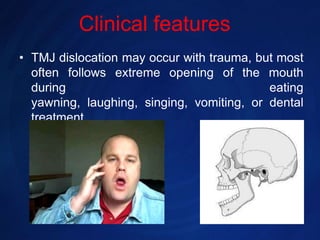
Clinical featuresTMJ dislocation may occur with trauma, but most often follows extreme opening of the mouth duringeating yawning, laughing, singing, vomiting, or dental treatment .
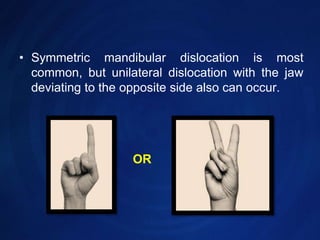
Symmetric mandibular dislocation is most common, but unilateral dislocation with the jaw deviating to the opposite side also can occur.OR
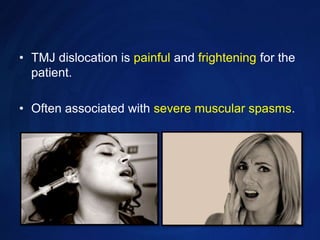
TMJ dislocation is painfuland frightening for the patient. Often associated with severe muscular spasms.
The patient is unable to close the mouth and there is excessive salivation .A depression may be noted in the preauricular area. Palpation of the TMJ reveals one or both of the condyles trapped in front of the articular eminence and spasm of the muscles of mastication.
Thank youReverence Contemporary Oral and Maxillofacial Surgery,4th EdPart …8     chapter …30     pages …682 - 683

Clinical features of tmj dislocation

  • 1.
    Clinical featuresofTMJ dislocationBYAmin Abusallamah
  • 2.
    Clinical featuresTMJ dislocationmay occur with trauma, but most often follows extreme opening of the mouth duringeating yawning, laughing, singing, vomiting, or dental treatment .
  • 3.
    Symmetric mandibular dislocationis most common, but unilateral dislocation with the jaw deviating to the opposite side also can occur.OR
  • 4.
    TMJ dislocation ispainfuland frightening for the patient. Often associated with severe muscular spasms.
  • 5.
    The patient isunable to close the mouth and there is excessive salivation .A depression may be noted in the preauricular area. Palpation of the TMJ reveals one or both of the condyles trapped in front of the articular eminence and spasm of the muscles of mastication.
  • 6.
    Thank youReverence ContemporaryOral and Maxillofacial Surgery,4th EdPart …8 chapter …30 pages …682 - 683