Techniques of Mandibular Anesthesia Prepared by  Dr shabeel pn
Mandibular Anesthesia Lower success rate than Maxillary anesthesia - approx. 80-85 % Related to bone density Less access to nerve trunks  
Mandibular Nerve Blocks Inferior alveolar Mental - Incisive  Buccal Lingual Gow-Gates Akinosi
Mandibular Anesthesia Most commonly performed technique Has highest failure rate (15-20%) Success depends on depositing solution within 1 mm of nerve trunk
Inferior Alveolar Nerve Block Not a complete mandibular nerve block. Requires supplemental buccal nerve block May require infiltration of incisors or mesial root of first molar
Inferior Alveolar Nerve Block Nerves anesthetized Inferior Alveolar Mental Incisive  Lingual
Inferior Alveolar Nerve Block Areas Anesthetized Mandibular teeth to midline Body of mandible, inferior ramus  Buccal mucosa anterior to mental foramen Anterior 2/3 tongue & floor of mouth Lingual soft tissue and periosteum
Inferior Alveolar Nerve Block Indications Multiple mandibular teeth Buccal anterior soft tissue Lingual anesthesia
Inferior Alveolar Nerve Block  Contraindications Infection/inflammation at injection site Patients at risk for self injury (eg. children)
Inferior Alveolar Nerve Block 10%-15% positive aspiration
Inferior Alveolar Nerve Block Alternatives Mental nerve block Incisive nerve block Anterior infiltration
Inferior Alveolar Nerve Block Alternatives (cont.) Periodontal ligament injection (PDL) Gow-Gates Akinosi  Intraseptal
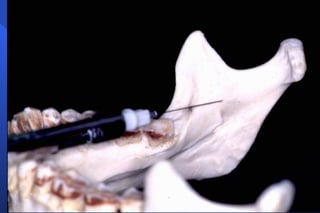
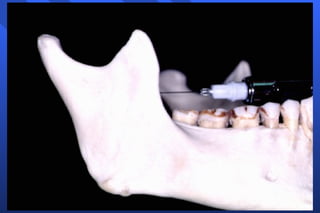
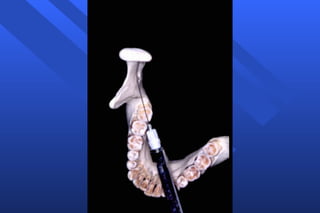
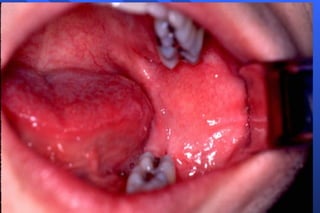
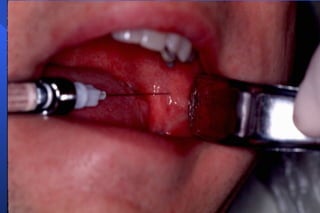
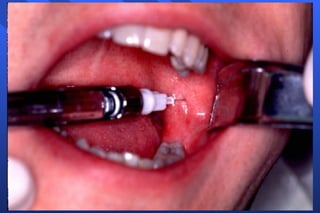
Inferior Alveolar Nerve Block Technique Apply topical Area of insertion : medial ramus, mid-coronoid notch, level with occlusal plane (1 cm above), 3/4 posterior from coronoid notch to pterygomandibular raphe advance to bone (20-25 mm)
Inferior Alveolar Nerve Block  Target Area Inferior alveolar nerve, near mandibular foramen Landmarks Coronoid notch Pterygomandibular raphe Occlusal plane of mandibular posteriors
Inferior Alveolar Nerve Block Precautions Do not inject if bone not contacted Avoid forceful bone contact
Inferior Alveolar Nerve Block Failure of Anesthesia Injection too low Injection too anterior Accessory innervation -Mylohyoid nerve -contralateral Incisive nerve innervation
Inferior Alveolar Nerve Block Complications Hematoma Trismus Facial paralysis


Inferior Alveolar Nerve Block

  • 1.
    Techniques of MandibularAnesthesia Prepared by Dr shabeel pn
  • 2.
    Mandibular Anesthesia Lowersuccess rate than Maxillary anesthesia - approx. 80-85 % Related to bone density Less access to nerve trunks  
  • 3.
    Mandibular Nerve BlocksInferior alveolar Mental - Incisive Buccal Lingual Gow-Gates Akinosi
  • 4.
    Mandibular Anesthesia Mostcommonly performed technique Has highest failure rate (15-20%) Success depends on depositing solution within 1 mm of nerve trunk
  • 5.
    Inferior Alveolar NerveBlock Not a complete mandibular nerve block. Requires supplemental buccal nerve block May require infiltration of incisors or mesial root of first molar
  • 6.
    Inferior Alveolar NerveBlock Nerves anesthetized Inferior Alveolar Mental Incisive Lingual
  • 7.
    Inferior Alveolar NerveBlock Areas Anesthetized Mandibular teeth to midline Body of mandible, inferior ramus Buccal mucosa anterior to mental foramen Anterior 2/3 tongue & floor of mouth Lingual soft tissue and periosteum
  • 8.
    Inferior Alveolar NerveBlock Indications Multiple mandibular teeth Buccal anterior soft tissue Lingual anesthesia
  • 9.
    Inferior Alveolar NerveBlock Contraindications Infection/inflammation at injection site Patients at risk for self injury (eg. children)
  • 10.
    Inferior Alveolar NerveBlock 10%-15% positive aspiration
  • 11.
    Inferior Alveolar NerveBlock Alternatives Mental nerve block Incisive nerve block Anterior infiltration
  • 12.
    Inferior Alveolar NerveBlock Alternatives (cont.) Periodontal ligament injection (PDL) Gow-Gates Akinosi Intraseptal
  • 13.
    Inferior Alveolar NerveBlock Technique Apply topical Area of insertion : medial ramus, mid-coronoid notch, level with occlusal plane (1 cm above), 3/4 posterior from coronoid notch to pterygomandibular raphe advance to bone (20-25 mm)
  • 14.
    Inferior Alveolar NerveBlock Target Area Inferior alveolar nerve, near mandibular foramen Landmarks Coronoid notch Pterygomandibular raphe Occlusal plane of mandibular posteriors
  • 15.
    Inferior Alveolar NerveBlock Precautions Do not inject if bone not contacted Avoid forceful bone contact
  • 16.
    Inferior Alveolar NerveBlock Failure of Anesthesia Injection too low Injection too anterior Accessory innervation -Mylohyoid nerve -contralateral Incisive nerve innervation
  • 17.
    Inferior Alveolar NerveBlock Complications Hematoma Trismus Facial paralysis
  • 18.
  • 19.
  • 20.
  • 21.
  • 22.
  • 23.