TITANIUM
CHLORIDE
TITANIUM CHLORIDE
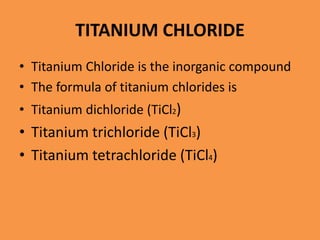
• Titanium Chloride is the inorganic compound
• The formula of titanium chlorides is
• Titanium dichloride (TiCl2)
• Titanium trichloride (TiCl3)
• Titanium tetrachloride (TiCl4)
TATINIUM (III) CHLORIDE
• Titanium(III)chloride is one of the most common
halides of titanium and is an important catalyst for
the manufacturing of polylefins
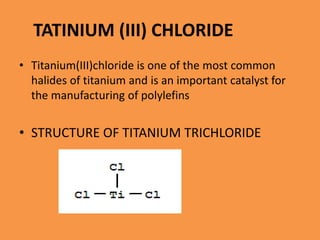
• STRUCTURE OF TITANIUM TRICHLORIDE
Synthesis of TiCl3
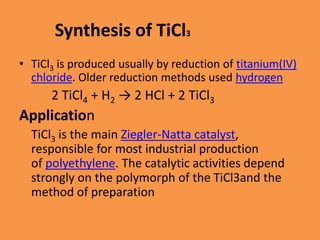
• TiCl3 is produced usually by reduction of titanium(IV)
chloride. Older reduction methods used hydrogen
2 TiCl4 + H2 → 2 HCl + 2 TiCl3
Application
TiCl3 is the main Ziegler-Natta catalyst,
responsible for most industrial production
of polyethylene. The catalytic activities depend
strongly on the polymorph of the TiCl3and the
method of preparation
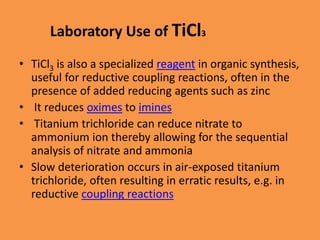
Laboratory Use of TiCl3
• TiCl3 is also a specialized reagent in organic synthesis,
useful for reductive coupling reactions, often in the
presence of added reducing agents such as zinc
• It reduces oximes to imines
• Titanium trichloride can reduce nitrate to
ammonium ion thereby allowing for the sequential
analysis of nitrate and ammonia
• Slow deterioration occurs in air-exposed titanium
trichloride, often resulting in erratic results, e.g. in
reductive coupling reactions
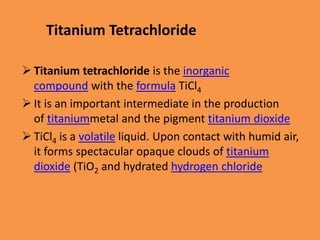
Titanium Tetrachloride
 Titanium tetrachloride is the inorganic
compound with the formula TiCl4
 It is an important intermediate in the production
of titaniummetal and the pigment titanium dioxide
 TiCl4 is a volatile liquid. Upon contact with humid air,
it forms spectacular opaque clouds of titanium
dioxide (TiO2 and hydrated hydrogen chloride
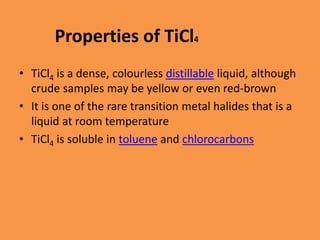
Properties of TiCl4
• TiCl4 is a dense, colourless distillable liquid, although
crude samples may be yellow or even red-brown
• It is one of the rare transition metal halides that is a
liquid at room temperature
• TiCl4 is soluble in toluene and chlorocarbons
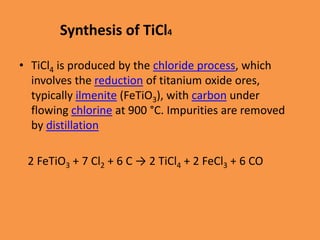
Synthesis of TiCl4
• TiCl4 is produced by the chloride process, which
involves the reduction of titanium oxide ores,
typically ilmenite (FeTiO3), with carbon under
flowing chlorine at 900 °C. Impurities are removed
by distillation
2 FeTiO3 + 7 Cl2 + 6 C → 2 TiCl4 + 2 FeCl3 + 6 CO
Applications of TiCl4
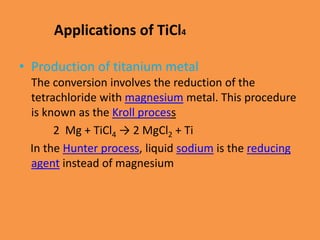
• Production of titanium metal
The conversion involves the reduction of the
tetrachloride with magnesium metal. This procedure
is known as the Kroll process
2 Mg + TiCl4 → 2 MgCl2 + Ti
In the Hunter process, liquid sodium is the reducing
agent instead of magnesium
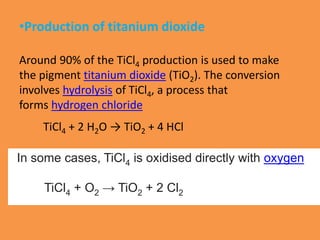
•Production of titanium dioxide
Around 90% of the TiCl4 production is used to make
the pigment titanium dioxide (TiO2). The conversion
involves hydrolysis of TiCl4, a process that
forms hydrogen chloride
TiCl4 + 2 H2O → TiO2 + 4 HCl
In some cases, TiCl4 is oxidised directly with oxygen
TiCl4 + O2 → TiO2 + 2 Cl2
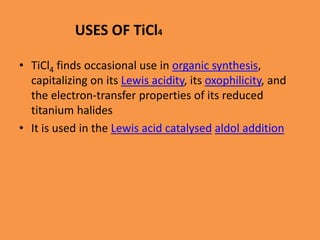
USES OF TiCl4
• TiCl4 finds occasional use in organic synthesis,
capitalizing on its Lewis acidity, its oxophilicity, and
the electron-transfer properties of its reduced
titanium halides
• It is used in the Lewis acid catalysed aldol addition
TITANIUM CHLORIDE [PHARMACEUTICAL REAGENT]

TITANIUM CHLORIDE [PHARMACEUTICAL REAGENT]

  • 1.
  • 2.
    TITANIUM CHLORIDE • TitaniumChloride is the inorganic compound • The formula of titanium chlorides is • Titanium dichloride (TiCl2) • Titanium trichloride (TiCl3) • Titanium tetrachloride (TiCl4)
  • 3.
    TATINIUM (III) CHLORIDE •Titanium(III)chloride is one of the most common halides of titanium and is an important catalyst for the manufacturing of polylefins • STRUCTURE OF TITANIUM TRICHLORIDE
  • 4.
    Synthesis of TiCl3 •TiCl3 is produced usually by reduction of titanium(IV) chloride. Older reduction methods used hydrogen 2 TiCl4 + H2 → 2 HCl + 2 TiCl3 Application TiCl3 is the main Ziegler-Natta catalyst, responsible for most industrial production of polyethylene. The catalytic activities depend strongly on the polymorph of the TiCl3and the method of preparation
  • 5.
    Laboratory Use ofTiCl3 • TiCl3 is also a specialized reagent in organic synthesis, useful for reductive coupling reactions, often in the presence of added reducing agents such as zinc • It reduces oximes to imines • Titanium trichloride can reduce nitrate to ammonium ion thereby allowing for the sequential analysis of nitrate and ammonia • Slow deterioration occurs in air-exposed titanium trichloride, often resulting in erratic results, e.g. in reductive coupling reactions
  • 6.
    Titanium Tetrachloride  Titaniumtetrachloride is the inorganic compound with the formula TiCl4  It is an important intermediate in the production of titaniummetal and the pigment titanium dioxide  TiCl4 is a volatile liquid. Upon contact with humid air, it forms spectacular opaque clouds of titanium dioxide (TiO2 and hydrated hydrogen chloride
  • 7.
    Properties of TiCl4 •TiCl4 is a dense, colourless distillable liquid, although crude samples may be yellow or even red-brown • It is one of the rare transition metal halides that is a liquid at room temperature • TiCl4 is soluble in toluene and chlorocarbons
  • 8.
    Synthesis of TiCl4 •TiCl4 is produced by the chloride process, which involves the reduction of titanium oxide ores, typically ilmenite (FeTiO3), with carbon under flowing chlorine at 900 °C. Impurities are removed by distillation 2 FeTiO3 + 7 Cl2 + 6 C → 2 TiCl4 + 2 FeCl3 + 6 CO
  • 9.
    Applications of TiCl4 •Production of titanium metal The conversion involves the reduction of the tetrachloride with magnesium metal. This procedure is known as the Kroll process 2 Mg + TiCl4 → 2 MgCl2 + Ti In the Hunter process, liquid sodium is the reducing agent instead of magnesium
  • 10.
    •Production of titaniumdioxide Around 90% of the TiCl4 production is used to make the pigment titanium dioxide (TiO2). The conversion involves hydrolysis of TiCl4, a process that forms hydrogen chloride TiCl4 + 2 H2O → TiO2 + 4 HCl In some cases, TiCl4 is oxidised directly with oxygen TiCl4 + O2 → TiO2 + 2 Cl2
  • 11.
    USES OF TiCl4 •TiCl4 finds occasional use in organic synthesis, capitalizing on its Lewis acidity, its oxophilicity, and the electron-transfer properties of its reduced titanium halides • It is used in the Lewis acid catalysed aldol addition