
1
Content
 Structure of skin
 Various problems associated with skin
 Pigmentation
 Prickly heat
 Wrinkles
 Reference
2
3
4
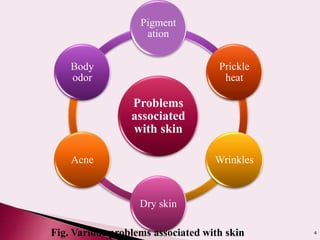
Problems
associated
with skin
Pigment
ation
Prickle
heat
Wrinkles
Dry skin
Acne
Body
odor
Fig. Various problems associated with skin
I. Pigmentation
5
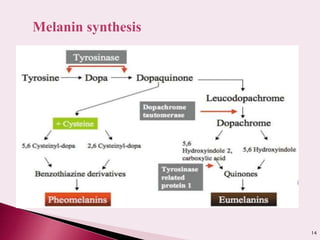
 Skin color is generally due to melanin
 Melanin is synthesized by melanocytes within
melanosome and transferred to keratinocytes.
 Human being come in a glorious spectrum of
different colors: light, dark, plain or freckly skin;
 Skin pigmentation has far reaching social and
psychological implications.
 Melanin pigmentation disorders are important for
medical and cosmetic reasons.
6
The amount and type of melanin determines a
person's skin colour – or skin pigmentation.
Pigmentation is the colouring of a person's skin.
When a person is healthy, his or her skin will appear
normal in colour.
In the case of illness or injury, the person's skin may
change colour, becoming darker (hyperpigmentation) or
lighter (hypopigmentation).
7
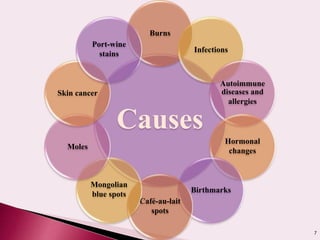
Causes
Burns
Infections
Autoimmune
diseases and
allergies
Hormonal
changes
Birthmarks
Café-au-lait
spots
Mongolian
blue spots
Moles
Skin cancer
Port-wine
stains
8
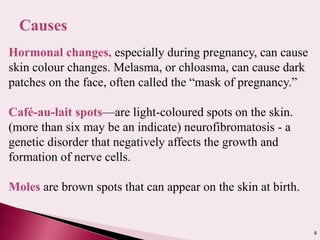
Hormonal changes, especially during pregnancy, can cause
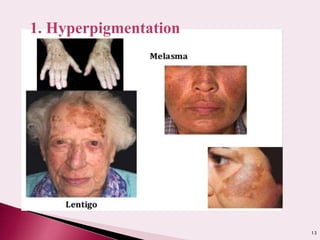
skin colour changes. Melasma, or chloasma, can cause dark
patches on the face, often called the “mask of pregnancy.”
Café-au-lait spots—are light-coloured spots on the skin.
(more than six may be an indicate) neurofibromatosis - a
genetic disorder that negatively affects the growth and
formation of nerve cells.
Moles are brown spots that can appear on the skin at birth.
Causes
9
Mongolian blue spots are bluish patches that can
appear on the backs of babies and young children,
usually of asian descent. They are harmless and often
fade over time.
Port-wine stains are a type of birthmark caused by
swollen blood vessels. They are usually flat and appear
pink or red in colour.
Skin cancer can change skin colour or texture. Your
doctor should examine moles or other rapidly changing
skin lesions.
10
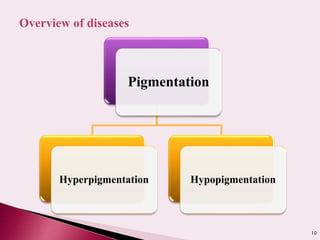
Pigmentation
Hyperpigmentation Hypopigmentation
Overview of diseases
11
1. Hyperpigmentation
 Irregular areas in which there are changes to skin
colour are much more common than you might
think.
 Often, you may have changes in the pigmentation
of a certain area of your skin due to a difference in
the level of melanin it contains.
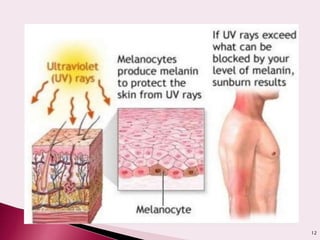
 Melanin is the substance that provides colour to
the skin and protects it from the sun.
12
13
1. Hyperpigmentation
Melanin synthesis
14
15
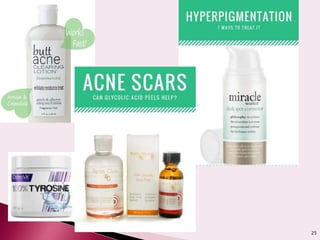
Treatment : -
Depigmentations
Depigmenting agents might act in of following ways:
By selectively destroying or decharacterizing melanocytes.
By interfering with the biosynthesis of melanin and
precursors.
By inactivating or preventing the biosynthesis of enzyme
tyrosinase.
16
By interfering with the transfer of melanin
granules to malpighian cells either by inhibiting the
phagocytosis of melanocytic dendrites or by causing
intercellular edema.
By changing the melanin present in melanosomes
from dark colored, oxidized form to light colored,
reduced form. Because of its reducing potency the
agent can cause discoloration of the pigments.
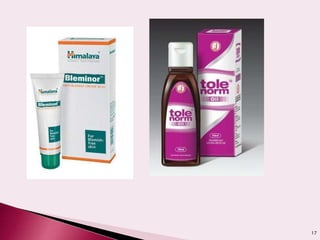
17
18
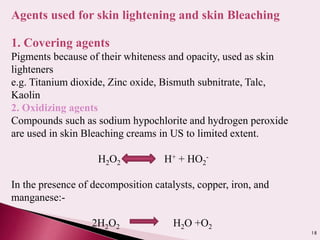
Agents used for skin lightening and skin Bleaching
1. Covering agents
Pigments because of their whiteness and opacity, used as skin
lighteners
e.g. Titanium dioxide, Zinc oxide, Bismuth subnitrate, Talc,
Kaolin
2. Oxidizing agents
Compounds such as sodium hypochlorite and hydrogen peroxide
are used in skin Bleaching creams in US to limited extent.
H2O2 H+ + HO2
-
In the presence of decomposition catalysts, copper, iron, and
manganese:-
2H2O2 H2O +O2
19
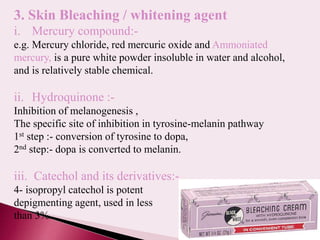
3. Skin Bleaching / whitening agent
i. Mercury compound:-
e.g. Mercury chloride, red mercuric oxide and Ammoniated
mercury, is a pure white powder insoluble in water and alcohol,
and is relatively stable chemical.
ii. Hydroquinone :-
Inhibition of melanogenesis ,
The specific site of inhibition in tyrosine-melanin pathway
1st step :- conversion of tyrosine to dopa,
2nd step:- dopa is converted to melanin.
iii. Catechol and its derivatives:-
4- isopropyl catechol is potent
depigmenting agent, used in less
than 3%.
20
iv. Ascorbic acid and its derivatives:-
e.g. ascorbyl oleate.
v. Oxidizing agents:-
e.g. Hydrogen peroxide, zinc peroxide.
vi. Kojic acid is produce by microbial fermentation using
aspergillus spp. which inhibit formation of melanin.
vii. Opaque covering agents
e.g. Titanium dioxide, zinc oxide, talc, kaolin, bismuth pigments are
use for temporary change in skin color.
vi. Other whitening agents:-
e.g. Arbutin, ellagic acid
21
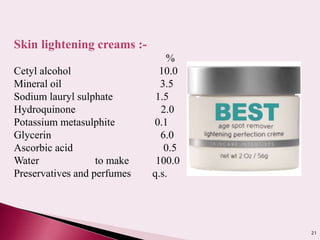
Skin lightening creams :-
%
Cetyl alcohol 10.0
Mineral oil 3.5
Sodium lauryl sulphate 1.5
Hydroquinone 2.0
Potassium metasulphite 0.1
Glycerin 6.0
Ascorbic acid 0.5
Water to make 100.0
Preservatives and perfumes q.s.
22
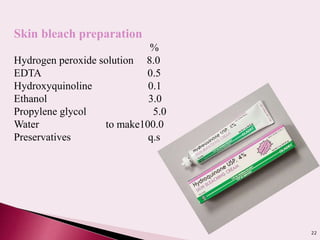
Skin bleach preparation
%
Hydrogen peroxide solution 8.0
EDTA 0.5
Hydroxyquinoline 0.1
Ethanol 3.0
Propylene glycol 5.0
Water to make100.0
Preservatives q.s
23
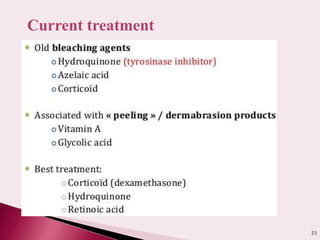
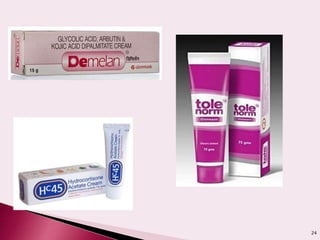
Current treatment
24
25
26
2. Hypopigmentation disorder
Hypopigmentation, the absence of normal amounts
of melanin (the chemical that gives skin its colour),
is almost as common.
Causes:-
Improperly administered skin resurfacing treatments,
such as Photo facials, laser peels, or chemical peels
can also cause skin damage that result in
hypopigmentation.
27
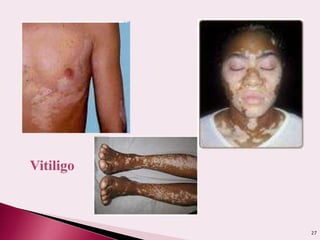
Vitiligo
28
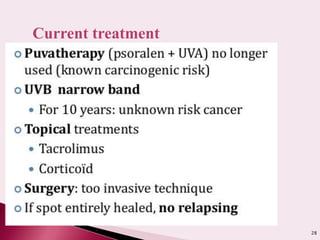
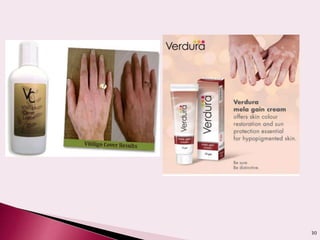
Current treatment
29
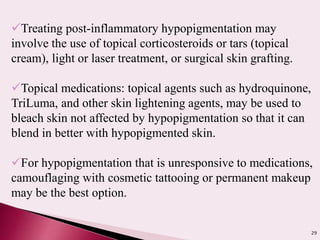
Treating post-inflammatory hypopigmentation may
involve the use of topical corticosteroids or tars (topical
cream), light or laser treatment, or surgical skin grafting.
Topical medications: topical agents such as hydroquinone,
TriLuma, and other skin lightening agents, may be used to
bleach skin not affected by hypopigmentation so that it can
blend in better with hypopigmented skin.
For hypopigmentation that is unresponsive to medications,
camouflaging with cosmetic tattooing or permanent makeup
may be the best option.
30
31
32
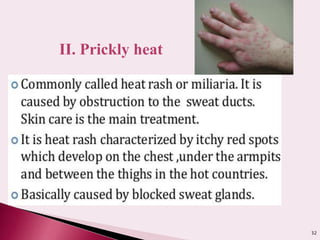
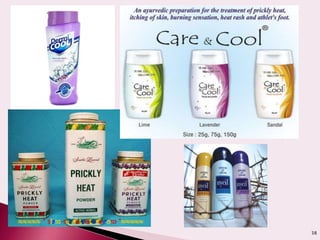
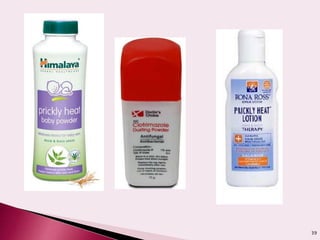
II. Prickly heat
33
34
35
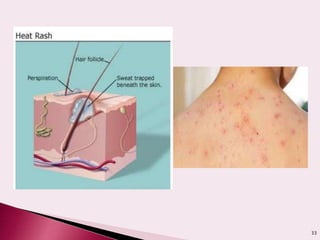
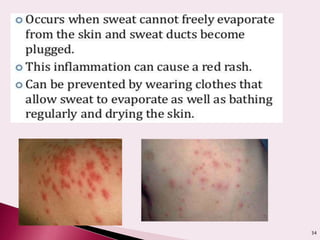
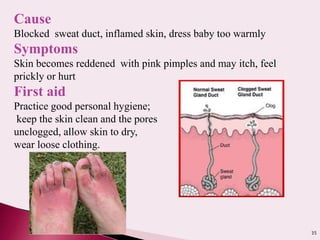
Cause
Blocked sweat duct, inflamed skin, dress baby too warmly
Symptoms
Skin becomes reddened with pink pimples and may itch, feel
prickly or hurt
First aid
Practice good personal hygiene;
keep the skin clean and the pores
unclogged, allow skin to dry,
wear loose clothing.
36
Prevention
37
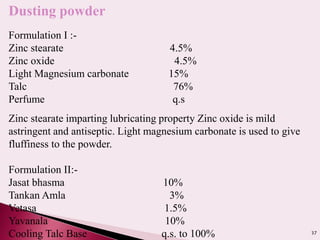
Dusting powder
Formulation I :-
Zinc stearate 4.5%
Zinc oxide 4.5%
Light Magnesium carbonate 15%
Talc 76%
Perfume q.s
Zinc stearate imparting lubricating property Zinc oxide is mild
astringent and antiseptic. Light magnesium carbonate is used to give
fluffiness to the powder.
Formulation II:-
Jasat bhasma 10%
Tankan Amla 3%
Vetasa 1.5%
Yavanala 10%
Cooling Talc Base q.s. to 100%
38
39
40
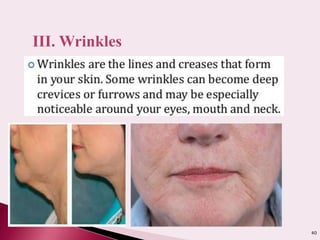
III. Wrinkles
41
Formation of Wrinkles:-
Alteration of collagen and clastin that correlated with
wrinkled skin.
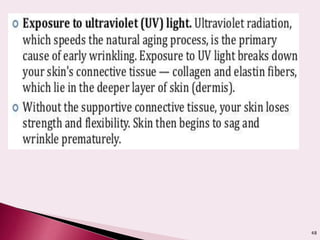
It has been shown recently that within minutes of
suberythrogenic ultra violet B(UVB) expose, that induce
in human skin of matrix degrading metalo proteinase
messenger RNA,
Their translated proteins and consequent activity form
complexes
42
And involving signal transduction, transcription
factors and cytokine release,
Repetative UVR by chronic production of
matrix damage which leads to scars and
wrinkles formation
43
44
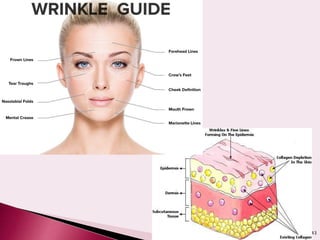
Classification of wrinkles
1. Linear wrinkles :-
Commonly called crow’s feets around the outer corners of
the eye.
2. Glyphic wrinkles:-
Crisscrossing triangular or rectangular wrinkles
commonly seeing on the cheeks and nape of neck.
3. Crinkling :-
Fine wrinkles commonly seeing on the unexposed skin of
elderly peoples.
45
46
Causes
47
48
49
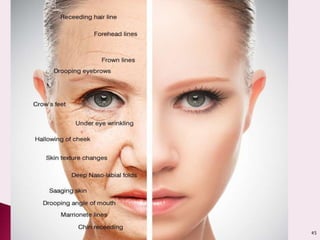
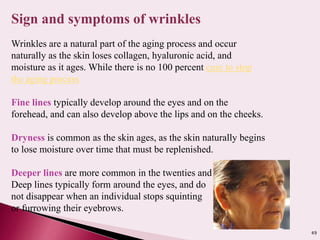
Sign and symptoms of wrinkles
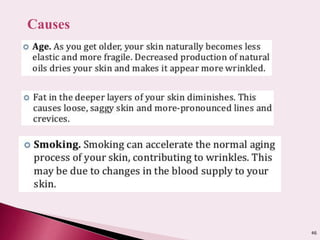
Wrinkles are a natural part of the aging process and occur
naturally as the skin loses collagen, hyaluronic acid, and
moisture as it ages. While there is no 100 percent cure to stop
the aging process
Fine lines typically develop around the eyes and on the
forehead, and can also develop above the lips and on the cheeks.
Dryness is common as the skin ages, as the skin naturally begins
to lose moisture over time that must be replenished.
Deeper lines are more common in the twenties and thirties.
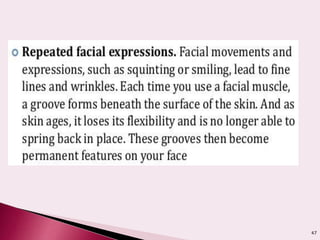
Deep lines typically form around the eyes, and do
not disappear when an individual stops squinting
or furrowing their eyebrows.
50
Treatment
 Topical retinoids. From vitamin A, retinoids –
such as tretinoin (Renova, Retin - A) and
tazarotene (Avage, Tazorac) - that you apply to
your skin may reduce fine wrinkles, splotches and
skin roughness.
 Because retinoids can make your skin burn
more easily, you’ll need to use a broad- spectrum
sunscreen and wear protective clothing daily.
Retinoids may cause redness, dryness, itching,
and a burning or tingling sensation.
51
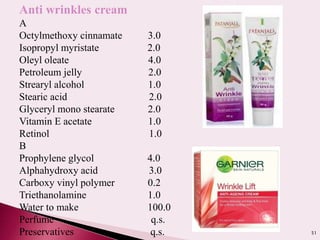
Anti wrinkles cream
A
Octylmethoxy cinnamate 3.0
Isopropyl myristate 2.0
Oleyl oleate 4.0
Petroleum jelly 2.0
Strearyl alcohol 1.0
Stearic acid 2.0
Glyceryl mono stearate 2.0
Vitamin E acetate 1.0
Retinol 1.0
B
Prophylene glycol 4.0
Alphahydroxy acid 3.0
Carboxy vinyl polymer 0.2
Triethanolamine 1.0
Water to make 100.0
Perfume q.s.
Preservatives q.s.
52
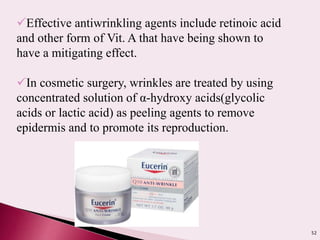
Effective antiwrinkling agents include retinoic acid
and other form of Vit. A that have being shown to
have a mitigating effect.
In cosmetic surgery, wrinkles are treated by using
concentrated solution of α-hydroxy acids(glycolic
acids or lactic acid) as peeling agents to remove
epidermis and to promote its reproduction.
53
54
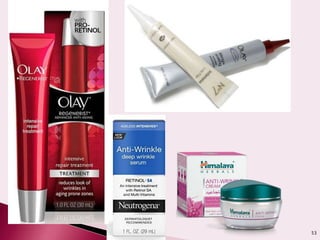
 Nonprescription wrinkle cream, The
effectiveness of anti-wrinkle cream depends in
part on the active ingredients. Retinol,
antioxidants and some peptide may result in slight
to modest improvements in wrinkles.
 With nonprescription wrinkle creams, your
results, if any, are limited and usually short-lived
because these creams contain less of the active
ingredients than do prescription creams.
55
56

problems associated with skin[ as per Pharmaceutics]

  • 1.
  • 2.
    Content  Structure ofskin  Various problems associated with skin  Pigmentation  Prickly heat  Wrinkles  Reference 2
  • 3.
  • 4.
  • 5.
    I. Pigmentation 5  Skincolor is generally due to melanin  Melanin is synthesized by melanocytes within melanosome and transferred to keratinocytes.  Human being come in a glorious spectrum of different colors: light, dark, plain or freckly skin;  Skin pigmentation has far reaching social and psychological implications.  Melanin pigmentation disorders are important for medical and cosmetic reasons.
  • 6.
    6 The amount andtype of melanin determines a person's skin colour – or skin pigmentation. Pigmentation is the colouring of a person's skin. When a person is healthy, his or her skin will appear normal in colour. In the case of illness or injury, the person's skin may change colour, becoming darker (hyperpigmentation) or lighter (hypopigmentation).
  • 7.
  • 8.
    8 Hormonal changes, especiallyduring pregnancy, can cause skin colour changes. Melasma, or chloasma, can cause dark patches on the face, often called the “mask of pregnancy.” Café-au-lait spots—are light-coloured spots on the skin. (more than six may be an indicate) neurofibromatosis - a genetic disorder that negatively affects the growth and formation of nerve cells. Moles are brown spots that can appear on the skin at birth. Causes
  • 9.
    9 Mongolian blue spotsare bluish patches that can appear on the backs of babies and young children, usually of asian descent. They are harmless and often fade over time. Port-wine stains are a type of birthmark caused by swollen blood vessels. They are usually flat and appear pink or red in colour. Skin cancer can change skin colour or texture. Your doctor should examine moles or other rapidly changing skin lesions.
  • 10.
  • 11.
    11 1. Hyperpigmentation  Irregularareas in which there are changes to skin colour are much more common than you might think.  Often, you may have changes in the pigmentation of a certain area of your skin due to a difference in the level of melanin it contains.  Melanin is the substance that provides colour to the skin and protects it from the sun.
  • 12.
  • 13.
  • 14.
  • 15.
    15 Treatment : - Depigmentations Depigmentingagents might act in of following ways: By selectively destroying or decharacterizing melanocytes. By interfering with the biosynthesis of melanin and precursors. By inactivating or preventing the biosynthesis of enzyme tyrosinase.
  • 16.
    16 By interfering withthe transfer of melanin granules to malpighian cells either by inhibiting the phagocytosis of melanocytic dendrites or by causing intercellular edema. By changing the melanin present in melanosomes from dark colored, oxidized form to light colored, reduced form. Because of its reducing potency the agent can cause discoloration of the pigments.
  • 17.
  • 18.
    18 Agents used forskin lightening and skin Bleaching 1. Covering agents Pigments because of their whiteness and opacity, used as skin lighteners e.g. Titanium dioxide, Zinc oxide, Bismuth subnitrate, Talc, Kaolin 2. Oxidizing agents Compounds such as sodium hypochlorite and hydrogen peroxide are used in skin Bleaching creams in US to limited extent. H2O2 H+ + HO2 - In the presence of decomposition catalysts, copper, iron, and manganese:- 2H2O2 H2O +O2
  • 19.
    19 3. Skin Bleaching/ whitening agent i. Mercury compound:- e.g. Mercury chloride, red mercuric oxide and Ammoniated mercury, is a pure white powder insoluble in water and alcohol, and is relatively stable chemical. ii. Hydroquinone :- Inhibition of melanogenesis , The specific site of inhibition in tyrosine-melanin pathway 1st step :- conversion of tyrosine to dopa, 2nd step:- dopa is converted to melanin. iii. Catechol and its derivatives:- 4- isopropyl catechol is potent depigmenting agent, used in less than 3%.
  • 20.
    20 iv. Ascorbic acidand its derivatives:- e.g. ascorbyl oleate. v. Oxidizing agents:- e.g. Hydrogen peroxide, zinc peroxide. vi. Kojic acid is produce by microbial fermentation using aspergillus spp. which inhibit formation of melanin. vii. Opaque covering agents e.g. Titanium dioxide, zinc oxide, talc, kaolin, bismuth pigments are use for temporary change in skin color. vi. Other whitening agents:- e.g. Arbutin, ellagic acid
  • 21.
    21 Skin lightening creams:- % Cetyl alcohol 10.0 Mineral oil 3.5 Sodium lauryl sulphate 1.5 Hydroquinone 2.0 Potassium metasulphite 0.1 Glycerin 6.0 Ascorbic acid 0.5 Water to make 100.0 Preservatives and perfumes q.s.
  • 22.
    22 Skin bleach preparation % Hydrogenperoxide solution 8.0 EDTA 0.5 Hydroxyquinoline 0.1 Ethanol 3.0 Propylene glycol 5.0 Water to make100.0 Preservatives q.s
  • 23.
  • 24.
  • 25.
  • 26.
    26 2. Hypopigmentation disorder Hypopigmentation,the absence of normal amounts of melanin (the chemical that gives skin its colour), is almost as common. Causes:- Improperly administered skin resurfacing treatments, such as Photo facials, laser peels, or chemical peels can also cause skin damage that result in hypopigmentation.
  • 27.
  • 28.
  • 29.
    29 Treating post-inflammatory hypopigmentationmay involve the use of topical corticosteroids or tars (topical cream), light or laser treatment, or surgical skin grafting. Topical medications: topical agents such as hydroquinone, TriLuma, and other skin lightening agents, may be used to bleach skin not affected by hypopigmentation so that it can blend in better with hypopigmented skin. For hypopigmentation that is unresponsive to medications, camouflaging with cosmetic tattooing or permanent makeup may be the best option.
  • 30.
  • 31.
  • 32.
  • 33.
  • 34.
  • 35.
    35 Cause Blocked sweat duct,inflamed skin, dress baby too warmly Symptoms Skin becomes reddened with pink pimples and may itch, feel prickly or hurt First aid Practice good personal hygiene; keep the skin clean and the pores unclogged, allow skin to dry, wear loose clothing.
  • 36.
  • 37.
    37 Dusting powder Formulation I:- Zinc stearate 4.5% Zinc oxide 4.5% Light Magnesium carbonate 15% Talc 76% Perfume q.s Zinc stearate imparting lubricating property Zinc oxide is mild astringent and antiseptic. Light magnesium carbonate is used to give fluffiness to the powder. Formulation II:- Jasat bhasma 10% Tankan Amla 3% Vetasa 1.5% Yavanala 10% Cooling Talc Base q.s. to 100%
  • 38.
  • 39.
  • 40.
  • 41.
    41 Formation of Wrinkles:- Alterationof collagen and clastin that correlated with wrinkled skin. It has been shown recently that within minutes of suberythrogenic ultra violet B(UVB) expose, that induce in human skin of matrix degrading metalo proteinase messenger RNA, Their translated proteins and consequent activity form complexes
  • 42.
    42 And involving signaltransduction, transcription factors and cytokine release, Repetative UVR by chronic production of matrix damage which leads to scars and wrinkles formation
  • 43.
  • 44.
    44 Classification of wrinkles 1.Linear wrinkles :- Commonly called crow’s feets around the outer corners of the eye. 2. Glyphic wrinkles:- Crisscrossing triangular or rectangular wrinkles commonly seeing on the cheeks and nape of neck. 3. Crinkling :- Fine wrinkles commonly seeing on the unexposed skin of elderly peoples.
  • 45.
  • 46.
  • 47.
  • 48.
  • 49.
    49 Sign and symptomsof wrinkles Wrinkles are a natural part of the aging process and occur naturally as the skin loses collagen, hyaluronic acid, and moisture as it ages. While there is no 100 percent cure to stop the aging process Fine lines typically develop around the eyes and on the forehead, and can also develop above the lips and on the cheeks. Dryness is common as the skin ages, as the skin naturally begins to lose moisture over time that must be replenished. Deeper lines are more common in the twenties and thirties. Deep lines typically form around the eyes, and do not disappear when an individual stops squinting or furrowing their eyebrows.
  • 50.
    50 Treatment  Topical retinoids.From vitamin A, retinoids – such as tretinoin (Renova, Retin - A) and tazarotene (Avage, Tazorac) - that you apply to your skin may reduce fine wrinkles, splotches and skin roughness.  Because retinoids can make your skin burn more easily, you’ll need to use a broad- spectrum sunscreen and wear protective clothing daily. Retinoids may cause redness, dryness, itching, and a burning or tingling sensation.
  • 51.
    51 Anti wrinkles cream A Octylmethoxycinnamate 3.0 Isopropyl myristate 2.0 Oleyl oleate 4.0 Petroleum jelly 2.0 Strearyl alcohol 1.0 Stearic acid 2.0 Glyceryl mono stearate 2.0 Vitamin E acetate 1.0 Retinol 1.0 B Prophylene glycol 4.0 Alphahydroxy acid 3.0 Carboxy vinyl polymer 0.2 Triethanolamine 1.0 Water to make 100.0 Perfume q.s. Preservatives q.s.
  • 52.
    52 Effective antiwrinkling agentsinclude retinoic acid and other form of Vit. A that have being shown to have a mitigating effect. In cosmetic surgery, wrinkles are treated by using concentrated solution of α-hydroxy acids(glycolic acids or lactic acid) as peeling agents to remove epidermis and to promote its reproduction.
  • 53.
  • 54.
    54  Nonprescription wrinklecream, The effectiveness of anti-wrinkle cream depends in part on the active ingredients. Retinol, antioxidants and some peptide may result in slight to modest improvements in wrinkles.  With nonprescription wrinkle creams, your results, if any, are limited and usually short-lived because these creams contain less of the active ingredients than do prescription creams.
  • 55.
  • 56.