CHEMISRTY
PROJECT
⋆
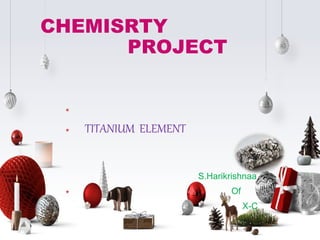
⋆ TITANIUM ELEMENT
S.Harikrishnaa
⋆ Of
X-C
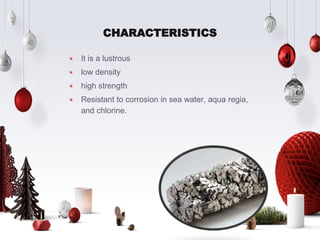
CHARACTERISTICS
⋆ It is a lustrous
⋆ low density
⋆ high strength
⋆ Resistant to corrosion in sea water, aqua regia,
and chlorine.
TITANIUM
⋆ Titanium was discovered in Cornwall, Great Britain, by William Gregor in
1791.
⋆ Titanium (Ti), chemical element, a silvery gray metal of Group 4 (IVb) of the
periodic table.
⋆ Titanium is a chemical element with the symbol-Ti and atomic number 22.
⋆ Melting point: 1,668 °C
⋆ Boiling point: 3,287 °C
PRODUCTION
⋆ Although titanium is the fourth most common metal element in the earth's
crust (behind aluminum, iron, and magnesium), the production of titanium
metal is extremely sensitive to contamination, particularly by oxygen, which
accounts for its relatively recent development and high cost
USES:-
⋆ Titanium is as strong as steel but much less
dense. It is therefore important as an
alloying agent with many metals including
aluminium, molybdenum and iron
⋆ These alloys are mainly used in aircraft,
spacecraft and missiles because of their low
density and ability to withstand extremes of
temperature.
⋆ About 65 percent of all titanium sold is used
in aerospace applications.
⋆ They are also used in golf clubs, laptops,
bicycles and crutches.
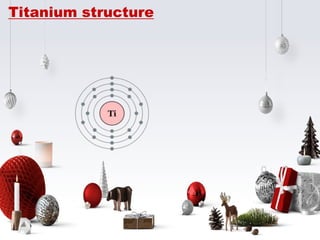
Titanium structure
⋆ Like aluminium and magnesium, titanium metal and its alloys
oxidize immediately upon exposure to air.
⋆ Titanium readily reacts with oxygen at 1,200 °C (2,190 °F) in
air, and at 610 °C (1,130 °F) in pure oxygen, forming titanium
dioxide.
PHYSICAL PROPERTIES:-
⋆ It is a strong metal with low density,that is quite ductile
⋆ Titanium is not as hard as some grades of heat-treated steel.
⋆ it is non-magnetic and a poor conductor of heat and electricity.
Chemical properties
Occurrence
⋆ Titanium is a very common element.
⋆ It is the ninth most abundant element in the Earth's
crust.
⋆ Its abundance is estimated to be about 0.63 percent.
⋆ That places titanium just above hydrogen and just
below potassium among elements present in the earth.
⋆ It is present as oxides in most igneous rocks
⋆ The most common mineral sources of titanium are
ilmenite, rutile, and titanite. Titanium is also obtained
from iron ore slags. Slag is an earthy material that
floats to the top when iron is removed from iron ore.
PROPERTIES
⋆ Titanium exists in two allotropic forms, one of which is a dark gray,
shiny metal. The other allotrope is a dark gray amorphous powder.
⋆ Titanium tends to be brittle, although it becomes malleable and
ductile at higher temperatures. Chemically, titanium is relatively
inactive.
⋆ At moderate temperatures, it resists attack by oxygen, most acids,
chlorine, and other corrosive agents.
⋆ Aerospace applications account for 80% of titanium consumption,
while 20% of the metal is used in armor, medical hardware, and
consumer goods.
ADVANTAGE:-
⋆ One of the most notable advantages of titanium is
its strength.
⋆ It is the strongest and most durable metals on the
planet,which is why it's used in so many industrial
applications.
DISADVANTAGE:-
⋆ Titanium metal is considered to be non-toxic.
⋆ As metal shavings, or powder, it is a considerable
fire hazard.
⋆ Titanium chlorides are corrosive.
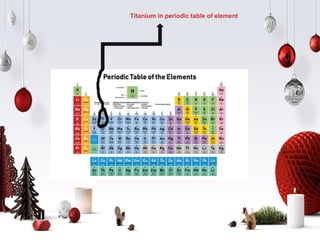
Titanium in periodic table of element
Chemistry project

Chemistry project

  • 1.
  • 2.
    CHARACTERISTICS ⋆ It isa lustrous ⋆ low density ⋆ high strength ⋆ Resistant to corrosion in sea water, aqua regia, and chlorine.
  • 3.
    TITANIUM ⋆ Titanium wasdiscovered in Cornwall, Great Britain, by William Gregor in 1791. ⋆ Titanium (Ti), chemical element, a silvery gray metal of Group 4 (IVb) of the periodic table. ⋆ Titanium is a chemical element with the symbol-Ti and atomic number 22. ⋆ Melting point: 1,668 °C ⋆ Boiling point: 3,287 °C PRODUCTION ⋆ Although titanium is the fourth most common metal element in the earth's crust (behind aluminum, iron, and magnesium), the production of titanium metal is extremely sensitive to contamination, particularly by oxygen, which accounts for its relatively recent development and high cost
  • 4.
    USES:- ⋆ Titanium isas strong as steel but much less dense. It is therefore important as an alloying agent with many metals including aluminium, molybdenum and iron ⋆ These alloys are mainly used in aircraft, spacecraft and missiles because of their low density and ability to withstand extremes of temperature. ⋆ About 65 percent of all titanium sold is used in aerospace applications. ⋆ They are also used in golf clubs, laptops, bicycles and crutches.
  • 5.
  • 6.
    ⋆ Like aluminiumand magnesium, titanium metal and its alloys oxidize immediately upon exposure to air. ⋆ Titanium readily reacts with oxygen at 1,200 °C (2,190 °F) in air, and at 610 °C (1,130 °F) in pure oxygen, forming titanium dioxide. PHYSICAL PROPERTIES:- ⋆ It is a strong metal with low density,that is quite ductile ⋆ Titanium is not as hard as some grades of heat-treated steel. ⋆ it is non-magnetic and a poor conductor of heat and electricity. Chemical properties
  • 7.
    Occurrence ⋆ Titanium isa very common element. ⋆ It is the ninth most abundant element in the Earth's crust. ⋆ Its abundance is estimated to be about 0.63 percent. ⋆ That places titanium just above hydrogen and just below potassium among elements present in the earth. ⋆ It is present as oxides in most igneous rocks ⋆ The most common mineral sources of titanium are ilmenite, rutile, and titanite. Titanium is also obtained from iron ore slags. Slag is an earthy material that floats to the top when iron is removed from iron ore.
  • 8.
    PROPERTIES ⋆ Titanium existsin two allotropic forms, one of which is a dark gray, shiny metal. The other allotrope is a dark gray amorphous powder. ⋆ Titanium tends to be brittle, although it becomes malleable and ductile at higher temperatures. Chemically, titanium is relatively inactive. ⋆ At moderate temperatures, it resists attack by oxygen, most acids, chlorine, and other corrosive agents. ⋆ Aerospace applications account for 80% of titanium consumption, while 20% of the metal is used in armor, medical hardware, and consumer goods.
  • 9.
    ADVANTAGE:- ⋆ One ofthe most notable advantages of titanium is its strength. ⋆ It is the strongest and most durable metals on the planet,which is why it's used in so many industrial applications. DISADVANTAGE:- ⋆ Titanium metal is considered to be non-toxic. ⋆ As metal shavings, or powder, it is a considerable fire hazard. ⋆ Titanium chlorides are corrosive.
  • 10.
    Titanium in periodictable of element