EXTRACTION OF TITANIUM
Presented by:-
•S Pavanchand-1012107916
•G Rajkumar-1012107917
•K Ram prasad-1012107918
•V Ravikumar babu-1012107919
•B Sai-1012107920
•Ch Sai-1012107921
•K Salman royal-1012107922
•D Sampath-1012107923
DETAILS ABOUT TITANIUM
•Atomic Number-22
•Atomic Weight-47.90 amu
•Density-4.54 gm/cm3
•Melting point-1668°C
•Boiling point-3260 °C
•Titanium is a allotropic metal HCP structure upto 882
COMMON MINERALS OF TITANIUM
•Rutile-TiO2
•Ilimenite-FeO.TiO2
Sources of titanium in india
•Tuticorin(tamilnadu)
•Kerala
Reduction of TiO2
•Thermodynamic calculations indicate reduction by
•Carbon leads to formation of brittle carbide
•Mg leads to contamination with TiN and TiH
•Alkali reduction only at high temperature
•Halide route preferable
•TiO2
electrolysis with Cryolite + NaCl bath produces powdered and
heavily contaminated Ti
Upgradation/Concentration of Ilmenite
•Upgradation of Titania to about 90% (sysnthetic rutile)
• Ilmenite contains titania and iron oxide which can not be removed by
physical beneficiation methods
•Removal by
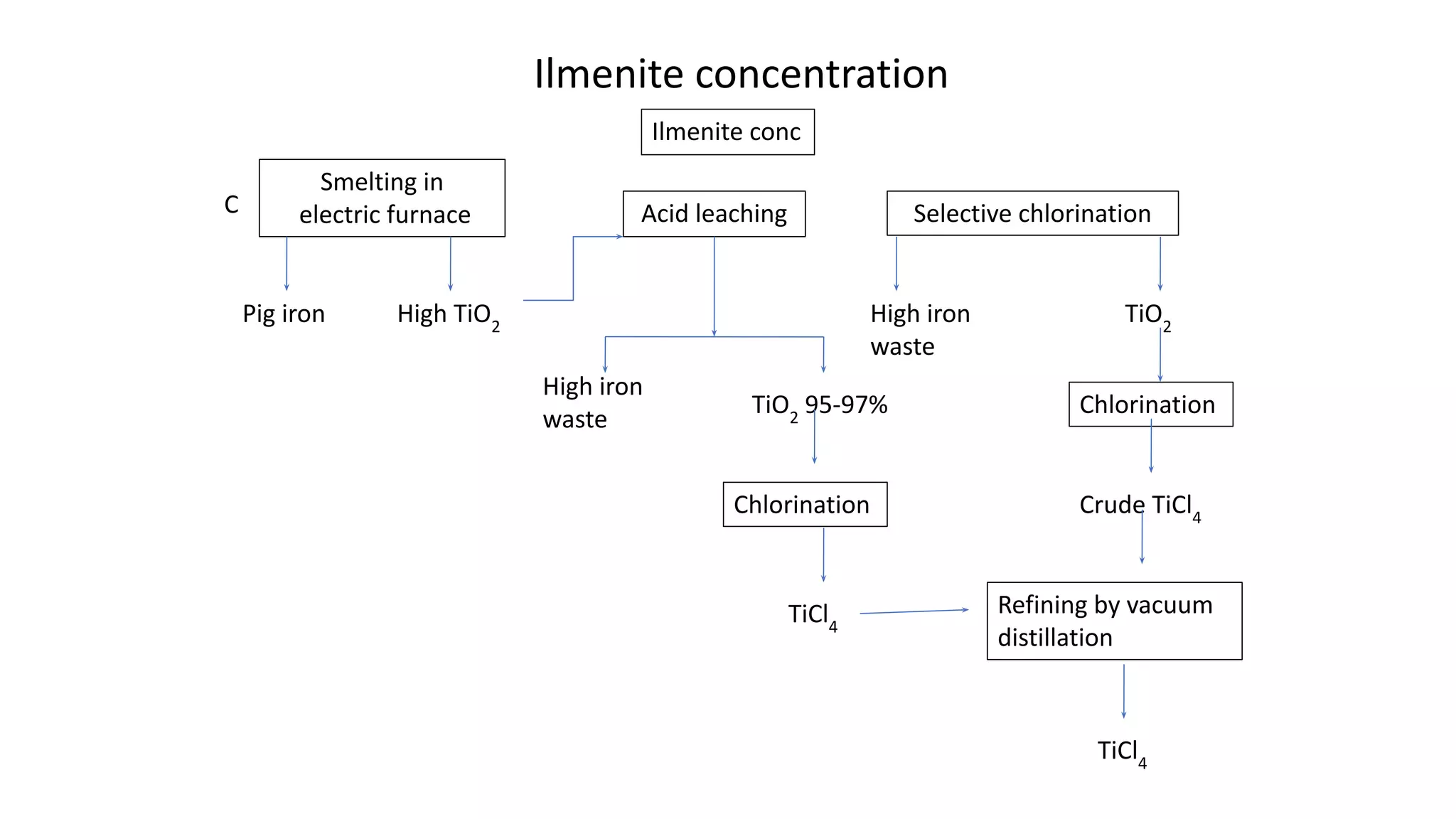
Ilmenite concentration
Ilmenite conc
Smelting in
electric furnace Acid leaching Selective chlorination
Pig iron High TiO2
TiO2
95-97%
High iron
waste
Chlorination
TiCl4
High iron
waste
TiO2
Chlorination
Crude TiCl4
Refining by vacuum
distillation
TiCl4
C
Upgradation/Concentration of Ilmenite
•Reduction smelting of Ilmenite with Carbon
• Pig Iron + TiO2
• Titania is subjected to acid treatment
•Direct leaching of Ilmenite with acids like HCl / H2
SO4
• high pressures leads to preferential dissolution of Iron
•Magnetic removal of Iron at 1200o
C by using NaCl or Na2
CO3
•Selective dissolution of Iron Oxide to produce Iron Halides (Cl, Br, HCl)
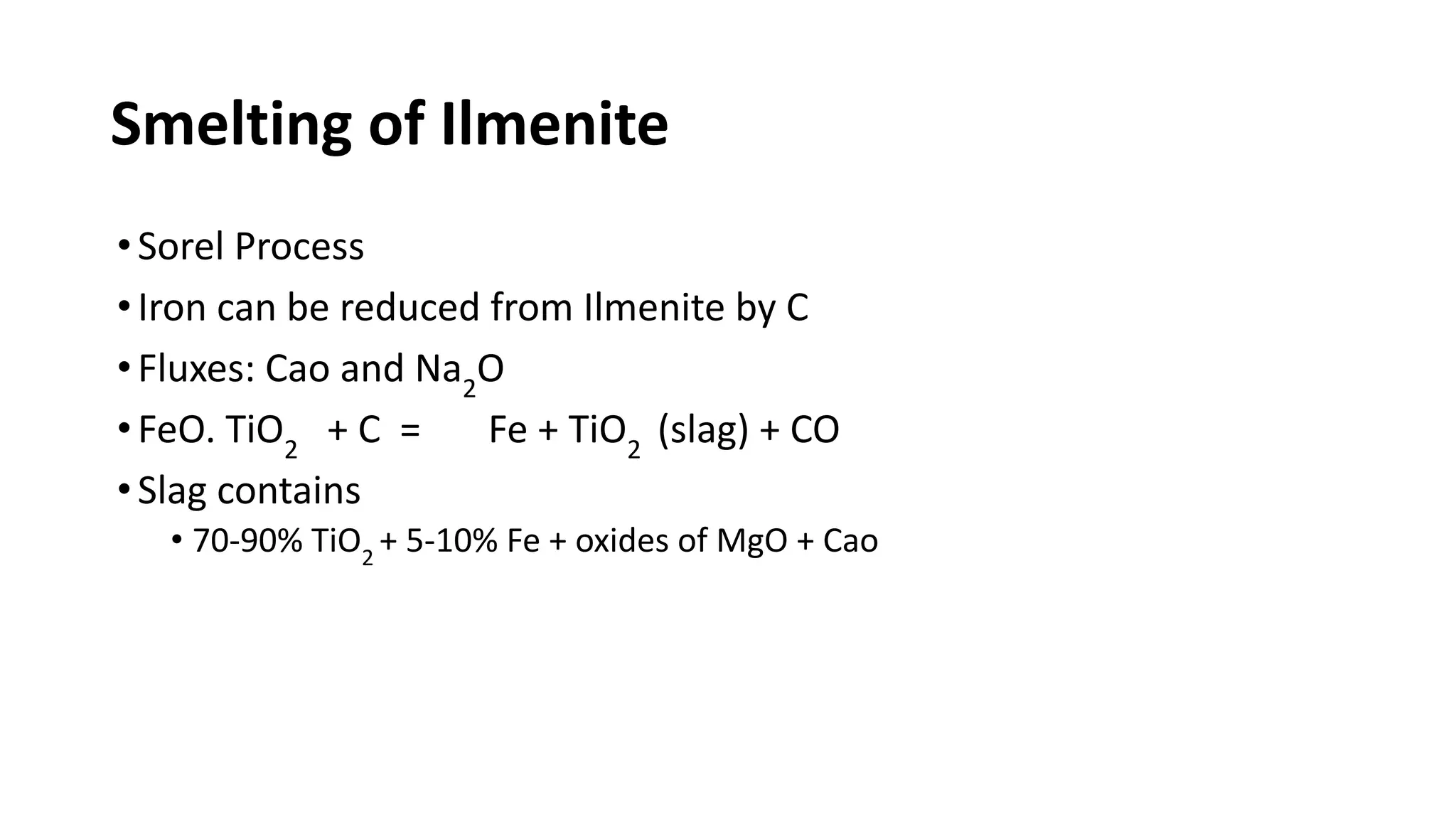
Smelting of Ilmenite
•Sorel Process
•Iron can be reduced from Ilmenite by C
•Fluxes: Cao and Na2
O
•FeO. TiO2
+ C = Fe + TiO2
(slag) + CO
•Slag contains
• 70-90% TiO2
+ 5-10% Fe + oxides of MgO + Cao
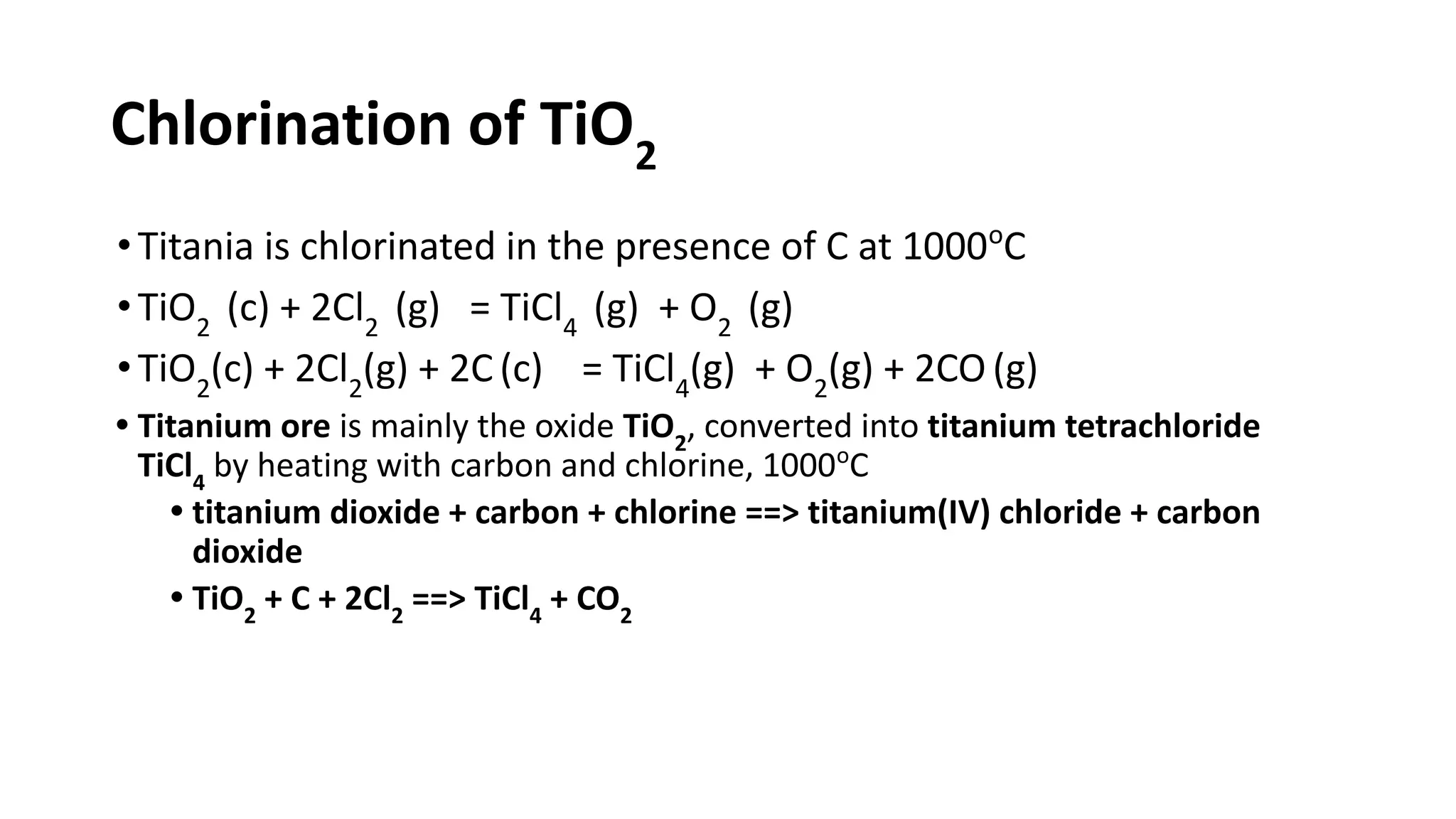
Chlorination of TiO2
•Titania is chlorinated in the presence of C at 1000o
C
•TiO2
(c) + 2Cl2
(g) = TiCl4
(g) + O2
(g)
•TiO2
(c) + 2Cl2
(g) + 2C (c) = TiCl4
(g) + O2
(g) + 2CO (g)
• Titanium ore is mainly the oxide TiO2
, converted into titanium tetrachloride
TiCl4
by heating with carbon and chlorine, 1000o
C
• titanium dioxide + carbon + chlorine ==> titanium(IV) chloride + carbon
dioxide
• TiO2
+ C + 2Cl2
==> TiCl4
+ CO2
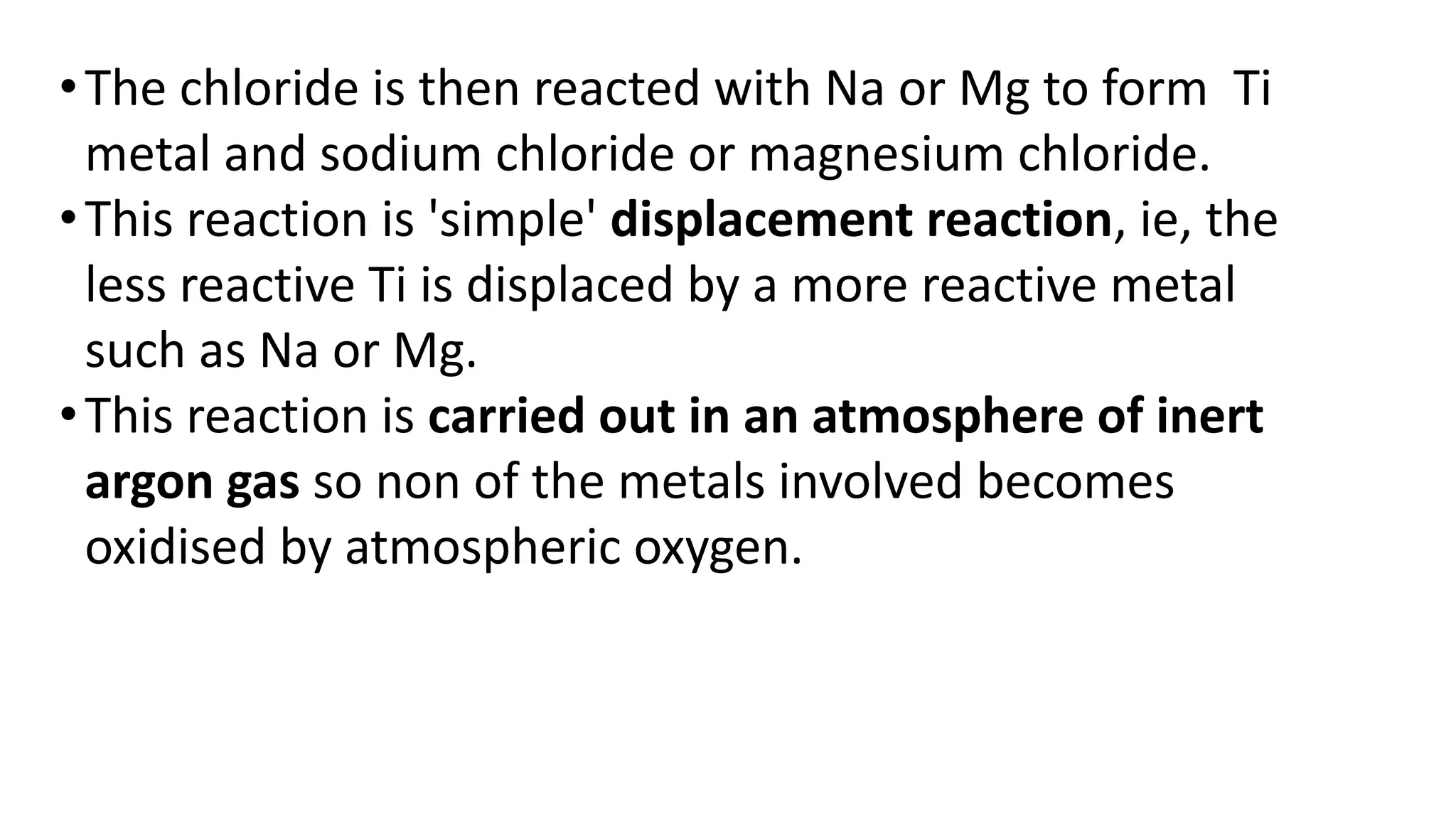
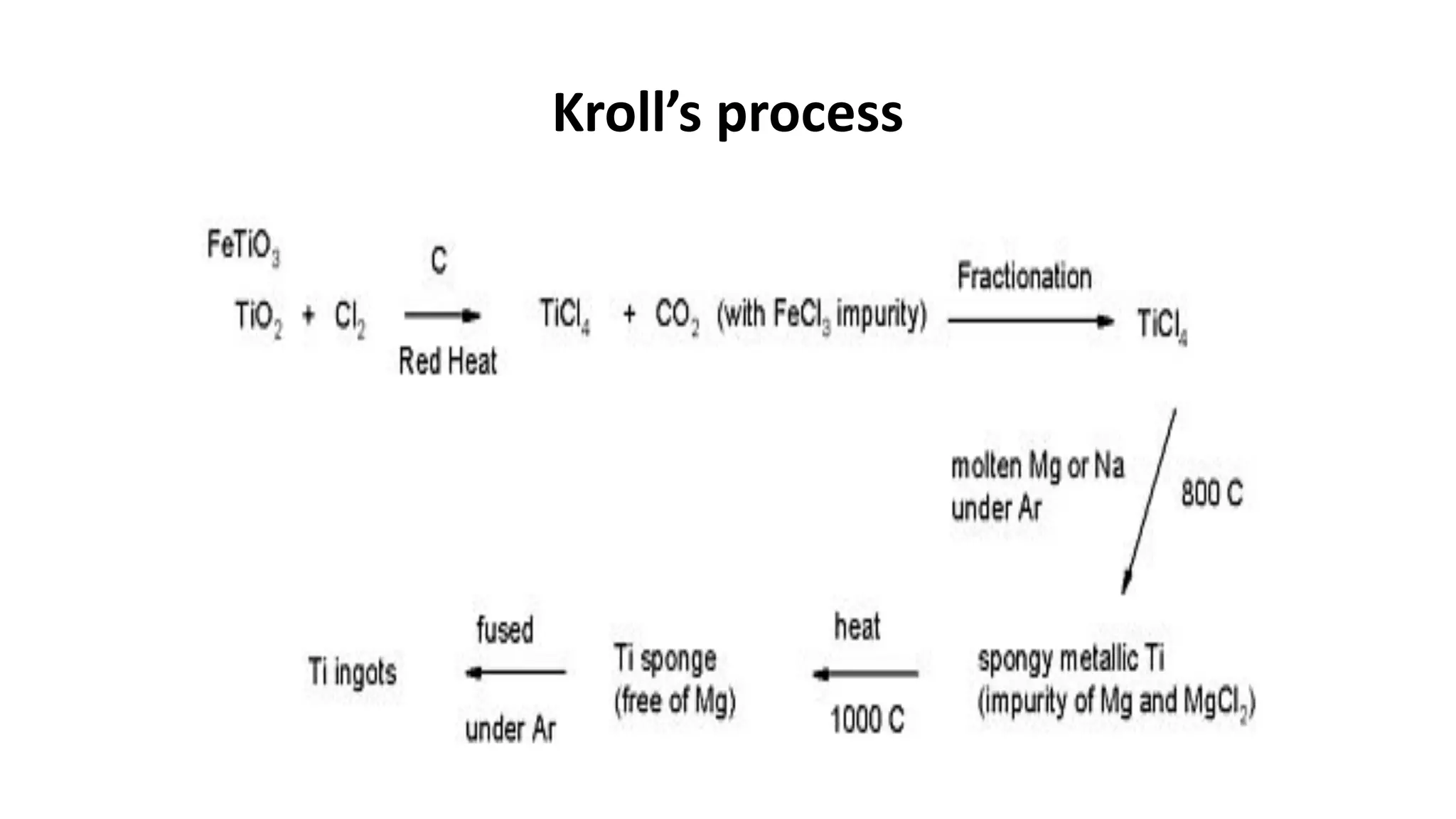
•The chloride is then reacted with Na or Mg to form Ti
metal and sodium chloride or magnesium chloride.
•This reaction is 'simple' displacement reaction, ie, the
less reactive Ti is displaced by a more reactive metal
such as Na or Mg.
•This reaction is carried out in an atmosphere of inert
argon gas so non of the metals involved becomes
oxidised by atmospheric oxygen.
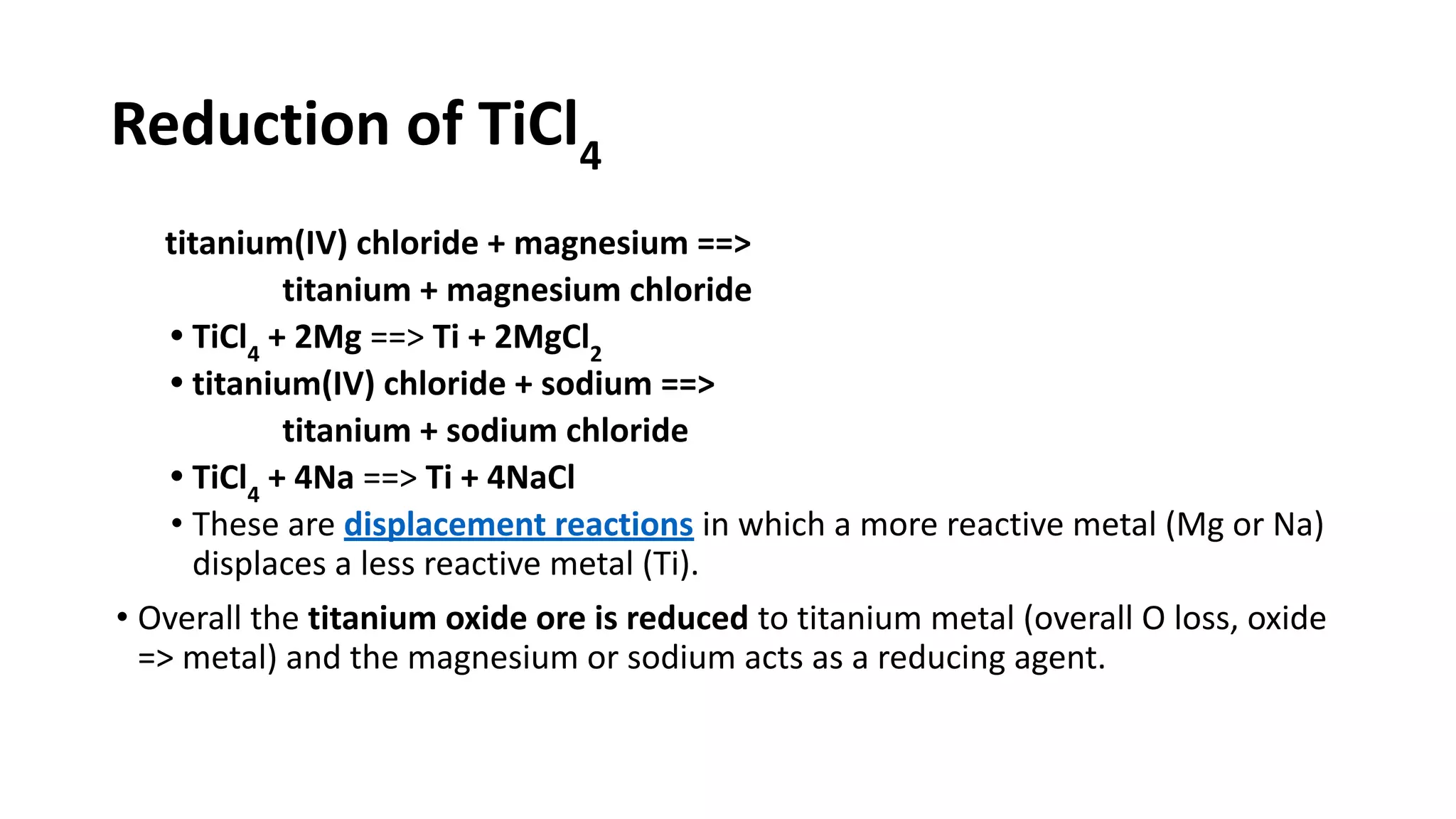
Reduction of TiCl4
titanium(IV) chloride + magnesium ==>
titanium + magnesium chloride
• TiCl4
+ 2Mg ==> Ti + 2MgCl2
• titanium(IV) chloride + sodium ==>
titanium + sodium chloride
• TiCl4
+ 4Na ==> Ti + 4NaCl
• These are displacement reactions in which a more reactive metal (Mg or Na)
displaces a less reactive metal (Ti).
• Overall the titanium oxide ore is reduced to titanium metal (overall O loss, oxide
=> metal) and the magnesium or sodium acts as a reducing agent.
Kroll’s process
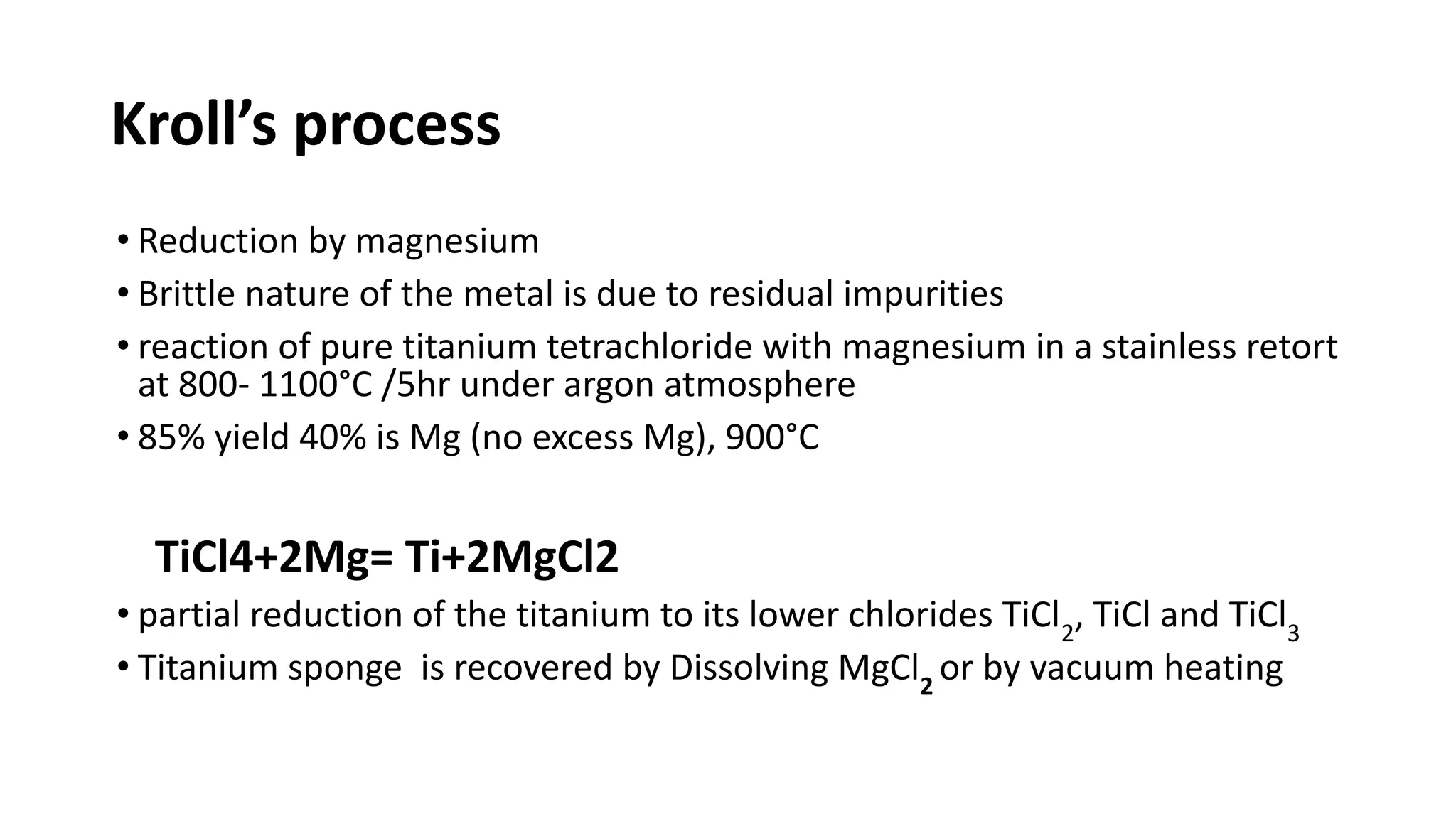
• Reduction by magnesium
• Brittle nature of the metal is due to residual impurities
• reaction of pure titanium tetrachloride with magnesium in a stainless retort
at 800- 1100°C /5hr under argon atmosphere
• 85% yield 40% is Mg (no excess Mg), 900°C
TiCl4+2Mg= Ti+2MgCl2
• partial reduction of the titanium to its lower chlorides TiCl2
, TiCl and TiCl3
• Titanium sponge is recovered by Dissolving MgCl2
or by vacuum heating
Kroll’s process
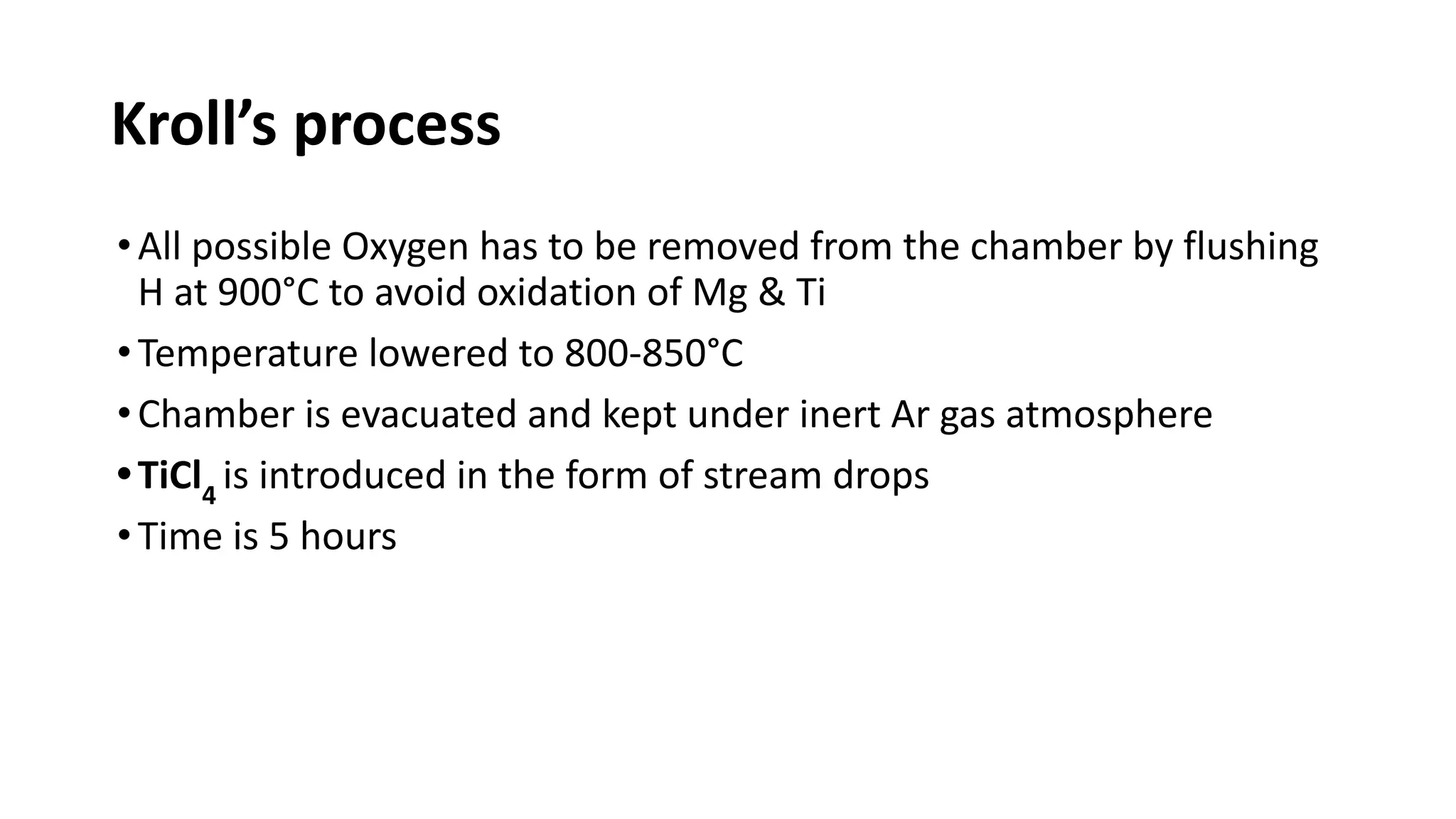
•All possible Oxygen has to be removed from the chamber by flushing
H at 900°C to avoid oxidation of Mg & Ti
•Temperature lowered to 800-850°C
•Chamber is evacuated and kept under inert Ar gas atmosphere
•TiCl4
is introduced in the form of stream drops
•Time is 5 hours
Kroll’s process
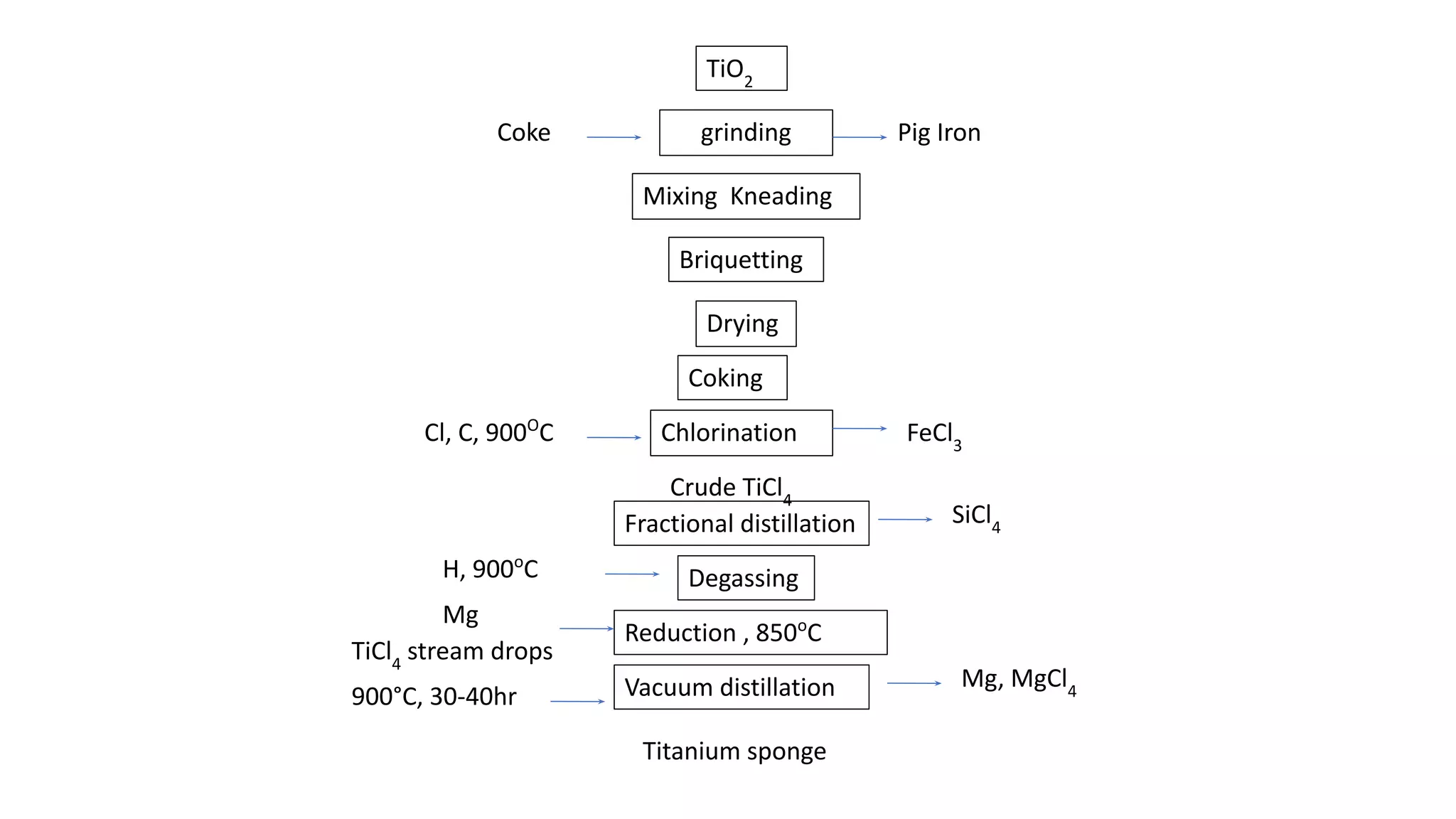
grinding
TiO2
Coke
Mixing Kneading
Briquetting
Drying
Coking
Chlorination
Cl, C, 900O
C FeCl3
Crude TiCl4
Fractional distillation SiCl4
Degassing
Reduction , 850o
C
Mg
Vacuum distillation
TiCl4
stream drops
H, 900o
C
Mg, MgCl4
Titanium sponge
900°C, 30-40hr
Pig Iron
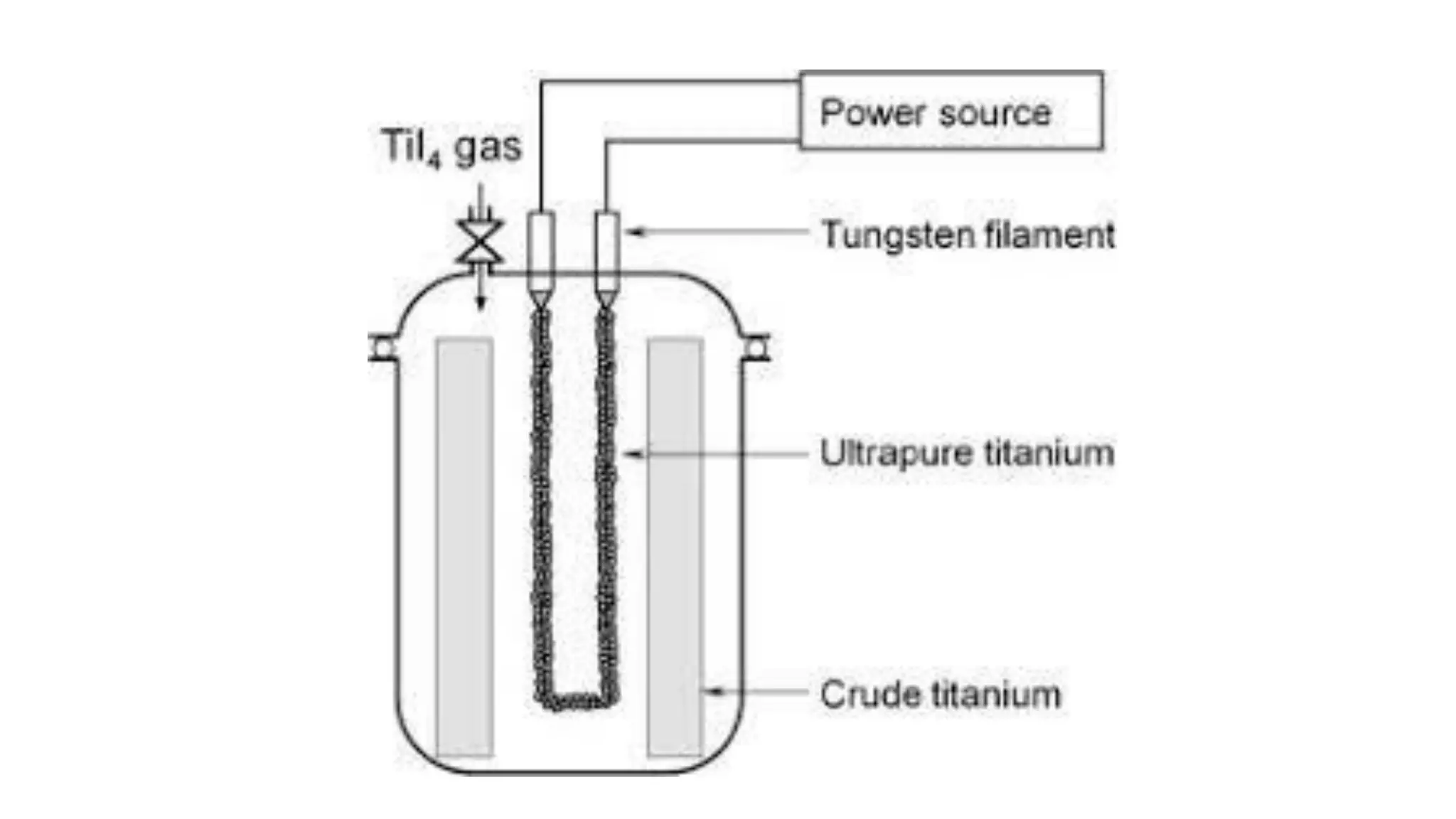
Vanrakell’s iodide process
• It is also called the hot filament or hotwire process
because the use of heated filament for the
decomposition of vapors.
•This process aims at the formation of a volatile halide
of a metal at low temperatures by a reaction with a
halogen and its subsequent decomposition to produce
very pure crystal metal.
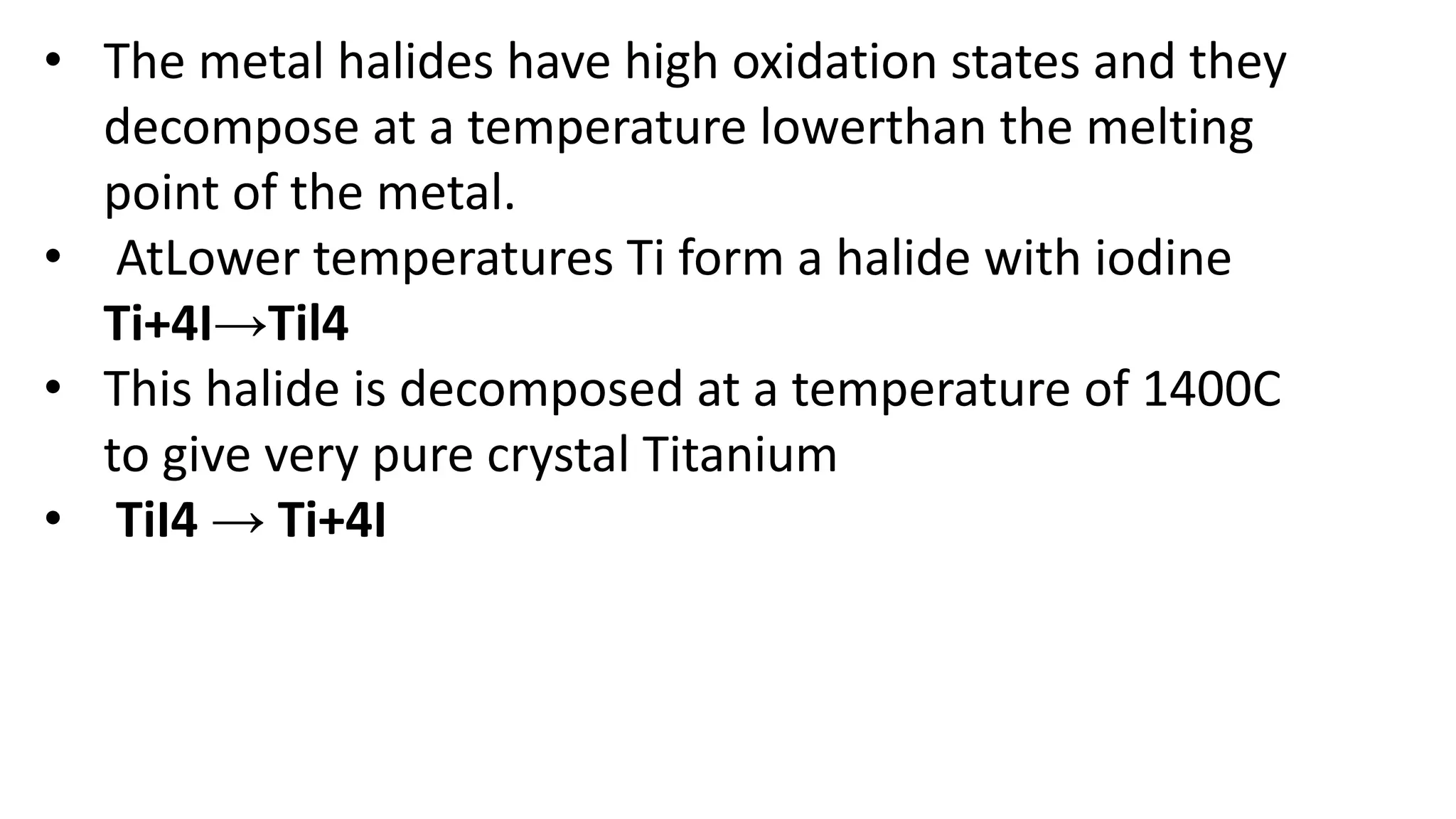
• The metal halides have high oxidation states and they
decompose at a temperature lowerthan the melting
point of the metal.
• AtLower temperatures Ti form a halide with iodine
Ti+4I→Til4
• This halide is decomposed at a temperature of 1400C
to give very pure crystal Titanium
• TiI4 → Ti+4I
Applications & Uses
•for high-temperature performance, creep resistance,
strength, and metallurgical structure
•aerospace industry - for example in aircraft engines
and air frames; wide chord titanium fan blades &
landing gear
•for pipes, etc, in the nuclear, oil and chemical
industries where corrosion is likely to occur.
THANK YOU

EXTRACTION OF TITANIUM.pdf

  • 1.
  • 2.
    Presented by:- •S Pavanchand-1012107916 •GRajkumar-1012107917 •K Ram prasad-1012107918 •V Ravikumar babu-1012107919 •B Sai-1012107920 •Ch Sai-1012107921 •K Salman royal-1012107922 •D Sampath-1012107923
  • 3.
    DETAILS ABOUT TITANIUM •AtomicNumber-22 •Atomic Weight-47.90 amu •Density-4.54 gm/cm3 •Melting point-1668°C •Boiling point-3260 °C •Titanium is a allotropic metal HCP structure upto 882
  • 4.
    COMMON MINERALS OFTITANIUM •Rutile-TiO2 •Ilimenite-FeO.TiO2
  • 5.
    Sources of titaniumin india •Tuticorin(tamilnadu) •Kerala
  • 6.
    Reduction of TiO2 •Thermodynamiccalculations indicate reduction by •Carbon leads to formation of brittle carbide •Mg leads to contamination with TiN and TiH •Alkali reduction only at high temperature •Halide route preferable •TiO2 electrolysis with Cryolite + NaCl bath produces powdered and heavily contaminated Ti
  • 7.
    Upgradation/Concentration of Ilmenite •Upgradationof Titania to about 90% (sysnthetic rutile) • Ilmenite contains titania and iron oxide which can not be removed by physical beneficiation methods •Removal by
  • 8.
    Ilmenite concentration Ilmenite conc Smeltingin electric furnace Acid leaching Selective chlorination Pig iron High TiO2 TiO2 95-97% High iron waste Chlorination TiCl4 High iron waste TiO2 Chlorination Crude TiCl4 Refining by vacuum distillation TiCl4 C
  • 9.
    Upgradation/Concentration of Ilmenite •Reductionsmelting of Ilmenite with Carbon • Pig Iron + TiO2 • Titania is subjected to acid treatment •Direct leaching of Ilmenite with acids like HCl / H2 SO4 • high pressures leads to preferential dissolution of Iron •Magnetic removal of Iron at 1200o C by using NaCl or Na2 CO3 •Selective dissolution of Iron Oxide to produce Iron Halides (Cl, Br, HCl)
  • 10.
    Smelting of Ilmenite •SorelProcess •Iron can be reduced from Ilmenite by C •Fluxes: Cao and Na2 O •FeO. TiO2 + C = Fe + TiO2 (slag) + CO •Slag contains • 70-90% TiO2 + 5-10% Fe + oxides of MgO + Cao
  • 11.
    Chlorination of TiO2 •Titaniais chlorinated in the presence of C at 1000o C •TiO2 (c) + 2Cl2 (g) = TiCl4 (g) + O2 (g) •TiO2 (c) + 2Cl2 (g) + 2C (c) = TiCl4 (g) + O2 (g) + 2CO (g) • Titanium ore is mainly the oxide TiO2 , converted into titanium tetrachloride TiCl4 by heating with carbon and chlorine, 1000o C • titanium dioxide + carbon + chlorine ==> titanium(IV) chloride + carbon dioxide • TiO2 + C + 2Cl2 ==> TiCl4 + CO2
  • 12.
    •The chloride isthen reacted with Na or Mg to form Ti metal and sodium chloride or magnesium chloride. •This reaction is 'simple' displacement reaction, ie, the less reactive Ti is displaced by a more reactive metal such as Na or Mg. •This reaction is carried out in an atmosphere of inert argon gas so non of the metals involved becomes oxidised by atmospheric oxygen.
  • 13.
    Reduction of TiCl4 titanium(IV)chloride + magnesium ==> titanium + magnesium chloride • TiCl4 + 2Mg ==> Ti + 2MgCl2 • titanium(IV) chloride + sodium ==> titanium + sodium chloride • TiCl4 + 4Na ==> Ti + 4NaCl • These are displacement reactions in which a more reactive metal (Mg or Na) displaces a less reactive metal (Ti). • Overall the titanium oxide ore is reduced to titanium metal (overall O loss, oxide => metal) and the magnesium or sodium acts as a reducing agent.
  • 14.
    Kroll’s process • Reductionby magnesium • Brittle nature of the metal is due to residual impurities • reaction of pure titanium tetrachloride with magnesium in a stainless retort at 800- 1100°C /5hr under argon atmosphere • 85% yield 40% is Mg (no excess Mg), 900°C TiCl4+2Mg= Ti+2MgCl2 • partial reduction of the titanium to its lower chlorides TiCl2 , TiCl and TiCl3 • Titanium sponge is recovered by Dissolving MgCl2 or by vacuum heating
  • 15.
    Kroll’s process •All possibleOxygen has to be removed from the chamber by flushing H at 900°C to avoid oxidation of Mg & Ti •Temperature lowered to 800-850°C •Chamber is evacuated and kept under inert Ar gas atmosphere •TiCl4 is introduced in the form of stream drops •Time is 5 hours
  • 16.
  • 17.
    grinding TiO2 Coke Mixing Kneading Briquetting Drying Coking Chlorination Cl, C,900O C FeCl3 Crude TiCl4 Fractional distillation SiCl4 Degassing Reduction , 850o C Mg Vacuum distillation TiCl4 stream drops H, 900o C Mg, MgCl4 Titanium sponge 900°C, 30-40hr Pig Iron
  • 18.
    Vanrakell’s iodide process •It is also called the hot filament or hotwire process because the use of heated filament for the decomposition of vapors. •This process aims at the formation of a volatile halide of a metal at low temperatures by a reaction with a halogen and its subsequent decomposition to produce very pure crystal metal.
  • 20.
    • The metalhalides have high oxidation states and they decompose at a temperature lowerthan the melting point of the metal. • AtLower temperatures Ti form a halide with iodine Ti+4I→Til4 • This halide is decomposed at a temperature of 1400C to give very pure crystal Titanium • TiI4 → Ti+4I
  • 21.
    Applications & Uses •forhigh-temperature performance, creep resistance, strength, and metallurgical structure •aerospace industry - for example in aircraft engines and air frames; wide chord titanium fan blades & landing gear •for pipes, etc, in the nuclear, oil and chemical industries where corrosion is likely to occur.
  • 22.