Homogeneous Catalysis
CONTENTS:
 Introduction
 Homogeneous Catalysis
 Hydrogenation Catalysis
 Hydroformylation
 Hydrocynation
 References.
2
Introduction
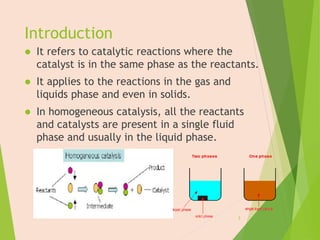
 It refers to catalytic reactions where the
catalyst is in the same phase as the reactants.
 It applies to the reactions in the gas and
liquids phase and even in solids.
 In homogeneous catalysis, all the reactants
and catalysts are present in a single fluid
phase and usually in the liquid phase.
3
General features:
 Liquid phase reactions dominate the field.
 Industrially less relevant; but complex
organic or asymmetric transformations
possible!
 Reaction conditions milder than required for
heterogeneous reactions (-78 °C - ~200 °C).
 Investigation of reactions by spectroscopic
methods (NMR, MS, IR, UV-Vis) directly in
solution possible.
 Fine-tuning of catalyst properties using
different ligands/additives easy possible.
 Major challenge: Separation of products and
catalysts/additives.
4
Advantages
Advantages of homogeneous processes can be
summarized as follows:
 In many reactions, homogeneous catalysts are
more active and/or selective compared to
heterogeneous catalysts.
 In homogeneous catalysis, the catalysts are
molecularly dispersed within the fluid. Hence,
pore diffusion limitations are absent. However,
bulk phase mass transfer limitation may occurs.
 Catalytic chemistry and mechanism for
homogeneous catalysis are better studied and
understood. Therefore, it is easier to control and
manipulate the process parameters.
5
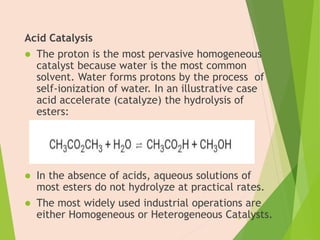
Acid Catalysis
 The proton is the most pervasive homogeneous
catalyst because water is the most common
solvent. Water forms protons by the process of
self-ionization of water. In an illustrative case
acid accelerate (catalyze) the hydrolysis of
esters:
 In the absence of acids, aqueous solutions of
most esters do not hydrolyze at practical rates.
 The most widely used industrial operations are
either Homogeneous or Heterogeneous Catalysts.6
Examples
 Many of the homogeneous catalysed
reactions have been studied in both gas and
liquid phases and some of the common
examples in gas phase are as follows.
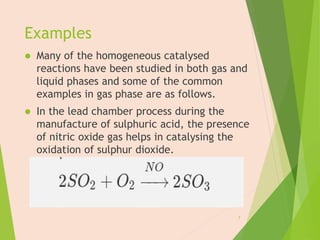
 In the lead chamber process during the
manufacture of sulphuric acid, the presence
of nitric oxide gas helps in catalysing the
oxidation of sulphur dioxide.
7
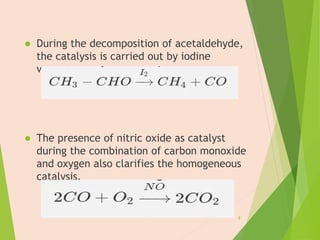
 During the decomposition of acetaldehyde,
the catalysis is carried out by iodine
vapours.
 The presence of nitric oxide as catalyst
during the combination of carbon monoxide
and oxygen also clarifies the homogeneous
catalysis.
8
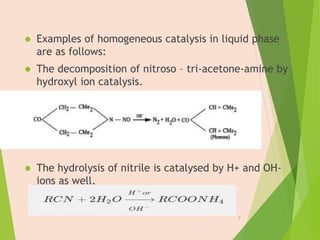
 Examples of homogeneous catalysis in liquid phase
are as follows:
 The decomposition of nitroso – tri-acetone-amine by
hydroxyl ion catalysis.
 The hydrolysis of nitrile is catalysed by H+ and OH-
ions as well.
9
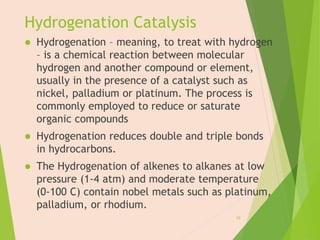
Hydrogenation Catalysis
 Hydrogenation – meaning, to treat with hydrogen
– is a chemical reaction between molecular
hydrogen and another compound or element,
usually in the presence of a catalyst such as
nickel, palladium or platinum. The process is
commonly employed to reduce or saturate
organic compounds
 Hydrogenation reduces double and triple bonds
in hydrocarbons.
 The Hydrogenation of alkenes to alkanes at low
pressure (1-4 atm) and moderate temperature
(0-100 C) contain nobel metals such as platinum,
palladium, or rhodium.
10
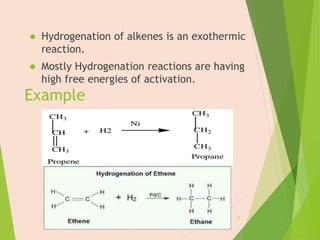
Example
 Hydrogenation of alkenes is an exothermic
reaction.
 Mostly Hydrogenation reactions are having
high free energies of activation.
11
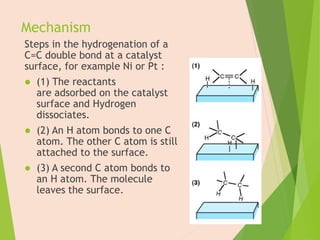
Mechanism
Steps in the hydrogenation of a
C=C double bond at a catalyst
surface, for example Ni or Pt :
 (1) The reactants
are adsorbed on the catalyst
surface and Hydrogen
dissociates.
 (2) An H atom bonds to one C
atom. The other C atom is still
attached to the surface.
 (3) A second C atom bonds to
an H atom. The molecule
leaves the surface.
12
Catalyst used in catalytic hydrogenation
reaction are following
 Palladium
 Adam's Catalyst
 Raney Nicke
 Copper Chromite
 Transfer Hydrogenation
 Rhodium
 Ruthenium
 Triethylamine
13
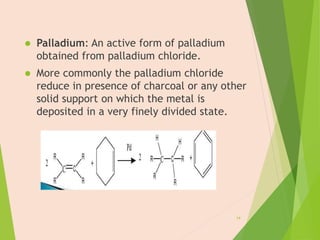
 Palladium: An active form of palladium
obtained from palladium chloride.
 More commonly the palladium chloride
reduce in presence of charcoal or any other
solid support on which the metal is
deposited in a very finely divided state.
14
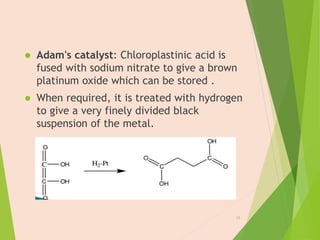
 Adam's catalyst: Chloroplastinic acid is
fused with sodium nitrate to give a brown
platinum oxide which can be stored .
 When required, it is treated with hydrogen
to give a very finely divided black
suspension of the metal.
15
Advantages & Disadvantages
Advantages:
 Relatively high specificity
 Relatively low reaction temperatures
 Far more easily studied from chemical &
mechanistic aspects
 Far more active
 Generally Far more selective for single
product.
Disadvantages:
 More difficult for achieving product/
catalyst separations.
16
Applications
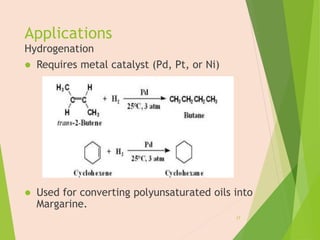
Hydrogenation
 Requires metal catalyst (Pd, Pt, or Ni)
 Used for converting polyunsaturated oils into
Margarine.
17
18
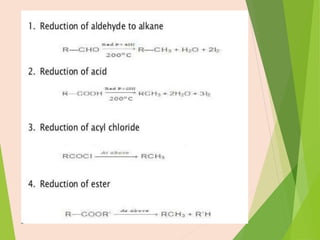
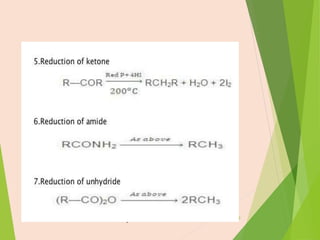
 Reduction of esters
 Reduction of amide
 Reduction of unhydride. 19
Hydroformylation
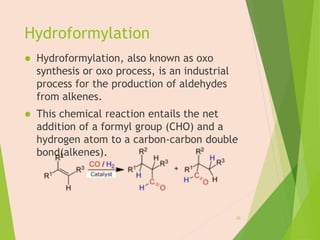
 Hydroformylation, also known as oxo
synthesis or oxo process, is an industrial
process for the production of aldehydes
from alkenes.
 This chemical reaction entails the net
addition of a formyl group (CHO) and a
hydrogen atom to a carbon-carbon double
bond(alkenes).
20
Mechanism
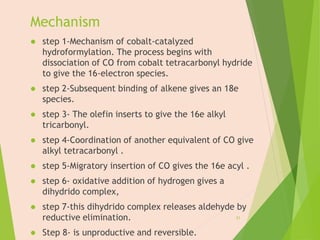
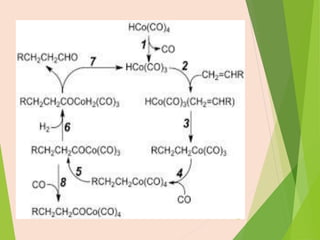
 step 1-Mechanism of cobalt-catalyzed
hydroformylation. The process begins with
dissociation of CO from cobalt tetracarbonyl hydride
to give the 16-electron species.
 step 2-Subsequent binding of alkene gives an 18e
species.
 step 3- The olefin inserts to give the 16e alkyl
tricarbonyl.
 step 4-Coordination of another equivalent of CO give
alkyl tetracarbonyl .
 step 5-Migratory insertion of CO gives the 16e acyl .
 step 6- oxidative addition of hydrogen gives a
dihydrido complex,
 step 7-this dihydrido complex releases aldehyde by
reductive elimination.
 Step 8- is unproductive and reversible.
21
22
Examples of Catalyst:
 Cobalt tetracarbonyl hydride
 Tris(triphenylphosphine)rhodium carbonyl
hydride
Disadvantages:
 Catalyst losses due to its high Volatility
 Loss of alkene through Hydrogenation in a
reaction Competing with Hydroformylation
 Inherent difficulties in mechanic studies
23
Hydrocyanation
 Hydrocyanation is, the process whereby H+
and –CN ions are added to a molecular
substrate.
 The substrate is an alkene and the product
is a nitrile.
 Cyanide is both a good σ–donor and π–
acceptor its presence accelerates the rate
of substitution of ligands
 A key step in hydrocyanation is the
oxidative addition of hydrogen cyanide to
low–valent metal complexes.
24
Examples
Mechanism:
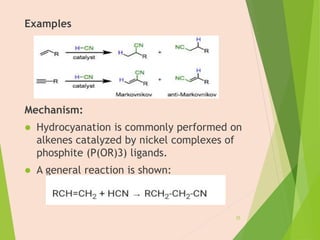
 Hydrocyanation is commonly performed on
alkenes catalyzed by nickel complexes of
phosphite (P(OR)3) ligands.
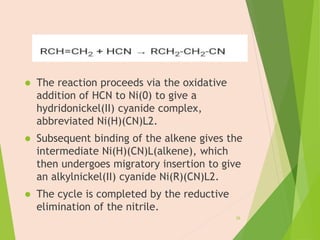
 A general reaction is shown:
25
 The reaction proceeds via the oxidative
addition of HCN to Ni(0) to give a
hydridonickel(II) cyanide complex,
abbreviated Ni(H)(CN)L2.
 Subsequent binding of the alkene gives the
intermediate Ni(H)(CN)L(alkene), which
then undergoes migratory insertion to give
an alkylnickel(II) cyanide Ni(R)(CN)L2.
 The cycle is completed by the reductive
elimination of the nitrile.
26
Applications of Hydrocyanation
 Hydrocyanation is important due to the
versatility of alkyl nitriles (RCN), which are
important intermediates for the syntheses
of amides, amines, carboxylic acids, and
esters.
 The most important industrial application is
the nickel-catalyzed synthesis of
adiponitrile (NC–(CH2)4–CN) synthesis from
1,3–butadiene (CH2=CH–CH=CH2).
 Adiponitrile is a precursor to
hexamethylenediamine (H2N–(CH2)6–NH2),
which is used for the production of certain
kinds of Nylon. 27
References:-
1. https://en.m.wikipedia.org/wiki/Homogen
eous_catalysis
2. https://chemistry.tutorvista.com/inorganic
-chemistry/homogeneous-
catalyst.html?view=simple
3. https://en.m.wikipedia.org/wiki/Hydrogen
ation
4. https://en.m.wikipedia.org/wiki/Hydrofor
mylation
5. https://en.m.wikipedia.org/wiki/Hydrocya
nation
28
29
30

Homogeneous catalysis [ MPHARM, MSC, BPHARM, BSC]

  • 1.
  • 2.
    CONTENTS:  Introduction  HomogeneousCatalysis  Hydrogenation Catalysis  Hydroformylation  Hydrocynation  References. 2
  • 3.
    Introduction  It refersto catalytic reactions where the catalyst is in the same phase as the reactants.  It applies to the reactions in the gas and liquids phase and even in solids.  In homogeneous catalysis, all the reactants and catalysts are present in a single fluid phase and usually in the liquid phase. 3
  • 4.
    General features:  Liquidphase reactions dominate the field.  Industrially less relevant; but complex organic or asymmetric transformations possible!  Reaction conditions milder than required for heterogeneous reactions (-78 °C - ~200 °C).  Investigation of reactions by spectroscopic methods (NMR, MS, IR, UV-Vis) directly in solution possible.  Fine-tuning of catalyst properties using different ligands/additives easy possible.  Major challenge: Separation of products and catalysts/additives. 4
  • 5.
    Advantages Advantages of homogeneousprocesses can be summarized as follows:  In many reactions, homogeneous catalysts are more active and/or selective compared to heterogeneous catalysts.  In homogeneous catalysis, the catalysts are molecularly dispersed within the fluid. Hence, pore diffusion limitations are absent. However, bulk phase mass transfer limitation may occurs.  Catalytic chemistry and mechanism for homogeneous catalysis are better studied and understood. Therefore, it is easier to control and manipulate the process parameters. 5
  • 6.
    Acid Catalysis  Theproton is the most pervasive homogeneous catalyst because water is the most common solvent. Water forms protons by the process of self-ionization of water. In an illustrative case acid accelerate (catalyze) the hydrolysis of esters:  In the absence of acids, aqueous solutions of most esters do not hydrolyze at practical rates.  The most widely used industrial operations are either Homogeneous or Heterogeneous Catalysts.6
  • 7.
    Examples  Many ofthe homogeneous catalysed reactions have been studied in both gas and liquid phases and some of the common examples in gas phase are as follows.  In the lead chamber process during the manufacture of sulphuric acid, the presence of nitric oxide gas helps in catalysing the oxidation of sulphur dioxide. 7
  • 8.
     During thedecomposition of acetaldehyde, the catalysis is carried out by iodine vapours.  The presence of nitric oxide as catalyst during the combination of carbon monoxide and oxygen also clarifies the homogeneous catalysis. 8
  • 9.
     Examples ofhomogeneous catalysis in liquid phase are as follows:  The decomposition of nitroso – tri-acetone-amine by hydroxyl ion catalysis.  The hydrolysis of nitrile is catalysed by H+ and OH- ions as well. 9
  • 10.
    Hydrogenation Catalysis  Hydrogenation– meaning, to treat with hydrogen – is a chemical reaction between molecular hydrogen and another compound or element, usually in the presence of a catalyst such as nickel, palladium or platinum. The process is commonly employed to reduce or saturate organic compounds  Hydrogenation reduces double and triple bonds in hydrocarbons.  The Hydrogenation of alkenes to alkanes at low pressure (1-4 atm) and moderate temperature (0-100 C) contain nobel metals such as platinum, palladium, or rhodium. 10
  • 11.
    Example  Hydrogenation ofalkenes is an exothermic reaction.  Mostly Hydrogenation reactions are having high free energies of activation. 11
  • 12.
    Mechanism Steps in thehydrogenation of a C=C double bond at a catalyst surface, for example Ni or Pt :  (1) The reactants are adsorbed on the catalyst surface and Hydrogen dissociates.  (2) An H atom bonds to one C atom. The other C atom is still attached to the surface.  (3) A second C atom bonds to an H atom. The molecule leaves the surface. 12
  • 13.
    Catalyst used incatalytic hydrogenation reaction are following  Palladium  Adam's Catalyst  Raney Nicke  Copper Chromite  Transfer Hydrogenation  Rhodium  Ruthenium  Triethylamine 13
  • 14.
     Palladium: Anactive form of palladium obtained from palladium chloride.  More commonly the palladium chloride reduce in presence of charcoal or any other solid support on which the metal is deposited in a very finely divided state. 14
  • 15.
     Adam's catalyst:Chloroplastinic acid is fused with sodium nitrate to give a brown platinum oxide which can be stored .  When required, it is treated with hydrogen to give a very finely divided black suspension of the metal. 15
  • 16.
    Advantages & Disadvantages Advantages: Relatively high specificity  Relatively low reaction temperatures  Far more easily studied from chemical & mechanistic aspects  Far more active  Generally Far more selective for single product. Disadvantages:  More difficult for achieving product/ catalyst separations. 16
  • 17.
    Applications Hydrogenation  Requires metalcatalyst (Pd, Pt, or Ni)  Used for converting polyunsaturated oils into Margarine. 17
  • 18.
  • 19.
     Reduction ofesters  Reduction of amide  Reduction of unhydride. 19
  • 20.
    Hydroformylation  Hydroformylation, alsoknown as oxo synthesis or oxo process, is an industrial process for the production of aldehydes from alkenes.  This chemical reaction entails the net addition of a formyl group (CHO) and a hydrogen atom to a carbon-carbon double bond(alkenes). 20
  • 21.
    Mechanism  step 1-Mechanismof cobalt-catalyzed hydroformylation. The process begins with dissociation of CO from cobalt tetracarbonyl hydride to give the 16-electron species.  step 2-Subsequent binding of alkene gives an 18e species.  step 3- The olefin inserts to give the 16e alkyl tricarbonyl.  step 4-Coordination of another equivalent of CO give alkyl tetracarbonyl .  step 5-Migratory insertion of CO gives the 16e acyl .  step 6- oxidative addition of hydrogen gives a dihydrido complex,  step 7-this dihydrido complex releases aldehyde by reductive elimination.  Step 8- is unproductive and reversible. 21
  • 22.
  • 23.
    Examples of Catalyst: Cobalt tetracarbonyl hydride  Tris(triphenylphosphine)rhodium carbonyl hydride Disadvantages:  Catalyst losses due to its high Volatility  Loss of alkene through Hydrogenation in a reaction Competing with Hydroformylation  Inherent difficulties in mechanic studies 23
  • 24.
    Hydrocyanation  Hydrocyanation is,the process whereby H+ and –CN ions are added to a molecular substrate.  The substrate is an alkene and the product is a nitrile.  Cyanide is both a good σ–donor and π– acceptor its presence accelerates the rate of substitution of ligands  A key step in hydrocyanation is the oxidative addition of hydrogen cyanide to low–valent metal complexes. 24
  • 25.
    Examples Mechanism:  Hydrocyanation iscommonly performed on alkenes catalyzed by nickel complexes of phosphite (P(OR)3) ligands.  A general reaction is shown: 25
  • 26.
     The reactionproceeds via the oxidative addition of HCN to Ni(0) to give a hydridonickel(II) cyanide complex, abbreviated Ni(H)(CN)L2.  Subsequent binding of the alkene gives the intermediate Ni(H)(CN)L(alkene), which then undergoes migratory insertion to give an alkylnickel(II) cyanide Ni(R)(CN)L2.  The cycle is completed by the reductive elimination of the nitrile. 26
  • 27.
    Applications of Hydrocyanation Hydrocyanation is important due to the versatility of alkyl nitriles (RCN), which are important intermediates for the syntheses of amides, amines, carboxylic acids, and esters.  The most important industrial application is the nickel-catalyzed synthesis of adiponitrile (NC–(CH2)4–CN) synthesis from 1,3–butadiene (CH2=CH–CH=CH2).  Adiponitrile is a precursor to hexamethylenediamine (H2N–(CH2)6–NH2), which is used for the production of certain kinds of Nylon. 27
  • 28.
    References:- 1. https://en.m.wikipedia.org/wiki/Homogen eous_catalysis 2. https://chemistry.tutorvista.com/inorganic -chemistry/homogeneous- catalyst.html?view=simple 3.https://en.m.wikipedia.org/wiki/Hydrogen ation 4. https://en.m.wikipedia.org/wiki/Hydrofor mylation 5. https://en.m.wikipedia.org/wiki/Hydrocya nation 28
  • 29.
  • 30.