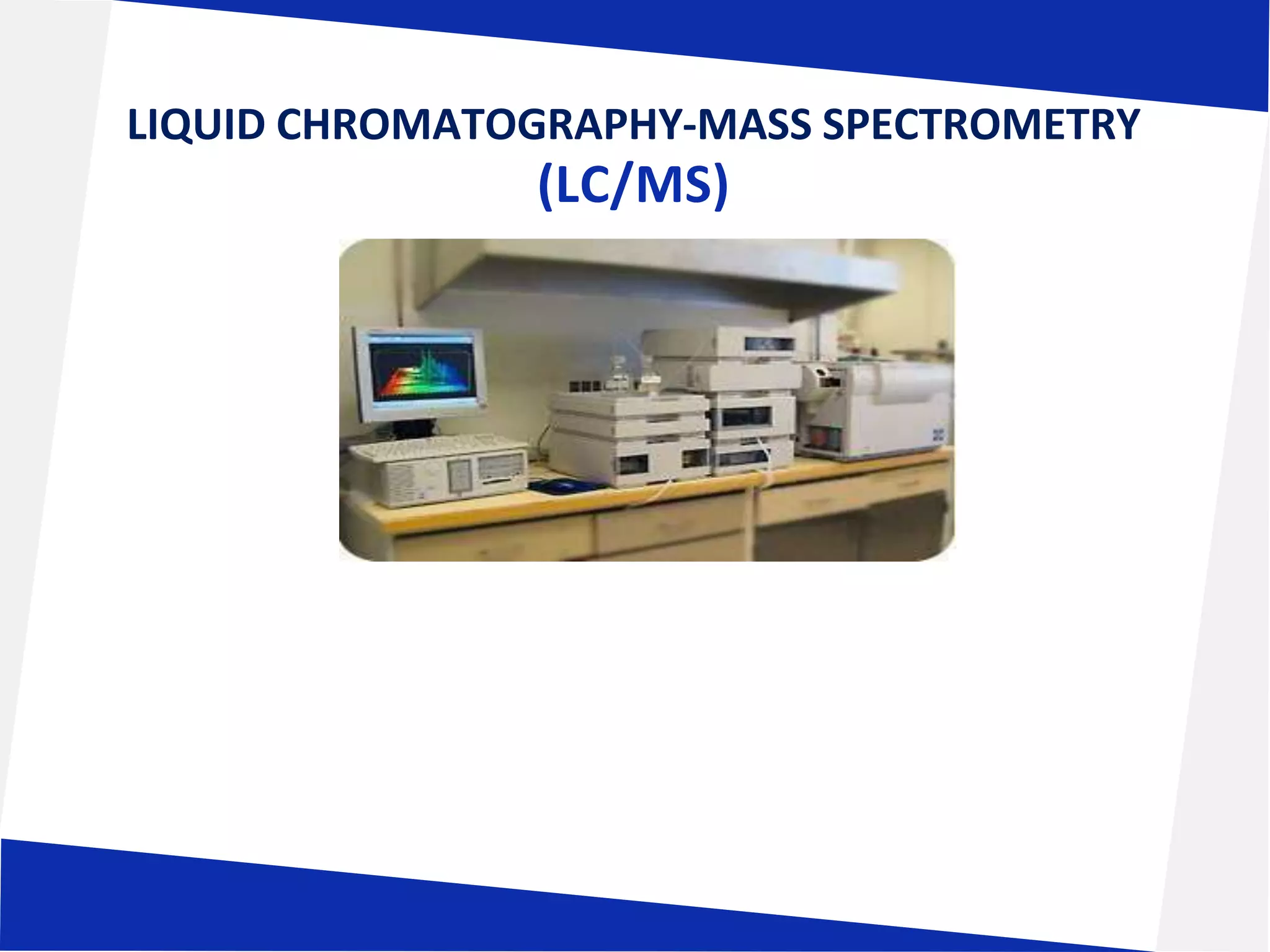
LIQUID CHROMATOGRAPHY-MASS SPECTROMETRY
(LC/MS)
Principle:
‱ LC/MS is a technique that combines physical separation
capabilities of liquid chromatography with mass analysis
capabilityofMassspectrometry.
‱ ItisamethodthatcombinesseparationpowerofHPLCwith
detectionpowerofMassspectrometry.
‱ InLC-MSweremovethedetectorfromthecolumnofLCandfit the
columntointerfaceofMS.
‱ InthemostofthecasestheinterfaceusedinLC-MSareionization source.
INTRODUCTION
‱ HPLCisamethod for separatingacomplexmixture in to its
components.
‱ Highsensitivityof massspectroscopy provides theinformation
for identification of compoundsor structural elucidation of
compounds.
‱ Combination of thesetwotechniques isLC-MS.
‱ Asthe metabolitesappearfrom the endof the column they
enter the massdetector, where the solvent isremovedand the
metabolitesareionized.
Theory of LC/MS
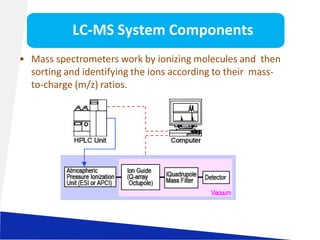
LC-MS System Components
‱ Mass spectrometers work by ionizing molecules and then
sorting and identifying the ions according to their mass-
to-charge (m/z) ratios.
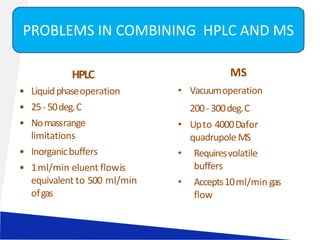
HPLC
‱ Liquidphaseoperation
‱ 25- 50deg.C
‱ Nomassrange
limitations
‱ Inorganicbuffers
‱ 1ml/min eluent flowis
equivalent to 500 ml/min
ofgas
MS
‱ Vacuumoperation
200- 300deg.C
‱ Upto 4000Dafor
quadrupole MS
‱ Requiresvolatile
buffers
‱ Accepts10ml/min gas
flow
PROBLEMS IN COMBINING HPLC AND MS
Themobile phaseisthe solvent that movesthe solute throughout
column.
Generalrequirements:-
(1) Lowcost,UVtransparency,high purity.
(2) Lowviscosity,low toxicity, nonflammability.
(3) Noncorrosiveto LCsystemcomponent.
Solventstrength andselectivity:-
It isthe abilityof solvent to elute solutesfromacolumn.
MOBILE PHASE
‱ The use of di-functional or tri-functional silanes to create bonded
groups with two or three attachment points leading to phases
with higher stability in low or higher pHandlower bleedfor LC-MS
‱ Most widely usedcolumnsfor LC-MSare :-
(1) fast LC column :-
the useof short column.(15-50mm)
(2) Micro LC column :-
the useof largecolumn. (20-150mm)
COLUMN
‱ Samplepreparation generally consists of concentrating the analyte
and removing compounds that can cause background ion or
suppressionization.
‱ Exampleof samplepreparationinclude:-
‱ OnColumnconcentration -to increaseanalyteconcentration.
‱ Desalting - to reduce the sodium and potassium adduct
formation that commonlyoccursin electrospray.
‱ Filtration- to separate a low molecular-weight drug from
proteins in plasma,milk, ortissue.
Sample preparation
‱ LC-MSsystemsinclude adevicefor introducing samples(suchas an
HPLC)aninterface for connectingsuchdevice,anion source that
ionizessamples,anelectrostatic lensthat efficiently introduces
the generatedions, amassanalyzerunit that separatesions based
on their mass-to-charge(m/z) ratio, anda detector unit that
detectstheseparatedions.
‱ In anLC-MSsystem,however, if the LCunit issimplyconnected
directlyto the MSunit, the liquid mobile phasewould vaporize,
resulting in large amountsof gasbeingintroduced into the MS
unit.
‱ Thiswould decreasethe vacuumlevel andprevent the targetions
from reachingthe detector. Sointerfaces are tobeused.
INTERFACES
‱ It isdifficult to interface aliquid chromatographyto amass-
spectrometercauseof the necessityto removethe solvent.
‱ Thecommonlyusedinterfacesare:-
(1) Electrosprayionization(ESI)
(2) Thermosprayionization(TSI)
(3) Atmosphericpressurechemicalionization(APCI)
(4) Atmosphericpressurephotoionization(APPI)
TYPES OF INTERFACES
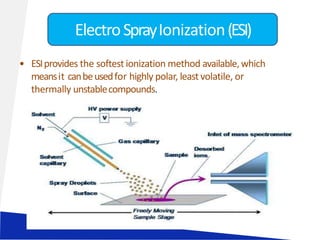
‱ ESIdrawssamplesolutions to the tip of acapillarytube,
whereit appliesahighvoltage of about 3to 5kV.
‱ A nebulizer gas flows from outside the capillary to spray the
sample.Thiscreatesafine mist of chargeddroplets with the same
polarity asthe appliedvoltage.
‱ Asthischargedparticles move,the solvent continuesto evaporate,
thereby increasingthe electricfield onthe droplet surface.When
the mutual repulsive force of the charges exceedsthe liquid
surfacetension, then fissionoccurs.
‱ Asthis evaporation andfissioncycleisrepeated, thedroplets
eventually becomesmallenoughthat the sampleionsare
liberated into the gasphase.
ElectroSprayIonization(ESI)
‱ ESIprovides the softest ionization method available, which
meansit canbeusedfor highly polar, least volatile, or
thermally unstablecompounds.
ElectroSprayIonization(ESI)
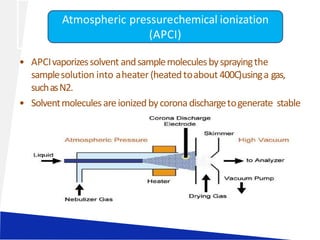
‱ APCIvaporizessolvent andsamplemoleculesbysprayingthe
samplesolution into aheater (heatedtoabout 400C)usinga gas,
suchasN2.
‱ Solventmoleculesareionizedbycoronadischargetogenerate stable
reactionions.
Atmospheric pressurechemical ionization
(APCI)
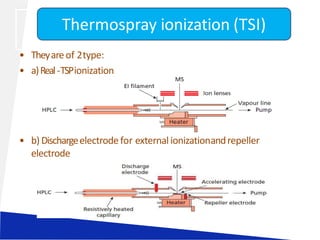
‱ Theyareof 2type:
‱ a)Real-TSPionization
‱ b) Dischargeelectrode for external ionizationandrepeller
electrode
Thermospray ionization (TSI)
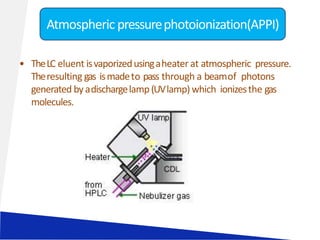
‱ TheLC eluent isvaporizedusingaheater at atmospheric pressure.
Theresulting gas ismadeto pass through a beamof photons
generated byadischargelamp(UVlamp) which ionizesthe gas
molecules.
Atmospheric pressurephotoionization(APPI)
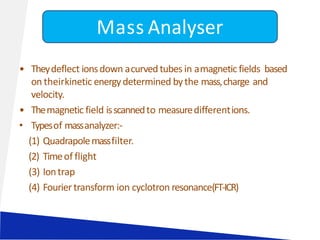
‱ Theydeflect ionsdown acurvedtubes in amagnetic fields based
on theirkinetic energydetermined bythe mass,charge and
velocity.
‱ Themagnetic field isscannedto measuredifferentions.
‱ Typesof massanalyzer:-
(1) Quadrapolemassfilter.
(2) Timeof flight
(3) Iontrap
(4) Fourier transform ion cyclotron resonance(FT-ICR)
Mass Analyser
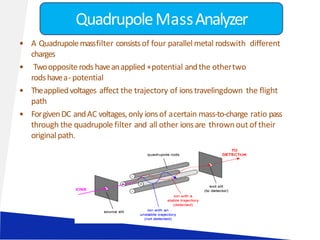
‱ A Quadrupolemassfilter consistsof four parallelmetal rodswith different
charges
‱ Twooppositerodshaveanapplied +potential andthe othertwo
rodshavea-potential
‱ Theappliedvoltages affect the trajectory of ionstravelingdown the flight
path
‱ ForgivenDC andAC voltages,only ionsof acertain mass-to-charge ratio pass
through the quadrupole filter and all other ionsare thrownout of their
originalpath.
QuadrupoleMassAnalyzer
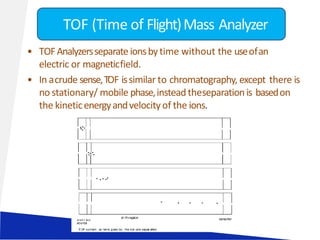
‱ TOFAnalyzersseparateionsbytime without the useofan
electric or magneticfield.
‱ In acrude sense,TOF issimilar to chromatography, except there is
no stationary/ mobile phase,insteadtheseparationis basedon
the kineticenergyandvelocityof the ions.
TOF (Time of Flight)Mass Analyzer
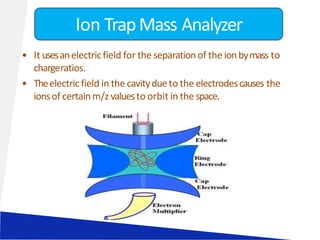
‱ It usesanelectricfield for the separationof the ionbymass to
chargeratios.
‱ Theelectricfield in the cavitydueto the electrodescauses the
ionsof certainm/z valuesto orbit in the space.
Ion TrapMass Analyzer
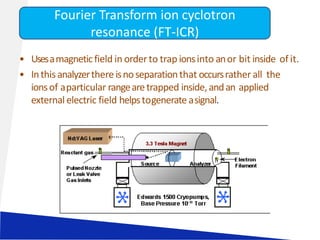
‱ Usesamagneticfield in orderto trap ionsinto anor bit inside of it.
‱ Inthisanalyzerthereisnoseparationthat occursrather all the
ionsof aparticular rangearetrapped inside,andan applied
external electric field helpstogenerate asignal.
Fourier Transform ion cyclotron
resonance (FT-ICR)
 PharmaceuticalApplications:
 Rapidchromatographyofbenzodiazepines
 Identificationofbileacidmetabolite
 BiochemicalApplications:
 Rapid protein identification using capillary LC/MS/MS and
databasesearching.
 ClinicalApplications:
 High-sensitivitydetectionoftrimipramineandthioridazine
Applications of LC-MS
 Food Applications:
 Identificationofaflatoxinsinfood
 DeterminationofvitaminD3inpoultryfeedsupplements
 EnvironmentalApplications:
 Detectionofphenylureaherbicides
 Detectionoflowlevelsofcarbarylin food
 Forensic Applications:
 illegalsubstances,toxicagents
 Explosives
Applications of LC-MS
LIQUID CHROMATOGRAPHY- MASS SPECTROSCOPY[LC-MS]

LIQUID CHROMATOGRAPHY- MASS SPECTROSCOPY[LC-MS]

  • 1.
  • 2.
    Principle: ‱ LC/MS isa technique that combines physical separation capabilities of liquid chromatography with mass analysis capabilityofMassspectrometry. ‱ ItisamethodthatcombinesseparationpowerofHPLCwith detectionpowerofMassspectrometry. ‱ InLC-MSweremovethedetectorfromthecolumnofLCandfit the columntointerfaceofMS. ‱ InthemostofthecasestheinterfaceusedinLC-MSareionization source. INTRODUCTION
  • 3.
    ‱ HPLCisamethod forseparatingacomplexmixture in to its components. ‱ Highsensitivityof massspectroscopy provides theinformation for identification of compoundsor structural elucidation of compounds. ‱ Combination of thesetwotechniques isLC-MS. ‱ Asthe metabolitesappearfrom the endof the column they enter the massdetector, where the solvent isremovedand the metabolitesareionized. Theory of LC/MS
  • 4.
    LC-MS System Components ‱Mass spectrometers work by ionizing molecules and then sorting and identifying the ions according to their mass- to-charge (m/z) ratios.
  • 5.
    HPLC ‱ Liquidphaseoperation ‱ 25-50deg.C ‱ Nomassrange limitations ‱ Inorganicbuffers ‱ 1ml/min eluent flowis equivalent to 500 ml/min ofgas MS ‱ Vacuumoperation 200- 300deg.C ‱ Upto 4000Dafor quadrupole MS ‱ Requiresvolatile buffers ‱ Accepts10ml/min gas flow PROBLEMS IN COMBINING HPLC AND MS
  • 6.
    Themobile phaseisthe solventthat movesthe solute throughout column. Generalrequirements:- (1) Lowcost,UVtransparency,high purity. (2) Lowviscosity,low toxicity, nonflammability. (3) Noncorrosiveto LCsystemcomponent. Solventstrength andselectivity:- It isthe abilityof solvent to elute solutesfromacolumn. MOBILE PHASE
  • 7.
    ‱ The useof di-functional or tri-functional silanes to create bonded groups with two or three attachment points leading to phases with higher stability in low or higher pHandlower bleedfor LC-MS ‱ Most widely usedcolumnsfor LC-MSare :- (1) fast LC column :- the useof short column.(15-50mm) (2) Micro LC column :- the useof largecolumn. (20-150mm) COLUMN
  • 8.
    ‱ Samplepreparation generallyconsists of concentrating the analyte and removing compounds that can cause background ion or suppressionization. ‱ Exampleof samplepreparationinclude:- ‱ OnColumnconcentration -to increaseanalyteconcentration. ‱ Desalting - to reduce the sodium and potassium adduct formation that commonlyoccursin electrospray. ‱ Filtration- to separate a low molecular-weight drug from proteins in plasma,milk, ortissue. Sample preparation
  • 9.
    ‱ LC-MSsystemsinclude adeviceforintroducing samples(suchas an HPLC)aninterface for connectingsuchdevice,anion source that ionizessamples,anelectrostatic lensthat efficiently introduces the generatedions, amassanalyzerunit that separatesions based on their mass-to-charge(m/z) ratio, anda detector unit that detectstheseparatedions. ‱ In anLC-MSsystem,however, if the LCunit issimplyconnected directlyto the MSunit, the liquid mobile phasewould vaporize, resulting in large amountsof gasbeingintroduced into the MS unit. ‱ Thiswould decreasethe vacuumlevel andprevent the targetions from reachingthe detector. Sointerfaces are tobeused. INTERFACES
  • 10.
    ‱ It isdifficultto interface aliquid chromatographyto amass- spectrometercauseof the necessityto removethe solvent. ‱ Thecommonlyusedinterfacesare:- (1) Electrosprayionization(ESI) (2) Thermosprayionization(TSI) (3) Atmosphericpressurechemicalionization(APCI) (4) Atmosphericpressurephotoionization(APPI) TYPES OF INTERFACES
  • 11.
    ‱ ESIdrawssamplesolutions tothe tip of acapillarytube, whereit appliesahighvoltage of about 3to 5kV. ‱ A nebulizer gas flows from outside the capillary to spray the sample.Thiscreatesafine mist of chargeddroplets with the same polarity asthe appliedvoltage. ‱ Asthischargedparticles move,the solvent continuesto evaporate, thereby increasingthe electricfield onthe droplet surface.When the mutual repulsive force of the charges exceedsthe liquid surfacetension, then fissionoccurs. ‱ Asthis evaporation andfissioncycleisrepeated, thedroplets eventually becomesmallenoughthat the sampleionsare liberated into the gasphase. ElectroSprayIonization(ESI)
  • 12.
    ‱ ESIprovides thesoftest ionization method available, which meansit canbeusedfor highly polar, least volatile, or thermally unstablecompounds. ElectroSprayIonization(ESI)
  • 13.
    ‱ APCIvaporizessolvent andsamplemoleculesbysprayingthe samplesolutioninto aheater (heatedtoabout 400C)usinga gas, suchasN2. ‱ Solventmoleculesareionizedbycoronadischargetogenerate stable reactionions. Atmospheric pressurechemical ionization (APCI)
  • 14.
    ‱ Theyareof 2type: ‱a)Real-TSPionization ‱ b) Dischargeelectrode for external ionizationandrepeller electrode Thermospray ionization (TSI)
  • 15.
    ‱ TheLC eluentisvaporizedusingaheater at atmospheric pressure. Theresulting gas ismadeto pass through a beamof photons generated byadischargelamp(UVlamp) which ionizesthe gas molecules. Atmospheric pressurephotoionization(APPI)
  • 16.
    ‱ Theydeflect ionsdownacurvedtubes in amagnetic fields based on theirkinetic energydetermined bythe mass,charge and velocity. ‱ Themagnetic field isscannedto measuredifferentions. ‱ Typesof massanalyzer:- (1) Quadrapolemassfilter. (2) Timeof flight (3) Iontrap (4) Fourier transform ion cyclotron resonance(FT-ICR) Mass Analyser
  • 17.
    ‱ A Quadrupolemassfilterconsistsof four parallelmetal rodswith different charges ‱ Twooppositerodshaveanapplied +potential andthe othertwo rodshavea-potential ‱ Theappliedvoltages affect the trajectory of ionstravelingdown the flight path ‱ ForgivenDC andAC voltages,only ionsof acertain mass-to-charge ratio pass through the quadrupole filter and all other ionsare thrownout of their originalpath. QuadrupoleMassAnalyzer
  • 18.
    ‱ TOFAnalyzersseparateionsbytime withoutthe useofan electric or magneticfield. ‱ In acrude sense,TOF issimilar to chromatography, except there is no stationary/ mobile phase,insteadtheseparationis basedon the kineticenergyandvelocityof the ions. TOF (Time of Flight)Mass Analyzer
  • 19.
    ‱ It usesanelectricfieldfor the separationof the ionbymass to chargeratios. ‱ Theelectricfield in the cavitydueto the electrodescauses the ionsof certainm/z valuesto orbit in the space. Ion TrapMass Analyzer
  • 20.
    ‱ Usesamagneticfield inorderto trap ionsinto anor bit inside of it. ‱ Inthisanalyzerthereisnoseparationthat occursrather all the ionsof aparticular rangearetrapped inside,andan applied external electric field helpstogenerate asignal. Fourier Transform ion cyclotron resonance (FT-ICR)
  • 21.
     PharmaceuticalApplications:  Rapidchromatographyofbenzodiazepines Identificationofbileacidmetabolite  BiochemicalApplications:  Rapid protein identification using capillary LC/MS/MS and databasesearching.  ClinicalApplications:  High-sensitivitydetectionoftrimipramineandthioridazine Applications of LC-MS
  • 22.
     Food Applications: Identificationofaflatoxinsinfood  DeterminationofvitaminD3inpoultryfeedsupplements  EnvironmentalApplications:  Detectionofphenylureaherbicides  Detectionoflowlevelsofcarbarylin food  Forensic Applications:  illegalsubstances,toxicagents  Explosives Applications of LC-MS