



STERIC PARAMETERS- Taft’s steric factor (Es)
STERIC PARAMETERS
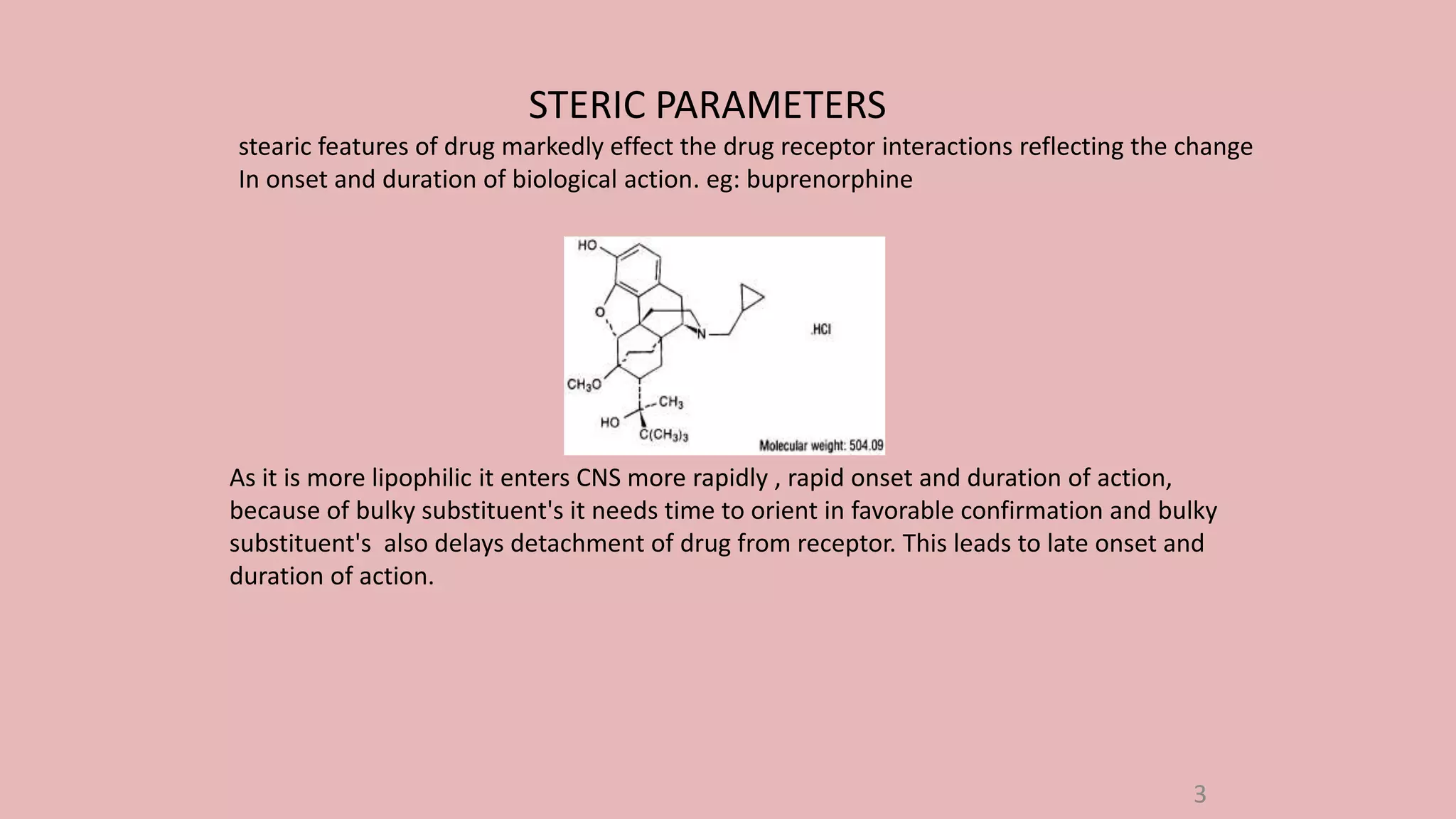
stearic features of drug markedly effect the drug receptor interactions reflecting the change
In onset and duration of biological action. eg: buprenorphine
As it is more lipophilic it enters CNS more rapidly , rapid onset and duration of action,
because of bulky substituent's it needs time to orient in favorable confirmation and bulky
substituent's also delays detachment of drug from receptor. This leads to late onset and
duration of action.
3
4/6/2022
 much harder to quantitate
 Examples are:
 Taft’s steric factor (Es) (~1956), an experimental value based on
rate constants
 Molar refractivity (MR)--measure of the volume occupied by an atom
or group--equation includes the MW, density, and the index of
refraction—
 Verloop steric parameter--computer program uses bond angles, van der
Waals radii, bond lengths
Steric Effects
The Taft equation is a linear free energy relationship (LFER) used in physical organic chemistry
in the study of reaction mechanisms and in the development of quantitative structure activity
relationships for organic compounds. It was developed by Robert W. Taft in 1952 as a
modification to the Hammett equation. While the Hammett equation accounts for how field,
inductive, and resonance effects influence reaction rates, the Taft equation also describes the
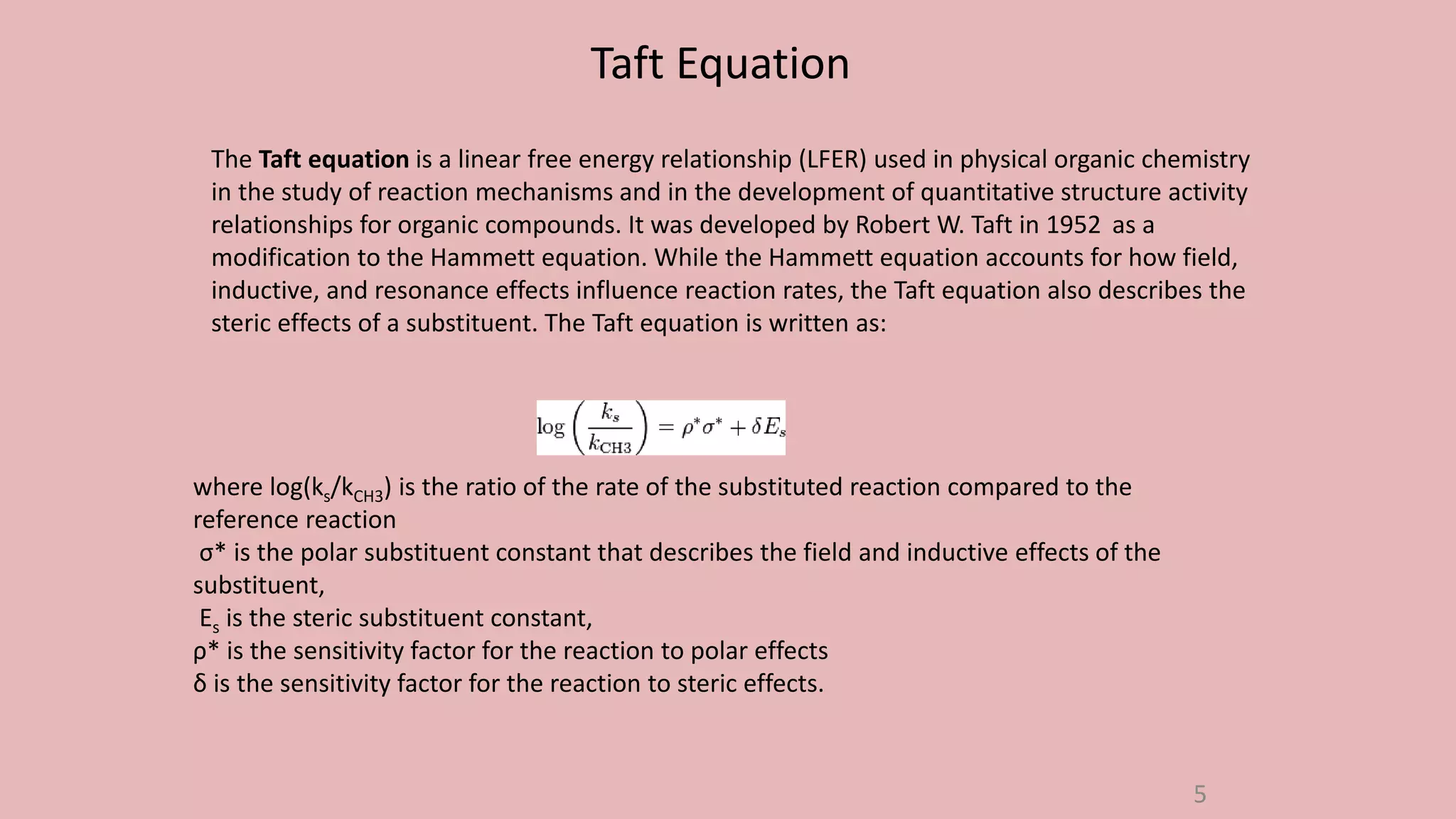
steric effects of a substituent. The Taft equation is written as:
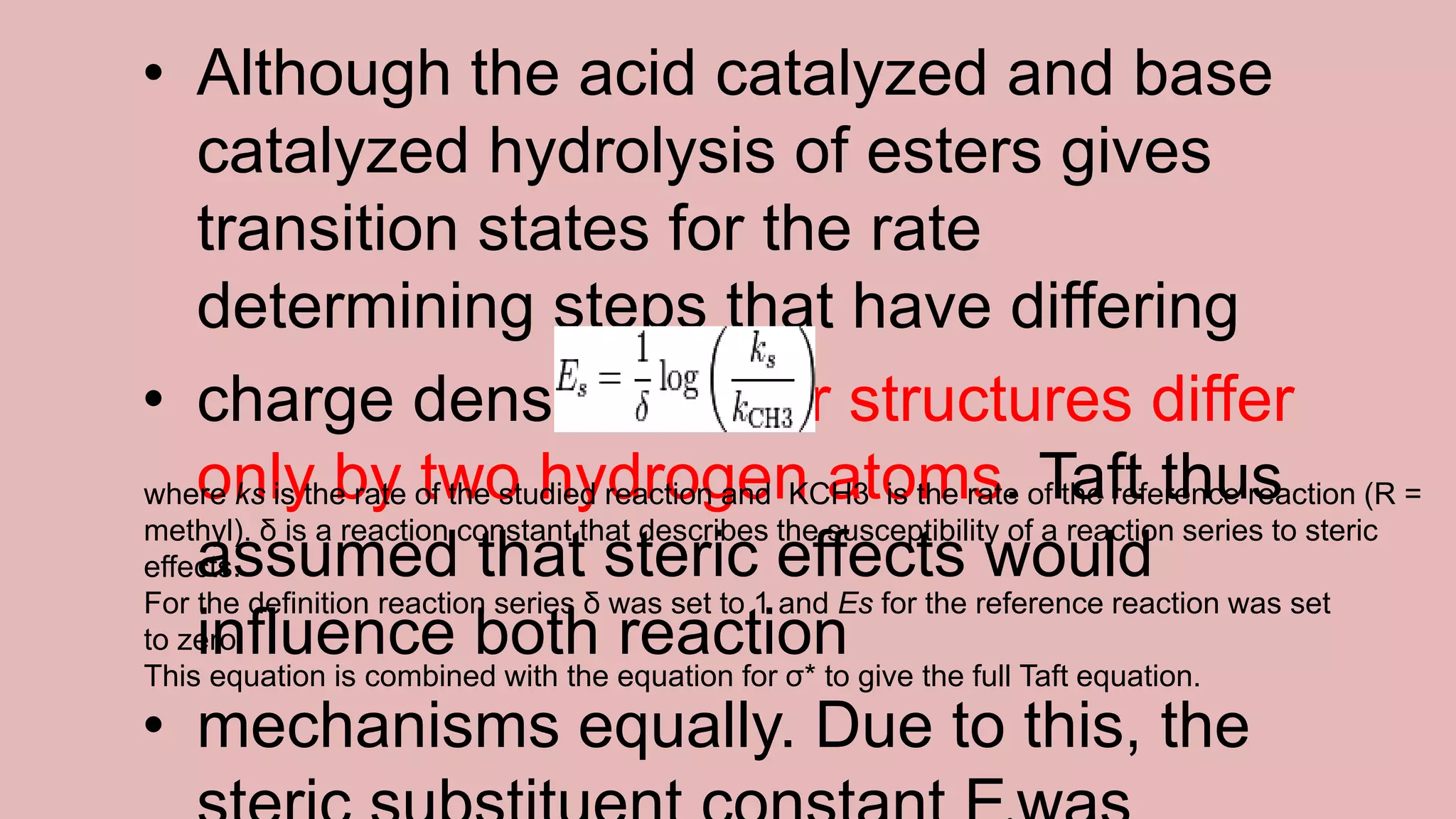
where log(ks/kCH3) is the ratio of the rate of the substituted reaction compared to the
reference reaction
σ* is the polar substituent constant that describes the field and inductive effects of the
substituent,
Es is the steric substituent constant,
ρ* is the sensitivity factor for the reaction to polar effects
δ is the sensitivity factor for the reaction to steric effects.
Taft Equation
5
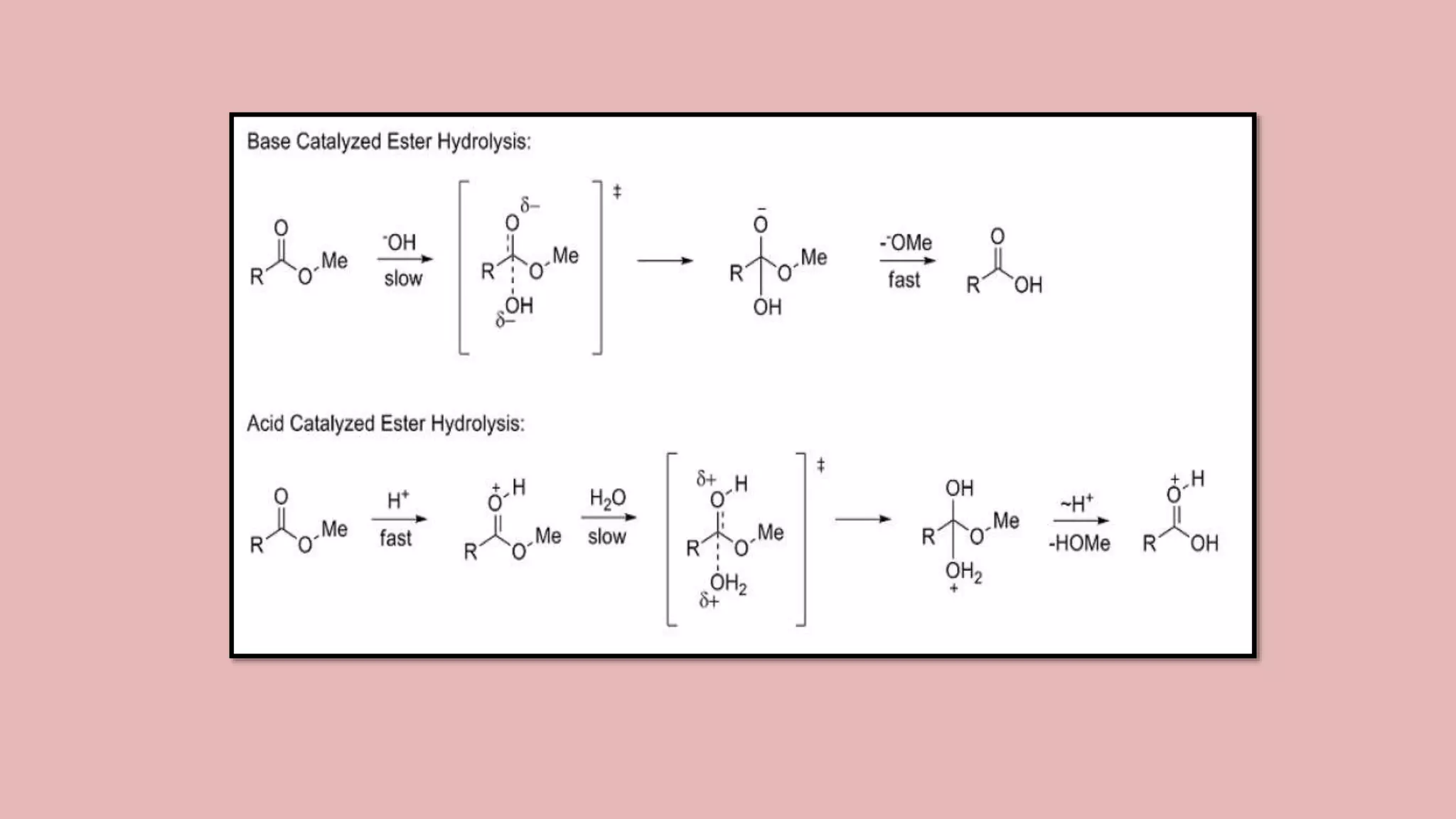
• The hydrolysis of esters can occur
through either acid and base catalyzed
mechanisms, both of which proceed
through a tetrahedral intermediate. In
the base catalyzed mechanism the
reactant goes from a neutral species to
negatively charged
• intermediate in the rate determining
(slow) step, while in the acid catalyzed
• Although the acid catalyzed and base
catalyzed hydrolysis of esters gives
transition states for the rate
determining steps that have differing
• charge densities, their structures differ
only by two hydrogen atoms. Taft thus
assumed that steric effects would
influence both reaction
• mechanisms equally. Due to this, the
where ks is the rate of the studied reaction and KCH3 is the rate of the reference reaction (R =
methyl). δ is a reaction constant that describes the susceptibility of a reaction series to steric
effects.
For the definition reaction series δ was set to 1 and Es for the reference reaction was set
to zero.
This equation is combined with the equation for σ* to give the full Taft equation.
4/6/2022
Steric Effects
 The third major factor that often must be
considered in QSAR involves steric effects.
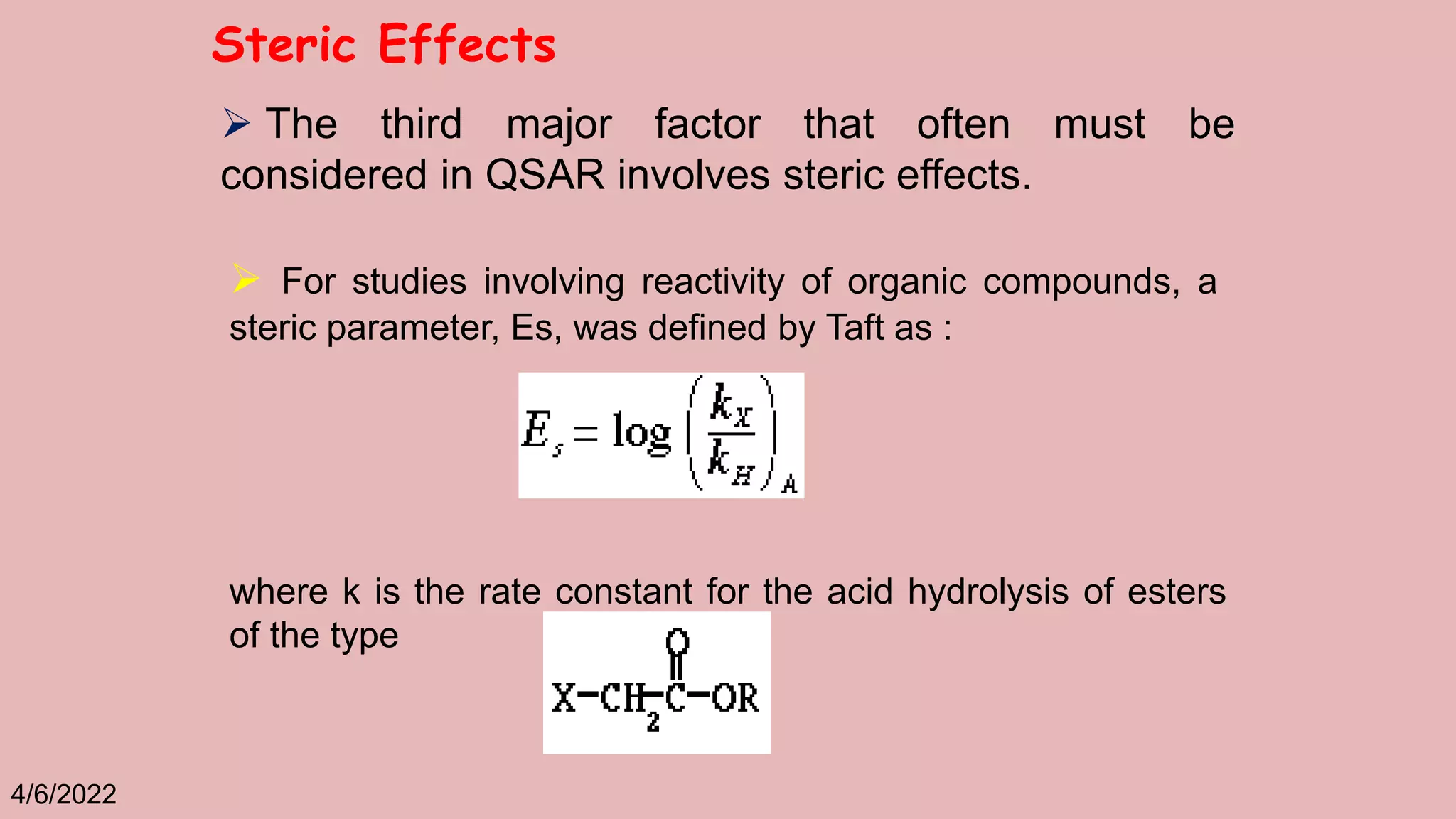
 For studies involving reactivity of organic compounds, a
steric parameter, Es, was defined by Taft as :
where k is the rate constant for the acid hydrolysis of esters
of the type
4/6/2022
– Assuming the electronic effects of substituent X
can be ignored, the size of X will affect the transition
state and hence the rate of reaction.
– By definition Es = 0 for X=H.
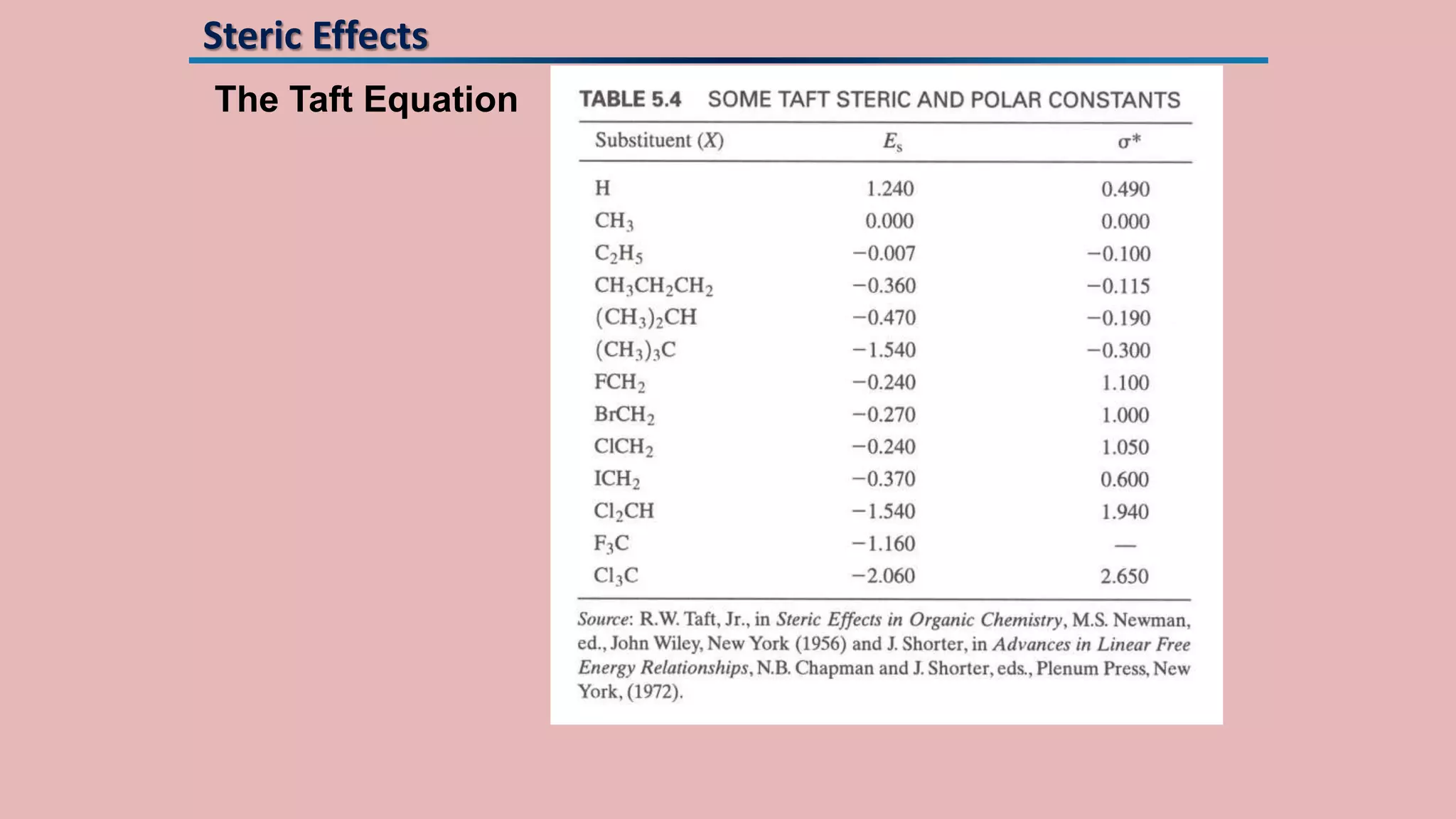
– Tables of values of Es for other substituents are
available.
Steric Effects
The Taft Equation
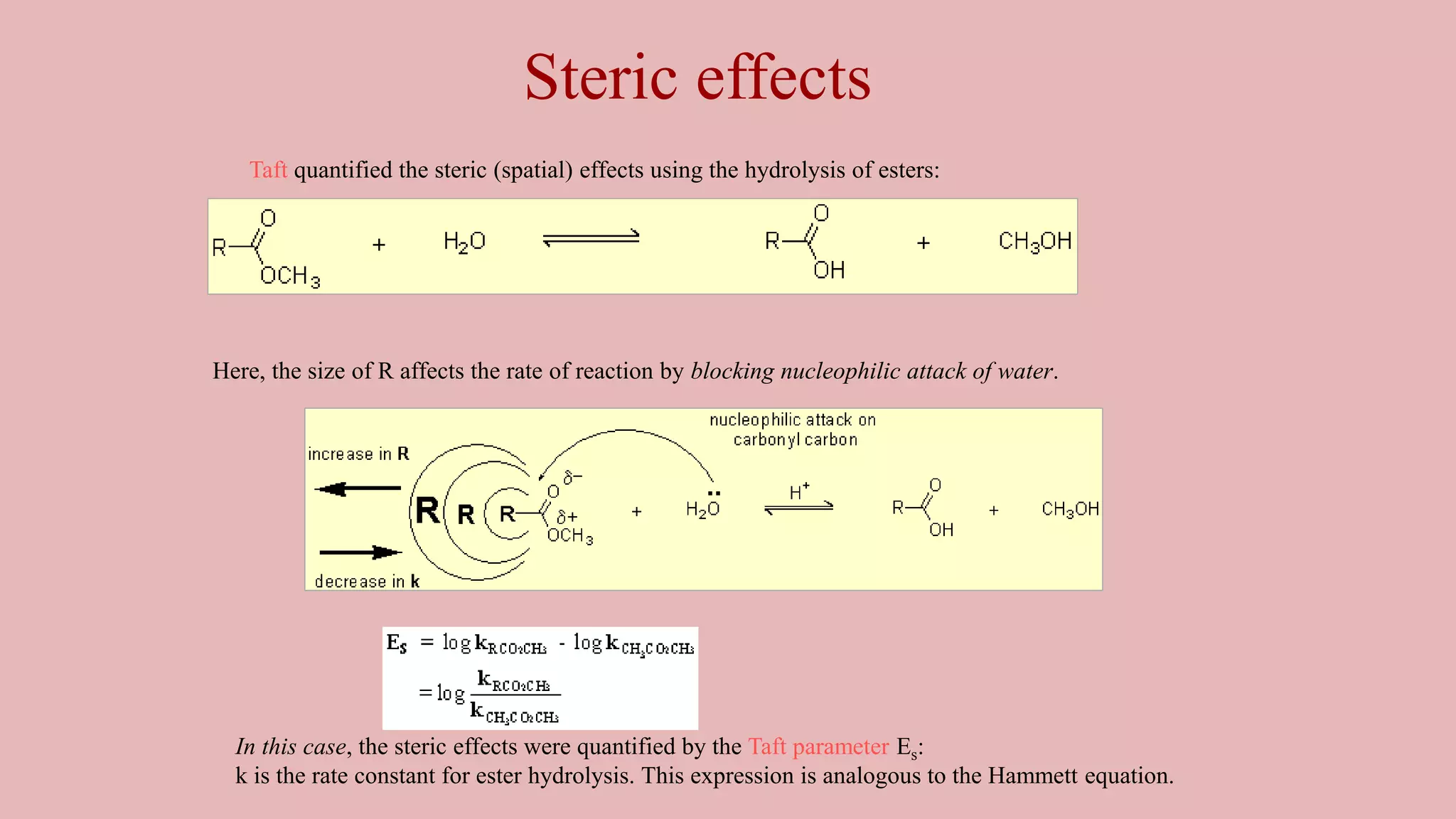
Here, the size of R affects the rate of reaction by blocking nucleophilic attack of water.
Taft quantified the steric (spatial) effects using the hydrolysis of esters:
In this case, the steric effects were quantified by the Taft parameter Es:
k is the rate constant for ester hydrolysis. This expression is analogous to the Hammett equation.
Steric effects
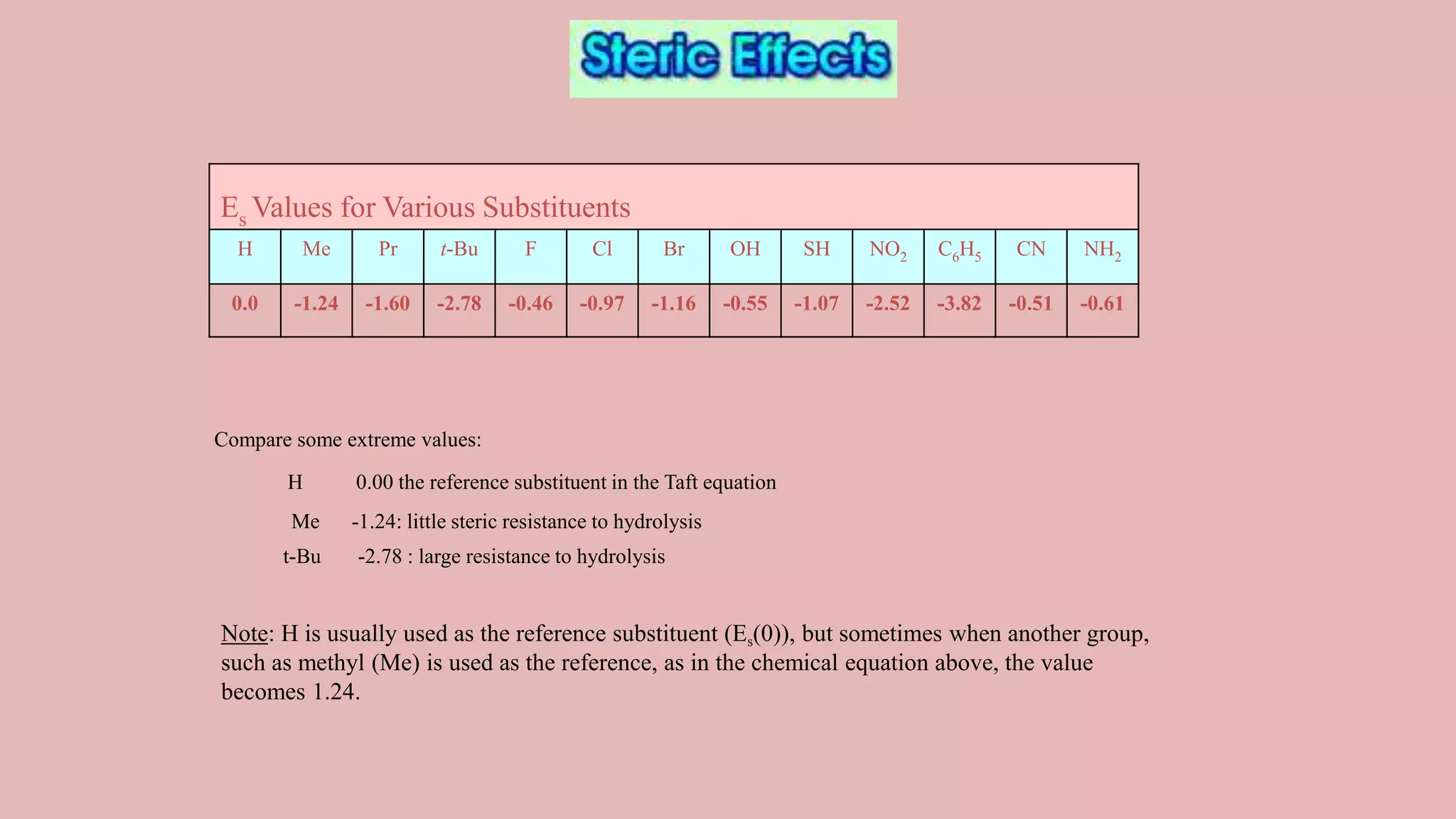
t-Bu -2.78 : large resistance to hydrolysis
Me -1.24: little steric resistance to hydrolysis
H 0.00 the reference substituent in the Taft equation
Compare some extreme values:
Es Values for Various Substituents
H Me Pr t-Bu F Cl Br OH SH NO2 C6H5 CN NH2
0.0 -1.24 -1.60 -2.78 -0.46 -0.97 -1.16 -0.55 -1.07 -2.52 -3.82 -0.51 -0.61
Note: H is usually used as the reference substituent (Es(0)), but sometimes when another group,
such as methyl (Me) is used as the reference, as in the chemical equation above, the value
becomes 1.24.
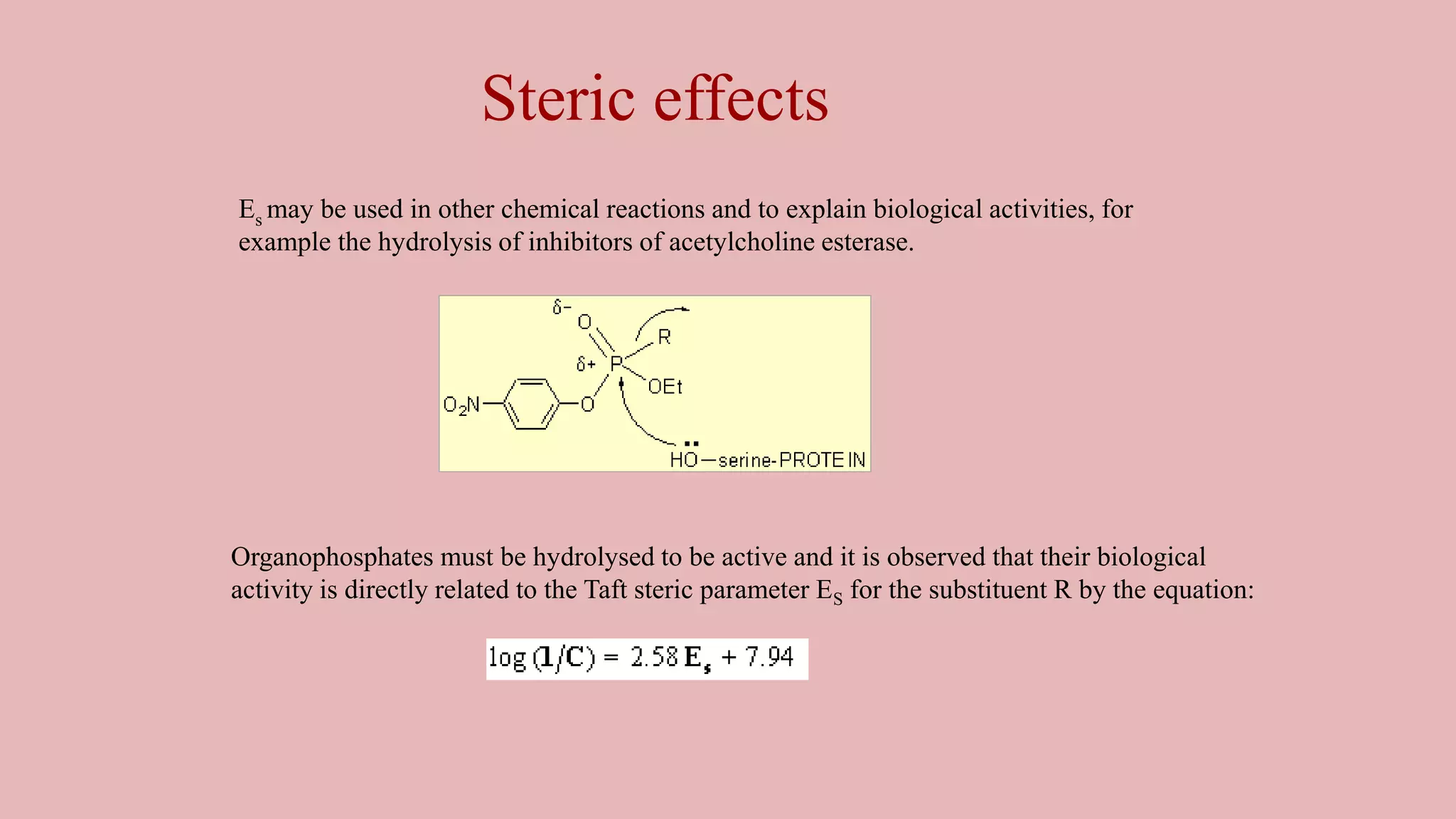
Organophosphates must be hydrolysed to be active and it is observed that their biological
activity is directly related to the Taft steric parameter ES for the substituent R by the equation:
Es may be used in other chemical reactions and to explain biological activities, for
example the hydrolysis of inhibitors of acetylcholine esterase.
Steric effects
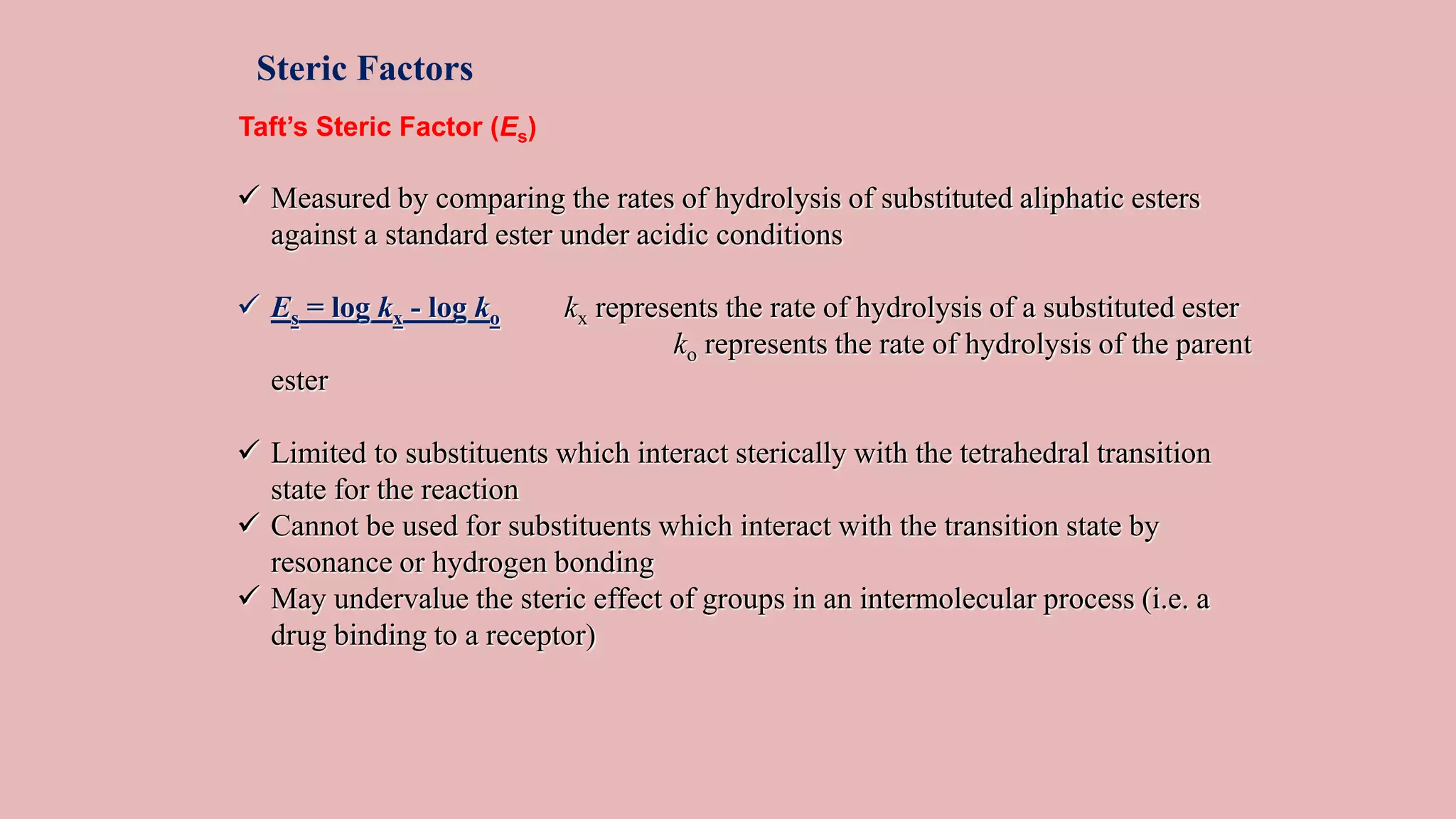
Steric Factors
Taft’s Steric Factor (Es)
 Measured by comparing the rates of hydrolysis of substituted aliphatic esters
against a standard ester under acidic conditions
 Es = log kx - log ko kx represents the rate of hydrolysis of a substituted ester
ko represents the rate of hydrolysis of the parent
ester
 Limited to substituents which interact sterically with the tetrahedral transition
state for the reaction
 Cannot be used for substituents which interact with the transition state by
resonance or hydrogen bonding
 May undervalue the steric effect of groups in an intermolecular process (i.e. a
drug binding to a receptor)
Steric parameters  taft’s steric factor (es)

Steric parameters taft’s steric factor (es)

  • 1.
    STERIC PARAMETERS- Taft’ssteric factor (Es)
  • 3.
    STERIC PARAMETERS stearic featuresof drug markedly effect the drug receptor interactions reflecting the change In onset and duration of biological action. eg: buprenorphine As it is more lipophilic it enters CNS more rapidly , rapid onset and duration of action, because of bulky substituent's it needs time to orient in favorable confirmation and bulky substituent's also delays detachment of drug from receptor. This leads to late onset and duration of action. 3
  • 4.
    4/6/2022  much harderto quantitate  Examples are:  Taft’s steric factor (Es) (~1956), an experimental value based on rate constants  Molar refractivity (MR)--measure of the volume occupied by an atom or group--equation includes the MW, density, and the index of refraction—  Verloop steric parameter--computer program uses bond angles, van der Waals radii, bond lengths Steric Effects
  • 5.
    The Taft equationis a linear free energy relationship (LFER) used in physical organic chemistry in the study of reaction mechanisms and in the development of quantitative structure activity relationships for organic compounds. It was developed by Robert W. Taft in 1952 as a modification to the Hammett equation. While the Hammett equation accounts for how field, inductive, and resonance effects influence reaction rates, the Taft equation also describes the steric effects of a substituent. The Taft equation is written as: where log(ks/kCH3) is the ratio of the rate of the substituted reaction compared to the reference reaction σ* is the polar substituent constant that describes the field and inductive effects of the substituent, Es is the steric substituent constant, ρ* is the sensitivity factor for the reaction to polar effects δ is the sensitivity factor for the reaction to steric effects. Taft Equation 5
  • 6.
    • The hydrolysisof esters can occur through either acid and base catalyzed mechanisms, both of which proceed through a tetrahedral intermediate. In the base catalyzed mechanism the reactant goes from a neutral species to negatively charged • intermediate in the rate determining (slow) step, while in the acid catalyzed
  • 8.
    • Although theacid catalyzed and base catalyzed hydrolysis of esters gives transition states for the rate determining steps that have differing • charge densities, their structures differ only by two hydrogen atoms. Taft thus assumed that steric effects would influence both reaction • mechanisms equally. Due to this, the where ks is the rate of the studied reaction and KCH3 is the rate of the reference reaction (R = methyl). δ is a reaction constant that describes the susceptibility of a reaction series to steric effects. For the definition reaction series δ was set to 1 and Es for the reference reaction was set to zero. This equation is combined with the equation for σ* to give the full Taft equation.
  • 9.
    4/6/2022 Steric Effects  Thethird major factor that often must be considered in QSAR involves steric effects.  For studies involving reactivity of organic compounds, a steric parameter, Es, was defined by Taft as : where k is the rate constant for the acid hydrolysis of esters of the type
  • 10.
    4/6/2022 – Assuming theelectronic effects of substituent X can be ignored, the size of X will affect the transition state and hence the rate of reaction. – By definition Es = 0 for X=H. – Tables of values of Es for other substituents are available.
  • 11.
  • 12.
    Here, the sizeof R affects the rate of reaction by blocking nucleophilic attack of water. Taft quantified the steric (spatial) effects using the hydrolysis of esters: In this case, the steric effects were quantified by the Taft parameter Es: k is the rate constant for ester hydrolysis. This expression is analogous to the Hammett equation. Steric effects
  • 13.
    t-Bu -2.78 :large resistance to hydrolysis Me -1.24: little steric resistance to hydrolysis H 0.00 the reference substituent in the Taft equation Compare some extreme values: Es Values for Various Substituents H Me Pr t-Bu F Cl Br OH SH NO2 C6H5 CN NH2 0.0 -1.24 -1.60 -2.78 -0.46 -0.97 -1.16 -0.55 -1.07 -2.52 -3.82 -0.51 -0.61 Note: H is usually used as the reference substituent (Es(0)), but sometimes when another group, such as methyl (Me) is used as the reference, as in the chemical equation above, the value becomes 1.24.
  • 14.
    Organophosphates must behydrolysed to be active and it is observed that their biological activity is directly related to the Taft steric parameter ES for the substituent R by the equation: Es may be used in other chemical reactions and to explain biological activities, for example the hydrolysis of inhibitors of acetylcholine esterase. Steric effects
  • 15.
    Steric Factors Taft’s StericFactor (Es)  Measured by comparing the rates of hydrolysis of substituted aliphatic esters against a standard ester under acidic conditions  Es = log kx - log ko kx represents the rate of hydrolysis of a substituted ester ko represents the rate of hydrolysis of the parent ester  Limited to substituents which interact sterically with the tetrahedral transition state for the reaction  Cannot be used for substituents which interact with the transition state by resonance or hydrogen bonding  May undervalue the steric effect of groups in an intermolecular process (i.e. a drug binding to a receptor)