SYNTHETIC
REAGENTS AND
APPLICATIONS
T C AISWARYA
FIRST YEAR MPHARM
DEPARTMENT OF PHARMACEUTICAL CHEMISTRY
NGSMIPS
1
Organic reactions involve reagents and substrates.
Chemical reagents bring about various types of changes in organic molecules to
yield products of immense value
Reagents have been found that can degrade complex molecules to simple
known molecules which enabled us to elucidate the structures of complex
compounds
A suitable choice of reagent and reaction conditions are essential for the success
of a reaction for the desired product
2
A few of the most important and widely used reagents along with a
few novel catalysts for the synthesis of a large varieties of natural
products, commercially useful chemicals of medicinal and industrial
importance have been included
Their preparations, mode of applications and mechanistic aspects
along with their uses are included
3
We discuss the following reagents:-
1) Aluminium isopropoxide
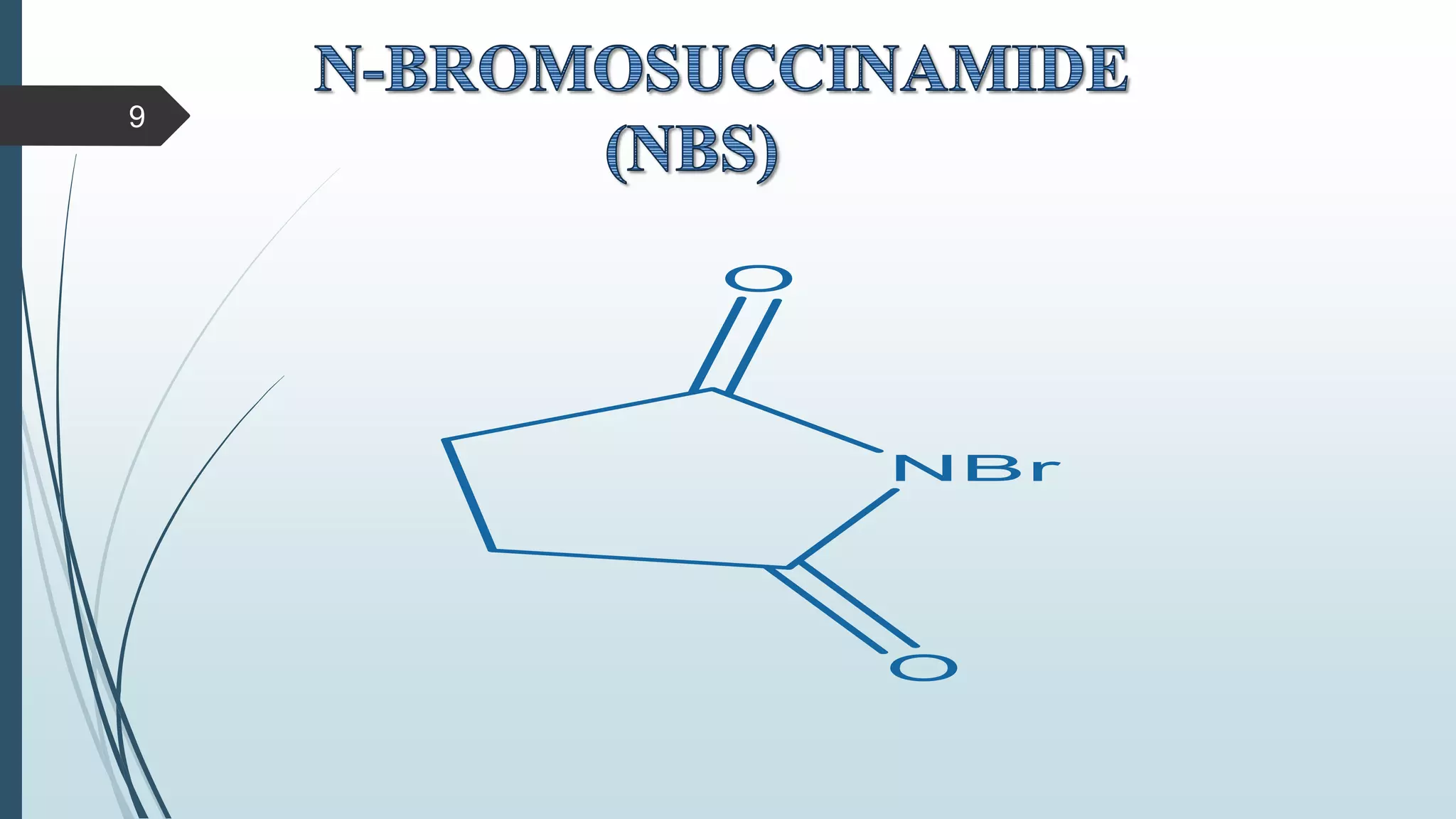
2) N-bromosuccinamide
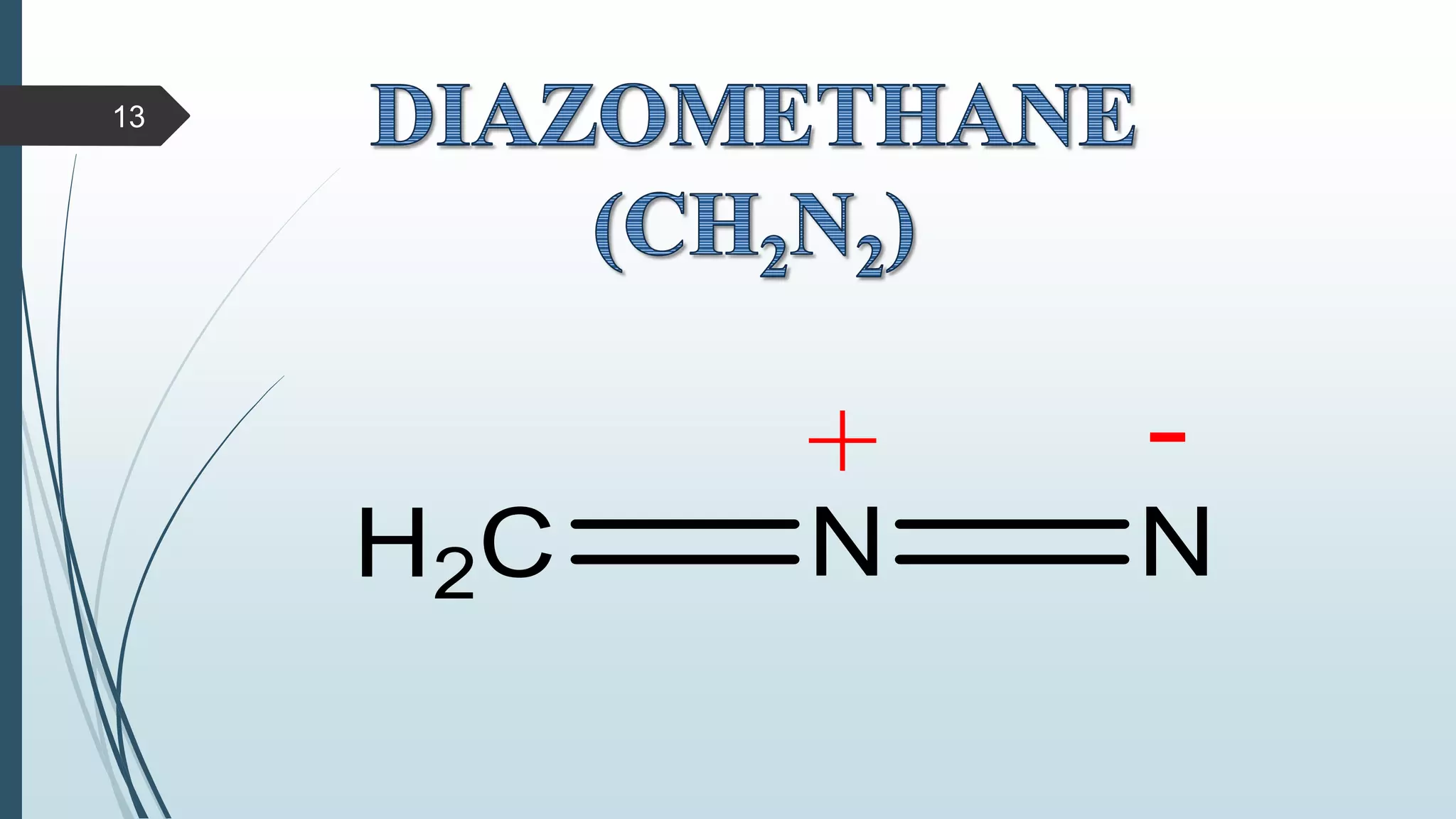
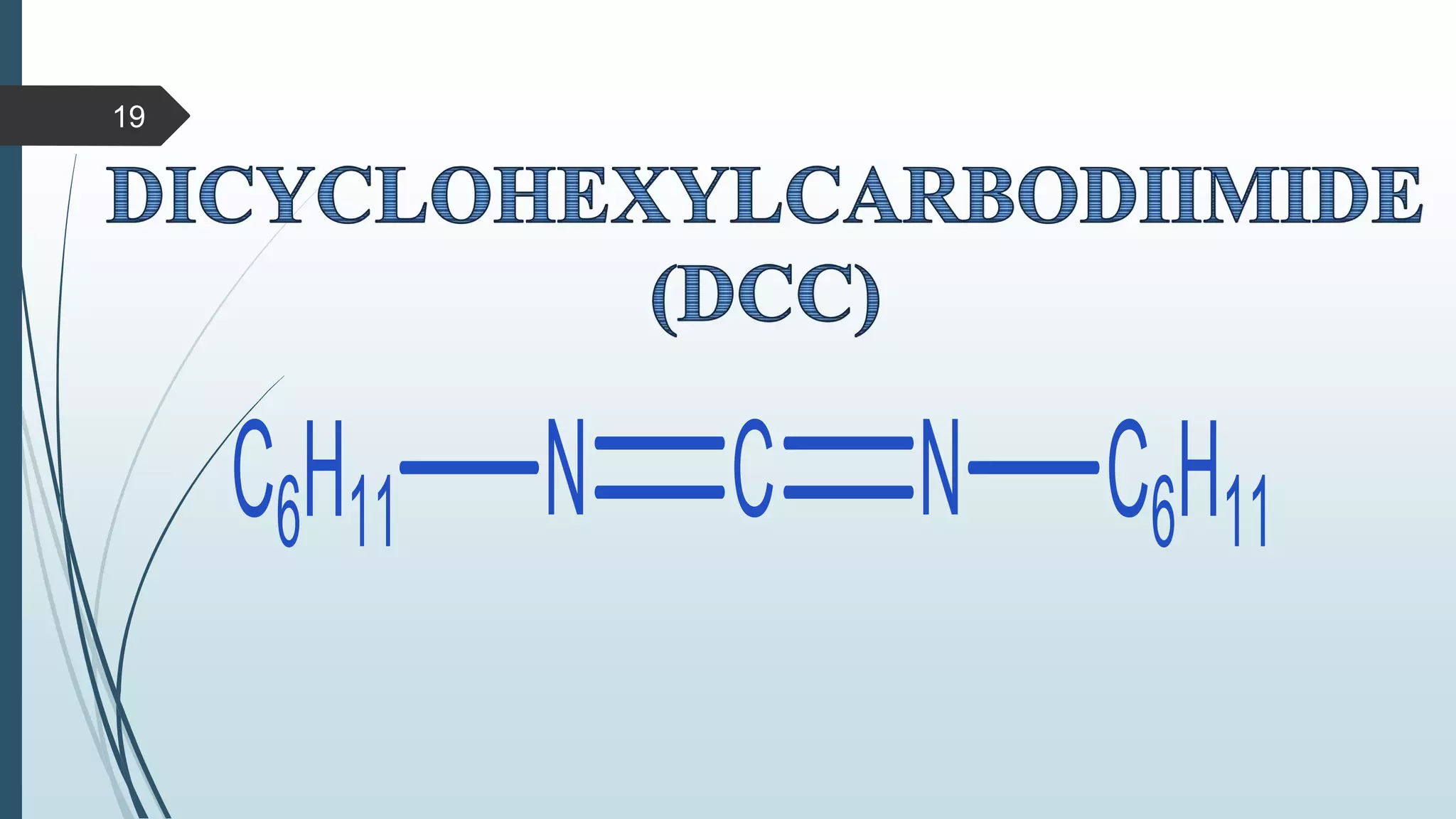
3) Diazomethane
4) Dicyclohexylcarbodiimide
5) Wilkinson reagent
6) Wittig reagent
4
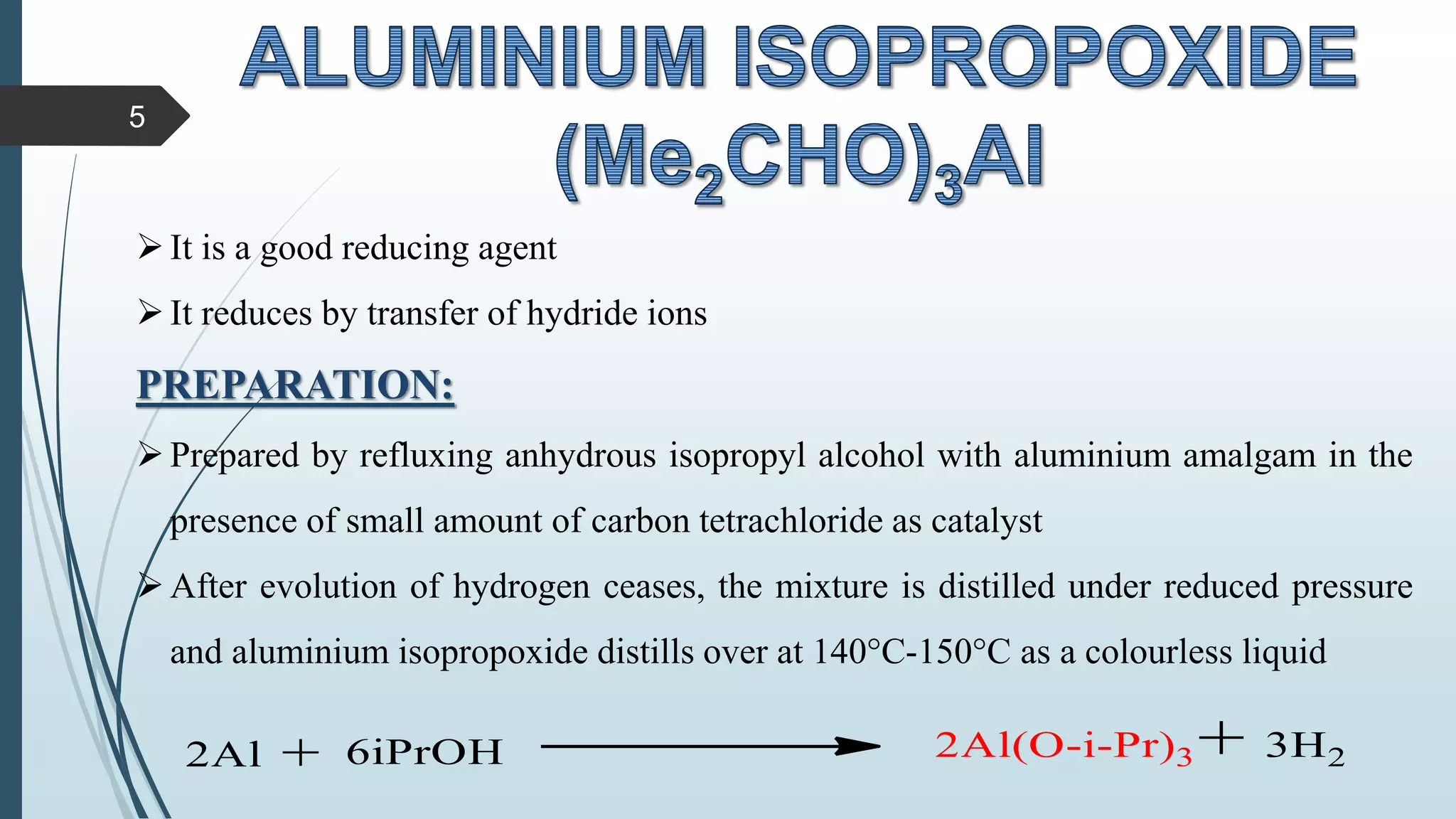
It is a good reducing agent
It reduces by transfer of hydride ions
PREPARATION:
Prepared by refluxing anhydrous isopropyl alcohol with aluminium amalgam in the
presence of small amount of carbon tetrachloride as catalyst
After evolution of hydrogen ceases, the mixture is distilled under reduced pressure
and aluminium isopropoxide distills over at 140°C-150°C as a colourless liquid
5
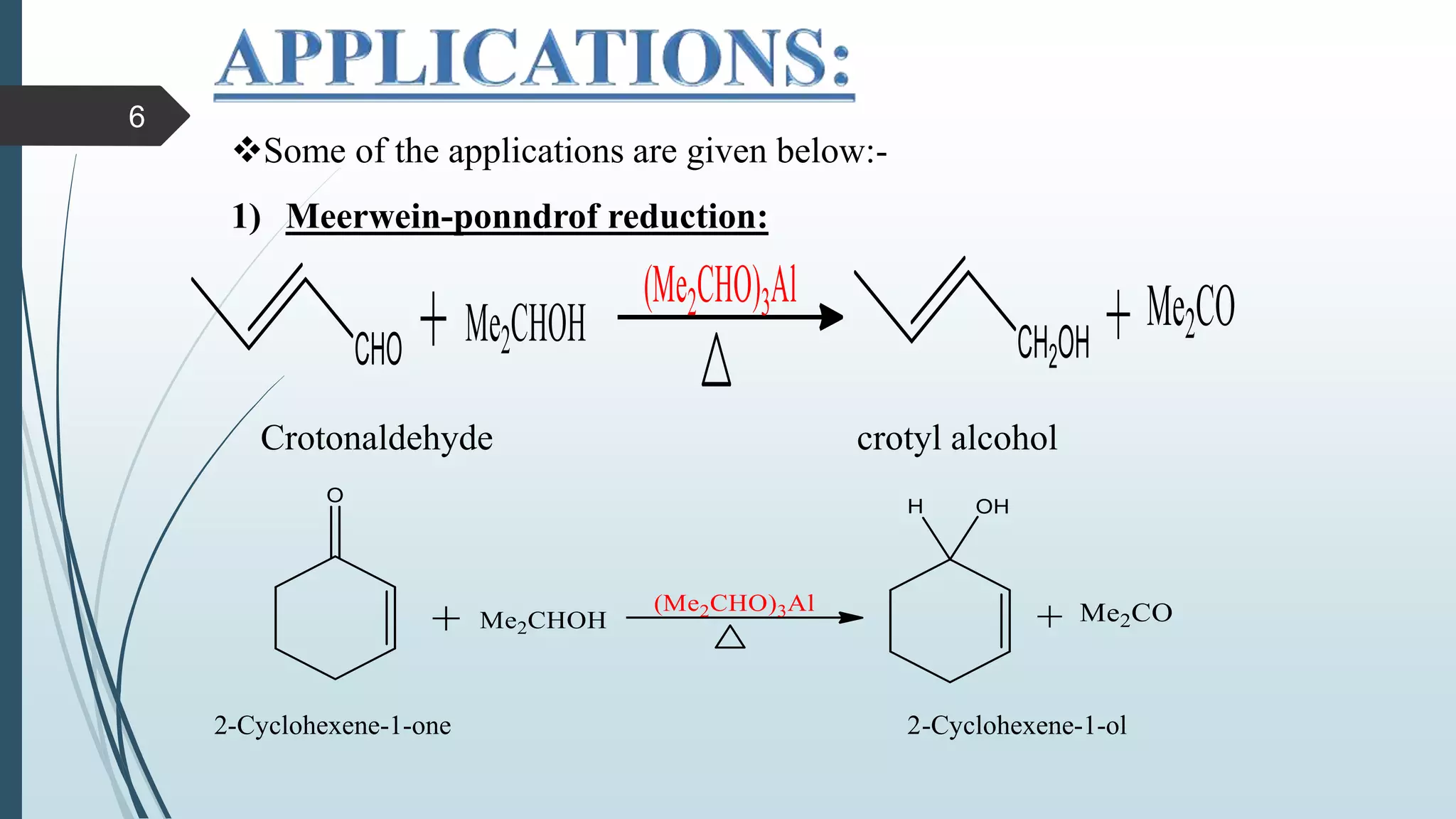
Some of the applications are given below:-
1) Meerwein-ponndrof reduction:
Crotonaldehyde crotyl alcohol
2-Cyclohexene-1-one 2-Cyclohexene-1-ol
6
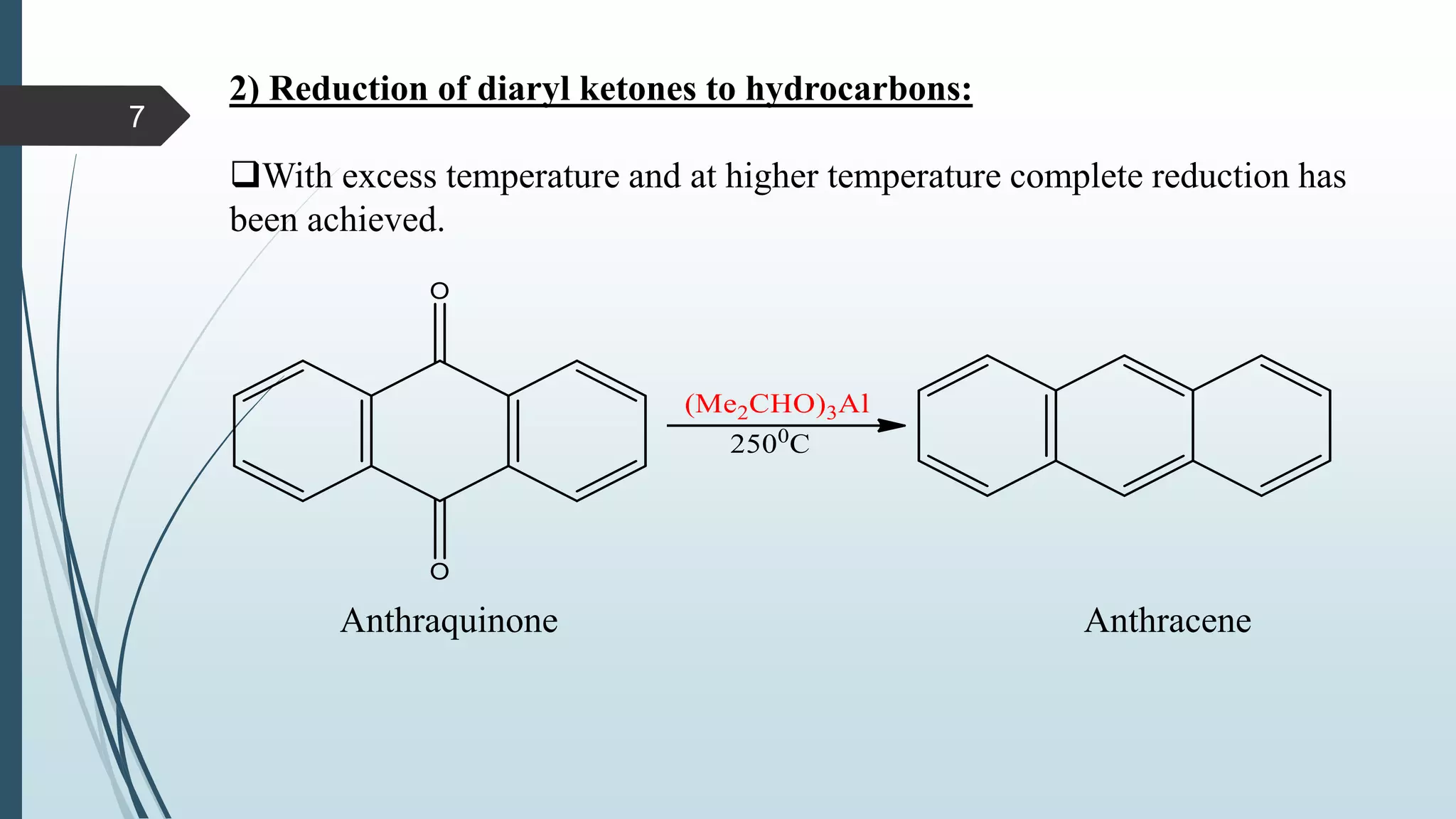
2) Reduction of diaryl ketones to hydrocarbons:
With excess temperature and at higher temperature complete reduction has
been achieved.
Anthraquinone Anthracene
7
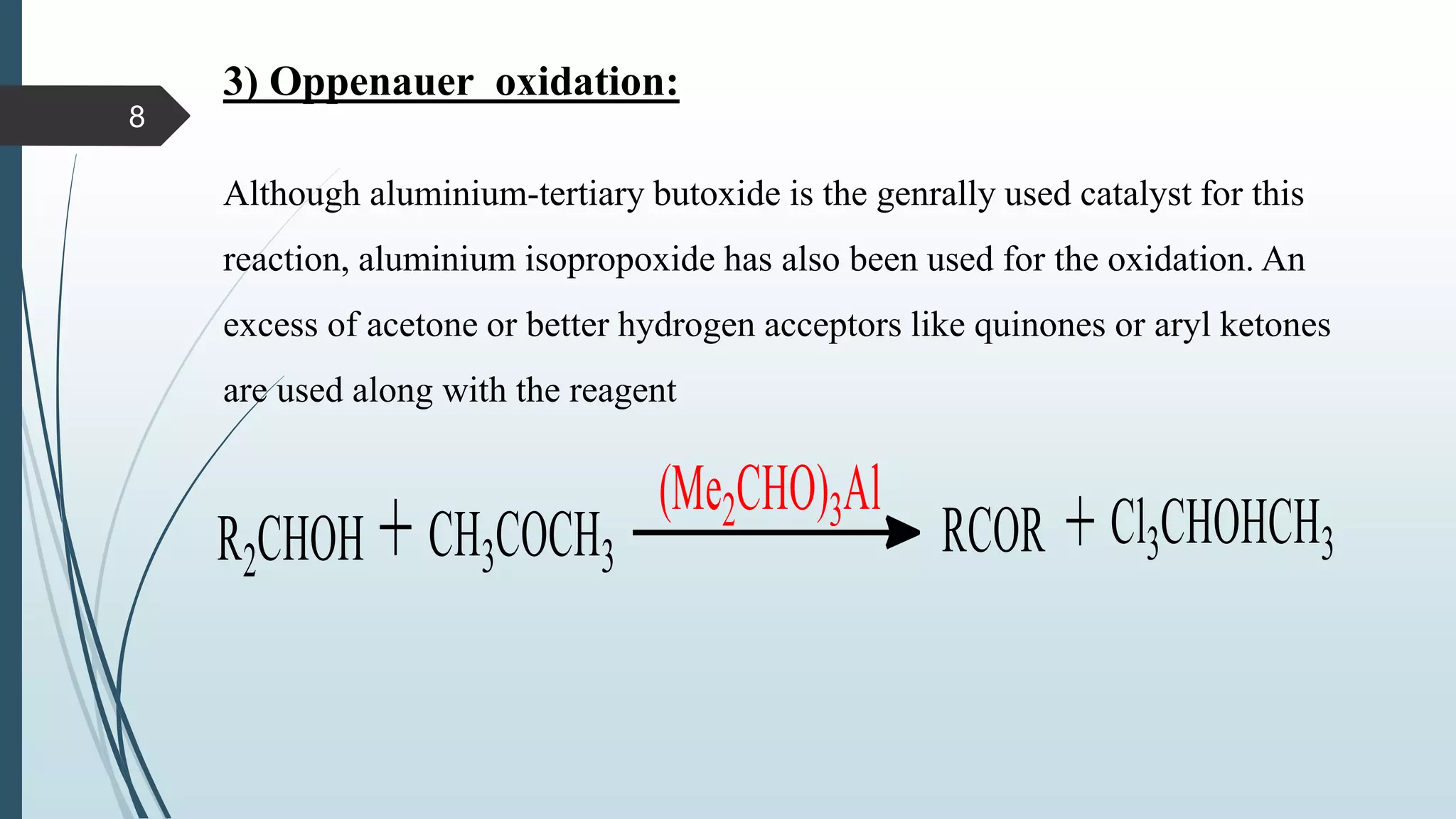
3) Oppenauer oxidation:
Although aluminium-tertiary butoxide is the genrally used catalyst for this
reaction, aluminium isopropoxide has also been used for the oxidation. An
excess of acetone or better hydrogen acceptors like quinones or aryl ketones
are used along with the reagent
8
9
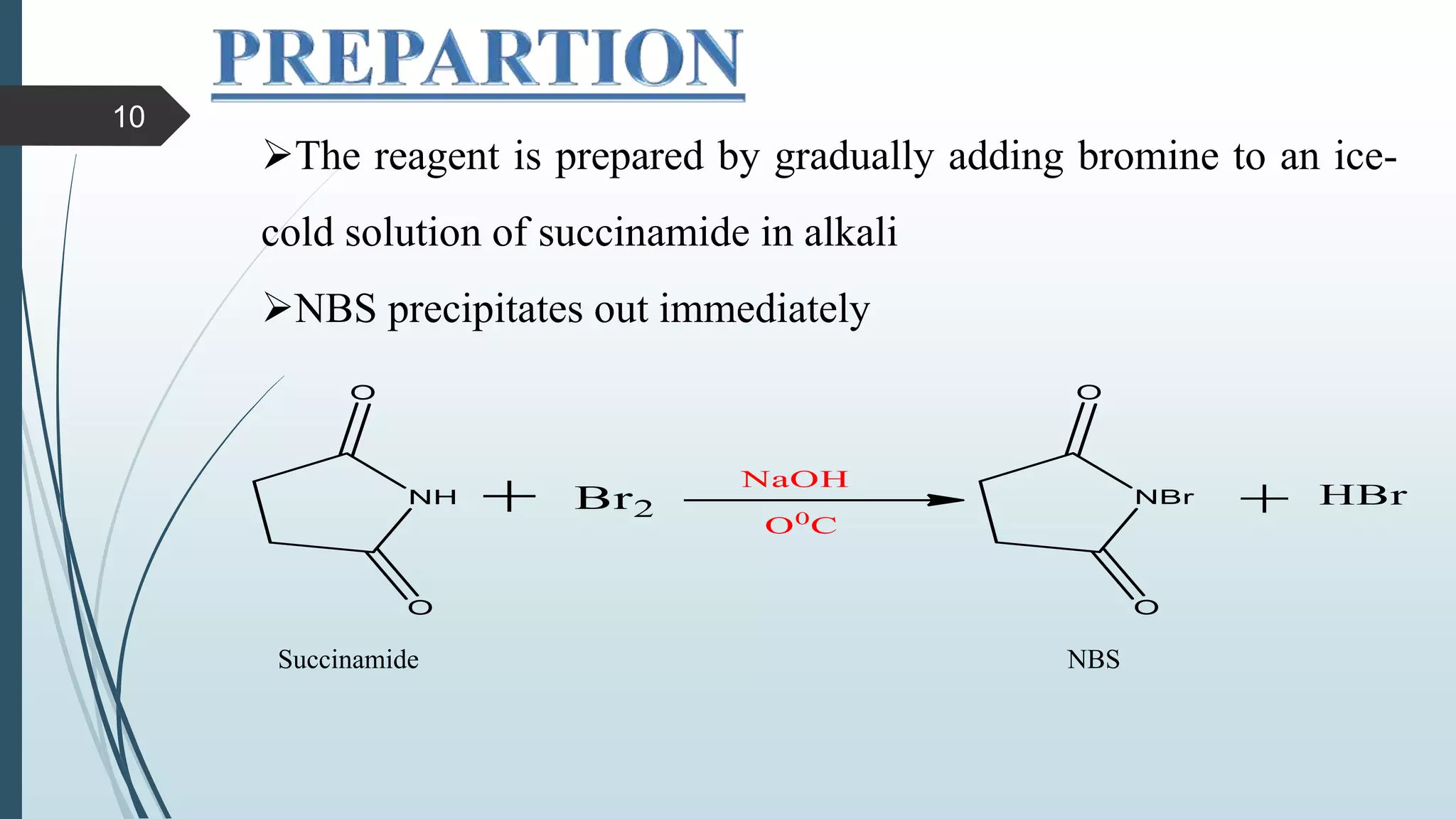
The reagent is prepared by gradually adding bromine to an ice-
cold solution of succinamide in alkali
NBS precipitates out immediately
Succinamide NBS
10
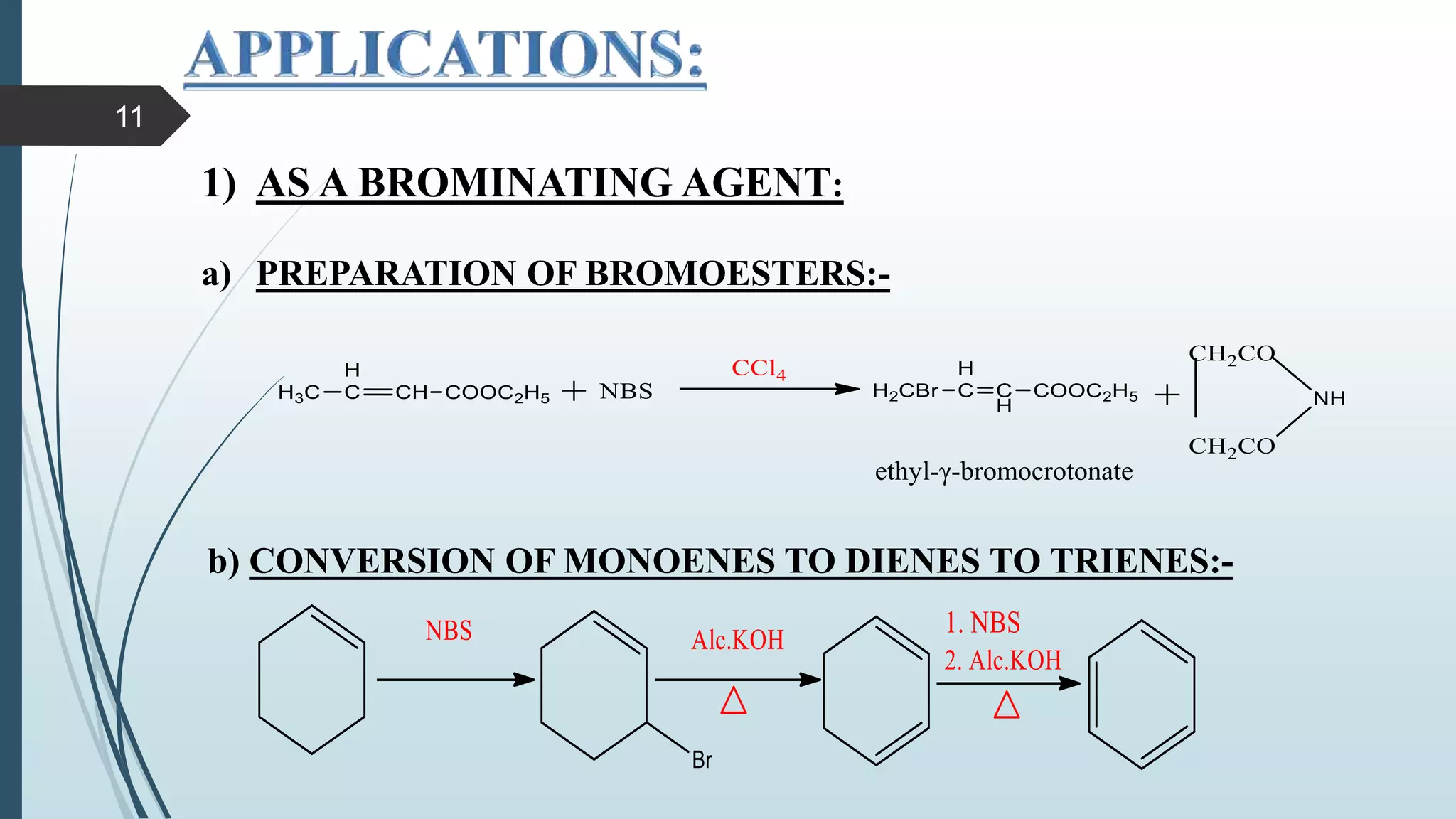
1) AS A BROMINATING AGENT:
a) PREPARATION OF BROMOESTERS:-
b) CONVERSION OF MONOENES TO DIENES TO TRIENES:-
ethyl-γ-bromocrotonate
11
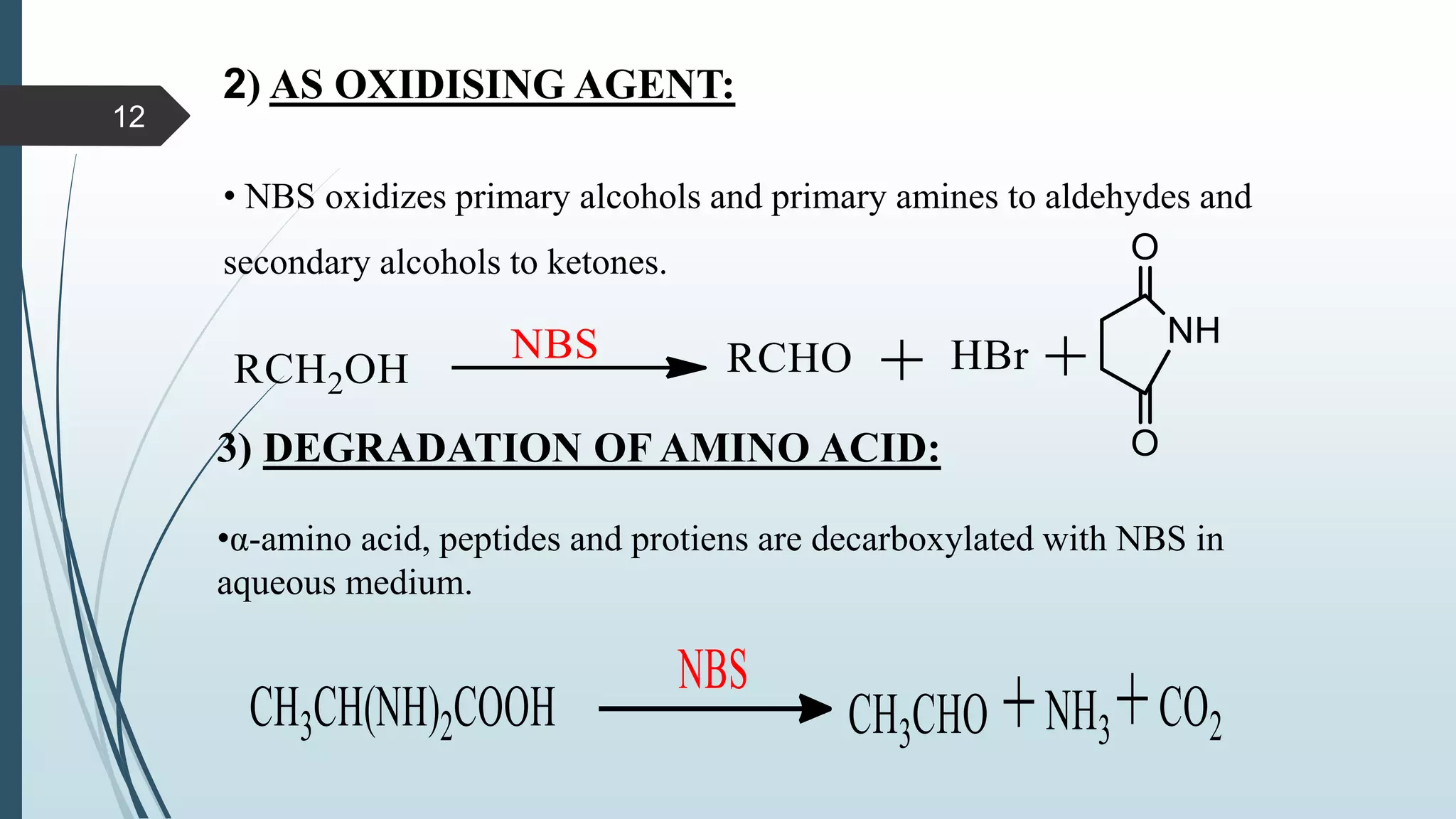
2) AS OXIDISING AGENT:
• NBS oxidizes primary alcohols and primary amines to aldehydes and
secondary alcohols to ketones.
3) DEGRADATION OF AMINO ACID:
•α-amino acid, peptides and protiens are decarboxylated with NBS in
aqueous medium.
12
13
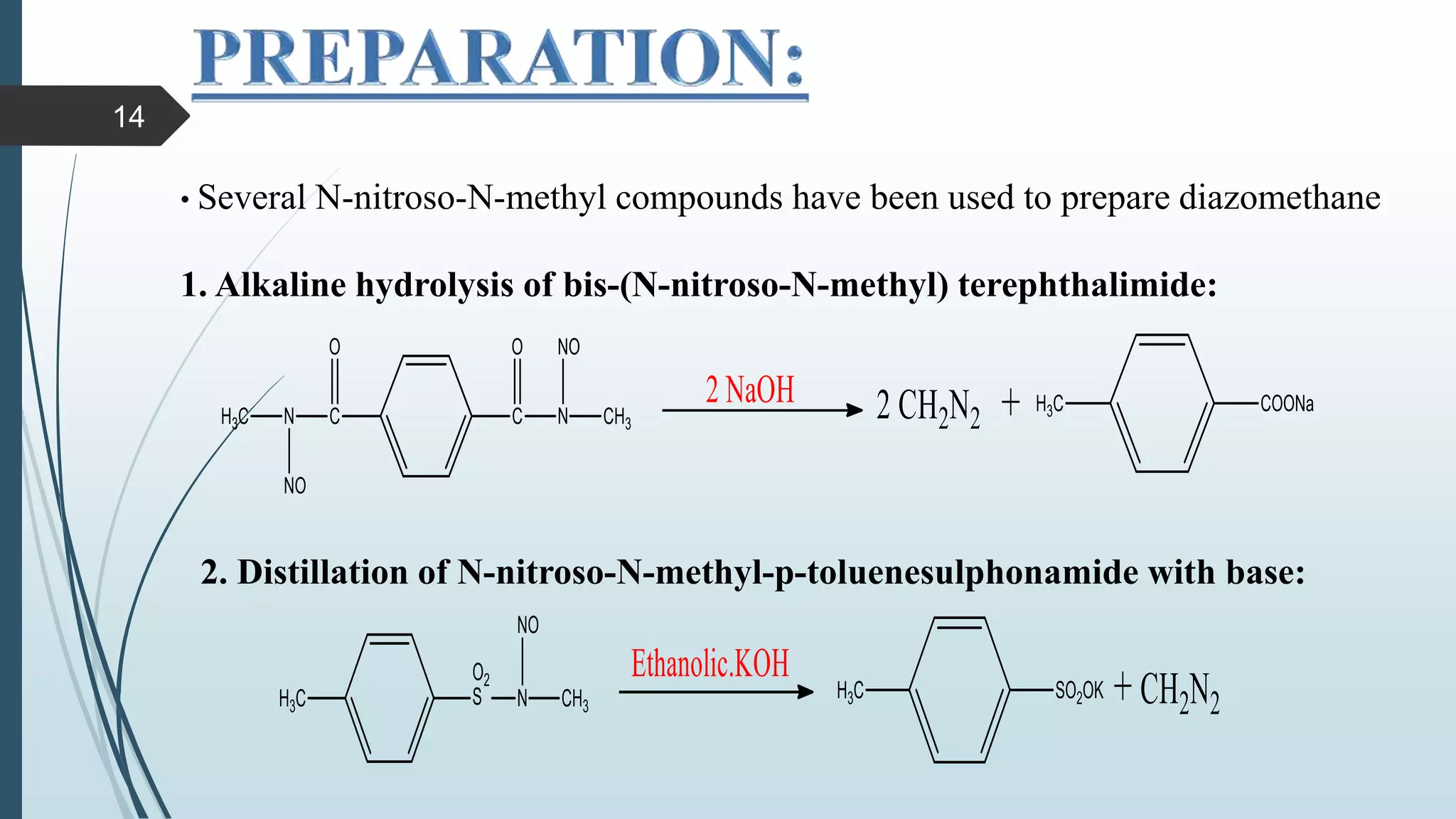
• Several N-nitroso-N-methyl compounds have been used to prepare diazomethane
1. Alkaline hydrolysis of bis-(N-nitroso-N-methyl) terephthalimide:
2. Distillation of N-nitroso-N-methyl-p-toluenesulphonamide with base:
14
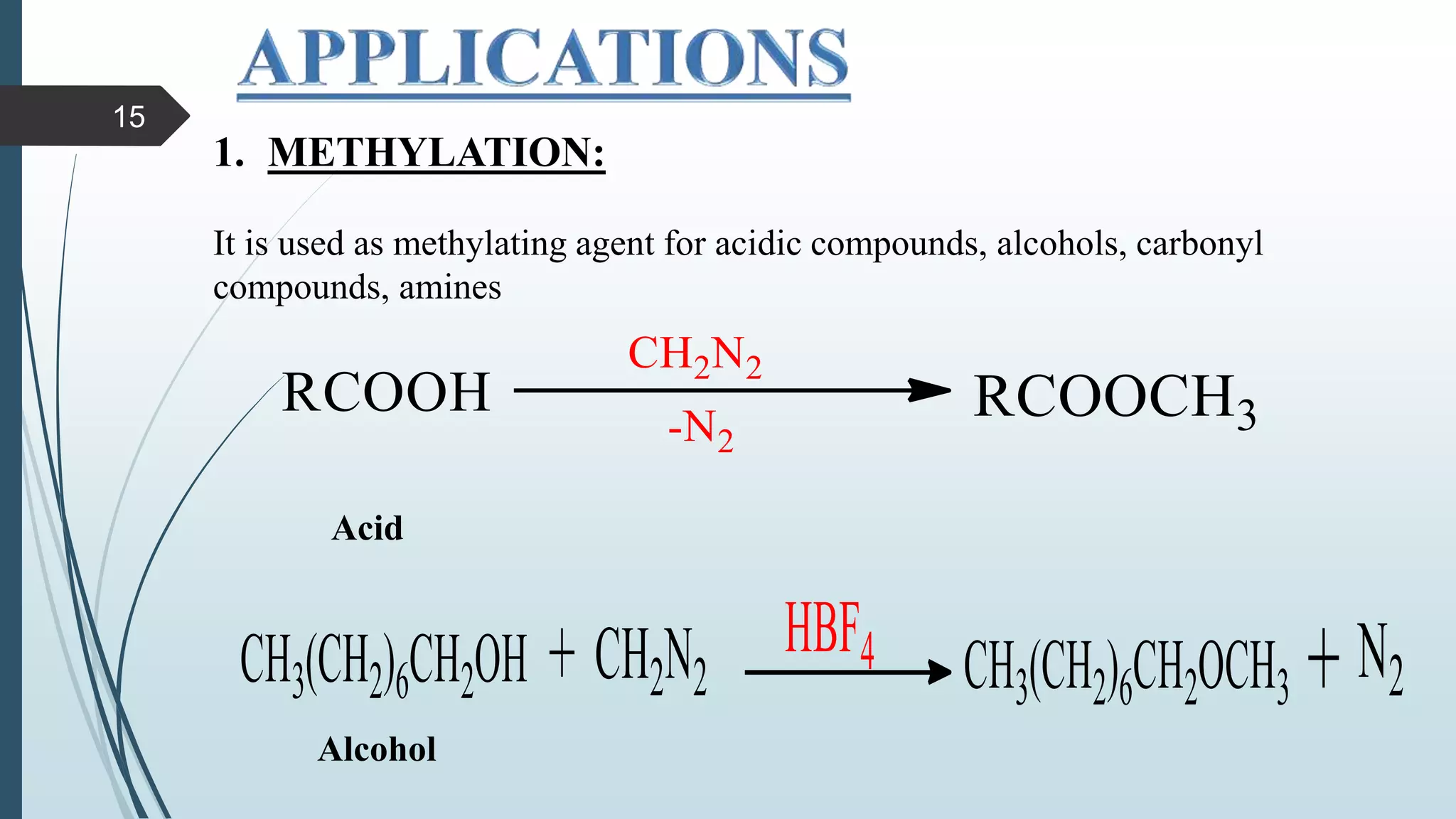
1. METHYLATION:
It is used as methylating agent for acidic compounds, alcohols, carbonyl
compounds, amines
Acid
Alcohol
15
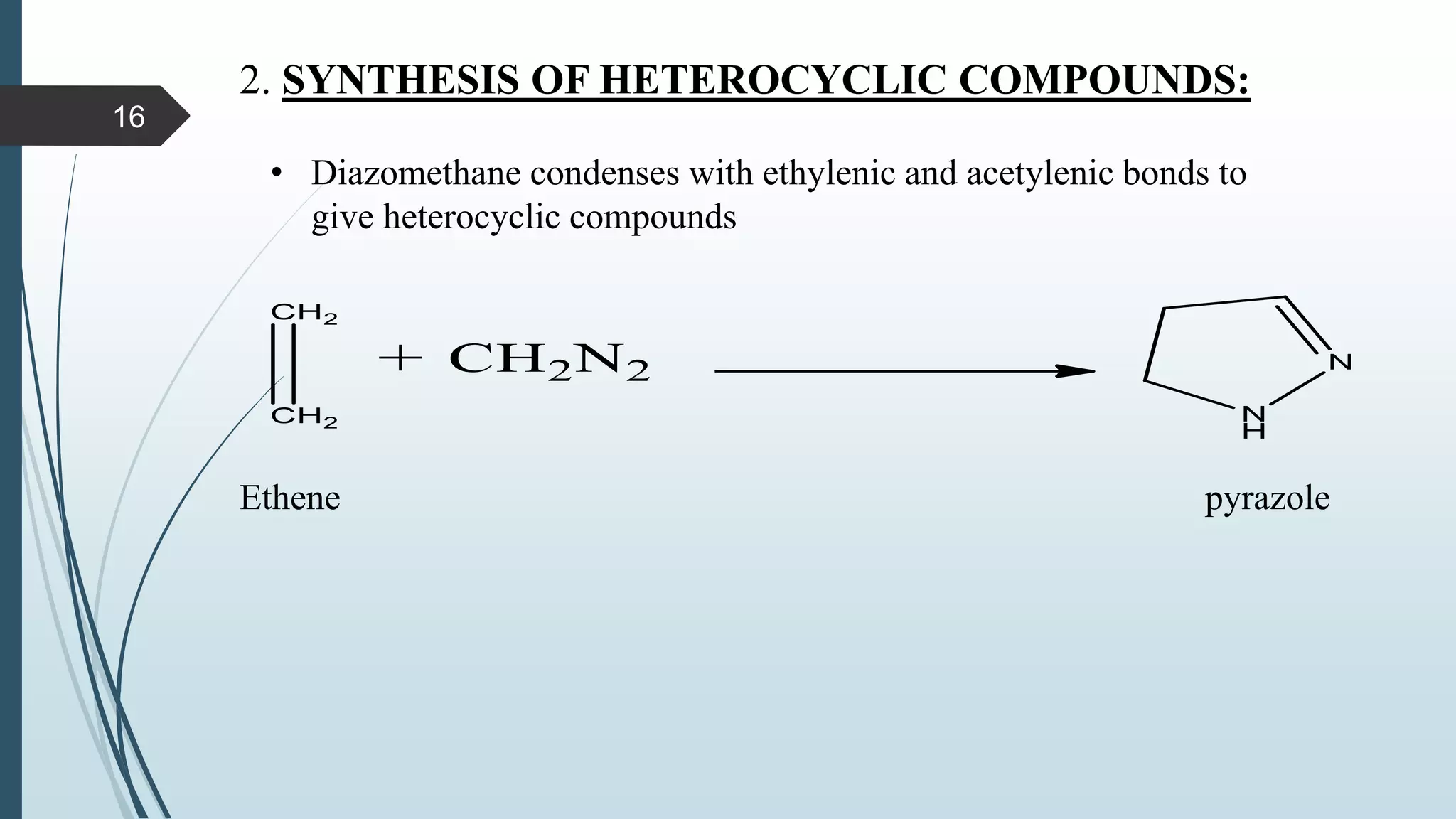
2. SYNTHESIS OF HETEROCYCLIC COMPOUNDS:
• Diazomethane condenses with ethylenic and acetylenic bonds to
give heterocyclic compounds
Ethene pyrazole
16
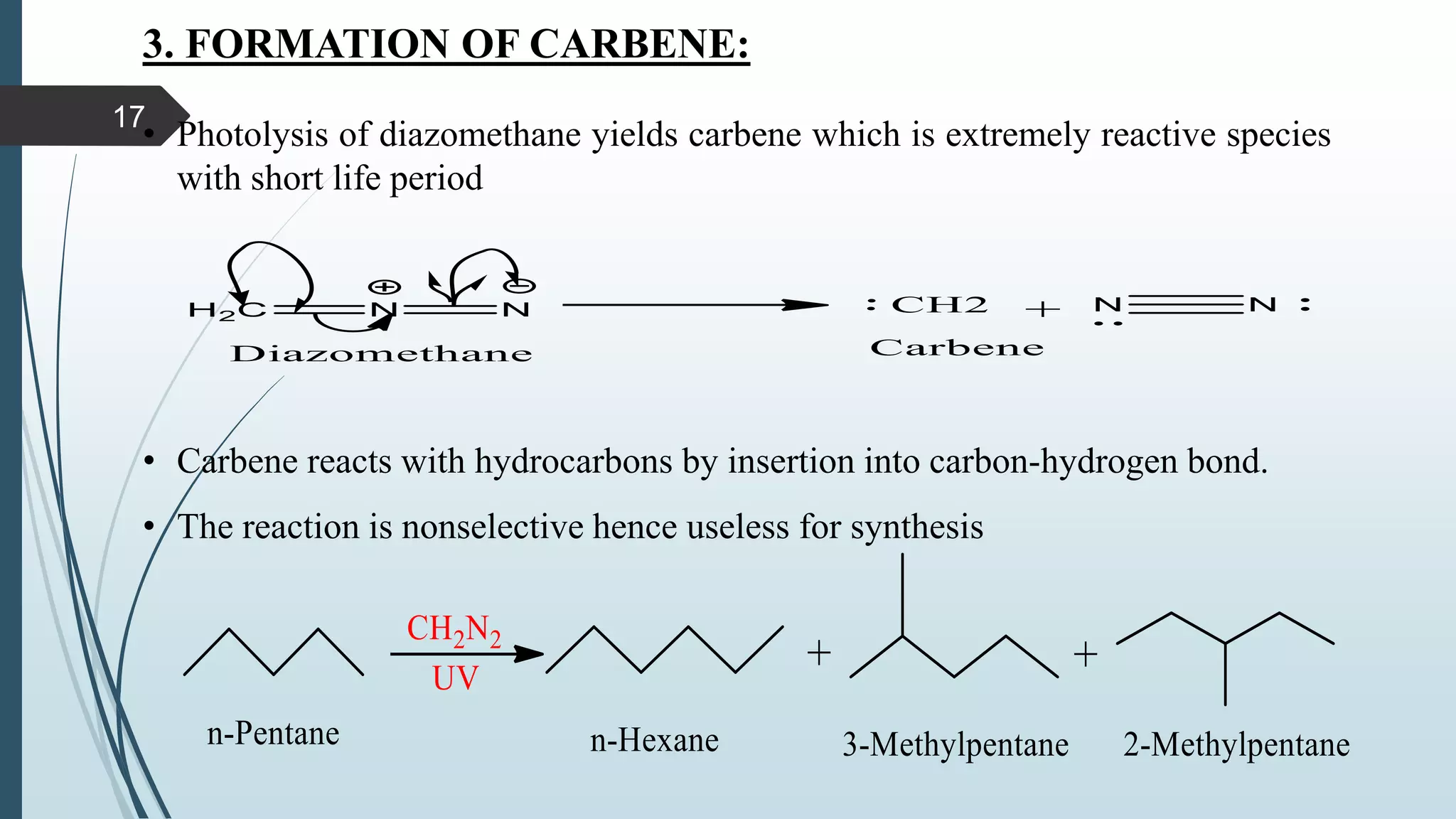
3. FORMATION OF CARBENE:
• Photolysis of diazomethane yields carbene which is extremely reactive species
with short life period
• Carbene reacts with hydrocarbons by insertion into carbon-hydrogen bond.
• The reaction is nonselective hence useless for synthesis
17
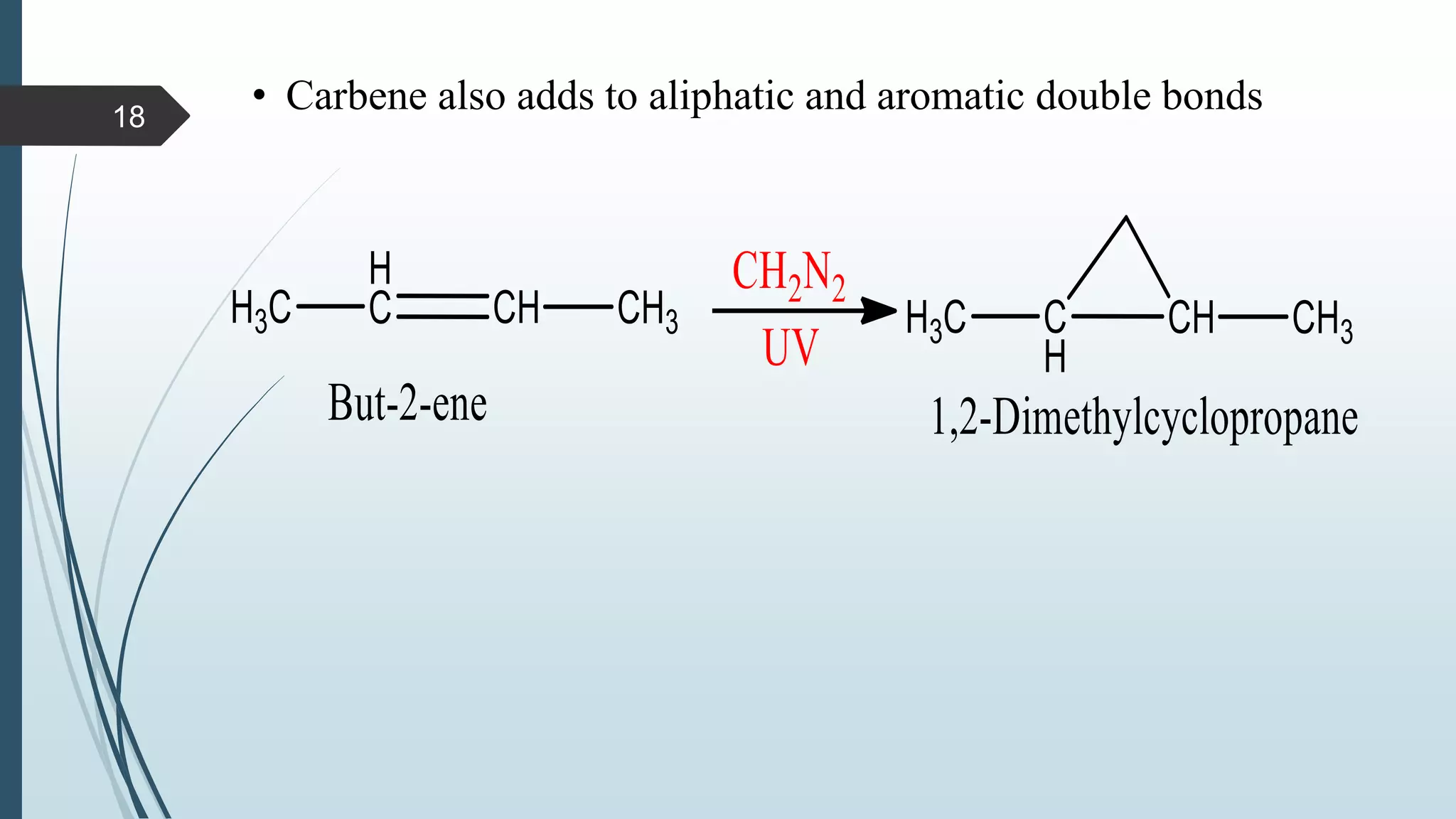
• Carbene also adds to aliphatic and aromatic double bonds18
19
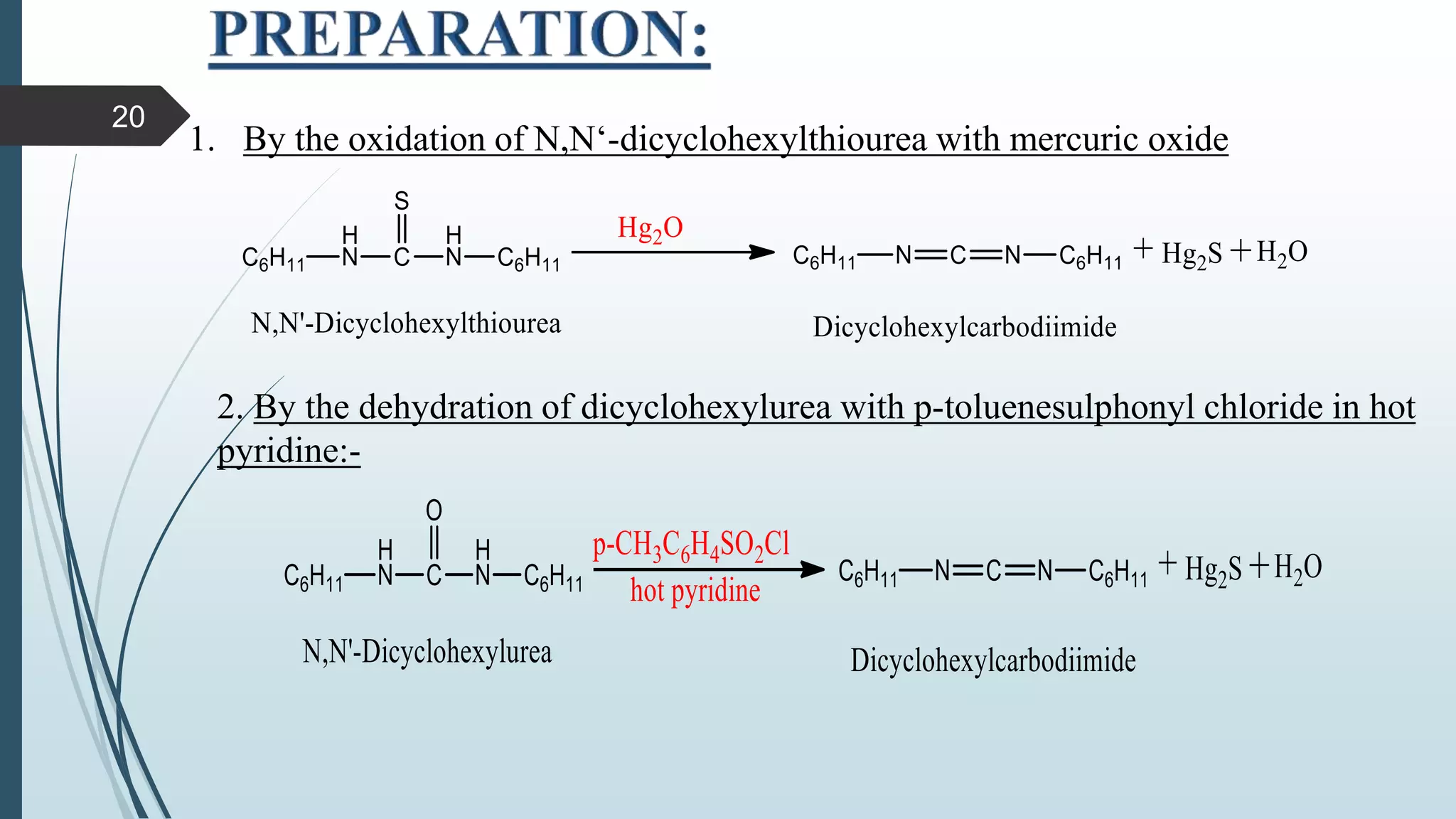
1. By the oxidation of N,N‘-dicyclohexylthiourea with mercuric oxide
2. By the dehydration of dicyclohexylurea with p-toluenesulphonyl chloride in hot
pyridine:-
20
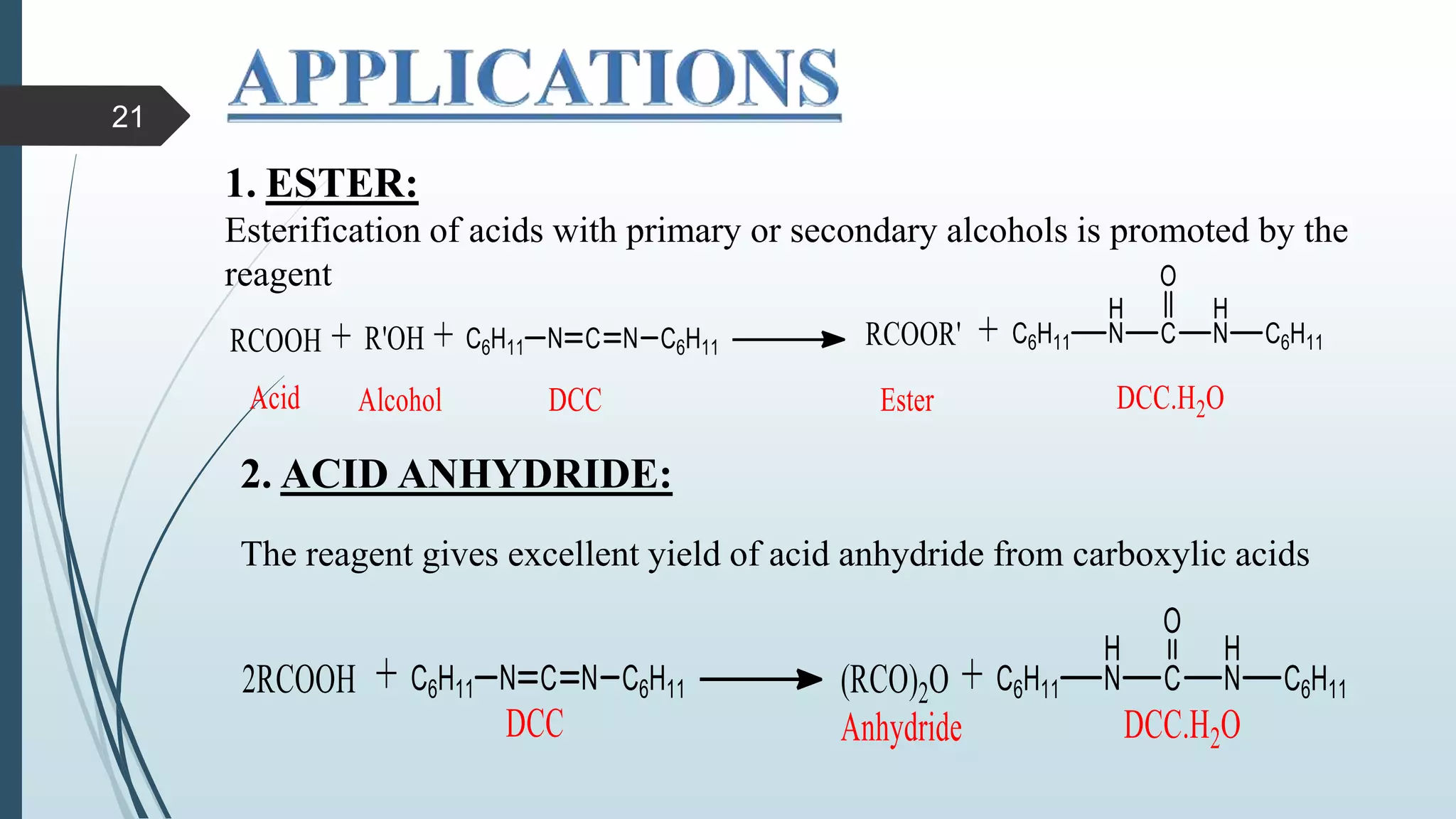
1. ESTER:
Esterification of acids with primary or secondary alcohols is promoted by the
reagent
2. ACID ANHYDRIDE:
The reagent gives excellent yield of acid anhydride from carboxylic acids
21
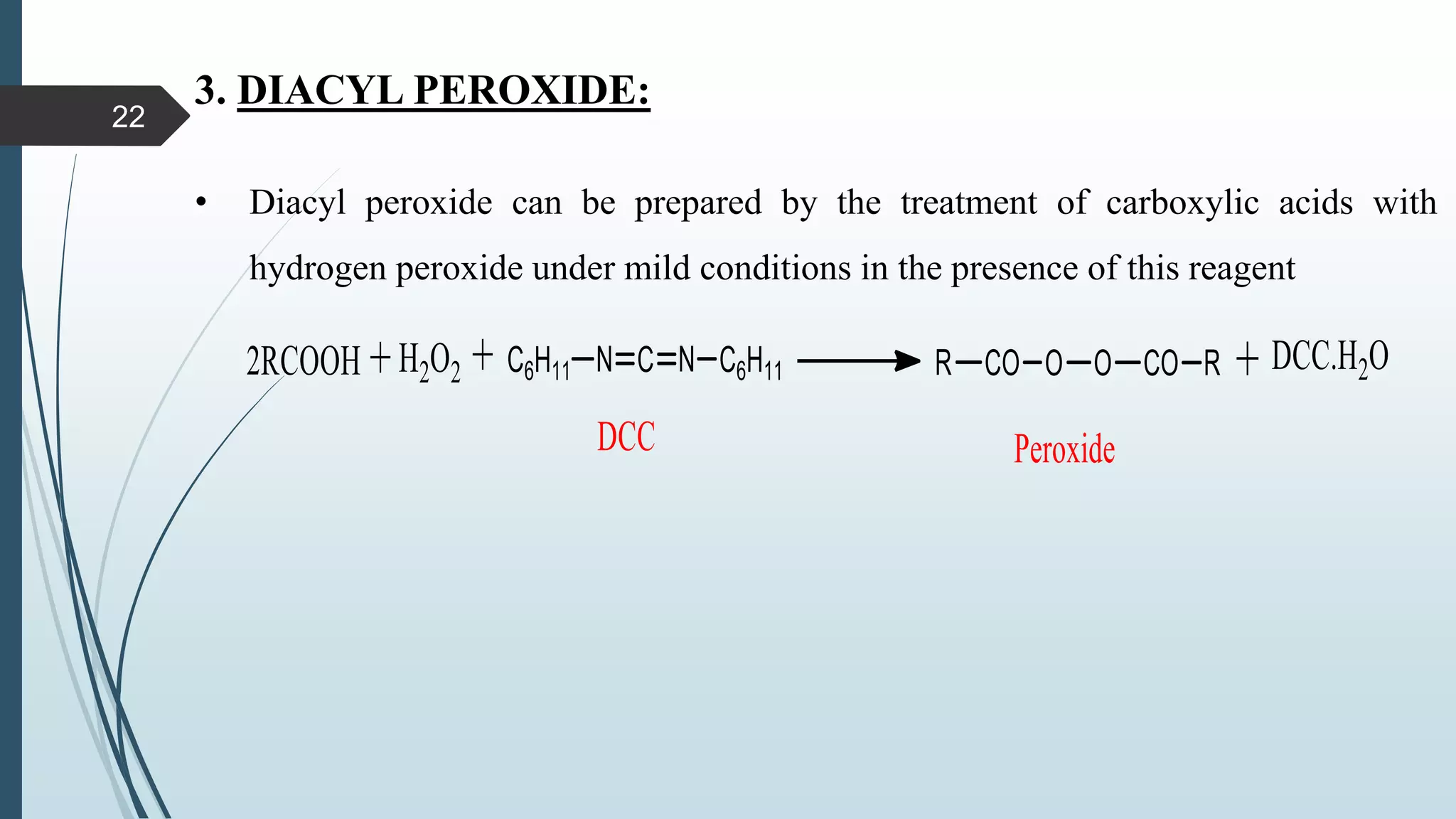
3. DIACYL PEROXIDE:
• Diacyl peroxide can be prepared by the treatment of carboxylic acids with
hydrogen peroxide under mild conditions in the presence of this reagent
22
23
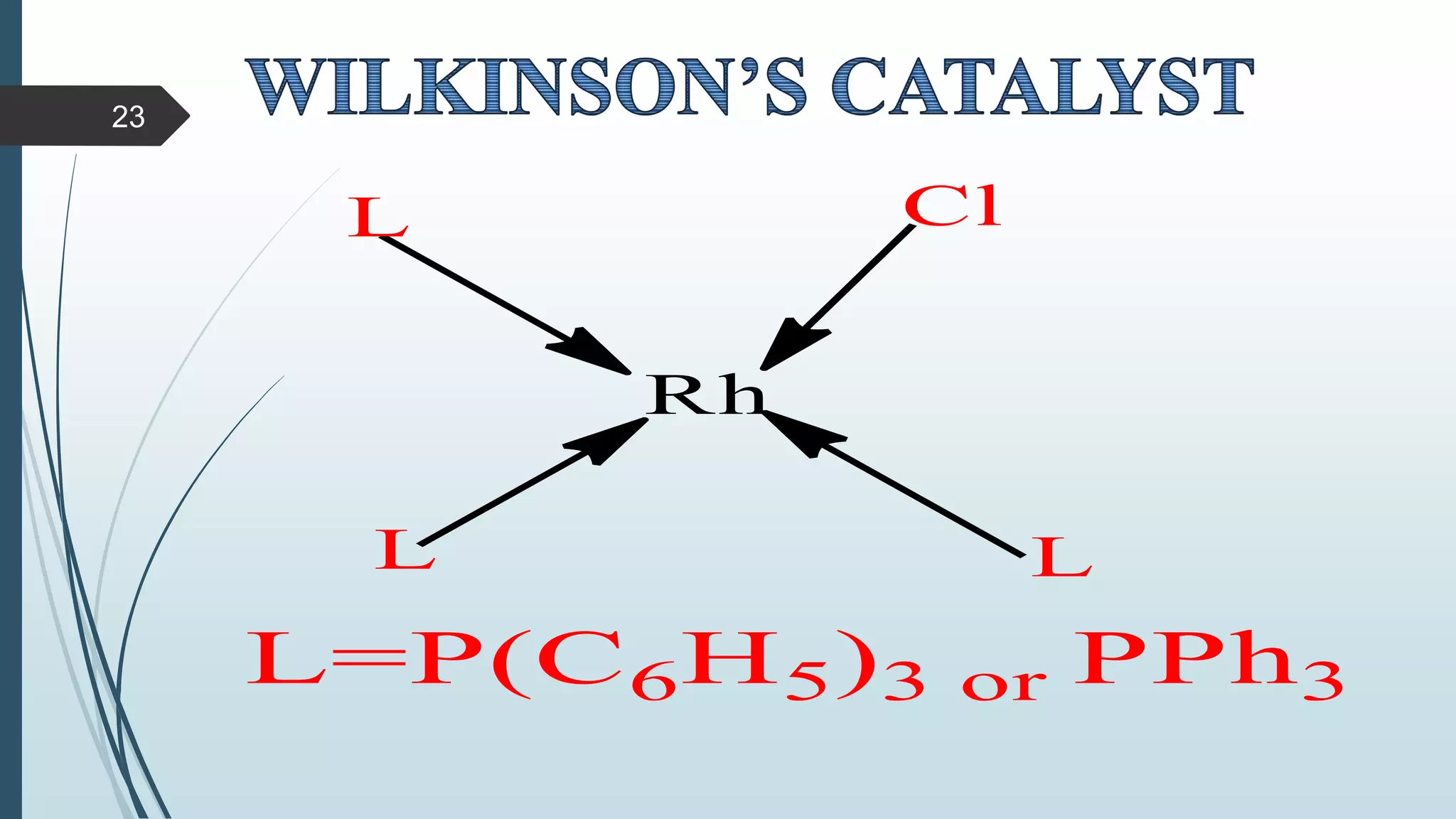
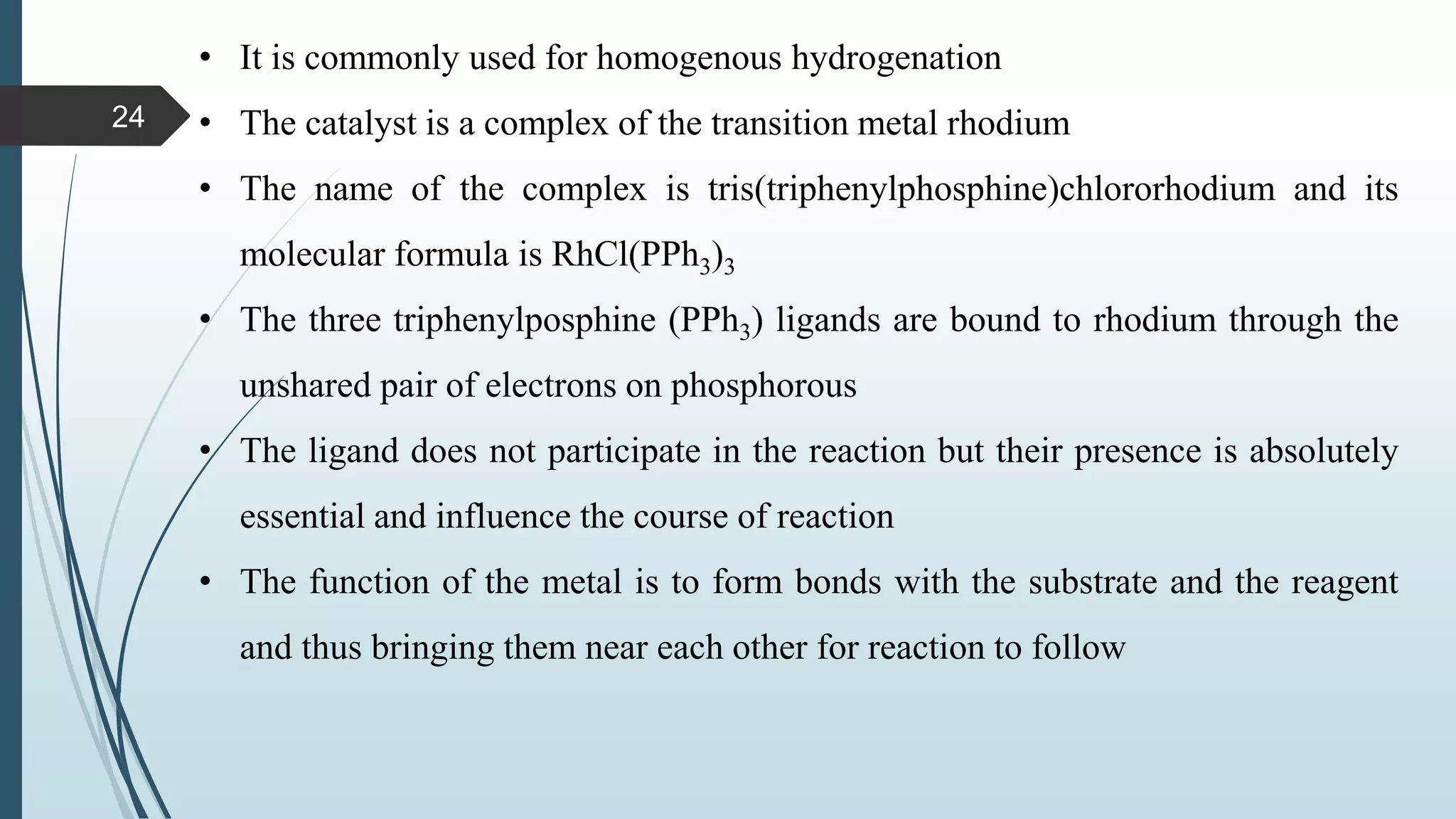
• It is commonly used for homogenous hydrogenation
• The catalyst is a complex of the transition metal rhodium
• The name of the complex is tris(triphenylphosphine)chlororhodium and its
molecular formula is RhCl(PPh3)3
• The three triphenylposphine (PPh3) ligands are bound to rhodium through the
unshared pair of electrons on phosphorous
• The ligand does not participate in the reaction but their presence is absolutely
essential and influence the course of reaction
• The function of the metal is to form bonds with the substrate and the reagent
and thus bringing them near each other for reaction to follow
24
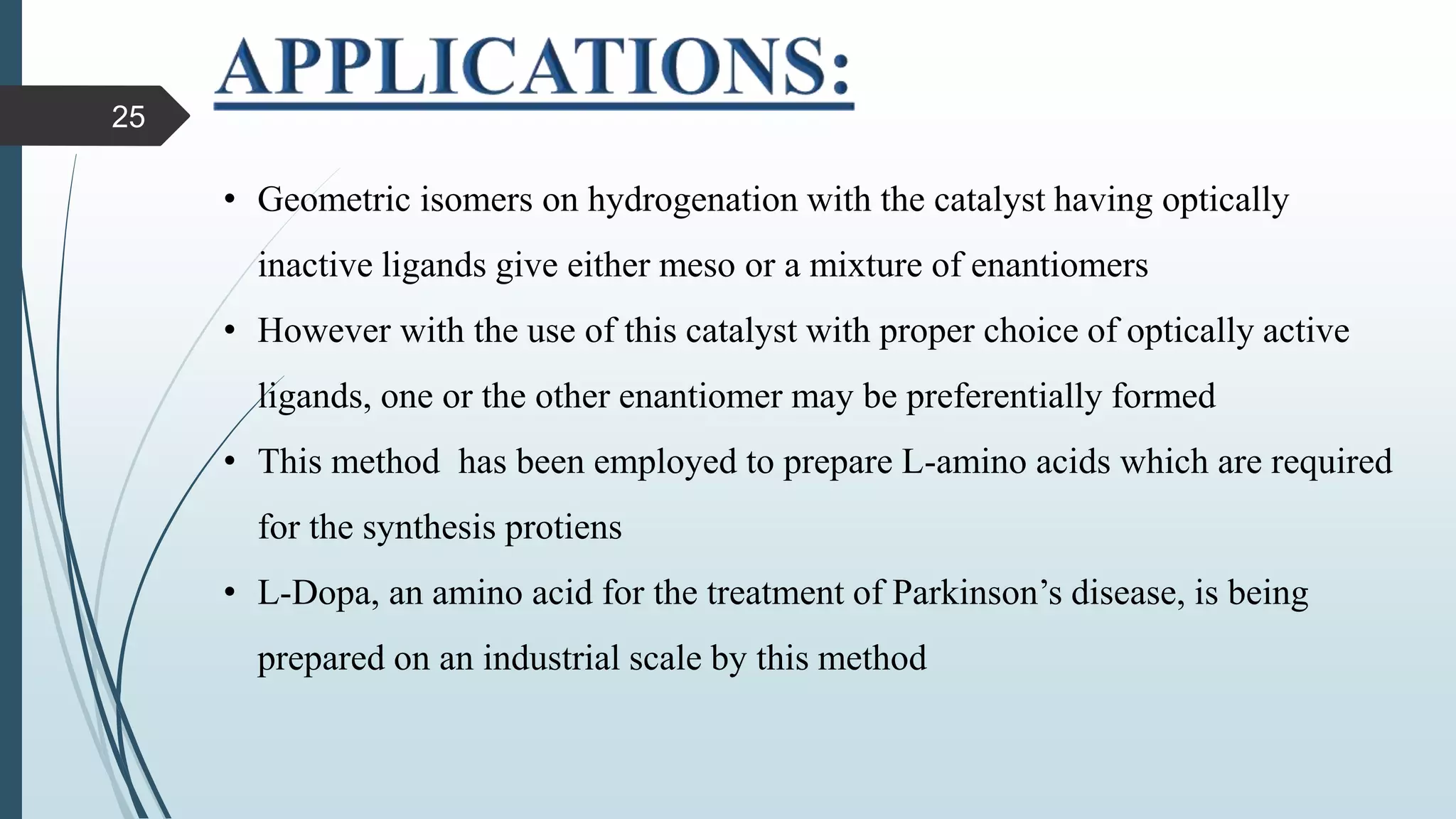
• Geometric isomers on hydrogenation with the catalyst having optically
inactive ligands give either meso or a mixture of enantiomers
• However with the use of this catalyst with proper choice of optically active
ligands, one or the other enantiomer may be preferentially formed
• This method has been employed to prepare L-amino acids which are required
for the synthesis protiens
• L-Dopa, an amino acid for the treatment of Parkinson’s disease, is being
prepared on an industrial scale by this method
25
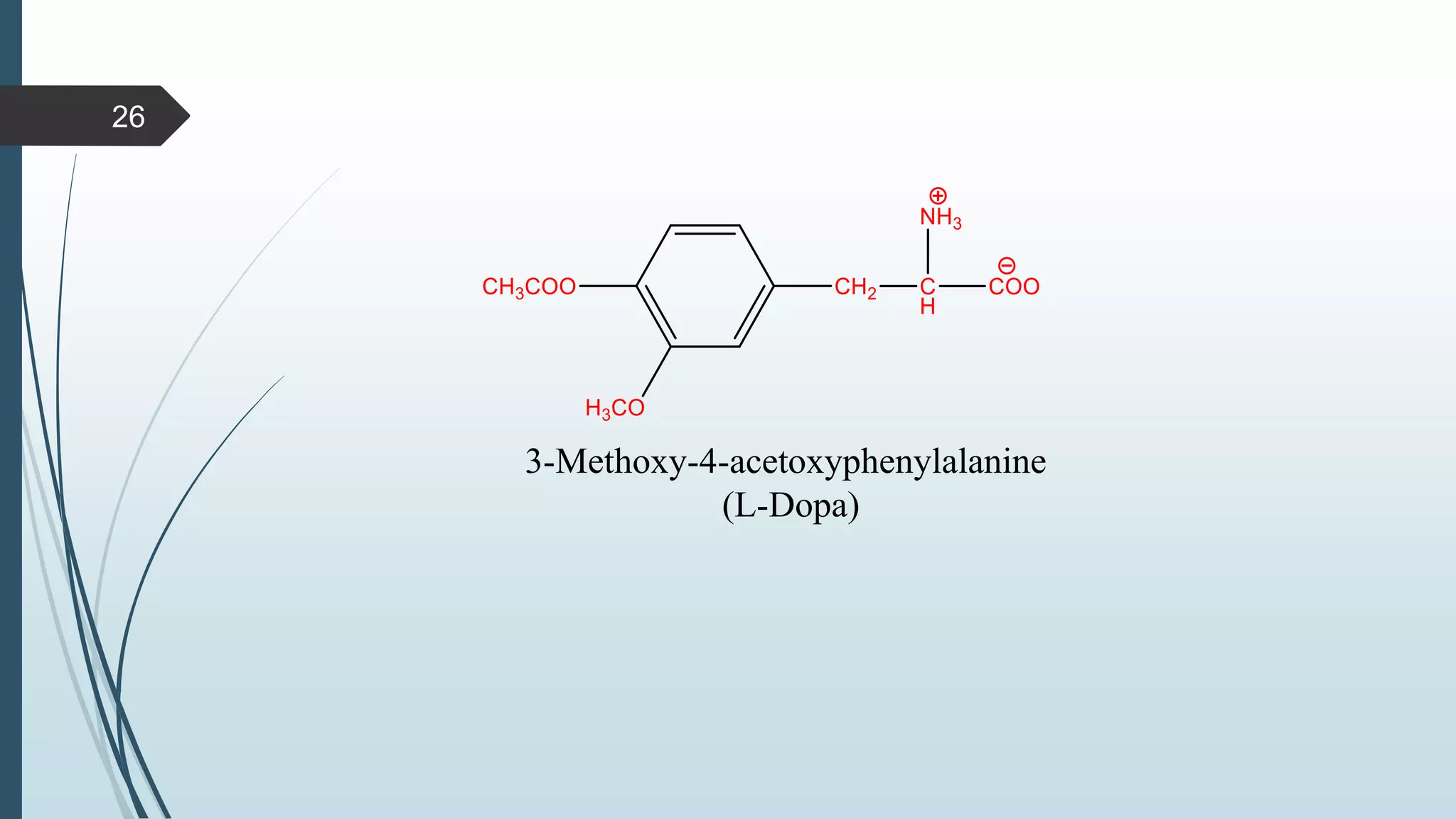
3-Methoxy-4-acetoxyphenylalanine
(L-Dopa)
26
27
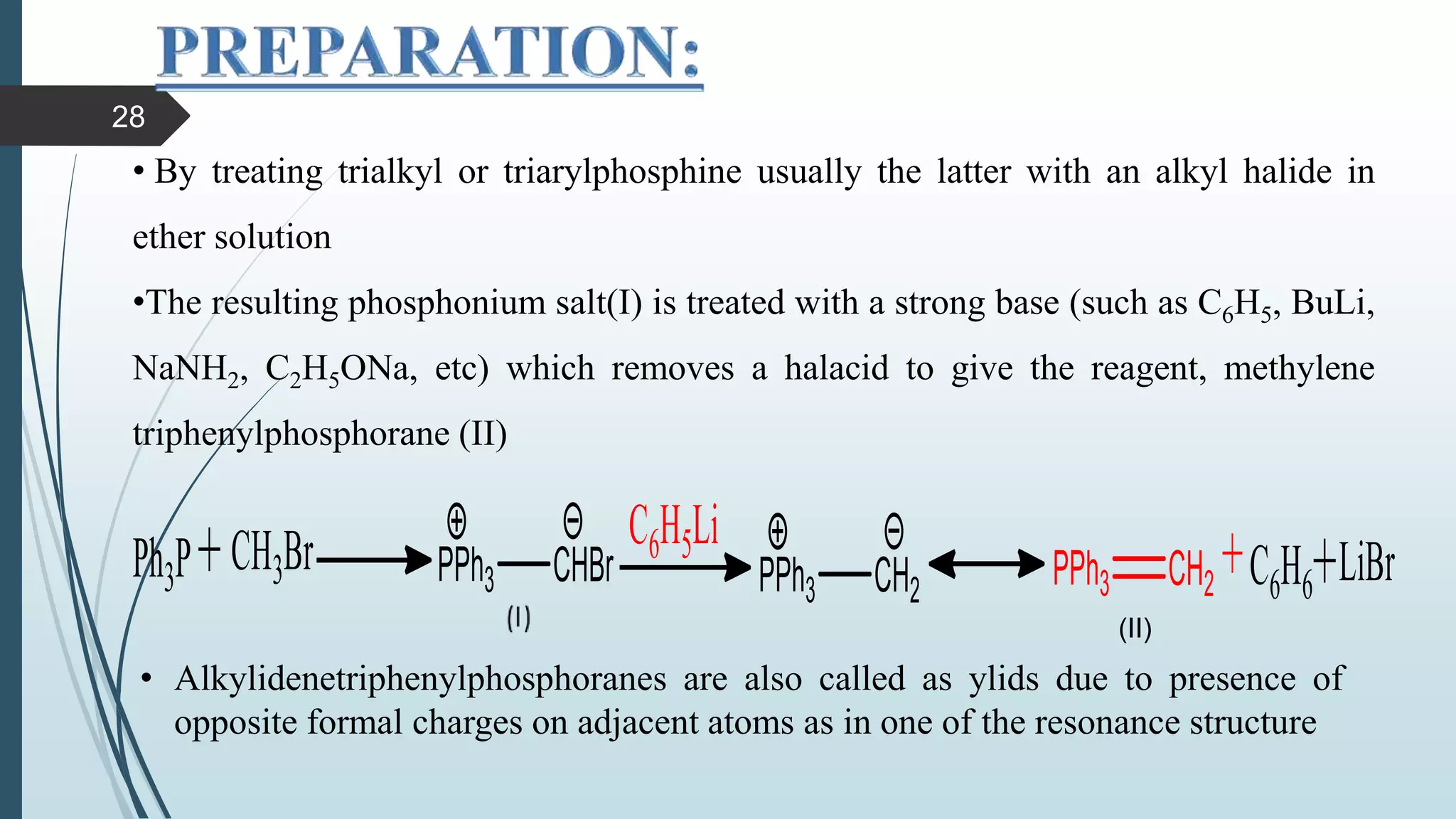
• By treating trialkyl or triarylphosphine usually the latter with an alkyl halide in
ether solution
•The resulting phosphonium salt(I) is treated with a strong base (such as C6H5, BuLi,
NaNH2, C2H5ONa, etc) which removes a halacid to give the reagent, methylene
triphenylphosphorane (II)
(II)
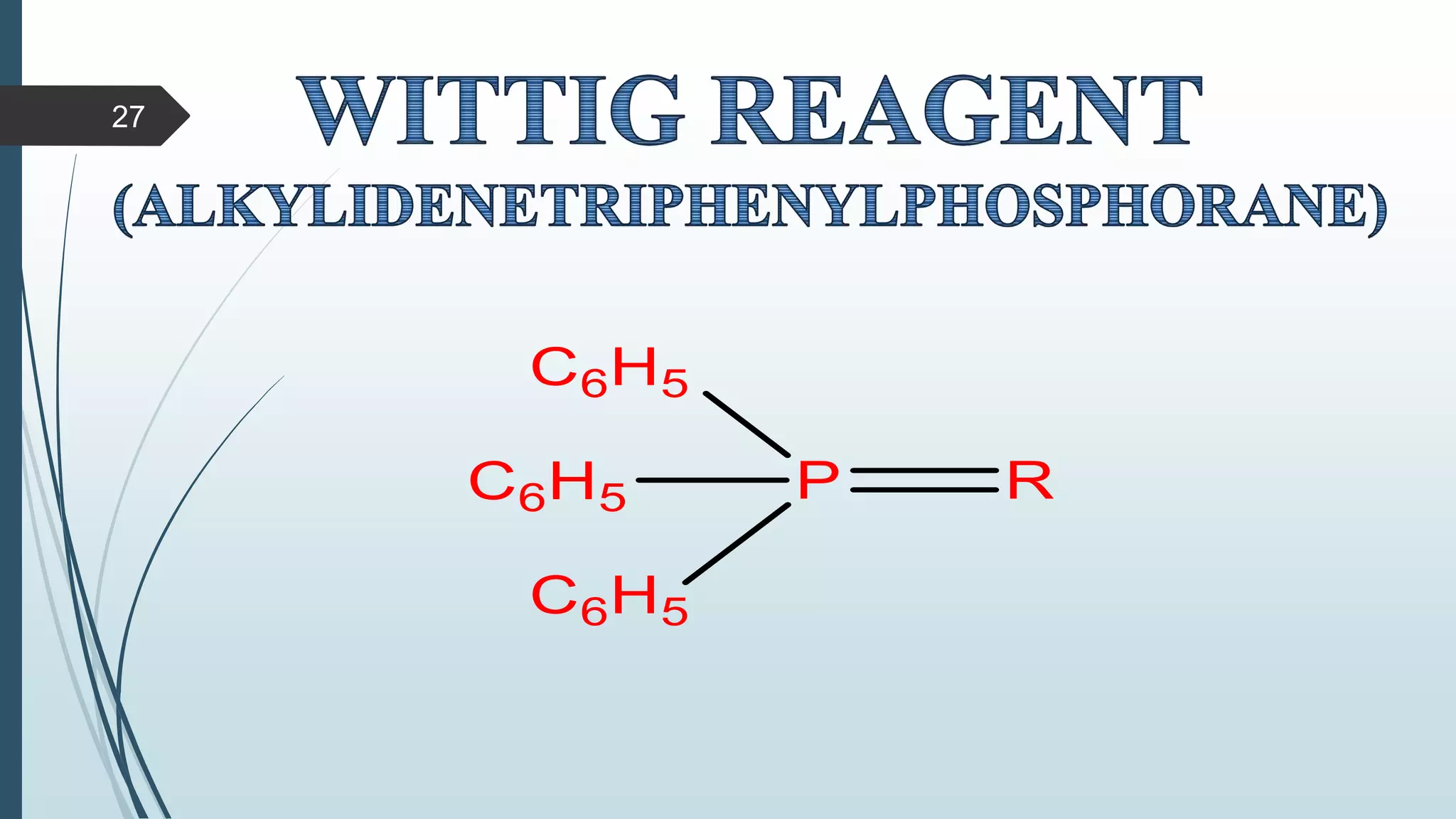
• Alkylidenetriphenylphosphoranes are also called as ylids due to presence of
opposite formal charges on adjacent atoms as in one of the resonance structure
28
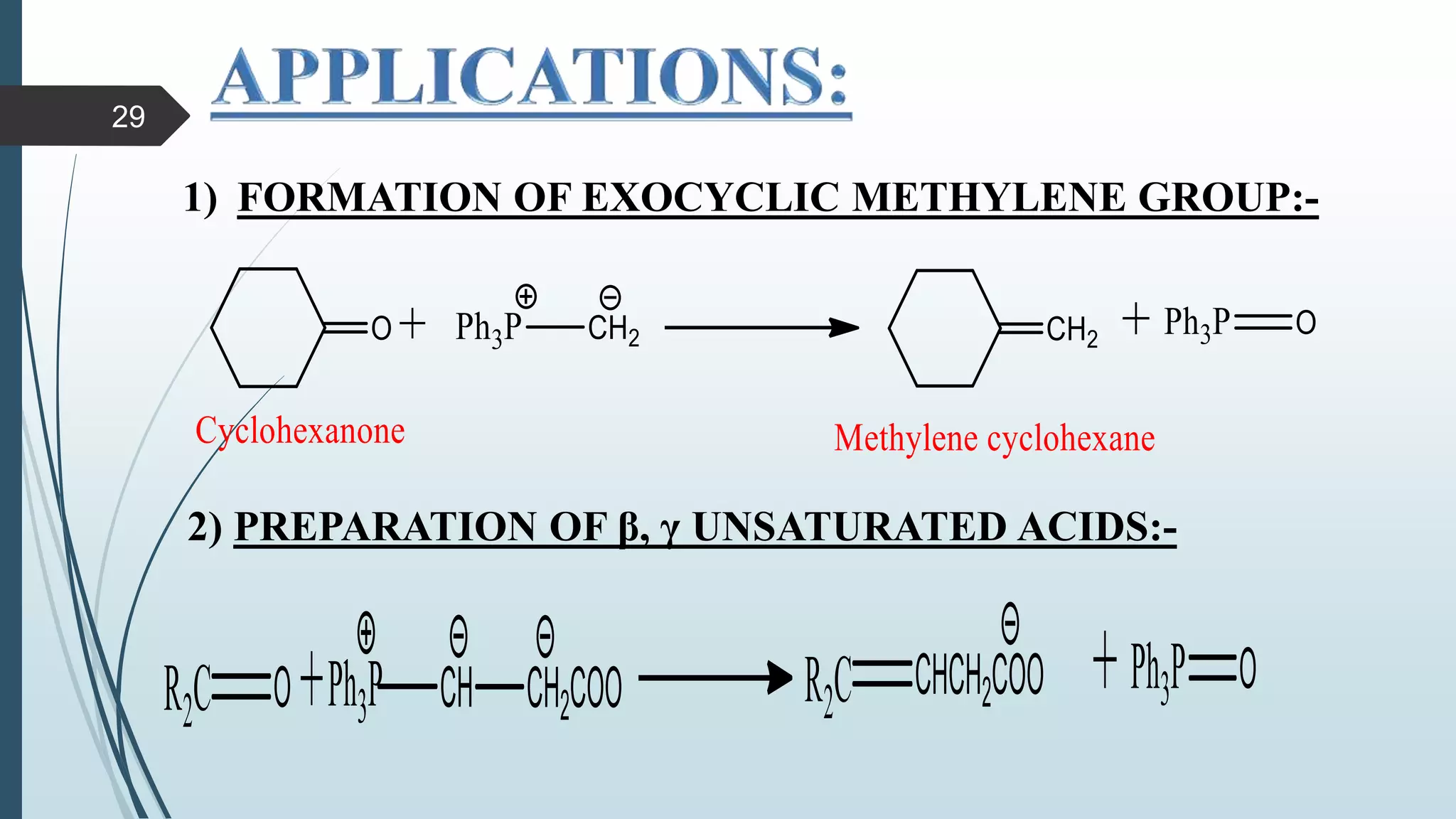
1) FORMATION OF EXOCYCLIC METHYLENE GROUP:-
2) PREPARATION OF β, γ UNSATURATED ACIDS:-
29
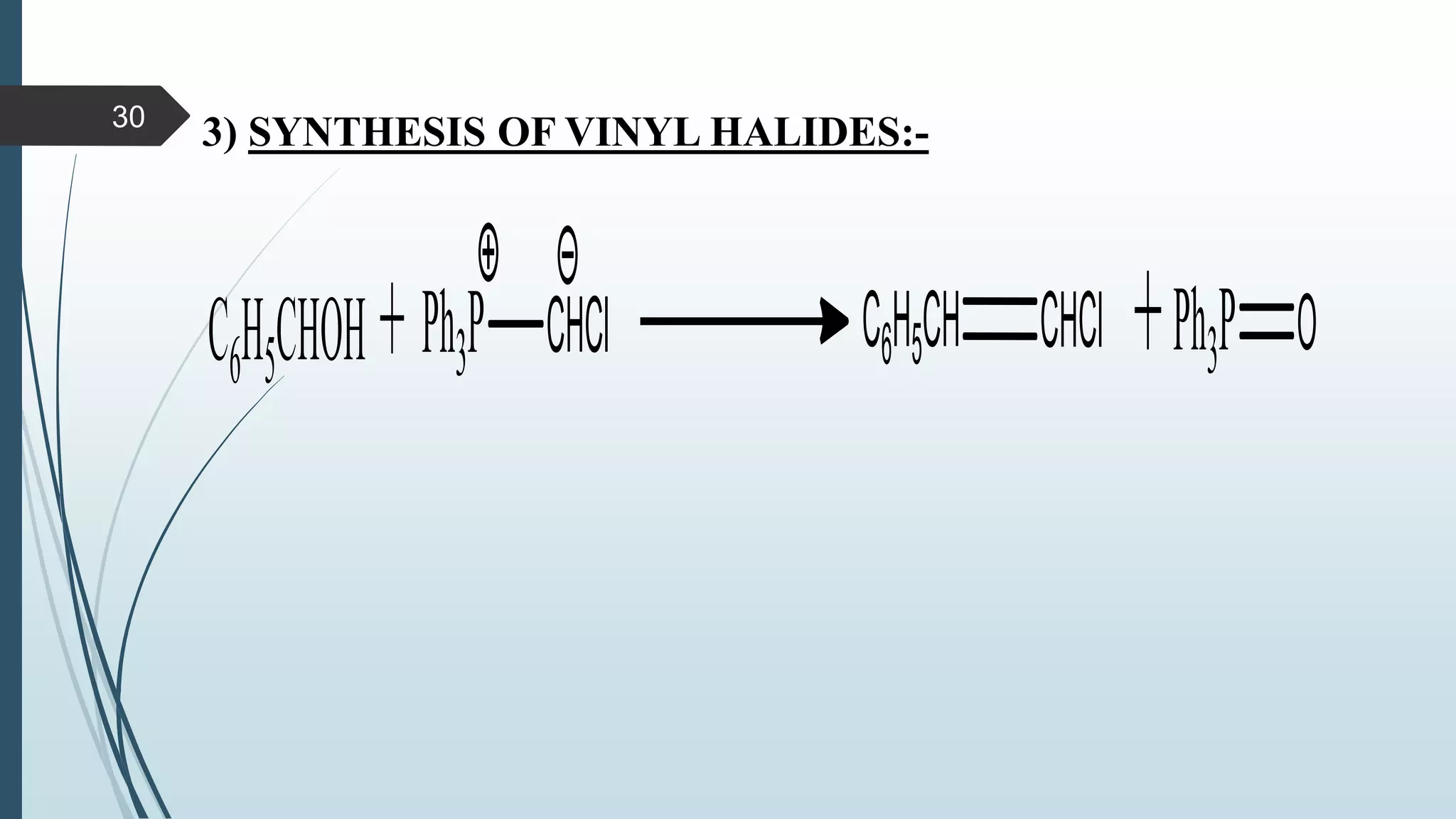
3) SYNTHESIS OF VINYL HALIDES:-30
1) Sanyal s n. Reactions, rearrangements and reagents. 4th edition.
Bharati bhawan publishers and distributors. P:186, 197-198, 203-
212, 250-251.
2) Reactions and reagents by O.P.Agarwal, p.no.840-844
3) https://en.wikipedia.org/wiki/Diazo#From_amines
4) http://onlinelibrary.wiley.com/diazopropane
5) http://www.brainyresort.com/en/wittig-reaction- mechanism
31
32

Synthetic reagents and applications

  • 1.
    SYNTHETIC REAGENTS AND APPLICATIONS T CAISWARYA FIRST YEAR MPHARM DEPARTMENT OF PHARMACEUTICAL CHEMISTRY NGSMIPS 1
  • 2.
    Organic reactions involvereagents and substrates. Chemical reagents bring about various types of changes in organic molecules to yield products of immense value Reagents have been found that can degrade complex molecules to simple known molecules which enabled us to elucidate the structures of complex compounds A suitable choice of reagent and reaction conditions are essential for the success of a reaction for the desired product 2
  • 3.
    A few ofthe most important and widely used reagents along with a few novel catalysts for the synthesis of a large varieties of natural products, commercially useful chemicals of medicinal and industrial importance have been included Their preparations, mode of applications and mechanistic aspects along with their uses are included 3
  • 4.
    We discuss thefollowing reagents:- 1) Aluminium isopropoxide 2) N-bromosuccinamide 3) Diazomethane 4) Dicyclohexylcarbodiimide 5) Wilkinson reagent 6) Wittig reagent 4
  • 5.
    It is agood reducing agent It reduces by transfer of hydride ions PREPARATION: Prepared by refluxing anhydrous isopropyl alcohol with aluminium amalgam in the presence of small amount of carbon tetrachloride as catalyst After evolution of hydrogen ceases, the mixture is distilled under reduced pressure and aluminium isopropoxide distills over at 140°C-150°C as a colourless liquid 5
  • 6.
    Some of theapplications are given below:- 1) Meerwein-ponndrof reduction: Crotonaldehyde crotyl alcohol 2-Cyclohexene-1-one 2-Cyclohexene-1-ol 6
  • 7.
    2) Reduction ofdiaryl ketones to hydrocarbons: With excess temperature and at higher temperature complete reduction has been achieved. Anthraquinone Anthracene 7
  • 8.
    3) Oppenauer oxidation: Althoughaluminium-tertiary butoxide is the genrally used catalyst for this reaction, aluminium isopropoxide has also been used for the oxidation. An excess of acetone or better hydrogen acceptors like quinones or aryl ketones are used along with the reagent 8
  • 9.
  • 10.
    The reagent isprepared by gradually adding bromine to an ice- cold solution of succinamide in alkali NBS precipitates out immediately Succinamide NBS 10
  • 11.
    1) AS ABROMINATING AGENT: a) PREPARATION OF BROMOESTERS:- b) CONVERSION OF MONOENES TO DIENES TO TRIENES:- ethyl-γ-bromocrotonate 11
  • 12.
    2) AS OXIDISINGAGENT: • NBS oxidizes primary alcohols and primary amines to aldehydes and secondary alcohols to ketones. 3) DEGRADATION OF AMINO ACID: •α-amino acid, peptides and protiens are decarboxylated with NBS in aqueous medium. 12
  • 13.
  • 14.
    • Several N-nitroso-N-methylcompounds have been used to prepare diazomethane 1. Alkaline hydrolysis of bis-(N-nitroso-N-methyl) terephthalimide: 2. Distillation of N-nitroso-N-methyl-p-toluenesulphonamide with base: 14
  • 15.
    1. METHYLATION: It isused as methylating agent for acidic compounds, alcohols, carbonyl compounds, amines Acid Alcohol 15
  • 16.
    2. SYNTHESIS OFHETEROCYCLIC COMPOUNDS: • Diazomethane condenses with ethylenic and acetylenic bonds to give heterocyclic compounds Ethene pyrazole 16
  • 17.
    3. FORMATION OFCARBENE: • Photolysis of diazomethane yields carbene which is extremely reactive species with short life period • Carbene reacts with hydrocarbons by insertion into carbon-hydrogen bond. • The reaction is nonselective hence useless for synthesis 17
  • 18.
    • Carbene alsoadds to aliphatic and aromatic double bonds18
  • 19.
  • 20.
    1. By theoxidation of N,N‘-dicyclohexylthiourea with mercuric oxide 2. By the dehydration of dicyclohexylurea with p-toluenesulphonyl chloride in hot pyridine:- 20
  • 21.
    1. ESTER: Esterification ofacids with primary or secondary alcohols is promoted by the reagent 2. ACID ANHYDRIDE: The reagent gives excellent yield of acid anhydride from carboxylic acids 21
  • 22.
    3. DIACYL PEROXIDE: •Diacyl peroxide can be prepared by the treatment of carboxylic acids with hydrogen peroxide under mild conditions in the presence of this reagent 22
  • 23.
  • 24.
    • It iscommonly used for homogenous hydrogenation • The catalyst is a complex of the transition metal rhodium • The name of the complex is tris(triphenylphosphine)chlororhodium and its molecular formula is RhCl(PPh3)3 • The three triphenylposphine (PPh3) ligands are bound to rhodium through the unshared pair of electrons on phosphorous • The ligand does not participate in the reaction but their presence is absolutely essential and influence the course of reaction • The function of the metal is to form bonds with the substrate and the reagent and thus bringing them near each other for reaction to follow 24
  • 25.
    • Geometric isomerson hydrogenation with the catalyst having optically inactive ligands give either meso or a mixture of enantiomers • However with the use of this catalyst with proper choice of optically active ligands, one or the other enantiomer may be preferentially formed • This method has been employed to prepare L-amino acids which are required for the synthesis protiens • L-Dopa, an amino acid for the treatment of Parkinson’s disease, is being prepared on an industrial scale by this method 25
  • 26.
  • 27.
  • 28.
    • By treatingtrialkyl or triarylphosphine usually the latter with an alkyl halide in ether solution •The resulting phosphonium salt(I) is treated with a strong base (such as C6H5, BuLi, NaNH2, C2H5ONa, etc) which removes a halacid to give the reagent, methylene triphenylphosphorane (II) (II) • Alkylidenetriphenylphosphoranes are also called as ylids due to presence of opposite formal charges on adjacent atoms as in one of the resonance structure 28
  • 29.
    1) FORMATION OFEXOCYCLIC METHYLENE GROUP:- 2) PREPARATION OF β, γ UNSATURATED ACIDS:- 29
  • 30.
    3) SYNTHESIS OFVINYL HALIDES:-30
  • 31.
    1) Sanyal sn. Reactions, rearrangements and reagents. 4th edition. Bharati bhawan publishers and distributors. P:186, 197-198, 203- 212, 250-251. 2) Reactions and reagents by O.P.Agarwal, p.no.840-844 3) https://en.wikipedia.org/wiki/Diazo#From_amines 4) http://onlinelibrary.wiley.com/diazopropane 5) http://www.brainyresort.com/en/wittig-reaction- mechanism 31
  • 32.