Titanium
Advance Building Materials
Yash Kotgirwar|114AR0032
Introduction
 Transition Metal (Ti)
 Titanium was found in 1970. It is named after the Titans,
earth giants in ancient Greek Mythology.
 Titanium is the fourth abundant metal on earth crust (~
0.86%) after aluminium, iron and magnesium.
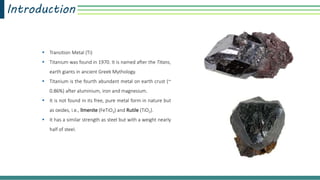
 It is not found in its free, pure metal form in nature but
as oxides, i.e., llmenite (FeTiO3) and Rutile (TiO2).
 It has a similar strength as steel but with a weight nearly
half of steel.
Ores
 The ore is mined in Brazil, India, Canada, Norway, South Africa and
Australia.
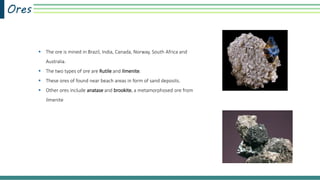
 The two types of ore are Rutile and Ilmenite.
 These ores of found near beach areas in form of sand deposits.
 Other ores include anatase and brookite, a metamorphosed ore from
ilmenite
Physical Properties
 Lustrous, metallic white in colour
 High strength-to-weight ratio
 Low density and ductile (especially in an
oxygen free environment)
 Relatively high melting point of 1725°C
 Low electrical and thermal conductivity
 Specific gravity of 0.451
 Slightly paramagnetic
 60% denser than aluminium but more
than twice as strong
 Not as hard as some grades of heat-
treated steel
 Ultimate tensile strength of 434 MPa
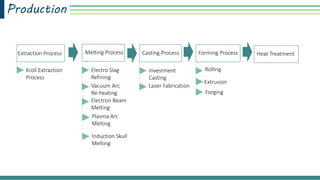
Production
Extraction Process Melting Process Casting Process Forming Process Heat Treatment
Kroll Extraction
Process
Electro Slag
Refining
Vacuum Arc
Re-heating
Electron Beam
Melting
Induction Skull
Melting
Plasma Arc
Melting
Investment
Casting
Laser Fabrication
Rolling
Extrusion
Forging
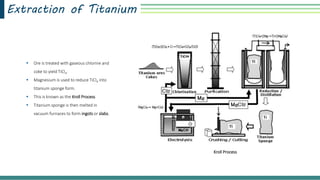
Extraction of Titanium
 Ore is treated with gaseous chlorine and
coke to yield TiCl4.
 Magnesium is used to reduce TiCl4 into
titanium sponge form.
 This is known as the Kroll Process
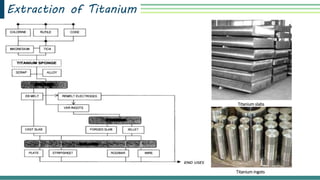
 Titanium sponge is then melted in
vacuum furnaces to form ingots or slabs.
Kroll Process
Extraction of Titanium
Titanium ingots
Titanium slabs
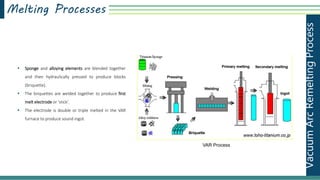
Melting Processes
VacuumArcRemeltingProcess
 Sponge and alloying elements are blended together
and then hydraulically pressed to produce blocks
(briquette).
 The briquettes are welded together to produce first
melt electrode or ‘stick’.
 The electrode is double or triple melted in the VAR
furnace to produce sound ingot.
VAR Process
Titanium Alloys
 Alloys are majorly made with Aluminium, Molybdenum,
Cobalt, Zirconium, Tin etc.
 Alloys are mainly of 4 types
 Alpha phase alloys- lowest strength,formable,weldable
 Alpha plus Beta alloys-high strength
 Near alpha alloys- medium strength , good creep
resistance
 Beta phase alloys-high strength, lacks ductility
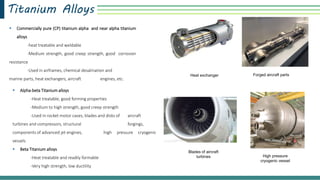
Titanium Alloys
 Commercially pure (CP) titanium alpha and near alpha titanium
alloys
-heat treatable and weldable
-Medium strength, good creep strength, good corrosion
resistance
-Used in airframes, chemical desalination and
marine parts, heat exchangers, aircraft engines, etc.
Heat exchanger Forged aircraft parts
 Alpha-beta Titanium alloys
-Heat treatable, good forming properties
-Medium to high strength, good creep strength
-Used in rocket motor cases, blades and disks of aircraft
turbines and compressors, structural forgings,
components of advanced jet engines, high pressure cryogenic
vessels
 Beta Titanium alloys
-Heat treatable and readily formable
-Very high strength, low ductility
Blades of aircraft
turbines High pressure
cryogenic vessel
Characteristics-Building Material
 Unparalleled corrosion resistance
-forms stable oxide films
-suited to application in coastal areas
-corrosion resistant to corrosive gases
-resists acid rain
 Great strength
-as strong as steel
-highly workable
 Light weight
-less burden on structure
-ease of fabrication
 Aesthetics
-anodic oxidation
 Environmentally sound
-human friendly metal
 Workability
-formability
-weldability
-bonding and adhesion
ArchitecturalApplications
NationalGrandTheatre,
China
Surface: Roll dull was used in
the titanium composite
material
TaipeiArena,Taiwan
First building in Taiwan where titanium was being used .
HotelMarquesdeRiscal,Spain
Lustrous colourful titanium cladding on the exterior.
KyushuOilDome,China
HangzhouGrantTheatre,China
KyushuNationalStadium,China
UNMCTower,Nebraska
Gold tinted titanium-exterior cladding
FujiTelevisionHeadquarter
GuggenheimMuseum.Bilbao
Other Applications
Aircraft and jet
engines Chemical plants Tanker trucks
Vehicles Daily use productsMedical prosthetics
References
▪ A. Anjali, A. Vasudha. Titanium: A New Generation Material for Architectural Applications. Accessed 11th October,
2018.
Retrieved from https://www.toho-titanium.co.jp/en/products/solution.html
▪ Nippon Steel and Sumitomo Metal. Features of Titanium Building Material. Retrieved from http://www.nssmc.com/
▪ Chen, J.; Poon, C.S. Photocatalytic
construction and building materials: From fundamentals to applications. Build. Environ. 2009, 44, 1899-1906.
Thank you!

Titanium

  • 1.
  • 2.
    Introduction  Transition Metal(Ti)  Titanium was found in 1970. It is named after the Titans, earth giants in ancient Greek Mythology.  Titanium is the fourth abundant metal on earth crust (~ 0.86%) after aluminium, iron and magnesium.  It is not found in its free, pure metal form in nature but as oxides, i.e., llmenite (FeTiO3) and Rutile (TiO2).  It has a similar strength as steel but with a weight nearly half of steel.
  • 3.
    Ores  The oreis mined in Brazil, India, Canada, Norway, South Africa and Australia.  The two types of ore are Rutile and Ilmenite.  These ores of found near beach areas in form of sand deposits.  Other ores include anatase and brookite, a metamorphosed ore from ilmenite
  • 4.
    Physical Properties  Lustrous,metallic white in colour  High strength-to-weight ratio  Low density and ductile (especially in an oxygen free environment)  Relatively high melting point of 1725°C  Low electrical and thermal conductivity  Specific gravity of 0.451  Slightly paramagnetic  60% denser than aluminium but more than twice as strong  Not as hard as some grades of heat- treated steel  Ultimate tensile strength of 434 MPa
  • 5.
    Production Extraction Process MeltingProcess Casting Process Forming Process Heat Treatment Kroll Extraction Process Electro Slag Refining Vacuum Arc Re-heating Electron Beam Melting Induction Skull Melting Plasma Arc Melting Investment Casting Laser Fabrication Rolling Extrusion Forging
  • 6.
    Extraction of Titanium Ore is treated with gaseous chlorine and coke to yield TiCl4.  Magnesium is used to reduce TiCl4 into titanium sponge form.  This is known as the Kroll Process  Titanium sponge is then melted in vacuum furnaces to form ingots or slabs. Kroll Process
  • 7.
    Extraction of Titanium Titaniumingots Titanium slabs
  • 8.
    Melting Processes VacuumArcRemeltingProcess  Spongeand alloying elements are blended together and then hydraulically pressed to produce blocks (briquette).  The briquettes are welded together to produce first melt electrode or ‘stick’.  The electrode is double or triple melted in the VAR furnace to produce sound ingot. VAR Process
  • 9.
    Titanium Alloys  Alloysare majorly made with Aluminium, Molybdenum, Cobalt, Zirconium, Tin etc.  Alloys are mainly of 4 types  Alpha phase alloys- lowest strength,formable,weldable  Alpha plus Beta alloys-high strength  Near alpha alloys- medium strength , good creep resistance  Beta phase alloys-high strength, lacks ductility
  • 10.
    Titanium Alloys  Commerciallypure (CP) titanium alpha and near alpha titanium alloys -heat treatable and weldable -Medium strength, good creep strength, good corrosion resistance -Used in airframes, chemical desalination and marine parts, heat exchangers, aircraft engines, etc. Heat exchanger Forged aircraft parts  Alpha-beta Titanium alloys -Heat treatable, good forming properties -Medium to high strength, good creep strength -Used in rocket motor cases, blades and disks of aircraft turbines and compressors, structural forgings, components of advanced jet engines, high pressure cryogenic vessels  Beta Titanium alloys -Heat treatable and readily formable -Very high strength, low ductility Blades of aircraft turbines High pressure cryogenic vessel
  • 11.
    Characteristics-Building Material  Unparalleledcorrosion resistance -forms stable oxide films -suited to application in coastal areas -corrosion resistant to corrosive gases -resists acid rain  Great strength -as strong as steel -highly workable  Light weight -less burden on structure -ease of fabrication  Aesthetics -anodic oxidation  Environmentally sound -human friendly metal  Workability -formability -weldability -bonding and adhesion
  • 12.
  • 13.
    NationalGrandTheatre, China Surface: Roll dullwas used in the titanium composite material
  • 14.
    TaipeiArena,Taiwan First building inTaiwan where titanium was being used .
  • 15.
  • 16.
  • 17.
  • 18.
  • 19.
  • 20.
  • 21.
  • 22.
    Other Applications Aircraft andjet engines Chemical plants Tanker trucks Vehicles Daily use productsMedical prosthetics
  • 23.
    References ▪ A. Anjali,A. Vasudha. Titanium: A New Generation Material for Architectural Applications. Accessed 11th October, 2018. Retrieved from https://www.toho-titanium.co.jp/en/products/solution.html ▪ Nippon Steel and Sumitomo Metal. Features of Titanium Building Material. Retrieved from http://www.nssmc.com/ ▪ Chen, J.; Poon, C.S. Photocatalytic construction and building materials: From fundamentals to applications. Build. Environ. 2009, 44, 1899-1906.
  • 24.