Heterocyclic
compounds
Quinolines and Isoquinolines
Reactivity
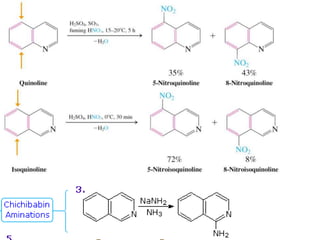
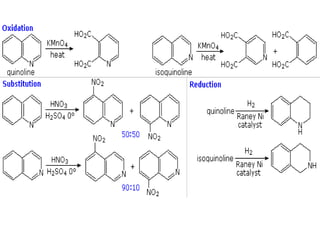
Quinoline and isoquinoline both have
1. Have basic, pyridine-like nitrogen atoms, which undergo
electrophilic substitutions.
2. Are less reactive toward electrophilic substitution than
benzene because of the electronegative nitrogen atom that
withdraws electrons from the ring.
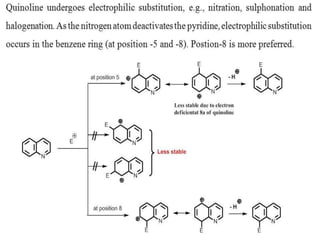
3. Electrophilic substitution occurs on the benzene ring rather
than on the nitrogen-containing pyridine ring, and a mixture of
substitution products is obtained.
Important method of synthesis
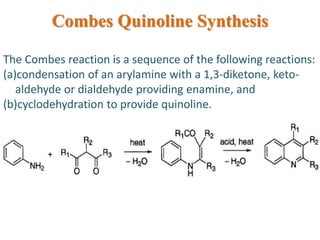
Combes Quinoline Synthesis
The Combes reaction is a sequence of the following reactions:
(a)condensation of an arylamine with a 1,3-diketone, keto-
aldehyde or dialdehyde providing enamine, and
(b)cyclodehydration to provide quinoline.
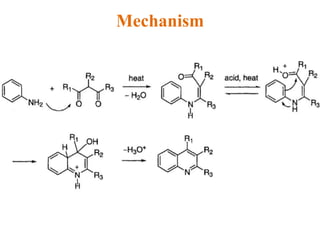
Mechanism
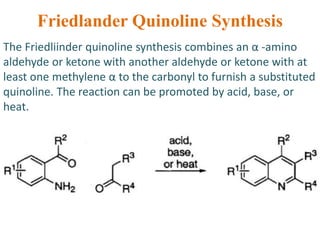
Friedlander Quinoline Synthesis
The Friedliinder quinoline synthesis combines an α -amino
aldehyde or ketone with another aldehyde or ketone with at
least one methylene α to the carbonyl to furnish a substituted
quinoline. The reaction can be promoted by acid, base, or
heat.
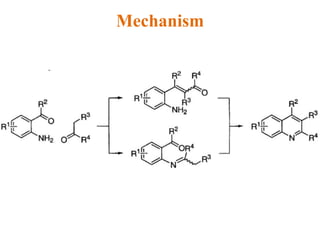
Mechanism
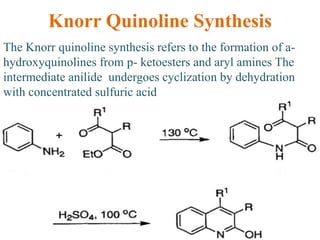
Knorr Quinoline Synthesis
The Knorr quinoline synthesis refers to the formation of a-
hydroxyquinolines from p- ketoesters and aryl amines The
intermediate anilide undergoes cyclization by dehydration
with concentrated sulfuric acid
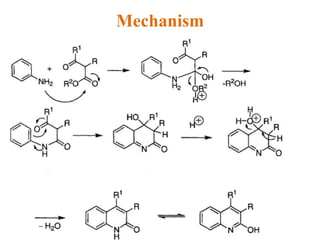
Mechanism
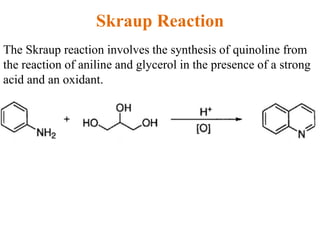
Skraup Reaction
The Skraup reaction involves the synthesis of quinoline from
the reaction of aniline and glycerol in the presence of a strong
acid and an oxidant.
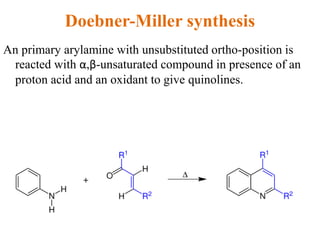
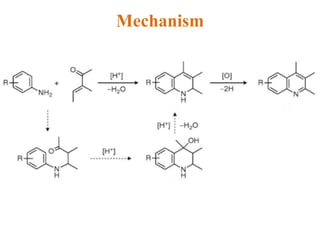
Doebner-Miller synthesis
An primary arylamine with unsubstituted ortho-position is
reacted with α,β-unsaturated compound in presence of an
proton acid and an oxidant to give quinolines.
Mechanism
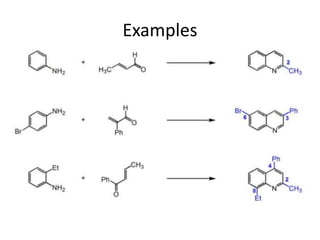
Examples
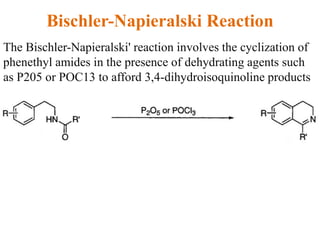
Bischler-Napieralski Reaction
The Bischler-Napieralski' reaction involves the cyclization of
phenethyl amides in the presence of dehydrating agents such
as P205 or POC13 to afford 3,4-dihydroisoquinoline products
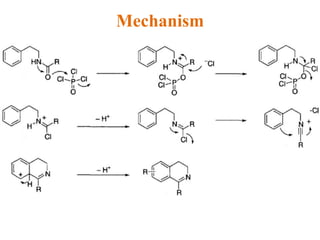
Mechanism
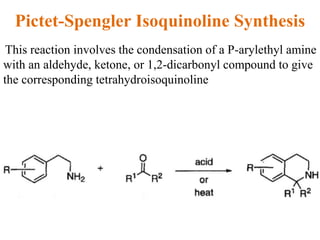
Pictet-Spengler Isoquinoline Synthesis
This reaction involves the condensation of a P-arylethyl amine
with an aldehyde, ketone, or 1,2-dicarbonyl compound to give
the corresponding tetrahydroisoquinoline
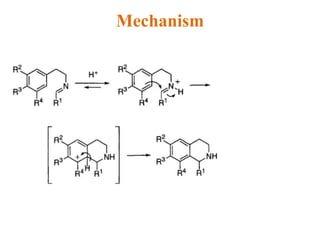
Mechanism
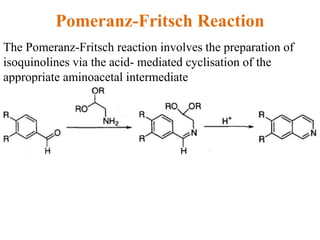
Pomeranz-Fritsch Reaction
The Pomeranz-Fritsch reaction involves the preparation of
isoquinolines via the acid- mediated cyclisation of the
appropriate aminoacetal intermediate
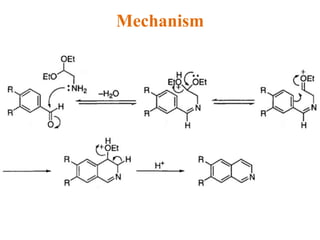
Mechanism
General reactions
Indoles
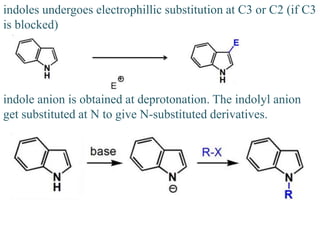
Reactivity
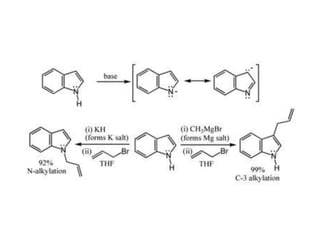
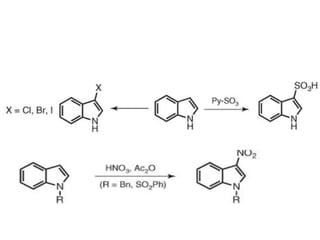
indoles undergoes electrophillic substitution at C3 or C2 (if C3
is blocked)
indole anion is obtained at deprotonation. The indolyl anion
get substituted at N to give N-substituted derivatives.
Important method of synthesis
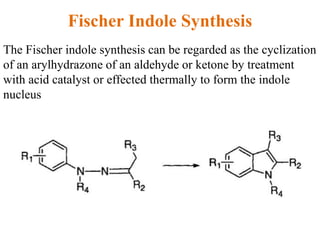
Fischer Indole Synthesis
The Fischer indole synthesis can be regarded as the cyclization
of an arylhydrazone of an aldehyde or ketone by treatment
with acid catalyst or effected thermally to form the indole
nucleus
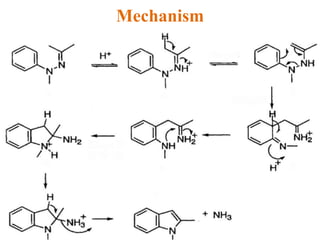
Mechanism
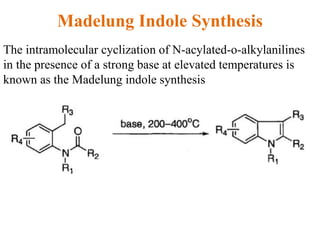
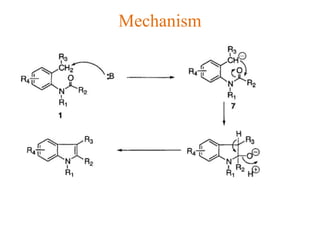
Madelung Indole Synthesis
The intramolecular cyclization of N-acylated-o-alkylanilines
in the presence of a strong base at elevated temperatures is
known as the Madelung indole synthesis
Mechanism
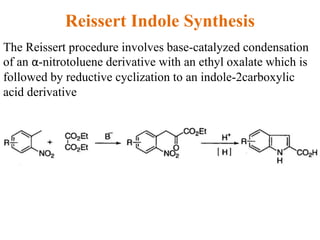
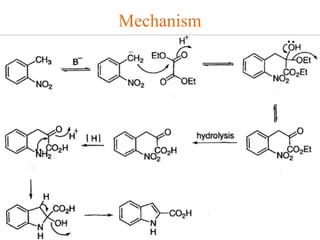
Reissert Indole Synthesis
The Reissert procedure involves base-catalyzed condensation
of an α-nitrotoluene derivative with an ethyl oxalate which is
followed by reductive cyclization to an indole-2carboxylic
acid derivative
Mechanism
General reactions
Heterocyclic compounds

Heterocyclic compounds