by : Rajnish Kumar, Assistant Professor & Ajay Kumar, M.
Pharma Student, Noida Institute of Engineering &
Technology, Pharmacy Institute, Plot no. 19, Knowledge
Park-2, Institutional Area, Greater Noida, U. P., India-
201306.
PROTECTING GROUPS IN ORGANIC CHEMISTRY
Role of protection in
organic chemistry
• a.When there are two functional groups of unequal reactivity within a
molecule, the more reactive group can be made to react alone, but it may
not be possible to react the less reactive functional group selectively.
b. A group the use of which makes possible to react a less reactive
functional group selectively in presence of a more reactive group is known
as protecting group.
c. A protecting group blocks the reactivity of a functional group by
converting it into a different group which is inert to the conditions of some
reaction(s) that is to be carried out as part of a synthetic route.
d. When we choosing a suitable protecting group, the following features
must be considered.
Cheap and commercially available
Simple to put in high yield
Stable to reaction conditions
Easy to remove in high yield
◦ Protection of Alcohols.
◦ Protection of Carbonyl Groups in Aldehyde And Ketones.
◦ Protection of Carboxylic acid.
◦ Protection of amines.
Protecting groups for
different functional groups
Protection of Alcohols
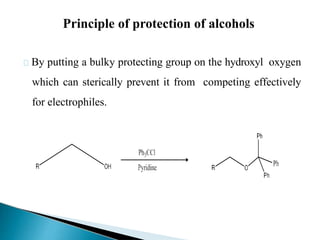
By putting a bulky protecting group on the hydroxyl oxygen
which can sterically prevent it from competing effectively
for electrophiles.
Principle of protection of alcohols
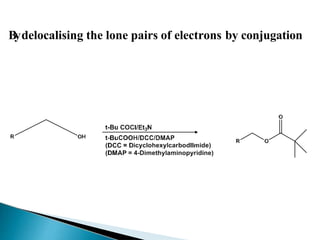
Bydelocalising the lone pairs of electrons by conjugation
Acetals Or Ketals As Protecting Groups For Alcohols
Ether As Protecting Groups For Alcohals
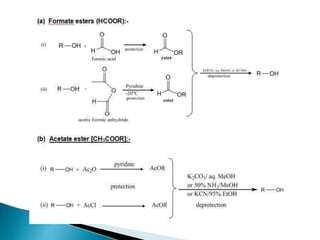
Ester As Protecting Groups For Alcohals
Protecting groups for alcohols
Acetals or ketals as protecting
groups for alcohol
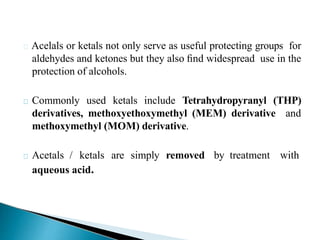
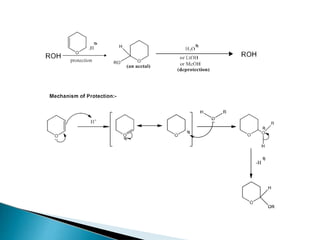
Acelals or ketals not only serve as useful protecting groups for
aldehydes and ketones but they also find widespread use in the
protection of alcohols.
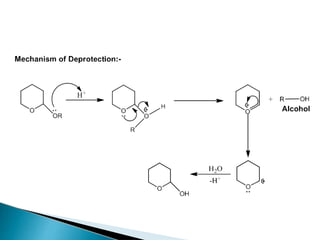
Commonly used ketals include Tetrahydropyranyl (THP)
derivatives, methoxyethoxymethyl (MEM) derivative and
methoxymethyl (MOM) derivative.
Acetals / ketals are simply removed by treatment with
aqueous acid.
Ether as protecting groups for
alcohols
Alcohols may be simply converted to ethers by
nucleophilic attack on a suitable alkyl halide.
Ethers are stable to basic and mildly acidic
conditions; they do not react with oxidizing /
reducing agents and are inert to organo-metallic
reagents. However, this stability means that many
others are not easily cleaved to their parent
alcohol under mild conditions. Therefore, only
certain ethers, which are easily cleaved under
mild conditions, are commonly used as protecting
groups for alcohols.
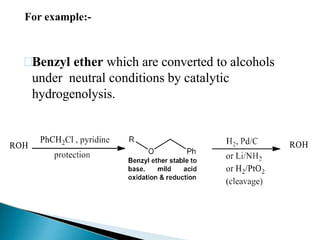
Benzyl ether which are converted to alcohols
under neutral conditions by catalytic
hydrogenolysis.
For example:-
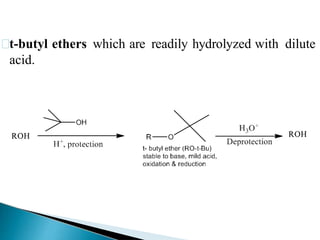
t-butyl ethers which are readily hydrolyzed with dilute
acid.
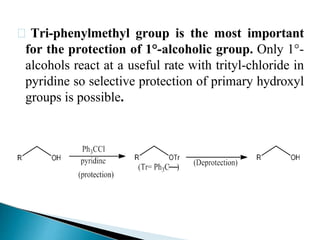
Tri-phenylmethyl group is the most important
for the protection of 1°-alcoholic group. Only 1°-
alcohols react at a useful rate with trityl-chloride in
pyridine so selective protection of primary hydroxyl
groups is possible.
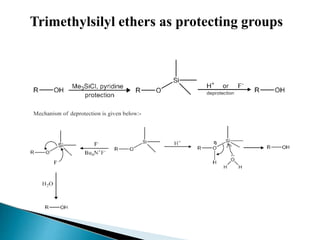
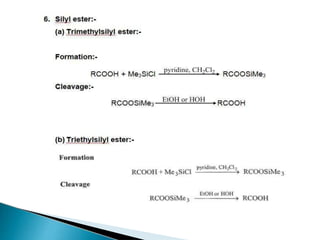
Trimethylsilyl ethers as protecting groups
Esters As Protecting Group For
Alcohol
Trichloroacetate esters
[Cl3CCOOR]:
Pivoloate ester
[Me3CCOOR]:-
Protection of 1,2 & 1,3 diols
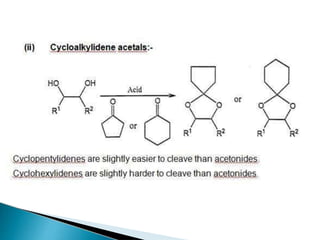
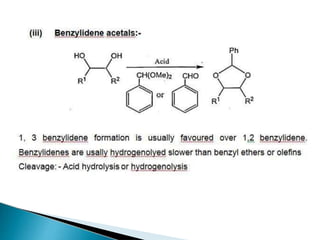
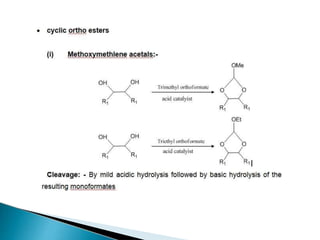
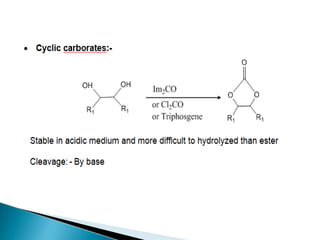
Cis 1, 2 diols and cis and trans-1,3 diols can be
protected as cyclic acetals and ketals (e.g., dioxlanes
and dioxanes) or cylic ortho esters that are cleaved by
acidic hydrolysis or as cylic esters (e.g, carbonates) that
are cleaved by basic hydrolysis.
Cyclic ortho esters are more readily cleaved by acidc
hydrolysis than cyclic acetals or ketals.
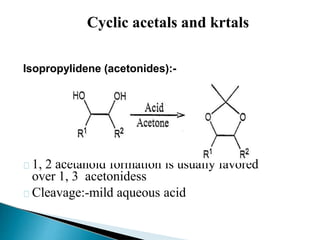
Isopropylidene (acetonides):-
1, 2 acetanoid formation is usually favored
over 1, 3 acetonidess
Cleavage:-mild aqueous acid
Cyclic acetals and krtals
Protection of carbonyl groups
in aldehyde and ketones
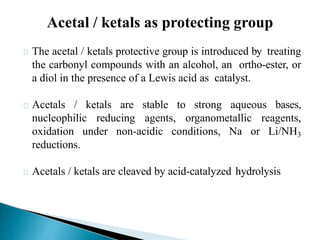
The acetal / ketals protective group is introduced by treating
the carbonyl compounds with an alcohol, an ortho-ester, or
a diol in the presence of a Lewis acid as catalyst.
Acetals / ketals are stable to strong aqueous bases,
nucleophilic reducing agents, organometallic reagents,
oxidation under non-acidic conditions, Na or Li/NH3
reductions.
Acetals / ketals are cleaved by acid-catalyzed hydrolysis
Acetal / ketals as protecting group
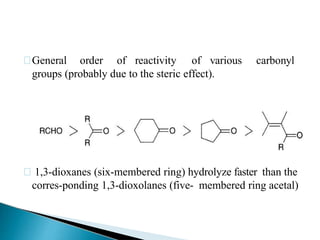
General order of reactivity of various carbonyl
groups (probably due to the steric effect).
1,3-dioxanes (six-membered ring) hydrolyze faster than the
corres-ponding 1,3-dioxolanes (five- membered ring acetal)
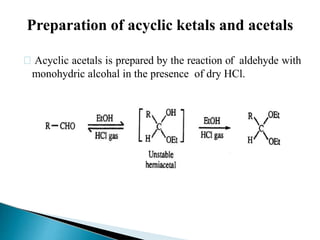
Acyclic acetals is prepared by the reaction of aldehyde with
monohydric alcohal in the presence of dry HCl.
Preparation of acyclic ketals and acetals
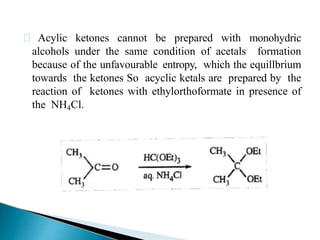
Acylic ketones cannot be prepared with monohydric
alcohols under the same condition of acetals formation
because of the unfavourable entropy, which the equillbrium
towards the ketones So acyclic ketals are prepared by the
reaction of ketones with ethylorthoformate in presence of
the NH4Cl.
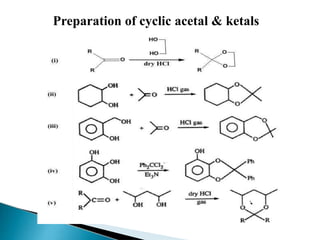
Preparation of cyclic acetal & ketals
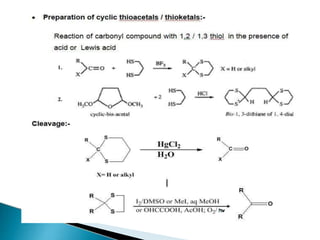
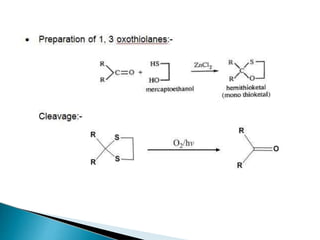
Thioacetals / thioketals are quite stable toward hydrolysis;
there is no special need to remove the H2O formed during
the reaction.
Thioacetal/ Thioketals as protecting group
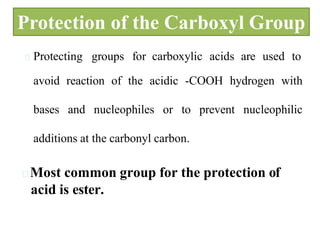
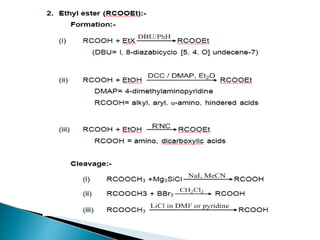
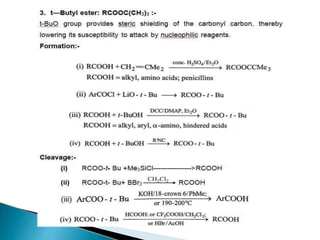
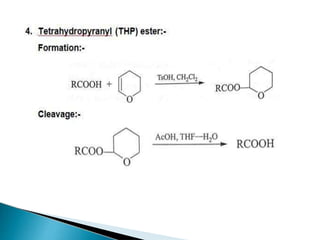
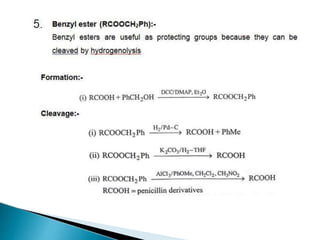
Protection of the Carboxyl Group
Protecting groups for carboxylic acids are used to
avoid reaction of the acidic -COOH hydrogen with
bases and nucleophiles or to prevent nucleophilic
additions at the carbonyl carbon.
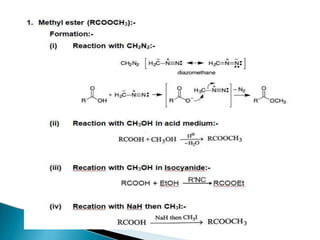
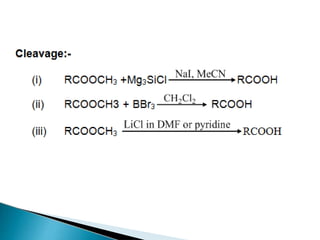
Most common group for the protection of
acid is ester.
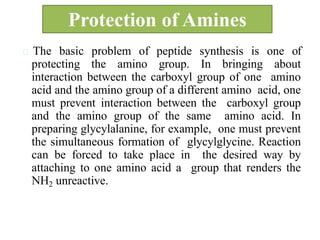
Protection of Amines
The basic problem of peptide synthesis is one of
protecting the amino group. In bringing about
interaction between the carboxyl group of one amino
acid and the amino group of a different amino acid, one
must prevent interaction between the carboxyl group
and the amino group of the same amino acid. In
preparing glycylalanine, for example, one must prevent
the simultaneous formation of glycylglycine. Reaction
can be forced to take place in the desired way by
attaching to one amino acid a group that renders the
NH2 unreactive.
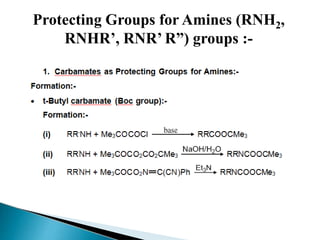
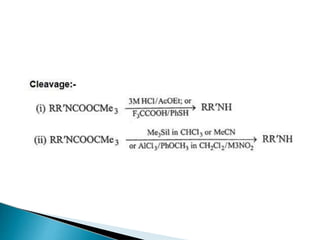
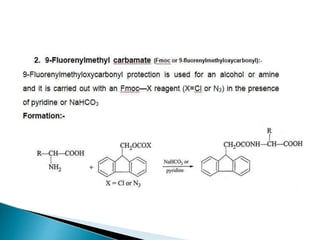
Protecting Groups for Amines (RNH2,
RNHR’, RNR’ R”) groups :-
1.Singh, J ; Yadav, L.D.S; Organic Synthesis;Pragati Publicaton; thirteenth edition-
2017; pp. 696- 721.
2.Kar, K.R.; Application of Redox and Reagents in Organic Synthesis; New
Central Book Agency (P) Ltd; volume-1; pp 376-385.
3.Clayden, J; Greeves, N; Warren, S; Wothers, P;
Organic Chemistry; pp 633-637 & 657
4.Hanson, J.R.; Protecting Groups in Organic Synthesis; Sheffield Academic
Press; pp 8- 80.
5.Morrison, R.T.; Boyd R.N.; Organic Chemistry; Prentice-Hall of India Private
Limited; Sixth Edition- 2002; pp. 1147
6.March, J; Smith, M.B.; March’sAdvanced Organic Chemistry: Reactions,
Mechanisms, and Structure; Wiley Publication; Sixth Edition; pp 1271-1279
References :-
Thank you!

Protecting Groups in Organic Chemistry

  • 1.
    by : RajnishKumar, Assistant Professor & Ajay Kumar, M. Pharma Student, Noida Institute of Engineering & Technology, Pharmacy Institute, Plot no. 19, Knowledge Park-2, Institutional Area, Greater Noida, U. P., India- 201306. PROTECTING GROUPS IN ORGANIC CHEMISTRY
  • 2.
    Role of protectionin organic chemistry
  • 3.
    • a.When thereare two functional groups of unequal reactivity within a molecule, the more reactive group can be made to react alone, but it may not be possible to react the less reactive functional group selectively. b. A group the use of which makes possible to react a less reactive functional group selectively in presence of a more reactive group is known as protecting group. c. A protecting group blocks the reactivity of a functional group by converting it into a different group which is inert to the conditions of some reaction(s) that is to be carried out as part of a synthetic route. d. When we choosing a suitable protecting group, the following features must be considered. Cheap and commercially available Simple to put in high yield Stable to reaction conditions Easy to remove in high yield
  • 4.
    ◦ Protection ofAlcohols. ◦ Protection of Carbonyl Groups in Aldehyde And Ketones. ◦ Protection of Carboxylic acid. ◦ Protection of amines. Protecting groups for different functional groups
  • 5.
  • 6.
    By putting abulky protecting group on the hydroxyl oxygen which can sterically prevent it from competing effectively for electrophiles. Principle of protection of alcohols
  • 7.
    Bydelocalising the lonepairs of electrons by conjugation
  • 8.
    Acetals Or KetalsAs Protecting Groups For Alcohols Ether As Protecting Groups For Alcohals Ester As Protecting Groups For Alcohals Protecting groups for alcohols
  • 9.
    Acetals or ketalsas protecting groups for alcohol
  • 10.
    Acelals or ketalsnot only serve as useful protecting groups for aldehydes and ketones but they also find widespread use in the protection of alcohols. Commonly used ketals include Tetrahydropyranyl (THP) derivatives, methoxyethoxymethyl (MEM) derivative and methoxymethyl (MOM) derivative. Acetals / ketals are simply removed by treatment with aqueous acid.
  • 13.
    Ether as protectinggroups for alcohols
  • 14.
    Alcohols may besimply converted to ethers by nucleophilic attack on a suitable alkyl halide. Ethers are stable to basic and mildly acidic conditions; they do not react with oxidizing / reducing agents and are inert to organo-metallic reagents. However, this stability means that many others are not easily cleaved to their parent alcohol under mild conditions. Therefore, only certain ethers, which are easily cleaved under mild conditions, are commonly used as protecting groups for alcohols.
  • 15.
    Benzyl ether whichare converted to alcohols under neutral conditions by catalytic hydrogenolysis. For example:-
  • 16.
    t-butyl ethers whichare readily hydrolyzed with dilute acid.
  • 17.
    Tri-phenylmethyl group isthe most important for the protection of 1°-alcoholic group. Only 1°- alcohols react at a useful rate with trityl-chloride in pyridine so selective protection of primary hydroxyl groups is possible.
  • 18.
    Trimethylsilyl ethers asprotecting groups
  • 19.
    Esters As ProtectingGroup For Alcohol
  • 21.
  • 22.
    Protection of 1,2& 1,3 diols
  • 23.
    Cis 1, 2diols and cis and trans-1,3 diols can be protected as cyclic acetals and ketals (e.g., dioxlanes and dioxanes) or cylic ortho esters that are cleaved by acidic hydrolysis or as cylic esters (e.g, carbonates) that are cleaved by basic hydrolysis. Cyclic ortho esters are more readily cleaved by acidc hydrolysis than cyclic acetals or ketals.
  • 24.
    Isopropylidene (acetonides):- 1, 2acetanoid formation is usually favored over 1, 3 acetonidess Cleavage:-mild aqueous acid Cyclic acetals and krtals
  • 29.
    Protection of carbonylgroups in aldehyde and ketones
  • 30.
    The acetal /ketals protective group is introduced by treating the carbonyl compounds with an alcohol, an ortho-ester, or a diol in the presence of a Lewis acid as catalyst. Acetals / ketals are stable to strong aqueous bases, nucleophilic reducing agents, organometallic reagents, oxidation under non-acidic conditions, Na or Li/NH3 reductions. Acetals / ketals are cleaved by acid-catalyzed hydrolysis Acetal / ketals as protecting group
  • 31.
    General order ofreactivity of various carbonyl groups (probably due to the steric effect). 1,3-dioxanes (six-membered ring) hydrolyze faster than the corres-ponding 1,3-dioxolanes (five- membered ring acetal)
  • 32.
    Acyclic acetals isprepared by the reaction of aldehyde with monohydric alcohal in the presence of dry HCl. Preparation of acyclic ketals and acetals
  • 33.
    Acylic ketones cannotbe prepared with monohydric alcohols under the same condition of acetals formation because of the unfavourable entropy, which the equillbrium towards the ketones So acyclic ketals are prepared by the reaction of ketones with ethylorthoformate in presence of the NH4Cl.
  • 34.
    Preparation of cyclicacetal & ketals
  • 35.
    Thioacetals / thioketalsare quite stable toward hydrolysis; there is no special need to remove the H2O formed during the reaction. Thioacetal/ Thioketals as protecting group
  • 38.
    Protection of theCarboxyl Group Protecting groups for carboxylic acids are used to avoid reaction of the acidic -COOH hydrogen with bases and nucleophiles or to prevent nucleophilic additions at the carbonyl carbon. Most common group for the protection of acid is ester.
  • 46.
    Protection of Amines Thebasic problem of peptide synthesis is one of protecting the amino group. In bringing about interaction between the carboxyl group of one amino acid and the amino group of a different amino acid, one must prevent interaction between the carboxyl group and the amino group of the same amino acid. In preparing glycylalanine, for example, one must prevent the simultaneous formation of glycylglycine. Reaction can be forced to take place in the desired way by attaching to one amino acid a group that renders the NH2 unreactive.
  • 47.
    Protecting Groups forAmines (RNH2, RNHR’, RNR’ R”) groups :-
  • 50.
    1.Singh, J ;Yadav, L.D.S; Organic Synthesis;Pragati Publicaton; thirteenth edition- 2017; pp. 696- 721. 2.Kar, K.R.; Application of Redox and Reagents in Organic Synthesis; New Central Book Agency (P) Ltd; volume-1; pp 376-385. 3.Clayden, J; Greeves, N; Warren, S; Wothers, P; Organic Chemistry; pp 633-637 & 657 4.Hanson, J.R.; Protecting Groups in Organic Synthesis; Sheffield Academic Press; pp 8- 80. 5.Morrison, R.T.; Boyd R.N.; Organic Chemistry; Prentice-Hall of India Private Limited; Sixth Edition- 2002; pp. 1147 6.March, J; Smith, M.B.; March’sAdvanced Organic Chemistry: Reactions, Mechanisms, and Structure; Wiley Publication; Sixth Edition; pp 1271-1279 References :-
  • 51.