Complex permanent tissues
Dr. K. GANESH KUMARI
ASSISTANT PROFESSOR
SRIMAD ANDAVAN ARTS AND SCIENCE COLLEGE (AUTONOMOUS)
TRICHY, TAMILNADU, INDIA
Xylem
• A conduction tissue in plants
• Complex tissue formed of many types
of cells
• Term proposed by Nageli (1958)
• Greek : xylos – wood
• Main function – conduction of water
and minerals from roots to leaves
• Additional function – provides
mechanical support
• It consists of both living and non
living cells
Two types of xylem in plants –
1. Primary xylem – formed from the
pro meristem (procambium) during
primary growth
2. Secondary xylem - formed from the
vascular cambium during secondary
growth
Components or elements of
xylem
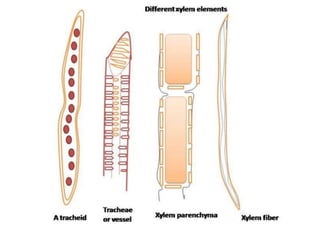
• The elements of xylem are
i. Tracheids
ii. Vessels
iii. Xylem fibres
iv. Xylem parenchyma
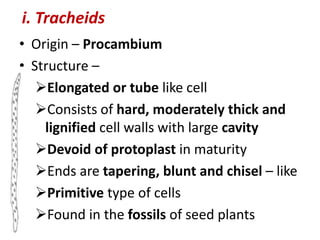
i. Tracheids
• Origin – Procambium
• Structure –
Elongated or tube like cell
Consists of hard, moderately thick and
lignified cell walls with large cavity
Devoid of protoplast in maturity
Ends are tapering, blunt and chisel – like
Primitive type of cells
Found in the fossils of seed plants
Cells with secondary cell
walls
Cells appear circular,
polygonal or polyhedral in
cross sections
Average length 5 – 6 mm
Major parts of the cells
imperforate
Only have pit – pairs at
common walls
Patterns of secondary thickenings
• Secondary cell wall materials are laid
down on the lateral walls of
tracheids
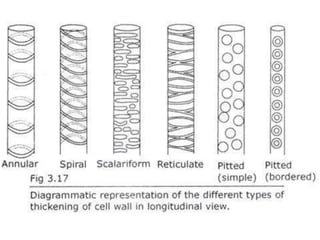
–Annular thickening
–Spiral (or) helical thickening
–Scalariform thickening
–Reticulate thickening
–Pitted thickening
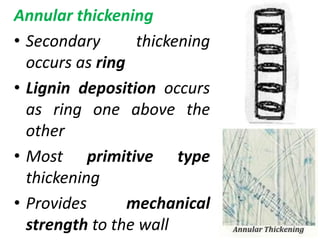
Annular thickening
• Secondary thickening
occurs as ring
• Lignin deposition occurs
as ring one above the
other
• Most primitive type
thickening
• Provides mechanical
strength to the wall
Spiral (or) helical
thickening
• Also called spiral
thickening
• Secondary walls
deposited as
spirals
• It is stronger than
annular thickening
Scalariform thickening
• Also called like ladder
like thickenings
• Wall materials
deposited as transverse
bands
• Bands are with few
interconnections
• Pits occurs in between
thickenings
Reticulate thickening
• Also called as net like thickening
• Net like distribution of secondary
materials
Pitted thickening
• Entire inner surface is
thickened
• Unthicken areas looks like
pits
• Used for the communication
with neighbouring cells
Two types of pits
• Simple pits – Areas with
primary walls
• Bordered pits – Areas with
secondary walls
• Its secondary wall outgrowths –
dome like structure with perforation
• The primary wall thickening is called torus
• In gymnosperms, torus is surrounded by
microfibrils, known as margo
Functions of Tracheids
• For the transport of water and minerals
• Chief supporting element in
gymnosperms
• Provides mechanical support
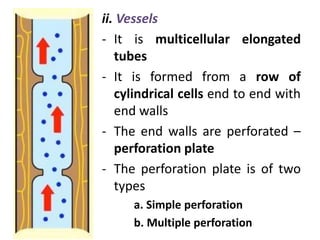
ii. Vessels
- It is multicellular elongated
tubes
- It is formed from a row of
cylindrical cells end to end with
end walls
- The end walls are perforated –
perforation plate
- The perforation plate is of two
types
a. Simple perforation
b. Multiple perforation
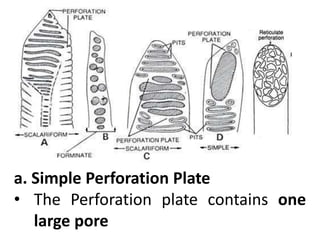
a. Simple Perforation Plate
• The Perforation plate contains one
large pore
b. Multiple perforation
• The perforation plate contains many
pores
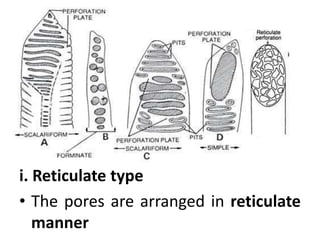
i. Reticulate type
• The pores are arranged in reticulate
manner
i. Scalariform type
• The pores are elongated and
arranged in parallel series
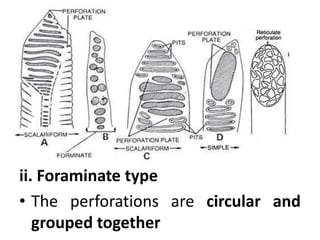
ii. Foraminate type
• The perforations are circular and
grouped together
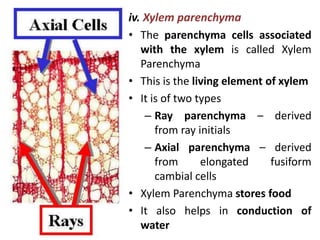
iv. Xylem parenchyma
• The parenchyma cells associated
with the xylem is called Xylem
Parenchyma
• This is the living element of xylem
• It is of two types
– Ray parenchyma – derived
from ray initials
– Axial parenchyma – derived
from elongated fusiform
cambial cells
• Xylem Parenchyma stores food
• It also helps in conduction of
water
THANK YOU

Complex permanent tissue

  • 1.
    Complex permanent tissues Dr.K. GANESH KUMARI ASSISTANT PROFESSOR SRIMAD ANDAVAN ARTS AND SCIENCE COLLEGE (AUTONOMOUS) TRICHY, TAMILNADU, INDIA
  • 2.
    Xylem • A conductiontissue in plants • Complex tissue formed of many types of cells • Term proposed by Nageli (1958) • Greek : xylos – wood • Main function – conduction of water and minerals from roots to leaves • Additional function – provides mechanical support
  • 3.
    • It consistsof both living and non living cells Two types of xylem in plants – 1. Primary xylem – formed from the pro meristem (procambium) during primary growth 2. Secondary xylem - formed from the vascular cambium during secondary growth
  • 4.
    Components or elementsof xylem • The elements of xylem are i. Tracheids ii. Vessels iii. Xylem fibres iv. Xylem parenchyma
  • 5.
    i. Tracheids • Origin– Procambium • Structure – Elongated or tube like cell Consists of hard, moderately thick and lignified cell walls with large cavity Devoid of protoplast in maturity Ends are tapering, blunt and chisel – like Primitive type of cells Found in the fossils of seed plants
  • 6.
    Cells with secondarycell walls Cells appear circular, polygonal or polyhedral in cross sections Average length 5 – 6 mm Major parts of the cells imperforate Only have pit – pairs at common walls
  • 7.
    Patterns of secondarythickenings • Secondary cell wall materials are laid down on the lateral walls of tracheids –Annular thickening –Spiral (or) helical thickening –Scalariform thickening –Reticulate thickening –Pitted thickening
  • 8.
    Annular thickening • Secondarythickening occurs as ring • Lignin deposition occurs as ring one above the other • Most primitive type thickening • Provides mechanical strength to the wall
  • 9.
    Spiral (or) helical thickening •Also called spiral thickening • Secondary walls deposited as spirals • It is stronger than annular thickening
  • 10.
    Scalariform thickening • Alsocalled like ladder like thickenings • Wall materials deposited as transverse bands • Bands are with few interconnections • Pits occurs in between thickenings
  • 11.
    Reticulate thickening • Alsocalled as net like thickening • Net like distribution of secondary materials
  • 12.
    Pitted thickening • Entireinner surface is thickened • Unthicken areas looks like pits • Used for the communication with neighbouring cells Two types of pits • Simple pits – Areas with primary walls • Bordered pits – Areas with secondary walls
  • 13.
    • Its secondarywall outgrowths – dome like structure with perforation
  • 14.
    • The primarywall thickening is called torus • In gymnosperms, torus is surrounded by microfibrils, known as margo
  • 15.
    Functions of Tracheids •For the transport of water and minerals • Chief supporting element in gymnosperms • Provides mechanical support
  • 17.
    ii. Vessels - Itis multicellular elongated tubes - It is formed from a row of cylindrical cells end to end with end walls - The end walls are perforated – perforation plate - The perforation plate is of two types a. Simple perforation b. Multiple perforation
  • 18.
    a. Simple PerforationPlate • The Perforation plate contains one large pore
  • 19.
    b. Multiple perforation •The perforation plate contains many pores
  • 20.
    i. Reticulate type •The pores are arranged in reticulate manner
  • 21.
    i. Scalariform type •The pores are elongated and arranged in parallel series
  • 22.
    ii. Foraminate type •The perforations are circular and grouped together
  • 23.
    iv. Xylem parenchyma •The parenchyma cells associated with the xylem is called Xylem Parenchyma • This is the living element of xylem • It is of two types – Ray parenchyma – derived from ray initials – Axial parenchyma – derived from elongated fusiform cambial cells • Xylem Parenchyma stores food • It also helps in conduction of water
  • 25.