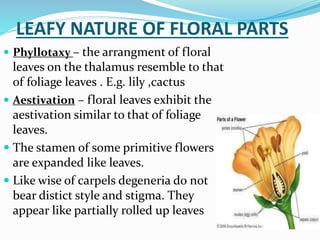
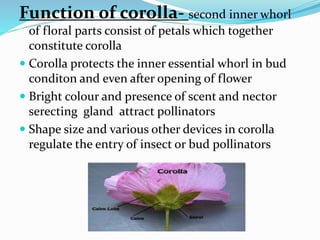
This document discusses the morphological nature and structure of flowers. It explains that flowers are highly condensed vegetative shoots modified for reproduction. The floral parts are equivalent to foliage leaves in position and modification. The thalamus is considered an condensed axis with highly condensed nodes and internodes so floral parts appear at the same level. Internodes are present between floral parts. Floral leaves exhibit phyllotaxy and aestivation similar to foliage leaves. The four whorls of floral parts - calyx, corolla, androecium, and gynoecium - each have specific protective and reproductive functions that aid in pollination and seed production.