Division: Gymnospermae
Class : Gnetopsida
Order : Gnetales
Family : Gnetaceae
 Gnetum has about 40 species, confined to the moist
tropical forests of West Africa, India, South China
and Malaysia. Five species occur in India. They are
 G.gnemon, G.contractum,
 G.latifolium,
 G.montamum
 G.ula.
 Young leaves, inflorescence fruits and seeds of G.
gnemon are edible. Its bark yields a fibre of high
tensile strength, ideal for paper pulp and fishing nets.
Seed kernels of G.ula yield an oil, used for
illumination, cooking and massage in rheumatism.
The kernels of G.latifolium are edible and its bark is
used for making nets and ropes.
 Gnetum, represented by about 40 species is
confined to the tropical and humid regions of the
world. Nearly all species, except G. microcarpum,
occur below an altitude of 1500 metres. Five
species (Gnetum contractum, G. gnemon, G.
montanum, G. ula and G. latifolium) have been
reported from India
 Gnetum ula is the most commonly occurring
species of India.
 Majority of the Gnetum species are climbers except a
few shrubs and trees. G. trinerve is apparently
parasitic.
 Two types of branches are present on the main stem
of the plant, i.e. branches of limited growth and
branches of unlimited growth.
 Each branch contains nodes and internodes.
 In climbing species the branches of limited growth or
short shoots are generally un-branched and bear the
foliage leaves.
 The leaves (9-10) are arranged in decussate pairs
 Adult plant is sporophyte. It very much resembles
angiosperms in appearance.
 The plant body is differentiated into root, stem and
leaves.
 Root: Root system is profusely branched tap root
system which does not grow very deep into the soil.
 Stem: Dwarf shoots of limited growth and long shoots
of unlimited growth.
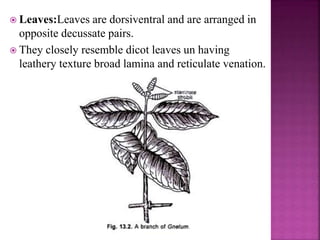
 Leaves:Leaves are dorsiventral and are arranged in
opposite decussate pairs.
 They closely resemble dicot leaves un having
leathery texture broad lamina and reticulate venation.
Primary Structure of Root
T.S of young root is
differentiated into 3 regions
1. Epiblema
2. Cortex
3. Vascular Cylinder
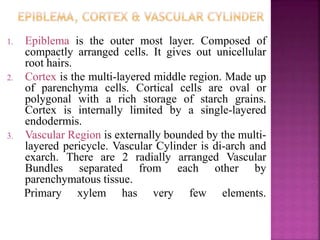
1. Epiblema is the outer most layer. Composed of
compactly arranged cells. It gives out unicellular
root hairs.
2. Cortex is the multi-layered middle region. Made up
of parenchyma cells. Cortical cells are oval or
polygonal with a rich storage of starch grains.
Cortex is internally limited by a single-layered
endodermis.
3. Vascular Region is externally bounded by the multi-
layered pericycle. Vascular Cylinder is di-arch and
exarch. There are 2 radially arranged Vascular
Bundles separated from each other by
parenchymatous tissue.
Primary xylem has very few elements.
In young Roots:
• Layers of starch filled cortical
cells.
• 4-6 layers of pericycle;
primary xylem visible.
• Roots may be Di-arch and Ex-
arch.
In older Roots:
• Primary xylem
indistinguishable due to
secondary growth.
• Consist of tracheids, vessels
and xylem parenchyma.
• Phloem consists of sieve tubes
and phloem parenchyma.
• “Bars of sanio” present in
tracheids; absent in vessels.
 Secondary growth is of the normal type.
 Cambium are formed internal to the phloem groups and external to
the xylem groups. Join to form a complete ring of cambium.
 Secondary xylem possesses vessels, tracheids and xylem
parenchyma.
 Medullary rays transverse the secondary xylem, composed of
parenchyma cells.
 Phloem is made up of sieve cells and phloem parenchyma.
 Periderm formation starts with the production of secondary vascular
tissues.
 Phellogen originates from the outer cortical layer, produces phellem
towards the outer side and phelloderm towards the inner side.
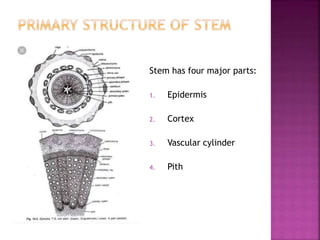
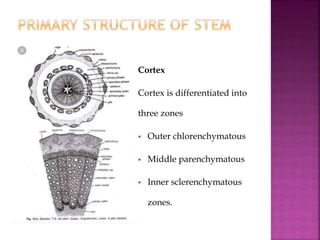
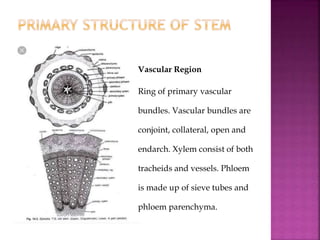
Stem has four major parts:
1. Epidermis
2. Cortex
3. Vascular cylinder
4. Pith
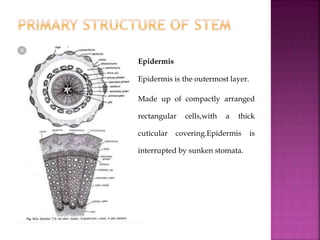
Epidermis
Epidermis is the outermost layer.
Made up of compactly arranged
rectangular cells,with a thick
cuticular covering.Epidermis is
interrupted by sunken stomata.
Cortex
Cortex is differentiated into
three zones
 Outer chlorenchymatous
 Middle parenchymatous
 Inner sclerenchymatous
zones.
Vascular Region
Ring of primary vascular
bundles. Vascular bundles are
conjoint, collateral, open and
endarch. Xylem consist of both
tracheids and vessels. Phloem
is made up of sieve tubes and
phloem parenchyma.
Pith
A parenchymatous pith is
present at the centre. Its cells
are polygonal in outline.
 They resemble dicot leaves
with cuticularised epidermis
stomata on both side expect on
veins.
 Mesophylls differentiated into
single layered palisade, well-
developed spongy parenchyma.
 Stone cell & latex tubes present
in mid-rib region.
 Vascular bundles:
1. Arch curve form in mid-rib region.
2. Conjoint collateral type.
3. Xylem: tracheids , vessels and xylem
parenchyma.
4. Phloem: sieve cells and phloem
parenchyma
 Reproduction is sexual. Gnetum is dioecious.
 The reproductive organs referred to as flowers are
organized into inflorescences.
 Inflorescences are usually axillary in position but
terminal inflorescences.
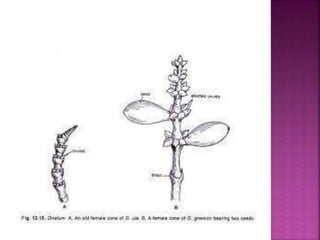
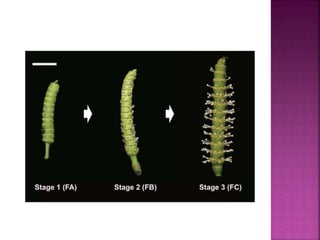
 The male strobilus has a long slender axis.
The male strobilus is branched and branching
may be of several kinds.
 The axis bears 10-25whorl of bracts (collars).
 -About 12-25 male flowers are arranged in
 three to six rings above each collar.
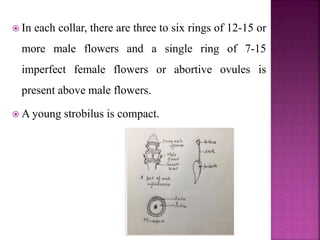
 In each collar, there are three to six rings of 12-15 or
more male flowers and a single ring of 7-15
imperfect female flowers or abortive ovules is
present above male flowers.
 A young strobilus is compact.
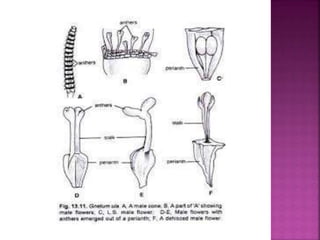
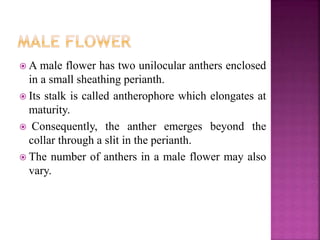
 A male flower has two unilocular anthers enclosed
in a small sheathing perianth.
 Its stalk is called antherophore which elongates at
maturity.
 Consequently, the anther emerges beyond the
collar through a slit in the perianth.
 The number of anthers in a male flower may also
vary.
 It is similar to the male strobilus in the young
stages.
 In a female strobilus, a ring of four to ten female
flowers (ovules) is present above each collar.
 There is a total absence of any male flowers.
Initially all the ovules look alike, but later only a
few grow to maturity. The upper few collars lack
ovules.
GNETUM................................pptx