Flowering Model
VIDANBIOLOGY
FLOWERING GENES IN Arabidopsis thaliana
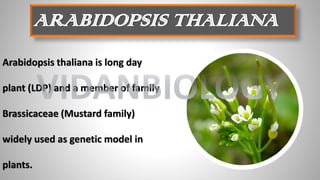
❑Arabidopsis thaliana is long day plant (LDP) and a
member of family Brassicaceae (Mustard family) widely
used as genetic model in plants.
❑Flower is modified shoot of limited growth.
❑Flowering requires reprogramming of Shoot Apical
Meristem (SAM).
❑Biological function of a flower is to help in reproduction.
❑Genetic analysis have identified 4 Classes of genes
which control flowering in Arabidopsis thaliana.
VIDANBIOLOGY
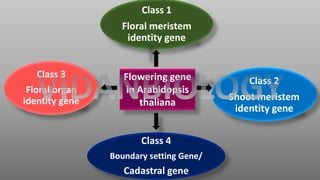
Class 1
Floral meristem
identity gene
Class 2
Shoot meristem
identity gene
Class 4
Boundary setting Gene/
Cadastral gene
Class 3
Floral organ
identity gene
Flowering gene
in Arabidopsis
thaliana
VIDANBIOLOGY
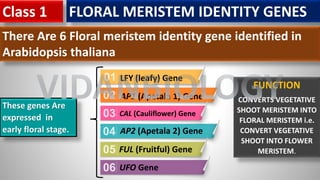
FLORAL MERISTEM IDENTITY GENES
There Are 6 Floral meristem identity gene identified in
Arabidopsis thaliana
These genes Are
expressed in
early floral stage.
LFY (leafy) Gene
AP1 (Apetala 1) Gene
CAL (Cauliflower) Gene
AP2 (Apetala 2) Gene
FUL (Fruitful) Gene
UFO Gene
FUNCTION
CONVERTS VEGETATIVE
SHOOT MERISTEM INTO
FLORAL MERISTEM i.e.
CONVERT VEGETATIVE
SHOOT INTO FLOWER
MERISTEM.
Class 1
VIDANBIOLOGY
SHOOT MERISTEM IDENTITY GENES
Class-2
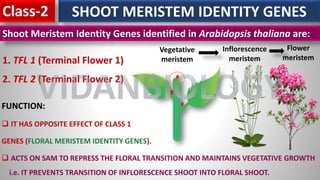
Shoot Meristem Identity Genes identified in Arabidopsis thaliana are:
1. TFL 1 (Terminal Flower 1)
2. TFL 2 (Terminal Flower 2)
FUNCTION:
❑ IT HAS OPPOSITE EFFECT OF CLASS 1
GENES (FLORAL MERISTEM IDENTITY GENES).
❑ ACTS ON SAM TO REPRESS THE FLORAL TRANSITION AND MAINTAINS VEGETATIVE GROWTH
i.e. IT PREVENTS TRANSITION OF INFLORESCENCE SHOOT INTO FLORAL SHOOT.
Vegetative
meristem
Inflorescence
meristem
Flower
meristem
VIDANBIOLOGY
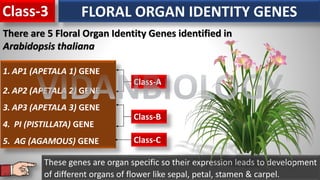
Class-3 FLORAL ORGAN IDENTITY GENES
There are 5 Floral Organ Identity Genes identified in
Arabidopsis thaliana
These genes are organ specific so their expression leads to development
of different organs of flower like sepal, petal, stamen & carpel.
1. AP1 (APETALA 1) GENE
2. AP2 (APETALA 2) GENE
3. AP3 (APETALA 3) GENE
4. PI (PISTILLATA) GENE
5. AG (AGAMOUS) GENE
Class-A
Class-B
Class-C
VIDANBIOLOGY
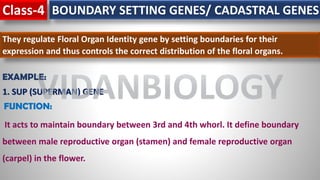
Class-4 BOUNDARY SETTING GENES/ CADASTRAL GENES
They regulate Floral Organ Identity gene by setting boundaries for their
expression and thus controls the correct distribution of the floral organs.
EXAMPLE:
1. SUP (SUPERMAN) GENE
FUNCTION:
It acts to maintain boundary between 3rd and 4th whorl. It define boundary
between male reproductive organ (stamen) and female reproductive organ
(carpel) in the flower.
VIDANBIOLOGY
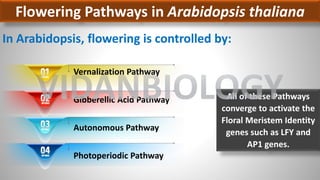
Flowering Pathways in Arabidopsis thaliana
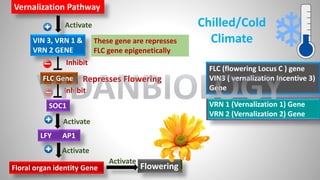
Vernalization Pathway
Gibberellic Acid Pathway
Autonomous Pathway
Photoperiodic Pathway
In Arabidopsis, flowering is controlled by:
All of these Pathways
converge to activate the
Floral Meristem Identity
genes such as LFY and
AP1 genes.
VIDANBIOLOGY
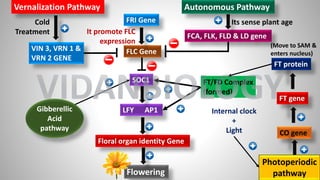
FRI Gene
FLC Gene
SOC1
LFY AP1
Floral organ identity Gene
FCA, FLK, FLD & LD gene
FT protein
FT gene
CO gene
FT/FD Complex
(formed)
VIN 3, VRN 1 &
VRN 2 GENE
Gibberellic
Acid
pathway
(Move to SAM &
enters nucleus)
Autonomous Pathway
Its sense plant age
It promote FLC
expression
Vernalization Pathway
Cold
Treatment
Photoperiodic
pathway
Flowering
Internal clock
+
Light
VIDANBIOLOGY
FLC Gene
SOC1
LFY AP1
VIN 3, VRN 1 &
VRN 2 GENE
Vernalization Pathway
Floral organ identity Gene Flowering
Activate
Activate
Activate
Activate
Inhibit
Inhibit
Represses Flowering
These gene are represses
FLC gene epigenetically
FLC (flowering Locus C ) gene
VIN3 ( vernalization Incentive 3)
Gene
VRN 1 (Vernalization 1) Gene
VRN 2 (Vernalization 2) Gene
Chilled/Cold
Climate
VIDANBIOLOGY
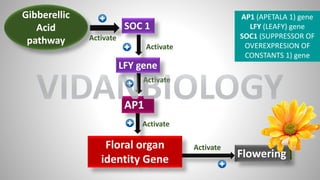
SOC 1
LFY gene
Floral organ
identity Gene
Gibberellic
Acid
pathway
Flowering
AP1
Activate
Activate
Activate
Activate
Activate
AP1 (APETALA 1) gene
LFY (LEAFY) gene
SOC1 (SUPPRESSOR OF
OVEREXPRESION OF
CONSTANTS 1) gene
VIDANBIOLOGY
FLC Gene
SOC1
Floral organ identity Gene
FCA, FLK, FLD & LD gene
Flowering
LFY gene
AP1
Activate
Inhibit
Activate
Activate
PROMOTE
Inhibit
Sensing
of Plant
Age
FLC (FLOWERING LOCUS C)
LFY [LEAFY]
AP1[APETALA 1}
SOC1 (SUPPRESSOR OF
OVERREXPRESSION OF CONSTANTS 1)
FCA (FLOWER|NG CONTROL LOCUS A)
FLK (FLOWERING LOCUS K)
FLD (FLOWERING LOCUS D)
LD (LUMINIDEPENDENS)
PROMOTE
VIDANBIOLOGY
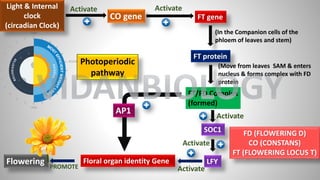
SOC1
LFY
Floral organ identity Gene
FT protein
FT gene
CO gene
FT/FD Complex
(formed)
(Move from leaves SAM & enters
nucleus & forms complex with FD
protein
Photoperiodic
pathway
Flowering
AP1
(In the Companion cells of the
phloem of leaves and stem)
Activate
PROMOTE Activate
Activate
Activate
Activate
Light & Internal
clock
(circadian Clock)
FD (FLOWERING D)
CO (CONSTANS)
FT (FLOWERING LOCUS T)
VIDANBIOLOGY
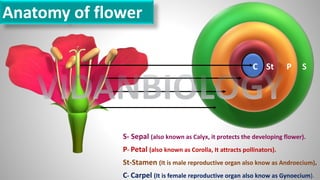
C St P S
S- Sepal (also known as Calyx, it protects the developing flower).
P- Petal (also known as Corolla, It attracts pollinators).
St-Stamen (It is male reproductive organ also know as Androecium).
C- Carpel (It is female reproductive organ also know as Gynoecium).
Anatomy of flower
VIDANBIOLOGY
Arabidopsis thaliana is long day
plant (LDP) and a member of family
Brassicaceae (Mustard family)
widely used as genetic model in
plants.
ARABIDOPSIS THALIANA
VIDANBIOLOGY
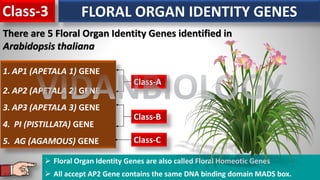
Class-3 FLORAL ORGAN IDENTITY GENES
There are 5 Floral Organ Identity Genes identified in
Arabidopsis thaliana
1. AP1 (APETALA 1) GENE
2. AP2 (APETALA 2) GENE
3. AP3 (APETALA 3) GENE
4. PI (PISTILLATA) GENE
5. AG (AGAMOUS) GENE
Class-A
Class-B
Class-C
➢ Floral Organ Identity Genes are also called Floral Homeotic Genes
➢ All accept AP2 Gene contains the same DNA binding domain MADS box.
VIDANBIOLOGY
Class A gene is mutually antagonist to Class C gene I.e. A and C are
antagonist to each other
➢ If class A gene gets mutated then at that place class C gene will get expressed
and if class C Gene gets mutated then at that place Class A gene will get
expressed
➢ Class B Genes Does not express individually
A C
VIDANBIOLOGY
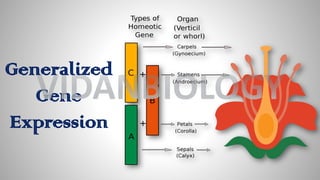
Generalized
Gene
Expression
VIDANBIOLOGY
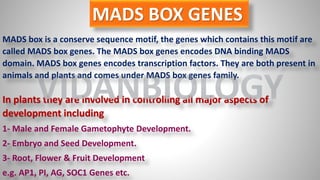
MADS BOX GENES
MADS box is a conserve sequence motif, the genes which contains this motif are
called MADS box genes. The MADS box genes encodes DNA binding MADS
domain. MADS box genes encodes transcription factors. They are both present in
animals and plants and comes under MADS box genes family.
In plants they are involved in controlling all major aspects of
development including
1- Male and Female Gametophyte Development.
2- Embryo and Seed Development.
3- Root, Flower & Fruit Development
e.g. AP1, PI, AG, SOC1 Genes etc.
VIDANBIOLOGY
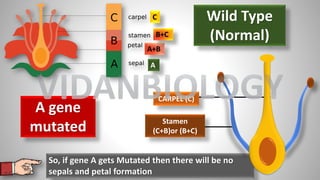
A
A+B
B+C
C
CARPEL (C)
Stamen
(C+B)or (B+C)
Wild Type
(Normal)
A gene
mutated
So, if gene A gets Mutated then there will be no
sepals and petal formation
VIDANBIOLOGY
C St P S C St St C
Wild Type (Normal) A gene mutated
VIDANBIOLOGY
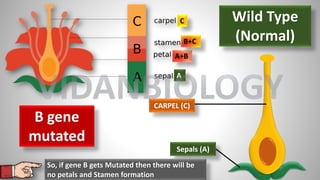
A
A+B
B+C
C Wild Type
(Normal)
B gene
mutated
CARPEL (C)
Sepals (A)
So, if gene B gets Mutated then there will be
no petals and Stamen formation
VIDANBIOLOGY
C St P S
Wild Type (Normal) B gene mutated
C C S S
VIDANBIOLOGY
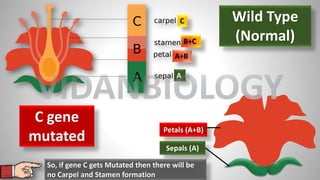
A
A+B
B+C
C
Sepals (A)
Petals (A+B)
C gene
mutated
Wild Type
(Normal)
So, if gene C gets Mutated then there will be
no Carpel and Stamen formation
VIDANBIOLOGY
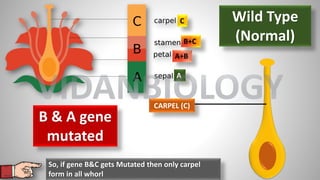
A
A+B
B+C
C Wild Type
(Normal)
B & A gene
mutated
CARPEL (C)
So, if gene B&C gets Mutated then only carpel
form in all whorl
VIDANBIOLOGY

ABC Model of Flower development

  • 1.
  • 2.
    FLOWERING GENES INArabidopsis thaliana ❑Arabidopsis thaliana is long day plant (LDP) and a member of family Brassicaceae (Mustard family) widely used as genetic model in plants. ❑Flower is modified shoot of limited growth. ❑Flowering requires reprogramming of Shoot Apical Meristem (SAM). ❑Biological function of a flower is to help in reproduction. ❑Genetic analysis have identified 4 Classes of genes which control flowering in Arabidopsis thaliana. VIDANBIOLOGY
  • 3.
    Class 1 Floral meristem identitygene Class 2 Shoot meristem identity gene Class 4 Boundary setting Gene/ Cadastral gene Class 3 Floral organ identity gene Flowering gene in Arabidopsis thaliana VIDANBIOLOGY
  • 4.
    FLORAL MERISTEM IDENTITYGENES There Are 6 Floral meristem identity gene identified in Arabidopsis thaliana These genes Are expressed in early floral stage. LFY (leafy) Gene AP1 (Apetala 1) Gene CAL (Cauliflower) Gene AP2 (Apetala 2) Gene FUL (Fruitful) Gene UFO Gene FUNCTION CONVERTS VEGETATIVE SHOOT MERISTEM INTO FLORAL MERISTEM i.e. CONVERT VEGETATIVE SHOOT INTO FLOWER MERISTEM. Class 1 VIDANBIOLOGY
  • 5.
    SHOOT MERISTEM IDENTITYGENES Class-2 Shoot Meristem Identity Genes identified in Arabidopsis thaliana are: 1. TFL 1 (Terminal Flower 1) 2. TFL 2 (Terminal Flower 2) FUNCTION: ❑ IT HAS OPPOSITE EFFECT OF CLASS 1 GENES (FLORAL MERISTEM IDENTITY GENES). ❑ ACTS ON SAM TO REPRESS THE FLORAL TRANSITION AND MAINTAINS VEGETATIVE GROWTH i.e. IT PREVENTS TRANSITION OF INFLORESCENCE SHOOT INTO FLORAL SHOOT. Vegetative meristem Inflorescence meristem Flower meristem VIDANBIOLOGY
  • 6.
    Class-3 FLORAL ORGANIDENTITY GENES There are 5 Floral Organ Identity Genes identified in Arabidopsis thaliana These genes are organ specific so their expression leads to development of different organs of flower like sepal, petal, stamen & carpel. 1. AP1 (APETALA 1) GENE 2. AP2 (APETALA 2) GENE 3. AP3 (APETALA 3) GENE 4. PI (PISTILLATA) GENE 5. AG (AGAMOUS) GENE Class-A Class-B Class-C VIDANBIOLOGY
  • 7.
    Class-4 BOUNDARY SETTINGGENES/ CADASTRAL GENES They regulate Floral Organ Identity gene by setting boundaries for their expression and thus controls the correct distribution of the floral organs. EXAMPLE: 1. SUP (SUPERMAN) GENE FUNCTION: It acts to maintain boundary between 3rd and 4th whorl. It define boundary between male reproductive organ (stamen) and female reproductive organ (carpel) in the flower. VIDANBIOLOGY
  • 8.
    Flowering Pathways inArabidopsis thaliana Vernalization Pathway Gibberellic Acid Pathway Autonomous Pathway Photoperiodic Pathway In Arabidopsis, flowering is controlled by: All of these Pathways converge to activate the Floral Meristem Identity genes such as LFY and AP1 genes. VIDANBIOLOGY
  • 9.
    FRI Gene FLC Gene SOC1 LFYAP1 Floral organ identity Gene FCA, FLK, FLD & LD gene FT protein FT gene CO gene FT/FD Complex (formed) VIN 3, VRN 1 & VRN 2 GENE Gibberellic Acid pathway (Move to SAM & enters nucleus) Autonomous Pathway Its sense plant age It promote FLC expression Vernalization Pathway Cold Treatment Photoperiodic pathway Flowering Internal clock + Light VIDANBIOLOGY
  • 10.
    FLC Gene SOC1 LFY AP1 VIN3, VRN 1 & VRN 2 GENE Vernalization Pathway Floral organ identity Gene Flowering Activate Activate Activate Activate Inhibit Inhibit Represses Flowering These gene are represses FLC gene epigenetically FLC (flowering Locus C ) gene VIN3 ( vernalization Incentive 3) Gene VRN 1 (Vernalization 1) Gene VRN 2 (Vernalization 2) Gene Chilled/Cold Climate VIDANBIOLOGY
  • 11.
    SOC 1 LFY gene Floralorgan identity Gene Gibberellic Acid pathway Flowering AP1 Activate Activate Activate Activate Activate AP1 (APETALA 1) gene LFY (LEAFY) gene SOC1 (SUPPRESSOR OF OVEREXPRESION OF CONSTANTS 1) gene VIDANBIOLOGY
  • 12.
    FLC Gene SOC1 Floral organidentity Gene FCA, FLK, FLD & LD gene Flowering LFY gene AP1 Activate Inhibit Activate Activate PROMOTE Inhibit Sensing of Plant Age FLC (FLOWERING LOCUS C) LFY [LEAFY] AP1[APETALA 1} SOC1 (SUPPRESSOR OF OVERREXPRESSION OF CONSTANTS 1) FCA (FLOWER|NG CONTROL LOCUS A) FLK (FLOWERING LOCUS K) FLD (FLOWERING LOCUS D) LD (LUMINIDEPENDENS) PROMOTE VIDANBIOLOGY
  • 13.
    SOC1 LFY Floral organ identityGene FT protein FT gene CO gene FT/FD Complex (formed) (Move from leaves SAM & enters nucleus & forms complex with FD protein Photoperiodic pathway Flowering AP1 (In the Companion cells of the phloem of leaves and stem) Activate PROMOTE Activate Activate Activate Activate Light & Internal clock (circadian Clock) FD (FLOWERING D) CO (CONSTANS) FT (FLOWERING LOCUS T) VIDANBIOLOGY
  • 14.
    C St PS S- Sepal (also known as Calyx, it protects the developing flower). P- Petal (also known as Corolla, It attracts pollinators). St-Stamen (It is male reproductive organ also know as Androecium). C- Carpel (It is female reproductive organ also know as Gynoecium). Anatomy of flower VIDANBIOLOGY
  • 15.
    Arabidopsis thaliana islong day plant (LDP) and a member of family Brassicaceae (Mustard family) widely used as genetic model in plants. ARABIDOPSIS THALIANA VIDANBIOLOGY
  • 16.
    Class-3 FLORAL ORGANIDENTITY GENES There are 5 Floral Organ Identity Genes identified in Arabidopsis thaliana 1. AP1 (APETALA 1) GENE 2. AP2 (APETALA 2) GENE 3. AP3 (APETALA 3) GENE 4. PI (PISTILLATA) GENE 5. AG (AGAMOUS) GENE Class-A Class-B Class-C ➢ Floral Organ Identity Genes are also called Floral Homeotic Genes ➢ All accept AP2 Gene contains the same DNA binding domain MADS box. VIDANBIOLOGY
  • 17.
    Class A geneis mutually antagonist to Class C gene I.e. A and C are antagonist to each other ➢ If class A gene gets mutated then at that place class C gene will get expressed and if class C Gene gets mutated then at that place Class A gene will get expressed ➢ Class B Genes Does not express individually A C VIDANBIOLOGY
  • 18.
  • 19.
    MADS BOX GENES MADSbox is a conserve sequence motif, the genes which contains this motif are called MADS box genes. The MADS box genes encodes DNA binding MADS domain. MADS box genes encodes transcription factors. They are both present in animals and plants and comes under MADS box genes family. In plants they are involved in controlling all major aspects of development including 1- Male and Female Gametophyte Development. 2- Embryo and Seed Development. 3- Root, Flower & Fruit Development e.g. AP1, PI, AG, SOC1 Genes etc. VIDANBIOLOGY
  • 20.
    A A+B B+C C CARPEL (C) Stamen (C+B)or (B+C) WildType (Normal) A gene mutated So, if gene A gets Mutated then there will be no sepals and petal formation VIDANBIOLOGY
  • 21.
    C St PS C St St C Wild Type (Normal) A gene mutated VIDANBIOLOGY
  • 22.
    A A+B B+C C Wild Type (Normal) Bgene mutated CARPEL (C) Sepals (A) So, if gene B gets Mutated then there will be no petals and Stamen formation VIDANBIOLOGY
  • 23.
    C St PS Wild Type (Normal) B gene mutated C C S S VIDANBIOLOGY
  • 24.
    A A+B B+C C Sepals (A) Petals (A+B) Cgene mutated Wild Type (Normal) So, if gene C gets Mutated then there will be no Carpel and Stamen formation VIDANBIOLOGY
  • 25.
    A A+B B+C C Wild Type (Normal) B& A gene mutated CARPEL (C) So, if gene B&C gets Mutated then only carpel form in all whorl VIDANBIOLOGY