This is Your
Presentation Title
3
Basic Terms
•Migration is the movement of large number of animals from one
place to another for feeding, reproduction or to escape weather
extremes.
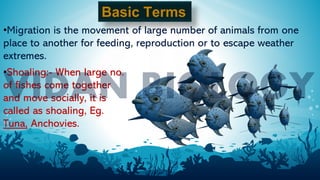
•Shoaling:- When large no.
of fishes come together
and move socially, it is
called as shoaling, Eg.
Tuna, Anchovies.
4
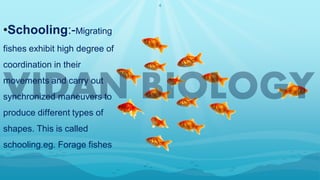
•Schooling:-Migrating
fishes exhibit high degree of
coordination in their
movements and carry out
synchronized maneuvers to
produce different types of
shapes. This is called
schooling.eg. Forage fishes
1. Freshwater Habitat
2. Marine Habitat
Fishes live in two different types of aquatic habitats:-
On the basis of cause, fish migration is
of following types :
➢Feeding or alimental migration:- It takes place in fishes for feeding.
Examples:- Salmons, cods and sword fish migrate for food.
➢Spawning migration :- It takes place in breeding season in those fishes
which have spawning grounds far away from the feeding places.
Examples:- Eels, salmons and a large no. of riverine fishes.
➢Juvenile migration:- It involves larval stages of fishes which hatch in
spawning grounds and migrate long distances to reach the feeding
habits of their parents.
➢ Recruitment migration:- It takes place when large no.
of larvae move from nursery habitat to the habitat of
adults.
➢ Seasonal migration:- It takes place in fishes that inhabit arctic
areas where in summer climate is conducive and food abundant but
as winter approaches temperature fall below zero and food becomes
scarce. Hence, fishes must migrate towards subtropical and tropical
areas to escape extremes of weather conditions.
“
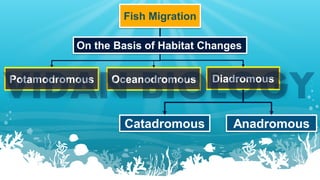
Fish Migration
Oceanodromous Diadromous
Catadromous Anadromous
On the Basis of Habitat Changes
Potamodromous
9
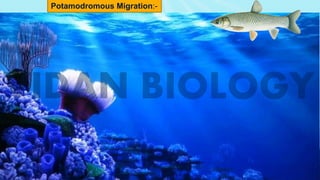
Potamodromous Migration:-
10
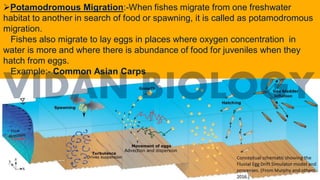
➢Potamodromous Migration:-When fishes migrate from one freshwater
habitat to another in search of food or spawning, it is called as potamodromous
migration.
Fishes also migrate to lay eggs in places where oxygen concentration in
water is more and where there is abundance of food for juveniles when they
hatch from eggs.
Example:- Common Asian Carps
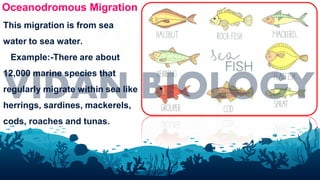
This migration is from sea
water to sea water.
Example:-There are about
12,000 marine species that
regularly migrate within sea like
herrings, sardines, mackerels,
cods, roaches and tunas.
Oceanodromous Migration
Reproduction
Reproduction
Catadromous
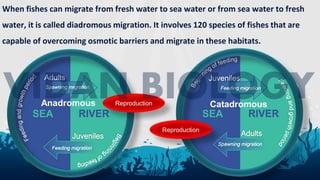
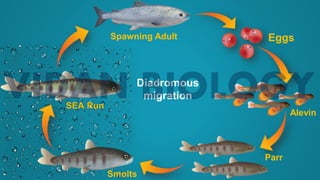
When fishes can migrate from fresh water to sea water or from sea water to fresh
water, it is called diadromous migration. It involves 120 species of fishes that are
capable of overcoming osmotic barriers and migrate in these habitats.
Anadromous
14
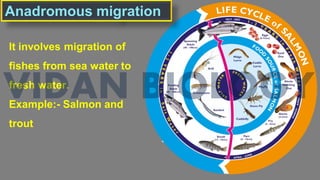
Anadromous migration
It involves migration of
fishes from sea water to
fresh water.
Example:- Salmon and
trout
Eggs
Alevin
Parr
Smolts
SEA Run
Spawning Adult
Diadromous
migration
16
17
❖To maintain homeostasis, freshwater species have
special adaptations for retaining ions and getting rid
of excess water.
They actively take in ions across their gills and skin, a
process that requires energy.
To get rid of excess water they excrete nitrogenous waste
products in great quantities in the form of highly diluted
urine.
18
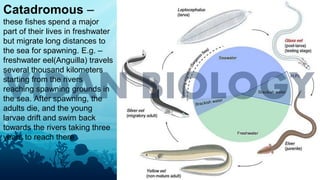
Catadromous –
these fishes spend a major
part of their lives in freshwater
but migrate long distances to
the sea for spawning. E.g. –
freshwater eel(Anguilla) travels
several thousand kilometers
starting from the rivers
reaching spawning grounds in
the sea. After spawning, the
adults die, and the young
larvae drift and swim back
towards the rivers taking three
years to reach there
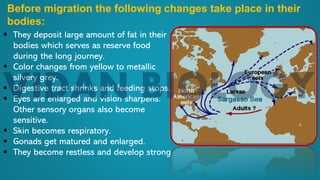
▪ They deposit large amount of fat in their
bodies which serves as reserve food
during the long journey.
▪ Color changes from yellow to metallic
silvery grey.
▪ Digestive tract shrinks and feeding stops.
▪ Eyes are enlarged and vision sharpens.
Other sensory organs also become
sensitive.
▪ Skin becomes respiratory.
▪ Gonads get matured and enlarged.
▪ They become restless and develop strong
Before migration the following changes take place in their
bodies:
20
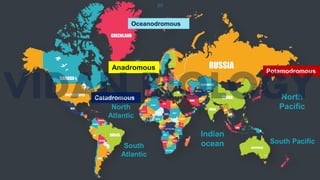
Anadromous
Oceanodromous
Potamodromous
Catadromous North
Pacific
South Pacific
Indian
ocean
South
Atlantic
North
Atlantic
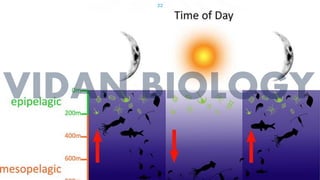
Vertical Migration
The movement of fishes towards upper surface of sea during night and towards
bottom during day fro various endogenous and exogenous reasons is called
vertical migration.
Diet vertical migration is a common behavior; many marine species move to
the surface at night to feed and then return to the depths during daytime.
Factors playing role in Vertical Migration:-
1. Endogenous factors:- which originate from organism itself like sex, age
biological rhythms, etc.
2. Exogenous factors:- These are the environment factors acting on the
organisms such as light, gravity, oxygen, temperature, predator-prey
interactions etc.
22
Fish migration (Animal Behavior) Catadromous, Anadromous

Fish migration (Animal Behavior) Catadromous, Anadromous

  • 2.
  • 3.
    3 Basic Terms •Migration isthe movement of large number of animals from one place to another for feeding, reproduction or to escape weather extremes. •Shoaling:- When large no. of fishes come together and move socially, it is called as shoaling, Eg. Tuna, Anchovies.
  • 4.
    4 •Schooling:-Migrating fishes exhibit highdegree of coordination in their movements and carry out synchronized maneuvers to produce different types of shapes. This is called schooling.eg. Forage fishes
  • 5.
    1. Freshwater Habitat 2.Marine Habitat Fishes live in two different types of aquatic habitats:-
  • 6.
    On the basisof cause, fish migration is of following types : ➢Feeding or alimental migration:- It takes place in fishes for feeding. Examples:- Salmons, cods and sword fish migrate for food. ➢Spawning migration :- It takes place in breeding season in those fishes which have spawning grounds far away from the feeding places. Examples:- Eels, salmons and a large no. of riverine fishes. ➢Juvenile migration:- It involves larval stages of fishes which hatch in spawning grounds and migrate long distances to reach the feeding habits of their parents.
  • 7.
    ➢ Recruitment migration:-It takes place when large no. of larvae move from nursery habitat to the habitat of adults. ➢ Seasonal migration:- It takes place in fishes that inhabit arctic areas where in summer climate is conducive and food abundant but as winter approaches temperature fall below zero and food becomes scarce. Hence, fishes must migrate towards subtropical and tropical areas to escape extremes of weather conditions.
  • 8.
    “ Fish Migration Oceanodromous Diadromous CatadromousAnadromous On the Basis of Habitat Changes Potamodromous
  • 9.
  • 10.
    10 ➢Potamodromous Migration:-When fishesmigrate from one freshwater habitat to another in search of food or spawning, it is called as potamodromous migration. Fishes also migrate to lay eggs in places where oxygen concentration in water is more and where there is abundance of food for juveniles when they hatch from eggs. Example:- Common Asian Carps
  • 11.
    This migration isfrom sea water to sea water. Example:-There are about 12,000 marine species that regularly migrate within sea like herrings, sardines, mackerels, cods, roaches and tunas. Oceanodromous Migration
  • 13.
    Reproduction Reproduction Catadromous When fishes canmigrate from fresh water to sea water or from sea water to fresh water, it is called diadromous migration. It involves 120 species of fishes that are capable of overcoming osmotic barriers and migrate in these habitats. Anadromous
  • 14.
    14 Anadromous migration It involvesmigration of fishes from sea water to fresh water. Example:- Salmon and trout
  • 15.
  • 16.
  • 17.
    17 ❖To maintain homeostasis,freshwater species have special adaptations for retaining ions and getting rid of excess water. They actively take in ions across their gills and skin, a process that requires energy. To get rid of excess water they excrete nitrogenous waste products in great quantities in the form of highly diluted urine.
  • 18.
    18 Catadromous – these fishesspend a major part of their lives in freshwater but migrate long distances to the sea for spawning. E.g. – freshwater eel(Anguilla) travels several thousand kilometers starting from the rivers reaching spawning grounds in the sea. After spawning, the adults die, and the young larvae drift and swim back towards the rivers taking three years to reach there
  • 19.
    ▪ They depositlarge amount of fat in their bodies which serves as reserve food during the long journey. ▪ Color changes from yellow to metallic silvery grey. ▪ Digestive tract shrinks and feeding stops. ▪ Eyes are enlarged and vision sharpens. Other sensory organs also become sensitive. ▪ Skin becomes respiratory. ▪ Gonads get matured and enlarged. ▪ They become restless and develop strong Before migration the following changes take place in their bodies:
  • 20.
  • 21.
    Vertical Migration The movementof fishes towards upper surface of sea during night and towards bottom during day fro various endogenous and exogenous reasons is called vertical migration. Diet vertical migration is a common behavior; many marine species move to the surface at night to feed and then return to the depths during daytime. Factors playing role in Vertical Migration:- 1. Endogenous factors:- which originate from organism itself like sex, age biological rhythms, etc. 2. Exogenous factors:- These are the environment factors acting on the organisms such as light, gravity, oxygen, temperature, predator-prey interactions etc.
  • 22.