BASIS OF
CLASSIFICATION
(Animal)
Live At- 03:00 PM
VIDAN BIOLOGY
BY- Mr. Ankit Mishra
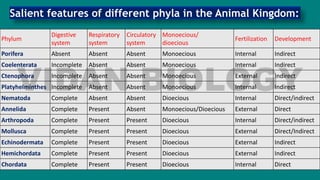
Phylum
Digestive
system
Respiratory
system
Circulatory
system
Monoecious/
dioecious
Fertilization Development
Porifera Absent Absent Absent Monoecious Internal Indirect
Coelenterata Incomplete Absent Absent Monoecious Internal Indirect
Ctenophora Incomplete Absent Absent Monoecious External Indirect
Platyhelminthes Incomplete Absent Absent Monoecious Internal Indirect
Nematoda Complete Absent Absent Dioecious Internal Direct/indirect
Annelida Complete Present Absent Monoecious/Dioecious External Direct
Arthropoda Complete Present Present Dioecious Internal Direct/indirect
Mollusca Complete Present Present Dioecious External Direct/Indirect
Echinodermata Complete Present Present Dioecious External Indirect
Hemichordata Complete Present Present Dioecious External Indirect
Chordata Complete Present Present Dioecious Internal Direct
Salient features of different phyla in the Animal Kingdom:
4.1 BASIS OF CLASSIFICATION
Inspite of differences in structure and form of different animals, there
are fundamental features common to various individuals in relation to
the arrangement of cells, body symmetry, nature of coelom, patterns
of digestive, circulatory or reproductive systems. These features are
used as the basis of animal classification and some of them are
discussed here.
Arrangement of body parts in a balanced geometrical
design, divisible into equal parts by planes of division is
called symmetry. The idea of symmetry is mainly derived
from Ernst Haeckel
An animal is said to be symmetrical only when a plane
passing through its center will divide it into similar halves.
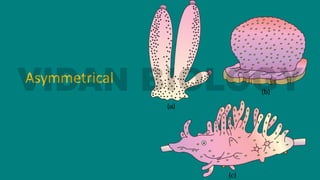
When an animal cannot be divided into similar halves it is
said to be asymmetrical.
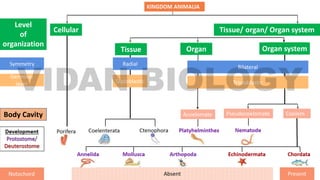
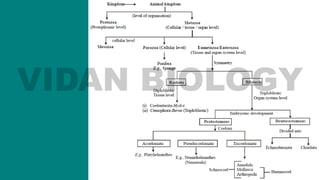
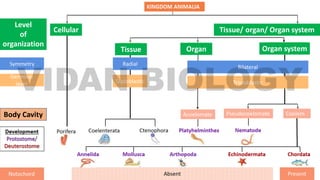
Level
of
organization
Body Cavity
Cellular
Tissue Organ Organ system
Tissue/ organ/ Organ system
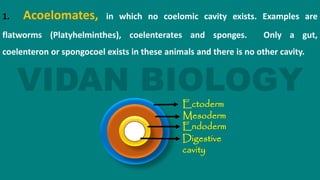
1. Acoelomates, in which no coelomic cavity exists. Examples are
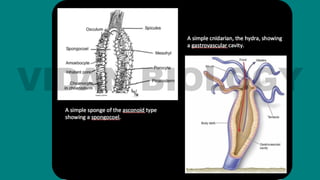
flatworms (Platyhelminthes), coelenterates and sponges. Only a gut,
coelenteron or spongocoel exists in these animals and there is no other cavity.
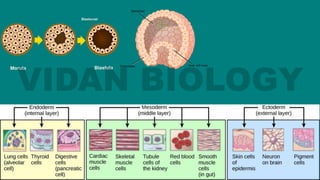
Ectoderm
Mesoderm
Endoderm
Digestive
cavity
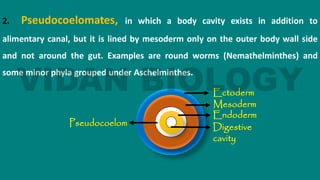
2. Pseudocoelomates, in which a body cavity exists in addition to
alimentary canal, but it is lined by mesoderm only on the outer body wall side
and not around the gut. Examples are round worms (Nemathelminthes) and
some minor phyla grouped under Aschelminthes.
Ectoderm
Mesoderm
Endoderm
Digestive
cavity
Pseudocoelom
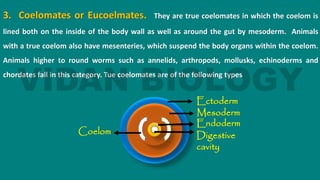
3. Coelomates or Eucoelmates. They are true coelomates in which the coelom is
lined both on the inside of the body wall as well as around the gut by mesoderm. Animals
with a true coelom also have mesenteries, which suspend the body organs within the coelom.
Animals higher to round worms such as annelids, arthropods, mollusks, echinoderms and
chordates fall in this category. Tue coelomates are of the following types
Ectoderm
Mesoderm
Endoderm
Digestive
cavity
Coelom
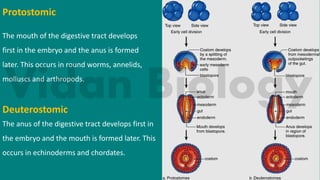
Protostomic
The mouth of the digestive tract develops
first in the embryo and the anus is formed
later. This occurs in round worms, annelids,
molluscs and arthropods.
Deuterostomic
The anus of the digestive tract develops first in
the embryo and the mouth is formed later. This
occurs in echinoderms and chordates.
Body plan
A set of morphological and developmental traits that are generally integrated into a functional
unit is referred to as a body plan. There are three types plan in the animal kingdom:
The cell aggregate plan
simplest animals like sponges. In this body plan, body is made of mereclusters of cells which are
not assembled as tissues. There are no nerve cells and, hence, there is no coordination amongst
the cells constituting the body.
The blind sac plan
This type of body plan is more complex than the cell aggregate plan, as is exhibited by
coelenterates and flatworms except tapeworms. They have a digestive cavity with only one
opening to the outside through which ingestion as well as egestion occurs.
The tube within a tube plan
The tube within a tube plan is exhibited by animals like earthworm, cockroach, man etc. In this
body plan, digestive system forms a continuous tube like structure with an opening at each end
e.g. mouth at the anterior end and ananus at posterior end.
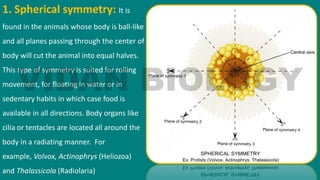
1. Spherical symmetry: It is
found in the animals whose body is ball-like
and all planes passing through the center of
body will cut the animal into equal halves.
This type of symmetry is suited for rolling
movement, for floating in water or in
sedentary habits in which case food is
available in all directions. Body organs like
cilia or tentacles are located all around the
body in a radiating manner. For
example, Volvox, Actinophrys (Heliozoa)
and Thalassicola (Radiolaria)
Asymmetrical
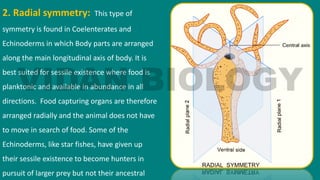
2. Radial symmetry: This type of
symmetry is found in Coelenterates and
Echinoderms in which Body parts are arranged
along the main longitudinal axis of body. It is
best suited for sessile existence where food is
planktonic and available in abundance in all
directions. Food capturing organs are therefore
arranged radially and the animal does not have
to move in search of food. Some of the
Echinoderms, like star fishes, have given up
their sessile existence to become hunters in
pursuit of larger prey but not their ancestral
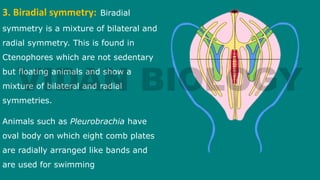
3. Biradial symmetry: Biradial
symmetry is a mixture of bilateral and
radial symmetry. This is found in
Ctenophores which are not sedentary
but floating animals and show a
mixture of bilateral and radial
symmetries.
Animals such as Pleurobrachia have
oval body on which eight comb plates
are radially arranged like bands and
are used for swimming
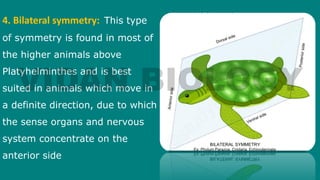
4. Bilateral symmetry: This type
of symmetry is found in most of
the higher animals above
Platyhelminthes and is best
suited in animals which move in
a definite direction, due to which
the sense organs and nervous
system concentrate on the
anterior side
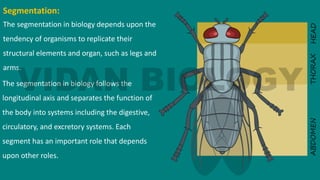
Segmentation:
The segmentation in biology depends upon the
tendency of organisms to replicate their
structural elements and organ, such as legs and
arms.
The segmentation in biology follows the
longitudinal axis and separates the function of
the body into systems including the digestive,
circulatory, and excretory systems. Each
segment has an important role that depends
upon other roles.
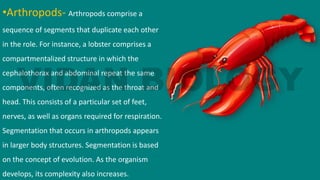
•Arthropods- Arthropods comprise a
sequence of segments that duplicate each other
in the role. For instance, a lobster comprises a
compartmentalized structure in which the
cephalothorax and abdominal repeat the same
components, often recognized as the throat and
head. This consists of a particular set of feet,
nerves, as well as organs required for respiration.
Segmentation that occurs in arthropods appears
in larger body structures. Segmentation is based
on the concept of evolution. As the organism
develops, its complexity also increases.
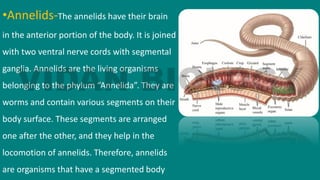
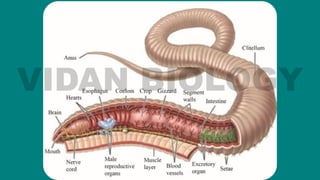
•Annelids-The annelids have their brain
in the anterior portion of the body. It is joined
with two ventral nerve cords with segmental
ganglia. Annelids are the living organisms
belonging to the phylum “Annelida”. They are
worms and contain various segments on their
body surface. These segments are arranged
one after the other, and they help in the
locomotion of annelids. Therefore, annelids
are organisms that have a segmented body
Connections,
repeated
segments, and
specialized
segments:
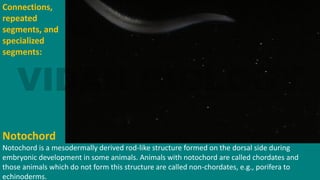
Notochord
Notochord is a mesodermally derived rod-like structure formed on the dorsal side during
embryonic development in some animals. Animals with notochord are called chordates and
those animals which do not form this structure are called non-chordates, e.g., porifera to
echinoderms.
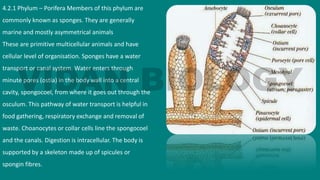
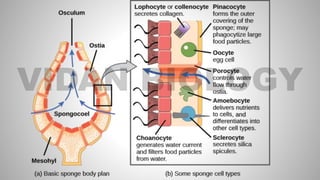
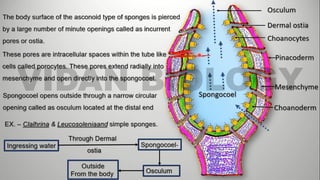
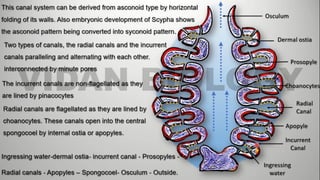
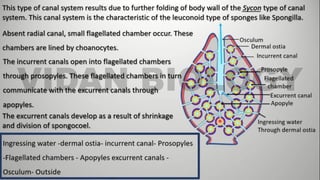
4.2.1 Phylum – Porifera Members of this phylum are
commonly known as sponges. They are generally
marine and mostly asymmetrical animals
These are primitive multicellular animals and have
cellular level of organisation. Sponges have a water
transport or canal system. Water enters through
minute pores (ostia) in the body wall into a central
cavity, spongocoel, from where it goes out through the
osculum. This pathway of water transport is helpful in
food gathering, respiratory exchange and removal of
waste. Choanocytes or collar cells line the spongocoel
and the canals. Digestion is intracellular. The body is
supported by a skeleton made up of spicules or
spongin fibres.
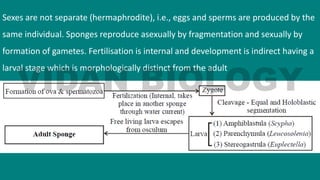
Sexes are not separate (hermaphrodite), i.e., eggs and sperms are produced by the
same individual. Sponges reproduce asexually by fragmentation and sexually by
formation of gametes. Fertilisation is internal and development is indirect having a
larval stage which is morphologically distinct from the adult
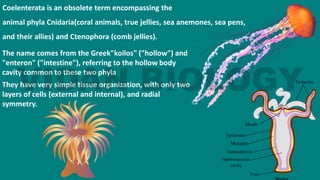
Coelenterata is an obsolete term encompassing the
animal phyla Cnidaria(coral animals, true jellies, sea anemones, sea pens,
and their allies) and Ctenophora (comb jellies).
The name comes from the Greek"koilos" ("hollow") and
"enteron" ("intestine"), referring to the hollow body
cavity common to these two phyla
They have very simple tissue organization, with only two
layers of cells (external and internal), and radial
symmetry.
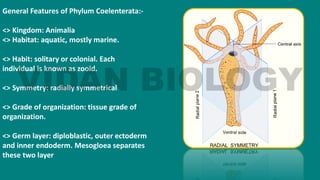
General Features of Phylum Coelenterata:-
<> Kingdom: Animalia
<> Habitat: aquatic, mostly marine.
<> Habit: solitary or colonial. Each
individual is known as zooid.
<> Symmetry: radially symmetrical
<> Grade of organization: tissue grade of
organization.
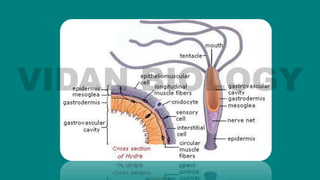
<> Germ layer: diploblastic, outer ectoderm
and inner endoderm. Mesogloea separates
these two layer
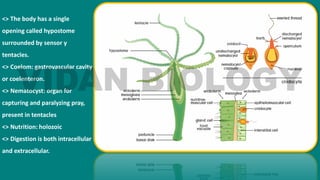
<> The body has a single
opening called hypostome
surrounded by sensor y
tentacles.
<> Coelom: gastrovascular cavity
or coelenteron.
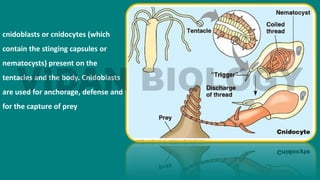
<> Nematocyst: organ for
capturing and paralyzing pray,
present in tentacles
<> Nutrition: holozoic
<> Digestion is both intracellular
and extracellular.
cnidoblasts or cnidocytes (which
contain the stinging capsules or
nematocysts) present on the
tentacles and the body. Cnidoblasts
are used for anchorage, defense and
for the capture of prey
<> Respiration and excretion are accomplished by
simple diffusion.
<> Circulatory system: absent
<> Nervous system: poorly develop
<> Many forms exhibit polymorphism ie. Polyp and
medusa
<> Polyps are sessile, asexual stage
<> Medusa are free swimming, sexual stage
<> Metagenesis: asexual polypoid generation alternate
with sexual medusoid generation
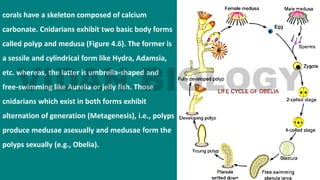
corals have a skeleton composed of calcium
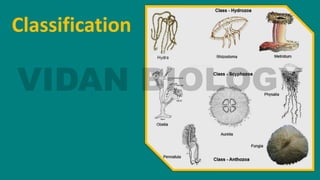
carbonate. Cnidarians exhibit two basic body forms
called polyp and medusa (Figure 4.6). The former is
a sessile and cylindrical form like Hydra, Adamsia,
etc. whereas, the latter is umbrella-shaped and
free-swimming like Aurelia or jelly fish. Those
cnidarians which exist in both forms exhibit
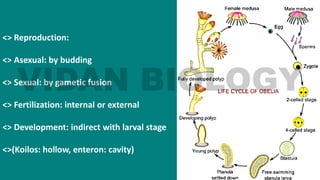
alternation of generation (Metagenesis), i.e., polyps
produce medusae asexually and medusae form the
polyps sexually (e.g., Obelia).
<> Reproduction:
<> Asexual: by budding
<> Sexual: by gametic fusion
<> Fertilization: internal or external
<> Development: indirect with larval stage
<>(Koilos: hollow, enteron: cavity)
Classification
Level
of
organization
Body Cavity
Cellular
Tissue Organ Organ system
Tissue/ organ/ Organ system
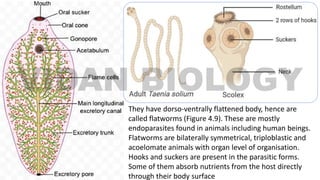
They have dorso-ventrally flattened body, hence are
called flatworms (Figure 4.9). These are mostly
endoparasites found in animals including human beings.
Flatworms are bilaterally symmetrical, triploblastic and
acoelomate animals with organ level of organisation.
Hooks and suckers are present in the parasitic forms.
Some of them absorb nutrients from the host directly
through their body surface
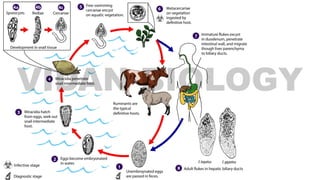
Sexes are not separate.
Fertilisation is internal and development is through many larval stages. Some
members like Planaria possess high regeneration capacity. Examples: Taenia
(Tapeworm), Fasciola (Liver fluke)
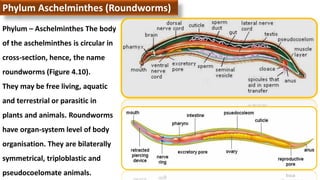
Phylum Aschelminthes (Roundworms)
Phylum – Aschelminthes The body
of the aschelminthes is circular in
cross-section, hence, the name
roundworms (Figure 4.10).
They may be free living, aquatic
and terrestrial or parasitic in
plants and animals. Roundworms
have organ-system level of body
organisation. They are bilaterally
symmetrical, triploblastic and
pseudocoelomate animals.
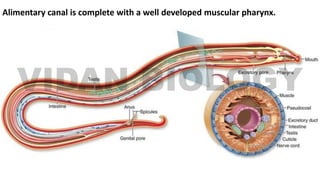
Alimentary canal is complete with a well developed muscular pharynx.
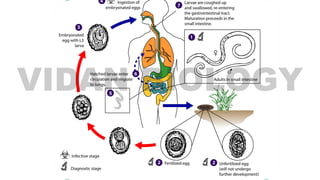
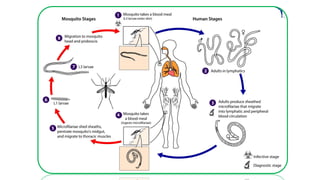
An excretory tube removes body wastes from the body cavity through the
excretory pore. Sexes are separate (dioecious), i.e., males and females are
distinct. Often females are longer than males. Fertilisation is internal and
development may be direct (the young ones resemble the adult) or indirect.
Examples : Ascaris (Roundworm), Wuchereria (Filaria worm), Ancylostoma
(Hookworm).
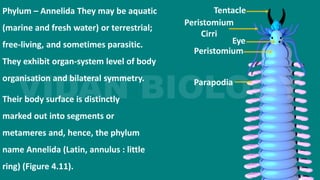
Phylum – Annelida They may be aquatic
(marine and fresh water) or terrestrial;
free-living, and sometimes parasitic.
They exhibit organ-system level of body
organisation and bilateral symmetry.
Their body surface is distinctly
marked out into segments or
metameres and, hence, the phylum
name Annelida (Latin, annulus : little
ring) (Figure 4.11).
Tentacle
Eye
Peristomium
Peristomium
Cirri
Parapodia
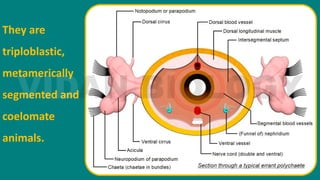
They are
triploblastic,
metamerically
segmented and
coelomate
animals.
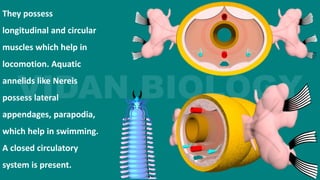
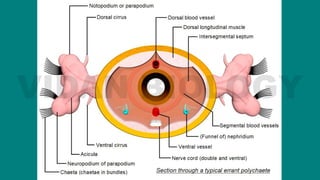
They possess
longitudinal and circular
muscles which help in
locomotion. Aquatic
annelids like Nereis
possess lateral
appendages, parapodia,
which help in swimming.
A closed circulatory
system is present.
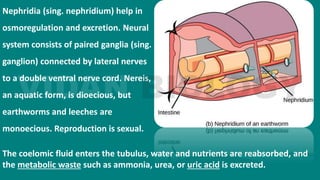
The coelomic fluid enters the tubulus, water and nutrients are reabsorbed, and
the metabolic waste such as ammonia, urea, or uric acid is excreted.
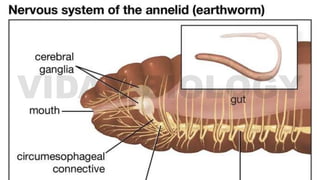
Nephridia (sing. nephridium) help in
osmoregulation and excretion. Neural
system consists of paired ganglia (sing.
ganglion) connected by lateral nerves
to a double ventral nerve cord. Nereis,
an aquatic form, is dioecious, but
earthworms and leeches are
monoecious. Reproduction is sexual.
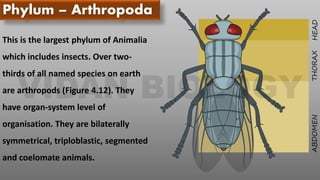
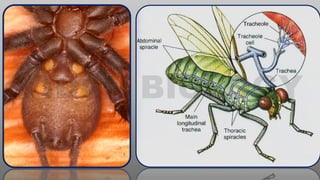
Phylum – Arthropoda
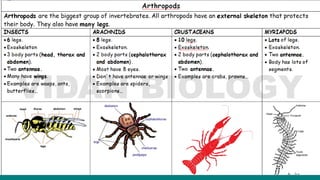
This is the largest phylum of Animalia
which includes insects. Over two-
thirds of all named species on earth
are arthropods (Figure 4.12). They
have organ-system level of
organisation. They are bilaterally
symmetrical, triploblastic, segmented
and coelomate animals.
Level
of
organization
Body Cavity
Cellular
Tissue Organ Organ system
Tissue/ organ/ Organ system
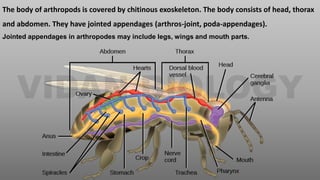
The body of arthropods is covered by chitinous exoskeleton. The body consists of head, thorax
and abdomen. They have jointed appendages (arthros-joint, poda-appendages).
Jointed appendages in arthropodes may include legs, wings and mouth parts.
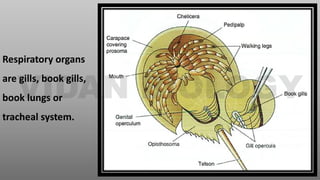
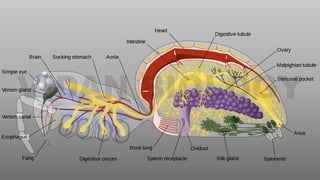
Respiratory organs
are gills, book gills,
book lungs or
tracheal system.
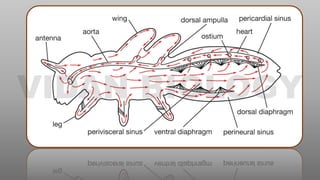
Circulatory system is of open type. Sensory
organs like antennae, eyes (compound and
simple), statocysts or balancing organs are
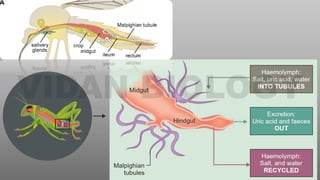
present. Excretion takes place through
malpighian tubules.
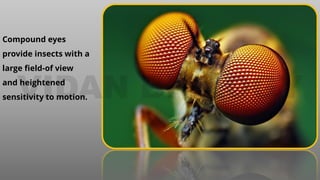
Compound eyes
provide insects with a
large field-of view
and heightened
sensitivity to motion.
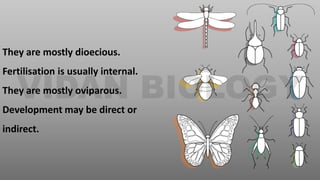
They are mostly dioecious.
Fertilisation is usually internal.
They are mostly oviparous.
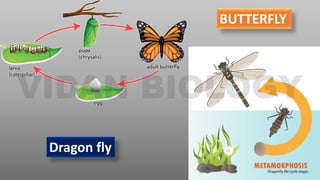
Development may be direct or
indirect.
BUTTERFLY
Dragon fly
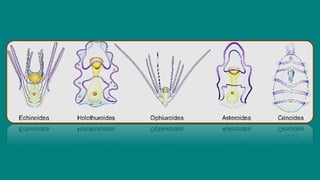
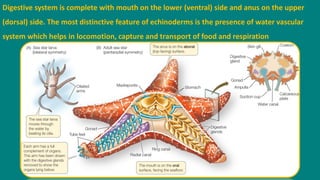
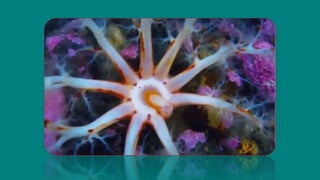
•“Echino” – Spiny, “Derm” – Skin
These animals have an endoskeleton
of calcareous ossicles and, hence, the
name Echinodermata (Spiny bodied,
Figure 4.14). All are marine with
organ-system level of organisation.
The adult echinoderms are radially
symmetrical but larvae are bilaterally
symmetrical. They are triploblastic
and coelomate animals.
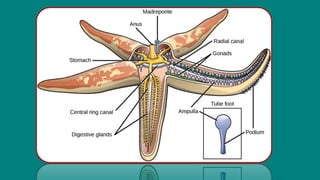
Digestive system is complete with mouth on the lower (ventral) side and anus on the upper
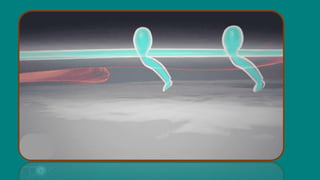
(dorsal) side. The most distinctive feature of echinoderms is the presence of water vascular
system which helps in locomotion, capture and transport of food and respiration
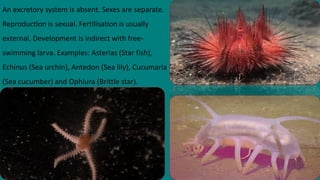
An excretory system is absent. Sexes are separate.
Reproduction is sexual. Fertilisation is usually
external. Development is indirect with free-
swimming larva. Examples: Asterias (Star fish),
Echinus (Sea urchin), Antedon (Sea lily), Cucumaria
(Sea cucumber) and Ophiura (Brittle star).
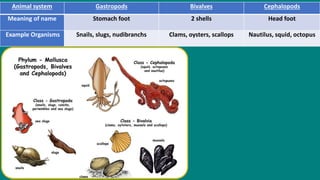
Animal system Gastropods Bivalves Cephalopods
Meaning of name Stomach foot 2 shells Head foot
Example Organisms Snails, slugs, nudibranchs Clams, oysters, scallops Nautilus, squid, octopus
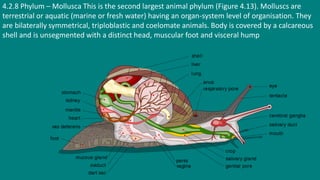
4.2.8 Phylum – Mollusca This is the second largest animal phylum (Figure 4.13). Molluscs are
terrestrial or aquatic (marine or fresh water) having an organ-system level of organisation. They
are bilaterally symmetrical, triploblastic and coelomate animals. Body is covered by a calcareous
shell and is unsegmented with a distinct head, muscular foot and visceral hump
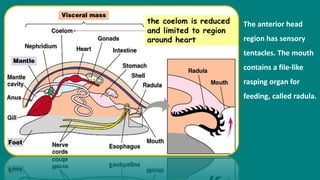
The anterior head
region has sensory
tentacles. The mouth
contains a file-like
rasping organ for
feeding, called radula.
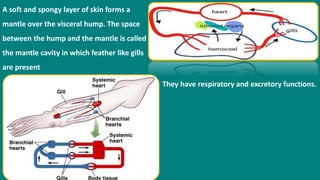
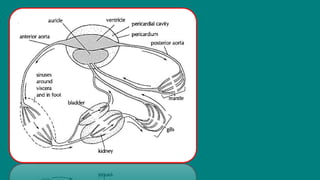
A soft and spongy layer of skin forms a
mantle over the visceral hump. The space
between the hump and the mantle is called
the mantle cavity in which feather like gills
are present
They have respiratory and excretory functions.
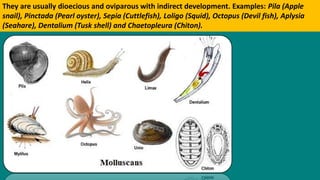
They are usually dioecious and oviparous with indirect development. Examples: Pila (Apple
snail), Pinctada (Pearl oyster), Sepia (Cuttlefish), Loligo (Squid), Octopus (Devil fish), Aplysia
(Seahare), Dentalium (Tusk shell) and Chaetopleura (Chiton).

Invertebrates (Plant Kingdom) complete

  • 1.
    BASIS OF CLASSIFICATION (Animal) Live At-03:00 PM VIDAN BIOLOGY BY- Mr. Ankit Mishra
  • 2.
    Phylum Digestive system Respiratory system Circulatory system Monoecious/ dioecious Fertilization Development Porifera AbsentAbsent Absent Monoecious Internal Indirect Coelenterata Incomplete Absent Absent Monoecious Internal Indirect Ctenophora Incomplete Absent Absent Monoecious External Indirect Platyhelminthes Incomplete Absent Absent Monoecious Internal Indirect Nematoda Complete Absent Absent Dioecious Internal Direct/indirect Annelida Complete Present Absent Monoecious/Dioecious External Direct Arthropoda Complete Present Present Dioecious Internal Direct/indirect Mollusca Complete Present Present Dioecious External Direct/Indirect Echinodermata Complete Present Present Dioecious External Indirect Hemichordata Complete Present Present Dioecious External Indirect Chordata Complete Present Present Dioecious Internal Direct Salient features of different phyla in the Animal Kingdom:
  • 4.
    4.1 BASIS OFCLASSIFICATION Inspite of differences in structure and form of different animals, there are fundamental features common to various individuals in relation to the arrangement of cells, body symmetry, nature of coelom, patterns of digestive, circulatory or reproductive systems. These features are used as the basis of animal classification and some of them are discussed here.
  • 5.
    Arrangement of bodyparts in a balanced geometrical design, divisible into equal parts by planes of division is called symmetry. The idea of symmetry is mainly derived from Ernst Haeckel An animal is said to be symmetrical only when a plane passing through its center will divide it into similar halves. When an animal cannot be divided into similar halves it is said to be asymmetrical.
  • 6.
    Level of organization Body Cavity Cellular Tissue OrganOrgan system Tissue/ organ/ Organ system
  • 7.
    1. Acoelomates, inwhich no coelomic cavity exists. Examples are flatworms (Platyhelminthes), coelenterates and sponges. Only a gut, coelenteron or spongocoel exists in these animals and there is no other cavity. Ectoderm Mesoderm Endoderm Digestive cavity
  • 8.
    2. Pseudocoelomates, inwhich a body cavity exists in addition to alimentary canal, but it is lined by mesoderm only on the outer body wall side and not around the gut. Examples are round worms (Nemathelminthes) and some minor phyla grouped under Aschelminthes. Ectoderm Mesoderm Endoderm Digestive cavity Pseudocoelom
  • 9.
    3. Coelomates orEucoelmates. They are true coelomates in which the coelom is lined both on the inside of the body wall as well as around the gut by mesoderm. Animals with a true coelom also have mesenteries, which suspend the body organs within the coelom. Animals higher to round worms such as annelids, arthropods, mollusks, echinoderms and chordates fall in this category. Tue coelomates are of the following types Ectoderm Mesoderm Endoderm Digestive cavity Coelom
  • 10.
    Protostomic The mouth ofthe digestive tract develops first in the embryo and the anus is formed later. This occurs in round worms, annelids, molluscs and arthropods. Deuterostomic The anus of the digestive tract develops first in the embryo and the mouth is formed later. This occurs in echinoderms and chordates.
  • 11.
    Body plan A setof morphological and developmental traits that are generally integrated into a functional unit is referred to as a body plan. There are three types plan in the animal kingdom: The cell aggregate plan simplest animals like sponges. In this body plan, body is made of mereclusters of cells which are not assembled as tissues. There are no nerve cells and, hence, there is no coordination amongst the cells constituting the body. The blind sac plan This type of body plan is more complex than the cell aggregate plan, as is exhibited by coelenterates and flatworms except tapeworms. They have a digestive cavity with only one opening to the outside through which ingestion as well as egestion occurs. The tube within a tube plan The tube within a tube plan is exhibited by animals like earthworm, cockroach, man etc. In this body plan, digestive system forms a continuous tube like structure with an opening at each end e.g. mouth at the anterior end and ananus at posterior end.
  • 12.
    1. Spherical symmetry:It is found in the animals whose body is ball-like and all planes passing through the center of body will cut the animal into equal halves. This type of symmetry is suited for rolling movement, for floating in water or in sedentary habits in which case food is available in all directions. Body organs like cilia or tentacles are located all around the body in a radiating manner. For example, Volvox, Actinophrys (Heliozoa) and Thalassicola (Radiolaria)
  • 13.
  • 14.
    2. Radial symmetry:This type of symmetry is found in Coelenterates and Echinoderms in which Body parts are arranged along the main longitudinal axis of body. It is best suited for sessile existence where food is planktonic and available in abundance in all directions. Food capturing organs are therefore arranged radially and the animal does not have to move in search of food. Some of the Echinoderms, like star fishes, have given up their sessile existence to become hunters in pursuit of larger prey but not their ancestral
  • 15.
    3. Biradial symmetry:Biradial symmetry is a mixture of bilateral and radial symmetry. This is found in Ctenophores which are not sedentary but floating animals and show a mixture of bilateral and radial symmetries. Animals such as Pleurobrachia have oval body on which eight comb plates are radially arranged like bands and are used for swimming
  • 16.
    4. Bilateral symmetry:This type of symmetry is found in most of the higher animals above Platyhelminthes and is best suited in animals which move in a definite direction, due to which the sense organs and nervous system concentrate on the anterior side
  • 17.
    Segmentation: The segmentation inbiology depends upon the tendency of organisms to replicate their structural elements and organ, such as legs and arms. The segmentation in biology follows the longitudinal axis and separates the function of the body into systems including the digestive, circulatory, and excretory systems. Each segment has an important role that depends upon other roles.
  • 18.
    •Arthropods- Arthropods comprisea sequence of segments that duplicate each other in the role. For instance, a lobster comprises a compartmentalized structure in which the cephalothorax and abdominal repeat the same components, often recognized as the throat and head. This consists of a particular set of feet, nerves, as well as organs required for respiration. Segmentation that occurs in arthropods appears in larger body structures. Segmentation is based on the concept of evolution. As the organism develops, its complexity also increases.
  • 19.
    •Annelids-The annelids havetheir brain in the anterior portion of the body. It is joined with two ventral nerve cords with segmental ganglia. Annelids are the living organisms belonging to the phylum “Annelida”. They are worms and contain various segments on their body surface. These segments are arranged one after the other, and they help in the locomotion of annelids. Therefore, annelids are organisms that have a segmented body
  • 21.
    Connections, repeated segments, and specialized segments: Notochord Notochord isa mesodermally derived rod-like structure formed on the dorsal side during embryonic development in some animals. Animals with notochord are called chordates and those animals which do not form this structure are called non-chordates, e.g., porifera to echinoderms.
  • 23.
    4.2.1 Phylum –Porifera Members of this phylum are commonly known as sponges. They are generally marine and mostly asymmetrical animals These are primitive multicellular animals and have cellular level of organisation. Sponges have a water transport or canal system. Water enters through minute pores (ostia) in the body wall into a central cavity, spongocoel, from where it goes out through the osculum. This pathway of water transport is helpful in food gathering, respiratory exchange and removal of waste. Choanocytes or collar cells line the spongocoel and the canals. Digestion is intracellular. The body is supported by a skeleton made up of spicules or spongin fibres.
  • 28.
    Sexes are notseparate (hermaphrodite), i.e., eggs and sperms are produced by the same individual. Sponges reproduce asexually by fragmentation and sexually by formation of gametes. Fertilisation is internal and development is indirect having a larval stage which is morphologically distinct from the adult
  • 30.
    Coelenterata is anobsolete term encompassing the animal phyla Cnidaria(coral animals, true jellies, sea anemones, sea pens, and their allies) and Ctenophora (comb jellies). The name comes from the Greek"koilos" ("hollow") and "enteron" ("intestine"), referring to the hollow body cavity common to these two phyla They have very simple tissue organization, with only two layers of cells (external and internal), and radial symmetry.
  • 31.
    General Features ofPhylum Coelenterata:- <> Kingdom: Animalia <> Habitat: aquatic, mostly marine. <> Habit: solitary or colonial. Each individual is known as zooid. <> Symmetry: radially symmetrical <> Grade of organization: tissue grade of organization. <> Germ layer: diploblastic, outer ectoderm and inner endoderm. Mesogloea separates these two layer
  • 32.
    <> The bodyhas a single opening called hypostome surrounded by sensor y tentacles. <> Coelom: gastrovascular cavity or coelenteron. <> Nematocyst: organ for capturing and paralyzing pray, present in tentacles <> Nutrition: holozoic <> Digestion is both intracellular and extracellular.
  • 33.
    cnidoblasts or cnidocytes(which contain the stinging capsules or nematocysts) present on the tentacles and the body. Cnidoblasts are used for anchorage, defense and for the capture of prey
  • 34.
    <> Respiration andexcretion are accomplished by simple diffusion. <> Circulatory system: absent <> Nervous system: poorly develop <> Many forms exhibit polymorphism ie. Polyp and medusa <> Polyps are sessile, asexual stage <> Medusa are free swimming, sexual stage <> Metagenesis: asexual polypoid generation alternate with sexual medusoid generation
  • 35.
    corals have askeleton composed of calcium carbonate. Cnidarians exhibit two basic body forms called polyp and medusa (Figure 4.6). The former is a sessile and cylindrical form like Hydra, Adamsia, etc. whereas, the latter is umbrella-shaped and free-swimming like Aurelia or jelly fish. Those cnidarians which exist in both forms exhibit alternation of generation (Metagenesis), i.e., polyps produce medusae asexually and medusae form the polyps sexually (e.g., Obelia).
  • 37.
    <> Reproduction: <> Asexual:by budding <> Sexual: by gametic fusion <> Fertilization: internal or external <> Development: indirect with larval stage <>(Koilos: hollow, enteron: cavity)
  • 40.
  • 41.
    Level of organization Body Cavity Cellular Tissue OrganOrgan system Tissue/ organ/ Organ system
  • 42.
    They have dorso-ventrallyflattened body, hence are called flatworms (Figure 4.9). These are mostly endoparasites found in animals including human beings. Flatworms are bilaterally symmetrical, triploblastic and acoelomate animals with organ level of organisation. Hooks and suckers are present in the parasitic forms. Some of them absorb nutrients from the host directly through their body surface
  • 43.
    Sexes are notseparate. Fertilisation is internal and development is through many larval stages. Some members like Planaria possess high regeneration capacity. Examples: Taenia (Tapeworm), Fasciola (Liver fluke)
  • 45.
    Phylum Aschelminthes (Roundworms) Phylum– Aschelminthes The body of the aschelminthes is circular in cross-section, hence, the name roundworms (Figure 4.10). They may be free living, aquatic and terrestrial or parasitic in plants and animals. Roundworms have organ-system level of body organisation. They are bilaterally symmetrical, triploblastic and pseudocoelomate animals.
  • 46.
    Alimentary canal iscomplete with a well developed muscular pharynx.
  • 47.
    An excretory tuberemoves body wastes from the body cavity through the excretory pore. Sexes are separate (dioecious), i.e., males and females are distinct. Often females are longer than males. Fertilisation is internal and development may be direct (the young ones resemble the adult) or indirect. Examples : Ascaris (Roundworm), Wuchereria (Filaria worm), Ancylostoma (Hookworm).
  • 50.
    Phylum – AnnelidaThey may be aquatic (marine and fresh water) or terrestrial; free-living, and sometimes parasitic. They exhibit organ-system level of body organisation and bilateral symmetry. Their body surface is distinctly marked out into segments or metameres and, hence, the phylum name Annelida (Latin, annulus : little ring) (Figure 4.11). Tentacle Eye Peristomium Peristomium Cirri Parapodia
  • 51.
  • 52.
    They possess longitudinal andcircular muscles which help in locomotion. Aquatic annelids like Nereis possess lateral appendages, parapodia, which help in swimming. A closed circulatory system is present.
  • 54.
    The coelomic fluidenters the tubulus, water and nutrients are reabsorbed, and the metabolic waste such as ammonia, urea, or uric acid is excreted. Nephridia (sing. nephridium) help in osmoregulation and excretion. Neural system consists of paired ganglia (sing. ganglion) connected by lateral nerves to a double ventral nerve cord. Nereis, an aquatic form, is dioecious, but earthworms and leeches are monoecious. Reproduction is sexual.
  • 56.
    Phylum – Arthropoda Thisis the largest phylum of Animalia which includes insects. Over two- thirds of all named species on earth are arthropods (Figure 4.12). They have organ-system level of organisation. They are bilaterally symmetrical, triploblastic, segmented and coelomate animals.
  • 57.
    Level of organization Body Cavity Cellular Tissue OrganOrgan system Tissue/ organ/ Organ system
  • 59.
    The body ofarthropods is covered by chitinous exoskeleton. The body consists of head, thorax and abdomen. They have jointed appendages (arthros-joint, poda-appendages). Jointed appendages in arthropodes may include legs, wings and mouth parts.
  • 60.
    Respiratory organs are gills,book gills, book lungs or tracheal system.
  • 63.
    Circulatory system isof open type. Sensory organs like antennae, eyes (compound and simple), statocysts or balancing organs are present. Excretion takes place through malpighian tubules.
  • 65.
    Compound eyes provide insectswith a large field-of view and heightened sensitivity to motion.
  • 67.
    They are mostlydioecious. Fertilisation is usually internal. They are mostly oviparous. Development may be direct or indirect.
  • 68.
  • 69.
    •“Echino” – Spiny,“Derm” – Skin These animals have an endoskeleton of calcareous ossicles and, hence, the name Echinodermata (Spiny bodied, Figure 4.14). All are marine with organ-system level of organisation. The adult echinoderms are radially symmetrical but larvae are bilaterally symmetrical. They are triploblastic and coelomate animals.
  • 71.
    Digestive system iscomplete with mouth on the lower (ventral) side and anus on the upper (dorsal) side. The most distinctive feature of echinoderms is the presence of water vascular system which helps in locomotion, capture and transport of food and respiration
  • 75.
    An excretory systemis absent. Sexes are separate. Reproduction is sexual. Fertilisation is usually external. Development is indirect with free- swimming larva. Examples: Asterias (Star fish), Echinus (Sea urchin), Antedon (Sea lily), Cucumaria (Sea cucumber) and Ophiura (Brittle star).
  • 76.
    Animal system GastropodsBivalves Cephalopods Meaning of name Stomach foot 2 shells Head foot Example Organisms Snails, slugs, nudibranchs Clams, oysters, scallops Nautilus, squid, octopus
  • 77.
    4.2.8 Phylum –Mollusca This is the second largest animal phylum (Figure 4.13). Molluscs are terrestrial or aquatic (marine or fresh water) having an organ-system level of organisation. They are bilaterally symmetrical, triploblastic and coelomate animals. Body is covered by a calcareous shell and is unsegmented with a distinct head, muscular foot and visceral hump
  • 78.
    The anterior head regionhas sensory tentacles. The mouth contains a file-like rasping organ for feeding, called radula.
  • 79.
    A soft andspongy layer of skin forms a mantle over the visceral hump. The space between the hump and the mantle is called the mantle cavity in which feather like gills are present They have respiratory and excretory functions.
  • 81.
    They are usuallydioecious and oviparous with indirect development. Examples: Pila (Apple snail), Pinctada (Pearl oyster), Sepia (Cuttlefish), Loligo (Squid), Octopus (Devil fish), Aplysia (Seahare), Dentalium (Tusk shell) and Chaetopleura (Chiton).