PLANT TAXONOMY
Welcome to
PRINCIPLES AND RULES ( ICN)
By
Dr. N. Sannigrahi, Associate Professor,
Department. Of Botany, Nistarini College,
Purulia, (W. B), India
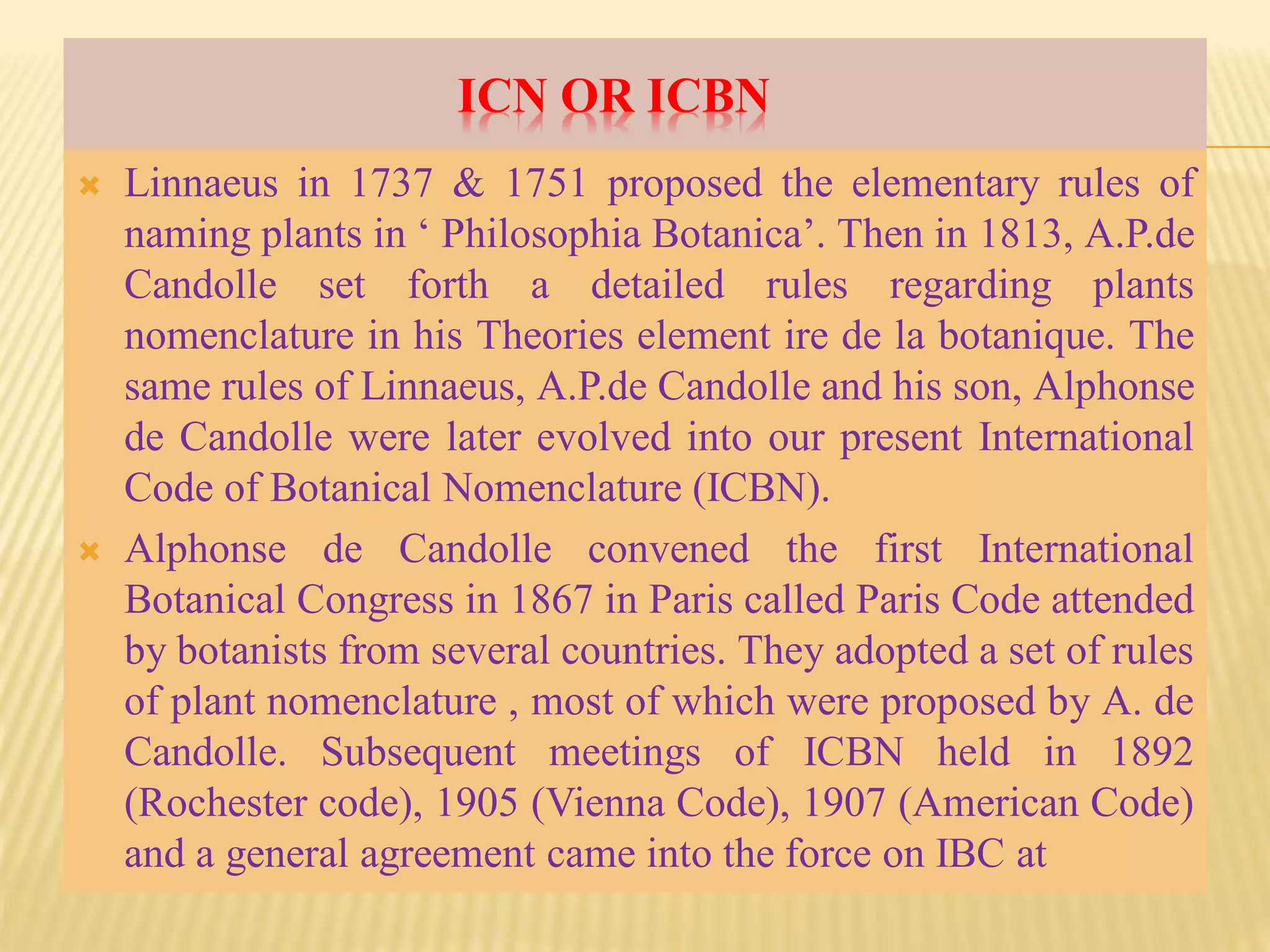
ICN OR ICBN
 Linnaeus in 1737 & 1751 proposed the elementary rules of
naming plants in ‘ Philosophia Botanica’. Then in 1813, A.P.de
Candolle set forth a detailed rules regarding plants
nomenclature in his Theories element ire de la botanique. The
same rules of Linnaeus, A.P.de Candolle and his son, Alphonse
de Candolle were later evolved into our present International
Code of Botanical Nomenclature (ICBN).
 Alphonse de Candolle convened the first International
Botanical Congress in 1867 in Paris called Paris Code attended
by botanists from several countries. They adopted a set of rules
of plant nomenclature , most of which were proposed by A. de
Candolle. Subsequent meetings of ICBN held in 1892
(Rochester code), 1905 (Vienna Code), 1907 (American Code)
and a general agreement came into the force on IBC at
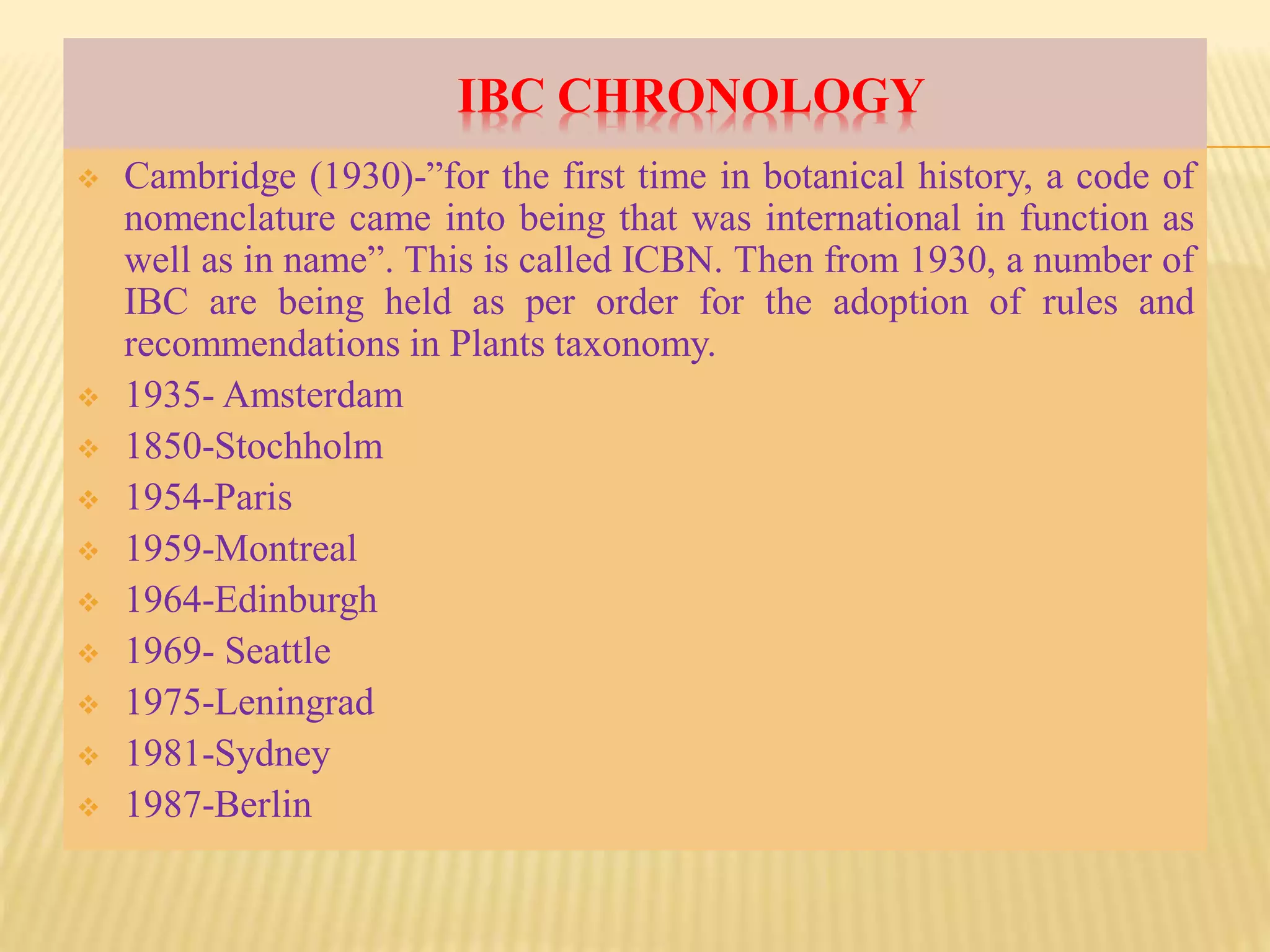
IBC CHRONOLOGY
 Cambridge (1930)-”for the first time in botanical history, a code of
nomenclature came into being that was international in function as
well as in name”. This is called ICBN. Then from 1930, a number of
IBC are being held as per order for the adoption of rules and
recommendations in Plants taxonomy.
 1935- Amsterdam
 1850-Stochholm
 1954-Paris
 1959-Montreal
 1964-Edinburgh
 1969- Seattle
 1975-Leningrad
 1981-Sydney
 1987-Berlin
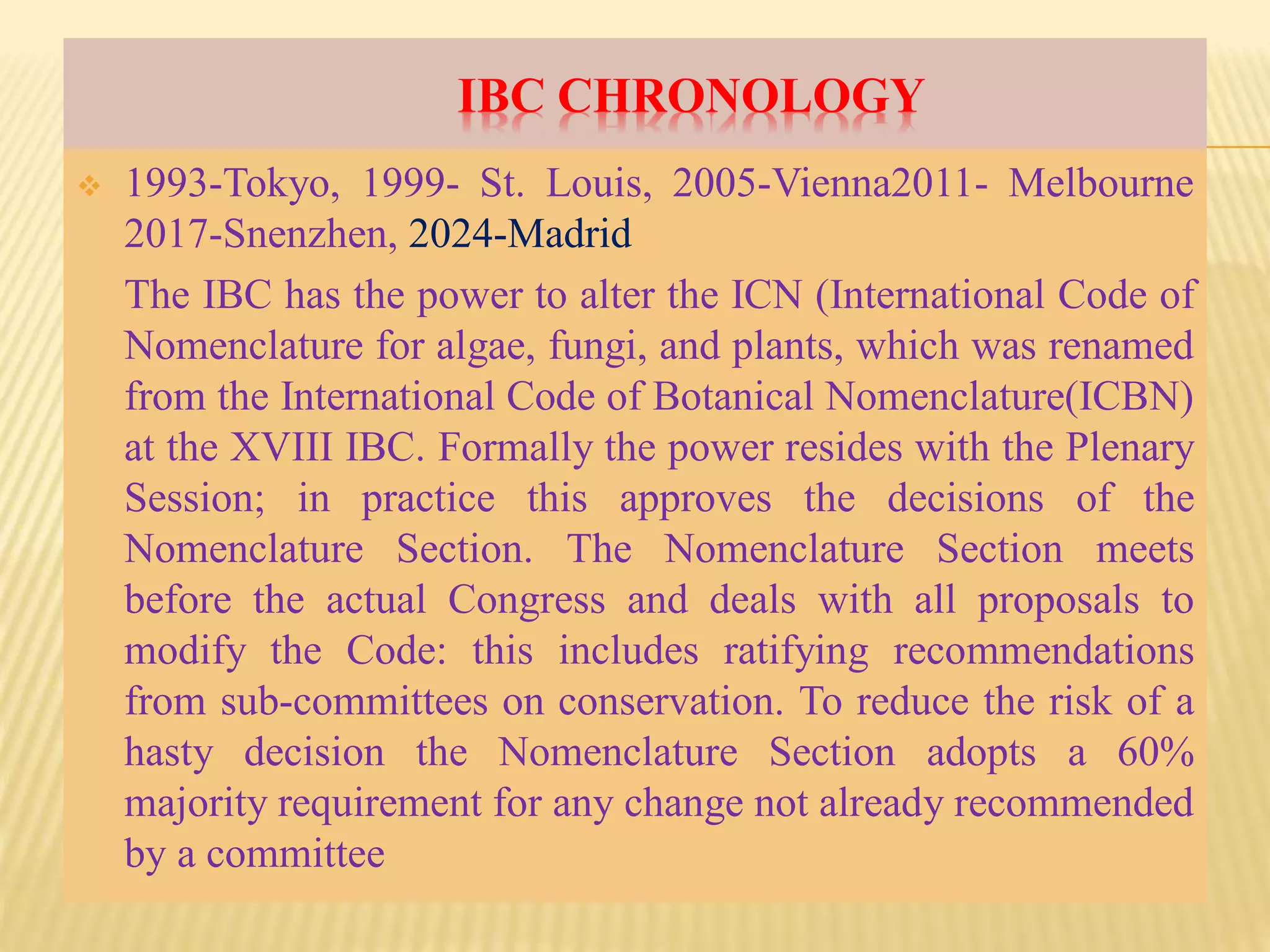
IBC CHRONOLOGY
 1993-Tokyo, 1999- St. Louis, 2005-Vienna2011- Melbourne
2017-Snenzhen, 2024-Madrid
The IBC has the power to alter the ICN (International Code of
Nomenclature for algae, fungi, and plants, which was renamed
from the International Code of Botanical Nomenclature(ICBN)
at the XVIII IBC. Formally the power resides with the Plenary
Session; in practice this approves the decisions of the
Nomenclature Section. The Nomenclature Section meets
before the actual Congress and deals with all proposals to
modify the Code: this includes ratifying recommendations
from sub-committees on conservation. To reduce the risk of a
hasty decision the Nomenclature Section adopts a 60%
majority requirement for any change not already recommended
by a committee
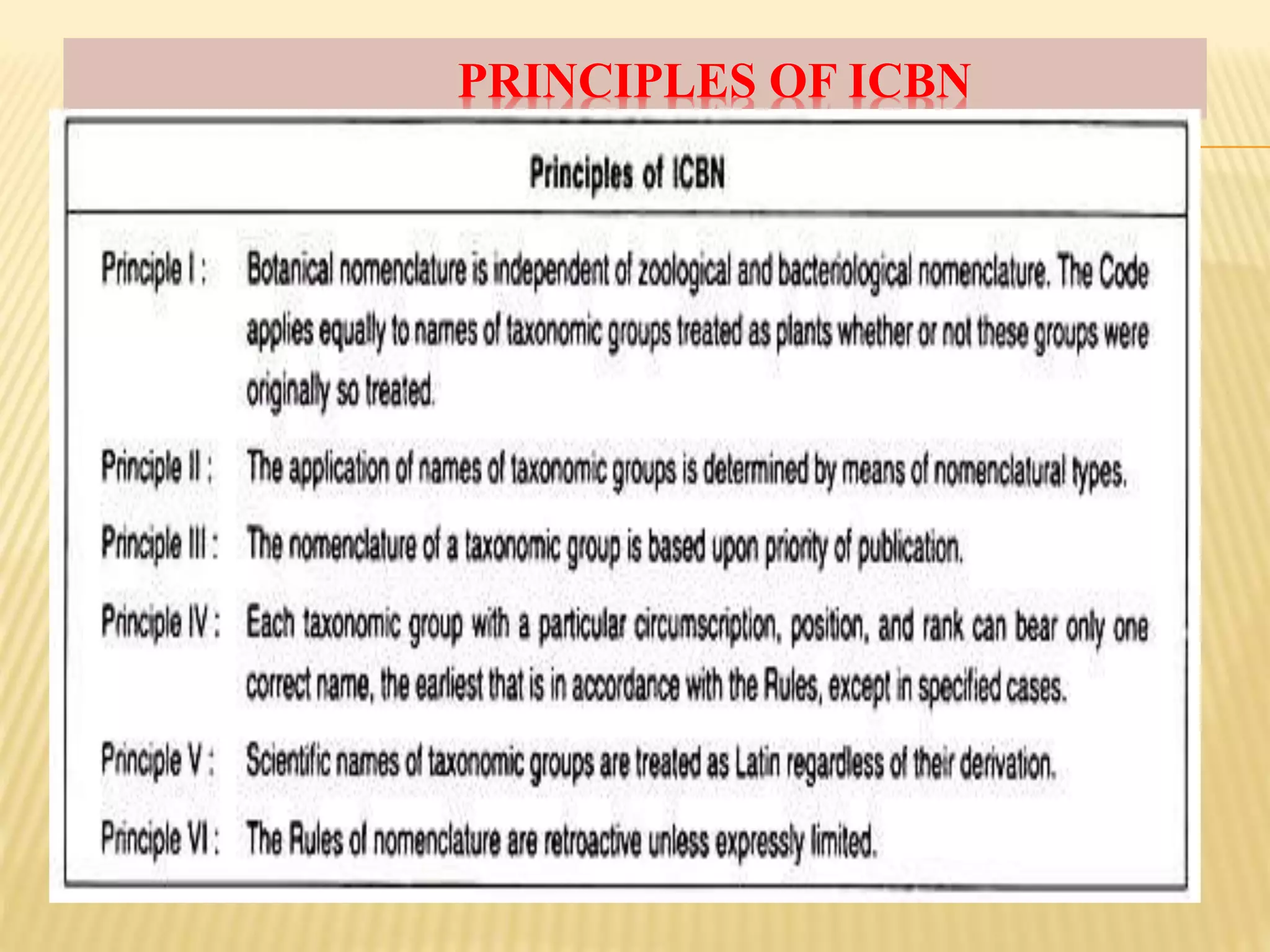
PRINCIPLES
 I. Botanical nomenclature is independent of zoological
nomenclature. The code applies equally to names of taxonomic
groups treated as plants whether or not these groups were
originally so treated (Plants do not include Bacteria).
 II. Application of names of taxonomic groups is determined by
means of nomenclature types.
 III. The nomenclature of a taxonomic group is based upon
priority of publication.
 IV. Each taxonomic group with a particular circumscription,
position, and route can bear only one correct name, the earliest
that is in accordance with the rules, except in specific cases.
 V. Scientific names of taxonomic groups are treated as Latin
regardless of their derivation.
 VI. The rules of nomenclature are retroactive unless expressly
PRINCIPLES OF ICBN
RULES OF NAMING PLANTS
 1) According to binomial system name of any plant species
consist of two names.
For E.g.: Solanum tuberosum (botanical name of Potato)
The first name show generic name& second name show
specific name.
Both names should not be same.
2) Length of generic name and specific name should not be
less than three letters and more than two letters.
3) First letter of generic name should be in capital letter&
specific name should be in small letter.
4) When written these names they should be underlined but
during the time of printing, they should be italic.
5) Name of the scientist should be written in short letter
after the specific name.
6) Scientific name should be derived from Latin or Greek
language.
RULES AND RECOMMENDATIONS OF ICBN
According to the ICBN(1983), the code “ are divided into
Rules , set out in Articles, and Recommendations”. As mention
under point No. 4 of the Preamble of 1983 ICBN” The object
of the Rules is to put the nomenclature of the past into order
and to provide for that of the future , names contrary to a rule
can not be maintained”.
The rules and recommendations of ICBN apply to all
organisms treated as plants (including fungi but excluding
bacteria), whether fossil or non-fossil. Nomenclature of
bacteria is governed by a separate code called International
Code of Bacterial Nomenclature (ICNB) and so as to
cultivated plants by ICNCP.
It is stated under point No. 10 of ICBN that the latest “edition
of the Code super codes all previous editions”
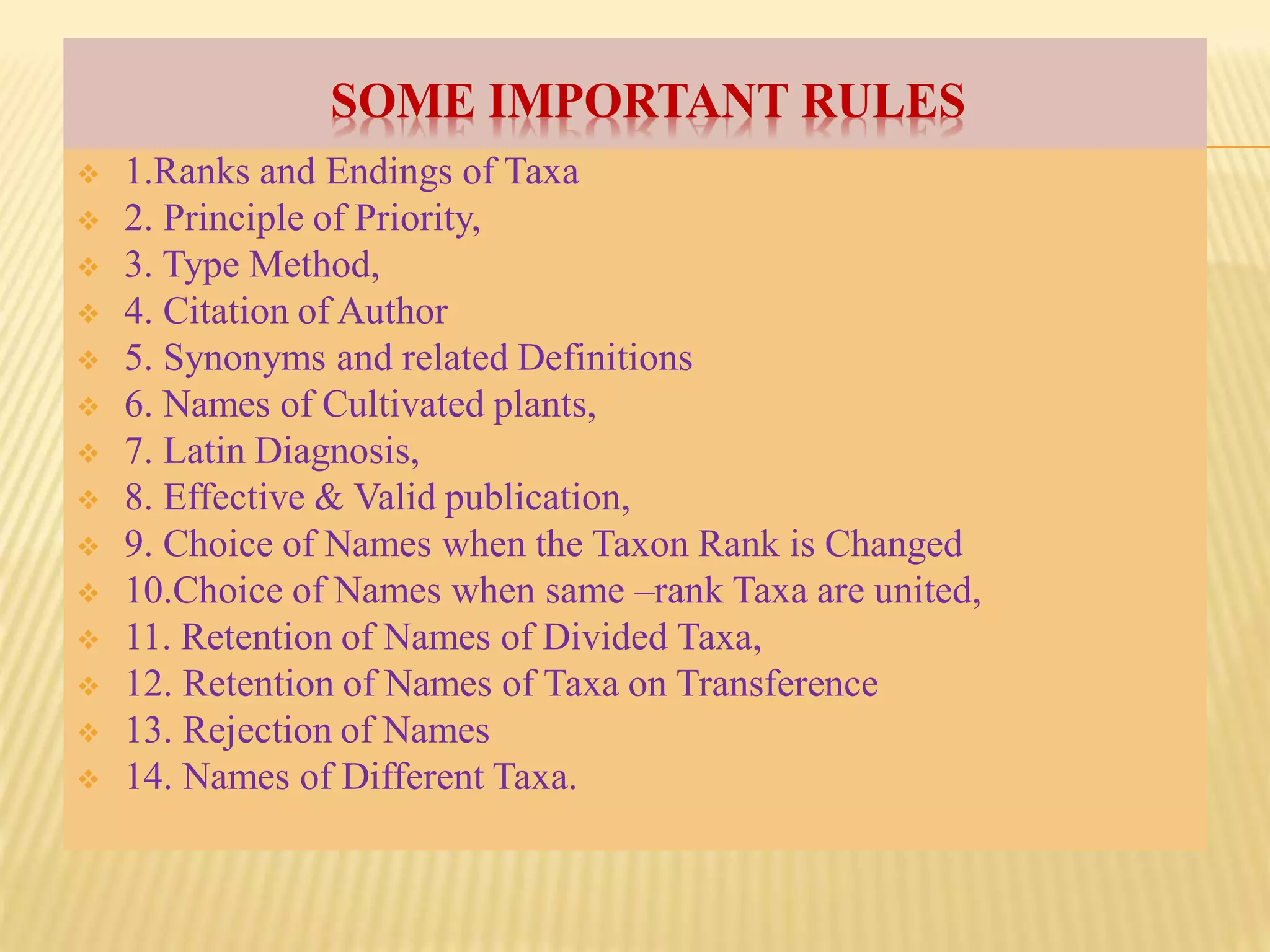
SOME IMPORTANT RULES
 1.Ranks and Endings of Taxa
 2. Principle of Priority,
 3. Type Method,
 4. Citation of Author
 5. Synonyms and related Definitions
 6. Names of Cultivated plants,
 7. Latin Diagnosis,
 8. Effective & Valid publication,
 9. Choice of Names when the Taxon Rank is Changed
 10.Choice of Names when same –rank Taxa are united,
 11. Retention of Names of Divided Taxa,
 12. Retention of Names of Taxa on Transference
 13. Rejection of Names
 14. Names of Different Taxa.
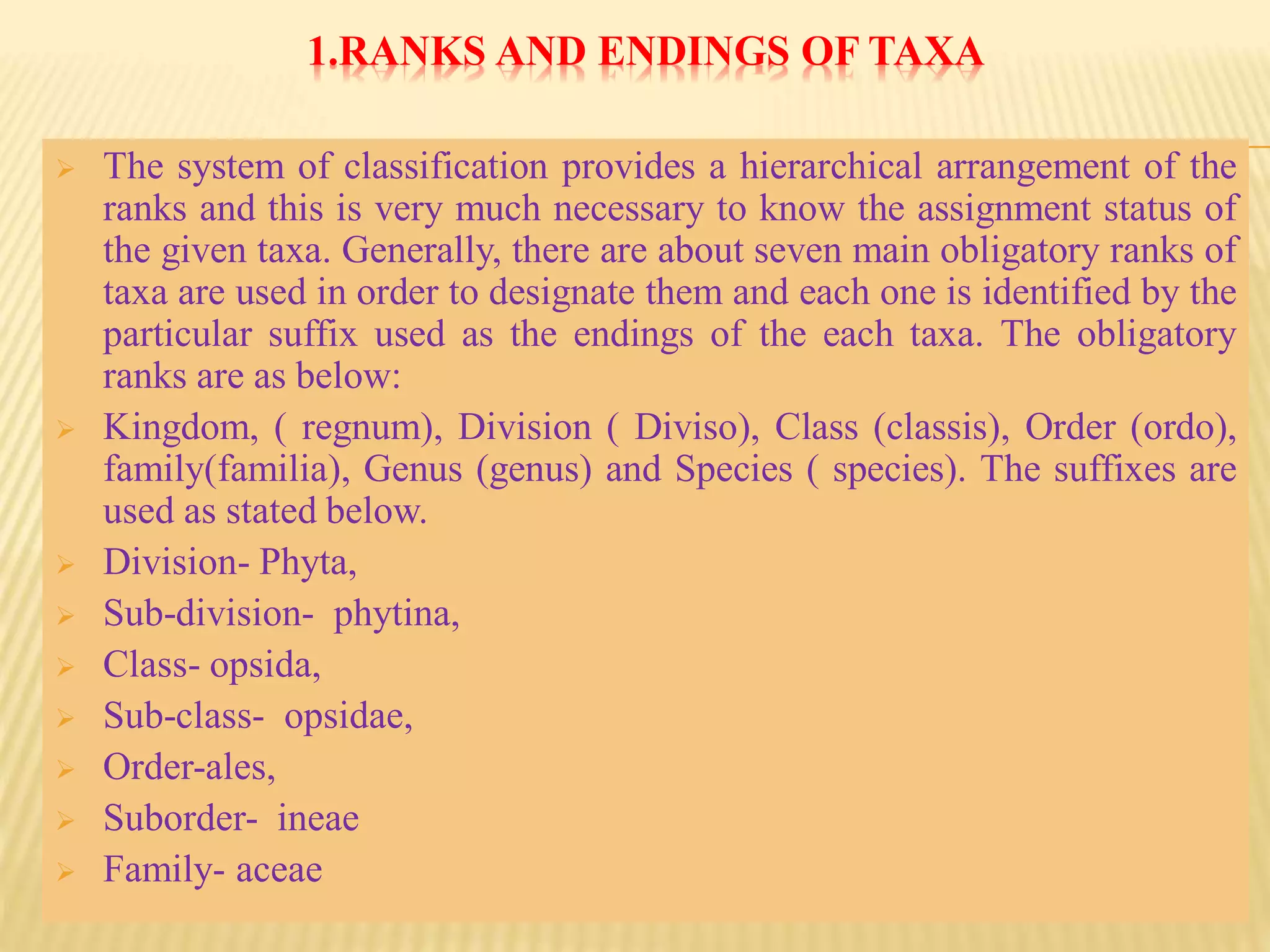
1.RANKS AND ENDINGS OF TAXA
 The system of classification provides a hierarchical arrangement of the
ranks and this is very much necessary to know the assignment status of
the given taxa. Generally, there are about seven main obligatory ranks of
taxa are used in order to designate them and each one is identified by the
particular suffix used as the endings of the each taxa. The obligatory
ranks are as below:
 Kingdom, ( regnum), Division ( Diviso), Class (classis), Order (ordo),
family(familia), Genus (genus) and Species ( species). The suffixes are
used as stated below.
 Division- Phyta,
 Sub-division- phytina,
 Class- opsida,
 Sub-class- opsidae,
 Order-ales,
 Suborder- ineae
 Family- aceae
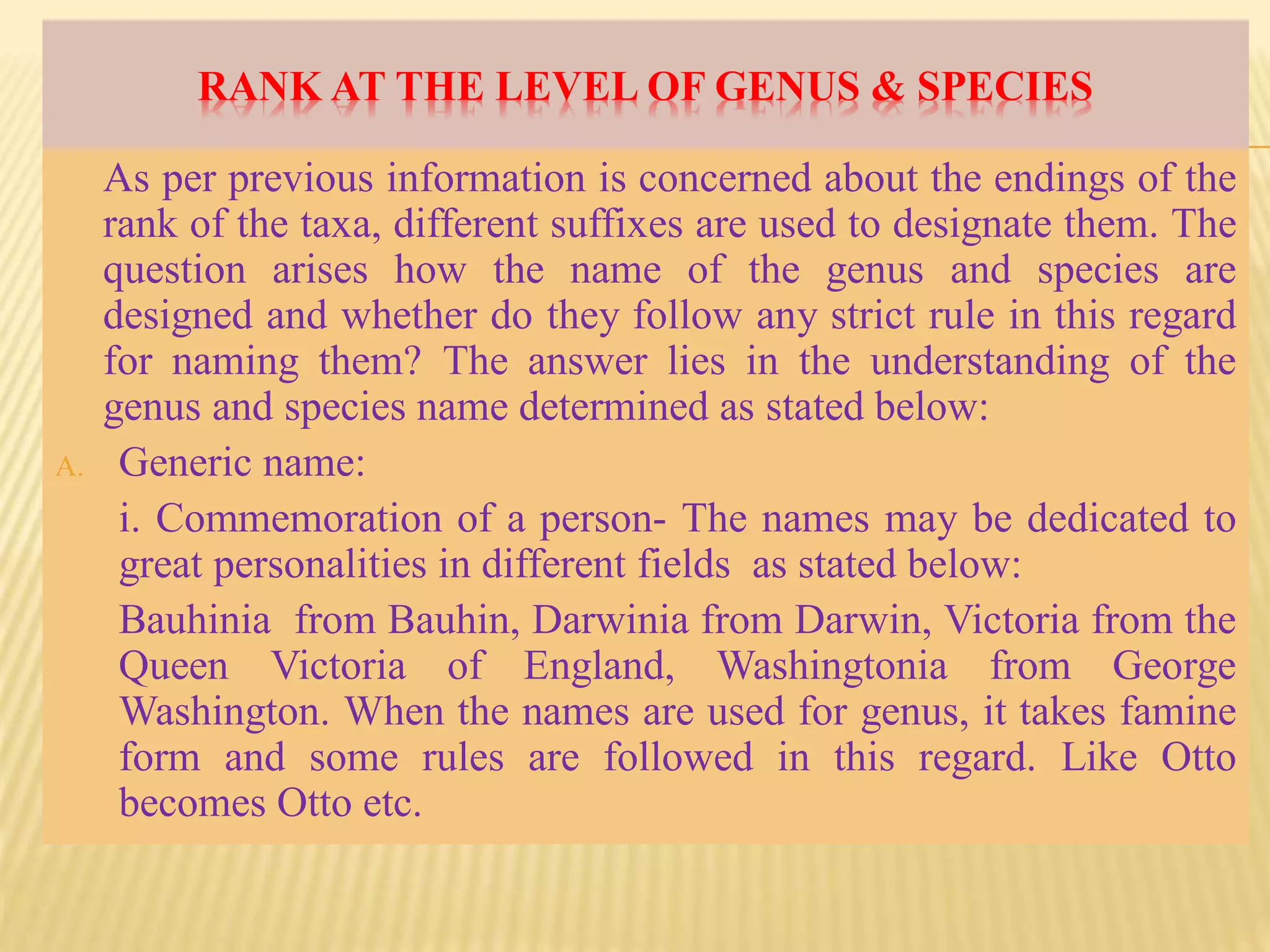
RANK AT THE LEVEL OF GENUS & SPECIES
As per previous information is concerned about the endings of the
rank of the taxa, different suffixes are used to designate them. The
question arises how the name of the genus and species are
designed and whether do they follow any strict rule in this regard
for naming them? The answer lies in the understanding of the
genus and species name determined as stated below:
A. Generic name:
i. Commemoration of a person- The names may be dedicated to
great personalities in different fields as stated below:
Bauhinia from Bauhin, Darwinia from Darwin, Victoria from the
Queen Victoria of England, Washingtonia from George
Washington. When the names are used for genus, it takes famine
form and some rules are followed in this regard. Like Otto
becomes Otto etc.
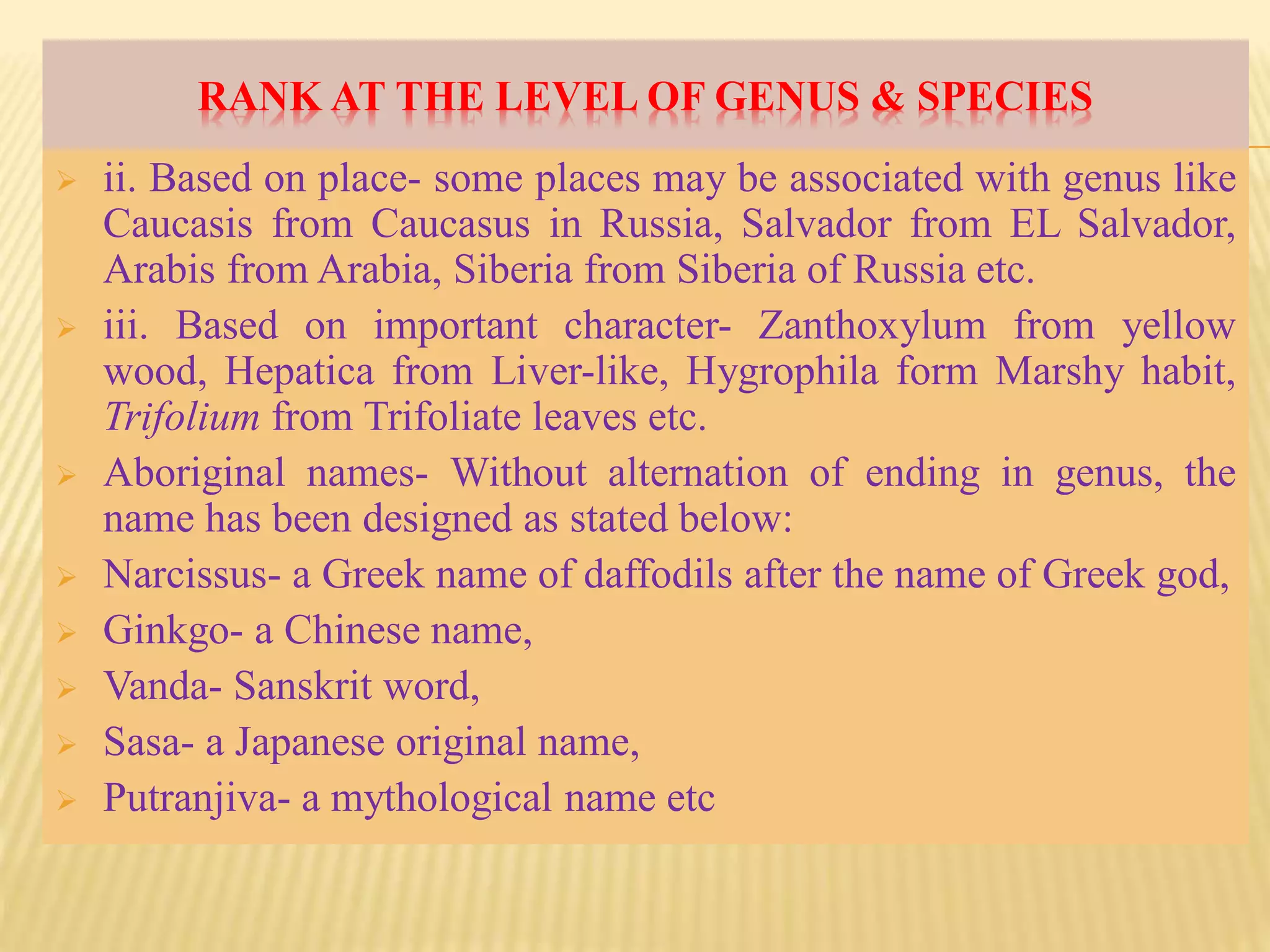
RANK AT THE LEVEL OF GENUS & SPECIES
 ii. Based on place- some places may be associated with genus like
Caucasis from Caucasus in Russia, Salvador from EL Salvador,
Arabis from Arabia, Siberia from Siberia of Russia etc.
 iii. Based on important character- Zanthoxylum from yellow
wood, Hepatica from Liver-like, Hygrophila form Marshy habit,
Trifolium from Trifoliate leaves etc.
 Aboriginal names- Without alternation of ending in genus, the
name has been designed as stated below:
 Narcissus- a Greek name of daffodils after the name of Greek god,
 Ginkgo- a Chinese name,
 Vanda- Sanskrit word,
 Sasa- a Japanese original name,
 Putranjiva- a mythological name etc
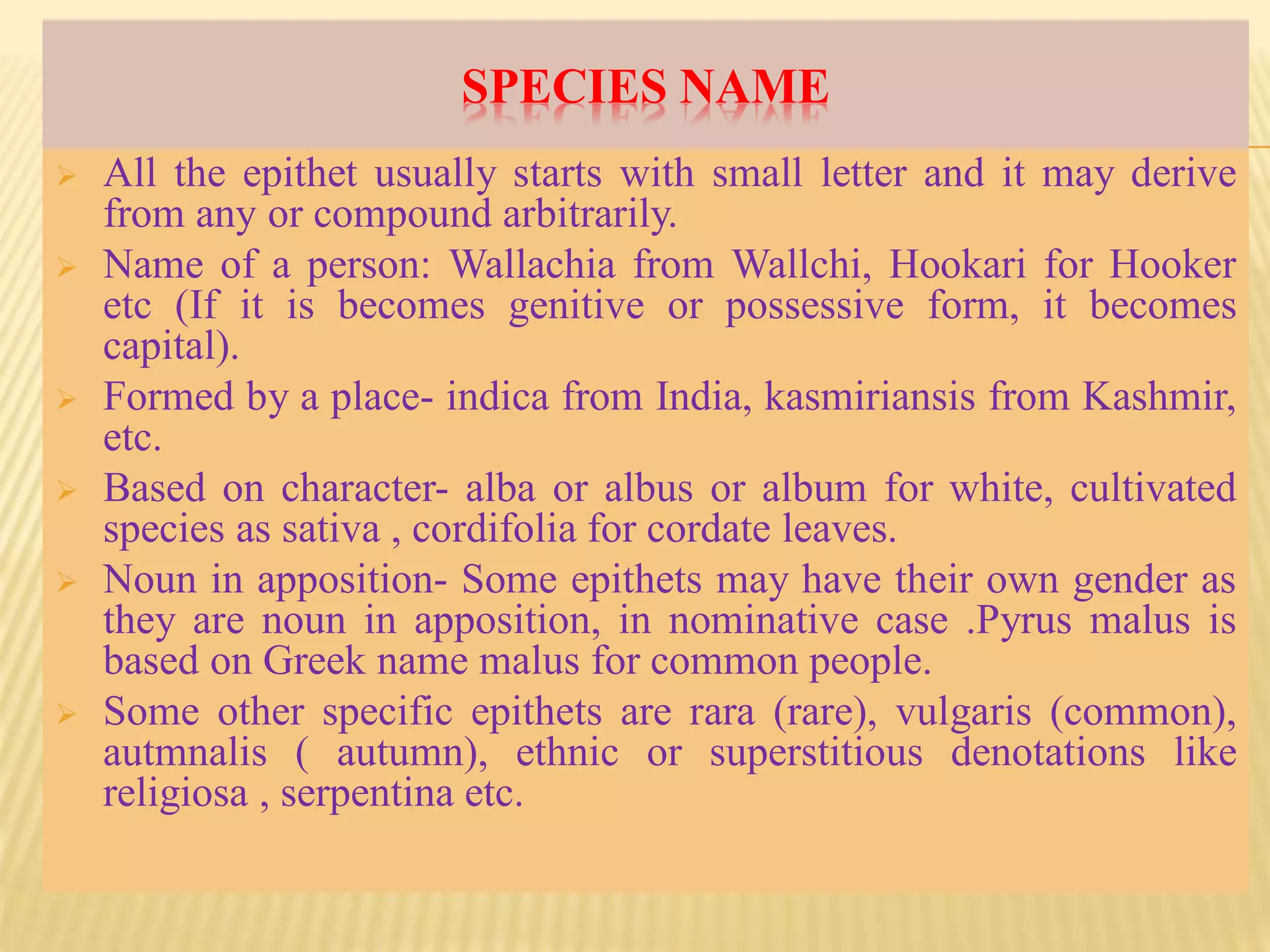
SPECIES NAME
 All the epithet usually starts with small letter and it may derive
from any or compound arbitrarily.
 Name of a person: Wallachia from Wallchi, Hookari for Hooker
etc (If it is becomes genitive or possessive form, it becomes
capital).
 Formed by a place- indica from India, kasmiriansis from Kashmir,
etc.
 Based on character- alba or albus or album for white, cultivated
species as sativa , cordifolia for cordate leaves.
 Noun in apposition- Some epithets may have their own gender as
they are noun in apposition, in nominative case .Pyrus malus is
based on Greek name malus for common people.
 Some other specific epithets are rara (rare), vulgaris (common),
autmnalis ( autumn), ethnic or superstitious denotations like
religiosa , serpentina etc.
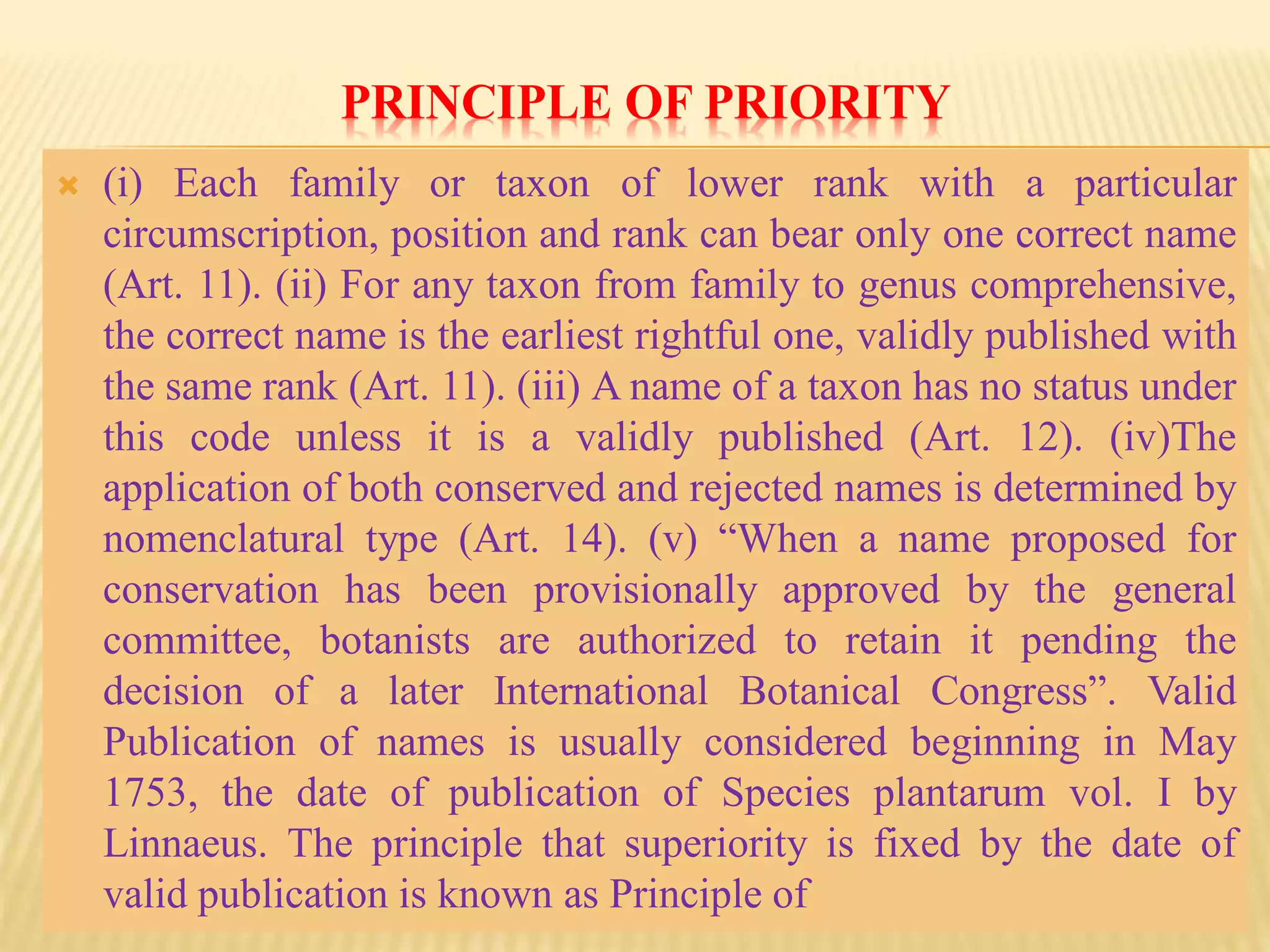
PRINCIPLE OF PRIORITY
 (i) Each family or taxon of lower rank with a particular
circumscription, position and rank can bear only one correct name
(Art. 11). (ii) For any taxon from family to genus comprehensive,
the correct name is the earliest rightful one, validly published with
the same rank (Art. 11). (iii) A name of a taxon has no status under
this code unless it is a validly published (Art. 12). (iv)The
application of both conserved and rejected names is determined by
nomenclatural type (Art. 14). (v) “When a name proposed for
conservation has been provisionally approved by the general
committee, botanists are authorized to retain it pending the
decision of a later International Botanical Congress”. Valid
Publication of names is usually considered beginning in May
1753, the date of publication of Species plantarum vol. I by
Linnaeus. The principle that superiority is fixed by the date of
valid publication is known as Principle of
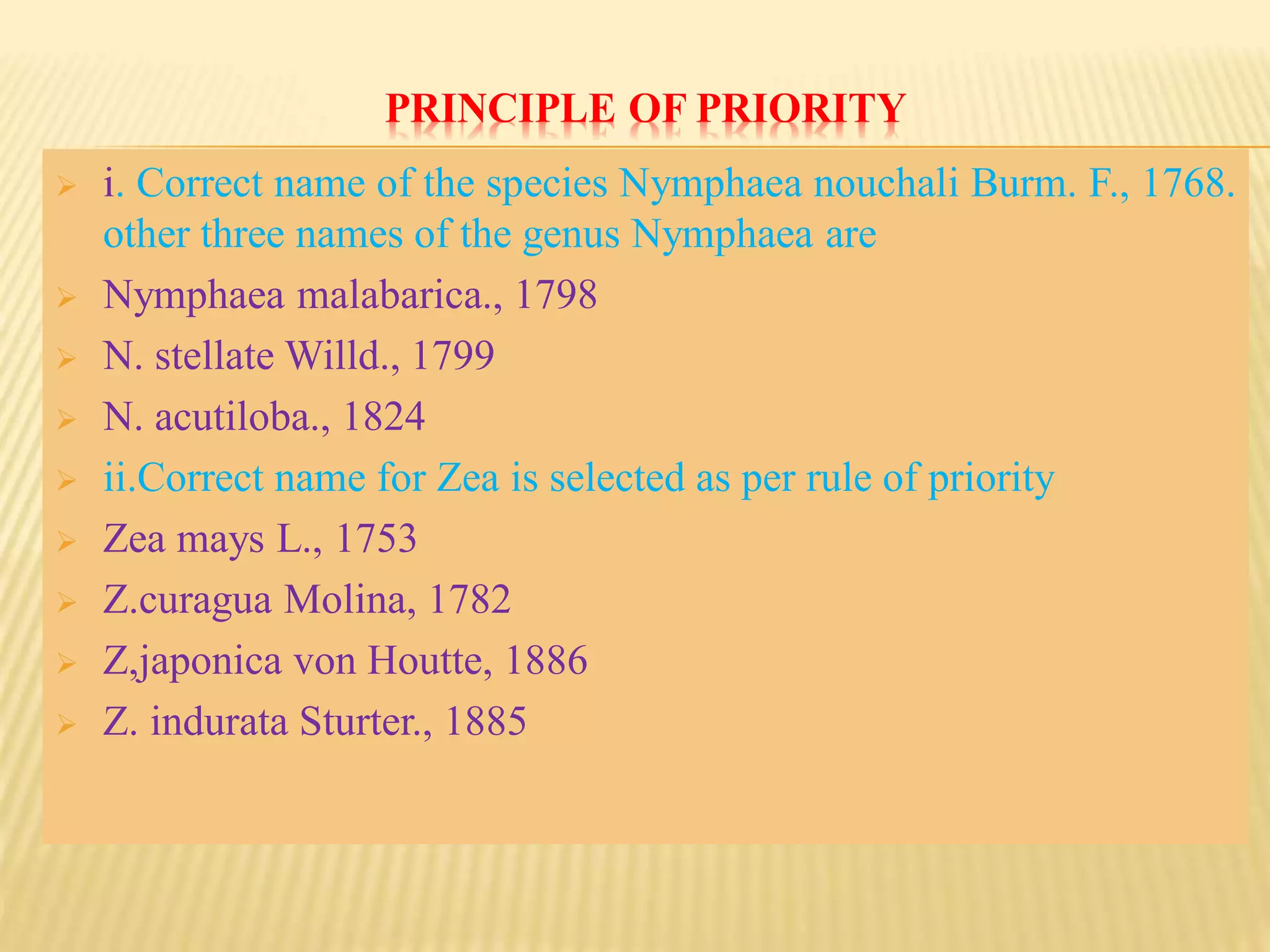
PRINCIPLE OF PRIORITY
 i. Correct name of the species Nymphaea nouchali Burm. F., 1768.
other three names of the genus Nymphaea are
 Nymphaea malabarica., 1798
 N. stellate Willd., 1799
 N. acutiloba., 1824
 ii.Correct name for Zea is selected as per rule of priority
 Zea mays L., 1753
 Z.curagua Molina, 1782
 Z,japonica von Houtte, 1886
 Z. indurata Sturter., 1885
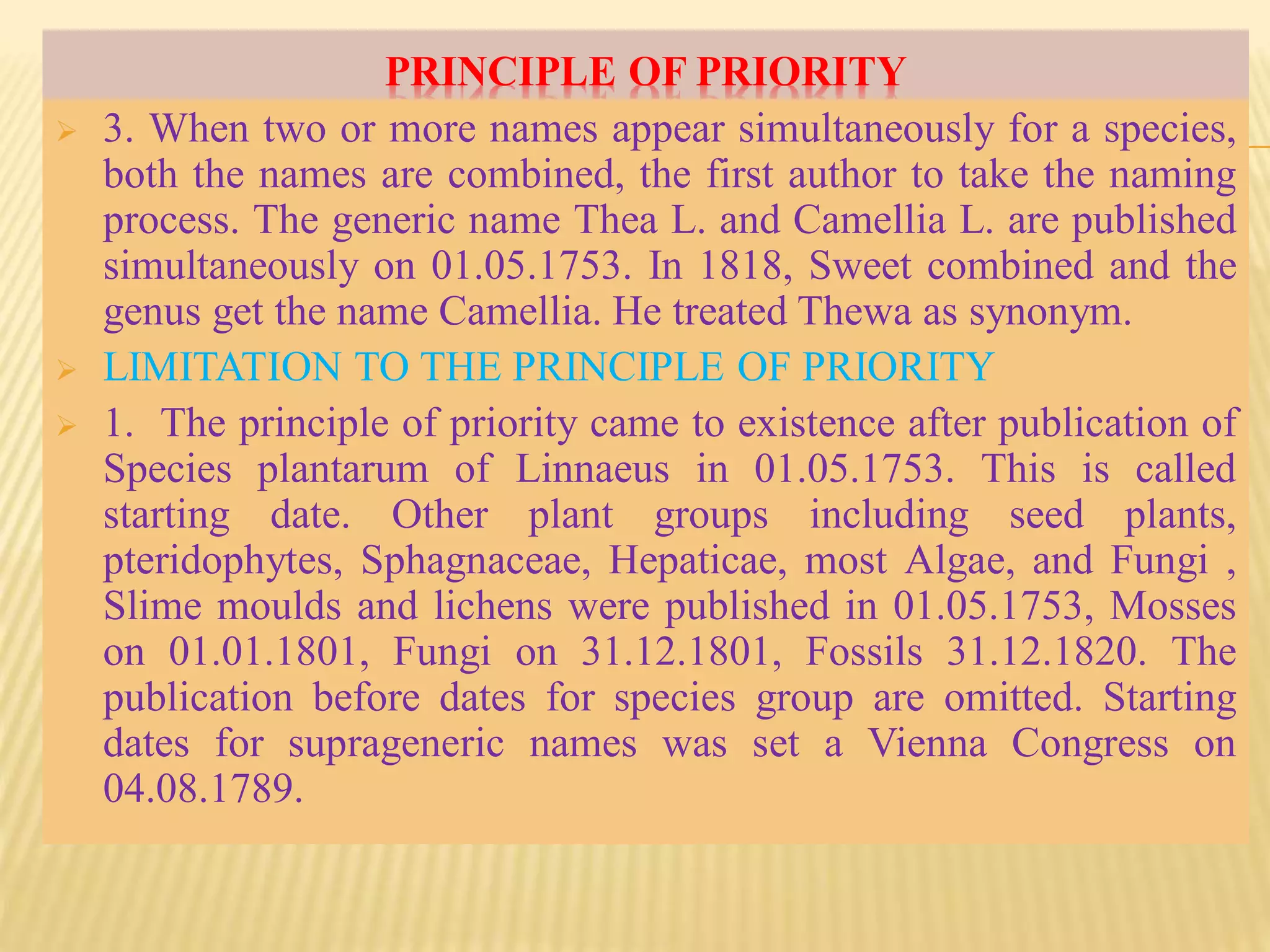
PRINCIPLE OF PRIORITY
 3. When two or more names appear simultaneously for a species,
both the names are combined, the first author to take the naming
process. The generic name Thea L. and Camellia L. are published
simultaneously on 01.05.1753. In 1818, Sweet combined and the
genus get the name Camellia. He treated Thewa as synonym.
 LIMITATION TO THE PRINCIPLE OF PRIORITY
 1. The principle of priority came to existence after publication of
Species plantarum of Linnaeus in 01.05.1753. This is called
starting date. Other plant groups including seed plants,
pteridophytes, Sphagnaceae, Hepaticae, most Algae, and Fungi ,
Slime moulds and lichens were published in 01.05.1753, Mosses
on 01.01.1801, Fungi on 31.12.1801, Fossils 31.12.1820. The
publication before dates for species group are omitted. Starting
dates for suprageneric names was set a Vienna Congress on
04.08.1789.
PRINCIPLE OF PRIORITY
 2. The principle of priority is applied only upto family level.
 3. A correct name for a taxon is chosen considering names and
epithets available at that rank. Other wise , a suitable name is
selected taking epithet from another rank.
 4. Nomina conservanda are to be used as correct names replacing
the earlier legitimate names, earlier legitimate name is rejected
treated as nomina rejicinda. The family name Theaceae D. Don ,
1825 is conserved in place of Ternstromiaceae Mirbe, 1813. The
genus Sesbania Scop., 1777 is conserved in place of Sesban
Adans., 1763 and Agati Adan., 1763.
 Thus, the above limitations are considered as far as the
conservation of the names at the different rank and categories.
TYPIFICATION/TYPE METHOD
 Typification is a methodology by which a certain representative of the
group is the source of the name for the same group. This is called
nomenclatural type. A type of a particular genus is a species so as to a
particular family is a genus. Type of a particular genus is species as Poa
pratensis for Poa. A single type specimen is designated and it is
generally treated as Holotype. The holotype should be kept in a
permanent herbarium and conserved properly. Publication on or after
January 1, 12958 of the name of a new taxon of the rank of the genus or
below is valid when the same type name is indicated Publication of
name of a new taxon of genus or below after January 1, 1990 should
carry either the word ‘typus’ or ‘holotypus’. Publication of names on or
after January 1, 2007 requires a specimen as a type but in case of
microscopic algae and fungi where preservation of the specimen is
technically difficult, illustration is accepted as type.
TYPIFICATION/TYPE METHOD
 ICN’s second principle states that a specimen must be associated with
the scientific name known as nomenclatural type. A nomenclatural
type is either a specimen or may be an illustration. Example: Herbarium
sheet for vascular plants. There are different nomenclatural types.
 Holotype : A specimen or illustration originally cited by the author in
protologue. It is a definitive reference source for identity. Citation of
holotype and submission of it is one of the criteria for valid publication
of a botanical name.
 Isotype: Duplicate specimen of the holotype collected from same
population by same person on same date with same field number. They
are the reliable duplicates of holotype and may be distributed to various
herbaria of various regions.
 Lectotype: Specimen selected from original material serves as a type,
when no holotype was designated at the time of publications or if
holotype is missing or destroyed.
 Syntype: When more than one specimen cited by the author in the
protologue without designating holotype.
TYPIFICATION/TYPE METHOD
 Neotype: Specimen derived from non-original collection selected
as the type, when original specimen is missing or destroyed.
 Paratype: Specimen cited in the protologue is other than
holotype, isotype or syntype.
 Epitype: Specimen or illustration serves as an interpretive type,
when holotype, neotype or lectotype is ambiguous.
 Thus, the type concept is the most important issue that to be
addressed in case of the developing the different type of
taxonomic problems. The different rules and regulations as framed
by ICBN is very important in this regard. Thus, addressing a
taxonomic problem with the adi of the element is very essential in
this regard.
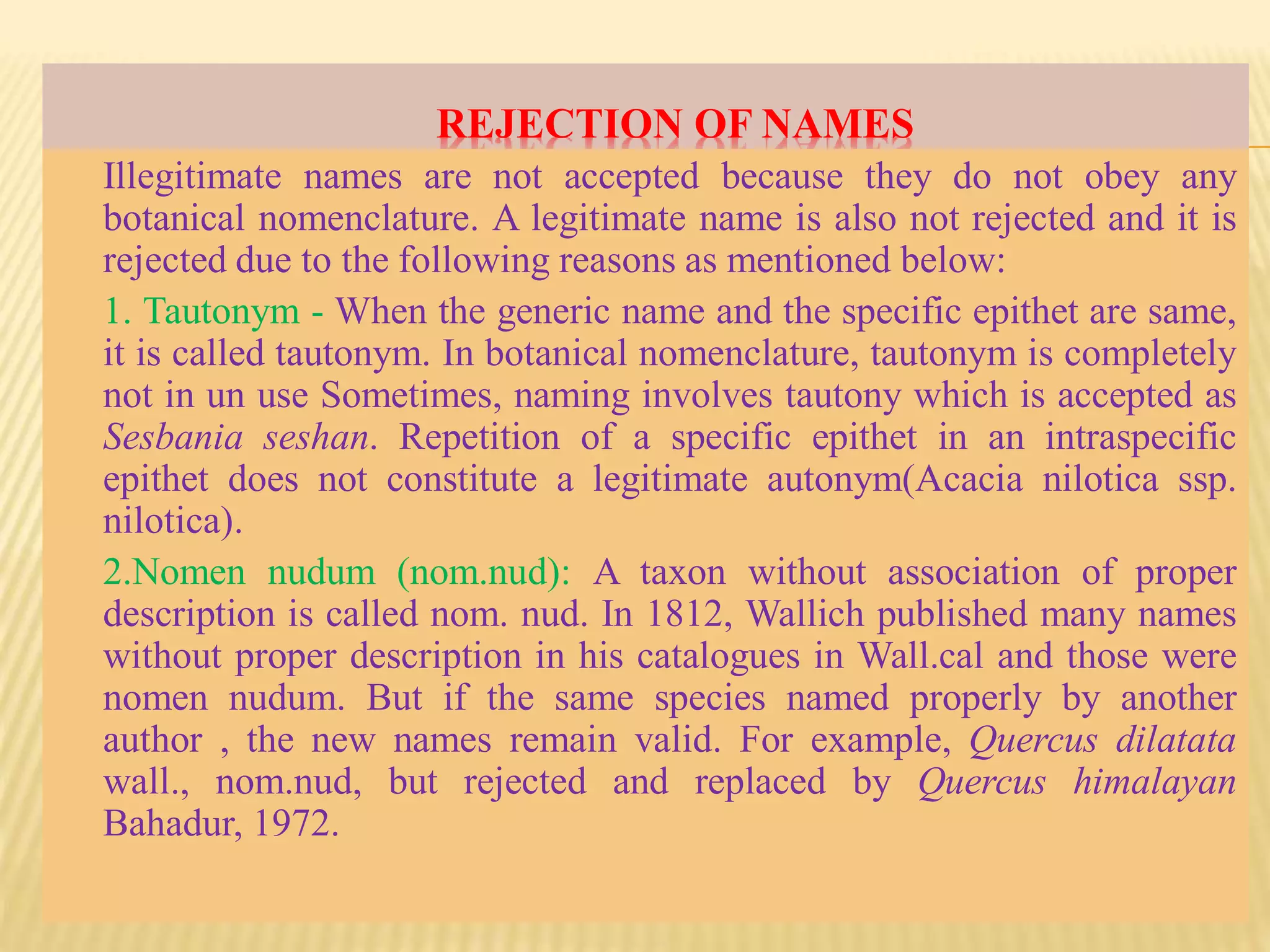
REJECTION OF NAMES
Illegitimate names are not accepted because they do not obey any
botanical nomenclature. A legitimate name is also not rejected and it is
rejected due to the following reasons as mentioned below:
1. Tautonym - When the generic name and the specific epithet are same,
it is called tautonym. In botanical nomenclature, tautonym is completely
not in un use Sometimes, naming involves tautony which is accepted as
Sesbania seshan. Repetition of a specific epithet in an intraspecific
epithet does not constitute a legitimate autonym(Acacia nilotica ssp.
nilotica).
2.Nomen nudum (nom.nud): A taxon without association of proper
description is called nom. nud. In 1812, Wallich published many names
without proper description in his catalogues in Wall.cal and those were
nomen nudum. But if the same species named properly by another
author , the new names remain valid. For example, Quercus dilatata
wall., nom.nud, but rejected and replaced by Quercus himalayan
Bahadur, 1972.
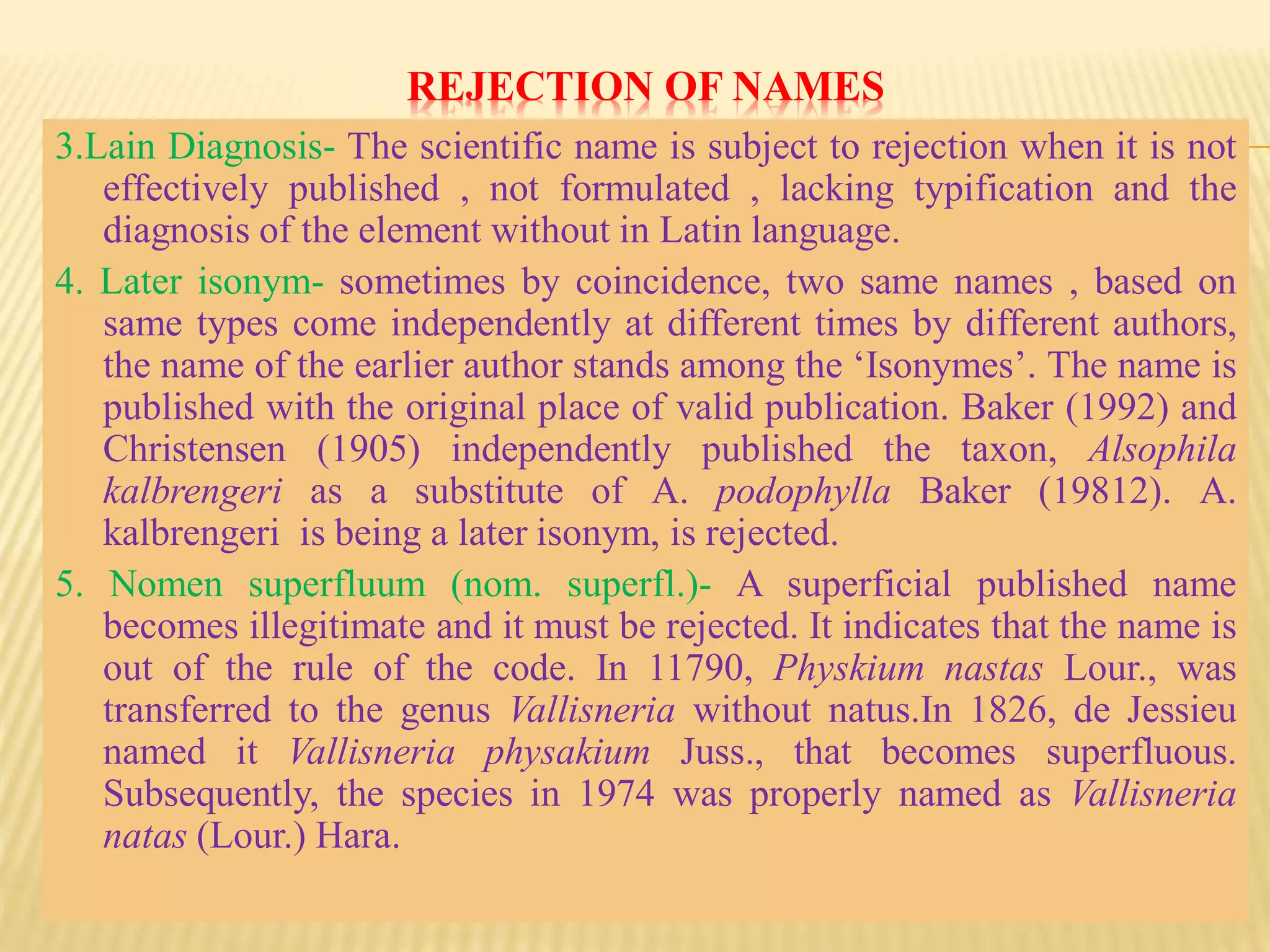
REJECTION OF NAMES
3.Lain Diagnosis- The scientific name is subject to rejection when it is not
effectively published , not formulated , lacking typification and the
diagnosis of the element without in Latin language.
4. Later isonym- sometimes by coincidence, two same names , based on
same types come independently at different times by different authors,
the name of the earlier author stands among the ‘Isonymes’. The name is
published with the original place of valid publication. Baker (1992) and
Christensen (1905) independently published the taxon, Alsophila
kalbrengeri as a substitute of A. podophylla Baker (19812). A.
kalbrengeri is being a later isonym, is rejected.
5. Nomen superfluum (nom. superfl.)- A superficial published name
becomes illegitimate and it must be rejected. It indicates that the name is
out of the rule of the code. In 11790, Physkium nastas Lour., was
transferred to the genus Vallisneria without natus.In 1826, de Jessieu
named it Vallisneria physakium Juss., that becomes superfluous.
Subsequently, the species in 1974 was properly named as Vallisneria
natas (Lour.) Hara.
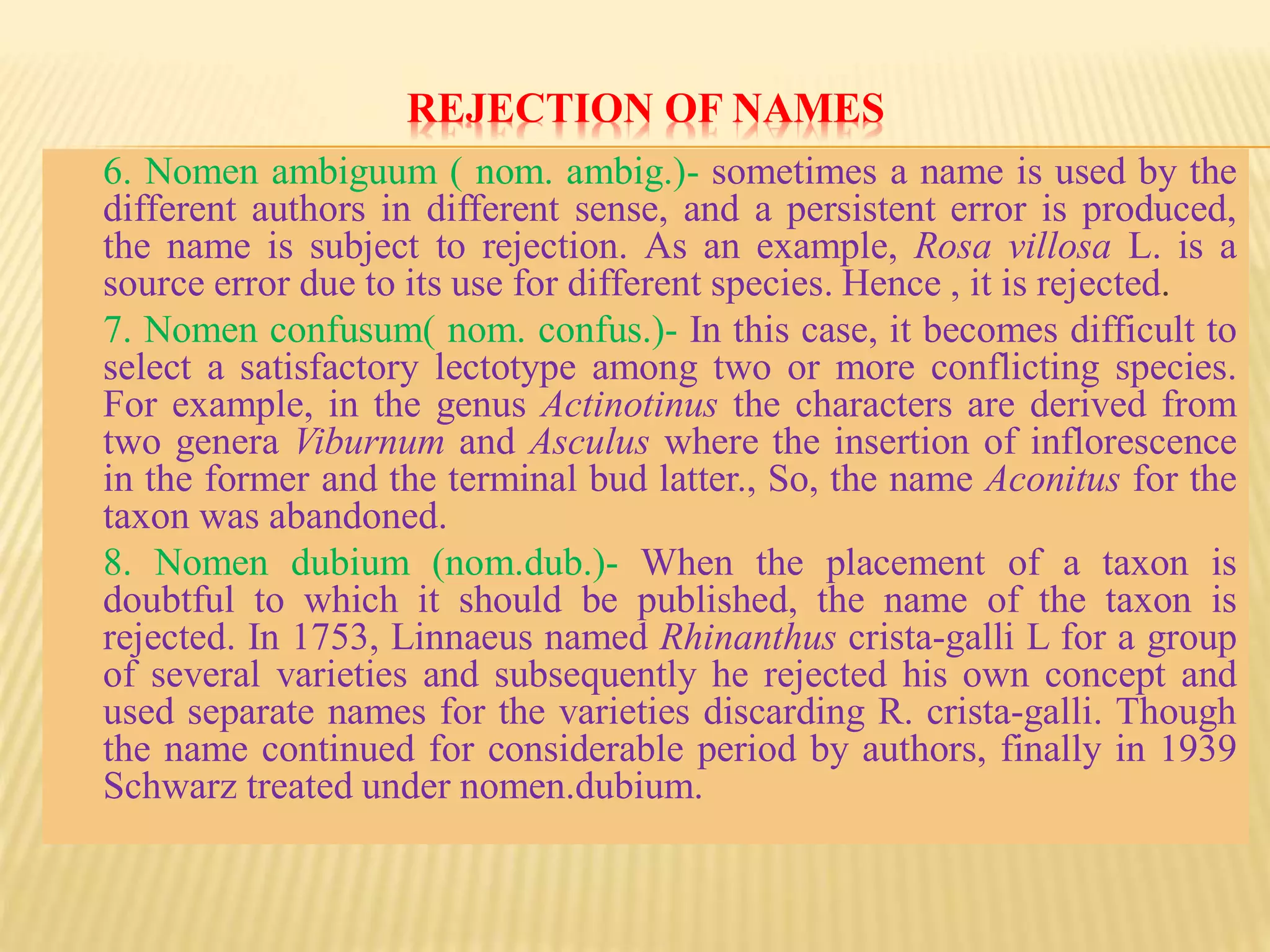
REJECTION OF NAMES
6. Nomen ambiguum ( nom. ambig.)- sometimes a name is used by the
different authors in different sense, and a persistent error is produced,
the name is subject to rejection. As an example, Rosa villosa L. is a
source error due to its use for different species. Hence , it is rejected.
7. Nomen confusum( nom. confus.)- In this case, it becomes difficult to
select a satisfactory lectotype among two or more conflicting species.
For example, in the genus Actinotinus the characters are derived from
two genera Viburnum and Asculus where the insertion of inflorescence
in the former and the terminal bud latter., So, the name Aconitus for the
taxon was abandoned.
8. Nomen dubium (nom.dub.)- When the placement of a taxon is
doubtful to which it should be published, the name of the taxon is
rejected. In 1753, Linnaeus named Rhinanthus crista-galli L for a group
of several varieties and subsequently he rejected his own concept and
used separate names for the varieties discarding R. crista-galli. Though
the name continued for considerable period by authors, finally in 1939
Schwarz treated under nomen.dubium.
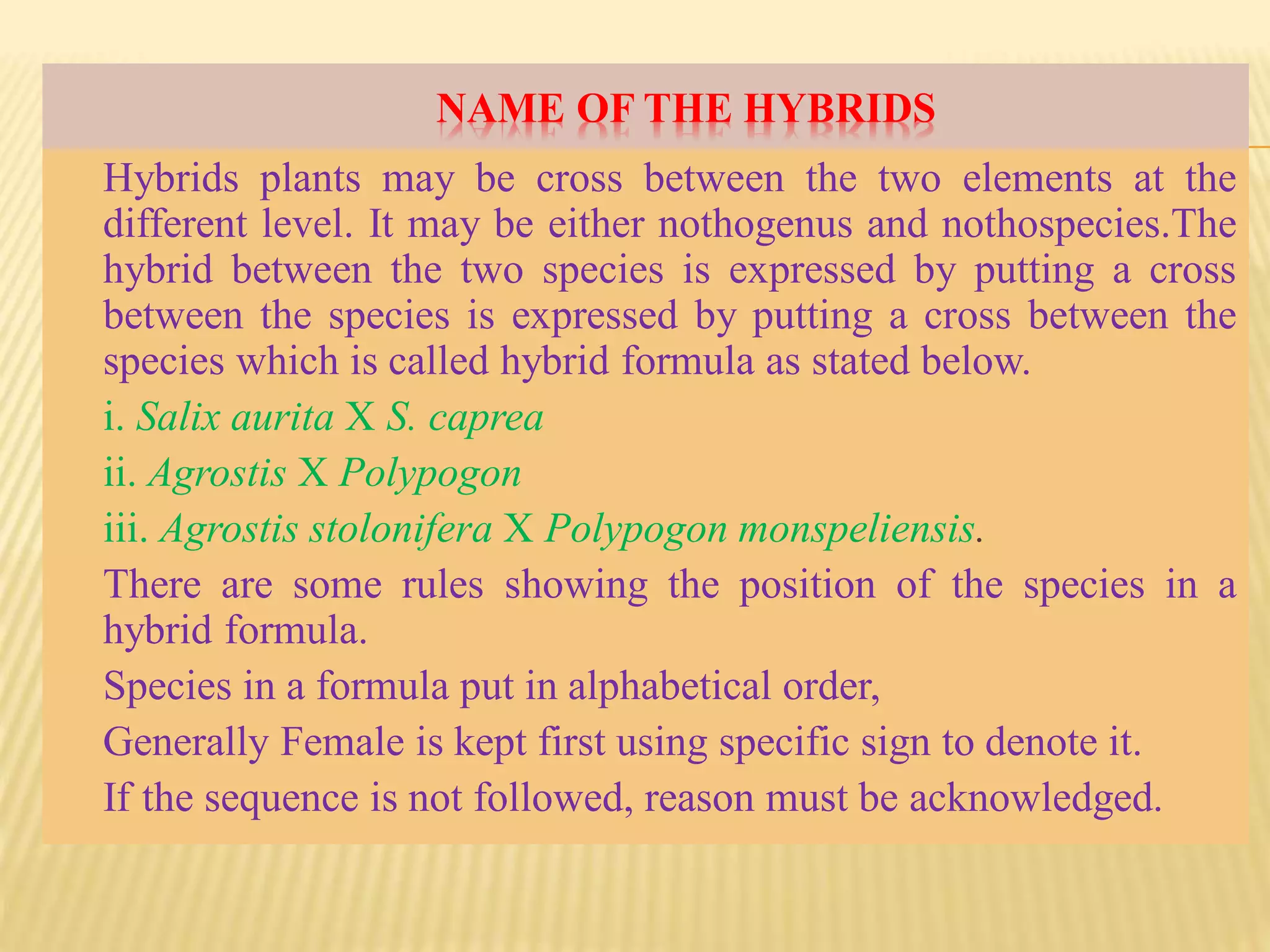
NAME OF THE HYBRIDS
Hybrids plants may be cross between the two elements at the
different level. It may be either nothogenus and nothospecies.The
hybrid between the two species is expressed by putting a cross
between the species is expressed by putting a cross between the
species which is called hybrid formula as stated below.
i. Salix aurita X S. caprea
ii. Agrostis X Polypogon
iii. Agrostis stolonifera X Polypogon monspeliensis.
There are some rules showing the position of the species in a
hybrid formula.
Species in a formula put in alphabetical order,
Generally Female is kept first using specific sign to denote it.
If the sequence is not followed, reason must be acknowledged.
NAME OF THE HYBRIDS
Hybrid may be interspecific of intergeneric, interspecific involves
two species under same genus but intergeneric involves two
different genera. A binary name is assigned to the interspecfic
hybrid or notho-species putting X before the specific epithet. The
hybrid should be self-perpetuating and or reproductively isolated.
The following examples can beautify the event.
i. Rosa X odorata ( Interspecific) derived from Rosa chinensis X
R. gigantea.
ii. Salix X capreola (Interspecific) derived from Salix aurita and
Salix caprea.
The variants of interspecific hybrids are named as nothosubspecies
and nothovarities , e.g. Salix rubens nothovar. basfordiana.
NAME OF THE HYBRIDS
In intergeneric cross, the naming of the hybrid follows the
following rules as stated below:
i. A cross between Triticum & Secale that produces a intergeneric
hybrid , named as xTriticosecale and in case of xAndropogon it is
Agrostis x Polypogon and in xPaeonia from Pyrus and Cynodon.
The name of the nothogenus derived from the combination of the
two.
Sometimes, intergeneric naming includes four or more genera to
produce an intergeneric hybrid. The hybrid carries a cross sign
immediately before it and it should be more than eight syllables.
The condensed formula xPotinara is the outcome of 4 genera-
Brassavola x Cattleya x Laelia x Sophrontitis. The hybrid genus
end with – ara derived from the person who produced the hybrid
or so.
NAME OF THE HYBRIDS
When the nothogeneic name is formed out of three genera, the
name does not contain eight syllables .But it consists of whole or
first part of one followed by the whole, or any part of the second
followed by the whole or the last part of the third followed by the
one or more connecting vowels. The nothogenic name of the
trigenic hybrid may be named as tetragenic hybrid if the above
pattern is not accepted i.e. from personal name to which added the
termination –ara.
Nothogenic hybrid of 3 genera:
Xsopholaeliocattleyaya, it is derived from (xSophronitis x Laelia x
Cattleya).
Two species involved in graft are demarcated by plus sign, e.g.
Hibiscus rosa-sinensis+ and H.syricus +---
THANK YOU VERY MUCH
 References:
 1.A text Book of Plant Systematics- C. Mohanty
 2.A text Book of Botany- Hait, Bhattacharya & Ghosh
 3. Plant taxonomy- O.P. Sharma,
 Studies in Botany
 College Botany
 Google for Images
 Different websites
 Disclaimer: this PPT has been designed and developed for
enriching the free knowledge domain in the field of plant sciences.

Principles and Rules.pdf

  • 1.
    PLANT TAXONOMY Welcome to PRINCIPLESAND RULES ( ICN) By Dr. N. Sannigrahi, Associate Professor, Department. Of Botany, Nistarini College, Purulia, (W. B), India
  • 2.
    ICN OR ICBN Linnaeus in 1737 & 1751 proposed the elementary rules of naming plants in ‘ Philosophia Botanica’. Then in 1813, A.P.de Candolle set forth a detailed rules regarding plants nomenclature in his Theories element ire de la botanique. The same rules of Linnaeus, A.P.de Candolle and his son, Alphonse de Candolle were later evolved into our present International Code of Botanical Nomenclature (ICBN).  Alphonse de Candolle convened the first International Botanical Congress in 1867 in Paris called Paris Code attended by botanists from several countries. They adopted a set of rules of plant nomenclature , most of which were proposed by A. de Candolle. Subsequent meetings of ICBN held in 1892 (Rochester code), 1905 (Vienna Code), 1907 (American Code) and a general agreement came into the force on IBC at
  • 3.
    IBC CHRONOLOGY  Cambridge(1930)-”for the first time in botanical history, a code of nomenclature came into being that was international in function as well as in name”. This is called ICBN. Then from 1930, a number of IBC are being held as per order for the adoption of rules and recommendations in Plants taxonomy.  1935- Amsterdam  1850-Stochholm  1954-Paris  1959-Montreal  1964-Edinburgh  1969- Seattle  1975-Leningrad  1981-Sydney  1987-Berlin
  • 4.
    IBC CHRONOLOGY  1993-Tokyo,1999- St. Louis, 2005-Vienna2011- Melbourne 2017-Snenzhen, 2024-Madrid The IBC has the power to alter the ICN (International Code of Nomenclature for algae, fungi, and plants, which was renamed from the International Code of Botanical Nomenclature(ICBN) at the XVIII IBC. Formally the power resides with the Plenary Session; in practice this approves the decisions of the Nomenclature Section. The Nomenclature Section meets before the actual Congress and deals with all proposals to modify the Code: this includes ratifying recommendations from sub-committees on conservation. To reduce the risk of a hasty decision the Nomenclature Section adopts a 60% majority requirement for any change not already recommended by a committee
  • 5.
    PRINCIPLES  I. Botanicalnomenclature is independent of zoological nomenclature. The code applies equally to names of taxonomic groups treated as plants whether or not these groups were originally so treated (Plants do not include Bacteria).  II. Application of names of taxonomic groups is determined by means of nomenclature types.  III. The nomenclature of a taxonomic group is based upon priority of publication.  IV. Each taxonomic group with a particular circumscription, position, and route can bear only one correct name, the earliest that is in accordance with the rules, except in specific cases.  V. Scientific names of taxonomic groups are treated as Latin regardless of their derivation.  VI. The rules of nomenclature are retroactive unless expressly
  • 6.
  • 7.
    RULES OF NAMINGPLANTS  1) According to binomial system name of any plant species consist of two names. For E.g.: Solanum tuberosum (botanical name of Potato) The first name show generic name& second name show specific name. Both names should not be same. 2) Length of generic name and specific name should not be less than three letters and more than two letters. 3) First letter of generic name should be in capital letter& specific name should be in small letter. 4) When written these names they should be underlined but during the time of printing, they should be italic. 5) Name of the scientist should be written in short letter after the specific name. 6) Scientific name should be derived from Latin or Greek language.
  • 8.
    RULES AND RECOMMENDATIONSOF ICBN According to the ICBN(1983), the code “ are divided into Rules , set out in Articles, and Recommendations”. As mention under point No. 4 of the Preamble of 1983 ICBN” The object of the Rules is to put the nomenclature of the past into order and to provide for that of the future , names contrary to a rule can not be maintained”. The rules and recommendations of ICBN apply to all organisms treated as plants (including fungi but excluding bacteria), whether fossil or non-fossil. Nomenclature of bacteria is governed by a separate code called International Code of Bacterial Nomenclature (ICNB) and so as to cultivated plants by ICNCP. It is stated under point No. 10 of ICBN that the latest “edition of the Code super codes all previous editions”
  • 9.
    SOME IMPORTANT RULES 1.Ranks and Endings of Taxa  2. Principle of Priority,  3. Type Method,  4. Citation of Author  5. Synonyms and related Definitions  6. Names of Cultivated plants,  7. Latin Diagnosis,  8. Effective & Valid publication,  9. Choice of Names when the Taxon Rank is Changed  10.Choice of Names when same –rank Taxa are united,  11. Retention of Names of Divided Taxa,  12. Retention of Names of Taxa on Transference  13. Rejection of Names  14. Names of Different Taxa.
  • 10.
    1.RANKS AND ENDINGSOF TAXA  The system of classification provides a hierarchical arrangement of the ranks and this is very much necessary to know the assignment status of the given taxa. Generally, there are about seven main obligatory ranks of taxa are used in order to designate them and each one is identified by the particular suffix used as the endings of the each taxa. The obligatory ranks are as below:  Kingdom, ( regnum), Division ( Diviso), Class (classis), Order (ordo), family(familia), Genus (genus) and Species ( species). The suffixes are used as stated below.  Division- Phyta,  Sub-division- phytina,  Class- opsida,  Sub-class- opsidae,  Order-ales,  Suborder- ineae  Family- aceae
  • 11.
    RANK AT THELEVEL OF GENUS & SPECIES As per previous information is concerned about the endings of the rank of the taxa, different suffixes are used to designate them. The question arises how the name of the genus and species are designed and whether do they follow any strict rule in this regard for naming them? The answer lies in the understanding of the genus and species name determined as stated below: A. Generic name: i. Commemoration of a person- The names may be dedicated to great personalities in different fields as stated below: Bauhinia from Bauhin, Darwinia from Darwin, Victoria from the Queen Victoria of England, Washingtonia from George Washington. When the names are used for genus, it takes famine form and some rules are followed in this regard. Like Otto becomes Otto etc.
  • 12.
    RANK AT THELEVEL OF GENUS & SPECIES  ii. Based on place- some places may be associated with genus like Caucasis from Caucasus in Russia, Salvador from EL Salvador, Arabis from Arabia, Siberia from Siberia of Russia etc.  iii. Based on important character- Zanthoxylum from yellow wood, Hepatica from Liver-like, Hygrophila form Marshy habit, Trifolium from Trifoliate leaves etc.  Aboriginal names- Without alternation of ending in genus, the name has been designed as stated below:  Narcissus- a Greek name of daffodils after the name of Greek god,  Ginkgo- a Chinese name,  Vanda- Sanskrit word,  Sasa- a Japanese original name,  Putranjiva- a mythological name etc
  • 13.
    SPECIES NAME  Allthe epithet usually starts with small letter and it may derive from any or compound arbitrarily.  Name of a person: Wallachia from Wallchi, Hookari for Hooker etc (If it is becomes genitive or possessive form, it becomes capital).  Formed by a place- indica from India, kasmiriansis from Kashmir, etc.  Based on character- alba or albus or album for white, cultivated species as sativa , cordifolia for cordate leaves.  Noun in apposition- Some epithets may have their own gender as they are noun in apposition, in nominative case .Pyrus malus is based on Greek name malus for common people.  Some other specific epithets are rara (rare), vulgaris (common), autmnalis ( autumn), ethnic or superstitious denotations like religiosa , serpentina etc.
  • 14.
    PRINCIPLE OF PRIORITY (i) Each family or taxon of lower rank with a particular circumscription, position and rank can bear only one correct name (Art. 11). (ii) For any taxon from family to genus comprehensive, the correct name is the earliest rightful one, validly published with the same rank (Art. 11). (iii) A name of a taxon has no status under this code unless it is a validly published (Art. 12). (iv)The application of both conserved and rejected names is determined by nomenclatural type (Art. 14). (v) “When a name proposed for conservation has been provisionally approved by the general committee, botanists are authorized to retain it pending the decision of a later International Botanical Congress”. Valid Publication of names is usually considered beginning in May 1753, the date of publication of Species plantarum vol. I by Linnaeus. The principle that superiority is fixed by the date of valid publication is known as Principle of
  • 15.
    PRINCIPLE OF PRIORITY i. Correct name of the species Nymphaea nouchali Burm. F., 1768. other three names of the genus Nymphaea are  Nymphaea malabarica., 1798  N. stellate Willd., 1799  N. acutiloba., 1824  ii.Correct name for Zea is selected as per rule of priority  Zea mays L., 1753  Z.curagua Molina, 1782  Z,japonica von Houtte, 1886  Z. indurata Sturter., 1885
  • 16.
    PRINCIPLE OF PRIORITY 3. When two or more names appear simultaneously for a species, both the names are combined, the first author to take the naming process. The generic name Thea L. and Camellia L. are published simultaneously on 01.05.1753. In 1818, Sweet combined and the genus get the name Camellia. He treated Thewa as synonym.  LIMITATION TO THE PRINCIPLE OF PRIORITY  1. The principle of priority came to existence after publication of Species plantarum of Linnaeus in 01.05.1753. This is called starting date. Other plant groups including seed plants, pteridophytes, Sphagnaceae, Hepaticae, most Algae, and Fungi , Slime moulds and lichens were published in 01.05.1753, Mosses on 01.01.1801, Fungi on 31.12.1801, Fossils 31.12.1820. The publication before dates for species group are omitted. Starting dates for suprageneric names was set a Vienna Congress on 04.08.1789.
  • 17.
    PRINCIPLE OF PRIORITY 2. The principle of priority is applied only upto family level.  3. A correct name for a taxon is chosen considering names and epithets available at that rank. Other wise , a suitable name is selected taking epithet from another rank.  4. Nomina conservanda are to be used as correct names replacing the earlier legitimate names, earlier legitimate name is rejected treated as nomina rejicinda. The family name Theaceae D. Don , 1825 is conserved in place of Ternstromiaceae Mirbe, 1813. The genus Sesbania Scop., 1777 is conserved in place of Sesban Adans., 1763 and Agati Adan., 1763.  Thus, the above limitations are considered as far as the conservation of the names at the different rank and categories.
  • 18.
    TYPIFICATION/TYPE METHOD  Typificationis a methodology by which a certain representative of the group is the source of the name for the same group. This is called nomenclatural type. A type of a particular genus is a species so as to a particular family is a genus. Type of a particular genus is species as Poa pratensis for Poa. A single type specimen is designated and it is generally treated as Holotype. The holotype should be kept in a permanent herbarium and conserved properly. Publication on or after January 1, 12958 of the name of a new taxon of the rank of the genus or below is valid when the same type name is indicated Publication of name of a new taxon of genus or below after January 1, 1990 should carry either the word ‘typus’ or ‘holotypus’. Publication of names on or after January 1, 2007 requires a specimen as a type but in case of microscopic algae and fungi where preservation of the specimen is technically difficult, illustration is accepted as type.
  • 19.
    TYPIFICATION/TYPE METHOD  ICN’ssecond principle states that a specimen must be associated with the scientific name known as nomenclatural type. A nomenclatural type is either a specimen or may be an illustration. Example: Herbarium sheet for vascular plants. There are different nomenclatural types.  Holotype : A specimen or illustration originally cited by the author in protologue. It is a definitive reference source for identity. Citation of holotype and submission of it is one of the criteria for valid publication of a botanical name.  Isotype: Duplicate specimen of the holotype collected from same population by same person on same date with same field number. They are the reliable duplicates of holotype and may be distributed to various herbaria of various regions.  Lectotype: Specimen selected from original material serves as a type, when no holotype was designated at the time of publications or if holotype is missing or destroyed.  Syntype: When more than one specimen cited by the author in the protologue without designating holotype.
  • 20.
    TYPIFICATION/TYPE METHOD  Neotype:Specimen derived from non-original collection selected as the type, when original specimen is missing or destroyed.  Paratype: Specimen cited in the protologue is other than holotype, isotype or syntype.  Epitype: Specimen or illustration serves as an interpretive type, when holotype, neotype or lectotype is ambiguous.  Thus, the type concept is the most important issue that to be addressed in case of the developing the different type of taxonomic problems. The different rules and regulations as framed by ICBN is very important in this regard. Thus, addressing a taxonomic problem with the adi of the element is very essential in this regard.
  • 21.
    REJECTION OF NAMES Illegitimatenames are not accepted because they do not obey any botanical nomenclature. A legitimate name is also not rejected and it is rejected due to the following reasons as mentioned below: 1. Tautonym - When the generic name and the specific epithet are same, it is called tautonym. In botanical nomenclature, tautonym is completely not in un use Sometimes, naming involves tautony which is accepted as Sesbania seshan. Repetition of a specific epithet in an intraspecific epithet does not constitute a legitimate autonym(Acacia nilotica ssp. nilotica). 2.Nomen nudum (nom.nud): A taxon without association of proper description is called nom. nud. In 1812, Wallich published many names without proper description in his catalogues in Wall.cal and those were nomen nudum. But if the same species named properly by another author , the new names remain valid. For example, Quercus dilatata wall., nom.nud, but rejected and replaced by Quercus himalayan Bahadur, 1972.
  • 22.
    REJECTION OF NAMES 3.LainDiagnosis- The scientific name is subject to rejection when it is not effectively published , not formulated , lacking typification and the diagnosis of the element without in Latin language. 4. Later isonym- sometimes by coincidence, two same names , based on same types come independently at different times by different authors, the name of the earlier author stands among the ‘Isonymes’. The name is published with the original place of valid publication. Baker (1992) and Christensen (1905) independently published the taxon, Alsophila kalbrengeri as a substitute of A. podophylla Baker (19812). A. kalbrengeri is being a later isonym, is rejected. 5. Nomen superfluum (nom. superfl.)- A superficial published name becomes illegitimate and it must be rejected. It indicates that the name is out of the rule of the code. In 11790, Physkium nastas Lour., was transferred to the genus Vallisneria without natus.In 1826, de Jessieu named it Vallisneria physakium Juss., that becomes superfluous. Subsequently, the species in 1974 was properly named as Vallisneria natas (Lour.) Hara.
  • 23.
    REJECTION OF NAMES 6.Nomen ambiguum ( nom. ambig.)- sometimes a name is used by the different authors in different sense, and a persistent error is produced, the name is subject to rejection. As an example, Rosa villosa L. is a source error due to its use for different species. Hence , it is rejected. 7. Nomen confusum( nom. confus.)- In this case, it becomes difficult to select a satisfactory lectotype among two or more conflicting species. For example, in the genus Actinotinus the characters are derived from two genera Viburnum and Asculus where the insertion of inflorescence in the former and the terminal bud latter., So, the name Aconitus for the taxon was abandoned. 8. Nomen dubium (nom.dub.)- When the placement of a taxon is doubtful to which it should be published, the name of the taxon is rejected. In 1753, Linnaeus named Rhinanthus crista-galli L for a group of several varieties and subsequently he rejected his own concept and used separate names for the varieties discarding R. crista-galli. Though the name continued for considerable period by authors, finally in 1939 Schwarz treated under nomen.dubium.
  • 24.
    NAME OF THEHYBRIDS Hybrids plants may be cross between the two elements at the different level. It may be either nothogenus and nothospecies.The hybrid between the two species is expressed by putting a cross between the species is expressed by putting a cross between the species which is called hybrid formula as stated below. i. Salix aurita X S. caprea ii. Agrostis X Polypogon iii. Agrostis stolonifera X Polypogon monspeliensis. There are some rules showing the position of the species in a hybrid formula. Species in a formula put in alphabetical order, Generally Female is kept first using specific sign to denote it. If the sequence is not followed, reason must be acknowledged.
  • 25.
    NAME OF THEHYBRIDS Hybrid may be interspecific of intergeneric, interspecific involves two species under same genus but intergeneric involves two different genera. A binary name is assigned to the interspecfic hybrid or notho-species putting X before the specific epithet. The hybrid should be self-perpetuating and or reproductively isolated. The following examples can beautify the event. i. Rosa X odorata ( Interspecific) derived from Rosa chinensis X R. gigantea. ii. Salix X capreola (Interspecific) derived from Salix aurita and Salix caprea. The variants of interspecific hybrids are named as nothosubspecies and nothovarities , e.g. Salix rubens nothovar. basfordiana.
  • 26.
    NAME OF THEHYBRIDS In intergeneric cross, the naming of the hybrid follows the following rules as stated below: i. A cross between Triticum & Secale that produces a intergeneric hybrid , named as xTriticosecale and in case of xAndropogon it is Agrostis x Polypogon and in xPaeonia from Pyrus and Cynodon. The name of the nothogenus derived from the combination of the two. Sometimes, intergeneric naming includes four or more genera to produce an intergeneric hybrid. The hybrid carries a cross sign immediately before it and it should be more than eight syllables. The condensed formula xPotinara is the outcome of 4 genera- Brassavola x Cattleya x Laelia x Sophrontitis. The hybrid genus end with – ara derived from the person who produced the hybrid or so.
  • 27.
    NAME OF THEHYBRIDS When the nothogeneic name is formed out of three genera, the name does not contain eight syllables .But it consists of whole or first part of one followed by the whole, or any part of the second followed by the whole or the last part of the third followed by the one or more connecting vowels. The nothogenic name of the trigenic hybrid may be named as tetragenic hybrid if the above pattern is not accepted i.e. from personal name to which added the termination –ara. Nothogenic hybrid of 3 genera: Xsopholaeliocattleyaya, it is derived from (xSophronitis x Laelia x Cattleya). Two species involved in graft are demarcated by plus sign, e.g. Hibiscus rosa-sinensis+ and H.syricus +---
  • 28.
    THANK YOU VERYMUCH  References:  1.A text Book of Plant Systematics- C. Mohanty  2.A text Book of Botany- Hait, Bhattacharya & Ghosh  3. Plant taxonomy- O.P. Sharma,  Studies in Botany  College Botany  Google for Images  Different websites  Disclaimer: this PPT has been designed and developed for enriching the free knowledge domain in the field of plant sciences.