GOVIND GURU TRIBLE
UNIVERSITY,BANSWARA
M.SC.(BOTANY)
2nd SAMASTER
1. Root is the descending or underground part
of the plant axis.
2. Root is usually cylindrical and non-green (lack
chlorophylls), but sometimes green as in
Trapa and Taeniophylum.
3. The growing point of root tip is sub- terminal
and protected by a root cap or calyptra.
4. Unicellular root hairs present just behind the
root caps which increase the absorptive
surface area of roots.
5. Lateral roots are endogenous in origin i.e.
arise from pericycle of the main root.
- Root is usually positively geotropic (grows downward
into the soil) and positively hydrotropic ( grows
towards the source of water) but negatively
phototropic .
- Root does not bear nodes, internodes, leaves or buds
(exceptions are sweet potato, wood apple etc.)
TYPES OF ROOTS
ON THE BASIS OF THEIR ORIGIN ROOT
ARE FOLLOWING TYPE –
TAP ROOT - On germination of a seed,
the radicle elongates into primary root
or true root or tap root. In dicot plants,
the tap root is persistent and produces
lateral roots such as secondary’ roots,
tertiary roots etc.
- All lateral roots arise in acropetal
succession i.e. younger roots towards
apex and older roots towards base.
The tap root and its branches
constitute the tap root system.
These are the roots that grow from any
part of the plant other than radicle. In
monocot plants, the tap root is short
lived and soon replaced by adventitious
roots. A group of adventitious roots and
their branches constitute adventitious
root system.
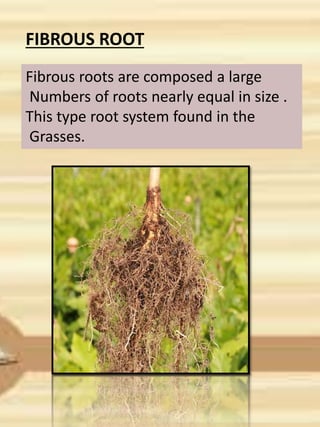
FIBROUS ROOT
Fibrous roots are composed a large
Numbers of roots nearly equal in size .
This type root system found in the
Grasses.
Root apex is sub terminal in position
because of terminal position of root cap.
Root apex is of few types depending on the
mode of origin of cap and relations
between histogens and primary tissue
regions of the root proper.
The following three theories of Root apex
organization are discussed below-
1. Apical CellTheory
2. HistogenTheory
3. Korper-KappeTheory.
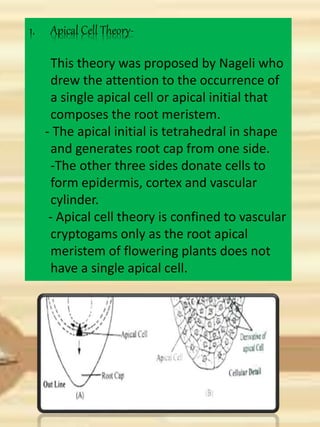
1. Apical Cell Theory-
This theory was proposed by Nageli who
drew the attention to the occurrence of
a single apical cell or apical initial that
composes the root meristem.
- The apical initial is tetrahedral in shape
and generates root cap from one side.
-The other three sides donate cells to
form epidermis, cortex and vascular
cylinder.
- Apical cell theory is confined to vascular
cryptogams only as the root apical
meristem of flowering plants does not
have a single apical cell.
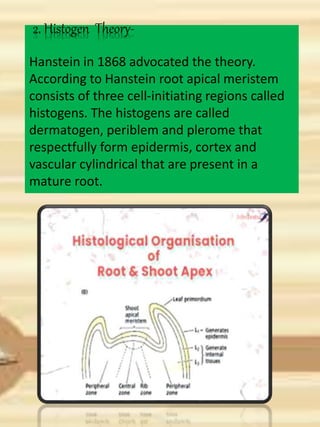
Hanstein in 1868 advocated the theory.
According to Hanstein root apical meristem
consists of three cell-initiating regions called
histogens. The histogens are called
dermatogen, periblem and plerome that
respectfully form epidermis, cortex and
vascular cylindrical that are present in a
mature root.
2. Histogen Theory-
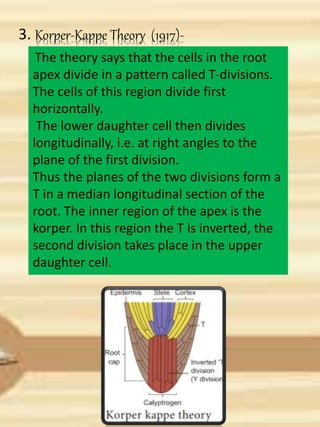
3. Korper-Kappe Theory (1917)-
The theory says that the cells in the root
apex divide in a pattern called T-divisions.
The cells of this region divide first
horizontally.
The lower daughter cell then divides
longitudinally, i.e. at right angles to the
plane of the first division.
Thus the planes of the two divisions form a
T in a median longitudinal section of the
root. The inner region of the apex is the
korper. In this region the T is inverted, the
second division takes place in the upper
daughter cell.
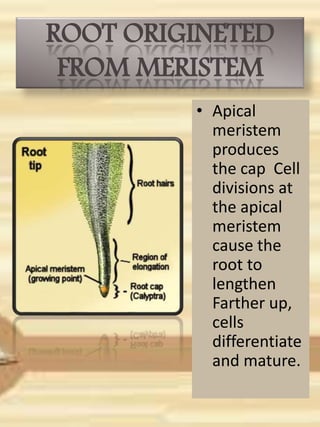
ROOT ORIGINETED
FROM MERISTEM
• Apical
meristem
produces
the cap Cell
divisions at
the apical
meristem
cause the
root to
lengthen
Farther up,
cells
differentiate
and mature.
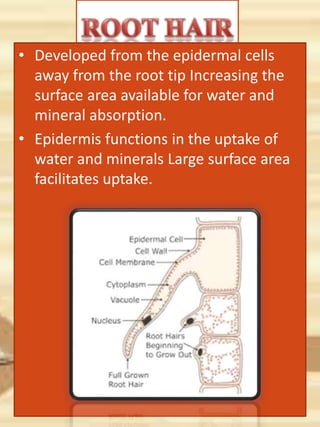
• Developed from the epidermal cells
away from the root tip Increasing the
surface area available for water and
mineral absorption.
• Epidermis functions in the uptake of
water and minerals Large surface area
facilitates uptake.
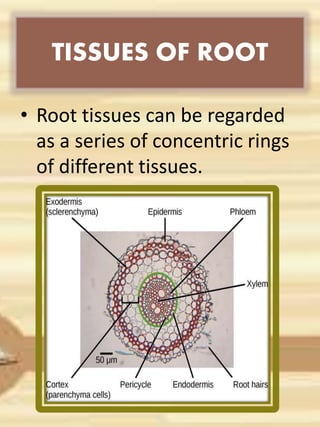
TISSUES OF ROOT
• Root tissues can be regarded
as a series of concentric rings
of different tissues.
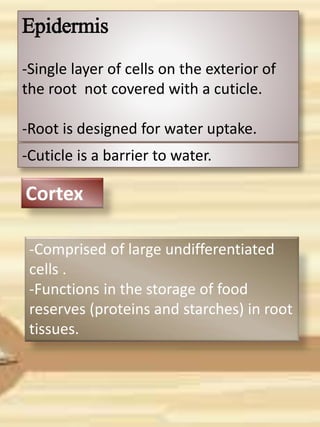
Epidermis
-Single layer of cells on the exterior of
the root not covered with a cuticle.
-Root is designed for water uptake.
-Cuticle is a barrier to water.
-Comprised of large undifferentiated
cells .
-Functions in the storage of food
reserves (proteins and starches) in root
tissues.
Cortex
Endodermis –
Single layer of cells outside
vascular system .Spaces between
the cells are covered with a waxy
layer, called suberin .
Blocks passage of water and
dissolved nutrients into the vascular
system .
Endodermis functions to regulate
the uptake of water and nutrients
into the plant.
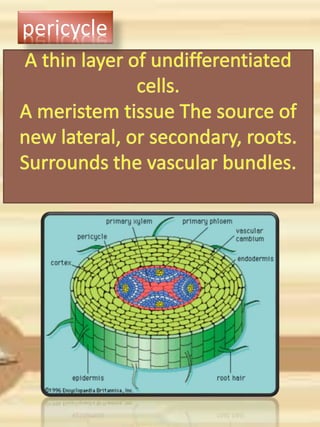
pericycle
•The transport system
1.Phloem –
Living cells comprised of seive tube
elements and companion cells.
2.Cambium –
A meristematic tissue supplying cells
that will develop into vascular
structures.
3.Xylem –
Dead cells with thickened cell walls,
typically larger than phloem cells.
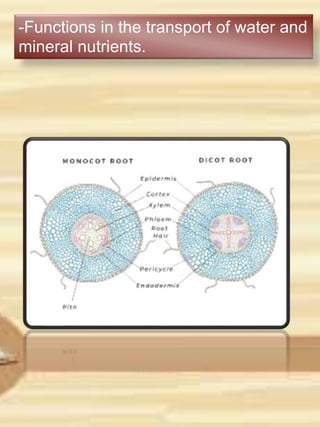
-Functions in the transport of water and
mineral nutrients.
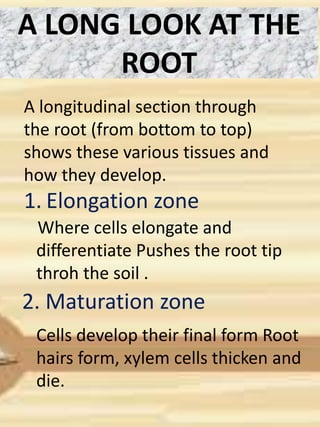
A LONG LOOK AT THE
ROOT
Where cells elongate and
differentiate Pushes the root tip
throh the soil .
A longitudinal section through
the root (from bottom to top)
shows these various tissues and
how they develop.
1. Elongation zone
2. Maturation zone
Cells develop their final form Root
hairs form, xylem cells thicken and
die.
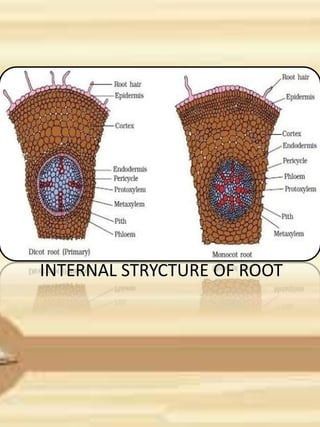
INTERNAL STRYCTURE OF ROOT
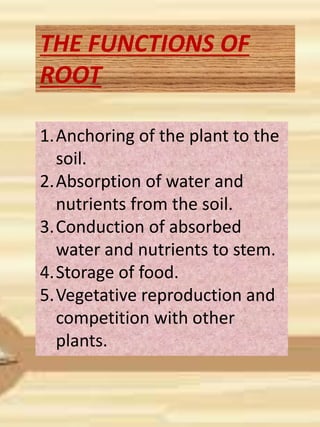
THE FUNCTIONS OF
ROOT
1.Anchoring of the plant to the
soil.
2.Absorption of water and
nutrients from the soil.
3.Conduction of absorbed
water and nutrients to stem.
4.Storage of food.
5.Vegetative reproduction and
competition with other
plants.
ROOT APEX

ROOT APEX

  • 2.
  • 3.
    1. Root isthe descending or underground part of the plant axis. 2. Root is usually cylindrical and non-green (lack chlorophylls), but sometimes green as in Trapa and Taeniophylum. 3. The growing point of root tip is sub- terminal and protected by a root cap or calyptra. 4. Unicellular root hairs present just behind the root caps which increase the absorptive surface area of roots. 5. Lateral roots are endogenous in origin i.e. arise from pericycle of the main root. - Root is usually positively geotropic (grows downward into the soil) and positively hydrotropic ( grows towards the source of water) but negatively phototropic . - Root does not bear nodes, internodes, leaves or buds (exceptions are sweet potato, wood apple etc.)
  • 4.
    TYPES OF ROOTS ONTHE BASIS OF THEIR ORIGIN ROOT ARE FOLLOWING TYPE – TAP ROOT - On germination of a seed, the radicle elongates into primary root or true root or tap root. In dicot plants, the tap root is persistent and produces lateral roots such as secondary’ roots, tertiary roots etc. - All lateral roots arise in acropetal succession i.e. younger roots towards apex and older roots towards base. The tap root and its branches constitute the tap root system.
  • 5.
    These are theroots that grow from any part of the plant other than radicle. In monocot plants, the tap root is short lived and soon replaced by adventitious roots. A group of adventitious roots and their branches constitute adventitious root system.
  • 6.
    FIBROUS ROOT Fibrous rootsare composed a large Numbers of roots nearly equal in size . This type root system found in the Grasses.
  • 7.
    Root apex issub terminal in position because of terminal position of root cap. Root apex is of few types depending on the mode of origin of cap and relations between histogens and primary tissue regions of the root proper. The following three theories of Root apex organization are discussed below- 1. Apical CellTheory 2. HistogenTheory 3. Korper-KappeTheory.
  • 8.
    1. Apical CellTheory- This theory was proposed by Nageli who drew the attention to the occurrence of a single apical cell or apical initial that composes the root meristem. - The apical initial is tetrahedral in shape and generates root cap from one side. -The other three sides donate cells to form epidermis, cortex and vascular cylinder. - Apical cell theory is confined to vascular cryptogams only as the root apical meristem of flowering plants does not have a single apical cell.
  • 9.
    Hanstein in 1868advocated the theory. According to Hanstein root apical meristem consists of three cell-initiating regions called histogens. The histogens are called dermatogen, periblem and plerome that respectfully form epidermis, cortex and vascular cylindrical that are present in a mature root. 2. Histogen Theory-
  • 10.
    3. Korper-Kappe Theory(1917)- The theory says that the cells in the root apex divide in a pattern called T-divisions. The cells of this region divide first horizontally. The lower daughter cell then divides longitudinally, i.e. at right angles to the plane of the first division. Thus the planes of the two divisions form a T in a median longitudinal section of the root. The inner region of the apex is the korper. In this region the T is inverted, the second division takes place in the upper daughter cell.
  • 11.
    ROOT ORIGINETED FROM MERISTEM •Apical meristem produces the cap Cell divisions at the apical meristem cause the root to lengthen Farther up, cells differentiate and mature.
  • 12.
    • Developed fromthe epidermal cells away from the root tip Increasing the surface area available for water and mineral absorption. • Epidermis functions in the uptake of water and minerals Large surface area facilitates uptake.
  • 13.
    TISSUES OF ROOT •Root tissues can be regarded as a series of concentric rings of different tissues.
  • 14.
    Epidermis -Single layer ofcells on the exterior of the root not covered with a cuticle. -Root is designed for water uptake. -Cuticle is a barrier to water. -Comprised of large undifferentiated cells . -Functions in the storage of food reserves (proteins and starches) in root tissues. Cortex
  • 15.
    Endodermis – Single layerof cells outside vascular system .Spaces between the cells are covered with a waxy layer, called suberin . Blocks passage of water and dissolved nutrients into the vascular system . Endodermis functions to regulate the uptake of water and nutrients into the plant.
  • 16.
  • 17.
    •The transport system 1.Phloem– Living cells comprised of seive tube elements and companion cells. 2.Cambium – A meristematic tissue supplying cells that will develop into vascular structures. 3.Xylem – Dead cells with thickened cell walls, typically larger than phloem cells.
  • 18.
    -Functions in thetransport of water and mineral nutrients.
  • 19.
    A LONG LOOKAT THE ROOT Where cells elongate and differentiate Pushes the root tip throh the soil . A longitudinal section through the root (from bottom to top) shows these various tissues and how they develop. 1. Elongation zone 2. Maturation zone Cells develop their final form Root hairs form, xylem cells thicken and die.
  • 20.
  • 21.
    THE FUNCTIONS OF ROOT 1.Anchoringof the plant to the soil. 2.Absorption of water and nutrients from the soil. 3.Conduction of absorbed water and nutrients to stem. 4.Storage of food. 5.Vegetative reproduction and competition with other plants.