EUPHORBIACEAE
Chandresh M Thakor.
MUIS_Msc_Botany
Semester_02
Enrollment number_22064601007
CLASSIFICATION –BENTHAM AND HOOKER
 Kingdom : Plantae

 Class : Dicotyledons

 Subclass : Monochlamydae

 Series : Unisexual

 Family : Euphorbiaceae
IDENTIFICATION OF CLASSIFICATION
1.Class:Dicotyledons
•Venation reticulate
•Flowers pentamerous.
2.subclass:Monochlamydeae
•Flowers usually with one whorl
of parienth.
CONTINUE......
3.Series:Unisexuales
• Flowers unisexual.
• Perianth much reduced or absent.
• Ovules 1 to 2 per carpel.
4.Family:Euphorbiaceae
• Alternate leaves.
• Stamens 1 to indefinite (free or united).
• Gynoecium tricarpellary
• Ovary superior.
GENERAL CHARACTER
There are about 283 genera and 7,300
species in this family.
• Habit
•The plants exhibit great variation in their habit.
•The plants may be herbs, shrubs or trees.
• Root
•Tap root , branched.d branched
CONTINUE......
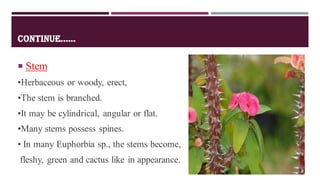
 Stem
•Herbaceous or woody, erect,
•The stem is branched.
•It may be cylindrical, angular or flat.
•Many stems possess spines.
• In many Euphorbia sp., the stems become,
fleshy, green and cactus like in appearance.
CONTINUE......
 Leaves
•The arrangement is usually alternate but,
sometimes they are opposite
• In many Euphorbias the leaves are
scaly and caducous.
•In many Euphorbia sp., they are
represented
by glands or spines.
CONTINUE.....
 Inflorescence:
•The inflorescence varies greatly.
•It may be racemose or cymose or
sometimes complex.
 Flower:
• The flowers are incomplete, regular,
actinomorphic and hypogynous.
•The flowers are always unisexual.
CONTINUE.....
 Perianth:
•The perianth consists of 4 or 5 sepals or petals.
•The aestivation is valvate or imbricate.
•Occasionally, both calyx and corolla are present,
e.g., Croton.
•. In majority of cases either calyx or corolla or
both are absent.
• In Ricinus communis the calyx is present and
the corolla absent.
CONTINUE.....
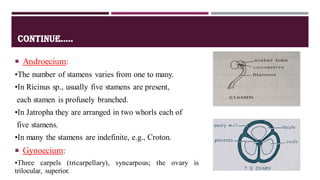
 Androecium:
•The number of stamens varies from one to many.
•In Ricinus sp., usually five stamens are present,
each stamen is profusely branched.
•In Jatropha they are arranged in two whorls each of
five stamens.
•In many the stamens are indefinite, e.g., Croton.
 Gynoecium:
•Three carpels (tricarpellary), syncarpous; the ovary is
trilocular, superior.
CONTINUE.....
 Fruit:
•drupe fruit
•The fruits are schizocarpic.
 Seeds:
•The seed is endospermic.
 Pollination:
 Usually entomophilous, i.e., through
the agency of insects. Only cross-
pollination takes place.
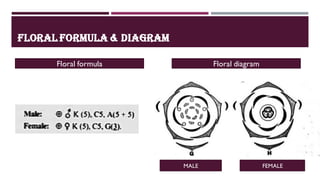
FLORAL FORMULA & DIAGRAM
Floral formula Floral diagram
MALE FEMALE
ECONOMIC IMPORTANCE
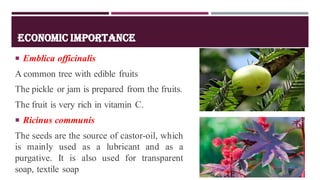
 Emblica officinalis
A common tree with edible fruits
The pickle or jam is prepared from the fruits.
The fruit is very rich in vitamin C.
 Ricinus communis
The seeds are the source of castor-oil, which
is mainly used as a lubricant and as a
purgative. It is also used for transparent
soap, textile soap
CONTINUE
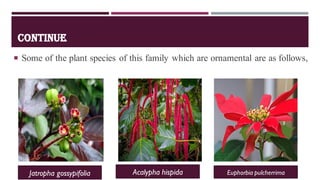
 Some of the plant species of this family which are ornamental are as follows,
Jatropha gossypifolia Acalypha hispida Euphorbia pulcherrima
EUPHORBIACEAE FAMILY PPT