TIMBER
STRUCTURE OF A TREE
A tree basically consist of three parts
- trunk
- crown
- roots
BY KIRTHIGA.E
From the visibility aspect ,trees are
divided into categories
1.MACROSTRUCTURE
2.MICROSTRUCTURE
 MACROSTRUCTURE:
 The structure of wood visible to the
naked eye or at a small magnification is
called the macrostructure.
 The components present in tree are as
follows:
1.Pith 2.Heart wood 3.Sap wood
4.Cambium layer 5.inner bark 6.Outer
bark 7.medullary rays.
PITH:
 The inner central portion central portion of
the tree is called pith or medulla.
 Varies in size and shape for different types
of trees.
 Consist of cellular tissues and nourishes the
plant in its young age.
 When they become old,pith dies up and
decays and the sap is then transmitted by
the woody fibres deposited roundthe pith.
HEART WOOD:
 The inner annual ring surrounding the
pith is the heart wood.
 Dark in colour.
 It indicates dead portion of a tree.
 It does not take active part in the growth
of a tree.
 It imparts rigidity to the tree and hence
provides strong and durable.
SAP WOOD:
 The outer annual rings between heart
wood and cambium layer is the sap wood.
 Light in colour and weight.
 Indicates growth and contains sap.
 Annual rings of sap wood are less sharply
defined than of heart wood.
 It takes active part in the growth of tree.
And sap moves upward direction.
 Also known as ALBURNUM.
CAMBIUM LAYER:
 The thin layer of sap between sap wood
and inner bark is the CAMBIUM LAYER.
 Indicates sap yet not been converted into
sap wood.
 If the bark is removed for any reason,this
layer get exposed and the cells resulting
in the death of tree.
INNER BARK:
 The inner skin covering the cambium
layer is known as the inner bark.
 It gives protection to the cambium
layer from any injury.
OUTER BARK:
 The outer skin of the tree is known as
the outer bark and also protective
layer.
 It contains cracks and fissures.
 It consist of cells of wood fibre,known
as cortex.
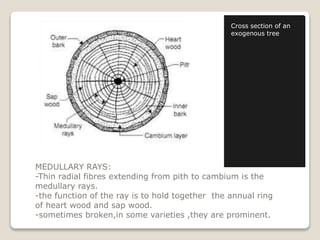
MEDULLARY RAYS:
-Thin radial fibres extending from pith to cambium is the
medullary rays.
-the function of the ray is to hold together the annual ring
of heart wood and sap wood.
-sometimes broken,in some varieties ,they are prominent.
Cross section of an
exogenous tree
Timber

Timber

  • 1.
    TIMBER STRUCTURE OF ATREE A tree basically consist of three parts - trunk - crown - roots BY KIRTHIGA.E
  • 2.
    From the visibilityaspect ,trees are divided into categories 1.MACROSTRUCTURE 2.MICROSTRUCTURE  MACROSTRUCTURE:  The structure of wood visible to the naked eye or at a small magnification is called the macrostructure.  The components present in tree are as follows: 1.Pith 2.Heart wood 3.Sap wood 4.Cambium layer 5.inner bark 6.Outer bark 7.medullary rays.
  • 3.
    PITH:  The innercentral portion central portion of the tree is called pith or medulla.  Varies in size and shape for different types of trees.  Consist of cellular tissues and nourishes the plant in its young age.  When they become old,pith dies up and decays and the sap is then transmitted by the woody fibres deposited roundthe pith.
  • 4.
    HEART WOOD:  Theinner annual ring surrounding the pith is the heart wood.  Dark in colour.  It indicates dead portion of a tree.  It does not take active part in the growth of a tree.  It imparts rigidity to the tree and hence provides strong and durable.
  • 5.
    SAP WOOD:  Theouter annual rings between heart wood and cambium layer is the sap wood.  Light in colour and weight.  Indicates growth and contains sap.  Annual rings of sap wood are less sharply defined than of heart wood.  It takes active part in the growth of tree. And sap moves upward direction.  Also known as ALBURNUM.
  • 6.
    CAMBIUM LAYER:  Thethin layer of sap between sap wood and inner bark is the CAMBIUM LAYER.  Indicates sap yet not been converted into sap wood.  If the bark is removed for any reason,this layer get exposed and the cells resulting in the death of tree.
  • 7.
    INNER BARK:  Theinner skin covering the cambium layer is known as the inner bark.  It gives protection to the cambium layer from any injury. OUTER BARK:  The outer skin of the tree is known as the outer bark and also protective layer.  It contains cracks and fissures.  It consist of cells of wood fibre,known as cortex.
  • 8.
    MEDULLARY RAYS: -Thin radialfibres extending from pith to cambium is the medullary rays. -the function of the ray is to hold together the annual ring of heart wood and sap wood. -sometimes broken,in some varieties ,they are prominent. Cross section of an exogenous tree