Building Structural System
                         (Timber)

Group Member:

LUKMAN ALHAKIM BIN MOHAMMAD KAMIL       2010770815
SYED ALWI BIN SYED SULAIMAN             2010938119
MUHAMMAD FARIS HADI BIN GHAZALI         2010933221
MUHAMMAD REDZUAN BIN ZULKIFLI           2010344265
MUSAHIDDIN BIN MD ZAINAL                2010740055
Introduction
                     
 Wood is a natural resource that is widely available throughout
  the world.
 With proper management, there is a potential for an endless
  supply of timber and other wood-based materials.
 Due to the low energy required and the low pollution during
  manufacture timber has a far less detrimental impact on the
  environment than other building materials.
 Timber is a live material. Its properties are anisotropic, they
  change with changes in environmental conditions and load
  duration has also a significant effect upon strength and
  deformation.
 To be able to design timber structures successfully, the
  practicing engineer needs to be aware of the particular
  properties of the timber being specified.
Introduction
                  
Benefits of Timber Framing:

1. Fast, efficient and cost effective
2. Flexible to add further extensions
3. Environmentally friendly
4. Hand crafted
5. Unique character
6. Buildings with an organic, natural, earthly charm
Introduction
          
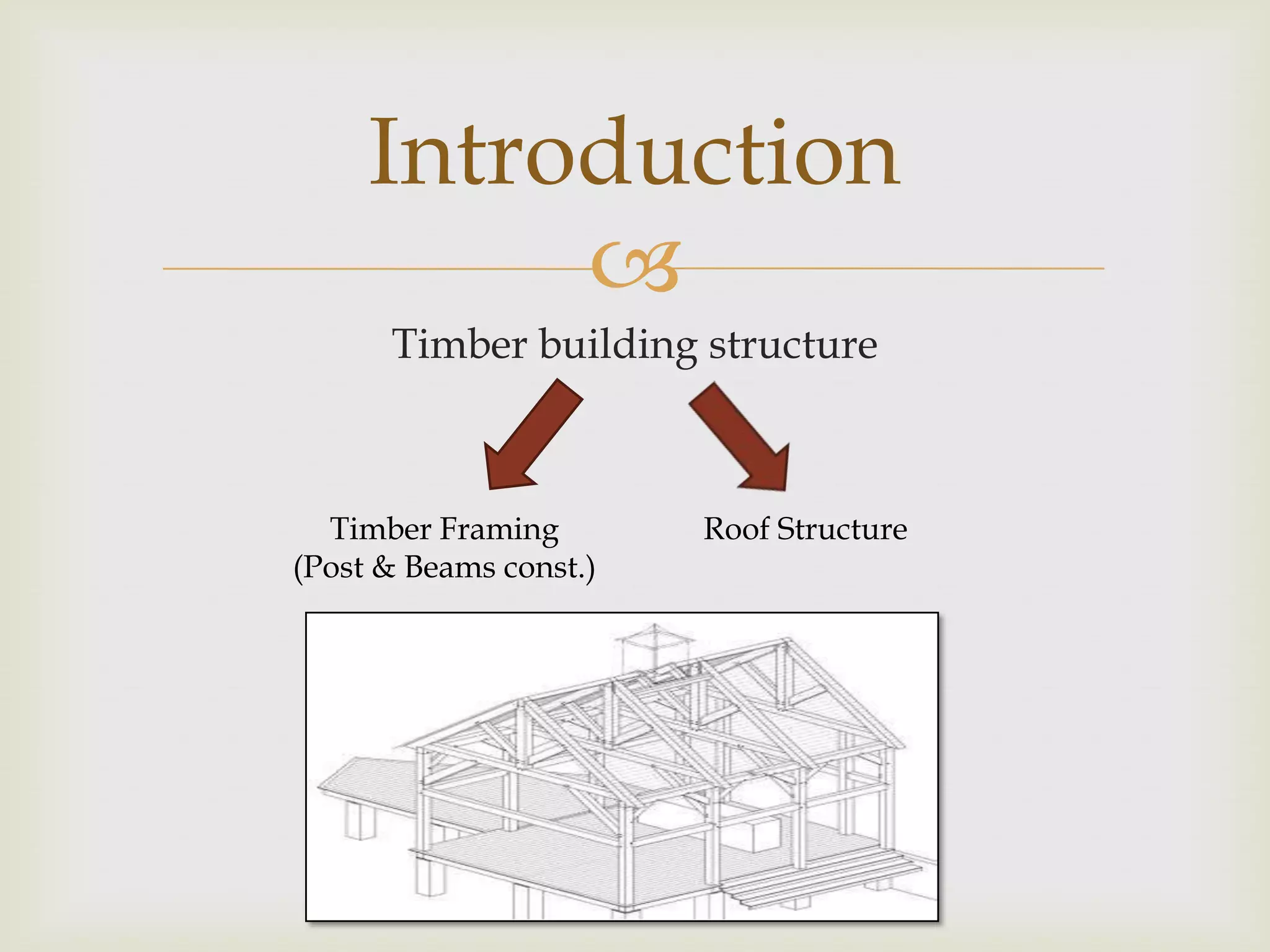
      Timber building structure


  Timber Framing        Roof Structure
(Post & Beams const.)
Timber as Structure
               
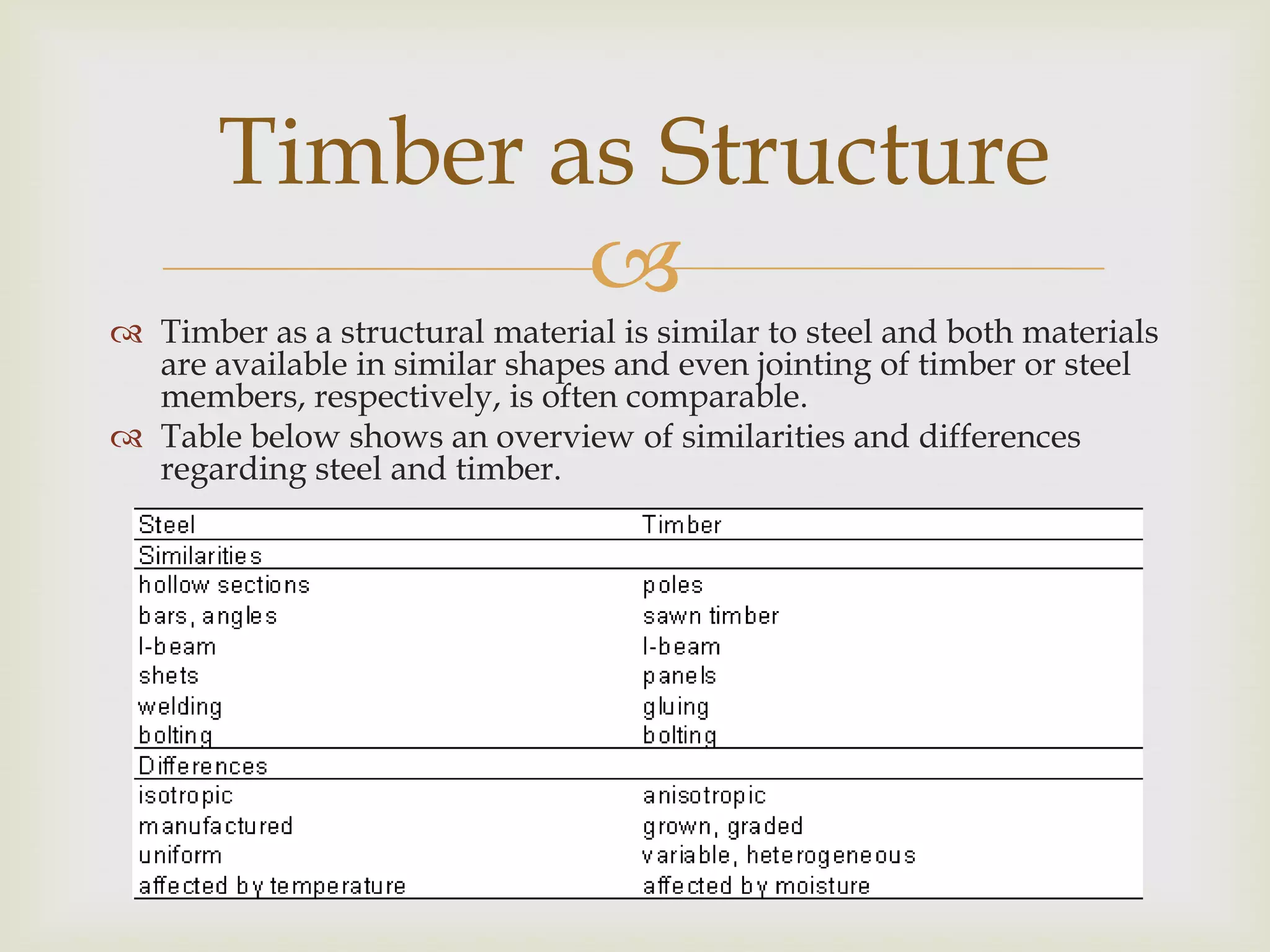
 Timber as a structural material is similar to steel and both materials
  are available in similar shapes and even jointing of timber or steel
  members, respectively, is often comparable.
 Table below shows an overview of similarities and differences
  regarding steel and timber.
Timber as Structure
              
 Timber members are particularly capable of acting as tension,
  compression and bending members.
 Compared to steel or concrete, the modulus of elasticity is low.
 The texture and appearance of timber makes it very suitable for
  use in visually exposed structures.
 The combination of steel and timber often produces light and
  competitive structures with timber as compression and steel as
  tension members.
 Most timber is found in buildings having a simple rectangular
  form used, for example, in floor joists, rafters and other roof
  components or for walls in timber framed housing, large
  structures can be built economically in other forms such as
  domes and examples exist spanning over 100 meters.
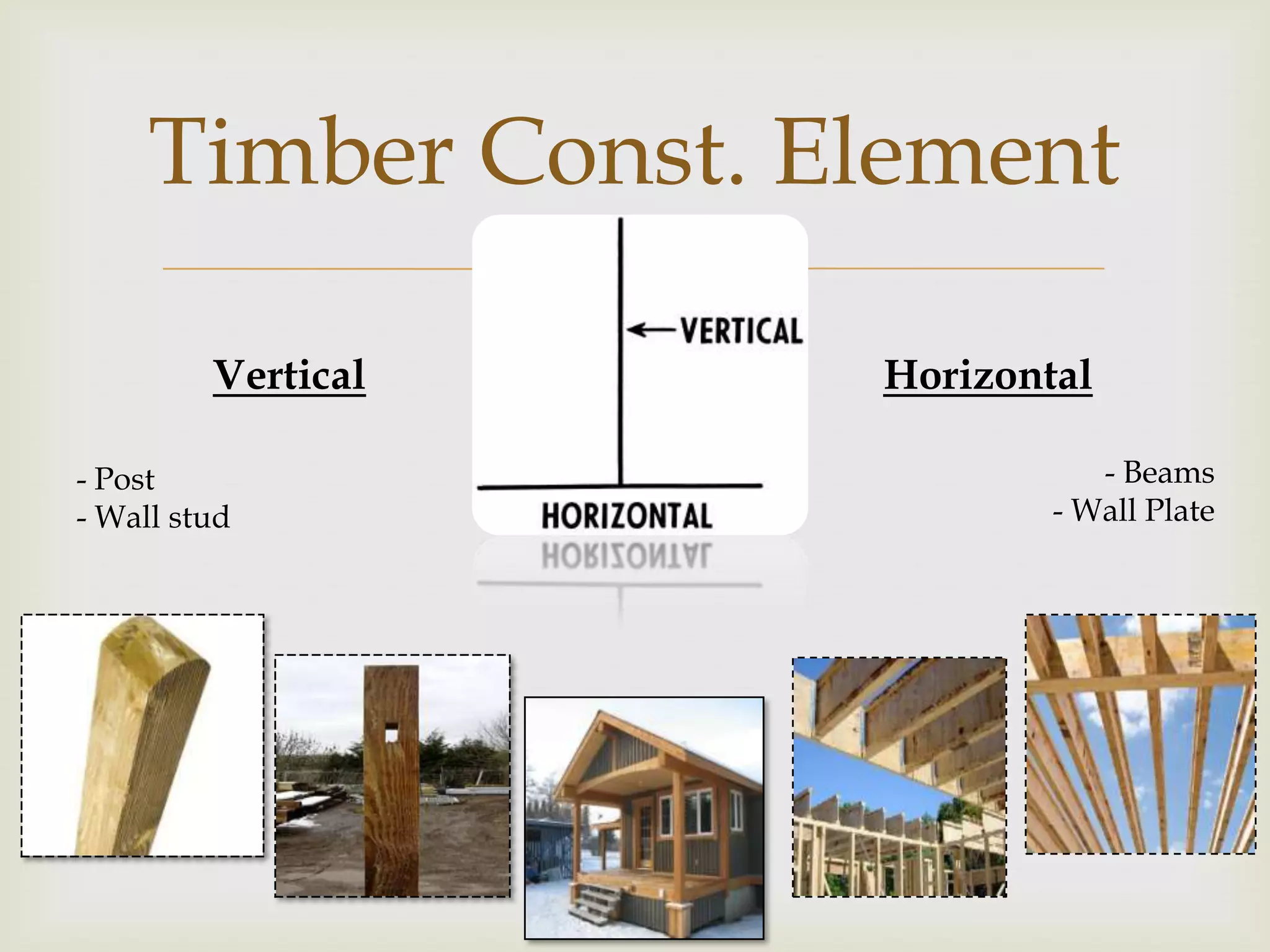
Timber Const. Element
              
         Vertical   Horizontal

- Post                         - Beams
- Wall stud                 - Wall Plate
Timber (Load)
                       
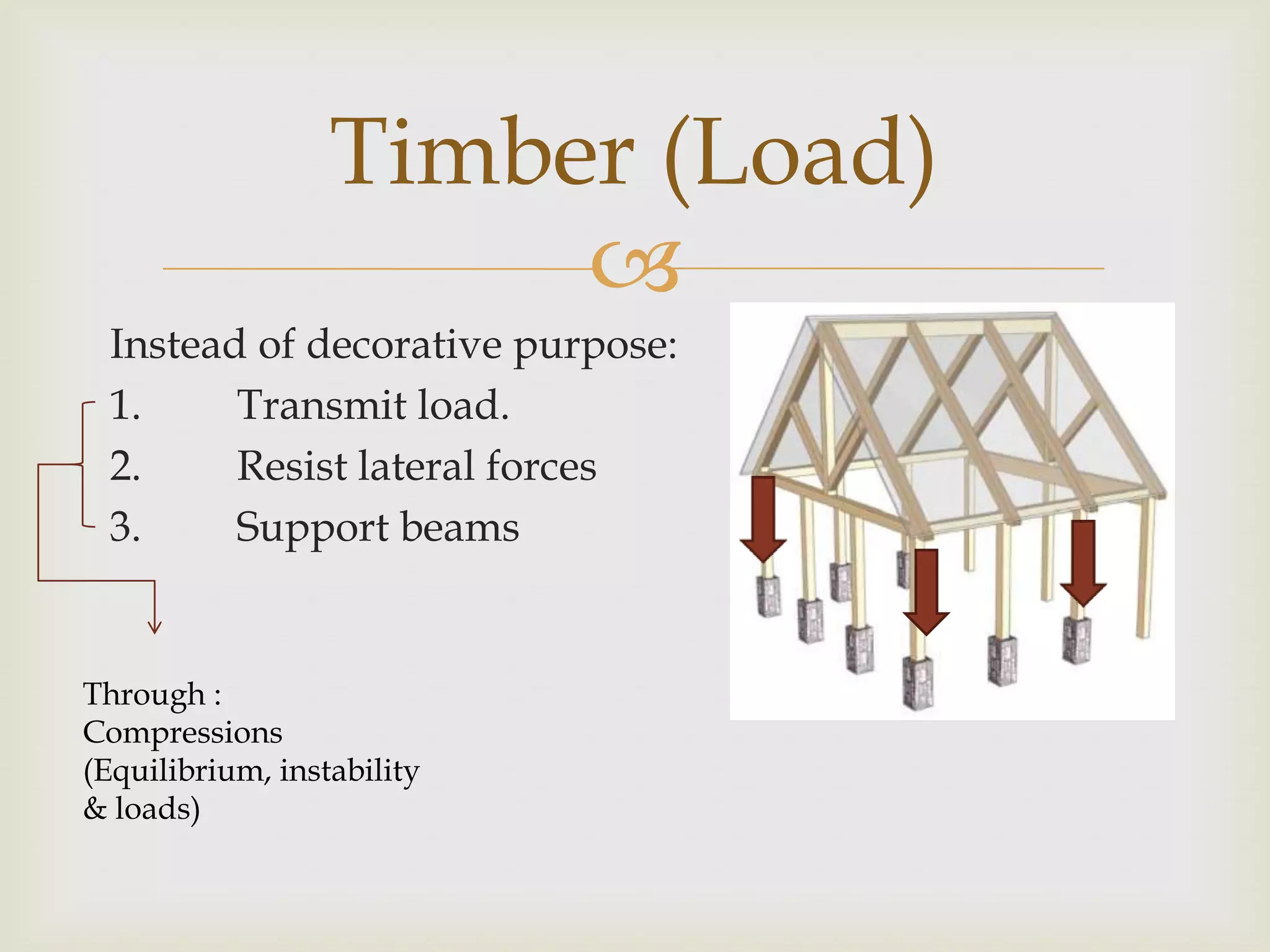
  Instead of decorative purpose:
  1.     Transmit load.
  2.     Resist lateral forces
  3.     Support beams


Through :
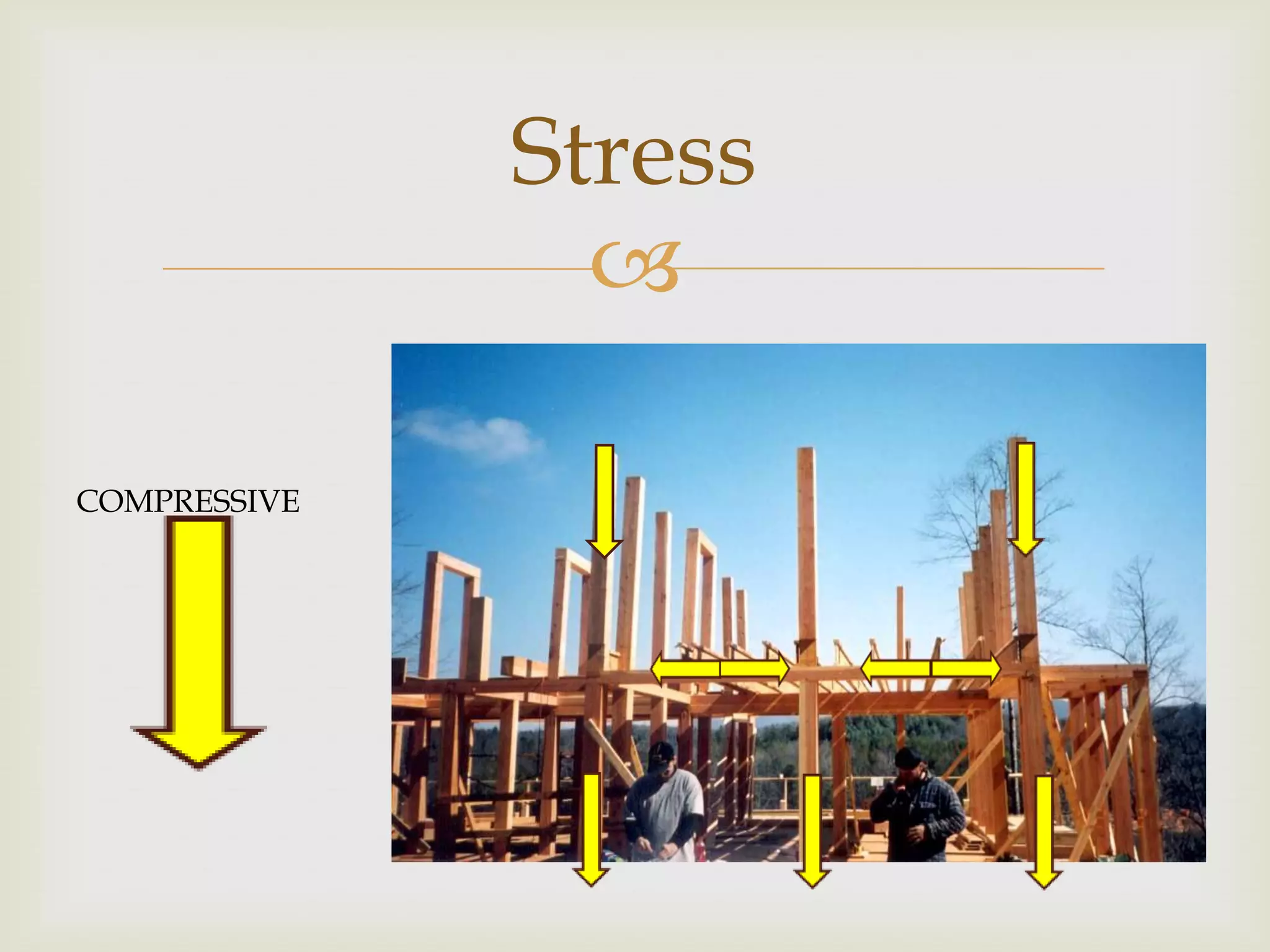
Compressions
(Equilibrium, instability
& loads)
Axial Load
                        
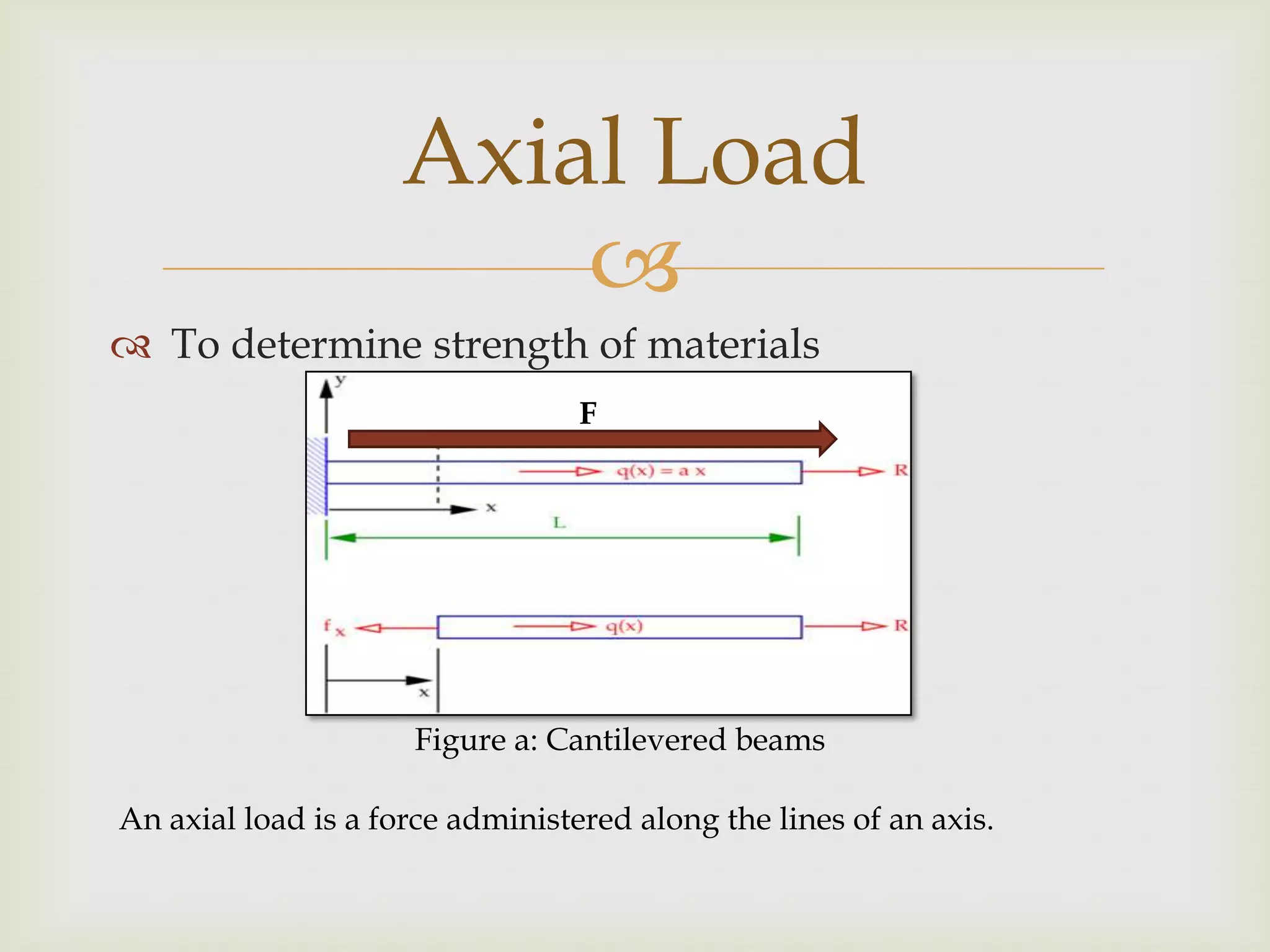
 To determine strength of materials
                                  F


                     Figure a: Cantilevered beams

An axial load is a force administered along the lines of an axis.
Stress
                

COMPRESSIVE
Stress (Calculation)
         

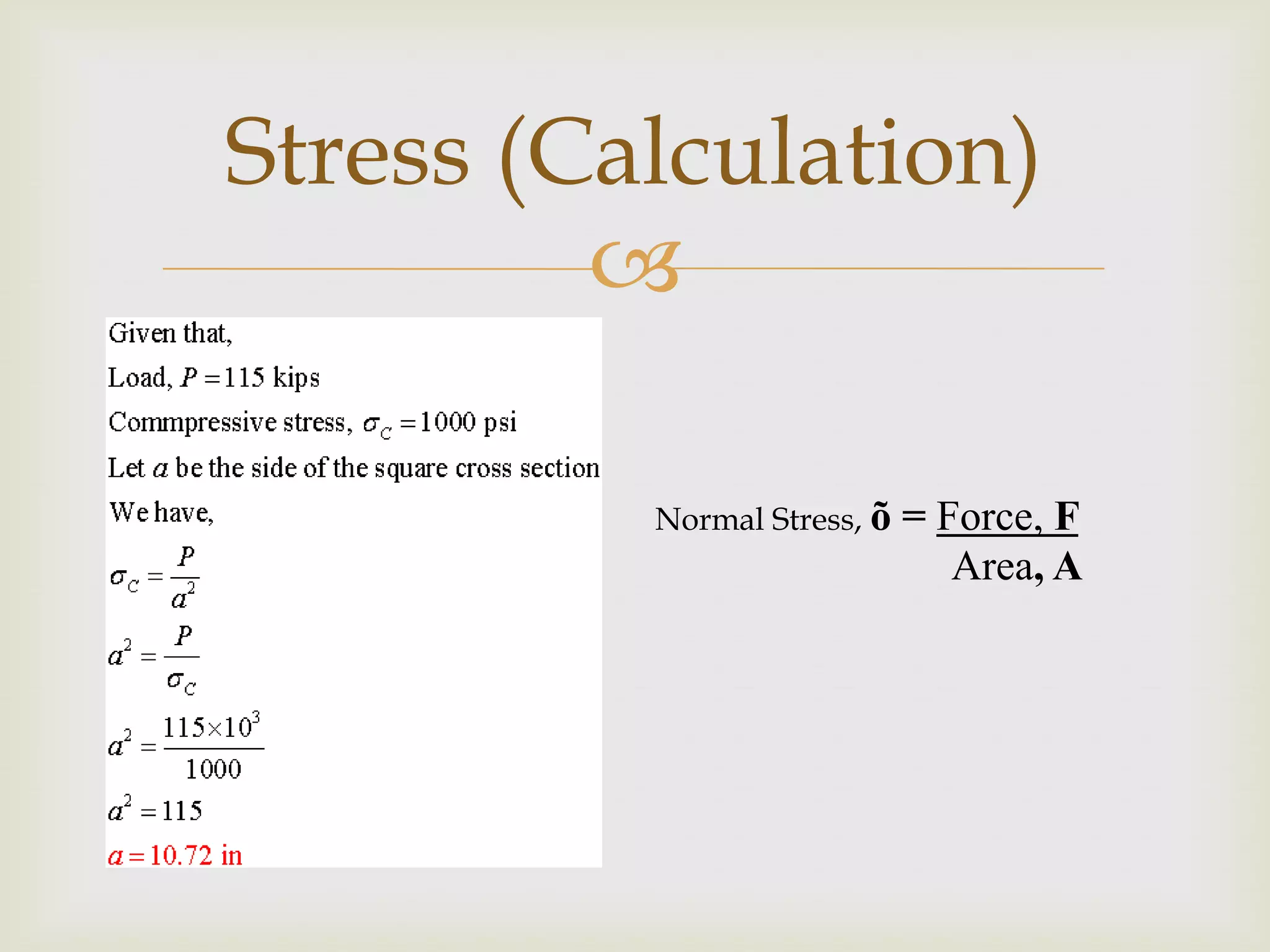
          Normal Stress, õ   = Force, F
                                Area, A
Deflection
                     
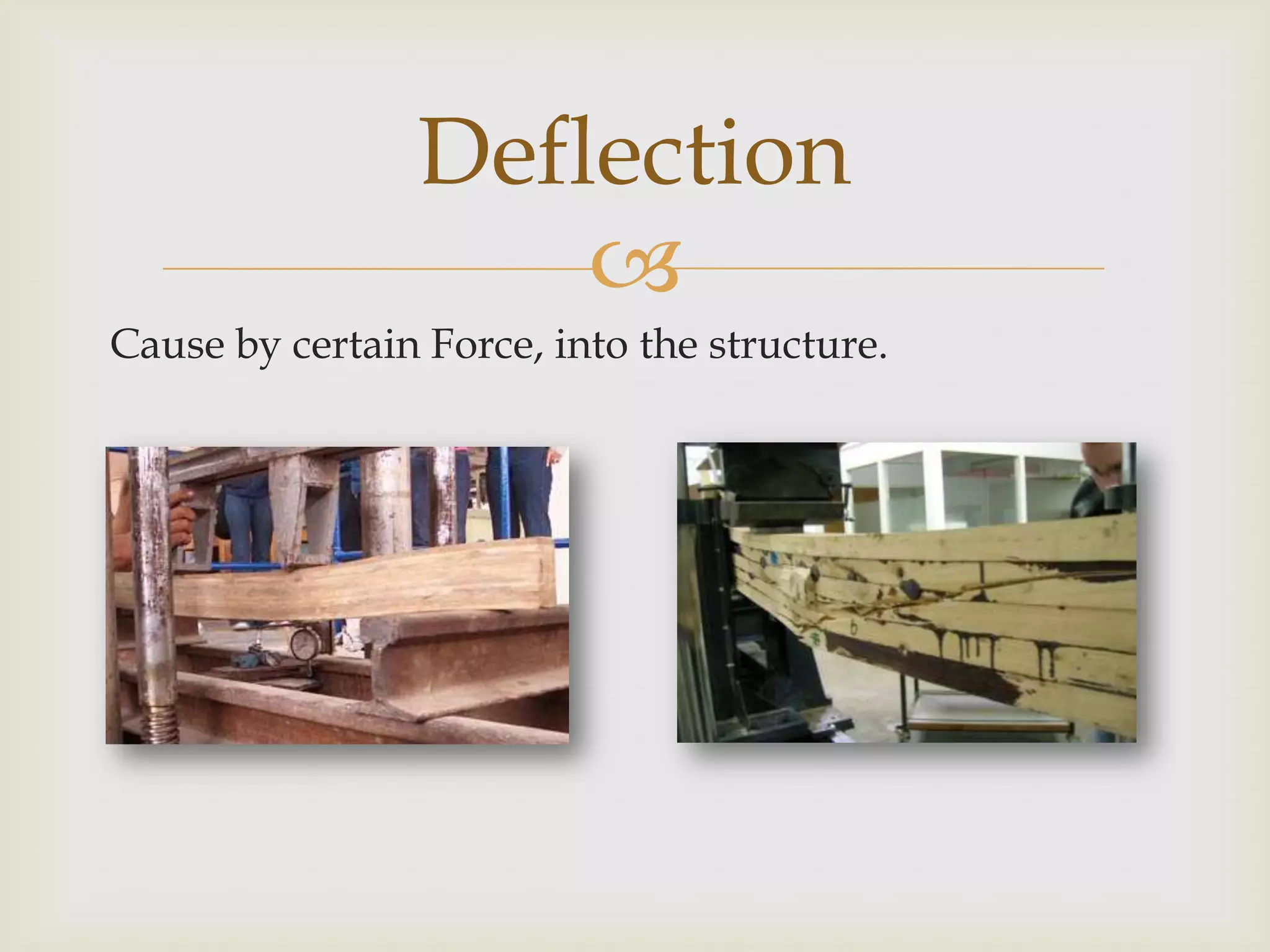
Cause by certain Force, into the structure.
Deflection
                        
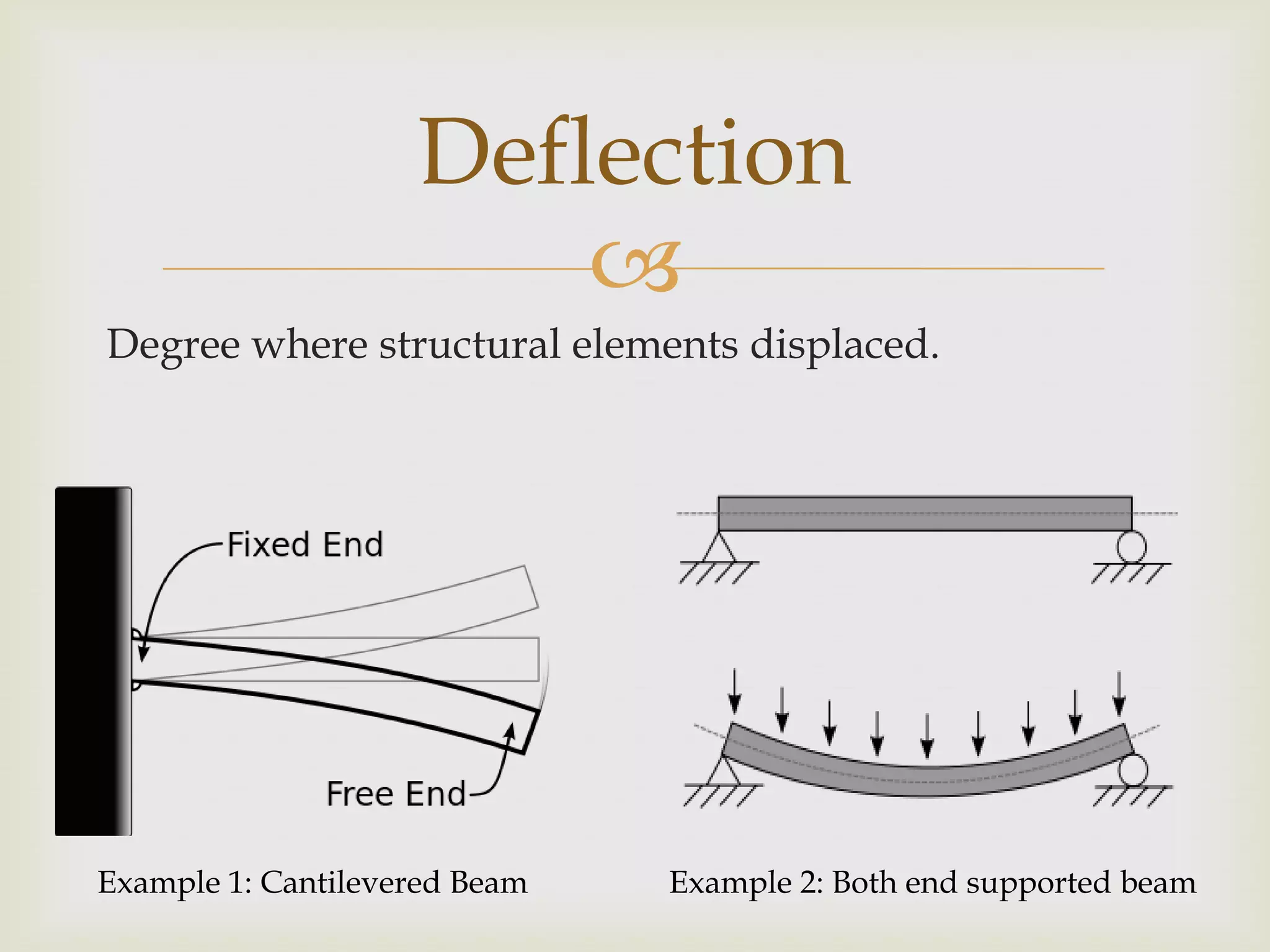
Degree where structural elements displaced.


Example 1: Cantilevered Beam   Example 2: Both end supported beam
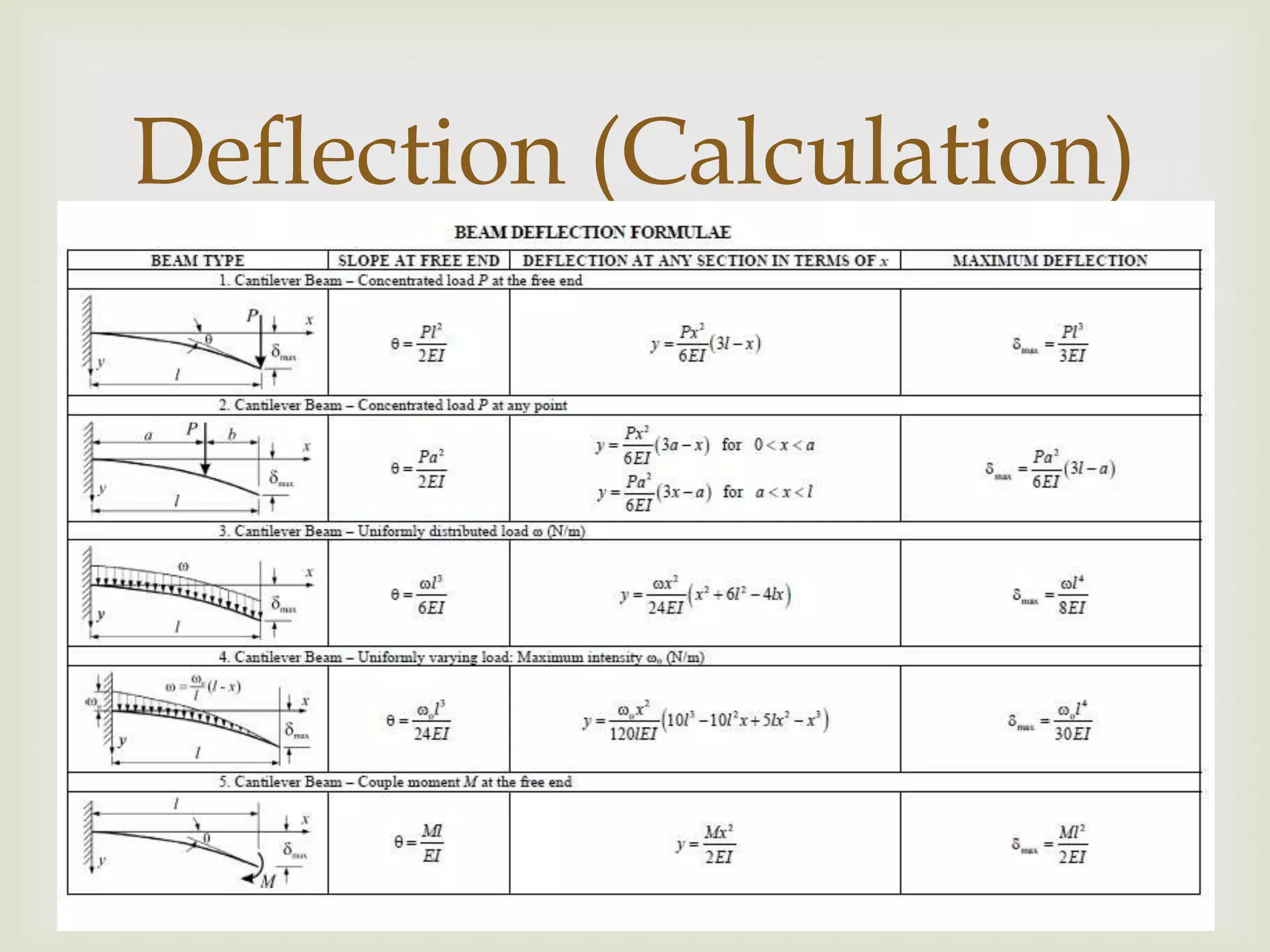
Deflection (Calculation)
           
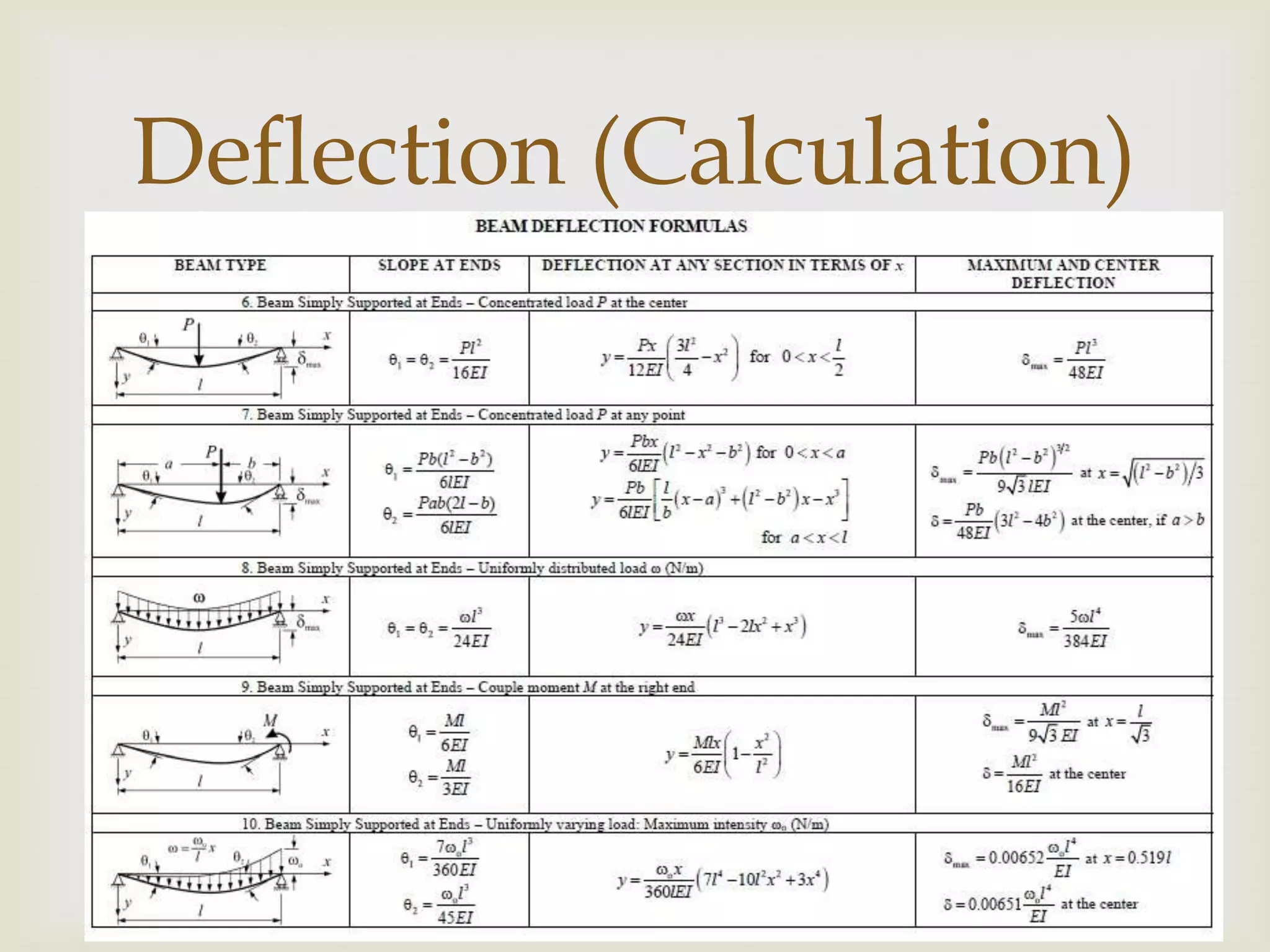
Deflection (Calculation)
           
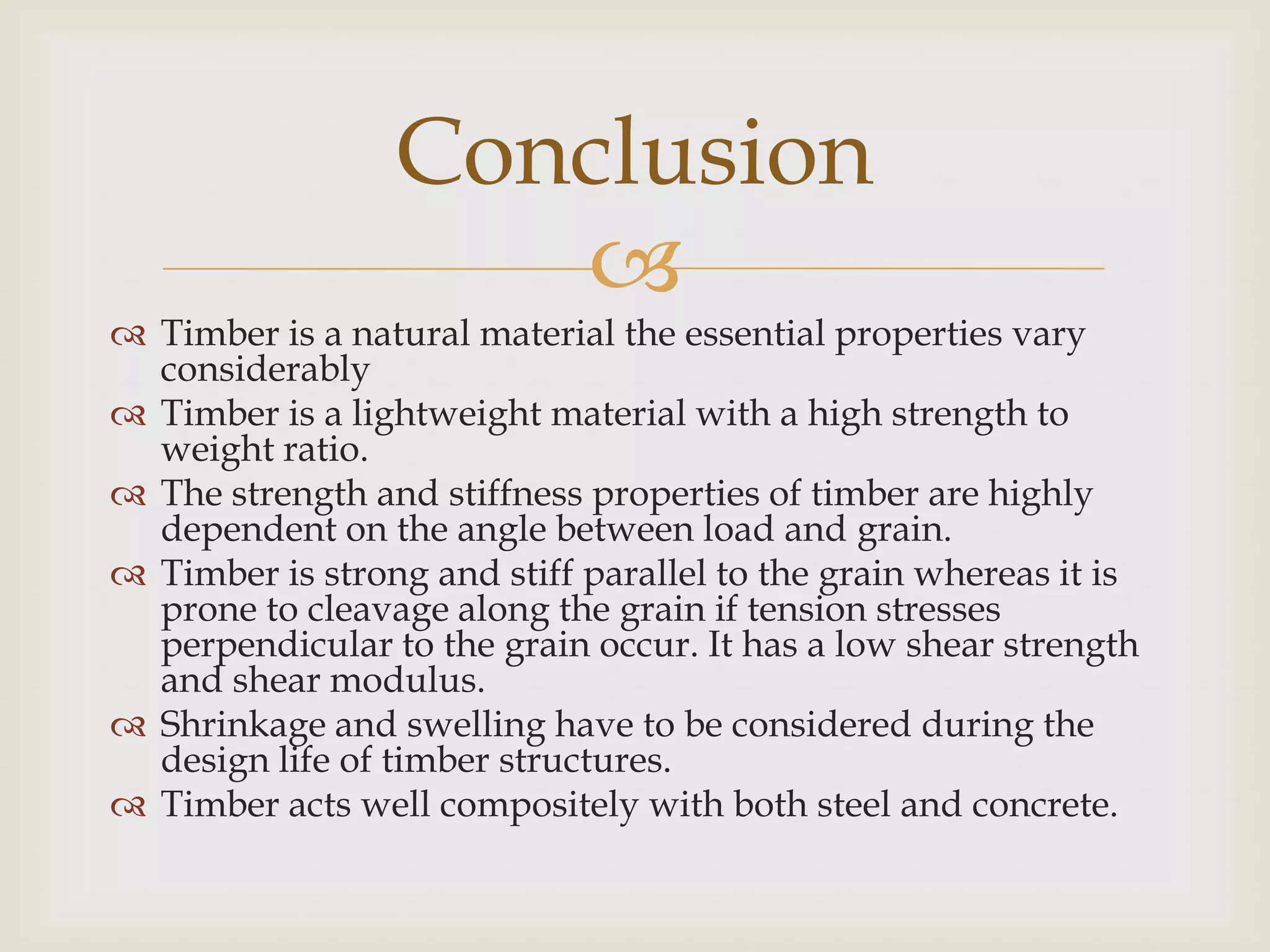
Conclusion
                    
 Timber is a natural material the essential properties vary
  considerably
 Timber is a lightweight material with a high strength to
  weight ratio.
 The strength and stiffness properties of timber are highly
  dependent on the angle between load and grain.
 Timber is strong and stiff parallel to the grain whereas it is
  prone to cleavage along the grain if tension stresses
  perpendicular to the grain occur. It has a low shear strength
  and shear modulus.
 Shrinkage and swelling have to be considered during the
  design life of timber structures.
 Timber acts well compositely with both steel and concrete.
References
                    
URL
 http://research.ttlchiltern.co.uk/pif306/pages/durability
  beta1.1/durability%20beta%201.1/step/a05/a5.htm
 http://en.wikipedia.org/wiki/Column
 http://www.engineeringcivil.com/what-is-the-stress-in-
  timber-beams.html
 http://en.wikipedia.org/wiki/Deflection_(engineering)
Books
 C.J.Mettem, Structural Timber Design and Technology


Thank
 You

Timber structure

  • 1.
    Building Structural System (Timber) Group Member: LUKMAN ALHAKIM BIN MOHAMMAD KAMIL 2010770815 SYED ALWI BIN SYED SULAIMAN 2010938119 MUHAMMAD FARIS HADI BIN GHAZALI 2010933221 MUHAMMAD REDZUAN BIN ZULKIFLI 2010344265 MUSAHIDDIN BIN MD ZAINAL 2010740055
  • 2.
    Introduction   Wood is a natural resource that is widely available throughout the world.  With proper management, there is a potential for an endless supply of timber and other wood-based materials.  Due to the low energy required and the low pollution during manufacture timber has a far less detrimental impact on the environment than other building materials.  Timber is a live material. Its properties are anisotropic, they change with changes in environmental conditions and load duration has also a significant effect upon strength and deformation.  To be able to design timber structures successfully, the practicing engineer needs to be aware of the particular properties of the timber being specified.
  • 3.
    Introduction  Benefits of Timber Framing: 1. Fast, efficient and cost effective 2. Flexible to add further extensions 3. Environmentally friendly 4. Hand crafted 5. Unique character 6. Buildings with an organic, natural, earthly charm
  • 4.
    Introduction  Timber building structure Timber Framing Roof Structure (Post & Beams const.)
  • 5.
    Timber as Structure   Timber as a structural material is similar to steel and both materials are available in similar shapes and even jointing of timber or steel members, respectively, is often comparable.  Table below shows an overview of similarities and differences regarding steel and timber.
  • 6.
    Timber as Structure   Timber members are particularly capable of acting as tension, compression and bending members.  Compared to steel or concrete, the modulus of elasticity is low.  The texture and appearance of timber makes it very suitable for use in visually exposed structures.  The combination of steel and timber often produces light and competitive structures with timber as compression and steel as tension members.  Most timber is found in buildings having a simple rectangular form used, for example, in floor joists, rafters and other roof components or for walls in timber framed housing, large structures can be built economically in other forms such as domes and examples exist spanning over 100 meters.
  • 7.
    Timber Const. Element  Vertical Horizontal - Post - Beams - Wall stud - Wall Plate
  • 8.
    Timber (Load)  Instead of decorative purpose: 1. Transmit load. 2. Resist lateral forces 3. Support beams Through : Compressions (Equilibrium, instability & loads)
  • 9.
    Axial Load   To determine strength of materials F Figure a: Cantilevered beams An axial load is a force administered along the lines of an axis.
  • 10.
    Stress  COMPRESSIVE
  • 11.
    Stress (Calculation)  Normal Stress, õ = Force, F Area, A
  • 12.
    Deflection  Cause by certain Force, into the structure.
  • 13.
    Deflection  Degree where structural elements displaced. Example 1: Cantilevered Beam Example 2: Both end supported beam
  • 14.
  • 15.
  • 16.
    Conclusion   Timber is a natural material the essential properties vary considerably  Timber is a lightweight material with a high strength to weight ratio.  The strength and stiffness properties of timber are highly dependent on the angle between load and grain.  Timber is strong and stiff parallel to the grain whereas it is prone to cleavage along the grain if tension stresses perpendicular to the grain occur. It has a low shear strength and shear modulus.  Shrinkage and swelling have to be considered during the design life of timber structures.  Timber acts well compositely with both steel and concrete.
  • 17.
    References  URL  http://research.ttlchiltern.co.uk/pif306/pages/durability beta1.1/durability%20beta%201.1/step/a05/a5.htm  http://en.wikipedia.org/wiki/Column  http://www.engineeringcivil.com/what-is-the-stress-in- timber-beams.html  http://en.wikipedia.org/wiki/Deflection_(engineering) Books  C.J.Mettem, Structural Timber Design and Technology
  • 18.