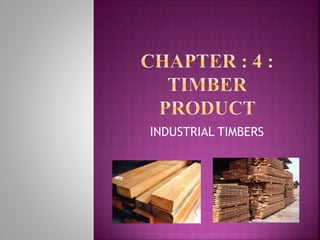
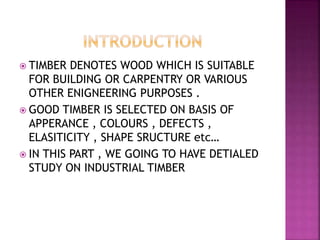
INDUSTRIAL TIMBERS
 TIMBER DENOTES WOOD WHICH IS SUITABLE
FOR BUILDING OR CARPENTRY OR VARIOUS
OTHER ENIGNEERING PURPOSES .
 GOOD TIMBER IS SELECTED ON BASIS OF
APPERANCE , COLOURS , DEFECTS ,
ELASITICITY , SHAPE SRUCTURE etc…
 IN THIS PART , WE GOING TO HAVE DETIALED
STUDY ON INDUSTRIAL TIMBER
 THE TIMBER WHICH IS PREPARED SCIENTIFICALLY IN A
FACTORY IS TERMED AS INDUSTRIAL TIMBER
 SUCH TIMBER POSSESSESS DESIRED SHAPE , APPERANCE ,
STRENGTH etc….
 Following are variety of industrial timber :
 VENEERS
 PLYWOOD
 FIBREBOARDS
 IMPREG BOARD
 COMPREG BOARD
 BLOCK BOARD AND LAMIN BOARD
 GLULAM
 FLUSHDOOR SHUTTERS
 PARTICLE BOARDOR CHIP BOARD
 HARDBOARD
 THESE ARE THIN SHEET OR SLICES OF WOOD OF
SUPERIOR QUALITY
 THICKNESS OF VENEERS VARIES FROM 0.40 mm to
6 mm
 Veneer is obtained either by "peeling" the trunk
of a tree or by slicing large rectangular blocks of
wood known as flitches. The appearance of the
grain and figure in wood comes from slicing
through the growth rings of a tree and depends
upon the angle at which the wood is sliced
 THEY ARE OBTAINED BY ROTATING A LOG OF
WOOD AGAINST A SHARP KNIFE OF ROTARY
CUTTER ORSAW
 THE VENEERS AFTER BEING REMOVED ARE DRIED
IN KILNS TO REMOVE MOISTURE
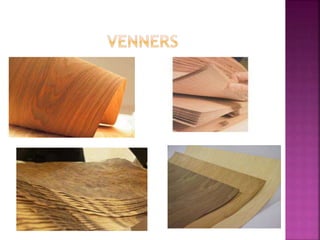
 There are a few types of veneers available,
each serving a particular purpose:
 Raw veneer
 Paper backed veneer
 Phenolic backed veneer
 Laid up veneer
 Reconstituted veneer
 ADVANTAGES OF THE VENEERS :
Furniture made with wood veneer uses less wood
than the same piece of furniture made with solid
wood. Some projects built using wood veneer
would not be possible to construct using solid
lumber, owing to expansion and contraction
caused by fluctuation of temperature and
humidity.
 USES OF VENEERS :
Veneer beading is a thin layer of
decorative edging placed around objects, such as
jewellery boxes. Veneer is also used to replace
decorative papers in Wood Veneer HPL. Veneer is
also a type of manufactured board.
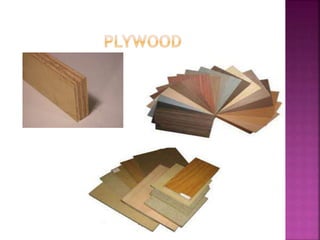
 The meaning of term ply is a thin layer .
 The plywood are boards which are prepared from
thin layer of wood or venners
 The three or more veneers in odd numbers are
placed one above the other with the direcation
of grains of successive layers at right angles to
each other
 When it glued pressure should be appied on
veneers.
 For hot pressure , hydradulic press is used .
Temp : 150-261 degree c
 For coldpressurse , pressure applied on plywood
varies from o.70 to 1.40 N/mm 2
 STRUCTURAL CHARACTERS OF PLYWOOD :
A typical plywood panel has face veneers of a
higher grade than the core veneers.
The principal function of the core layers is to
increase the separation between the outer layers
where the bending stresses are highest.
Bending stress decreases from the maximum at
the face layers to nearly zero at the central
layer.
Shear stress, by contrast, is higher in the center
of the panel, and zero at the outer fibers.
 SIZES OF PLYWOOD :
 The most commonly used thickness range is
from 0.14 to 3.0 in (0.36 to 7.6 cm). The sizes of
the most commonly used plywood sheets are 4
by 8 ft (1.2 by 2.4 m) or 3 by 6 ft (0.91 by 1.8
m). Width and length may vary in 1 ft (30 cm)
increments.
 In the United States, the most commonly used
size is 4 ft by 8 ft or 5 ft by 5 ft.
 Sizes on specialised plywood for concrete
forming range from 6 to 21 mm, and a multitude
of formats exist, though 15x750x1500mm is very
commonly used.
 The plywood are available in different commercial forms such as
BATTENBOARD
LAMINBOARD
MEATAL FACED PLYWOOD
MULTIPLY
THREE-PLY
VENEERED PLYWOOD
 The plywood is also classified on basis of purpose
SOFTWOOD PLYWOOD
HARDWOOD PLYWOOD
TROPICAL PLYWOOD
AIRCRAFT PLYWOOD
MARNINE PLYWOOD
FLEXIABLE PLYWOOD
SPECIAL PURPOSE PLY WOOD
DECRORATIVE PLYWOOD
 APPLICATION OF PLYWOOD
 Plywood is used in many applications that need
high-quality, high-strength sheet material.
 Exterior glued plywood is suitable for outdoor use,
but because moisture affects the strength of wood,
optimal performance is achieved in end uses where
the wood's moisture content remains relatively low.
 Plywood is also used as an engineering material for
stressed-skin applications.
 Plywood is often used to create curved surfaces
because it can easily bend with the grain. Skateboard
ramps often utilize plywood as the top smooth
surface over bent curves to create transition that can
simulate the shapes of ocean waves.
 These are rigid boards and they are also known
as the pressed wood or reconstructed wood
 The thickness varies from 3mm to 12mmm
 Length : 3m to 4.50 m
 Width 1.20 m to 1.80 m
 Weight limits are 9600N/m3 TO 500 N/m2
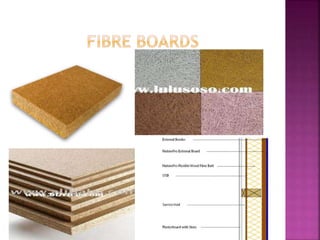
 Fibreboard is a type of engineered
wood product that is made out of wood fibres .
Types of fibreboard (in order of increasing
density) include particle board, medium-density
fibreboard, and hardboard. Fibreboard is
sometimes used as a synonym for particle board,
but particle board usually refers to low-density
fibreboard.
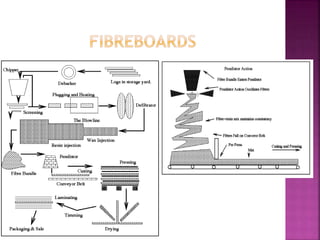
 MANUFACTURE PROCESS OF FIBRE BOARDS:
DEBARKING
CHIPPING
PULPING
THE BLOWLINE
MAT FORMATION
PRESSING
FINISHING
 DEPENDING UPON FORM AND COMPOSITION ,
THE FIBREBOARD ARE CLASSIFIED AS
INSULATING BOARD
MEDIUM HARD BOARD
HARD BOARDS
SUPER HARD BOARD AND LAMINATED
 Different uses and applications include:
sound proofing/deadening,
structural sheathing,
low-slope roofing,
sound deadening flooring underlayment,
 APPLICATION OF FIBRE BOADRS:
Fibreboard is often used to make furniture or
cabinets. It is an excellent material for
veneering, but also has a smooth surface that
holds paint well. Some homeowners may use
fibreboard panels in the home in place
of drywall, or in any other application that
calls for a hardboard wood product. This
material is not recommended for use in
exterior applications because it is vulnerable
to moisture and humidity.
 The timber which is fully or partly covered
with resin is know as the impreg timber
 Resin used : phenol formaldehyde
 Timber which has been made flame-
resistant, fungi-resistant, or insect-proof by
forcing into it under vacuum or pressure a
flame retardant or a fungal or insect poison.
 Trade names of impreg timber
formica
sungloss
sunmica
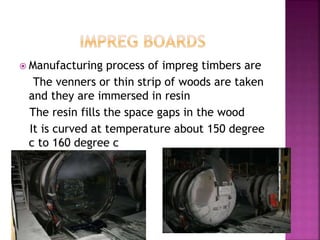
 Manufacturing process of impreg timbers are
The venners or thin strip of woods are taken
and they are immersed in resin
The resin fills the space gaps in the wood
It is curved at temperature about 150 degree
c to 160 degree c
 Classification impreg timber and their uses:
 Class A, EN 351 P8/HC4 - impregnation chemical
Tanalith E.
 Use in contact with land, water and concrete. Fence
posts, power poles and transmission lines, bridges,
boat fabrications, concrete constructions, railway
sleepers, and various other weather influenced
timber structures.
 Class AB; P8/HC3 EN 351 - impregnation chemical
Tanalith E.
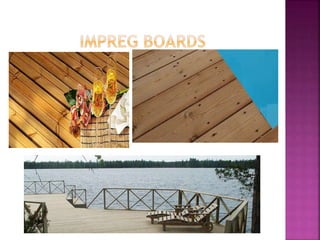
 Use of land and without water. The terrace tables,
boat bridges, scaffolds, weatherboard, wooden,
gazebo, noise barriers, handrails, fence boards,
garden furniture, children's playground. Tanalith E
concentration in the timber is below the Class A.
 Advantages of impreg boards :
 Not affected by moisture and weather
condition
 Strong and durable
 More electrical insulation
 Decent apperaance
 Resists acidic effects
 Free from pests and insects
 Processed wood whose cells are impregnated
with a resin and compressed, to reduce shrinking
and swelling and to increase density
and strength. This wood is called as compreg
timber
 The process of preparing compreg timbers is
same as the that of impreg timber except that
curing is carried out under pressure .
 The strength and durability of compreg timber
are more as compared impreg timber
 The sp. Gravity od compreg timber is 1.30 to
1.35
 Appilication of compreg timber :
 Moulds for molding techniques like, injection
molding, blow molding, transfer molding
rotational molding, casting, patterns, profiles,
extrude, die etc.
 used for making boxes for the heavy equipments,
electrical transformers, fish storage boxes,
marine decks & cabins etc. Compreg plywood
can be used for manufacturing of pallets for
industrial application and railway berths & seats
etc.
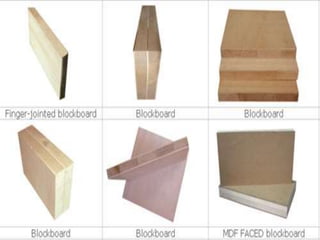
 Block boards are boards having a core made up of strips of
wood , each not exceeding 25 mm in width
 The edges are glued togather to form a sheet which is
finished with one or two cross bonded veneers
 Block board is composed of a core of softwood strips (up to
about 25mm wide) placed edge to edge and sandwiched
between veneers of hardwood, the 'sandwich' is then bonded
under high pressure.
 block boards are made in moisture resistant & boiling
water resistant grade. The wooden battens are seasoned in
scientifically run seasoning kiln plants and then get plain
with the four sider precision plainer to obtain the uniform
thickness of battens.
 These battens are systematically arranged and care is
taken to avoid any gap between the battens. Regular test
are conducted to maintain the quality of block boards as
per relevant standards.
Sizes:
Blockboard is sold in sheets of 2440 x 1220mm and are normally 30mm thick.
 Block board has a good resistance to warping if both sides are left natural or
painted/papered. If only one side is finished, then surface tensions build up
which will cause the sheet into a bend.
Application
 Furniture,
 Kitchen Cabinets,
 Partitions,
 Exteriors uses,
 Bank Counters,
 Ship Counters,
 Ship Cabinets,
 Wardrobes
 Construction,
 Packing
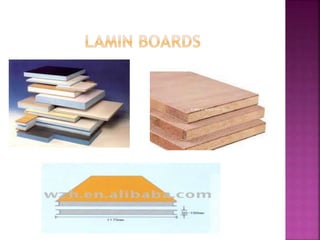
 When thickness of core strips does not exceed 7
mm , such boards are called as lamin boards
 Laminboard, also commonly known as
lumberboard, joinery board or blockboard,
consists of a central layer of edge-glued battens
of between 24 and 30 mm width, covered on
both sides with a facing veneer. 5-ply
blockboard/5-ply lumber-core has a double-layer
of veneer on each face for added strength.
Laminboard is a higher-grade variant of
blockboard in which the central core consists of
thinner 5-8mm battens or veneer arranged 'on
edge'.
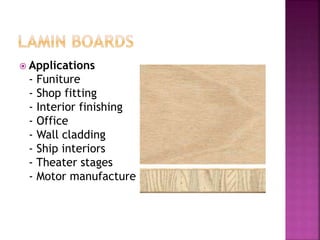
 Applications
- Funiture
- Shop fitting
- Interior finishing
- Office
- Wall cladding
- Ship interiors
- Theater stages
- Motor manufacture
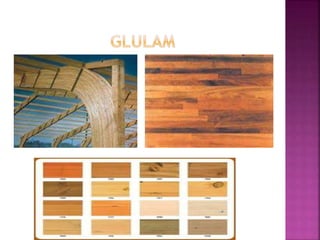
 IT means glued and laminated wood
 It is not made of veneers but with solid wood
 Glued laminated timber, also called Glulam, is
a type of structural timber product comprising a
number of layers of dimensioned timber bonded
together with durable, moisture-resistant
structural adhesives
 Glulam is readily produced in curved shapes and
it is available in a range of species and
appearance characteristics to meet varied end-
use requirements . Connections are usually made
with bolts or plain steel dowels and steel plates.
 Glulam provides the strength and versatility
of large wood members without relying on
the old growth-dependent solid-sawn
timbers. It reduces the overall amount of
wood used when compared to solid sawn
timbers by diminishing the negative impact
of knots and other small defects in each
component board.
 Glulam can be manufactured to a variety of
straight and curved configurations so it offers
architects artistic freedom without
sacrificing structural requirements
 Manufacturing process :
timber section are first dried in the kiln
machined to form interlocking v – cut across
the width
suitable glues are appiled and forced
togather under longitudinal pressure , while
glue curls
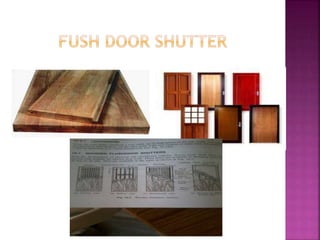
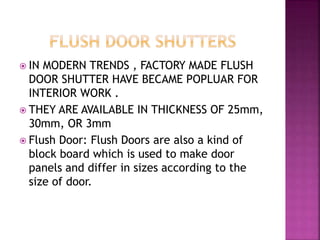
 IN MODERN TRENDS , FACTORY MADE FLUSH
DOOR SHUTTER HAVE BECAME POPLUAR FOR
INTERIOR WORK .
 THEY ARE AVAILABLE IN THICKNESS OF 25mm,
30mm, OR 3mm
 Flush Door: Flush Doors are also a kind of
block board which is used to make door
panels and differ in sizes according to the
size of door.
 SALIENT FEATURES:
 Manufacture in strict adherence to
IS:2202:1991
 Bonded with UPF Synthetic Resin adhesive to
make it Boiling Water Proof.
 Hot Pressed, Treated with chemical
Preservatives like Copper, Chromium &
Arsenic for better resistance to termite
attack.
 Hardwood Frame-cum Internal Lipping.
 Blockboard Construction, Dimensionally
stable & study.
 Magnus flush door are assembled with hard
wood which is known for its load bearing
capacity. Full size frames are used for better
strength. Both side lock rails are provided for
sufficient strength to the handles and knobs.
All core, battens and frames are treated with
special chemical, which makes the door
stable in case of borer and termite attack.
BWP grade PF resin is used during
manufacturing which provide long life to
doors in any climate.
 Application :
Ideal for external a well as internal door
shutter for all types of building, residence,
office, nursing home, auditoriums,
classrooms, hotels, schools, colleges,
barracks, hospitals etc.
 Different types of flush door shutters are
available in the market
 celluar core type
 Hollow core type
 Block board core type
 Particle or mdf board core type
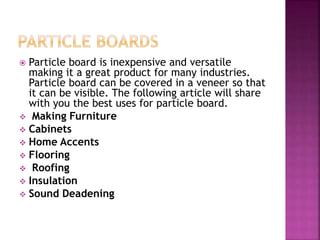
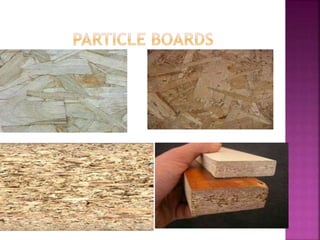
 Particle board, also known
as particleboard and chipboard, is
an engineered wood product manufactured
from wood chips, sawmill shavings, or
even saw dust, and a synthetic resin or other
suitable binder, which is pressed
and extruded. Particleboard is a composite
material.
 Particleboard is cheaper, denser and more
uniform than conventional wood
and plywood and is substituted for them
when appearance and strength are less
important than cost.
 Manufacturing process
 wooden particles or rise husk , embedded in
resin and subjected to heat with pressure .
 These boards are manufacturing by extrusion
pressing or pressing in parallel plates
 Four types of particle board :
FLAT PRESSED SINGLE LAYER BOARD
FLAT PRESSED THREE LAYER BOARD
EXTRUSION PRESSED SOLID BOARD
EXTRUSION PRESSED TUBULAR CORE
 Particle board is inexpensive and versatile
making it a great product for many industries.
Particle board can be covered in a veneer so that
it can be visible. The following article will share
with you the best uses for particle board.
 Making Furniture
 Cabinets
 Home Accents
 Flooring
 Roofing
 Insulation
 Sound Deadening
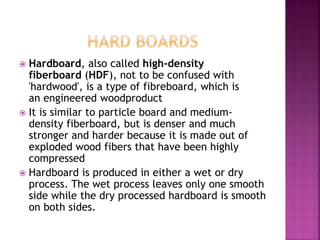
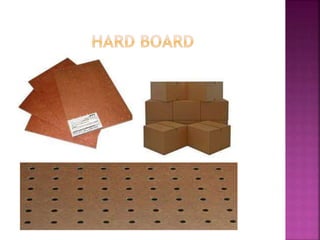
 Hardboard, also called high-density
fiberboard (HDF), not to be confused with
'hardwood', is a type of fibreboard, which is
an engineered woodproduct
 It is similar to particle board and medium-
density fiberboard, but is denser and much
stronger and harder because it is made out of
exploded wood fibers that have been highly
compressed
 Hardboard is produced in either a wet or dry
process. The wet process leaves only one smooth
side while the dry processed hardboard is smooth
on both sides.
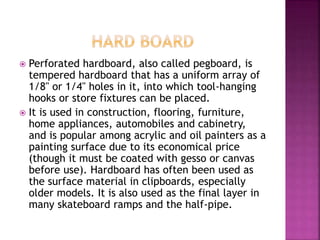
 Perforated hardboard, also called pegboard, is
tempered hardboard that has a uniform array of
1/8" or 1/4" holes in it, into which tool-hanging
hooks or store fixtures can be placed.
 It is used in construction, flooring, furniture,
home appliances, automobiles and cabinetry,
and is popular among acrylic and oil painters as a
painting surface due to its economical price
(though it must be coated with gesso or canvas
before use). Hardboard has often been used as
the surface material in clipboards, especially
older models. It is also used as the final layer in
many skateboard ramps and the half-pipe.
Industrial Timber.pptx

Industrial Timber.pptx

  • 1.
  • 2.
     TIMBER DENOTESWOOD WHICH IS SUITABLE FOR BUILDING OR CARPENTRY OR VARIOUS OTHER ENIGNEERING PURPOSES .  GOOD TIMBER IS SELECTED ON BASIS OF APPERANCE , COLOURS , DEFECTS , ELASITICITY , SHAPE SRUCTURE etc…  IN THIS PART , WE GOING TO HAVE DETIALED STUDY ON INDUSTRIAL TIMBER
  • 3.
     THE TIMBERWHICH IS PREPARED SCIENTIFICALLY IN A FACTORY IS TERMED AS INDUSTRIAL TIMBER  SUCH TIMBER POSSESSESS DESIRED SHAPE , APPERANCE , STRENGTH etc….  Following are variety of industrial timber :  VENEERS  PLYWOOD  FIBREBOARDS  IMPREG BOARD  COMPREG BOARD  BLOCK BOARD AND LAMIN BOARD  GLULAM  FLUSHDOOR SHUTTERS  PARTICLE BOARDOR CHIP BOARD  HARDBOARD
  • 4.
     THESE ARETHIN SHEET OR SLICES OF WOOD OF SUPERIOR QUALITY  THICKNESS OF VENEERS VARIES FROM 0.40 mm to 6 mm  Veneer is obtained either by "peeling" the trunk of a tree or by slicing large rectangular blocks of wood known as flitches. The appearance of the grain and figure in wood comes from slicing through the growth rings of a tree and depends upon the angle at which the wood is sliced  THEY ARE OBTAINED BY ROTATING A LOG OF WOOD AGAINST A SHARP KNIFE OF ROTARY CUTTER ORSAW  THE VENEERS AFTER BEING REMOVED ARE DRIED IN KILNS TO REMOVE MOISTURE
  • 5.
     There area few types of veneers available, each serving a particular purpose:  Raw veneer  Paper backed veneer  Phenolic backed veneer  Laid up veneer  Reconstituted veneer
  • 6.
     ADVANTAGES OFTHE VENEERS : Furniture made with wood veneer uses less wood than the same piece of furniture made with solid wood. Some projects built using wood veneer would not be possible to construct using solid lumber, owing to expansion and contraction caused by fluctuation of temperature and humidity.  USES OF VENEERS : Veneer beading is a thin layer of decorative edging placed around objects, such as jewellery boxes. Veneer is also used to replace decorative papers in Wood Veneer HPL. Veneer is also a type of manufactured board.
  • 8.
     The meaningof term ply is a thin layer .  The plywood are boards which are prepared from thin layer of wood or venners  The three or more veneers in odd numbers are placed one above the other with the direcation of grains of successive layers at right angles to each other  When it glued pressure should be appied on veneers.  For hot pressure , hydradulic press is used . Temp : 150-261 degree c  For coldpressurse , pressure applied on plywood varies from o.70 to 1.40 N/mm 2
  • 9.
     STRUCTURAL CHARACTERSOF PLYWOOD : A typical plywood panel has face veneers of a higher grade than the core veneers. The principal function of the core layers is to increase the separation between the outer layers where the bending stresses are highest. Bending stress decreases from the maximum at the face layers to nearly zero at the central layer. Shear stress, by contrast, is higher in the center of the panel, and zero at the outer fibers.
  • 10.
     SIZES OFPLYWOOD :  The most commonly used thickness range is from 0.14 to 3.0 in (0.36 to 7.6 cm). The sizes of the most commonly used plywood sheets are 4 by 8 ft (1.2 by 2.4 m) or 3 by 6 ft (0.91 by 1.8 m). Width and length may vary in 1 ft (30 cm) increments.  In the United States, the most commonly used size is 4 ft by 8 ft or 5 ft by 5 ft.  Sizes on specialised plywood for concrete forming range from 6 to 21 mm, and a multitude of formats exist, though 15x750x1500mm is very commonly used.
  • 11.
     The plywoodare available in different commercial forms such as BATTENBOARD LAMINBOARD MEATAL FACED PLYWOOD MULTIPLY THREE-PLY VENEERED PLYWOOD  The plywood is also classified on basis of purpose SOFTWOOD PLYWOOD HARDWOOD PLYWOOD TROPICAL PLYWOOD AIRCRAFT PLYWOOD MARNINE PLYWOOD FLEXIABLE PLYWOOD SPECIAL PURPOSE PLY WOOD DECRORATIVE PLYWOOD
  • 12.
     APPLICATION OFPLYWOOD  Plywood is used in many applications that need high-quality, high-strength sheet material.  Exterior glued plywood is suitable for outdoor use, but because moisture affects the strength of wood, optimal performance is achieved in end uses where the wood's moisture content remains relatively low.  Plywood is also used as an engineering material for stressed-skin applications.  Plywood is often used to create curved surfaces because it can easily bend with the grain. Skateboard ramps often utilize plywood as the top smooth surface over bent curves to create transition that can simulate the shapes of ocean waves.
  • 14.
     These arerigid boards and they are also known as the pressed wood or reconstructed wood  The thickness varies from 3mm to 12mmm  Length : 3m to 4.50 m  Width 1.20 m to 1.80 m  Weight limits are 9600N/m3 TO 500 N/m2  Fibreboard is a type of engineered wood product that is made out of wood fibres . Types of fibreboard (in order of increasing density) include particle board, medium-density fibreboard, and hardboard. Fibreboard is sometimes used as a synonym for particle board, but particle board usually refers to low-density fibreboard.
  • 15.
     MANUFACTURE PROCESSOF FIBRE BOARDS: DEBARKING CHIPPING PULPING THE BLOWLINE MAT FORMATION PRESSING FINISHING
  • 17.
     DEPENDING UPONFORM AND COMPOSITION , THE FIBREBOARD ARE CLASSIFIED AS INSULATING BOARD MEDIUM HARD BOARD HARD BOARDS SUPER HARD BOARD AND LAMINATED  Different uses and applications include: sound proofing/deadening, structural sheathing, low-slope roofing, sound deadening flooring underlayment,
  • 18.
     APPLICATION OFFIBRE BOADRS: Fibreboard is often used to make furniture or cabinets. It is an excellent material for veneering, but also has a smooth surface that holds paint well. Some homeowners may use fibreboard panels in the home in place of drywall, or in any other application that calls for a hardboard wood product. This material is not recommended for use in exterior applications because it is vulnerable to moisture and humidity.
  • 20.
     The timberwhich is fully or partly covered with resin is know as the impreg timber  Resin used : phenol formaldehyde  Timber which has been made flame- resistant, fungi-resistant, or insect-proof by forcing into it under vacuum or pressure a flame retardant or a fungal or insect poison.  Trade names of impreg timber formica sungloss sunmica
  • 21.
     Manufacturing processof impreg timbers are The venners or thin strip of woods are taken and they are immersed in resin The resin fills the space gaps in the wood It is curved at temperature about 150 degree c to 160 degree c
  • 22.
     Classification impregtimber and their uses:  Class A, EN 351 P8/HC4 - impregnation chemical Tanalith E.  Use in contact with land, water and concrete. Fence posts, power poles and transmission lines, bridges, boat fabrications, concrete constructions, railway sleepers, and various other weather influenced timber structures.  Class AB; P8/HC3 EN 351 - impregnation chemical Tanalith E.  Use of land and without water. The terrace tables, boat bridges, scaffolds, weatherboard, wooden, gazebo, noise barriers, handrails, fence boards, garden furniture, children's playground. Tanalith E concentration in the timber is below the Class A.
  • 23.
     Advantages ofimpreg boards :  Not affected by moisture and weather condition  Strong and durable  More electrical insulation  Decent apperaance  Resists acidic effects  Free from pests and insects
  • 25.
     Processed woodwhose cells are impregnated with a resin and compressed, to reduce shrinking and swelling and to increase density and strength. This wood is called as compreg timber  The process of preparing compreg timbers is same as the that of impreg timber except that curing is carried out under pressure .  The strength and durability of compreg timber are more as compared impreg timber  The sp. Gravity od compreg timber is 1.30 to 1.35
  • 26.
     Appilication ofcompreg timber :  Moulds for molding techniques like, injection molding, blow molding, transfer molding rotational molding, casting, patterns, profiles, extrude, die etc.  used for making boxes for the heavy equipments, electrical transformers, fish storage boxes, marine decks & cabins etc. Compreg plywood can be used for manufacturing of pallets for industrial application and railway berths & seats etc.
  • 28.
     Block boardsare boards having a core made up of strips of wood , each not exceeding 25 mm in width  The edges are glued togather to form a sheet which is finished with one or two cross bonded veneers  Block board is composed of a core of softwood strips (up to about 25mm wide) placed edge to edge and sandwiched between veneers of hardwood, the 'sandwich' is then bonded under high pressure.  block boards are made in moisture resistant & boiling water resistant grade. The wooden battens are seasoned in scientifically run seasoning kiln plants and then get plain with the four sider precision plainer to obtain the uniform thickness of battens.  These battens are systematically arranged and care is taken to avoid any gap between the battens. Regular test are conducted to maintain the quality of block boards as per relevant standards.
  • 29.
    Sizes: Blockboard is soldin sheets of 2440 x 1220mm and are normally 30mm thick.  Block board has a good resistance to warping if both sides are left natural or painted/papered. If only one side is finished, then surface tensions build up which will cause the sheet into a bend. Application  Furniture,  Kitchen Cabinets,  Partitions,  Exteriors uses,  Bank Counters,  Ship Counters,  Ship Cabinets,  Wardrobes  Construction,  Packing
  • 31.
     When thicknessof core strips does not exceed 7 mm , such boards are called as lamin boards  Laminboard, also commonly known as lumberboard, joinery board or blockboard, consists of a central layer of edge-glued battens of between 24 and 30 mm width, covered on both sides with a facing veneer. 5-ply blockboard/5-ply lumber-core has a double-layer of veneer on each face for added strength. Laminboard is a higher-grade variant of blockboard in which the central core consists of thinner 5-8mm battens or veneer arranged 'on edge'.
  • 32.
     Applications - Funiture -Shop fitting - Interior finishing - Office - Wall cladding - Ship interiors - Theater stages - Motor manufacture
  • 34.
     IT meansglued and laminated wood  It is not made of veneers but with solid wood  Glued laminated timber, also called Glulam, is a type of structural timber product comprising a number of layers of dimensioned timber bonded together with durable, moisture-resistant structural adhesives  Glulam is readily produced in curved shapes and it is available in a range of species and appearance characteristics to meet varied end- use requirements . Connections are usually made with bolts or plain steel dowels and steel plates.
  • 35.
     Glulam providesthe strength and versatility of large wood members without relying on the old growth-dependent solid-sawn timbers. It reduces the overall amount of wood used when compared to solid sawn timbers by diminishing the negative impact of knots and other small defects in each component board.  Glulam can be manufactured to a variety of straight and curved configurations so it offers architects artistic freedom without sacrificing structural requirements
  • 36.
     Manufacturing process: timber section are first dried in the kiln machined to form interlocking v – cut across the width suitable glues are appiled and forced togather under longitudinal pressure , while glue curls
  • 38.
     IN MODERNTRENDS , FACTORY MADE FLUSH DOOR SHUTTER HAVE BECAME POPLUAR FOR INTERIOR WORK .  THEY ARE AVAILABLE IN THICKNESS OF 25mm, 30mm, OR 3mm  Flush Door: Flush Doors are also a kind of block board which is used to make door panels and differ in sizes according to the size of door.
  • 39.
     SALIENT FEATURES: Manufacture in strict adherence to IS:2202:1991  Bonded with UPF Synthetic Resin adhesive to make it Boiling Water Proof.  Hot Pressed, Treated with chemical Preservatives like Copper, Chromium & Arsenic for better resistance to termite attack.  Hardwood Frame-cum Internal Lipping.  Blockboard Construction, Dimensionally stable & study.
  • 40.
     Magnus flushdoor are assembled with hard wood which is known for its load bearing capacity. Full size frames are used for better strength. Both side lock rails are provided for sufficient strength to the handles and knobs. All core, battens and frames are treated with special chemical, which makes the door stable in case of borer and termite attack. BWP grade PF resin is used during manufacturing which provide long life to doors in any climate.
  • 41.
     Application : Idealfor external a well as internal door shutter for all types of building, residence, office, nursing home, auditoriums, classrooms, hotels, schools, colleges, barracks, hospitals etc.  Different types of flush door shutters are available in the market  celluar core type  Hollow core type  Block board core type  Particle or mdf board core type
  • 43.
     Particle board,also known as particleboard and chipboard, is an engineered wood product manufactured from wood chips, sawmill shavings, or even saw dust, and a synthetic resin or other suitable binder, which is pressed and extruded. Particleboard is a composite material.  Particleboard is cheaper, denser and more uniform than conventional wood and plywood and is substituted for them when appearance and strength are less important than cost.
  • 44.
     Manufacturing process wooden particles or rise husk , embedded in resin and subjected to heat with pressure .  These boards are manufacturing by extrusion pressing or pressing in parallel plates  Four types of particle board : FLAT PRESSED SINGLE LAYER BOARD FLAT PRESSED THREE LAYER BOARD EXTRUSION PRESSED SOLID BOARD EXTRUSION PRESSED TUBULAR CORE
  • 45.
     Particle boardis inexpensive and versatile making it a great product for many industries. Particle board can be covered in a veneer so that it can be visible. The following article will share with you the best uses for particle board.  Making Furniture  Cabinets  Home Accents  Flooring  Roofing  Insulation  Sound Deadening
  • 47.
     Hardboard, alsocalled high-density fiberboard (HDF), not to be confused with 'hardwood', is a type of fibreboard, which is an engineered woodproduct  It is similar to particle board and medium- density fiberboard, but is denser and much stronger and harder because it is made out of exploded wood fibers that have been highly compressed  Hardboard is produced in either a wet or dry process. The wet process leaves only one smooth side while the dry processed hardboard is smooth on both sides.
  • 48.
     Perforated hardboard,also called pegboard, is tempered hardboard that has a uniform array of 1/8" or 1/4" holes in it, into which tool-hanging hooks or store fixtures can be placed.  It is used in construction, flooring, furniture, home appliances, automobiles and cabinetry, and is popular among acrylic and oil painters as a painting surface due to its economical price (though it must be coated with gesso or canvas before use). Hardboard has often been used as the surface material in clipboards, especially older models. It is also used as the final layer in many skateboard ramps and the half-pipe.