
1. Pith: It is the inner most part of the tree and therefore the oldest 
part of exogeneous tree when the plant becomes old, the pith dies 
and becomes and dark and fibrous. It varies in shape and size 
2. Heart Wood: It is the portion surrounding pith. It is strong and dark 
in color. This portion is useful for several engineering purpose. It is 
the dead part of wood. It consists of various annular rings. 
3. Sap Wood: It is the layer next to heart wood. It denotes contains 
sap and recent growth. It takes active part in the growth of trees by 
permitting sap to move in upward direction. Annual rings of sap 
wood are less sharply divided and are light in color. The sap wood is 
also called as alburnum. 
4. Cambium Layer: It is a thin layer of fresh sap lying among sap 
wood and the inner bark. It has sap which is not still converted into 
sap wood. If the bark is removed & cambium layer is exposed to 
atmosphere then cells cease to be active and tree dies. 
5. Inner Bark: It is a inner skin of tree defensive the cambium layer. It 
provides protection to cambium layer. 
6. Outer Bark: It is the outer skin of the tree and contain of wood 
fibres. Sometimes it contains cracks and fissures 
7. 7. Medullary Rags: These are thin radial fibers extending from 
pith to cambium layer. They together hold annular rings. In some of 
trees they are broken and some other they cannot be prominent
SEASONING 
1.ARTIFICIAL 
SEASONING 
2.NATURAL 
SEASONIG
(a) Boiling: In this technique timber is immersed in water and then water 
is boiled for 3 to 4 hours. Then slowly it is dried. Instead of boiling 
water hot steam can be circulated on timber. The procedure of 
seasoning is fast, but costly. 
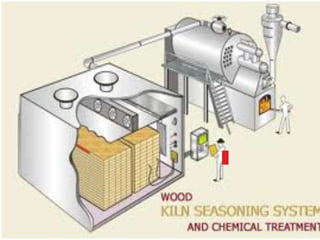
(c) Chemical Seasoning: In this technique, in a solution of suitable salt 
the timber is immersed .Then in a kiln the timber is dried. By chemical 
seasoning ensures uniform seasoning of outer and inner parts of 
timber. 
(d) Electrical Seasoning: In this technique through timber high frequency 
alternate electric current is passed Resistance to electric current is low. 
In timber is high when moisture content. The resistance reduces as 
moisture content reduces. Measure of resistance may be used to stop 
seasoning at appropriate level.
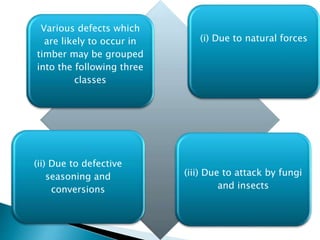
Various defects which 
are likely to occur in 
timber may be grouped 
into the following three 
classes 
(i) Due to natural forces 
(ii) Due to defective 
seasoning and 
conversions 
(iii) Due to attack by fungi 
and insects
(i) Defects due to Natural 
Forces: The following 
defects are caused by 
natural forces: 
(a) Knots (b) Shakes 
(c) Wind cracks (d) Upsets 
a) Knots 
c)Winds 
CRACKS 
and upset 
b)SHAKES
If seasoning is not uniform, the 
converted timber may warp and 
twist in various directions. 
Sometimes honey combining and 
even cracks appear. This type of 
defects are more susceptible in 
case of kiln seasoning.
Timber and its theory

Timber and its theory

  • 5.
    1. Pith: Itis the inner most part of the tree and therefore the oldest part of exogeneous tree when the plant becomes old, the pith dies and becomes and dark and fibrous. It varies in shape and size 2. Heart Wood: It is the portion surrounding pith. It is strong and dark in color. This portion is useful for several engineering purpose. It is the dead part of wood. It consists of various annular rings. 3. Sap Wood: It is the layer next to heart wood. It denotes contains sap and recent growth. It takes active part in the growth of trees by permitting sap to move in upward direction. Annual rings of sap wood are less sharply divided and are light in color. The sap wood is also called as alburnum. 4. Cambium Layer: It is a thin layer of fresh sap lying among sap wood and the inner bark. It has sap which is not still converted into sap wood. If the bark is removed & cambium layer is exposed to atmosphere then cells cease to be active and tree dies. 5. Inner Bark: It is a inner skin of tree defensive the cambium layer. It provides protection to cambium layer. 6. Outer Bark: It is the outer skin of the tree and contain of wood fibres. Sometimes it contains cracks and fissures 7. 7. Medullary Rags: These are thin radial fibers extending from pith to cambium layer. They together hold annular rings. In some of trees they are broken and some other they cannot be prominent
  • 8.
  • 14.
    (a) Boiling: Inthis technique timber is immersed in water and then water is boiled for 3 to 4 hours. Then slowly it is dried. Instead of boiling water hot steam can be circulated on timber. The procedure of seasoning is fast, but costly. (c) Chemical Seasoning: In this technique, in a solution of suitable salt the timber is immersed .Then in a kiln the timber is dried. By chemical seasoning ensures uniform seasoning of outer and inner parts of timber. (d) Electrical Seasoning: In this technique through timber high frequency alternate electric current is passed Resistance to electric current is low. In timber is high when moisture content. The resistance reduces as moisture content reduces. Measure of resistance may be used to stop seasoning at appropriate level.
  • 15.
    Various defects which are likely to occur in timber may be grouped into the following three classes (i) Due to natural forces (ii) Due to defective seasoning and conversions (iii) Due to attack by fungi and insects
  • 16.
    (i) Defects dueto Natural Forces: The following defects are caused by natural forces: (a) Knots (b) Shakes (c) Wind cracks (d) Upsets a) Knots c)Winds CRACKS and upset b)SHAKES
  • 21.
    If seasoning isnot uniform, the converted timber may warp and twist in various directions. Sometimes honey combining and even cracks appear. This type of defects are more susceptible in case of kiln seasoning.