This document has been scanned from hard-copy archives for research and study purposes. Please note
not all information may be current. We have tried, in preparing this copy, to make the content accessible to
the widest possible audience but in some cases we recognise that the automatic text recognition maybe
inadequate and we apologise in advance for any inconvenience this may cause.
TECHNICAL PUBLICATION
Published 1961 (Bulletin)
Revised 1964 (Technical Publication)
Revised 1974, 1977
Reprinted 1979, 1981, 1983
Revised 1987
ISBN 0 7240 2067 S
ISSN 0 1SS-7S48
Doe 811.5
Sapwood and Heartwood
by
R. K. Bamber
Sapwood
Transition
Zone
Heartwood
(b)
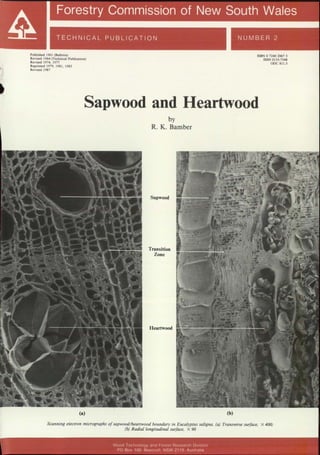
Scanning electron micrographs ofsapwood/heartwood boundary in Eucalyptus sa/igna. (a) Transverse surface. X 400;
(b) Radial longitudinal surface. X 90

Wood Technology and Forest Research Division '
, PO Box 100 Beec roll. NSW 2119 Australia I
I .___ _ _ . .
In most trees two types of wood can be recognised,
sapwood and heartwood. Sapwood is the outer, pale-
coloured wood and heartwood the inner, mostly darker,
wood. Because of its susceptibility to fungi and wood
destroying insects and lack of colour, sapwood is
generally considered inferior to heartwood and is often
discarded during conversion.
However, by use of the appropriate preservative
treatment, sapwood can be made equal if not superior to
heartwood of the same species in durability, thus
reducing waste and in addition enabling the marketing of
species with little or no heartwood. It is possible, if the
properties of sapwood are well understood, to use
untreated sapwood of many species in numerous
situations with safety.
To assist in the best utilisation of sapwood, the properties
of sapwood and heartwood are reviewed, with emphasis
being given to the function, determination of sapwood
and heartwood, relative strengths, durability and
utilisation.
FUNCTION OF SAPWOOD AND
HEARTWOOD IN THE LIVING TREE
Sapwood has three main functions in the living tree:
support, conduction and storage. Support for the tree is
provided by the tracheids in the softwoods (conifers,
Figure I) and by the fibres in the hardwoods (flowering
plants, Figure 2). These are the most abundant wood cells
and can constitute as much as 95 per cent of the total
wood volume. Conduction of water and mineral salts
from the roots to the leaves occurs in the sapwood by
means of the vessels in hardwoods and tracheids in the
softwoods. The sapwood is so well evolved for
conduction that sawcuts can be made past the centre of a
tree from opposite sides at different levels without halting
the flow of water to the leaves. The sapwood serves as a
store for food reserves usually in the form of starch. These
reserves originate from the sugars produced by the
photosynthesis in the leaves, the sugars being
translocated down through the phloem tissue and then
inwards by the ray parenchyma tissue (Figure 3), and then
transformed into starch grains in the axial and ray
parenchyma cells (Figure 4). The starch grains may be
reconverted back into soluble sugars to satisfy food
requirements for growth. The starch reserves are known
to be greatly depleted during periods of intense growth of
the crown and can be completely resorbed when such
growth occurs after fire or insect defoliation. Once the
tree is felled and the wood dried , the starch is retained in
the wood cells as a permanent deposit. No economic
process for removing the starch deposits from wood has
been successfully demonstrated. Great variations in the
amounts of starch occur both between and within species.
In contrast to the sapwood heartwood has no living cells
and neither conducts water or stores reserve materials.
Heartwood does not appear to be essential for the growth
and survival of trees. While it does provide the main
structural support for most trees this role could have been
adequately provided if it had remained as sapwood .
It has been suggested that heartwood forms as a
repository for waste metabolic products (polyphenolics
or tannins) or for surplus photosynthates. It is more
likely, however, that heartwood forms to keep the amount
of sapwood at an optimum thus conserving the
nutritional balance in the living part of the tree as it is well
2
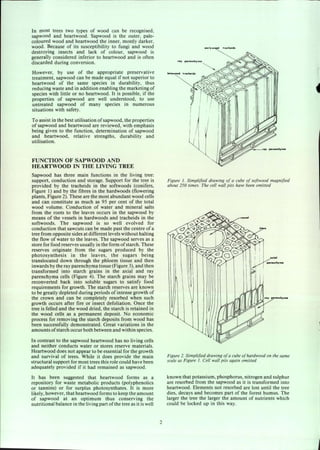
Figure I. Simplified drawing of a cube of softwood magnified
about 250 times. The cell wall pits have been omitted
.....
,.renchy....
Figure 2. Simplified drawing ofa cube ofhardwood on the same
scale as Figure 1. Cell wall pits again omitted
known that potassium, phosphorus, nitrogen and sulphur
are resorbed from the sapwood as it is transformed into
heartwood. Elements not resorbed are lost until the tree
dies, decays and becomes part of the forest humus. The
larger the tree the larger the amount of nutrients which
could be locked up in this way.
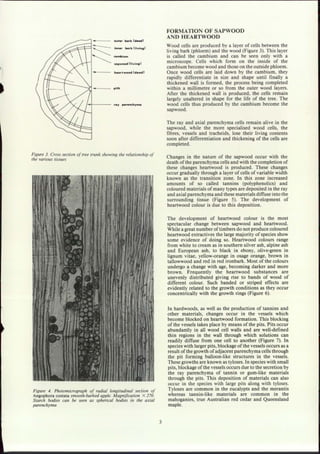
out.. ba,k ldeodl
Inne, ba,k lllvlnll'
camblurn
lOpwood lllvlnlll
hea,twood ldeadl
pith
1-1f--- - - ray parenchyma
Figure 3. Cross section oftree trunk showing the relationship of
the various tissues
Figure 4. Photomicrograph of radial longitudinal section of
Angophora costata smooth-barked apple. Magnification X 270.
Starch bodies can be seen as spherical bodies in the axial
parenchyma
3
FORMAnON OF SAPWOOD
A D HEARTWOOD
Wood cells are produced by a layer of cells between the
living bark (phloem) and the wood (Figure 3). This layer
is called the cambium and can be seen only with a
microscope. Cells which form on the inside of the
cambium become wood and those on the outside phloem.
Once wood cells are laid down by the cambium, they
rapidly differentiate in size and shape until finally a
thickened wall is formed, the process being completed
within a millimetre or so from the outer wood layers.
After the thickened wall is produced, the cells remain
largely unaltered in shape for the life of the tree. The
wood cells thus produced by the cambium become the
sapwood.
The ray and axial parenchyma cells remain alive in the
sapwood, while the more specialised wood cells, the
fibres, vessels and tracheids, lose their living contents
soon after differentiation and thickening of the cells are
completed.
Changes in the nature of the sapwood occur with the
death of the parenchyma cells and with the completion of
these changes heartwood is produced. These changes
occur gradually through a layer of cells of variable width
known as the transition zone. In this zone increased
amounts of so called tannins (polyphenolics) and
coloured materials of many types are deposited in the ray
and axial parenchyma and these materials diffuse into the
surrounding tissue (Figure 5). The development of
heartwood colour is due to this deposition.
The development of heartwood colour is the most
spectacular change between sapwood and heartwood.
While a great number of timbers do not produce coloured
heartwood extractives the large majority of species show
some evidence of doing so. Heartwood colours range
from white to cream as in southern silver ash, alpine ash
and European ash, to black in ebony, olive-green in
lignum vitae, yellow-orange in osage orange, brown in
tallowwood and red in red ironbark. Most of the colours
undergo a change with age, becoming darker and more
brown. Frequently the heartwood substances are
unevenly distributed giving rise to bands of wood of
different colour. Such banded or striped effects are
evidently related to the growth conditions as they occur
concentrically with the growth rings (Figure 6).
In hardwoods, as well as the production of tannins and
other materials, changes occur in the vessels which
become blocked on heartwood formation. This blocking
of the vessels takes place by means of the pits. Pits occur
abundantly in all wood cell walls and are well-defined
thin regions in the wall through which solutions can
readily diffuse from one cell to another (Figure 7). In
species with larger pits, blockage of the vessels occurs as a
result of the growth of adjacent parenchyma cells through
the pit forming balloon-like structures in the vessels.
These growths are known as tyloses. In species with small
pits, blockage of the vessels occurs due to the secretion by
the ray parenchyma of tannin or gum-like materials
through the pits. This deposition of materials can also
occur in the species with large pits along with tyloses.
Tyloses are common in the eucalypts and the merantis
whereas tannin-like materials are common in the
mahoganies, true Australian red cedar and Queensland
maple.
..-- PIT MEMBRANE
PRIMARY
WALL
t
_ - - TO RI
SECONDARY
WALL
++
In softwoods, blockage of the trach eids on heartwood
formation can occur either by closing of the pits
(aspiration) or by the increased deposition of resins and
tannins. The pit membrane of a trach eid is a specialised
structure consisting of a thickened centre (torus)
-supported by a cellulose web, the web being flexible and
. allowing the torus to move and close (aspirate) the pit
opening (Figure 7).
Aspiration is confined to the pits of the earlywood
tracheids, latewood pits remaining open. Latewood
tracheids appear to be specialised structural cells not
conducting cells. The y have narrow lumens and thick cell
walls and are formed near the end of the growing season.
Earlywood trac heids have wide lume ns and thin cell walls
and are formed in the first part of the growing season .
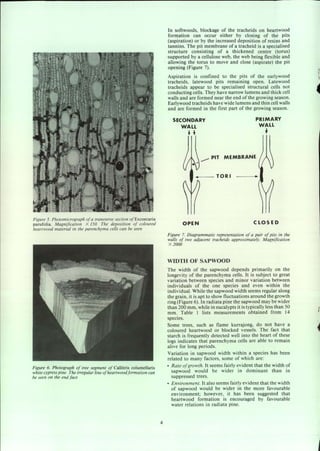
Figure 5. Photomicrograph ofa transverse section ofExcoecaria
parufolia. Magnification X 150. The deposition of coloured
heartwood material in the parenchyma cells can be seen
OPEN CLOSED
Figure 6. Photograph of tree segment of Callitris columellaris
white cypresspine. The irregular line ofheartwoodformation can
be seen on the end face
Figure 7. Diagrammatic representation of a pair of pits in the
walls of two adjacent tracheids approximately. Magnification
X 2000 .
WIDTH OF SAPWOOD
The width of the sapwood depends primarily on the
longevity of the parenchyma cells. It is subject to great
variation between species and minor variation between
individuals of the one species and even within the
indi vidual. While the sapwood width seems regular along
the grain , it is apt to show fluctuations around the growth
ring (Figure 6). In radiata pine the sapwood may be wider
than 200 mm, while in eucalypts it is typically less than 50
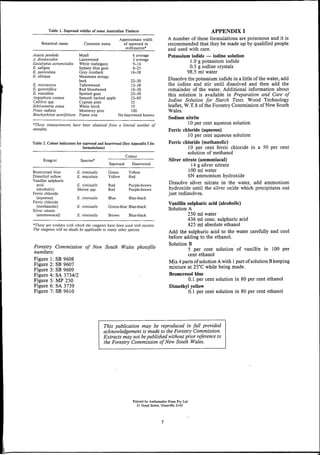
mm. Table 1 lists measurements obtained from 14
species.
Some trees, such as flame kurrajong, do not have a
coloured heartwood or blocked vessels. The fact that
starch is frequently detected well into the heart of these
logs indicates that parenchyma cells are able to remain
alive for long periods.
Variation in sapwood width within a species has been
related to man y factors, some of which are:
• Rate ofgrowth. It seems fairly evident that the width of
sapwood would be wider in dominant than in
suppressed trees.
• Environment. It also seems fairly evident that the width
of sapwood would be wider in the more favourable
environment; however, it has been suggested that
heartwood formation is encouraged by favourable
water relations in rad iata pine.
(
;
4
I
(
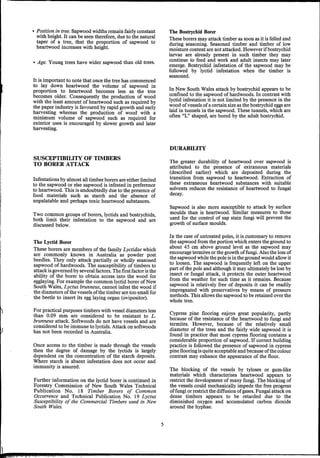
• Position in tree.Sapwood widths remain fairly constant
with height. It can be seen therefore, due to the natural
taper of a tree, that the proportion of sapwood to
heartwood increases with height.
• Age. Young trees have wider sapwood than old trees.
It is important to note that once the tree has commenced
to lay down heartwood the volume of sapwood in
proportion to heartwood becomes less as the tree
b~comes older. Consequently the production of wood
with the l~ast am0l;lnt of heartwood such as required by
the paper industry is favoured by rapid growth and early
harvestmg whereas the production of wood with a
minimum volume of sapwood such as required for
exterior uses is encouraged by slower growth and later
harvesting.
SUSCEPTIBILITY OF TIMBERS
TO BORER ATTACK
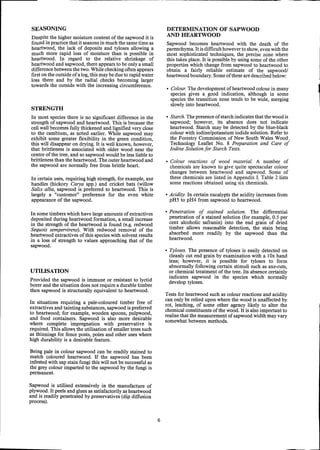
Infestations by almost all timber borers are either limited
to the sapwood or else sapwood is infested in preference
to heartwood. This is undoubtedly due to the presence of
food materials such as starch and the absence of
unpalatable and perhaps toxic heartwood substances.
Two common groups of borers, lyctids and bostrychids
both limit their infestation to the sapwood and are
discussed below.
The Lyctid Borer
These borers are members of the family Lyctidae which
are commonly known in Australia as powder post
beedles. They only attack partially or wholly seasoned
sapwo?d of hardwoods. The susceptibility of timbers to
attackis governed by several factors. The first factor is the
ability of the borer to obtain access into the wood for
egglaying. For example the common lyctid borer of New
South Wales, Lyctus brunneus, cannot infest the wood if
the diameters of the vessels of the timber are too small for
the beetle to insert its egg laying organ (ovipositor).
For practical purposes timbers with vessel diameters less
than 0.09 mm are considered to be resistant to L.
brunneus attack. Softwoods do not have vessels and are
considered to be immune to lyctids. Attack on softwoods
has not been recorded in Australia.
Once access to the timber is made through the vessels
then the degree of damage by the lyctids is largely
dependent on the concentration of the starch deposits.
Where starch is absent infestation does not occur and
immunity is assured.
Further information on the lyctid borer is continued in
Forestry Commission of New South Wales Technical
Publication No. 18 Timber Borers of Common
Occurrel}~e. and Technical Publication No. 19 Lyctus
Susceptibility of the Commercial Timbers used in New
South Wales.
5
The Bostrychid Borer
These borers may attack timber as soon as it is felled and
during seasoning. Seasoned timber and timber of low
moisture content are not attacked. However ifbostrychid
larv~e are already present in such timber they may
contmue to feed and work and adult insects may later
emerge. Bostrychid infestation of the sapwood may be
followed by lyctid infestation when the timber is
seasoned.
In New South Wales attack by bostrychid appears to be
confined to the sapwood of hardwoods. In contrast with
lyctid infestation it is not limited by the presence in the
wood of vessels of a certain size as the bostrychid eggsare
laid in tunnels in the sapwood. These tunnels, which are
often "L" shaped, are bored by the adult bostrychid.
DURABILITY
The greater durability of heartwood over sapwood is
attributed to the presence of extraneous materials
(described earlier) which are deposited during the
transition from sapwood to heartwood. Extraction of
these extraneous heartwood substances with suitable
solvents reduces the resistance of heartwood to fungal
decay.
Sapwood is also more susceptible to attack by surface
moulds than is heartwood. Similar measures to those
used for the control of sap stain fungi will prevent the
growth of surface moulds.
In the case of untreated poles, it is customary to remove
the sapwood from the portion which enters the ground to
about 45 cm above ground level as the sapwood may
encourage termites or the growth of fungi. Alsothe loss of
the sapwood while the pole is in the ground would allowit
to loosen. The sapwood is frequently left on the upper
part of the pole and although it may ultimately be lost by
insect or fungal attack, it protects the outer heartwood
from the weather for such time as it remains. Because
sapwood is relatively free of deposits it can be readily
impregnated with preservatives by means of pressure
methods. This allowsthe sapwood to be retained over the
whole tree.
Cypress pine flo~ring enjoys great popularity, partly
becal;lse of the resistance of the heartwood to fungi and
t~rmites. However, because of the relatively small
diameter of the trees and the fairly wide sapwood it is
found in practice that most cypress flooring contains a
consi~er~ble proportion of sapwood. If correct building
practice is followed the presence of sapwood in cypress
pine flooring is quite acceptable and because ofthe colour
contrast may enhance the appearance of the floor.
The blocking of the vessels by tyloses or gum-like
mat~rials which characterises heartwood appears to
restnct the development of many fungi. The blocking of
the vessels could mechanically impede the free progress
of fungi or restrict the diffusion of gases.Fungal attack on
dense timbers appears to be retarded due to the
diminished oxygen and accumulated carbon dioxide
around the hyphae.
SEASONING
Despite the higher moisture content of the sapwood it is
found in practice that it seasons in much the same time as
heartwood, the lack of deposits and tyloses allowing a
much more rapid loss of moisture than is possible in
heartwood. In regard to the relative shrinkage of
heartwood and sapwood, there appears to be only a small
difference between the two. While checking often appears
first on the outside of a log,this may be due to rapid water
loss there and by the radial checks becoming larger
towards the outside with the increasing circumference.
STRENGTH
In most species there is no significant difference in the
strength of sapwood and heartwood. This is because the
cell wall becomes fully thickened and lignified very close
to the cambium, as noted earlier. While sapwood may
exhibit some greater flexibility in the green condition,
this will disappear on drying. It is well known, however,
that brittleness is associated with older wood near the
centre of the tree, and so sapwood would be less liable to
brittleness than the heartwood. The outer heartwood and
the sapwood are normally free from brittle heart.
In certain uses, requiring high strength, for example, axe
handles (hickory Carya spp.) and cricket bats (willow
Salix alba, sapwood is preferred to heartwood. This is
largely a "customer" preference for the even white
appearance of the sapwood.
In some timbers which have large amounts of extractives
deposited during heartwood formation, a small increase
in the strength of the heartwood is found (e.g. redwood
Sequois sempervirens). With redwood removal of the
heartwood extractives of this species with solvent results
in a loss of strength to values approaching that of the
sapwood.
UTILISATION
Provided the sapwood is immune or resistant to lyctid
borer and the situation does not require a durable timber
then sapwood is structurally equivalent to heartwood.
In situations requiring a pale-coloured timber free of
extractives and tainting substances, sapwood is preferred
to heartwood; for example, wooden spoons, pulpwood,
and food containers. Sapwood is also more desirable
where complete impregnation with preservative is
required. This allows the utilisation of smaller trees such
as thinnings for fence posts, poles and other uses where
high durability is a desirable feature.
Being pale in colour sapwood can be readily stained to
match coloured heartwood. If the sapwood has been
infested with sap stain fungi this will not be successful as
the grey colour imparted to the sapwood by the fungi is
permanent.
Sapwood is utilised extensively in the manufacture of
plywood. It peels and glues as satisfactorily as heartwood
and is readily penetrated by preservatives (dip diffusion
process).
6
DETERMINATION OF SAPWOOD
AND HEARTWOOD
Sapwood becomes heartwood with the death of the
parenchyma. Itis difficult however to show,even with the
most sophisticated techniques, the precise zone where
this takes place. It is possible by using some of the other
properties which change from sapwood to heartwood to
obtain a fairly reliable estimate of the sapwood/
heartwood boundary. Some of these are described below:
• Colour. The development of heartwood colour in many
species gives a good indication, although in some
species the transition zone tends to be wide, merging
slowly into heartwood.
• Starch.The presence of starch indicates that the wood is
sapwood; however, its absence does not indicate
heartwood. Starch may be detected by the blue-black
colour with iodine/potassium iodide solution. Refer to
the Forestry Commission of New South Wales Wood,
Technology Leaflet No. 8 Preparation and Care of
Iodine Solution for Starch Tests.
• Colour reactions of wood material. A number of
chemicals are known to give quite spectacular colour
changes between heartwood and sapwood. Some of
these chemicals are listed in Appendix 1. Table 2 lists
some reactions obtained using six chemicals.
• Acidity. In certain eucalypts the acidity increases from
pH5 to pH4 from sapwood to heartwood.
• Penetration of stained solution. The differential
penetration of a stained solution (for example, 0.5 per
cent alcoholic safranin) into the end grain of dried
timber allows reasonable detection, the stain being
absorbed more readily by the sapwood than the
heartwood.
• Tyloses. The presence of tyloses is easily detected on
cleanly cut end grain by examination with a 10x hand
lens; however, it is possible for tyloses to form
abnormally following certain stimuli such as axe-cuts,
or chemical treatment ofthe tree. Its absence certainly
indicates sapwood in the species which normally
develop tyloses.
Tests for heartwood such as colour reactions and acidity
can only be relied upon where the wood is unaffected by
rot, leaching, of some other agency likely to alter the
chemical constituents of the wood. It is also important to
realise that the measurement of sapwood width may vary
somewhat between methods.
1
Table 1. Sapwood widths of some Australian Timbers
Table 2. Colour indicators for sapwood and heartwood (See Appendix I for
formulations)
'These measurements have been obtained from a limited number of
samples. . .
"These are timbers with which the reagents have been used wuh success.
The reagents will no doubt be applicable to many other species.
APPENDIX I
A number of these formulations are poisonous and it is
recommended that they be made up by qualified people
and used with care.
Potassium iodide - iodine solution
1.0 g potassium iodide
0.5 g iodine crystals
98.5 ml water
Dissolve the potassium iodide in a little of the water, add
the iodine and stir until dissolved and then add the
remainder of the water. Additional information about
this solution is available in Preparation and Care of
Iodine Solution for Starch Tests. Wood Technology
leaflet, W.T.8 of the Forestry Commission of New South
Wales.
Sodium nitrite
10 per cent aqueous solution
Ferric chloride (aqueous)
10 per cent aqueous solution
Ferric chloride (methanolic)
10 per cent ferric chloride in a 50 per cent
solution of methanol
Silver nitrate (ammoniacal)
14 g silver nitrate
100 ml water
6N ammonium hydroxide
Dissolve silver nitrate in the water, add ammonium
hydroxide until the silver oxide which precipitates out
just redissolves.
Vanillin sulphuric acid (alcoholic)
Solution A
250 ml water
436 ml cone. sulphuric acid
425 ml absolute ethanol
Add the sulphuric acid to the water carefully and cool
before adding to the ethanol.
Solution B
5 per cent solution of vanillin in 100 per
cent ethanol
Mix 4 parts of solution Awith 1part of solution Bkeeping
mixture at 2YC while being made.
Bromcresol blue
0.1 per cent solution in 80 per cent ethanol
Dimethyl yellow
0.1 per cent solution in 80 per cent ethanol
Approximate width
of sapwood in
millimetres*
6 average
3 average
9-16
6-25
16-38
22-30
12-38
16-38
25-50
25-60
25
75
100
No heartwood known
Common name
Myall
Lancewood
White mahogany
Sydney blue gum
Grey ironbark
Messmate stringy
bark
Tallowwood
Red blood wood
Spotted gum
Smooth barked apple
Cypress pine
White birch
Monterey pine
Flame tree
Colour
Reagent Species"
Sapwood Heartwood
Bromcresol blue E. vtminalis Green Yellow
Dimethyl yellow E. maculata Yellow Red
Vanillin sulphuric
acid E. viminalis Red Purple-brown
(alcoholic) Shorea spp. Red Purple-brown
Ferric chloride
(aqueous) E. viminalts Blue Blue-black
Ferric chloride
(methanolic) E. vitninalis Green-blue Blue-black
Silver nitrate
(ammoniacal) E. viminalis Brown Blue-black
Botanical name
E. microcorvs
E. gummifeia
E. maculata
Angophora costata
Callitris spp.
Schizomeria ovata
PIlIUS radiata
Brachychiton acerifolium
Forestry Commission of New South Wales photojile
numbers:
Figure 1: SB 9608
Figure 2: SB 9607
Figure 3: SB 9609
Figure 4: SA 3734/2
Figure 5: MP 250
Figure 6: SA 3739
Figure 7: SB 9610
Acacia pendula
A. doratoxvlon
Eucalyptus acmenioides
E. saligna
E. paniculata
E. obltqua
This publication may be reproduced in full provided
acknowledgement is made to the Forestry Commission.
Extracts may not be published without prior referenceto
the Forestry Commission ofNew South Wales.
Printed by Ambassador Press Pty Lld
51 Good Street, GranvilIe 2142
7

Sapwood-and-Heartwood1.pdf

  • 1.
    This document hasbeen scanned from hard-copy archives for research and study purposes. Please note not all information may be current. We have tried, in preparing this copy, to make the content accessible to the widest possible audience but in some cases we recognise that the automatic text recognition maybe inadequate and we apologise in advance for any inconvenience this may cause.
  • 2.
    TECHNICAL PUBLICATION Published 1961(Bulletin) Revised 1964 (Technical Publication) Revised 1974, 1977 Reprinted 1979, 1981, 1983 Revised 1987 ISBN 0 7240 2067 S ISSN 0 1SS-7S48 Doe 811.5 Sapwood and Heartwood by R. K. Bamber Sapwood Transition Zone Heartwood (b) Scanning electron micrographs ofsapwood/heartwood boundary in Eucalyptus sa/igna. (a) Transverse surface. X 400; (b) Radial longitudinal surface. X 90 Wood Technology and Forest Research Division ' , PO Box 100 Beec roll. NSW 2119 Australia I I .___ _ _ . .
  • 3.
    In most treestwo types of wood can be recognised, sapwood and heartwood. Sapwood is the outer, pale- coloured wood and heartwood the inner, mostly darker, wood. Because of its susceptibility to fungi and wood destroying insects and lack of colour, sapwood is generally considered inferior to heartwood and is often discarded during conversion. However, by use of the appropriate preservative treatment, sapwood can be made equal if not superior to heartwood of the same species in durability, thus reducing waste and in addition enabling the marketing of species with little or no heartwood. It is possible, if the properties of sapwood are well understood, to use untreated sapwood of many species in numerous situations with safety. To assist in the best utilisation of sapwood, the properties of sapwood and heartwood are reviewed, with emphasis being given to the function, determination of sapwood and heartwood, relative strengths, durability and utilisation. FUNCTION OF SAPWOOD AND HEARTWOOD IN THE LIVING TREE Sapwood has three main functions in the living tree: support, conduction and storage. Support for the tree is provided by the tracheids in the softwoods (conifers, Figure I) and by the fibres in the hardwoods (flowering plants, Figure 2). These are the most abundant wood cells and can constitute as much as 95 per cent of the total wood volume. Conduction of water and mineral salts from the roots to the leaves occurs in the sapwood by means of the vessels in hardwoods and tracheids in the softwoods. The sapwood is so well evolved for conduction that sawcuts can be made past the centre of a tree from opposite sides at different levels without halting the flow of water to the leaves. The sapwood serves as a store for food reserves usually in the form of starch. These reserves originate from the sugars produced by the photosynthesis in the leaves, the sugars being translocated down through the phloem tissue and then inwards by the ray parenchyma tissue (Figure 3), and then transformed into starch grains in the axial and ray parenchyma cells (Figure 4). The starch grains may be reconverted back into soluble sugars to satisfy food requirements for growth. The starch reserves are known to be greatly depleted during periods of intense growth of the crown and can be completely resorbed when such growth occurs after fire or insect defoliation. Once the tree is felled and the wood dried , the starch is retained in the wood cells as a permanent deposit. No economic process for removing the starch deposits from wood has been successfully demonstrated. Great variations in the amounts of starch occur both between and within species. In contrast to the sapwood heartwood has no living cells and neither conducts water or stores reserve materials. Heartwood does not appear to be essential for the growth and survival of trees. While it does provide the main structural support for most trees this role could have been adequately provided if it had remained as sapwood . It has been suggested that heartwood forms as a repository for waste metabolic products (polyphenolics or tannins) or for surplus photosynthates. It is more likely, however, that heartwood forms to keep the amount of sapwood at an optimum thus conserving the nutritional balance in the living part of the tree as it is well 2 Figure I. Simplified drawing of a cube of softwood magnified about 250 times. The cell wall pits have been omitted ..... ,.renchy.... Figure 2. Simplified drawing ofa cube ofhardwood on the same scale as Figure 1. Cell wall pits again omitted known that potassium, phosphorus, nitrogen and sulphur are resorbed from the sapwood as it is transformed into heartwood. Elements not resorbed are lost until the tree dies, decays and becomes part of the forest humus. The larger the tree the larger the amount of nutrients which could be locked up in this way.
  • 4.
    out.. ba,k ldeodl Inne,ba,k lllvlnll' camblurn lOpwood lllvlnlll hea,twood ldeadl pith 1-1f--- - - ray parenchyma Figure 3. Cross section oftree trunk showing the relationship of the various tissues Figure 4. Photomicrograph of radial longitudinal section of Angophora costata smooth-barked apple. Magnification X 270. Starch bodies can be seen as spherical bodies in the axial parenchyma 3 FORMAnON OF SAPWOOD A D HEARTWOOD Wood cells are produced by a layer of cells between the living bark (phloem) and the wood (Figure 3). This layer is called the cambium and can be seen only with a microscope. Cells which form on the inside of the cambium become wood and those on the outside phloem. Once wood cells are laid down by the cambium, they rapidly differentiate in size and shape until finally a thickened wall is formed, the process being completed within a millimetre or so from the outer wood layers. After the thickened wall is produced, the cells remain largely unaltered in shape for the life of the tree. The wood cells thus produced by the cambium become the sapwood. The ray and axial parenchyma cells remain alive in the sapwood, while the more specialised wood cells, the fibres, vessels and tracheids, lose their living contents soon after differentiation and thickening of the cells are completed. Changes in the nature of the sapwood occur with the death of the parenchyma cells and with the completion of these changes heartwood is produced. These changes occur gradually through a layer of cells of variable width known as the transition zone. In this zone increased amounts of so called tannins (polyphenolics) and coloured materials of many types are deposited in the ray and axial parenchyma and these materials diffuse into the surrounding tissue (Figure 5). The development of heartwood colour is due to this deposition. The development of heartwood colour is the most spectacular change between sapwood and heartwood. While a great number of timbers do not produce coloured heartwood extractives the large majority of species show some evidence of doing so. Heartwood colours range from white to cream as in southern silver ash, alpine ash and European ash, to black in ebony, olive-green in lignum vitae, yellow-orange in osage orange, brown in tallowwood and red in red ironbark. Most of the colours undergo a change with age, becoming darker and more brown. Frequently the heartwood substances are unevenly distributed giving rise to bands of wood of different colour. Such banded or striped effects are evidently related to the growth conditions as they occur concentrically with the growth rings (Figure 6). In hardwoods, as well as the production of tannins and other materials, changes occur in the vessels which become blocked on heartwood formation. This blocking of the vessels takes place by means of the pits. Pits occur abundantly in all wood cell walls and are well-defined thin regions in the wall through which solutions can readily diffuse from one cell to another (Figure 7). In species with larger pits, blockage of the vessels occurs as a result of the growth of adjacent parenchyma cells through the pit forming balloon-like structures in the vessels. These growths are known as tyloses. In species with small pits, blockage of the vessels occurs due to the secretion by the ray parenchyma of tannin or gum-like materials through the pits. This deposition of materials can also occur in the species with large pits along with tyloses. Tyloses are common in the eucalypts and the merantis whereas tannin-like materials are common in the mahoganies, true Australian red cedar and Queensland maple.
  • 5.
    ..-- PIT MEMBRANE PRIMARY WALL t _- - TO RI SECONDARY WALL ++ In softwoods, blockage of the trach eids on heartwood formation can occur either by closing of the pits (aspiration) or by the increased deposition of resins and tannins. The pit membrane of a trach eid is a specialised structure consisting of a thickened centre (torus) -supported by a cellulose web, the web being flexible and . allowing the torus to move and close (aspirate) the pit opening (Figure 7). Aspiration is confined to the pits of the earlywood tracheids, latewood pits remaining open. Latewood tracheids appear to be specialised structural cells not conducting cells. The y have narrow lumens and thick cell walls and are formed near the end of the growing season. Earlywood trac heids have wide lume ns and thin cell walls and are formed in the first part of the growing season . Figure 5. Photomicrograph ofa transverse section ofExcoecaria parufolia. Magnification X 150. The deposition of coloured heartwood material in the parenchyma cells can be seen OPEN CLOSED Figure 6. Photograph of tree segment of Callitris columellaris white cypresspine. The irregular line ofheartwoodformation can be seen on the end face Figure 7. Diagrammatic representation of a pair of pits in the walls of two adjacent tracheids approximately. Magnification X 2000 . WIDTH OF SAPWOOD The width of the sapwood depends primarily on the longevity of the parenchyma cells. It is subject to great variation between species and minor variation between individuals of the one species and even within the indi vidual. While the sapwood width seems regular along the grain , it is apt to show fluctuations around the growth ring (Figure 6). In radiata pine the sapwood may be wider than 200 mm, while in eucalypts it is typically less than 50 mm. Table 1 lists measurements obtained from 14 species. Some trees, such as flame kurrajong, do not have a coloured heartwood or blocked vessels. The fact that starch is frequently detected well into the heart of these logs indicates that parenchyma cells are able to remain alive for long periods. Variation in sapwood width within a species has been related to man y factors, some of which are: • Rate ofgrowth. It seems fairly evident that the width of sapwood would be wider in dominant than in suppressed trees. • Environment. It also seems fairly evident that the width of sapwood would be wider in the more favourable environment; however, it has been suggested that heartwood formation is encouraged by favourable water relations in rad iata pine. ( ; 4
  • 6.
    I ( • Position intree.Sapwood widths remain fairly constant with height. It can be seen therefore, due to the natural taper of a tree, that the proportion of sapwood to heartwood increases with height. • Age. Young trees have wider sapwood than old trees. It is important to note that once the tree has commenced to lay down heartwood the volume of sapwood in proportion to heartwood becomes less as the tree b~comes older. Consequently the production of wood with the l~ast am0l;lnt of heartwood such as required by the paper industry is favoured by rapid growth and early harvestmg whereas the production of wood with a minimum volume of sapwood such as required for exterior uses is encouraged by slower growth and later harvesting. SUSCEPTIBILITY OF TIMBERS TO BORER ATTACK Infestations by almost all timber borers are either limited to the sapwood or else sapwood is infested in preference to heartwood. This is undoubtedly due to the presence of food materials such as starch and the absence of unpalatable and perhaps toxic heartwood substances. Two common groups of borers, lyctids and bostrychids both limit their infestation to the sapwood and are discussed below. The Lyctid Borer These borers are members of the family Lyctidae which are commonly known in Australia as powder post beedles. They only attack partially or wholly seasoned sapwo?d of hardwoods. The susceptibility of timbers to attackis governed by several factors. The first factor is the ability of the borer to obtain access into the wood for egglaying. For example the common lyctid borer of New South Wales, Lyctus brunneus, cannot infest the wood if the diameters of the vessels of the timber are too small for the beetle to insert its egg laying organ (ovipositor). For practical purposes timbers with vessel diameters less than 0.09 mm are considered to be resistant to L. brunneus attack. Softwoods do not have vessels and are considered to be immune to lyctids. Attack on softwoods has not been recorded in Australia. Once access to the timber is made through the vessels then the degree of damage by the lyctids is largely dependent on the concentration of the starch deposits. Where starch is absent infestation does not occur and immunity is assured. Further information on the lyctid borer is continued in Forestry Commission of New South Wales Technical Publication No. 18 Timber Borers of Common Occurrel}~e. and Technical Publication No. 19 Lyctus Susceptibility of the Commercial Timbers used in New South Wales. 5 The Bostrychid Borer These borers may attack timber as soon as it is felled and during seasoning. Seasoned timber and timber of low moisture content are not attacked. However ifbostrychid larv~e are already present in such timber they may contmue to feed and work and adult insects may later emerge. Bostrychid infestation of the sapwood may be followed by lyctid infestation when the timber is seasoned. In New South Wales attack by bostrychid appears to be confined to the sapwood of hardwoods. In contrast with lyctid infestation it is not limited by the presence in the wood of vessels of a certain size as the bostrychid eggsare laid in tunnels in the sapwood. These tunnels, which are often "L" shaped, are bored by the adult bostrychid. DURABILITY The greater durability of heartwood over sapwood is attributed to the presence of extraneous materials (described earlier) which are deposited during the transition from sapwood to heartwood. Extraction of these extraneous heartwood substances with suitable solvents reduces the resistance of heartwood to fungal decay. Sapwood is also more susceptible to attack by surface moulds than is heartwood. Similar measures to those used for the control of sap stain fungi will prevent the growth of surface moulds. In the case of untreated poles, it is customary to remove the sapwood from the portion which enters the ground to about 45 cm above ground level as the sapwood may encourage termites or the growth of fungi. Alsothe loss of the sapwood while the pole is in the ground would allowit to loosen. The sapwood is frequently left on the upper part of the pole and although it may ultimately be lost by insect or fungal attack, it protects the outer heartwood from the weather for such time as it remains. Because sapwood is relatively free of deposits it can be readily impregnated with preservatives by means of pressure methods. This allowsthe sapwood to be retained over the whole tree. Cypress pine flo~ring enjoys great popularity, partly becal;lse of the resistance of the heartwood to fungi and t~rmites. However, because of the relatively small diameter of the trees and the fairly wide sapwood it is found in practice that most cypress flooring contains a consi~er~ble proportion of sapwood. If correct building practice is followed the presence of sapwood in cypress pine flooring is quite acceptable and because ofthe colour contrast may enhance the appearance of the floor. The blocking of the vessels by tyloses or gum-like mat~rials which characterises heartwood appears to restnct the development of many fungi. The blocking of the vessels could mechanically impede the free progress of fungi or restrict the diffusion of gases.Fungal attack on dense timbers appears to be retarded due to the diminished oxygen and accumulated carbon dioxide around the hyphae.
  • 7.
    SEASONING Despite the highermoisture content of the sapwood it is found in practice that it seasons in much the same time as heartwood, the lack of deposits and tyloses allowing a much more rapid loss of moisture than is possible in heartwood. In regard to the relative shrinkage of heartwood and sapwood, there appears to be only a small difference between the two. While checking often appears first on the outside of a log,this may be due to rapid water loss there and by the radial checks becoming larger towards the outside with the increasing circumference. STRENGTH In most species there is no significant difference in the strength of sapwood and heartwood. This is because the cell wall becomes fully thickened and lignified very close to the cambium, as noted earlier. While sapwood may exhibit some greater flexibility in the green condition, this will disappear on drying. It is well known, however, that brittleness is associated with older wood near the centre of the tree, and so sapwood would be less liable to brittleness than the heartwood. The outer heartwood and the sapwood are normally free from brittle heart. In certain uses, requiring high strength, for example, axe handles (hickory Carya spp.) and cricket bats (willow Salix alba, sapwood is preferred to heartwood. This is largely a "customer" preference for the even white appearance of the sapwood. In some timbers which have large amounts of extractives deposited during heartwood formation, a small increase in the strength of the heartwood is found (e.g. redwood Sequois sempervirens). With redwood removal of the heartwood extractives of this species with solvent results in a loss of strength to values approaching that of the sapwood. UTILISATION Provided the sapwood is immune or resistant to lyctid borer and the situation does not require a durable timber then sapwood is structurally equivalent to heartwood. In situations requiring a pale-coloured timber free of extractives and tainting substances, sapwood is preferred to heartwood; for example, wooden spoons, pulpwood, and food containers. Sapwood is also more desirable where complete impregnation with preservative is required. This allows the utilisation of smaller trees such as thinnings for fence posts, poles and other uses where high durability is a desirable feature. Being pale in colour sapwood can be readily stained to match coloured heartwood. If the sapwood has been infested with sap stain fungi this will not be successful as the grey colour imparted to the sapwood by the fungi is permanent. Sapwood is utilised extensively in the manufacture of plywood. It peels and glues as satisfactorily as heartwood and is readily penetrated by preservatives (dip diffusion process). 6 DETERMINATION OF SAPWOOD AND HEARTWOOD Sapwood becomes heartwood with the death of the parenchyma. Itis difficult however to show,even with the most sophisticated techniques, the precise zone where this takes place. It is possible by using some of the other properties which change from sapwood to heartwood to obtain a fairly reliable estimate of the sapwood/ heartwood boundary. Some of these are described below: • Colour. The development of heartwood colour in many species gives a good indication, although in some species the transition zone tends to be wide, merging slowly into heartwood. • Starch.The presence of starch indicates that the wood is sapwood; however, its absence does not indicate heartwood. Starch may be detected by the blue-black colour with iodine/potassium iodide solution. Refer to the Forestry Commission of New South Wales Wood, Technology Leaflet No. 8 Preparation and Care of Iodine Solution for Starch Tests. • Colour reactions of wood material. A number of chemicals are known to give quite spectacular colour changes between heartwood and sapwood. Some of these chemicals are listed in Appendix 1. Table 2 lists some reactions obtained using six chemicals. • Acidity. In certain eucalypts the acidity increases from pH5 to pH4 from sapwood to heartwood. • Penetration of stained solution. The differential penetration of a stained solution (for example, 0.5 per cent alcoholic safranin) into the end grain of dried timber allows reasonable detection, the stain being absorbed more readily by the sapwood than the heartwood. • Tyloses. The presence of tyloses is easily detected on cleanly cut end grain by examination with a 10x hand lens; however, it is possible for tyloses to form abnormally following certain stimuli such as axe-cuts, or chemical treatment ofthe tree. Its absence certainly indicates sapwood in the species which normally develop tyloses. Tests for heartwood such as colour reactions and acidity can only be relied upon where the wood is unaffected by rot, leaching, of some other agency likely to alter the chemical constituents of the wood. It is also important to realise that the measurement of sapwood width may vary somewhat between methods. 1
  • 8.
    Table 1. Sapwoodwidths of some Australian Timbers Table 2. Colour indicators for sapwood and heartwood (See Appendix I for formulations) 'These measurements have been obtained from a limited number of samples. . . "These are timbers with which the reagents have been used wuh success. The reagents will no doubt be applicable to many other species. APPENDIX I A number of these formulations are poisonous and it is recommended that they be made up by qualified people and used with care. Potassium iodide - iodine solution 1.0 g potassium iodide 0.5 g iodine crystals 98.5 ml water Dissolve the potassium iodide in a little of the water, add the iodine and stir until dissolved and then add the remainder of the water. Additional information about this solution is available in Preparation and Care of Iodine Solution for Starch Tests. Wood Technology leaflet, W.T.8 of the Forestry Commission of New South Wales. Sodium nitrite 10 per cent aqueous solution Ferric chloride (aqueous) 10 per cent aqueous solution Ferric chloride (methanolic) 10 per cent ferric chloride in a 50 per cent solution of methanol Silver nitrate (ammoniacal) 14 g silver nitrate 100 ml water 6N ammonium hydroxide Dissolve silver nitrate in the water, add ammonium hydroxide until the silver oxide which precipitates out just redissolves. Vanillin sulphuric acid (alcoholic) Solution A 250 ml water 436 ml cone. sulphuric acid 425 ml absolute ethanol Add the sulphuric acid to the water carefully and cool before adding to the ethanol. Solution B 5 per cent solution of vanillin in 100 per cent ethanol Mix 4 parts of solution Awith 1part of solution Bkeeping mixture at 2YC while being made. Bromcresol blue 0.1 per cent solution in 80 per cent ethanol Dimethyl yellow 0.1 per cent solution in 80 per cent ethanol Approximate width of sapwood in millimetres* 6 average 3 average 9-16 6-25 16-38 22-30 12-38 16-38 25-50 25-60 25 75 100 No heartwood known Common name Myall Lancewood White mahogany Sydney blue gum Grey ironbark Messmate stringy bark Tallowwood Red blood wood Spotted gum Smooth barked apple Cypress pine White birch Monterey pine Flame tree Colour Reagent Species" Sapwood Heartwood Bromcresol blue E. vtminalis Green Yellow Dimethyl yellow E. maculata Yellow Red Vanillin sulphuric acid E. viminalis Red Purple-brown (alcoholic) Shorea spp. Red Purple-brown Ferric chloride (aqueous) E. viminalts Blue Blue-black Ferric chloride (methanolic) E. vitninalis Green-blue Blue-black Silver nitrate (ammoniacal) E. viminalis Brown Blue-black Botanical name E. microcorvs E. gummifeia E. maculata Angophora costata Callitris spp. Schizomeria ovata PIlIUS radiata Brachychiton acerifolium Forestry Commission of New South Wales photojile numbers: Figure 1: SB 9608 Figure 2: SB 9607 Figure 3: SB 9609 Figure 4: SA 3734/2 Figure 5: MP 250 Figure 6: SA 3739 Figure 7: SB 9610 Acacia pendula A. doratoxvlon Eucalyptus acmenioides E. saligna E. paniculata E. obltqua This publication may be reproduced in full provided acknowledgement is made to the Forestry Commission. Extracts may not be published without prior referenceto the Forestry Commission ofNew South Wales. Printed by Ambassador Press Pty Lld 51 Good Street, GranvilIe 2142 7