Timber
By :
Durgesh Kumar Yadav
ContentContent
• Characteristics of good timber.
• Defects in timber.
Characteristics of good
Timber
 Appearance & Color :-
Freshly cut surface should give sweet
smell & shining surface. A darker color of wood
indicates greater durability.
 Hardness :-
A good quality timber should be
hard enough to resist deterioration.
 Strength :-
It should have sufficient strength
to resist heavy structural loads.
Characteristics of good
Timber
Elasticity :-
It should have the property of elasticity
to regain it’s original shape after removal of loads.
Durability :-
It should be able to resist attacks of
fungi & worms and also atmospheric effects for a longer
period of time.
Defects :-
Timber should be free from defects such
as sap, dead knots, shakes and other defects.
Characteristics of good
Timber
 Fibers & Structure :-
It should have straight &
closed fibers. It should have regular annual rings. Timber
with narrow annual rings are generally the strongest.
 Shape & Weight :-
It should retain it’s shape during the
process of seasoning. Heavy timbers are always stronger
than light weight timber.
 Workability :-
It should be well seasoned & easily
workable. Teeth of saw should not get clogged during
the process of sawing.
Characteristics of good
Timber
 Diagram :-
IN TIMBER
DEFECTSDEFECTS
Defects in timber
 Definition :-
In this case, “Defect” means
anything that effects the structural integrity or
appearance of timber..
Defect due to Natural forces
CHEMICAL
STAIN
KNOTS
SHAKES
RIND
GALLS
UPSETS
TWISTED
FIBRES
Defect due to Natural forces
CHEMICAL STAIN:-The wood is
sometimes discoloured by the
chemical action caused with it
by some external agency.This is
known as chemical stain.
KNOTS:- 'Knots' are
probably the most common
defect in timber. Knots
occur where a branch has
grown out of the trunk. A lot
of knots means the timber is
difficult to work and is
weakened.
PIN KNOT:-diameter up to 6.50mm
SMALL KNOT:-diameter up to 6.5 and 20mm
MEDIUM KNOT:-diameter between 20 and 40mm
LARGE KNOT:-diameter greater than 40mm
DEAD KNOT:-Knot which is separated from body of wood.It is not safe
to use wood with such a knot for engineering purposes.
DECAYED KNOT:-Popularly known as unsound knot and form by
action of fungi on wood.
LIVE KNOT:-it is thoroughly fixed in wood and cannot separated out
from body of wood.it is free from cracks and decay.wood containing this
knot can be used for engineering purposes.
LOOSE KNOT:-it is preliminary stage of dead knot.
ROUND KNOT:-the cross-section of this type of knot is either round or
oval
TIGHT KNOT:-it is preliminary stage of live knot.the fibres of knot are
firmly held in sorrounding wood.
SHAKES:-These are longitudinal
seperations in wood between the annual
rings.These are cracks which partly or
completely separate fibres of wood.The
seperations make the wood undesirable
when apperance is importent
STAR SHAKES CUP SHAKES HEART SHAKES RING SHAKES
TWISTED FIBRES:-these are known as
wandering hearts and caused by twisting
of young trees by fast blowing wind.the
timbers with twisted fibres is unsuitable for
sawing
UPSETS:-these indicate wood fibres which
are injured by crushing or compression.the
upsets are mainly due to improper felling of
tree and exposure of tree in its young age to
fast blowing wind
RIND GALLS:-the rind means bark and gall
indicates abnormal growth.hence peculiar
curved swelling found on the body of tree
are known as rind gall.
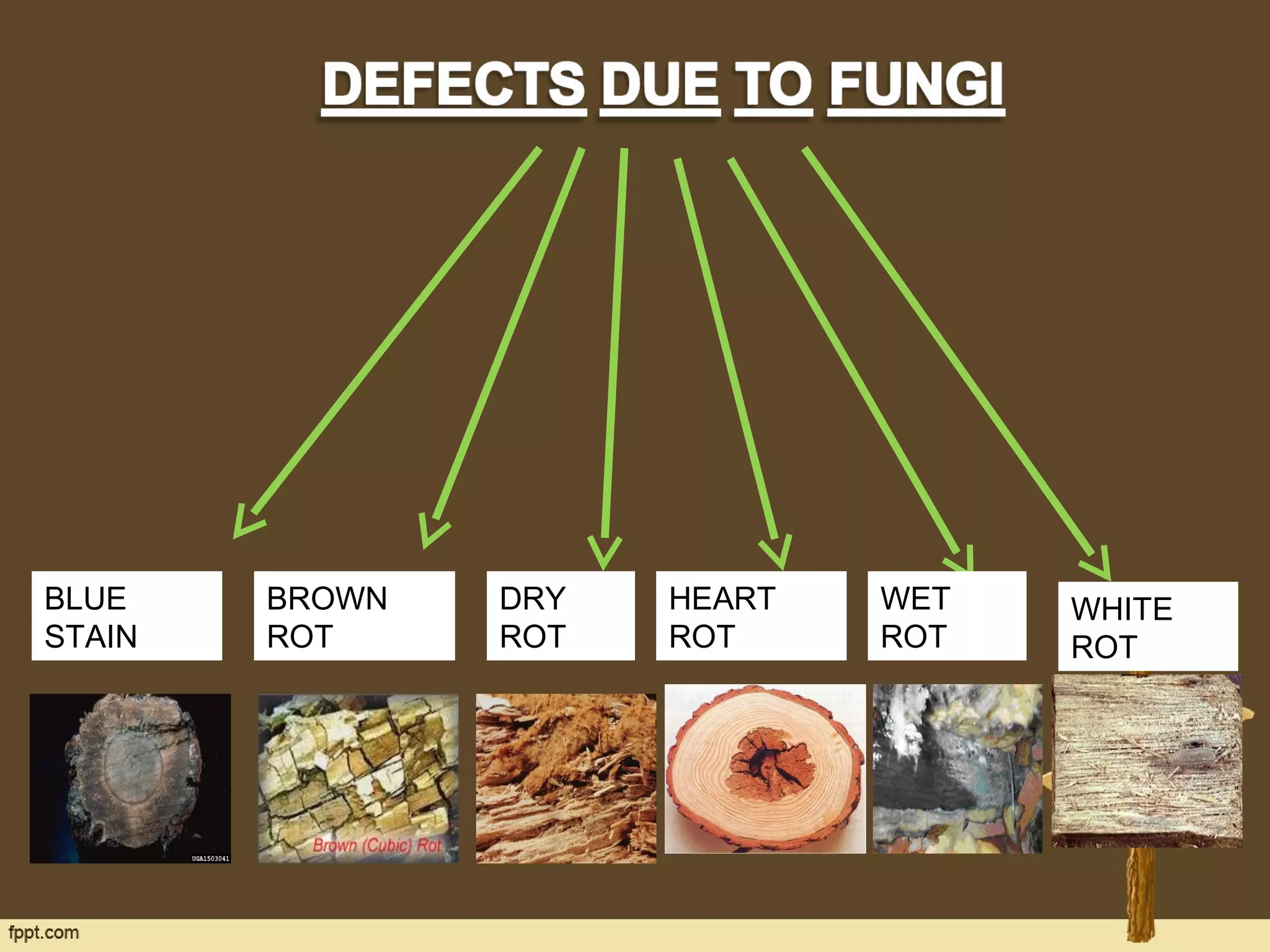
BLUE
STAIN
BROWN
ROT
DRY
ROT
HEART
ROT
WET
ROT
WHITE
ROT
(CAUSED BY)
BEETLES
MARINE BOARERS
TERMITES
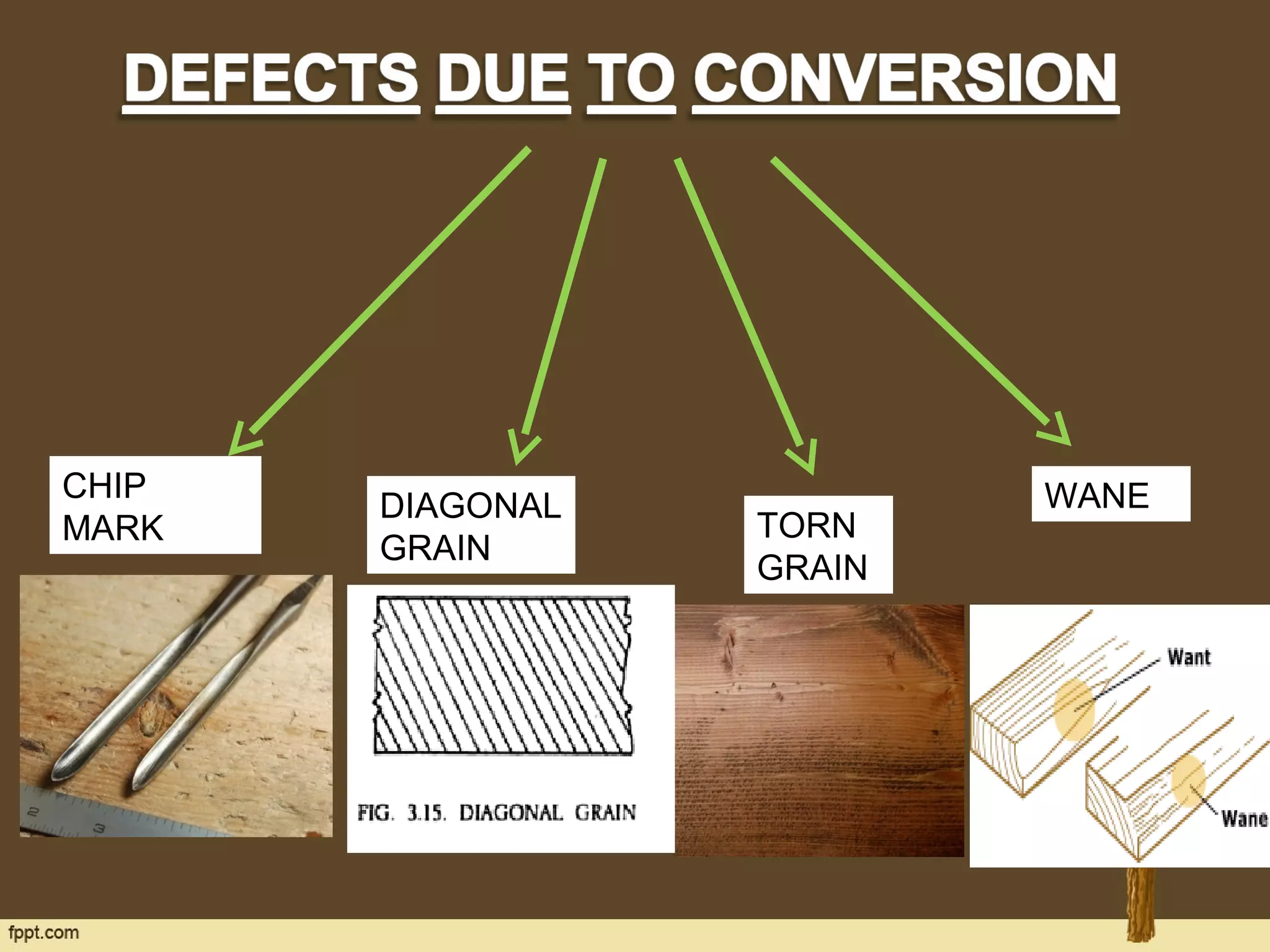
CHIP
MARK
DIAGONAL
GRAIN
TORN
GRAIN
WANE
TWIST CUP BOW SPRING SPLIT
HONEY
COMBING
timber characteristics and defects

timber characteristics and defects

  • 1.
  • 2.
    ContentContent • Characteristics ofgood timber. • Defects in timber.
  • 3.
    Characteristics of good Timber Appearance & Color :- Freshly cut surface should give sweet smell & shining surface. A darker color of wood indicates greater durability.  Hardness :- A good quality timber should be hard enough to resist deterioration.  Strength :- It should have sufficient strength to resist heavy structural loads.
  • 4.
    Characteristics of good Timber Elasticity:- It should have the property of elasticity to regain it’s original shape after removal of loads. Durability :- It should be able to resist attacks of fungi & worms and also atmospheric effects for a longer period of time. Defects :- Timber should be free from defects such as sap, dead knots, shakes and other defects.
  • 5.
    Characteristics of good Timber Fibers & Structure :- It should have straight & closed fibers. It should have regular annual rings. Timber with narrow annual rings are generally the strongest.  Shape & Weight :- It should retain it’s shape during the process of seasoning. Heavy timbers are always stronger than light weight timber.  Workability :- It should be well seasoned & easily workable. Teeth of saw should not get clogged during the process of sawing.
  • 6.
  • 7.
  • 8.
    Defects in timber Definition :- In this case, “Defect” means anything that effects the structural integrity or appearance of timber..
  • 10.
    Defect due toNatural forces CHEMICAL STAIN KNOTS SHAKES RIND GALLS UPSETS TWISTED FIBRES
  • 11.
    Defect due toNatural forces CHEMICAL STAIN:-The wood is sometimes discoloured by the chemical action caused with it by some external agency.This is known as chemical stain. KNOTS:- 'Knots' are probably the most common defect in timber. Knots occur where a branch has grown out of the trunk. A lot of knots means the timber is difficult to work and is weakened.
  • 12.
    PIN KNOT:-diameter upto 6.50mm SMALL KNOT:-diameter up to 6.5 and 20mm MEDIUM KNOT:-diameter between 20 and 40mm LARGE KNOT:-diameter greater than 40mm DEAD KNOT:-Knot which is separated from body of wood.It is not safe to use wood with such a knot for engineering purposes. DECAYED KNOT:-Popularly known as unsound knot and form by action of fungi on wood. LIVE KNOT:-it is thoroughly fixed in wood and cannot separated out from body of wood.it is free from cracks and decay.wood containing this knot can be used for engineering purposes. LOOSE KNOT:-it is preliminary stage of dead knot. ROUND KNOT:-the cross-section of this type of knot is either round or oval TIGHT KNOT:-it is preliminary stage of live knot.the fibres of knot are firmly held in sorrounding wood.
  • 13.
    SHAKES:-These are longitudinal seperationsin wood between the annual rings.These are cracks which partly or completely separate fibres of wood.The seperations make the wood undesirable when apperance is importent STAR SHAKES CUP SHAKES HEART SHAKES RING SHAKES
  • 14.
    TWISTED FIBRES:-these areknown as wandering hearts and caused by twisting of young trees by fast blowing wind.the timbers with twisted fibres is unsuitable for sawing UPSETS:-these indicate wood fibres which are injured by crushing or compression.the upsets are mainly due to improper felling of tree and exposure of tree in its young age to fast blowing wind RIND GALLS:-the rind means bark and gall indicates abnormal growth.hence peculiar curved swelling found on the body of tree are known as rind gall.
  • 15.
  • 16.
  • 17.
  • 18.
    TWIST CUP BOWSPRING SPLIT HONEY COMBING