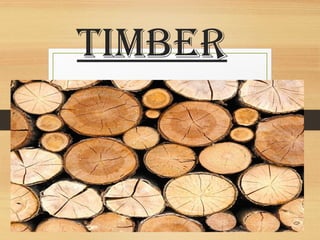
TIMBER
Timber is a form of wood .it is used for building or engineering
purposes.All trees are divided in to 2 groups based on their mode of
growth.
1) Endogenous : These trees grow by the formation of layers
of new wood crossing & penetrating the fibres of the
wood previousy formed,eg.Bamboo,coconut,etc..
2) Exogenous :It grow outwards by the addition of rings of
young wood.,eg.Teak,sal,etc..
• The c/s of exogenous trees shows distinct concentric rings called
annual rings.the timber is an exogenous trees are mainly used in
engineering works.these are sub divided in to
i. Conifers or evergreen trees which yield soft wood,.
eg:pine,deodar,etc..
ii. Deciduous Broad leaf trees which yield hard wood,.
eg:Teak,sal ,etc..
characteristics of hard timber
 heavy in weight.
 Dark in colour
 Durable
 It doesn’t show clear annual rings
 It is strong
 It is non resinous
characteristics of soft timber
 light in weight
 It is light in color
 It is resinous
 It has straight fibres
 It has distinct annual rings
 It is comparatively weak
 It can be split easily.
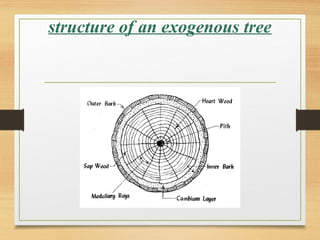
structure of an exogenous tree
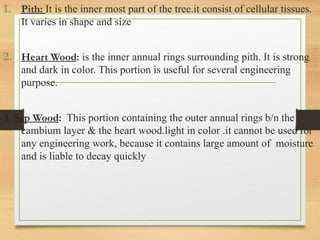
1. Pith: It is the inner most part of the tree.it consist of cellular tissues.
It varies in shape and size
2. Heart Wood: is the inner annual rings surrounding pith. It is strong
and dark in color. This portion is useful for several engineering
purpose.
3. Sap Wood: This portion containing the outer annual rings b/n the
cambium layer & the heart wood.light in color .it cannot be used for
any engineering work, because it contains large amount of moisture
and is liable to decay quickly
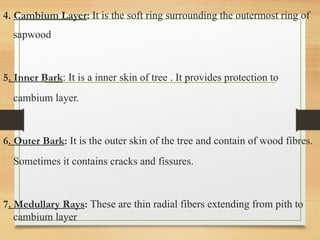
4. Cambium Layer: It is the soft ring surrounding the outermost ring of
sapwood
5. Inner Bark: It is a inner skin of tree . It provides protection to
cambium layer.
6. Outer Bark: It is the outer skin of the tree and contain of wood fibres.
Sometimes it contains cracks and fissures.
7. Medullary Rays: These are thin radial fibers extending from pith to
cambium layer
SEASONING OF TIMBER
A newly cut trees contains water about 50% of its
own dry weight in the form of moisture &
sap.The moisture content is lead to decay of
timber. There for the water is removed soon
before applied for its purpose. This process of
removal of moisture is known as seasoning of
timber
METHODS OF SEASONING
 Natural seasoning
 Artificial seasoning
NATURAL SEASONING OR AIR SEASONING
It is a natural method by placing the timber under a
shelter.They are allowed to get free circulation of air for a
period of 2 to 4 years
ARTIFICIAL SEASONING
1.Boiling
2.Chemical seasoning
3.Electrical seasoning
4.Kiln seasoning
5.Water seasoning
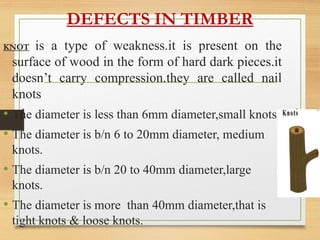
DEFECTS IN TIMBER
KNOT is a type of weakness.it is present on the
surface of wood in the form of hard dark pieces.it
doesn’t carry compression.they are called nail
knots
• The diameter is less than 6mm diameter,small knots.
• The diameter is b/n 6 to 20mm diameter, medium
knots.
• The diameter is b/n 20 to 40mm diameter,large
knots.
• The diameter is more than 40mm diameter,that is
tight knots & loose knots.
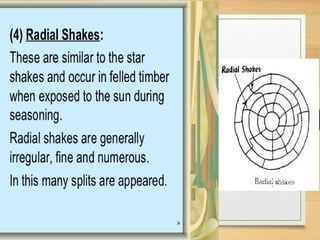
SHAKE
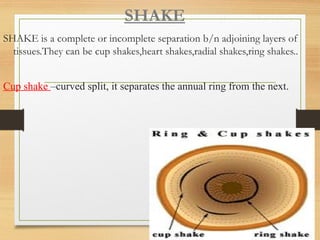
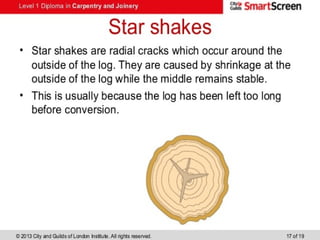
SHAKE is a complete or incomplete separation b/n adjoining layers of
tissues.They can be cup shakes,heart shakes,radial shakes,ring shakes..
Cup shake –curved split, it separates the annual ring from the next.
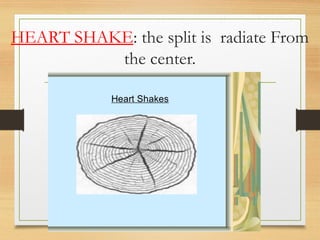
HEART SHAKE: the split is radiate From
the center.
PROPERTIES OF WOOD
• Colour and odur
• Specific gravity
• Moisture content
• Shrinkage and swelling
• Strength
USES OF TIMBER
• It is used for door and window frames,shutters of doors and windows ,
roofing materials ,etc
• It is used for formwork of cement concrete, centering of an arch,etc..
• It is used for making railway coach wagons,sleepers
• It is used for temporary bridges & boat construction
• Making furniture,agricultural instruments,musical instruments
THANK YOU

TIMBER its uses properties and defects.pptx

  • 1.
  • 2.
    Timber is aform of wood .it is used for building or engineering purposes.All trees are divided in to 2 groups based on their mode of growth. 1) Endogenous : These trees grow by the formation of layers of new wood crossing & penetrating the fibres of the wood previousy formed,eg.Bamboo,coconut,etc.. 2) Exogenous :It grow outwards by the addition of rings of young wood.,eg.Teak,sal,etc..
  • 3.
    • The c/sof exogenous trees shows distinct concentric rings called annual rings.the timber is an exogenous trees are mainly used in engineering works.these are sub divided in to i. Conifers or evergreen trees which yield soft wood,. eg:pine,deodar,etc.. ii. Deciduous Broad leaf trees which yield hard wood,. eg:Teak,sal ,etc..
  • 4.
    characteristics of hardtimber  heavy in weight.  Dark in colour  Durable  It doesn’t show clear annual rings  It is strong  It is non resinous
  • 5.
    characteristics of softtimber  light in weight  It is light in color  It is resinous  It has straight fibres  It has distinct annual rings  It is comparatively weak  It can be split easily.
  • 6.
    structure of anexogenous tree
  • 7.
    1. Pith: Itis the inner most part of the tree.it consist of cellular tissues. It varies in shape and size 2. Heart Wood: is the inner annual rings surrounding pith. It is strong and dark in color. This portion is useful for several engineering purpose. 3. Sap Wood: This portion containing the outer annual rings b/n the cambium layer & the heart wood.light in color .it cannot be used for any engineering work, because it contains large amount of moisture and is liable to decay quickly
  • 8.
    4. Cambium Layer:It is the soft ring surrounding the outermost ring of sapwood 5. Inner Bark: It is a inner skin of tree . It provides protection to cambium layer. 6. Outer Bark: It is the outer skin of the tree and contain of wood fibres. Sometimes it contains cracks and fissures. 7. Medullary Rays: These are thin radial fibers extending from pith to cambium layer
  • 9.
    SEASONING OF TIMBER Anewly cut trees contains water about 50% of its own dry weight in the form of moisture & sap.The moisture content is lead to decay of timber. There for the water is removed soon before applied for its purpose. This process of removal of moisture is known as seasoning of timber
  • 10.
    METHODS OF SEASONING Natural seasoning  Artificial seasoning
  • 11.
    NATURAL SEASONING ORAIR SEASONING It is a natural method by placing the timber under a shelter.They are allowed to get free circulation of air for a period of 2 to 4 years ARTIFICIAL SEASONING 1.Boiling 2.Chemical seasoning 3.Electrical seasoning 4.Kiln seasoning 5.Water seasoning
  • 12.
    DEFECTS IN TIMBER KNOTis a type of weakness.it is present on the surface of wood in the form of hard dark pieces.it doesn’t carry compression.they are called nail knots • The diameter is less than 6mm diameter,small knots. • The diameter is b/n 6 to 20mm diameter, medium knots. • The diameter is b/n 20 to 40mm diameter,large knots. • The diameter is more than 40mm diameter,that is tight knots & loose knots.
  • 14.
    SHAKE SHAKE is acomplete or incomplete separation b/n adjoining layers of tissues.They can be cup shakes,heart shakes,radial shakes,ring shakes.. Cup shake –curved split, it separates the annual ring from the next.
  • 15.
    HEART SHAKE: thesplit is radiate From the center.
  • 18.
    PROPERTIES OF WOOD •Colour and odur • Specific gravity • Moisture content • Shrinkage and swelling • Strength
  • 19.
    USES OF TIMBER •It is used for door and window frames,shutters of doors and windows , roofing materials ,etc • It is used for formwork of cement concrete, centering of an arch,etc.. • It is used for making railway coach wagons,sleepers • It is used for temporary bridges & boat construction • Making furniture,agricultural instruments,musical instruments
  • 20.

Editor's Notes