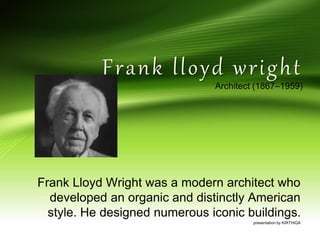
Frank lloyd wright
Architect (1867–1959)
Frank Lloyd Wright was a modern architect who
developed an organic and distinctly American
style. He designed numerous iconic buildings.
presentation by KIRTHIGA
Accomplishments:
 His architectural career lasted almost 70 years.
 Frank Lloyd Wright developed the theory "Form and
Function Are One.“
 During his final years, he designed two of his most famous
projects, the Guggenheim Museum and the Marin County
Civic Center.
 Frank Lloyd Wright designed 1141 homes and buildings, of
those 532 were completed by his death.
 Frank Lloyd Wright had a global impact on modern
architecture, influencing design styles not only in America,
but also in Europe and Asia.
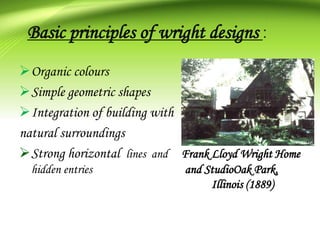
Basic principles of wright designs :
Organic colours
Simple geometric shapes
Integration of building with
natural surroundings
Strong horizontal lines and Frank Lloyd Wright Home
hidden entries and StudioOak Park,
Illinois (1889)
Famous Buildings:
 Fallingwater
(Edgar J. Kaufmann Sr. Residence),
Bear Run, Pennsylvania, 1935–1937
 Frederick C. Robie Residence,
Chicago, Illinois, 1909
 Solomon R. Guggenheim Museum,
New York City, 1956–1959
 Unity Temple,
Oak Park, Illinois, 1904
 Price Tower,
Bartlesville, Oklahoma, 1952–1956
FALLING WATER, SOUTHWESTERN PENNSYLVANIA
 The site chosen was a natural landscape area for the weak
end home with a water stream with it.
 It was thought that the building would
have a view of stream but fl wright made
it over the stream.
 Spaces are designed to bring nature inside the four walls
 Cluster organisation around central core
Wright used only 4 materials to build Fallingwater
— sandstone, reinforcedconcrete, steel
and glass.
Horizoantal element – concrete.
planes differentiated and accentuate by
changes in colour, texture, and material .
vertical element – native stone.
gives a sclupture quality highlighting
the horizontal
Interiors are simply through vibrant because of use of triadic
colours for furnitures and monochromatic brown colour for walls,
ceiling , floor
• Wright used a lot of clear glass to allow the outside to flow
freely into the inside.
• At certain times of day, the
glass becomes very reflective and
reminds some people of the
mirror-like surfaces of a calm
pool of water.
• At night, the glass seems to disappear.
• Wright chose the pale ochre color of the concrete to match the
back of a fallen rhododendron leaf.
Plans and section :
GUGGENHEIM MUSEUM, new york , united states.
• Established in 1937
• Type Art museum
• Frank Lloyd Wright created the
Guggenheim Museum as a series of
organic shapes.
• Circular forms spiral down like
the interior of a shell.
• Visitors to the museum begin on
the upper level and follow a sloping
ramp downward through connected
exhibition spaces.
Concept :
• The building itself became a work of art.
• At the core, an open rotunda offers views of artwork
on several levels.
• From the street, the building looks like a white ribbon
rolled into a cylindrical
shape, slightly wider at the
top than at the bottom.
• Internally, the galleries
form a spiral.
Its design was inspired by a
"Ziggurat" Babylonian temple
pyramid, inverted.
ROBIE HOUSE ,CHICAGO
• The Robie House of
1910 is generally
considered to be Wright’s
“best”Prairie style work.
• This style is characterized
by a dominating horizontal axis,
bandedwindows, and a spacious and open interior plan.
• The exterior is dominated by a lowhipped roof, simple
building materials (mainly brick, wood, and stucco)
Fl wright principle was followed
in this house:
strong horizontal lines
hidden entries
simple geometric shapes were followed in robie house glass
concept :
• The house was designed for Frederick C. Robie, a bicycle
manufacturer, who did not want a home done in the typical
Victorian style.
• Robie desired a modern floorplan and needed a garage, and a
playroom for children.
• He also required
that his home be
fire-proof, yet
retained an open floor
plan free of closed, box-like rooms that would prevent the
uniformity of decoration and design.
Unity temple , lake street , oak park, , united states
Background :
• In 1905, after the original
Unity Church burned down,
the Universalist congregation
of Oak Park, Illinois turned to
architect Frank Lloyd Wright to design them a new
structure.
• And finally, the architect was expected to design not
only the structure, but furniture and stained glass for
the building.
• Wright designed Unity Temple in Oak Park (1905) as
a place of worship for the Unitarian faith. This is his
original drawing of the building.
• As is consistent with the Unitarian faith, the
building is stately, solid, and devoid of religious
iconography.
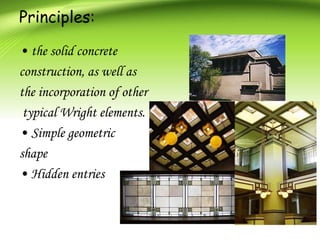
Principles:
• the solid concrete
construction, as well as
the incorporation of other
typical Wright elements.
• Simple geometric
shape
• Hidden entries
Meaning in architecture :
Falling water :
Repesent water, as it is placed above the falling water .
Robie house :
Represent Land . Constructed by wood, brick .
Guggenheim museum :
Represent social and culture . Since it is a museum , it
has art works that repesent culture .
Unity temple :
Represent Religion . Since it is a church .
Awards :
 AIA Gold Medal (1949)
 Twenty-five year award
 Royal Gold Medal (1941)
Famous quotes :
• The mother art is architecture. Without an architecture of our own we have no soul of
our own civilization.
• Form follows function - that has been misunderstood. Form and function should be
one, joined in a spiritual union.
• Nature is my manifestation of God. I go to nature every day for inspiration in the
day's work. I follow in building the principles which nature has used in its domain.
Source :
• http://en.wikiarquitectura.com/index.php/Fallingwater_House
• http://en.wikiarquitectura.com/index.php/Guggenheim_Museum_in_New_York
• http://en.wikiarquitectura.com/index.php/Robie_House
• http://en.wikipedia.org/wiki/Unity_Temple
• http://en.wikipedia.org/wiki/Frank_Lloyd_Wright
• http://www.biography.com/people/frank-lloyd-wright-9537511
• http://www.brainyquote.com/quotes/authors/f/frank_lloyd_wright.html#FxOCr6UIk0vuhiy
f.99

Frank lloyd wright

  • 1.
    Frank lloyd wright Architect(1867–1959) Frank Lloyd Wright was a modern architect who developed an organic and distinctly American style. He designed numerous iconic buildings. presentation by KIRTHIGA
  • 2.
    Accomplishments:  His architecturalcareer lasted almost 70 years.  Frank Lloyd Wright developed the theory "Form and Function Are One.“  During his final years, he designed two of his most famous projects, the Guggenheim Museum and the Marin County Civic Center.  Frank Lloyd Wright designed 1141 homes and buildings, of those 532 were completed by his death.  Frank Lloyd Wright had a global impact on modern architecture, influencing design styles not only in America, but also in Europe and Asia.
  • 3.
    Basic principles ofwright designs : Organic colours Simple geometric shapes Integration of building with natural surroundings Strong horizontal lines and Frank Lloyd Wright Home hidden entries and StudioOak Park, Illinois (1889)
  • 4.
    Famous Buildings:  Fallingwater (EdgarJ. Kaufmann Sr. Residence), Bear Run, Pennsylvania, 1935–1937  Frederick C. Robie Residence, Chicago, Illinois, 1909  Solomon R. Guggenheim Museum, New York City, 1956–1959  Unity Temple, Oak Park, Illinois, 1904  Price Tower, Bartlesville, Oklahoma, 1952–1956
  • 5.
    FALLING WATER, SOUTHWESTERNPENNSYLVANIA  The site chosen was a natural landscape area for the weak end home with a water stream with it.  It was thought that the building would have a view of stream but fl wright made it over the stream.  Spaces are designed to bring nature inside the four walls  Cluster organisation around central core
  • 6.
    Wright used only4 materials to build Fallingwater — sandstone, reinforcedconcrete, steel and glass. Horizoantal element – concrete. planes differentiated and accentuate by changes in colour, texture, and material . vertical element – native stone. gives a sclupture quality highlighting the horizontal Interiors are simply through vibrant because of use of triadic colours for furnitures and monochromatic brown colour for walls, ceiling , floor
  • 7.
    • Wright useda lot of clear glass to allow the outside to flow freely into the inside. • At certain times of day, the glass becomes very reflective and reminds some people of the mirror-like surfaces of a calm pool of water. • At night, the glass seems to disappear. • Wright chose the pale ochre color of the concrete to match the back of a fallen rhododendron leaf.
  • 8.
  • 9.
    GUGGENHEIM MUSEUM, newyork , united states. • Established in 1937 • Type Art museum • Frank Lloyd Wright created the Guggenheim Museum as a series of organic shapes. • Circular forms spiral down like the interior of a shell. • Visitors to the museum begin on the upper level and follow a sloping ramp downward through connected exhibition spaces.
  • 10.
    Concept : • Thebuilding itself became a work of art. • At the core, an open rotunda offers views of artwork on several levels. • From the street, the building looks like a white ribbon rolled into a cylindrical shape, slightly wider at the top than at the bottom. • Internally, the galleries form a spiral.
  • 11.
    Its design wasinspired by a "Ziggurat" Babylonian temple pyramid, inverted.
  • 12.
    ROBIE HOUSE ,CHICAGO •The Robie House of 1910 is generally considered to be Wright’s “best”Prairie style work. • This style is characterized by a dominating horizontal axis, bandedwindows, and a spacious and open interior plan. • The exterior is dominated by a lowhipped roof, simple building materials (mainly brick, wood, and stucco)
  • 13.
    Fl wright principlewas followed in this house: strong horizontal lines hidden entries simple geometric shapes were followed in robie house glass
  • 14.
    concept : • Thehouse was designed for Frederick C. Robie, a bicycle manufacturer, who did not want a home done in the typical Victorian style. • Robie desired a modern floorplan and needed a garage, and a playroom for children. • He also required that his home be fire-proof, yet retained an open floor plan free of closed, box-like rooms that would prevent the uniformity of decoration and design.
  • 15.
    Unity temple ,lake street , oak park, , united states Background : • In 1905, after the original Unity Church burned down, the Universalist congregation of Oak Park, Illinois turned to architect Frank Lloyd Wright to design them a new structure. • And finally, the architect was expected to design not only the structure, but furniture and stained glass for the building.
  • 16.
    • Wright designedUnity Temple in Oak Park (1905) as a place of worship for the Unitarian faith. This is his original drawing of the building. • As is consistent with the Unitarian faith, the building is stately, solid, and devoid of religious iconography.
  • 17.
    Principles: • the solidconcrete construction, as well as the incorporation of other typical Wright elements. • Simple geometric shape • Hidden entries
  • 18.
    Meaning in architecture: Falling water : Repesent water, as it is placed above the falling water . Robie house : Represent Land . Constructed by wood, brick . Guggenheim museum : Represent social and culture . Since it is a museum , it has art works that repesent culture . Unity temple : Represent Religion . Since it is a church .
  • 19.
    Awards :  AIAGold Medal (1949)  Twenty-five year award  Royal Gold Medal (1941) Famous quotes : • The mother art is architecture. Without an architecture of our own we have no soul of our own civilization. • Form follows function - that has been misunderstood. Form and function should be one, joined in a spiritual union. • Nature is my manifestation of God. I go to nature every day for inspiration in the day's work. I follow in building the principles which nature has used in its domain.
  • 20.
    Source : • http://en.wikiarquitectura.com/index.php/Fallingwater_House •http://en.wikiarquitectura.com/index.php/Guggenheim_Museum_in_New_York • http://en.wikiarquitectura.com/index.php/Robie_House • http://en.wikipedia.org/wiki/Unity_Temple • http://en.wikipedia.org/wiki/Frank_Lloyd_Wright • http://www.biography.com/people/frank-lloyd-wright-9537511 • http://www.brainyquote.com/quotes/authors/f/frank_lloyd_wright.html#FxOCr6UIk0vuhiy f.99