STONEWARE
PRESENTATION BY
KIRTHIGA.E
ABINAYA.P
SANDHYA.P
MOHANA PRIYA.S
SUBHASHREE.
STONEWARE
• Stoneware is a vitreous or semi-vitreous ceramic made primarily
from stoneware clay or non-refractory fire clay.
• Stoneware is fired at high temperatures and cooled down slowly
• It is nonporous and so does not need a glaze
Definition:
The term stoneware is used to indicate the
wares or articles prepared from refractory
clay which are mixed with stone and crushed
pottery .
• Matures between 1200-1300 ̊ C
(2192-2372 ̊ F). High fired!
• Hard, dense clay body which has a water
absorption rate of 3% or less when fully fired
• It is usually coloured grey or brownish because of
impurities in the clay used for its manufacture,
and is normally glazed.“
• Colors can be off-white, tan, grey and/or brown
• Often used for “art pottery”: jugs, mugs, plates,
bowls, etc.
• The key raw material in stoneware is either
naturally occurring stoneware clay or non-
refractory fire clay.
• The mineral kaolinite is present but
disordered, and although mica and quartz are
present their particle size is very small.
• Stoneware clay is often accompanied by
impurities such as iron or carbon, giving it a
"dirty" look, and its plasticity can vary widely.
• Non-refractory fire clay may be another key
raw material.
• Fire clays are generally considered refractory,
because they withstand very high
temperatures before melting or crumbling.
• Refractory fire clays have a high concentration
of the mineral kaolinite, with lesser amounts
of mica and quartz.
• Non-refractory fire clays, however, have larger
amounts of mica and feldspar.
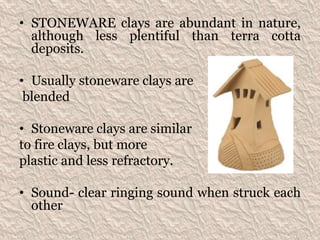
• STONEWARE clays are abundant in nature,
although less plentiful than terra cotta
deposits.
• Usually stoneware clays are
blended
• Stoneware clays are similar
to fire clays, but more
plastic and less refractory.
• Sound- clear ringing sound when struck each
other
• Stoneware clays have an absorption factor of
about 2 to 5 percent, and are usually fired to
temperatures ranging from 2100 degrees to
2372 degrees F (cone 3-cone 11*).
• As one might guess, stoneware clays are so
named because the fired wares exhibit stone-
like characteristics:
• a hard,
• dense surface with often variegated color.
• Stoneware usually bonds well with its glazes, and
should be completely leak-proof after firing to
maturity.
• It is tough and forgiving during throwing and
firing stages, and is often used for industrial
ceramics.
• Fired stoneware can yield pleasing colors ranging
from buff or light gray to brown or dark gray.
• Because of its hard, tight qualities, this clay is an
excellent choice for functional applications,
especially dinnerware.
• The higher the maturing temperature of the
stoneware, the more durable the product.
GOOD BODY CHARACTERISTICS:
• Good plasticity for forming method but with enough
tooth to make large shapes w/o slumping.
• Body open enough to dry w/o undue warping or
cracking.
• Shrinkage controlled in drying and firing: no tendency
to cracking.
• Does not warp or slump much in firing to maturity
• Desired degree of vitrification
• Color desired
• Freedom from alkalies (soluble salts) that cause
scumming.
TYPES OF STONE WARE
• Traditional stoneware
• Fine stoneware
• Chemical stoneware
• Thermal shock resistant stoneware
• Electrical stoneware
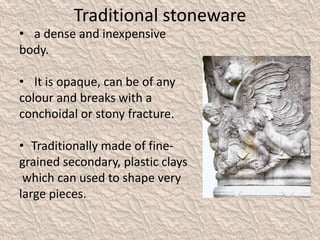
Traditional stoneware
• a dense and inexpensive
body.
• It is opaque, can be of any
colour and breaks with a
conchoidal or stony fracture.
• Traditionally made of fine-
grained secondary, plastic clays
which can used to shape very
large pieces.
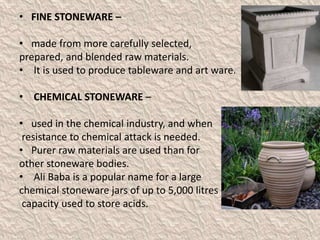
• FINE STONEWARE –
• made from more carefully selected,
prepared, and blended raw materials.
• It is used to produce tableware and art ware.
• CHEMICAL STONEWARE –
• used in the chemical industry, and when
resistance to chemical attack is needed.
• Purer raw materials are used than for
other stoneware bodies.
• Ali Baba is a popular name for a large
chemical stoneware jars of up to 5,000 litres
capacity used to store acids.
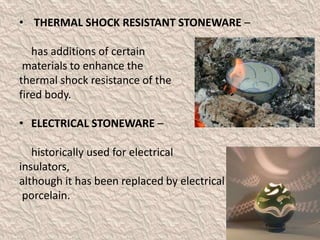
• THERMAL SHOCK RESISTANT STONEWARE –
has additions of certain
materials to enhance the
thermal shock resistance of the
fired body.
• ELECTRICAL STONEWARE –
historically used for electrical
insulators,
although it has been replaced by electrical
porcelain.
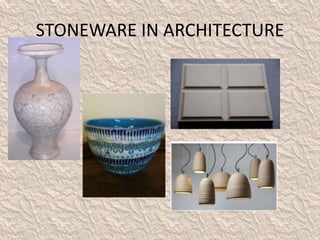
STONEWARE IN ARCHITECTURE
• Formulations for stoneware vary considerably,
although the vast majority will conform to:
• plastic fire clays, 0 to 100 percent;
• ball clays, 0 to 15 percent;
• quartz, 0 to 30 percent;
• feldspar and chamotte, 0 to 15 percent.

Stoneware

  • 1.
  • 2.
    STONEWARE • Stoneware isa vitreous or semi-vitreous ceramic made primarily from stoneware clay or non-refractory fire clay. • Stoneware is fired at high temperatures and cooled down slowly • It is nonporous and so does not need a glaze Definition: The term stoneware is used to indicate the wares or articles prepared from refractory clay which are mixed with stone and crushed pottery .
  • 3.
    • Matures between1200-1300 ̊ C (2192-2372 ̊ F). High fired! • Hard, dense clay body which has a water absorption rate of 3% or less when fully fired • It is usually coloured grey or brownish because of impurities in the clay used for its manufacture, and is normally glazed.“ • Colors can be off-white, tan, grey and/or brown • Often used for “art pottery”: jugs, mugs, plates, bowls, etc.
  • 4.
    • The keyraw material in stoneware is either naturally occurring stoneware clay or non- refractory fire clay. • The mineral kaolinite is present but disordered, and although mica and quartz are present their particle size is very small. • Stoneware clay is often accompanied by impurities such as iron or carbon, giving it a "dirty" look, and its plasticity can vary widely. • Non-refractory fire clay may be another key raw material.
  • 5.
    • Fire claysare generally considered refractory, because they withstand very high temperatures before melting or crumbling. • Refractory fire clays have a high concentration of the mineral kaolinite, with lesser amounts of mica and quartz. • Non-refractory fire clays, however, have larger amounts of mica and feldspar.
  • 6.
    • STONEWARE claysare abundant in nature, although less plentiful than terra cotta deposits. • Usually stoneware clays are blended • Stoneware clays are similar to fire clays, but more plastic and less refractory. • Sound- clear ringing sound when struck each other
  • 7.
    • Stoneware clayshave an absorption factor of about 2 to 5 percent, and are usually fired to temperatures ranging from 2100 degrees to 2372 degrees F (cone 3-cone 11*). • As one might guess, stoneware clays are so named because the fired wares exhibit stone- like characteristics: • a hard, • dense surface with often variegated color.
  • 8.
    • Stoneware usuallybonds well with its glazes, and should be completely leak-proof after firing to maturity. • It is tough and forgiving during throwing and firing stages, and is often used for industrial ceramics. • Fired stoneware can yield pleasing colors ranging from buff or light gray to brown or dark gray. • Because of its hard, tight qualities, this clay is an excellent choice for functional applications, especially dinnerware. • The higher the maturing temperature of the stoneware, the more durable the product.
  • 9.
    GOOD BODY CHARACTERISTICS: •Good plasticity for forming method but with enough tooth to make large shapes w/o slumping. • Body open enough to dry w/o undue warping or cracking. • Shrinkage controlled in drying and firing: no tendency to cracking. • Does not warp or slump much in firing to maturity • Desired degree of vitrification • Color desired • Freedom from alkalies (soluble salts) that cause scumming.
  • 10.
    TYPES OF STONEWARE • Traditional stoneware • Fine stoneware • Chemical stoneware • Thermal shock resistant stoneware • Electrical stoneware
  • 11.
    Traditional stoneware • adense and inexpensive body. • It is opaque, can be of any colour and breaks with a conchoidal or stony fracture. • Traditionally made of fine- grained secondary, plastic clays which can used to shape very large pieces.
  • 12.
    • FINE STONEWARE– • made from more carefully selected, prepared, and blended raw materials. • It is used to produce tableware and art ware. • CHEMICAL STONEWARE – • used in the chemical industry, and when resistance to chemical attack is needed. • Purer raw materials are used than for other stoneware bodies. • Ali Baba is a popular name for a large chemical stoneware jars of up to 5,000 litres capacity used to store acids.
  • 13.
    • THERMAL SHOCKRESISTANT STONEWARE – has additions of certain materials to enhance the thermal shock resistance of the fired body. • ELECTRICAL STONEWARE – historically used for electrical insulators, although it has been replaced by electrical porcelain.
  • 14.
  • 15.
    • Formulations forstoneware vary considerably, although the vast majority will conform to: • plastic fire clays, 0 to 100 percent; • ball clays, 0 to 15 percent; • quartz, 0 to 30 percent; • feldspar and chamotte, 0 to 15 percent.