• Bark
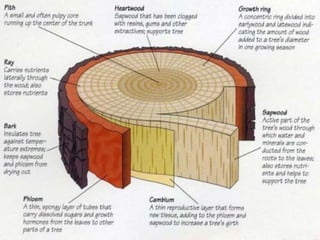
• Inner bark
• Cambium
• Growth ring
• Rays
• Pith (medulla)
• Sapwood
• Heartwood
Bark
the outer sheath of the tree.
It functions as:
● a moisture barrier,
● a thermal insulator, against extremes in
temperature – both hot or cold.
● an armour plate against extremes of
temperature, attack by insects, fungi, and
animals.
The bark of a well-established tree can usually
withstand minor damage, although excessive
ill treatment to this region could prove fatal.
Inner bark (bast or phloem)
Conducts food throughout the whole of the
tree, from the leaves to the roots.
Cambium
A thin layer or sleeve of cells located
between the sapwood and the bast
(phloem).These cells are responsible for the
tree’s growth. As they are formed, they
become subdivided in such a way that new
cells are added to both sapwood and
phloem, thus increasing the girth of the tree
 Growth ring
(Sometimes referred to as an annual ring) –
wood cells that have formed around the
circumference of the tree during
its growing season.The climate and time ofyear
dictate the growth pattern. Each ring is often
seen as two distinct bands, known as earlywood
(springwood) and latewood (summerwood).
Latewood is usually more dense than
earlywood and can be recognised by its darker
appearance.
Growth rings are important because
they enable the woodworker to decide
on the suitability of the wood as a
whole – either as timber for joinery
(appearance & stability) or, its structural
properties (strength & stability) as
carcaseing timber.
Rays
these may all appear (although falsely – as
not many do) to originate from the centre
(medulla) of the tree, hence the term
medullary rays is often used to describe this
strip of cells that allow sap to percolate
transversely through the wood.They are
also used to store excess food.
Rays are more noticeable in hardwood than
in softwood and even then can be seen with
the naked eye only in such woods as oak and
beech. fig. 1.21 shows how rays may be used
as a decorative feature once the wood has
been converted (sawn into timber).
Pith (medulla)
the core or centre of the tree, formed from
the tree’s earliest growth as a sapling.Wood
immediately surrounding the pith is called
juvenile wood, which is not suitable as timber.
Sapwood
the outer active part of the tree which, as its
name implies, receives and conducts sap
from the roots to the leaves.As this part of
the tree matures, it gradually becomes
heartwood.
Heartwood
the natural non-active part ofthe tree, often
darker in colour than sapwood, gives
strength and support to the tree and
provides the most durable wood for
conversion into timber

Carpentry Basic -Structural elements of a tree.pptx

  • 1.
    • Bark • Innerbark • Cambium • Growth ring • Rays • Pith (medulla) • Sapwood • Heartwood
  • 3.
    Bark the outer sheathof the tree. It functions as: ● a moisture barrier, ● a thermal insulator, against extremes in temperature – both hot or cold. ● an armour plate against extremes of temperature, attack by insects, fungi, and animals. The bark of a well-established tree can usually withstand minor damage, although excessive ill treatment to this region could prove fatal.
  • 4.
    Inner bark (bastor phloem) Conducts food throughout the whole of the tree, from the leaves to the roots.
  • 5.
    Cambium A thin layeror sleeve of cells located between the sapwood and the bast (phloem).These cells are responsible for the tree’s growth. As they are formed, they become subdivided in such a way that new cells are added to both sapwood and phloem, thus increasing the girth of the tree
  • 6.
     Growth ring (Sometimesreferred to as an annual ring) – wood cells that have formed around the circumference of the tree during its growing season.The climate and time ofyear dictate the growth pattern. Each ring is often seen as two distinct bands, known as earlywood (springwood) and latewood (summerwood). Latewood is usually more dense than earlywood and can be recognised by its darker appearance.
  • 7.
    Growth rings areimportant because they enable the woodworker to decide on the suitability of the wood as a whole – either as timber for joinery (appearance & stability) or, its structural properties (strength & stability) as carcaseing timber.
  • 8.
    Rays these may allappear (although falsely – as not many do) to originate from the centre (medulla) of the tree, hence the term medullary rays is often used to describe this strip of cells that allow sap to percolate transversely through the wood.They are also used to store excess food.
  • 9.
    Rays are morenoticeable in hardwood than in softwood and even then can be seen with the naked eye only in such woods as oak and beech. fig. 1.21 shows how rays may be used as a decorative feature once the wood has been converted (sawn into timber).
  • 10.
    Pith (medulla) the coreor centre of the tree, formed from the tree’s earliest growth as a sapling.Wood immediately surrounding the pith is called juvenile wood, which is not suitable as timber.
  • 11.
    Sapwood the outer activepart of the tree which, as its name implies, receives and conducts sap from the roots to the leaves.As this part of the tree matures, it gradually becomes heartwood.
  • 12.
    Heartwood the natural non-activepart ofthe tree, often darker in colour than sapwood, gives strength and support to the tree and provides the most durable wood for conversion into timber