Lecture No. 2
HAFIZ MASOOD AHMAD
Lecturer
Department of Forestry &
Range Management
University of Agriculture, Faisalabad
FUNCTIONAL TREE
MORPHOLOGY
Total tree species in Pakistan = 430
 Broad leaved/ Angiosperm/ Hard wood species =
408
 Conifers/ Gymnosperm/Soft wood Species= 22
Total tree genera =226
 Genera belonging to Broad leaved trees =215
 Genera belonging to conifer trees = 11
Total tree families =82
 Families belonging to Broad leaved trees = 77
 Families belonging to conifer trees = 5
TREES IN PAKISTAN
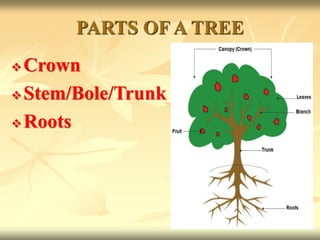
PARTS OF A TREE
 Crown
 Stem/Bole/Trunk
 Roots
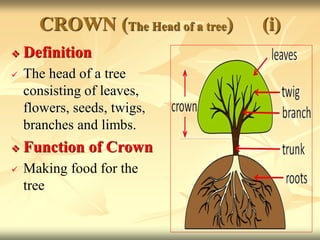
 Definition
 The head of a tree
consisting of leaves,
flowers, seeds, twigs,
branches and limbs.
 Function of Crown
 Making food for the
tree
CROWN (The Head of a tree) (i)
CROWN (The Head of a tree) (ii)
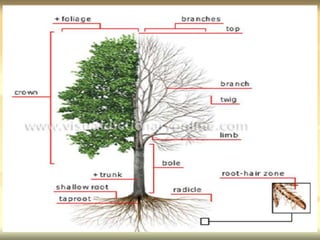
 Various Parts of a Crown:
 Leaves
 Flowers
 Fruits
 Seeds
 Twigs
 Branches.
 Limbs
CROWN (The Head of a tree) (iii)
 Leaves:
 Leaves are the green, flat, lateral outgrowth in
plants.
 These are generally dorso-ventrally flattened and
thin.
 Functions of Leaves:
 These are responsible for photosynthesis as they
contain chlorophyll.
 Respiration also take place in leaves
CROWN (The Head of a tree) (iv)
 Types of Leaves :
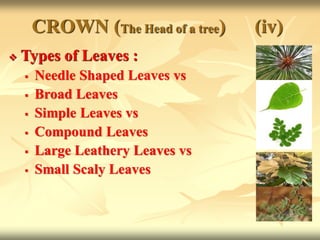
 Needle Shaped Leaves vs
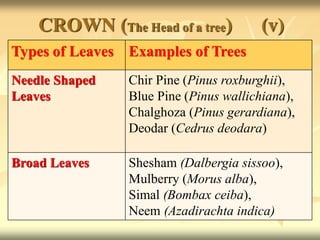
 Broad Leaves
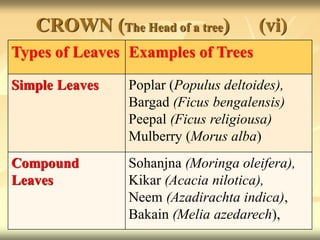
 Simple Leaves vs
 Compound Leaves
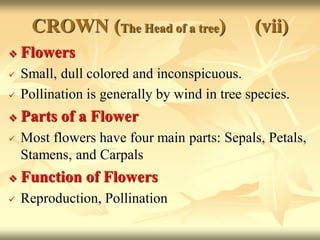
 Large Leathery Leaves vs
 Small Scaly Leaves
Types of Leaves Examples of Trees
Needle Shaped
Leaves
Chir Pine (Pinus roxburghii),
Blue Pine (Pinus wallichiana),
Chalghoza (Pinus gerardiana),
Deodar (Cedrus deodara)
Broad Leaves Shesham (Dalbergia sissoo),
Mulberry (Morus alba),
Simal (Bombax ceiba),
Neem (Azadirachta indica)
CROWN (The Head of a tree) (v)
Types of Leaves Examples of Trees
Simple Leaves Poplar (Populus deltoides),
Bargad (Ficus bengalensis)
Peepal (Ficus religiousa)
Mulberry (Morus alba)
Compound
Leaves
Sohanjna (Moringa oleifera),
Kikar (Acacia nilotica),
Neem (Azadirachta indica),
Bakain (Melia azedarech),
CROWN (The Head of a tree) (vi)
CROWN (The Head of a tree) (vii)
 Flowers
 Small, dull colored and inconspicuous.
 Pollination is generally by wind in tree species.
 Parts of a Flower
 Most flowers have four main parts: Sepals, Petals,
Stamens, and Carpals
 Function of Flowers
 Reproduction, Pollination
CROWN (The Head of a tree) (viii)
 Seed
 Important regeneration source of plants
 Parts of Seed:
 Endosperm i.e. Food storage chamber
 Embryo i.e. Future plant or baby tree
 Testa i.e. Protective cover.
 Plumule Future shoot
 Radicle Future root
CROWN (The Head of a tree) (ix)
 Seed Characters:
 Some seeds germinate on the tree but some after
falling.
 Some seeds undergo dormancy.
 Some seeds have very short viability e.g. Neem
and Jaman
 Some seeds have very long viability e.g. Kikar,
 Naked seeds are present in Gymnosperm
 While in Angiosperms, seeds are enclosed in
fruits
CROWN (The Head of a tree) (x)
 Twigs:
 Small branches of thumb thickness or less.
 Woody in nature.
 Entire tissue is alive.
 Function of Twigs:
 Support the leaves, flowers, fruits and seeds
 Transport water, nutrients and food
 Vegetative reproduction
CROWN (The Head of a tree) (xi)
 Branches:
 Larger twigs
 Woody in nature.
 Thickness varies from thumb to wrist.
 Central core of branches is generally dead.
 Functions of Branches: Same as twigs
 Support
 Transport of food, nutrients and water
 Storage of food, nutrients and water.
 Responsible for giving proper shape to the tree
 Limbs:
 Larger branches over wrist thickness
 Woody in nature
 Some times central core is dead
 Can be used as fuel as well as for timber
purpose
 Function of Limbs: (same as branches)
 Water, nutrients and synthesized food move
through the limbs
 Limbs support the branches and twigs
 These are also used for food storage
CROWN (The Head of a tree) (xii)
 Central part of a tree that is above roots and
below crown
 Consist of dead bark (dead phloem), living
bark (living phloem), cambium, sap wood
(living wood), and heart wood (dead wood).
 Most important and useful part of tree.
 Woody in nature.
 Central core is dead.
 Round cylindrical shape
 Having tapering
STEM
 Function of Stem:
 Mechanical Strength
 Stem supports limbs, limbs carry branches,
braches carry twigs and twigs carry leaves,
flowers, fruits and seed.
 Stem also transport water nutrients and food in
the tree.
 Source of wood
STEM
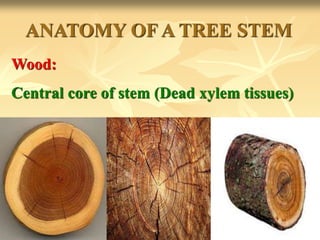
Wood:
Central core of stem (Dead xylem tissues)
ANATOMY OF A TREE STEM
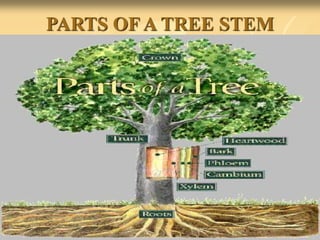
PARTS OF A TREE STEM
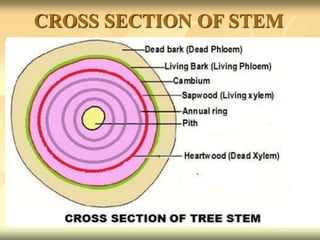
CROSS SECTION OF STEM
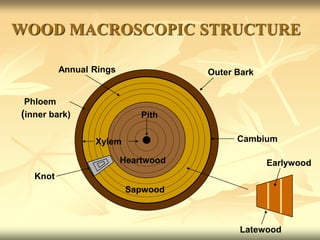
WOOD MACROSCOPIC STRUCTURE
Outer Bark
Cambium
Xylem
Phloem
(inner bark)
Heartwood
Sapwood
Pith
Annual Rings
Earlywood
Latewood
Knot
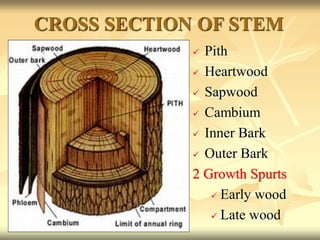
CROSS SECTION OF STEM
 Pith
 Heartwood
 Sapwood
 Cambium
 Inner Bark
 Outer Bark
2 Growth Spurts
 Early wood
 Late wood
 Sap wood/Living wood/Living xylem
 The soft outer layers of recently formed wood
between the heart wood and cambium, containing
functional vascular (xylem) tissues.
 It is light coloured region of the tree trunk
consisting of living wood cells and helps in
translocation.
 Function of Sapwood
 This layer transports water and nutrients from soil
to leaves
PARTS OF A TREE STEM
 Heart wood/Dead wood/Dead xylem
 Central core of dead xylem surrounded by thin
layer of living xylem
 Heartwood is the inner dark coloured part of the
wood of tree composed of dead cells filled with
resin, gums, tannins, etc.
 Function of Heartwood
 Deposition of food and waste products in central
woody cells and in canals.
PARTS OF A TREE STEM
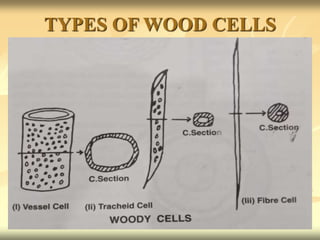
 Vessels: Larger woody cells with partially or
completely open end walls found in broad leaved
tree species (Angiosperms).
 Distributed uniformly throughout the cross
section or concentrated in the form of rings.
 Trachieds: Large woody cells with oblique end
walls found in conifer species (Gymnosperms)
 Fibers: Long narrow woody cells with pointed
ends like spindles found in broad leaved tree
species (Angiosperms).
TYPES OF WOOD CELLS
TYPES OF WOOD CELLS
TYPES OF WOOD CELLS
 Parenchyma cells: Wood cells that function
primarily in the storage and conduction of food
materials are known as parenchyma cells. These
cells typically form thin secondary walls and are
the last to remain functional prior to heartwood
formation.
 Ray cells: Living parenchyma present in radial
direction are also called Ray cells.
 Canals: Central ray cells collapse and give rise
to canals
 Cambium: Living xylem is surrounded by a
narrow layer of growth cells that is called
cambium.
 It exists inside of living bark (living phloem) and
out side of living wood (living xylum)
 Functions of Cambium
 Responsible for lateral growth
 Produce xylem cells (wood cells) Inside and
phloem cells (living bark) outside.
PARTS OF STEM
 Phloem: Living phloem is living bark while
dead phloem is dead bark
 Function of Phloem:
 Transportation of synthesized food.
 Bark: The outer most layers is called bark
consisting of phloem.
 It protects the inner living layer form extreme
temperature, drought and other factors.
 Bark yields important tree products like tannin
and cork for bottle stoppers and insulation.
PARTS OF STEM
FORMATION OF ANNUAL
RINGS IN TREE STEM
 Spring & summer wood cells = larger
 Autumn & early winter wood cells = Smaller
 Both layers can be easily distinguished.
 Annual ring or annual growth layer:
 A layer of spring/summer cells and a layer of
autumn/winter cells is collectively called Annual
ring
 Layers are generally visible, indicate the age and
growth of tree (more prominent in conifer trees).
STRUCTURE OF ROOT
 Root: Underground part of the tree, consisting of
woody and fibrous parts.
 Woody part provide mechanical support,
transport and storage of food.
 Two types of roots: Tap root and Fibrous root
 Structure of Root
 Central core dead xylem
 Many conductive tissues; mostly dead
 Conductive tissues of outer periphery; most of
are alive and functional.
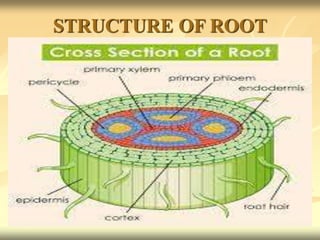
STRUCTURE OF ROOT
 Endodermis: The central core is surrounded by
a single layer of tightly packed, cemented cells
called endodermis
 Function of Endodermis: Controls the
movement of water and solutes. Degree of control
depends on vigor of cells.
 Cortex: The next layer is called cortex. These
are loosely packed living parenchyma cells.
Provide cushion & lubrication.
 Corky tissue: Outer most layer is corky tissue.
Waste products are deposited in it.
STRUCTURE OF ROOT
 Thin and Long, consist of few bundles of
conductive tissues
 Two additional structure, i.e. Root cap & Root
hair
 Root Cap: It is at the tip of fibrous roots,
consist of loosely packed living cells & provide
lubrication.
 Root Hair: Single celled appendages, increase
the area, absorb nutrients and water.
 Root surface area is 2-3 times more than leaf area
STRUCTURE OF ROOT
THANKS

L-2- Functional Tree Morphology W-23.pdf

  • 1.
    Lecture No. 2 HAFIZMASOOD AHMAD Lecturer Department of Forestry & Range Management University of Agriculture, Faisalabad FUNCTIONAL TREE MORPHOLOGY
  • 2.
    Total tree speciesin Pakistan = 430  Broad leaved/ Angiosperm/ Hard wood species = 408  Conifers/ Gymnosperm/Soft wood Species= 22 Total tree genera =226  Genera belonging to Broad leaved trees =215  Genera belonging to conifer trees = 11 Total tree families =82  Families belonging to Broad leaved trees = 77  Families belonging to conifer trees = 5 TREES IN PAKISTAN
  • 3.
    PARTS OF ATREE  Crown  Stem/Bole/Trunk  Roots
  • 4.
     Definition  Thehead of a tree consisting of leaves, flowers, seeds, twigs, branches and limbs.  Function of Crown  Making food for the tree CROWN (The Head of a tree) (i)
  • 5.
    CROWN (The Headof a tree) (ii)  Various Parts of a Crown:  Leaves  Flowers  Fruits  Seeds  Twigs  Branches.  Limbs
  • 7.
    CROWN (The Headof a tree) (iii)  Leaves:  Leaves are the green, flat, lateral outgrowth in plants.  These are generally dorso-ventrally flattened and thin.  Functions of Leaves:  These are responsible for photosynthesis as they contain chlorophyll.  Respiration also take place in leaves
  • 8.
    CROWN (The Headof a tree) (iv)  Types of Leaves :  Needle Shaped Leaves vs  Broad Leaves  Simple Leaves vs  Compound Leaves  Large Leathery Leaves vs  Small Scaly Leaves
  • 9.
    Types of LeavesExamples of Trees Needle Shaped Leaves Chir Pine (Pinus roxburghii), Blue Pine (Pinus wallichiana), Chalghoza (Pinus gerardiana), Deodar (Cedrus deodara) Broad Leaves Shesham (Dalbergia sissoo), Mulberry (Morus alba), Simal (Bombax ceiba), Neem (Azadirachta indica) CROWN (The Head of a tree) (v)
  • 10.
    Types of LeavesExamples of Trees Simple Leaves Poplar (Populus deltoides), Bargad (Ficus bengalensis) Peepal (Ficus religiousa) Mulberry (Morus alba) Compound Leaves Sohanjna (Moringa oleifera), Kikar (Acacia nilotica), Neem (Azadirachta indica), Bakain (Melia azedarech), CROWN (The Head of a tree) (vi)
  • 11.
    CROWN (The Headof a tree) (vii)  Flowers  Small, dull colored and inconspicuous.  Pollination is generally by wind in tree species.  Parts of a Flower  Most flowers have four main parts: Sepals, Petals, Stamens, and Carpals  Function of Flowers  Reproduction, Pollination
  • 12.
    CROWN (The Headof a tree) (viii)  Seed  Important regeneration source of plants  Parts of Seed:  Endosperm i.e. Food storage chamber  Embryo i.e. Future plant or baby tree  Testa i.e. Protective cover.  Plumule Future shoot  Radicle Future root
  • 13.
    CROWN (The Headof a tree) (ix)  Seed Characters:  Some seeds germinate on the tree but some after falling.  Some seeds undergo dormancy.  Some seeds have very short viability e.g. Neem and Jaman  Some seeds have very long viability e.g. Kikar,  Naked seeds are present in Gymnosperm  While in Angiosperms, seeds are enclosed in fruits
  • 14.
    CROWN (The Headof a tree) (x)  Twigs:  Small branches of thumb thickness or less.  Woody in nature.  Entire tissue is alive.  Function of Twigs:  Support the leaves, flowers, fruits and seeds  Transport water, nutrients and food  Vegetative reproduction
  • 15.
    CROWN (The Headof a tree) (xi)  Branches:  Larger twigs  Woody in nature.  Thickness varies from thumb to wrist.  Central core of branches is generally dead.  Functions of Branches: Same as twigs  Support  Transport of food, nutrients and water  Storage of food, nutrients and water.  Responsible for giving proper shape to the tree
  • 16.
     Limbs:  Largerbranches over wrist thickness  Woody in nature  Some times central core is dead  Can be used as fuel as well as for timber purpose  Function of Limbs: (same as branches)  Water, nutrients and synthesized food move through the limbs  Limbs support the branches and twigs  These are also used for food storage CROWN (The Head of a tree) (xii)
  • 17.
     Central partof a tree that is above roots and below crown  Consist of dead bark (dead phloem), living bark (living phloem), cambium, sap wood (living wood), and heart wood (dead wood).  Most important and useful part of tree.  Woody in nature.  Central core is dead.  Round cylindrical shape  Having tapering STEM
  • 18.
     Function ofStem:  Mechanical Strength  Stem supports limbs, limbs carry branches, braches carry twigs and twigs carry leaves, flowers, fruits and seed.  Stem also transport water nutrients and food in the tree.  Source of wood STEM
  • 19.
    Wood: Central core ofstem (Dead xylem tissues) ANATOMY OF A TREE STEM
  • 20.
    PARTS OF ATREE STEM
  • 21.
  • 22.
    WOOD MACROSCOPIC STRUCTURE OuterBark Cambium Xylem Phloem (inner bark) Heartwood Sapwood Pith Annual Rings Earlywood Latewood Knot
  • 23.
    CROSS SECTION OFSTEM  Pith  Heartwood  Sapwood  Cambium  Inner Bark  Outer Bark 2 Growth Spurts  Early wood  Late wood
  • 24.
     Sap wood/Livingwood/Living xylem  The soft outer layers of recently formed wood between the heart wood and cambium, containing functional vascular (xylem) tissues.  It is light coloured region of the tree trunk consisting of living wood cells and helps in translocation.  Function of Sapwood  This layer transports water and nutrients from soil to leaves PARTS OF A TREE STEM
  • 25.
     Heart wood/Deadwood/Dead xylem  Central core of dead xylem surrounded by thin layer of living xylem  Heartwood is the inner dark coloured part of the wood of tree composed of dead cells filled with resin, gums, tannins, etc.  Function of Heartwood  Deposition of food and waste products in central woody cells and in canals. PARTS OF A TREE STEM
  • 26.
     Vessels: Largerwoody cells with partially or completely open end walls found in broad leaved tree species (Angiosperms).  Distributed uniformly throughout the cross section or concentrated in the form of rings.  Trachieds: Large woody cells with oblique end walls found in conifer species (Gymnosperms)  Fibers: Long narrow woody cells with pointed ends like spindles found in broad leaved tree species (Angiosperms). TYPES OF WOOD CELLS
  • 27.
  • 28.
    TYPES OF WOODCELLS  Parenchyma cells: Wood cells that function primarily in the storage and conduction of food materials are known as parenchyma cells. These cells typically form thin secondary walls and are the last to remain functional prior to heartwood formation.  Ray cells: Living parenchyma present in radial direction are also called Ray cells.  Canals: Central ray cells collapse and give rise to canals
  • 29.
     Cambium: Livingxylem is surrounded by a narrow layer of growth cells that is called cambium.  It exists inside of living bark (living phloem) and out side of living wood (living xylum)  Functions of Cambium  Responsible for lateral growth  Produce xylem cells (wood cells) Inside and phloem cells (living bark) outside. PARTS OF STEM
  • 30.
     Phloem: Livingphloem is living bark while dead phloem is dead bark  Function of Phloem:  Transportation of synthesized food.  Bark: The outer most layers is called bark consisting of phloem.  It protects the inner living layer form extreme temperature, drought and other factors.  Bark yields important tree products like tannin and cork for bottle stoppers and insulation. PARTS OF STEM
  • 31.
    FORMATION OF ANNUAL RINGSIN TREE STEM  Spring & summer wood cells = larger  Autumn & early winter wood cells = Smaller  Both layers can be easily distinguished.  Annual ring or annual growth layer:  A layer of spring/summer cells and a layer of autumn/winter cells is collectively called Annual ring  Layers are generally visible, indicate the age and growth of tree (more prominent in conifer trees).
  • 32.
    STRUCTURE OF ROOT Root: Underground part of the tree, consisting of woody and fibrous parts.  Woody part provide mechanical support, transport and storage of food.  Two types of roots: Tap root and Fibrous root  Structure of Root  Central core dead xylem  Many conductive tissues; mostly dead  Conductive tissues of outer periphery; most of are alive and functional.
  • 33.
  • 34.
     Endodermis: Thecentral core is surrounded by a single layer of tightly packed, cemented cells called endodermis  Function of Endodermis: Controls the movement of water and solutes. Degree of control depends on vigor of cells.  Cortex: The next layer is called cortex. These are loosely packed living parenchyma cells. Provide cushion & lubrication.  Corky tissue: Outer most layer is corky tissue. Waste products are deposited in it. STRUCTURE OF ROOT
  • 35.
     Thin andLong, consist of few bundles of conductive tissues  Two additional structure, i.e. Root cap & Root hair  Root Cap: It is at the tip of fibrous roots, consist of loosely packed living cells & provide lubrication.  Root Hair: Single celled appendages, increase the area, absorb nutrients and water.  Root surface area is 2-3 times more than leaf area STRUCTURE OF ROOT
  • 36.