
TIMBER
By
KIRTHIGA.E
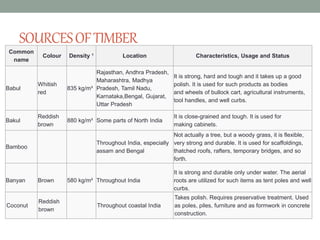
SOURCESOFTIMBER
Common
name
Colour Density ¹ Location Characteristics, Usage and Status
Babul
Whitish
red
835 kg/m³
Rajasthan, Andhra Pradesh,
Maharashtra, Madhya
Pradesh, Tamil Nadu,
Karnataka,Bengal, Gujarat,
Uttar Pradesh
It is strong, hard and tough and it takes up a good
polish. It is used for such products as bodies
and wheels of bullock cart, agricultural instruments,
tool handles, and well curbs.
Bakul
Reddish
brown
880 kg/m³ Some parts of North India
It is close-grained and tough. It is used for
making cabinets.
Bamboo
Throughout India, especially
assam and Bengal
Not actually a tree, but a woody grass, it is flexible,
very strong and durable. It is used for scaffoldings,
thatched roofs, rafters, temporary bridges, and so
forth.
Banyan Brown 580 kg/m³ Throughout India
It is strong and durable only under water. The aerial
roots are utilized for such items as tent poles and well
curbs.
Coconut
Reddish
brown
Throughout coastal India
Takes polish. Requires preservative treatment. Used
as poles, piles, furniture and as formwork in concrete
construction.
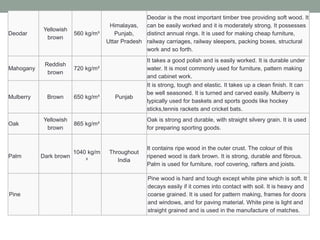
Deodar
Yellowish
brown
560 kg/m³
Himalayas,
Punjab,
Uttar Pradesh
Deodar is the most important timber tree providing soft wood. It
can be easily worked and it is moderately strong. It possesses
distinct annual rings. It is used for making cheap furniture,
railway carriages, railway sleepers, packing boxes, structural
work and so forth.
Mahogany
Reddish
brown
720 kg/m³
It takes a good polish and is easily worked. It is durable under
water. It is most commonly used for furniture, pattern making
and cabinet work.
Mulberry Brown 650 kg/m³ Punjab
It is strong, tough and elastic. It takes up a clean finish. It can
be well seasoned. It is turned and carved easily. Mulberry is
typically used for baskets and sports goods like hockey
sticks,tennis rackets and cricket bats.
Oak
Yellowish
brown
865 kg/m³
Oak is strong and durable, with straight silvery grain. It is used
for preparing sporting goods.
Palm Dark brown
1040 kg/m
³
Throughout
India
It contains ripe wood in the outer crust. The colour of this
ripened wood is dark brown. It is strong, durable and fibrous.
Palm is used for furniture, roof covering, rafters and joists.
Pine
Pine wood is hard and tough except white pine which is soft. It
decays easily if it comes into contact with soil. It is heavy and
coarse grained. It is used for pattern making, frames for doors
and windows, and for paving material. White pine is light and
straight grained and is used in the manufacture of matches.
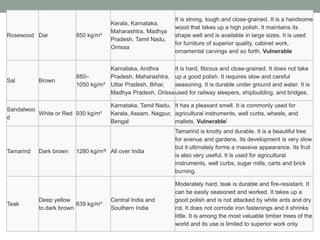
Rosewood Dar 850 kg/m³
Kerala, Karnataka,
Maharashtra, Madhya
Pradesh, Tamil Nadu,
Orrissa
It is strong, tough and close-grained. It is a handsome
wood that takes up a high polish. It maintains its
shape well and is available in large sizes. It is used
for furniture of superior quality, cabinet work,
ornamental carvings and so forth. Vulnerable
Sal Brown
880–
1050 kg/m³
Karnataka, Andhra
Pradesh, Maharashtra,
Uttar Pradesh, Bihar,
Madhya Pradesh, Orissa
It is hard, fibrous and close-grained. It does not take
up a good polish. It requires slow and careful
seasoning. It is durable under ground and water. It is
used for railway sleepers, shipbuilding, and bridges.
Sandalwoo
d
White or Red 930 kg/m³
Karnataka, Tamil Nadu,
Kerala, Assam, Nagpur,
Bengal
It has a pleasant smell. It is commonly used for
agricultural instruments, well curbs, wheels, and
mallets. Vulnerable[
Tamarind Dark brown 1280 kg/m³[ All over India
Tamarind is knotty and durable. It is a beautiful tree
for avenue and gardens. Its development is very slow
but it ultimately forms a massive appearance. Its fruit
is also very useful. It is used for agricultural
instruments, well curbs, sugar mills, carts and brick
burning.
Teak
Deep yellow
to dark brown
639 kg/m³
Central India and
Southern India
Moderately hard, teak is durable and fire-resistant. It
can be easily seasoned and worked. It takes up a
good polish and is not attacked by white ants and dry
rot. It does not corrode iron fastenings and it shrinks
little. It is among the most valuable timber trees of the
world and its use is limited to superior work only.
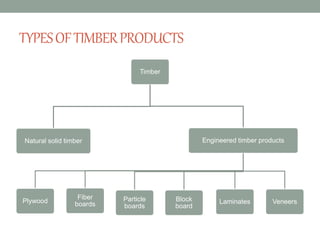
TYPESOFTIMBERPRODUCTS
Timber
Natural solid timber Engineered timber products
Plywood
Fiber
boards
Particle
boards
Block
board
Laminates Veneers
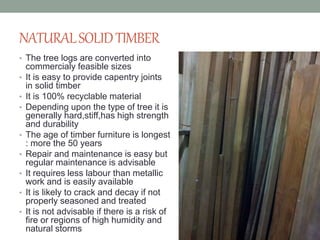
NATURALSOLIDTIMBER
• The tree logs are converted into
commercialy feasible sizes
• It is easy to provide capentry joints
in solid timber
• It is 100% recyclable material
• Depending upon the type of tree it is
generally hard,stiff,has high strength
and durability
• The age of timber furniture is longest
: more the 50 years
• Repair and maintenance is easy but
regular maintenance is advisable
• It requires less labour than metallic
work and is easily available
• It is likely to crack and decay if not
properly seasoned and treated
• It is not advisable if there is a risk of
fire or regions of high humidity and
natural storms
Plywood
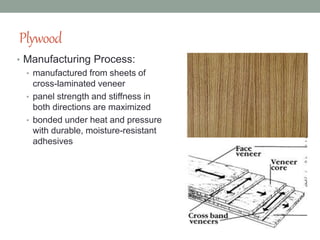
• Manufacturing Process:
• manufactured from sheets of
cross-laminated veneer
• panel strength and stiffness in
both directions are maximized
• bonded under heat and pressure
with durable, moisture-resistant
adhesives
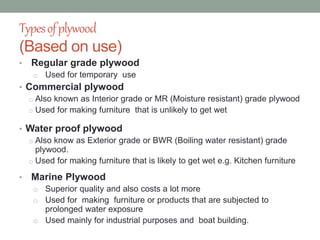
Typesofplywood
(Based on use)
• Regular grade plywood
o Used for temporary use
• Commercial plywood
o Also known as Interior grade or MR (Moisture resistant) grade plywood
o Used for making furniture that is unlikely to get wet
• Water proof plywood
o Also know as Exterior grade or BWR (Boiling water resistant) grade
plywood.
o Used for making furniture that is likely to get wet e.g. Kitchen furniture
• Marine Plywood
o Superior quality and also costs a lot more
o Used for making furniture or products that are subjected to
prolonged water exposure
o Used mainly for industrial purposes and boat building.
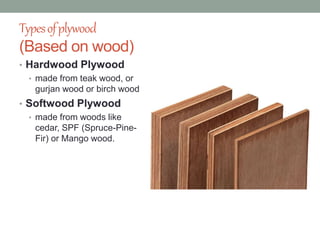
Typesofplywood
(Based on wood)
• Hardwood Plywood
• made from teak wood, or
gurjan wood or birch wood
• Softwood Plywood
• made from woods like
cedar, SPF (Spruce-Pine-
Fir) or Mango wood.
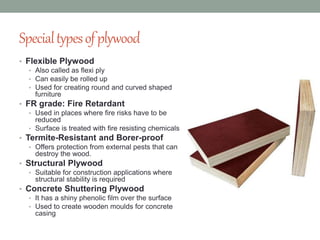
Specialtypesofplywood
• Flexible Plywood
• Also called as flexi ply
• Can easily be rolled up
• Used for creating round and curved shaped
furniture
• FR grade: Fire Retardant
• Used in places where fire risks have to be
reduced
• Surface is treated with fire resisting chemicals
• Termite-Resistant and Borer-proof
• Offers protection from external pests that can
destroy the wood.
• Structural Plywood
• Suitable for construction applications where
structural stability is required
• Concrete Shuttering Plywood
• It has a shiny phenolic film over the surface
• Used to create wooden moulds for concrete
casing
PropertiesofPlywood
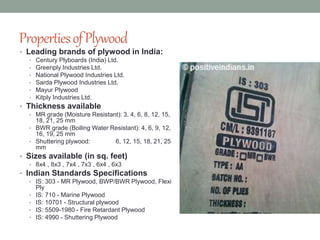
• Leading brands of plywood in India:
• Century Plyboards (India) Ltd.
• Greenply Industries Ltd.
• National Plywood Industries Ltd.
• Sarda Plywood Industries Ltd.
• Mayur Plywood
• Kitply Industries Ltd.
• Thickness available
• MR grade (Moisture Resistant): 3, 4, 6, 8, 12, 15,
18, 21, 25 mm
• BWR grade (Boiling Water Resistant): 4, 6, 9, 12,
16, 19, 25 mm
• Shuttering plywood: 6, 12, 15, 18, 21, 25
mm
• Sizes available (in sq. feet)
• 8x4 , 8x3 , 7x4 , 7x3 , 6x4 , 6x3
• Indian Standards Specifications
• IS: 303 - MR Plywood, BWP/BWR Plywood, Flexi
Ply
• IS: 710 - Marine Plywood
• IS: 10701 - Structural plywood
• IS: 5509-1980 - Fire Retardant Plywood
• IS: 4990 - Shuttering Plywood
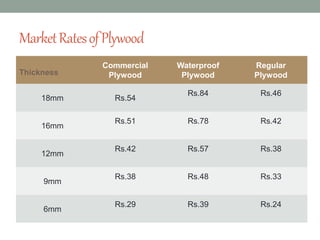
MarketRatesofPlywood
Thickness
Commercial
Plywood
Waterproof
Plywood
Regular
Plywood
18mm Rs.54
Rs.84 Rs.46
16mm
Rs.51 Rs.78 Rs.42
12mm
Rs.42 Rs.57 Rs.38
9mm
Rs.38 Rs.48 Rs.33
6mm
Rs.29 Rs.39 Rs.24
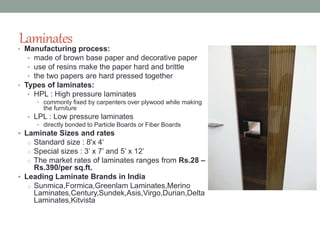
Laminates• Manufacturing process:
• made of brown base paper and decorative paper
• use of resins make the paper hard and brittle
• the two papers are hard pressed together
• Types of laminates:
• HPL : High pressure laminates
• commonly fixed by carpenters over plywood while making
the furniture
• LPL : Low pressure laminates
• directly bonded to Particle Boards or Fiber Boards
 Laminate Sizes and rates
o Standard size : 8'x 4‘
o Special sizes : 3’ x 7’ and 5’ x 12’
o The market rates of laminates ranges from Rs.28 –
Rs.390/per sq.ft.
 Leading Laminate Brands in India
o Sunmica,Formica,Greenlam Laminates,Merino
Laminates,Century,Sundek,Asis,Virgo,Durian,Delta
Laminates,Kitvista
• Types based on thickness
• Regular laminate sheets
• Thickness ranges from 0.6-1.5mm
• Glued using fevicol or other
adhesives
• Compact Laminates
• Thickness ranging from 3 mm to 30
mm
• These are self-supporting and
hence do not need to be glued
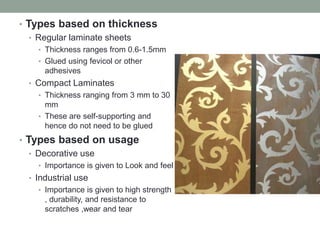
• Types based on usage
• Decorative use
• Importance is given to Look and feel
• Industrial use
• Importance is given to high strength
, durability, and resistance to
scratches ,wear and tear
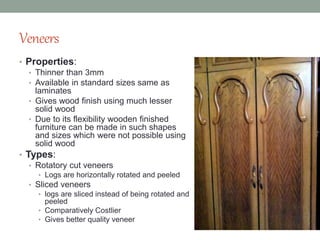
Veneers
• Properties:
• Thinner than 3mm
• Available in standard sizes same as
laminates
• Gives wood finish using much lesser
solid wood
• Due to its flexibility wooden finished
furniture can be made in such shapes
and sizes which were not possible using
solid wood
• Types:
• Rotatory cut veneers
• Logs are horizontally rotated and peeled
• Sliced veneers
• logs are sliced instead of being rotated and
peeled
• Comparatively Costlier
• Gives better quality veneer
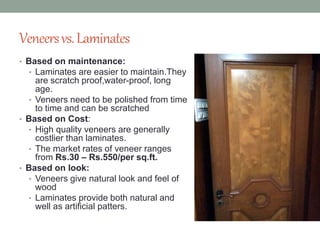
Veneersvs.Laminates
• Based on maintenance:
• Laminates are easier to maintain.They
are scratch proof,water-proof, long
age.
• Veneers need to be polished from time
to time and can be scratched
• Based on Cost:
• High quality veneers are generally
costlier than laminates.
• The market rates of veneer ranges
from Rs.30 – Rs.550/per sq.ft.
• Based on look:
• Veneers give natural look and feel of
wood
• Laminates provide both natural and
well as artificial patters.
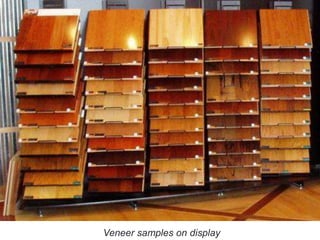
Veneer samples on display
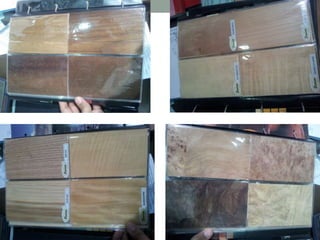
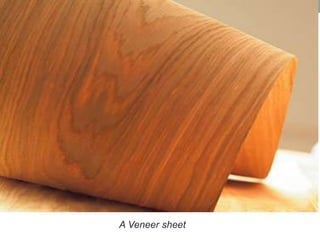
A Veneer sheet
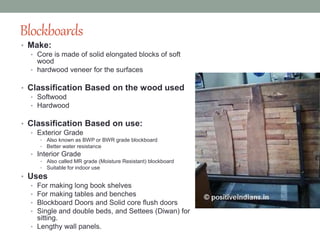
Blockboards
• Make:
• Core is made of solid elongated blocks of soft
wood
• hardwood veneer for the surfaces
• Classification Based on the wood used
• Softwood
• Hardwood
• Classification Based on use:
• Exterior Grade
• Also known as BWP or BWR grade blockboard
• Better water resistance
• Interior Grade
• Also called MR grade (Moisture Resistant) blockboard
• Suitable for indoor use
• Uses
• For making long book shelves
• For making tables and benches
• Blockboard Doors and Solid core flush doors
• Single and double beds, and Settees (Diwan) for
sitting.
• Lengthy wall panels.
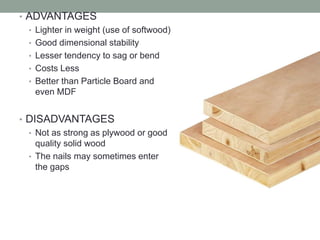
• ADVANTAGES
• Lighter in weight (use of softwood)
• Good dimensional stability
• Lesser tendency to sag or bend
• Costs Less
• Better than Particle Board and
even MDF
• DISADVANTAGES
• Not as strong as plywood or good
quality solid wood
• The nails may sometimes enter
the gaps
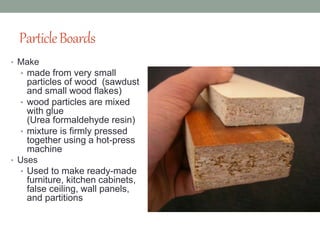
ParticleBoards
• Make
• made from very small
particles of wood (sawdust
and small wood flakes)
• wood particles are mixed
with glue
(Urea formaldehyde resin)
• mixture is firmly pressed
together using a hot-press
machine
• Uses
• Used to make ready-made
furniture, kitchen cabinets,
false ceiling, wall panels,
and partitions
• Classification:
• OSL: One sided lamination.
• Only one side of the (the top surface or show surface) is laminated,
• BSL: Both sided lamination.
• Both the top and bottom surfaces are laminated .
• BSL is costlier than OSL.
• Properties
• Age usually not more than 5yrs
• Very sensitive to water and even moisture
• Very light weight
• Eco-friendly as it is made up to waste wood particles
• The Indian Standards quality specification: IS:3087 and
IS:12823
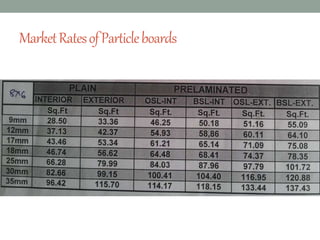
MarketRatesofParticleboards
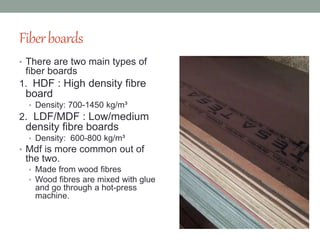
Fiberboards
• There are two main types of
fiber boards
1. HDF : High density fibre
board
• Density: 700-1450 kg/m³
2. LDF/MDF : Low/medium
density fibre boards
• Density: 600-800 kg/m³
• Mdf is more common out of
the two.
• Made from wood fibres
• Wood fibres are mixed with glue
and go through a hot-press
machine.
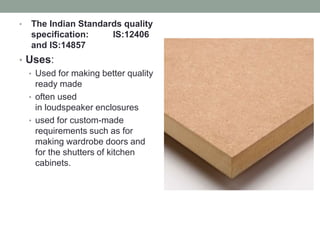
• The Indian Standards quality
specification: IS:12406
and IS:14857
• Uses:
• Used for making better quality
ready made
• often used
in loudspeaker enclosures
• used for custom-made
requirements such as for
making wardrobe doors and
for the shutters of kitchen
cabinets.
• Benefits of MDF
• Some varieties are less expensive than many natural woods
• Isotropic (properties same in all directions) ,so no tendency to split
• Consistent in strength and size
• Flexible. Can be used for curved walls or surfaces.
• Shapes well.
• Stable dimensions (won't expand or contract like wood)
• Easy to finish (i.e. paint)
• MDF boards are stronger, and hence costlier than plywood,particle
boards and block boards.
• Drawbacks of MDF
• Low grade MDF may swell and break when saturated with water.
• May warp or expand if not sealed.
• Dulls blades more quickly than many woods
• Weaker compared to plywood,
• Subject to significant shrinkage in low humidity environments.
• Similar to particle boards, MDF boards are also not nailed. Screws are
used instead
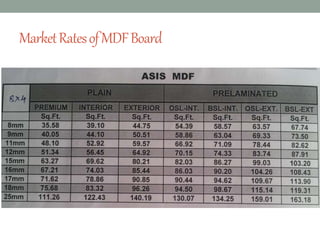
MarketRatesofMDFBoard
THANKYOU

Timber

  • 1.
  • 2.
    SOURCESOFTIMBER Common name Colour Density ¹Location Characteristics, Usage and Status Babul Whitish red 835 kg/m³ Rajasthan, Andhra Pradesh, Maharashtra, Madhya Pradesh, Tamil Nadu, Karnataka,Bengal, Gujarat, Uttar Pradesh It is strong, hard and tough and it takes up a good polish. It is used for such products as bodies and wheels of bullock cart, agricultural instruments, tool handles, and well curbs. Bakul Reddish brown 880 kg/m³ Some parts of North India It is close-grained and tough. It is used for making cabinets. Bamboo Throughout India, especially assam and Bengal Not actually a tree, but a woody grass, it is flexible, very strong and durable. It is used for scaffoldings, thatched roofs, rafters, temporary bridges, and so forth. Banyan Brown 580 kg/m³ Throughout India It is strong and durable only under water. The aerial roots are utilized for such items as tent poles and well curbs. Coconut Reddish brown Throughout coastal India Takes polish. Requires preservative treatment. Used as poles, piles, furniture and as formwork in concrete construction.
  • 3.
    Deodar Yellowish brown 560 kg/m³ Himalayas, Punjab, Uttar Pradesh Deodaris the most important timber tree providing soft wood. It can be easily worked and it is moderately strong. It possesses distinct annual rings. It is used for making cheap furniture, railway carriages, railway sleepers, packing boxes, structural work and so forth. Mahogany Reddish brown 720 kg/m³ It takes a good polish and is easily worked. It is durable under water. It is most commonly used for furniture, pattern making and cabinet work. Mulberry Brown 650 kg/m³ Punjab It is strong, tough and elastic. It takes up a clean finish. It can be well seasoned. It is turned and carved easily. Mulberry is typically used for baskets and sports goods like hockey sticks,tennis rackets and cricket bats. Oak Yellowish brown 865 kg/m³ Oak is strong and durable, with straight silvery grain. It is used for preparing sporting goods. Palm Dark brown 1040 kg/m ³ Throughout India It contains ripe wood in the outer crust. The colour of this ripened wood is dark brown. It is strong, durable and fibrous. Palm is used for furniture, roof covering, rafters and joists. Pine Pine wood is hard and tough except white pine which is soft. It decays easily if it comes into contact with soil. It is heavy and coarse grained. It is used for pattern making, frames for doors and windows, and for paving material. White pine is light and straight grained and is used in the manufacture of matches.
  • 4.
    Rosewood Dar 850kg/m³ Kerala, Karnataka, Maharashtra, Madhya Pradesh, Tamil Nadu, Orrissa It is strong, tough and close-grained. It is a handsome wood that takes up a high polish. It maintains its shape well and is available in large sizes. It is used for furniture of superior quality, cabinet work, ornamental carvings and so forth. Vulnerable Sal Brown 880– 1050 kg/m³ Karnataka, Andhra Pradesh, Maharashtra, Uttar Pradesh, Bihar, Madhya Pradesh, Orissa It is hard, fibrous and close-grained. It does not take up a good polish. It requires slow and careful seasoning. It is durable under ground and water. It is used for railway sleepers, shipbuilding, and bridges. Sandalwoo d White or Red 930 kg/m³ Karnataka, Tamil Nadu, Kerala, Assam, Nagpur, Bengal It has a pleasant smell. It is commonly used for agricultural instruments, well curbs, wheels, and mallets. Vulnerable[ Tamarind Dark brown 1280 kg/m³[ All over India Tamarind is knotty and durable. It is a beautiful tree for avenue and gardens. Its development is very slow but it ultimately forms a massive appearance. Its fruit is also very useful. It is used for agricultural instruments, well curbs, sugar mills, carts and brick burning. Teak Deep yellow to dark brown 639 kg/m³ Central India and Southern India Moderately hard, teak is durable and fire-resistant. It can be easily seasoned and worked. It takes up a good polish and is not attacked by white ants and dry rot. It does not corrode iron fastenings and it shrinks little. It is among the most valuable timber trees of the world and its use is limited to superior work only.
  • 5.
    TYPESOFTIMBERPRODUCTS Timber Natural solid timberEngineered timber products Plywood Fiber boards Particle boards Block board Laminates Veneers
  • 6.
    NATURALSOLIDTIMBER • The treelogs are converted into commercialy feasible sizes • It is easy to provide capentry joints in solid timber • It is 100% recyclable material • Depending upon the type of tree it is generally hard,stiff,has high strength and durability • The age of timber furniture is longest : more the 50 years • Repair and maintenance is easy but regular maintenance is advisable • It requires less labour than metallic work and is easily available • It is likely to crack and decay if not properly seasoned and treated • It is not advisable if there is a risk of fire or regions of high humidity and natural storms
  • 9.
    Plywood • Manufacturing Process: •manufactured from sheets of cross-laminated veneer • panel strength and stiffness in both directions are maximized • bonded under heat and pressure with durable, moisture-resistant adhesives
  • 10.
    Typesofplywood (Based on use) •Regular grade plywood o Used for temporary use • Commercial plywood o Also known as Interior grade or MR (Moisture resistant) grade plywood o Used for making furniture that is unlikely to get wet • Water proof plywood o Also know as Exterior grade or BWR (Boiling water resistant) grade plywood. o Used for making furniture that is likely to get wet e.g. Kitchen furniture • Marine Plywood o Superior quality and also costs a lot more o Used for making furniture or products that are subjected to prolonged water exposure o Used mainly for industrial purposes and boat building.
  • 11.
    Typesofplywood (Based on wood) •Hardwood Plywood • made from teak wood, or gurjan wood or birch wood • Softwood Plywood • made from woods like cedar, SPF (Spruce-Pine- Fir) or Mango wood.
  • 12.
    Specialtypesofplywood • Flexible Plywood •Also called as flexi ply • Can easily be rolled up • Used for creating round and curved shaped furniture • FR grade: Fire Retardant • Used in places where fire risks have to be reduced • Surface is treated with fire resisting chemicals • Termite-Resistant and Borer-proof • Offers protection from external pests that can destroy the wood. • Structural Plywood • Suitable for construction applications where structural stability is required • Concrete Shuttering Plywood • It has a shiny phenolic film over the surface • Used to create wooden moulds for concrete casing
  • 13.
    PropertiesofPlywood • Leading brandsof plywood in India: • Century Plyboards (India) Ltd. • Greenply Industries Ltd. • National Plywood Industries Ltd. • Sarda Plywood Industries Ltd. • Mayur Plywood • Kitply Industries Ltd. • Thickness available • MR grade (Moisture Resistant): 3, 4, 6, 8, 12, 15, 18, 21, 25 mm • BWR grade (Boiling Water Resistant): 4, 6, 9, 12, 16, 19, 25 mm • Shuttering plywood: 6, 12, 15, 18, 21, 25 mm • Sizes available (in sq. feet) • 8x4 , 8x3 , 7x4 , 7x3 , 6x4 , 6x3 • Indian Standards Specifications • IS: 303 - MR Plywood, BWP/BWR Plywood, Flexi Ply • IS: 710 - Marine Plywood • IS: 10701 - Structural plywood • IS: 5509-1980 - Fire Retardant Plywood • IS: 4990 - Shuttering Plywood
  • 14.
    MarketRatesofPlywood Thickness Commercial Plywood Waterproof Plywood Regular Plywood 18mm Rs.54 Rs.84 Rs.46 16mm Rs.51Rs.78 Rs.42 12mm Rs.42 Rs.57 Rs.38 9mm Rs.38 Rs.48 Rs.33 6mm Rs.29 Rs.39 Rs.24
  • 15.
    Laminates• Manufacturing process: •made of brown base paper and decorative paper • use of resins make the paper hard and brittle • the two papers are hard pressed together • Types of laminates: • HPL : High pressure laminates • commonly fixed by carpenters over plywood while making the furniture • LPL : Low pressure laminates • directly bonded to Particle Boards or Fiber Boards  Laminate Sizes and rates o Standard size : 8'x 4‘ o Special sizes : 3’ x 7’ and 5’ x 12’ o The market rates of laminates ranges from Rs.28 – Rs.390/per sq.ft.  Leading Laminate Brands in India o Sunmica,Formica,Greenlam Laminates,Merino Laminates,Century,Sundek,Asis,Virgo,Durian,Delta Laminates,Kitvista
  • 16.
    • Types basedon thickness • Regular laminate sheets • Thickness ranges from 0.6-1.5mm • Glued using fevicol or other adhesives • Compact Laminates • Thickness ranging from 3 mm to 30 mm • These are self-supporting and hence do not need to be glued • Types based on usage • Decorative use • Importance is given to Look and feel • Industrial use • Importance is given to high strength , durability, and resistance to scratches ,wear and tear
  • 18.
    Veneers • Properties: • Thinnerthan 3mm • Available in standard sizes same as laminates • Gives wood finish using much lesser solid wood • Due to its flexibility wooden finished furniture can be made in such shapes and sizes which were not possible using solid wood • Types: • Rotatory cut veneers • Logs are horizontally rotated and peeled • Sliced veneers • logs are sliced instead of being rotated and peeled • Comparatively Costlier • Gives better quality veneer
  • 19.
    Veneersvs.Laminates • Based onmaintenance: • Laminates are easier to maintain.They are scratch proof,water-proof, long age. • Veneers need to be polished from time to time and can be scratched • Based on Cost: • High quality veneers are generally costlier than laminates. • The market rates of veneer ranges from Rs.30 – Rs.550/per sq.ft. • Based on look: • Veneers give natural look and feel of wood • Laminates provide both natural and well as artificial patters.
  • 20.
  • 21.
  • 22.
    Blockboards • Make: • Coreis made of solid elongated blocks of soft wood • hardwood veneer for the surfaces • Classification Based on the wood used • Softwood • Hardwood • Classification Based on use: • Exterior Grade • Also known as BWP or BWR grade blockboard • Better water resistance • Interior Grade • Also called MR grade (Moisture Resistant) blockboard • Suitable for indoor use • Uses • For making long book shelves • For making tables and benches • Blockboard Doors and Solid core flush doors • Single and double beds, and Settees (Diwan) for sitting. • Lengthy wall panels.
  • 23.
    • ADVANTAGES • Lighterin weight (use of softwood) • Good dimensional stability • Lesser tendency to sag or bend • Costs Less • Better than Particle Board and even MDF • DISADVANTAGES • Not as strong as plywood or good quality solid wood • The nails may sometimes enter the gaps
  • 24.
    ParticleBoards • Make • madefrom very small particles of wood (sawdust and small wood flakes) • wood particles are mixed with glue (Urea formaldehyde resin) • mixture is firmly pressed together using a hot-press machine • Uses • Used to make ready-made furniture, kitchen cabinets, false ceiling, wall panels, and partitions
  • 25.
    • Classification: • OSL:One sided lamination. • Only one side of the (the top surface or show surface) is laminated, • BSL: Both sided lamination. • Both the top and bottom surfaces are laminated . • BSL is costlier than OSL. • Properties • Age usually not more than 5yrs • Very sensitive to water and even moisture • Very light weight • Eco-friendly as it is made up to waste wood particles • The Indian Standards quality specification: IS:3087 and IS:12823
  • 26.
  • 27.
    Fiberboards • There aretwo main types of fiber boards 1. HDF : High density fibre board • Density: 700-1450 kg/m³ 2. LDF/MDF : Low/medium density fibre boards • Density: 600-800 kg/m³ • Mdf is more common out of the two. • Made from wood fibres • Wood fibres are mixed with glue and go through a hot-press machine.
  • 28.
    • The IndianStandards quality specification: IS:12406 and IS:14857 • Uses: • Used for making better quality ready made • often used in loudspeaker enclosures • used for custom-made requirements such as for making wardrobe doors and for the shutters of kitchen cabinets.
  • 29.
    • Benefits ofMDF • Some varieties are less expensive than many natural woods • Isotropic (properties same in all directions) ,so no tendency to split • Consistent in strength and size • Flexible. Can be used for curved walls or surfaces. • Shapes well. • Stable dimensions (won't expand or contract like wood) • Easy to finish (i.e. paint) • MDF boards are stronger, and hence costlier than plywood,particle boards and block boards. • Drawbacks of MDF • Low grade MDF may swell and break when saturated with water. • May warp or expand if not sealed. • Dulls blades more quickly than many woods • Weaker compared to plywood, • Subject to significant shrinkage in low humidity environments. • Similar to particle boards, MDF boards are also not nailed. Screws are used instead
  • 30.
  • 31.