WOOD
Design and Manufacture
Wood
 Useful, natural material
 Hard and fibrous in nature
 3 classifications to wood:
 Hardwoods (slow growing 100 years from warmer
climates)
 Softwoods (quick growing 30 years)
 Manufactured boards (man made composites)
 Each species of tree provides different timber
that varies in colour, grain pattern, texture,
strength, weight, stability, durability, cost and
ease of working.
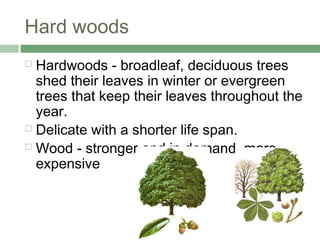
Hard woods
 Hardwoods - broadleaf, deciduous trees
shed their leaves in winter or evergreen
trees that keep their leaves throughout the
year.
 Delicate with a shorter life span.
 Wood - stronger and in demand, more
expensive
Hard
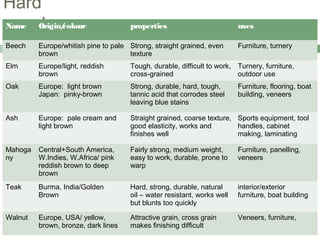
woodsName Origin/colour properties uses
Beech Europe/whitish pine to pale
brown
Strong, straight grained, even
texture
Furniture, turnery
Elm Europe/light, reddish
brown
Tough, durable, difficult to work,
cross-grained
Turnery, furniture,
outdoor use
Oak Europe: light brown
Japan: pinky-brown
Strong, durable, hard, tough,
tannic acid that corrodes steel
leaving blue stains
Furniture, flooring, boat
building, veneers
Ash Europe: pale cream and
light brown
Straight grained, coarse texture,
good elasticity, works and
finishes well
Sports equipment, tool
handles, cabinet
making, laminating
Mahoga
ny
Central+South America,
W.Indies, W.Africa/ pink
reddish brown to deep
brown
Fairly strong, medium weight,
easy to work, durable, prone to
warp
Furniture, panelling,
veneers
Teak Burma, India/Golden
Brown
Hard, strong, durable, natural
oil – water resistant, works well
but blunts too quickly
interior/exterior
furniture, boat building
Walnut Europe, USA/ yellow,
brown, bronze, dark lines
Attractive grain, cross grain
makes finishing difficult
Veneers, furniture,
Soft woods
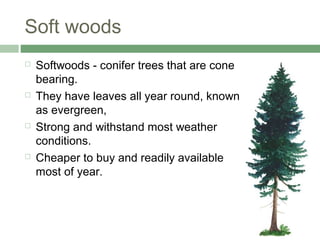
 Softwoods - conifer trees that are cone
bearing.
 They have leaves all year round, known
as evergreen,
 Strong and withstand most weather
conditions.
 Cheaper to buy and readily available
most of year.
softwoods
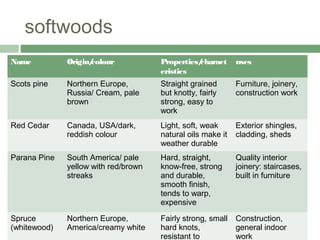
Name Origin/colour Properties/charact
eristics
uses
Scots pine Northern Europe,
Russia/ Cream, pale
brown
Straight grained
but knotty, fairly
strong, easy to
work
Furniture, joinery,
construction work
Red Cedar Canada, USA/dark,
reddish colour
Light, soft, weak
natural oils make it
weather durable
Exterior shingles,
cladding, sheds
Parana Pine South America/ pale
yellow with red/brown
streaks
Hard, straight,
know-free, strong
and durable,
smooth finish,
tends to warp,
expensive
Quality interior
joinery: staircases,
built in furniture
Spruce
(whitewood)
Northern Europe,
America/creamy white
Fairly strong, small
hard knots,
resistant to
Construction,
general indoor
work
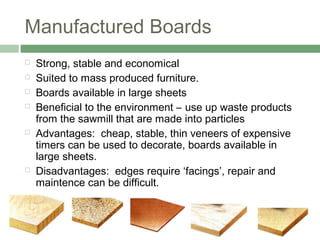
Manufactured Boards
 Strong, stable and economical
 Suited to mass produced furniture.
 Boards available in large sheets
 Beneficial to the environment – use up waste products
from the sawmill that are made into particles
 Advantages: cheap, stable, thin veneers of expensive
timers can be used to decorate, boards available in
large sheets.
 Disadvantages: edges require ‘facings’, repair and
maintence can be difficult.
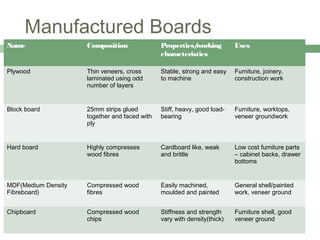
Manufactured Boards
Name Composition Properties/working
characteristics
Uses
Plywood Thin veneers, cross
laminated using odd
number of layers
Stable, strong and easy
to machine
Furniture, joinery,
construction work
Block board 25mm strips glued
together and faced with
ply
Stiff, heavy, good load-
bearing
Furniture, worktops,
veneer groundwork
Hard board Highly compresses
wood fibres
Cardboard like, weak
and brittle
Low cost furniture parts
– cabinet backs, drawer
bottoms
MDF(Medium Density
Fibreboard)
Compressed wood
fibres
Easily machined,
moulded and painted
General shell/painted
work, veneer ground
Chipboard Compressed wood
chips
Stiffness and strength
vary with density(thick)
Furniture shell, good
veneer ground
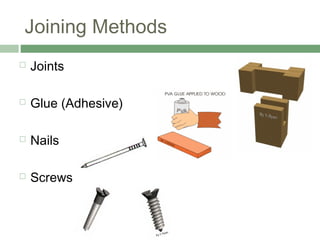
Joining Methods
 Joints
 Glue (Adhesive)
 Nails
 Screws
Adhesives
 Used to bind two pieces of material together
 Selection of which adhesive depends on
purpose of product and material to be joined.
 Wood glue join timber products
 Some will allow for repositioning and
adjustment
 Others can bond straight away.
 Adhesives will not usually bond to greasy or
wet surfaces
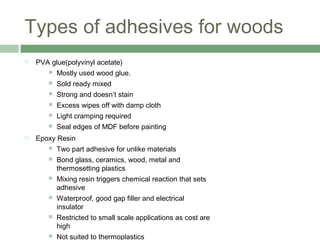
Types of adhesives for woods
 PVA glue(polyvinyl acetate)
 Mostly used wood glue.
 Sold ready mixed
 Strong and doesn’t stain
 Excess wipes off with damp cloth
 Light cramping required
 Seal edges of MDF before painting
 Epoxy Resin
 Two part adhesive for unlike materials
 Bond glass, ceramics, wood, metal and
thermosetting plastics
 Mixing resin triggers chemical reaction that sets
adhesive
 Waterproof, good gap filler and electrical
insulator
 Restricted to small scale applications as cost are
high
 Not suited to thermoplastics
Types of screws
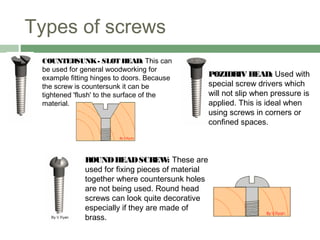
COUNTERSUNK- SLOT HEAD: This can
be used for general woodworking for
example fitting hinges to doors. Because
the screw is countersunk it can be
tightened 'flush' to the surface of the
material.
POZIDRIV HEAD: Used with
special screw drivers which
will not slip when pressure is
applied. This is ideal when
using screws in corners or
confined spaces.
ROUNDHEADSCREW: These are
used for fixing pieces of material
together where countersunk holes
are not being used. Round head
screws can look quite decorative
especially if they are made of
brass.
Types of screws (contd)
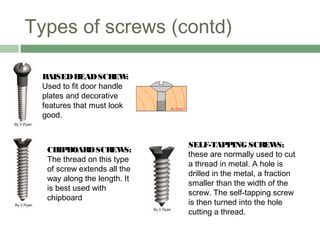
RAISEDHEADSCREW:
Used to fit door handle
plates and decorative
features that must look
good.
CHIPBOARDSCREWS:
The thread on this type
of screw extends all the
way along the length. It
is best used with
chipboard
SELF-TAPPING SCREWS:
these are normally used to cut
a thread in metal. A hole is
drilled in the metal, a fraction
smaller than the width of the
screw. The self-tapping screw
is then turned into the hole
cutting a thread.
Types of nails
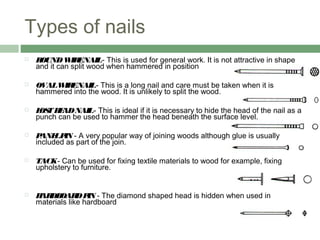
 ROUNDWIRENAIL- This is used for general work. It is not attractive in shape
and it can split wood when hammered in position     
 OVALWIRENAIL- This is a long nail and care must be taken when it is
hammered into the wood. It is unlikely to split the wood.     
 LOSTHEADNAIL- This is ideal if it is necessary to hide the head of the nail as a
punch can be used to hammer the head beneath the surface level.     
 PANELPIN - A very popular way of joining woods although glue is usually
included as part of the join.     
 TACK- Can be used for fixing textile materials to wood for example, fixing
upholstery to furniture.     
   
 HARDBOARDPIN - The diamond shaped head is hidden when used in
materials like hardboard    
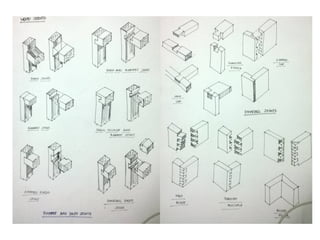
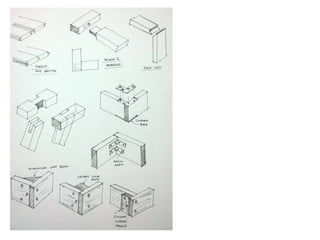
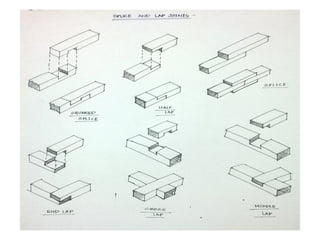
Joints
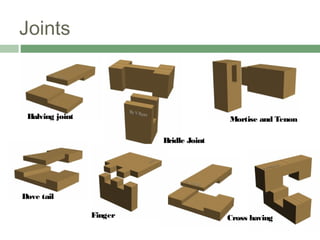
Bridle Joint
Halving joint
Dove tail
Cross having
Mortise and Tenon
Finger
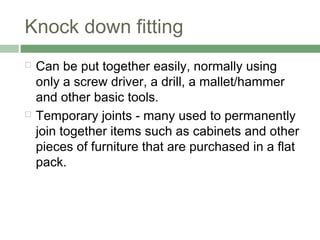
Knock down fitting
 Can be put together easily, normally using
only a screw driver, a drill, a mallet/hammer
and other basic tools.
 Temporary joints - many used to permanently
join together items such as cabinets and other
pieces of furniture that are purchased in a flat
pack.
Knock down fittings
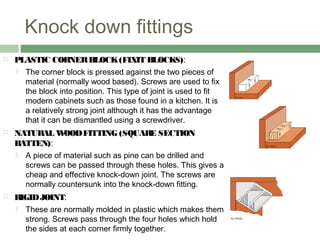
 PLASTIC CORNERBLOCK(FIXIT BLOCKS):
 The corner block is pressed against the two pieces of
material (normally wood based). Screws are used to fix
the block into position. This type of joint is used to fit
modern cabinets such as those found in a kitchen. It is
a relatively strong joint although it has the advantage
that it can be dismantled using a screwdriver.
 NATURAL WOODFITTING (SQUARE SECTION
BATTEN):
 A piece of material such as pine can be drilled and
screws can be passed through these holes. This gives a
cheap and effective knock-down joint. The screws are
normally countersunk into the knock-down fitting.
 RIGIDJOINT:
 These are normally molded in plastic which makes them
strong. Screws pass through the four holes which hold
the sides at each corner firmly together.
Knock down fittings
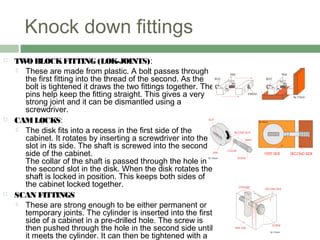
 TWOBLOCKFITTING (LOK-JOINTS):
 These are made from plastic. A bolt passes through
the first fitting into the thread of the second. As the
bolt is tightened it draws the two fittings together. The
pins help keep the fitting straight. This gives a very
strong joint and it can be dismantled using a
screwdriver.
 CAMLOCKS:
 The disk fits into a recess in the first side of the
cabinet. It rotates by inserting a screwdriver into the
slot in its side. The shaft is screwed into the second
side of the cabinet.
The collar of the shaft is passed through the hole in
the second slot in the disk. When the disk rotates the
shaft is locked in position. This keeps both sides of
the cabinet locked together.
 SCAN FITTINGS
 These are strong enough to be either permanent or
temporary joints. The cylinder is inserted into the first
side of a cabinet in a pre-drilled hole. The screw is
then pushed through the hole in the second side until
it meets the cylinder. It can then be tightened with a
THANK YOU!
PLEASE FEEL FREE TO GIVE ANY KIND OF FEEDBACK AND FOLLOW FORE
MORE UPLOADS! 

WOOD - AS A MATERIAL.

  • 1.
  • 2.
    Wood  Useful, naturalmaterial  Hard and fibrous in nature  3 classifications to wood:  Hardwoods (slow growing 100 years from warmer climates)  Softwoods (quick growing 30 years)  Manufactured boards (man made composites)  Each species of tree provides different timber that varies in colour, grain pattern, texture, strength, weight, stability, durability, cost and ease of working.
  • 3.
    Hard woods  Hardwoods- broadleaf, deciduous trees shed their leaves in winter or evergreen trees that keep their leaves throughout the year.  Delicate with a shorter life span.  Wood - stronger and in demand, more expensive
  • 4.
    Hard woodsName Origin/colour propertiesuses Beech Europe/whitish pine to pale brown Strong, straight grained, even texture Furniture, turnery Elm Europe/light, reddish brown Tough, durable, difficult to work, cross-grained Turnery, furniture, outdoor use Oak Europe: light brown Japan: pinky-brown Strong, durable, hard, tough, tannic acid that corrodes steel leaving blue stains Furniture, flooring, boat building, veneers Ash Europe: pale cream and light brown Straight grained, coarse texture, good elasticity, works and finishes well Sports equipment, tool handles, cabinet making, laminating Mahoga ny Central+South America, W.Indies, W.Africa/ pink reddish brown to deep brown Fairly strong, medium weight, easy to work, durable, prone to warp Furniture, panelling, veneers Teak Burma, India/Golden Brown Hard, strong, durable, natural oil – water resistant, works well but blunts too quickly interior/exterior furniture, boat building Walnut Europe, USA/ yellow, brown, bronze, dark lines Attractive grain, cross grain makes finishing difficult Veneers, furniture,
  • 5.
    Soft woods  Softwoods- conifer trees that are cone bearing.  They have leaves all year round, known as evergreen,  Strong and withstand most weather conditions.  Cheaper to buy and readily available most of year.
  • 6.
    softwoods Name Origin/colour Properties/charact eristics uses Scotspine Northern Europe, Russia/ Cream, pale brown Straight grained but knotty, fairly strong, easy to work Furniture, joinery, construction work Red Cedar Canada, USA/dark, reddish colour Light, soft, weak natural oils make it weather durable Exterior shingles, cladding, sheds Parana Pine South America/ pale yellow with red/brown streaks Hard, straight, know-free, strong and durable, smooth finish, tends to warp, expensive Quality interior joinery: staircases, built in furniture Spruce (whitewood) Northern Europe, America/creamy white Fairly strong, small hard knots, resistant to Construction, general indoor work
  • 7.
    Manufactured Boards  Strong,stable and economical  Suited to mass produced furniture.  Boards available in large sheets  Beneficial to the environment – use up waste products from the sawmill that are made into particles  Advantages: cheap, stable, thin veneers of expensive timers can be used to decorate, boards available in large sheets.  Disadvantages: edges require ‘facings’, repair and maintence can be difficult.
  • 8.
    Manufactured Boards Name CompositionProperties/working characteristics Uses Plywood Thin veneers, cross laminated using odd number of layers Stable, strong and easy to machine Furniture, joinery, construction work Block board 25mm strips glued together and faced with ply Stiff, heavy, good load- bearing Furniture, worktops, veneer groundwork Hard board Highly compresses wood fibres Cardboard like, weak and brittle Low cost furniture parts – cabinet backs, drawer bottoms MDF(Medium Density Fibreboard) Compressed wood fibres Easily machined, moulded and painted General shell/painted work, veneer ground Chipboard Compressed wood chips Stiffness and strength vary with density(thick) Furniture shell, good veneer ground
  • 9.
    Joining Methods  Joints Glue (Adhesive)  Nails  Screws
  • 10.
    Adhesives  Used tobind two pieces of material together  Selection of which adhesive depends on purpose of product and material to be joined.  Wood glue join timber products  Some will allow for repositioning and adjustment  Others can bond straight away.  Adhesives will not usually bond to greasy or wet surfaces
  • 11.
    Types of adhesivesfor woods  PVA glue(polyvinyl acetate)  Mostly used wood glue.  Sold ready mixed  Strong and doesn’t stain  Excess wipes off with damp cloth  Light cramping required  Seal edges of MDF before painting  Epoxy Resin  Two part adhesive for unlike materials  Bond glass, ceramics, wood, metal and thermosetting plastics  Mixing resin triggers chemical reaction that sets adhesive  Waterproof, good gap filler and electrical insulator  Restricted to small scale applications as cost are high  Not suited to thermoplastics
  • 12.
    Types of screws COUNTERSUNK-SLOT HEAD: This can be used for general woodworking for example fitting hinges to doors. Because the screw is countersunk it can be tightened 'flush' to the surface of the material. POZIDRIV HEAD: Used with special screw drivers which will not slip when pressure is applied. This is ideal when using screws in corners or confined spaces. ROUNDHEADSCREW: These are used for fixing pieces of material together where countersunk holes are not being used. Round head screws can look quite decorative especially if they are made of brass.
  • 13.
    Types of screws(contd) RAISEDHEADSCREW: Used to fit door handle plates and decorative features that must look good. CHIPBOARDSCREWS: The thread on this type of screw extends all the way along the length. It is best used with chipboard SELF-TAPPING SCREWS: these are normally used to cut a thread in metal. A hole is drilled in the metal, a fraction smaller than the width of the screw. The self-tapping screw is then turned into the hole cutting a thread.
  • 14.
    Types of nails ROUNDWIRENAIL- This is used for general work. It is not attractive in shape and it can split wood when hammered in position       OVALWIRENAIL- This is a long nail and care must be taken when it is hammered into the wood. It is unlikely to split the wood.       LOSTHEADNAIL- This is ideal if it is necessary to hide the head of the nail as a punch can be used to hammer the head beneath the surface level.       PANELPIN - A very popular way of joining woods although glue is usually included as part of the join.       TACK- Can be used for fixing textile materials to wood for example, fixing upholstery to furniture.           HARDBOARDPIN - The diamond shaped head is hidden when used in materials like hardboard    
  • 15.
    Joints Bridle Joint Halving joint Dovetail Cross having Mortise and Tenon Finger
  • 19.
    Knock down fitting Can be put together easily, normally using only a screw driver, a drill, a mallet/hammer and other basic tools.  Temporary joints - many used to permanently join together items such as cabinets and other pieces of furniture that are purchased in a flat pack.
  • 20.
    Knock down fittings PLASTIC CORNERBLOCK(FIXIT BLOCKS):  The corner block is pressed against the two pieces of material (normally wood based). Screws are used to fix the block into position. This type of joint is used to fit modern cabinets such as those found in a kitchen. It is a relatively strong joint although it has the advantage that it can be dismantled using a screwdriver.  NATURAL WOODFITTING (SQUARE SECTION BATTEN):  A piece of material such as pine can be drilled and screws can be passed through these holes. This gives a cheap and effective knock-down joint. The screws are normally countersunk into the knock-down fitting.  RIGIDJOINT:  These are normally molded in plastic which makes them strong. Screws pass through the four holes which hold the sides at each corner firmly together.
  • 21.
    Knock down fittings TWOBLOCKFITTING (LOK-JOINTS):  These are made from plastic. A bolt passes through the first fitting into the thread of the second. As the bolt is tightened it draws the two fittings together. The pins help keep the fitting straight. This gives a very strong joint and it can be dismantled using a screwdriver.  CAMLOCKS:  The disk fits into a recess in the first side of the cabinet. It rotates by inserting a screwdriver into the slot in its side. The shaft is screwed into the second side of the cabinet. The collar of the shaft is passed through the hole in the second slot in the disk. When the disk rotates the shaft is locked in position. This keeps both sides of the cabinet locked together.  SCAN FITTINGS  These are strong enough to be either permanent or temporary joints. The cylinder is inserted into the first side of a cabinet in a pre-drilled hole. The screw is then pushed through the hole in the second side until it meets the cylinder. It can then be tightened with a
  • 22.
    THANK YOU! PLEASE FEELFREE TO GIVE ANY KIND OF FEEDBACK AND FOLLOW FORE MORE UPLOADS! 